 Скачать презентацию Daily routine Shops and shopping Learning Objectives
Shopping.pptx
- Количество слайдов: 15




Daily routine. Shops and shopping.
Learning Objectives 8. S 3 give an opinion at discourse level on a range of general and curricular topics 8. S 5 interact with peers to negotiate, agree and organise priorities and plans for completing classroom tasks 8. R 2 understand specific information and detail in texts on a growing range of familiar general and curricular topics, including some extended texts

Discussion: Daily Routine 1. Education is important in all countries, but they say in Japan it is even more important. Why? 2. Going to extra classes in the afternoon is not compulsory for Korean students, but many of them attend private schools and academies. Why? 3. Japanese students never ask questions in class. Why? What do they do at the lesson? 4. What does Japanese and Korean teaching have in common? 5. Is discipline important at school? Why not?

Tell if you agree or disagree: Shopping can be a good therapy.

• Who likes shopping more: men or women? • What do usually women buy? • What do usually men buy?


Going shopping: new words 1. Hard (too much) – hardly (little effort) 2. Adore – love very much 3. Purchase – buy 4. Mass consumption products 5. Brand garments – modern clothes 6. Season discounts 7. Recover from everyday stress 8. Healing effect 9. Satisfaction 10. Cure emotional exhaustion
Answers 5 - Achieve • • • 1. T 2. T 3. F 4. T 5. F

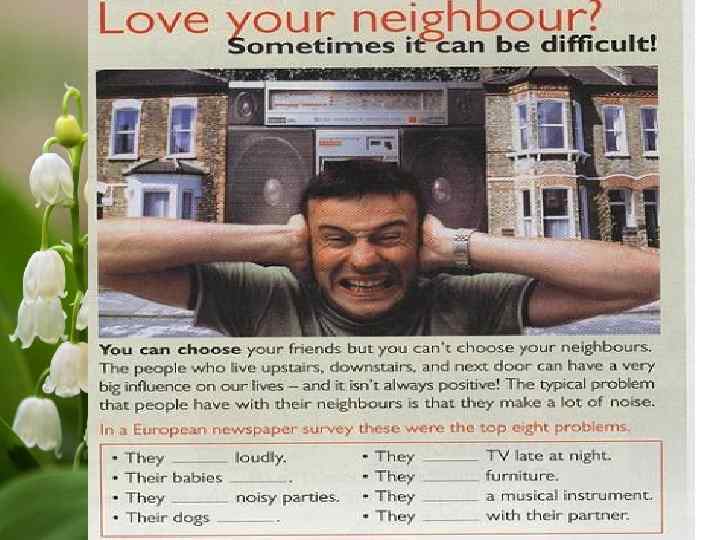
Homes: Questions for discussion: 1. What are the advantages and disadvantages of living in a house or a flat? 2. What do you think about people keeping big dogs in flats? 3. Which would you rather spend your money on - a wonderful house or wonderful holidays? 4. What is your relationship with your neighbours? What do you want your neighbours to be like? 5. Burglary is always a worry for home owners. What kinds of things can be done to make houses more secure? 6. Do you normally try to make improvements to your home with your own hands or do you usually pay professionals? What are the advantages and disadvantages in each case?
Speaking Assessment 1: • Task: Discuss any of the two statements with your partner saying whether you agree or disagree with them. Provide explanation to your answer. You should speak 4 -5 minutes.
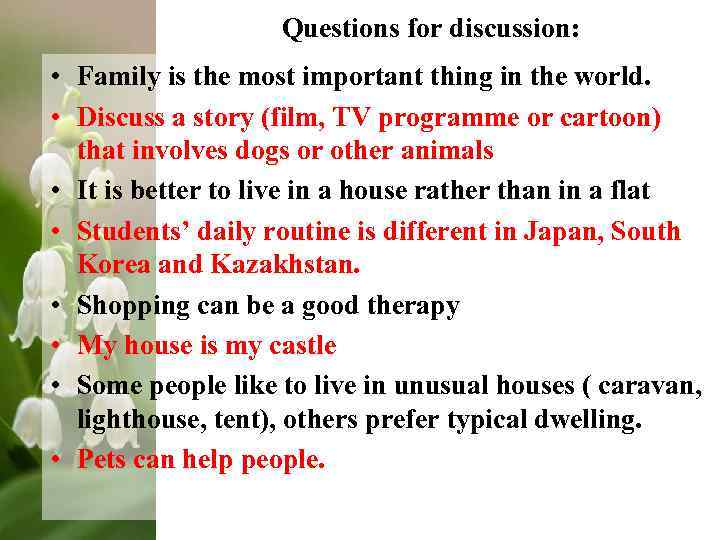
Questions for discussion: • Family is the most important thing in the world. • Discuss a story (film, TV programme or cartoon) that involves dogs or other animals • It is better to live in a house rather than in a flat • Students’ daily routine is different in Japan, South Korea and Kazakhstan. • Shopping can be a good therapy • My house is my castle • Some people like to live in unusual houses ( caravan, lighthouse, tent), others prefer typical dwelling. • Pets can help people.
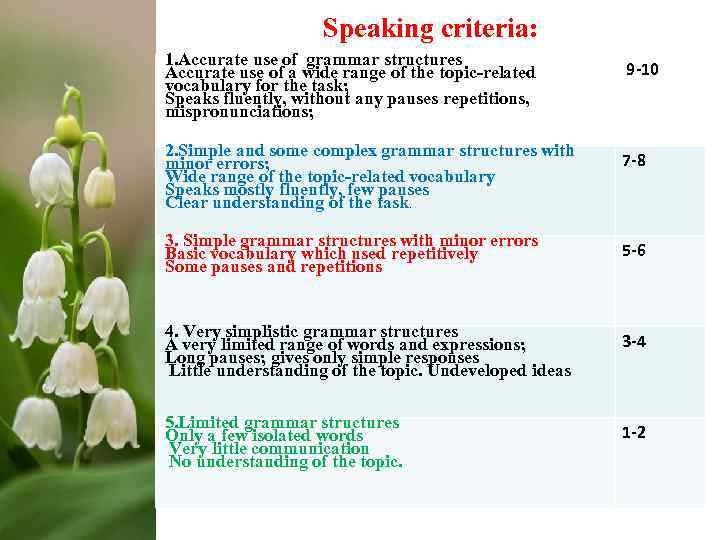
Speaking criteria: 1. Accurate use of grammar structures Accurate use of a wide range of the topic-related vocabulary for the task; Speaks fluently, without any pauses repetitions, mispronunciations; 9 -10 2. Simple and some complex grammar structures with minor errors; Wide range of the topic-related vocabulary Speaks mostly fluently, few pauses Clear understanding of the task. 7 -8 3. Simple grammar structures with minor errors Basic vocabulary which used repetitively Some pauses and repetitions 5 -6 4. Very simplistic grammar structures A very limited range of words and expressions; Long pauses; gives only simple responses Little understanding of the topic. Undeveloped ideas 3 -4 5. Limited grammar structures Only a few isolated words Very little communication No understanding of the topic. 1 -2
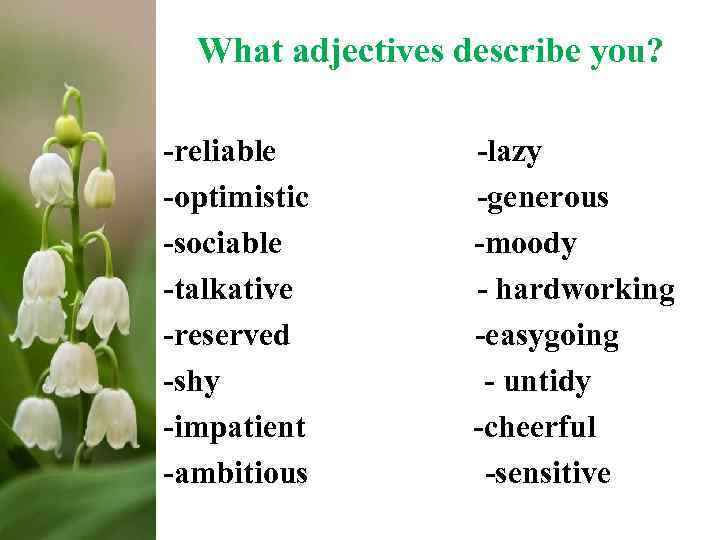
What adjectives describe you? -reliable -lazy -optimistic -generous -sociable -moody -talkative - hardworking -reserved -easygoing -shy - untidy -impatient -cheerful -ambitious -sensitive
Скачать презентацию Daily routine Shops and shopping Learning Objectives
Shopping.pptx