


 Скачать презентацию DAEDALUS EC 5 th framework aerosol users survey
5b6f4582b8817aa82d08c6643bfc6013.ppt
- Количество слайдов: 29
 DAEDALUS EC 5 th framework: aerosol users survey Olivier Boucher Laboratoire d ’Optique Atmosphérique USTL / CNRS, Villeneuve d ’Ascq, France Gerrit de Leeuw TNO, The Hague, Netherlands and the DAEDALUS team Atmospheric Chemistry Applications workshop - ESTEC -20 -21 January 2004
 DAEDALUS: an FP 5 GMES project Delivery of AErosol pro. Ducts for Assimilation and environmenta. L USe • specially written for the recent GMES call for proposal of the EESD • 3 year project: Jan 2003 - Dec 2005 • 7 partners: F, B, NL, N, P + JRC • run in parallel with another “aerosol” EC project (CREATE) Atmospheric Chemistry Applications workshop - ESTEC -20 -21 January 2004
 Reasons for getting interested in atmospheric aerosols: • visibility ==> tourism, aviation • air quality issues ==> human health, ecosystems • deposition and acid rain issues ==> ecosystems • climate effect (clear-sky, cloudy-sky) - anthropogenic aerosols are responsible for a radiative forcing - anthropogenic aerosols may modify the hydrological cycle - natural aerosols may response to climate change • satellite atmospheric corrections ==> retrieval of the properties of ocean, land, and atmosphere • role of aerosol deposition on ocean biology • improvement in meteorological (re)analysis • improvements in weather forecasts ? • depletion of the stratospheric ozone layer Atmospheric Chemistry Applications workshop - ESTEC -20 -21 January 2004
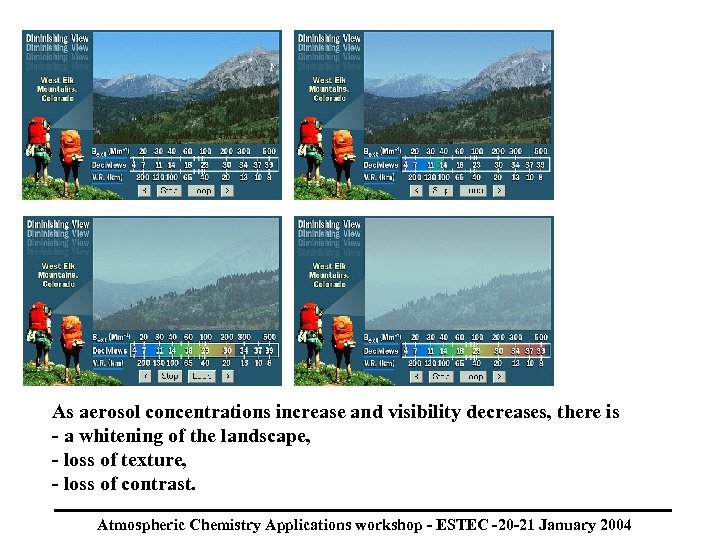 As aerosol concentrations increase and visibility decreases, there is - a whitening of the landscape, - loss of texture, - loss of contrast. Atmospheric Chemistry Applications workshop - ESTEC -20 -21 January 2004
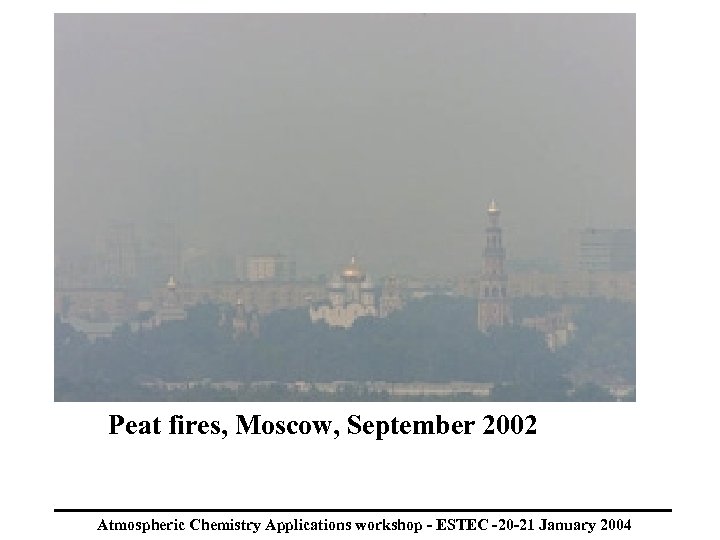 Peat fires, Moscow, September 2002 Atmospheric Chemistry Applications workshop - ESTEC -20 -21 January 2004
 WP 1: Users needs * 2 -page questionnaire on tropospheric and stratospheric aerosol products * Questionnaire was sent out by e-mail to over 200 people across Europe * 33 answers received so far (most are users, some producers, some inconsistencies) * Several talks and posters presented at this workshop CERMES, ADEME, EPA Ireland, … Atmospheric Chemistry Applications workshop - ESTEC -20 -21 January 2004
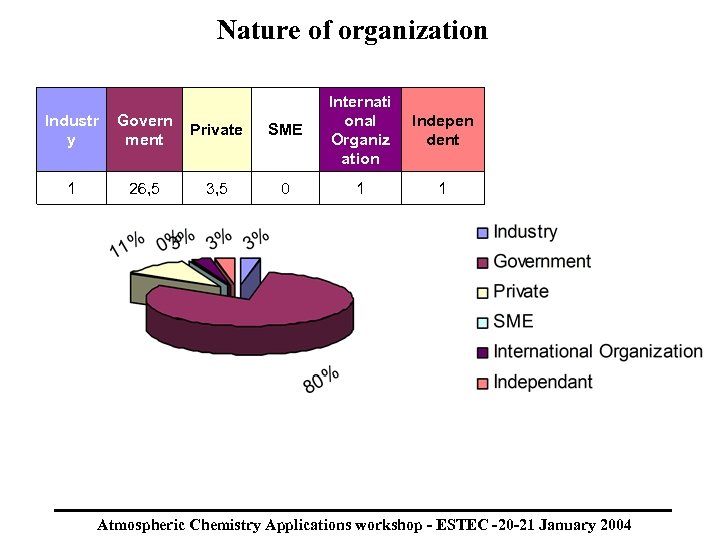 Nature of organization Industr y Govern ment Private SME Internati onal Organiz ation 1 26, 5 3, 5 0 1 Indepen dent 1 Atmospheric Chemistry Applications workshop - ESTEC -20 -21 January 2004
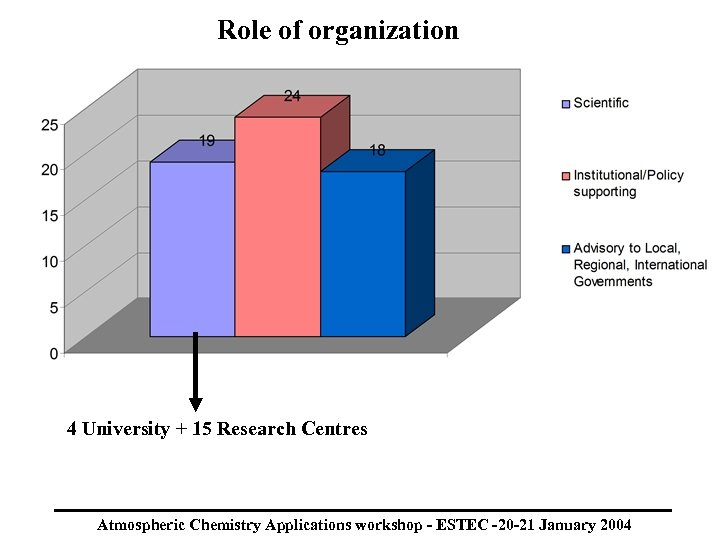 Role of organization 4 University + 15 Research Centres Atmospheric Chemistry Applications workshop - ESTEC -20 -21 January 2004
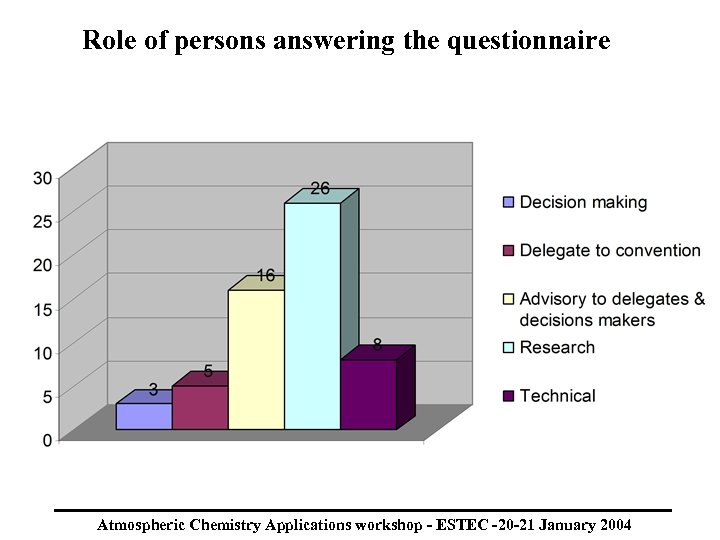 Role of persons answering the questionnaire Atmospheric Chemistry Applications workshop - ESTEC -20 -21 January 2004
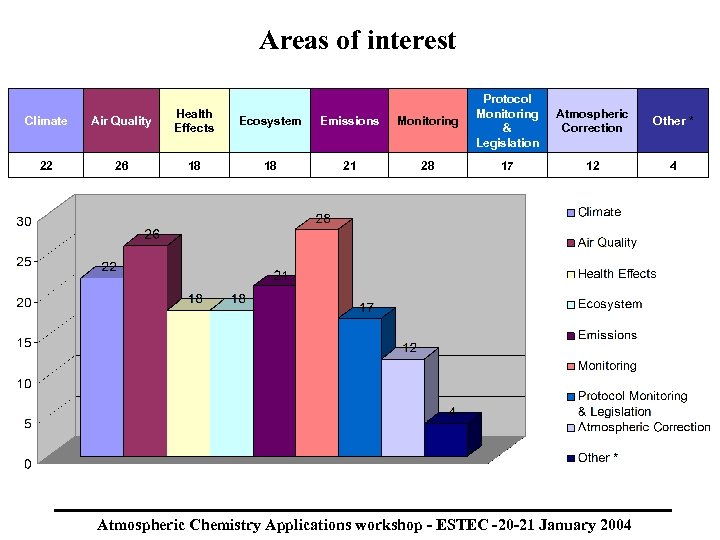 Areas of interest Climate Air Quality Health Effects Ecosystem Emissions Monitoring Protocol Monitoring & Legislation 22 26 18 18 21 28 17 Atmospheric Correction Other * 12 4 Atmospheric Chemistry Applications workshop - ESTEC -20 -21 January 2004
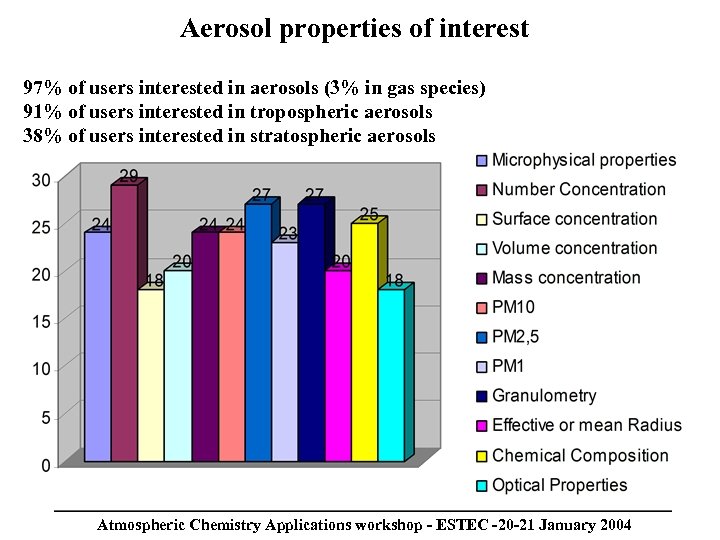 Aerosol properties of interest 97% of users interested in aerosols (3% in gas species) 91% of users interested in tropospheric aerosols 38% of users interested in stratospheric aerosols Atmospheric Chemistry Applications workshop - ESTEC -20 -21 January 2004
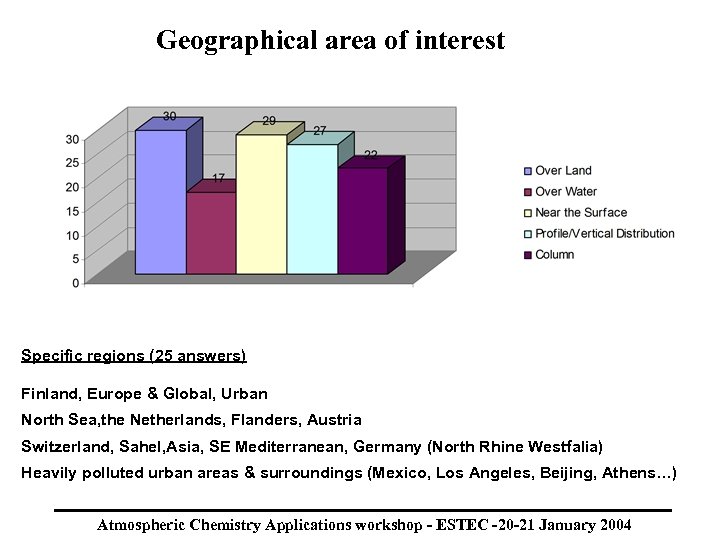 Geographical area of interest Specific regions (25 answers) Finland, Europe & Global, Urban North Sea, the Netherlands, Flanders, Austria Switzerland, Sahel, Asia, SE Mediterranean, Germany (North Rhine Westfalia) Heavily polluted urban areas & surroundings (Mexico, Los Angeles, Beijing, Athens…) Atmospheric Chemistry Applications workshop - ESTEC -20 -21 January 2004
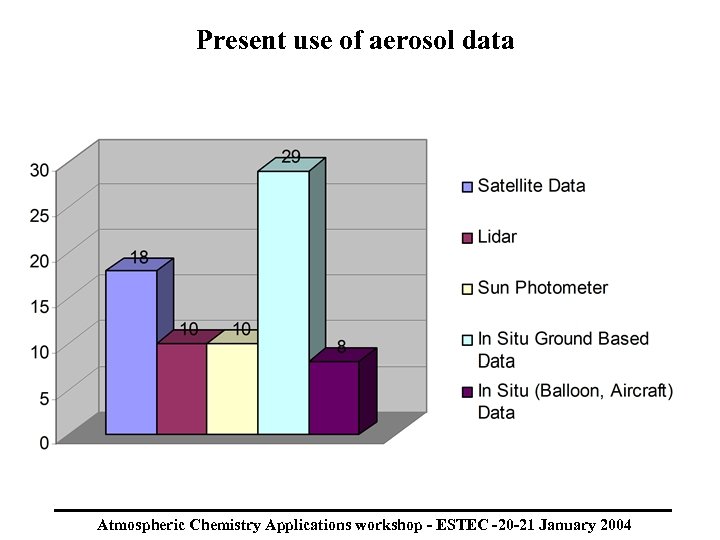 Present use of aerosol data Atmospheric Chemistry Applications workshop - ESTEC -20 -21 January 2004
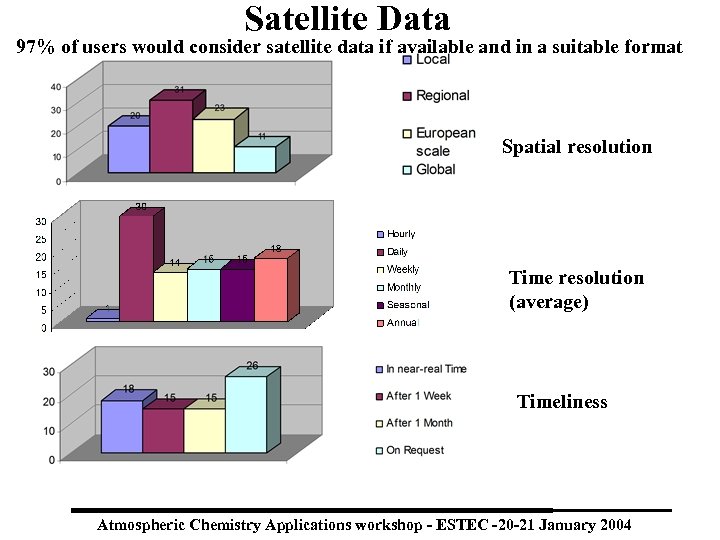 Satellite Data 97% of users would consider satellite data if available and in a suitable format Spatial resolution Time resolution (average) Timeliness Atmospheric Chemistry Applications workshop - ESTEC -20 -21 January 2004
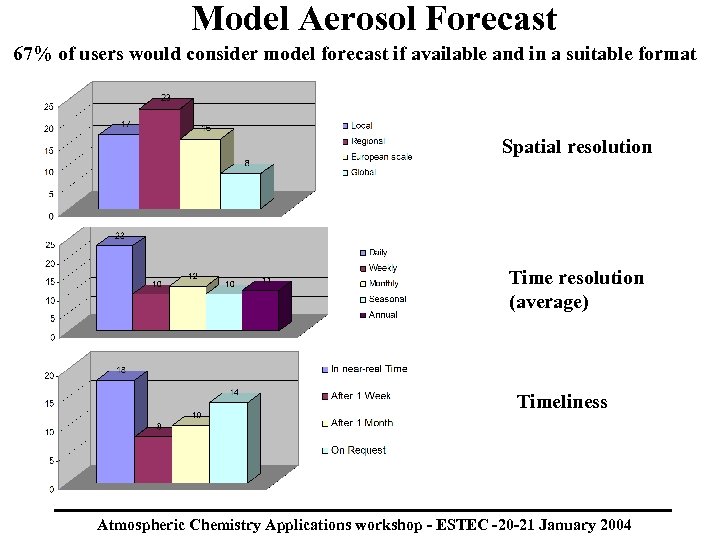 Model Aerosol Forecast 67% of users would consider model forecast if available and in a suitable format Spatial resolution Time resolution (average) Timeliness Atmospheric Chemistry Applications workshop - ESTEC -20 -21 January 2004
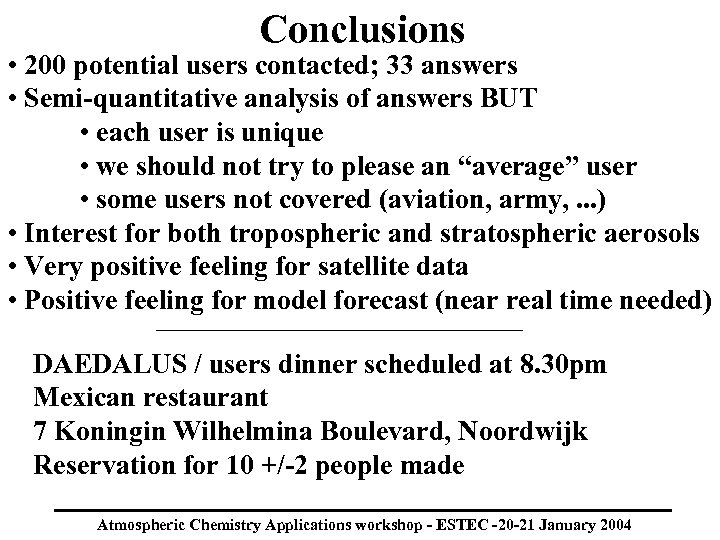 Conclusions • 200 potential users contacted; 33 answers • Semi-quantitative analysis of answers BUT • each user is unique • we should not try to please an “average” user • some users not covered (aviation, army, . . . ) • Interest for both tropospheric and stratospheric aerosols • Very positive feeling for satellite data • Positive feeling for model forecast (near real time needed) DAEDALUS / users dinner scheduled at 8. 30 pm Mexican restaurant 7 Koningin Wilhelmina Boulevard, Noordwijk Reservation for 10 +/-2 people made Atmospheric Chemistry Applications workshop - ESTEC -20 -21 January 2004
 http: //www-loa. univ-lille 1. fr/Daedalus boucher@loa. univ-lille 1. fr END Appendix on MODIS Rapid Response Team http: //rapidfire. sci. gsfc. nasa. gov Atmospheric Chemistry Applications workshop - ESTEC -20 -21 January 2004
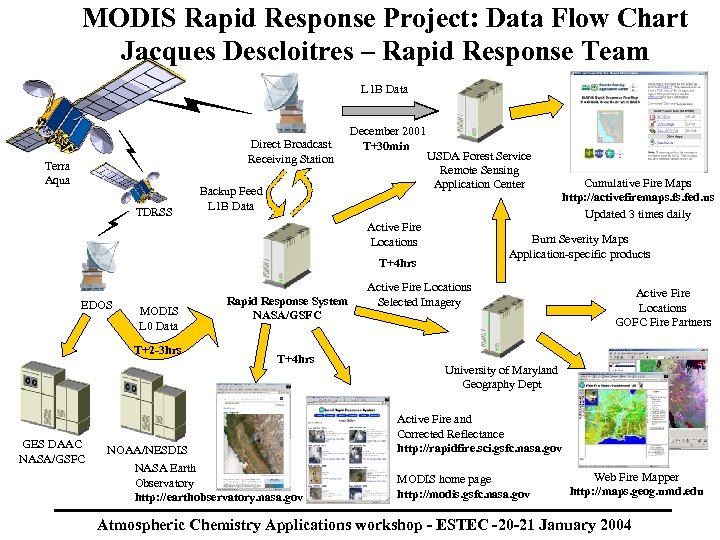 MODIS Rapid Response Project: Data Flow Chart Jacques Descloitres – Rapid Response Team L 1 B Data Direct Broadcast Receiving Station Terra Aqua TDRSS December 2001 T+30 min Backup Feed L 1 B Data USDA Forest Service Remote Sensing Application Center Active Fire Locations Burn Severity Maps Application-specific products T+4 hrs EDOS MODIS L 0 Data T+2 -3 hrs GES DAAC NASA/GSFC Rapid Response System NASA/GSFC T+4 hrs NOAA/NESDIS NASA Earth Observatory http: //earthobservatory. nasa. gov Cumulative Fire Maps http: //activefiremaps. fed. us Updated 3 times daily Active Fire Locations Selected Imagery Active Fire Locations GOFC Fire Partners University of Maryland Geography Dept Active Fire and Corrected Reflectance http: //rapidfire. sci. gsfc. nasa. gov MODIS home page http: //modis. gsfc. nasa. gov Web Fire Mapper http: //maps. geog. umd. edu Atmospheric Chemistry Applications workshop - ESTEC -20 -21 January 2004
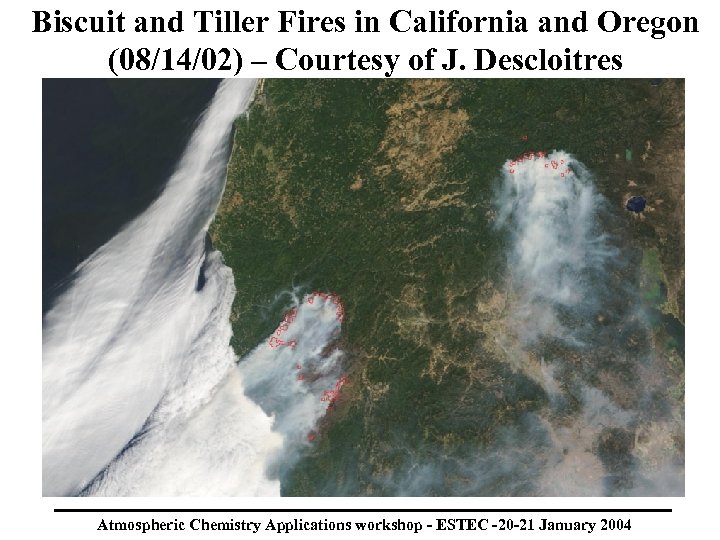 Biscuit and Tiller Fires in California and Oregon (08/14/02) – Courtesy of J. Descloitres Atmospheric Chemistry Applications workshop - ESTEC -20 -21 January 2004
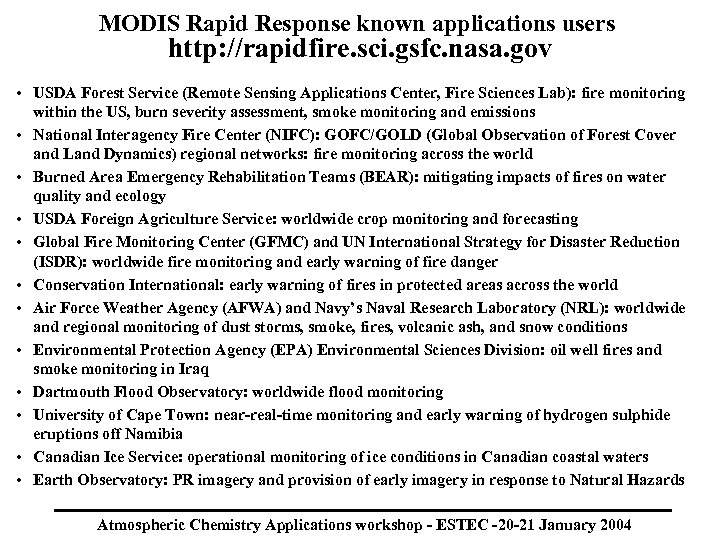 MODIS Rapid Response known applications users http: //rapidfire. sci. gsfc. nasa. gov • USDA Forest Service (Remote Sensing Applications Center, Fire Sciences Lab): fire monitoring within the US, burn severity assessment, smoke monitoring and emissions • National Interagency Fire Center (NIFC): GOFC/GOLD (Global Observation of Forest Cover and Land Dynamics) regional networks: fire monitoring across the world • Burned Area Emergency Rehabilitation Teams (BEAR): mitigating impacts of fires on water quality and ecology • USDA Foreign Agriculture Service: worldwide crop monitoring and forecasting • Global Fire Monitoring Center (GFMC) and UN International Strategy for Disaster Reduction (ISDR): worldwide fire monitoring and early warning of fire danger • Conservation International: early warning of fires in protected areas across the world • Air Force Weather Agency (AFWA) and Navy’s Naval Research Laboratory (NRL): worldwide and regional monitoring of dust storms, smoke, fires, volcanic ash, and snow conditions • Environmental Protection Agency (EPA) Environmental Sciences Division: oil well fires and smoke monitoring in Iraq • Dartmouth Flood Observatory: worldwide flood monitoring • University of Cape Town: near-real-time monitoring and early warning of hydrogen sulphide eruptions off Namibia • Canadian Ice Service: operational monitoring of ice conditions in Canadian coastal waters • Earth Observatory: PR imagery and provision of early imagery in response to Natural Hazards Atmospheric Chemistry Applications workshop - ESTEC -20 -21 January 2004
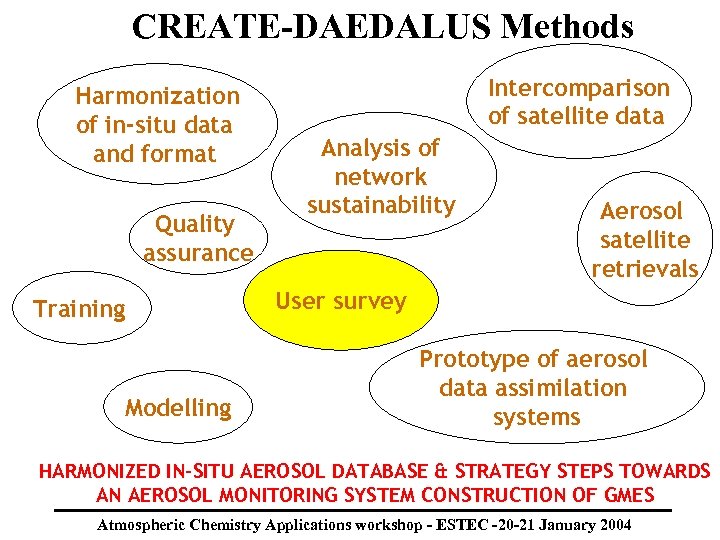 CREATE-DAEDALUS Methods Harmonization of in-situ data and format Quality assurance Training Modelling Intercomparison of satellite data Analysis of network sustainability Aerosol satellite retrievals User survey Prototype of aerosol data assimilation systems HARMONIZED IN-SITU AEROSOL DATABASE & STRATEGY STEPS TOWARDS AN AEROSOL MONITORING SYSTEM CONSTRUCTION OF GMES Atmospheric Chemistry Applications workshop - ESTEC -20 -21 January 2004
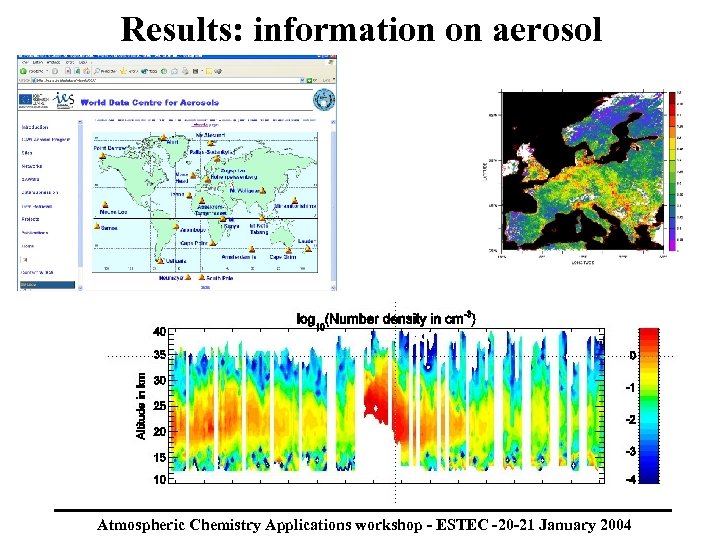 Results: information on aerosol 2. Model application Atmospheric Chemistry Applications workshop - ESTEC -20 -21 January 2004
 Lessons learned / Recommendations • CREATE • Emission databases are not accurate enough to predict evolution of aerosol fields over Europe • Validation of satellite derived aerosol products is needed from in-situ ground truth and vertical profile (sunphotometer / lidar) data • Measurement programmes should have long term continuity and not subject to vagaries of short term funding • Observational capacity needs to be increased • DAEDALUS • Difficulty in accessing and distributing processed data from ESA • Availability of model results and forecasts should be improved. • No infrastructure for a fully-European network of sunphotometers (e. g. , integration of PHOTONS / GAW needed) • Ingredients start to be available for an operational aerosol monitoring system although some work still needed for satellite aerosol retrieval and assimilation techniques. Atmospheric Chemistry Applications workshop - ESTEC -20 -21 January 2004
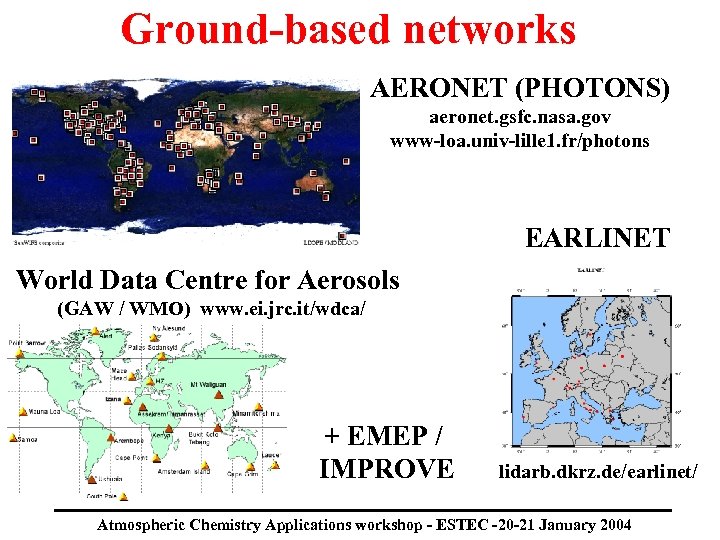 Ground-based networks AERONET (PHOTONS) aeronet. gsfc. nasa. gov www-loa. univ-lille 1. fr/photons EARLINET World Data Centre for Aerosols (GAW / WMO) www. ei. jrc. it/wdca/ + EMEP / IMPROVE lidarb. dkrz. de/earlinet/ Atmospheric Chemistry Applications workshop - ESTEC -20 -21 January 2004
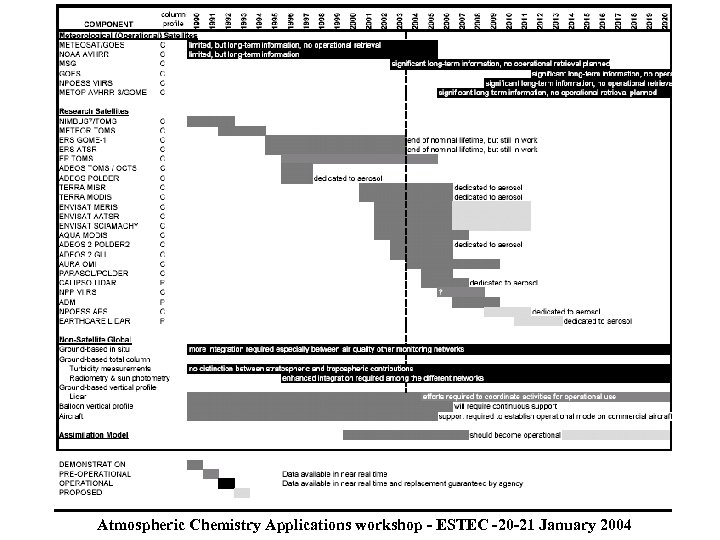 Atmospheric Chemistry Applications workshop - ESTEC -20 -21 January 2004
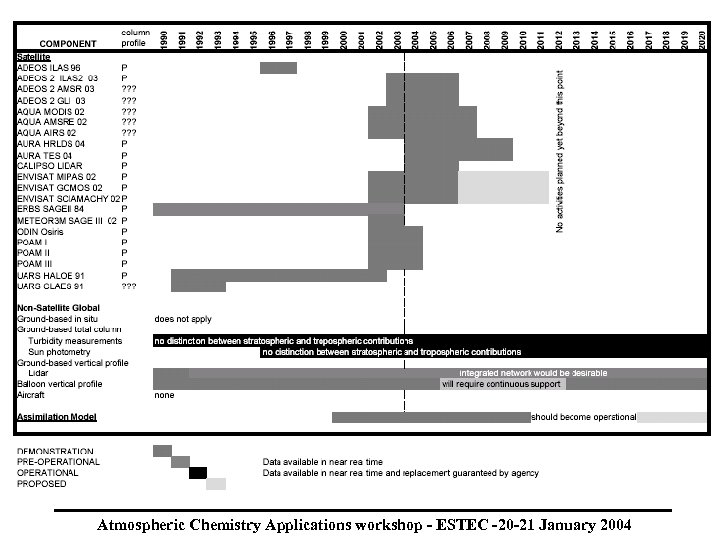 Atmospheric Chemistry Applications workshop - ESTEC -20 -21 January 2004
 Atmospheric aerosols are particles of natural or anthropogenic origin in suspension in the air. Typical sizes of 10 nm to 100 m, with different roles of the very fine mode (below 100 nm), accumulation mode (0. 1 to 1 m), and the coarse mode (1 to 10 m). Chemical composition varies: sulfate, nitrate, organics, black carbon, sea salt, dust, (may also carry some carcirogenic compounds) Particulate matter: PM 1, PM 2. 5, or PM 10. Typical lifetime of 5 to 10 days in the lower troposphere. Atmospheric Chemistry Applications workshop - ESTEC -20 -21 January 2004
 United-States • Clean Air act (1977) ==> IMPROVE network (measurements) ==> EPA (emissions) • NADP network for acid rain monitoring Europe • Convention on Long-Range Transboundary Air Pollutants ==> EMEP (emissions, measurements, modelling) organized in different task forces includes both gas and aerosol species • Clean Air For Europe (CAFE) (aims at a long-term, strategic and integrated policy to protect against air pollution effects on human health and env. ) post-Kyoto? -black carbon aerosol responsible for global warming -one of the (official) reason for the US to refuse Kyoto -measurements of black carbon still very delicate -we do not know yet how to monitor emissions and sinks Atmospheric Chemistry Applications workshop - ESTEC -20 -21 January 2004
 END Atmospheric Chemistry Applications workshop - ESTEC -20 -21 January 2004