 Скачать презентацию D 39 BU Business Management in the
ff5033319b58e980d4d42277dc467d6b.ppt
- Количество слайдов: 23



D 39 BU – Business Management in the Built Environment Leadership Dr. Turker Bayrak
Objectives • Distinguish the characteristics and attributes of a leader • Define leadership • Distinguish between various leadership styles • Differentiate between leadership and management
Leader The word leadership can refer to: • The traits, behaviour, influence, interaction patterns, role relationships & occupation of an administrative position. • Articulating visions (e. g. Bill Gates), embodying values & creating environment for the things that can be accomplished (Richards & Engle, 1986) • Those entities that perform one/ more acts of leading. • The ability to affect human behaviour so as to accomplish a mission. • Influencing a group of people to move towards its goal setting or goal achievement. (Stogdill, 1950) 3
Leader • Leading - directing and motivating all involved parties and dealing with employee behaviour issues. It is a dynamic process in which one individual influences others to contribute to the achievement of the group task.
Discussion Can you name 5 people that you consider as great leaders?
Examples of Leadership Excellence Who can be called an poor leader?
Key Leadership Qualities From your experience, write down as many of the key leadership qualities as you can. Bennis and Nanus identified the following key qualities; 1) The capacity to encourage and motivate others 2)The capacity to accept challenges and take risks 3) Self-awareness and self-knowledge 4) Personal persistence and commitment 5) A willingness and motivation to go on learning 6) An ability to learn and profit from failure and mistakes
Key Leadership Qualities Peters and Waterman suggest some additional leadership attributes: • Leadership by example. The ability to perform the detailed tasks that they require their subordinates to carry out, or at least their understanding of these tasks. • The identification and empathy with, and respect for the routines of their subordinates.
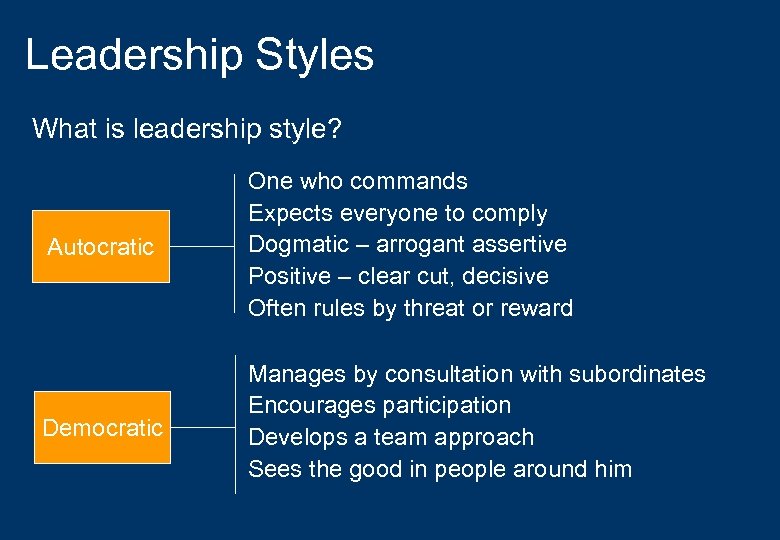
Leadership Styles What is leadership style? Autocratic One who commands Expects everyone to comply Dogmatic – arrogant assertive Positive – clear cut, decisive Often rules by threat or reward Democratic Manages by consultation with subordinates Encourages participation Develops a team approach Sees the good in people around him
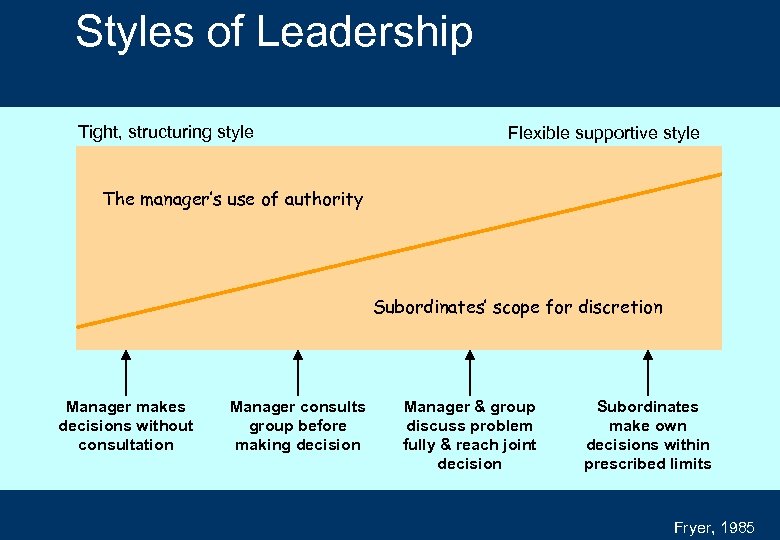
Styles of Leadership Tight, structuring style Flexible supportive style The manager’s use of authority Subordinates’ scope for discretion Manager makes decisions without consultation Manager consults group before making decision Manager & group discuss problem fully & reach joint decision Subordinates make own decisions within prescribed limits Fryer, 1985
Situational Approach & Contingency Models • Considers the importance of the situation • Belief that there is no single style of leadership appropriate to all situations ü ü Major contingency models include: Favourability or leadership situation – (Fielder) Quality and acceptance of leader’s decision – (Vroom and Yetton; and vroom & jago) Path-goal theory – (House; and House & Dessler) Maturity of followers – (Hersey & Blanchard; and Nicholls) 11
Leadership Tannenbaum and Schmidt identify four leadership behaviour styles as; • The leader tells • The leader sells • The leader consults • The leader joins
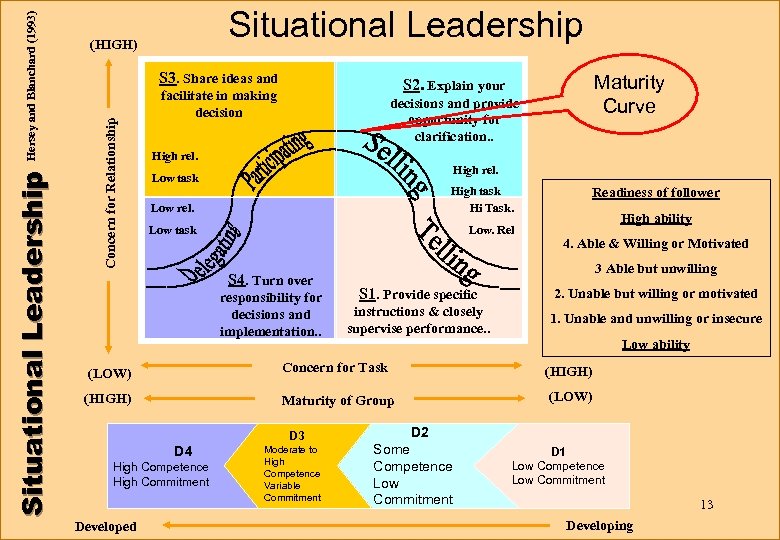
S 3. Share ideas and Concern for Relationship Hersey and Blanchard (1993) Situational Leadership (HIGH) Maturity Curve S 2. Explain your facilitate in making decisions and provide opportunity for clarification. . High rel. Low task Low rel. High task Hi Task. Low task Low. Rel S 4. Turn over responsibility for decisions and implementation. . Readiness of follower High ability 4. Able & Willing or Motivated 3 Able but unwilling S 1. Provide specific 2. Unable but willing or motivated instructions & closely supervise performance. . 1. Unable and unwilling or insecure Low ability (LOW) Concern for Task (HIGH) Maturity of Group (LOW) D 3 D 4 High Competence High Commitment Developed Moderate to High Competence Variable Commitment D 2 Some Competence Low Commitment D 1 Low Competence Low Commitment 13 Developing
Contingency Approach to Leadership (2) 2 Polarising Styles of Leaders: a) The directive managing, task orientated leader b) The non-directive human relations orientated leader.
Leadership What are the differences between traditional leaders, official leaders, and charismatic leaders? Traditional; • They drive authority from inheritance, birth or kinship Official leaders; • Drive authority from the offices they hold Charismatic leaders; • Exercise authority over others by force of personality or charm
Leadership Types of leaders can be listed as; • The charismatic leader’s authority springs out of the personality of the individual. • The traditional leader derives authority from factors such as birth, or custom and practice. This type of leaders are common within family businesses. • The appointed leader exercises rational-legal authority which derives from the position held. This type of leadership permits the ‘made’ rather than the ‘born’.
Types of Leaders (Cont…) Situational: Influence can only be effective by being in the right place at the right time. This type of leadership is too temporary in nature to be much value in business.
Types of Leaders (Cont…) Appointed: Influence arises directly out of his position (e. g. most managers and supervisors) Functional: Secures leadership position by what he or she does, rather than by what they are.
Leadership Styles – Determining Variables include: • Whether the leader is liked • How closely the work of the group is defined • The maturity of the group being managed • The location of decision authority • The degree of information input, etc…
Review & Discussion What is your prefer style of leadership? Give an example of a situation where you might need to adopt alternative style of leadership.
The Importance of Leadership… • The Leader-follower relationship is reciprocal • Leadership is related to motivation, interpersonal behaviour & the process of communication • Leadership is important in attempting to reduce employee dissatisfaction • Good leadership involves the effective process of delegation 21
How Do You Become a Leader? Leaders: • • • Decisive Follow through Select the best Empower employees Enhance career development Seek support
How Do You Become a Leader? Leaders (Cont): • Do not have all the answers • Do not be tough-minded, hard-nosed & abrasive • Do not play dirty politics • Do not shoot the messenger
Скачать презентацию D 39 BU Business Management in the
ff5033319b58e980d4d42277dc467d6b.ppt