 Скачать презентацию Customs Branch Smart Border Action Plan Update Transportation
01d90437a72579c517bbbffdc2b7debc.ppt
- Количество слайдов: 21



Customs Branch Smart Border Action Plan Update Transportation Border Working Group Customs Branch June 2003
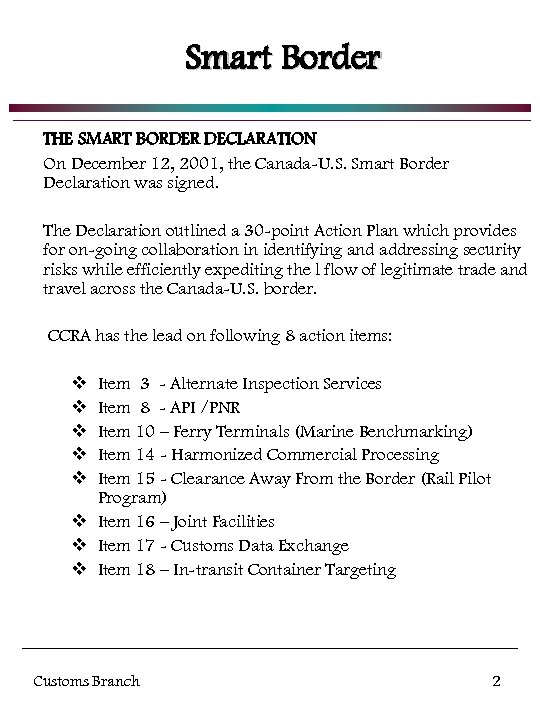
Smart Border THE SMART BORDER DECLARATION On December 12, 2001, the Canada-U. S. Smart Border Declaration was signed. The Declaration outlined a 30 -point Action Plan which provides for on-going collaboration in identifying and addressing security risks while efficiently expediting the l flow of legitimate trade and travel across the Canada-U. S. border. CCRA has the lead on following 8 action items: v v v Item 3 - Alternate Inspection Services Item 8 - API /PNR Item 10 – Ferry Terminals (Marine Benchmarking) Item 14 - Harmonized Commercial Processing Item 15 - Clearance Away From the Border (Rail Pilot Program) v Item 16 – Joint Facilities v Item 17 - Customs Data Exchange v Item 18 – In-transit Container Targeting Customs Branch 2
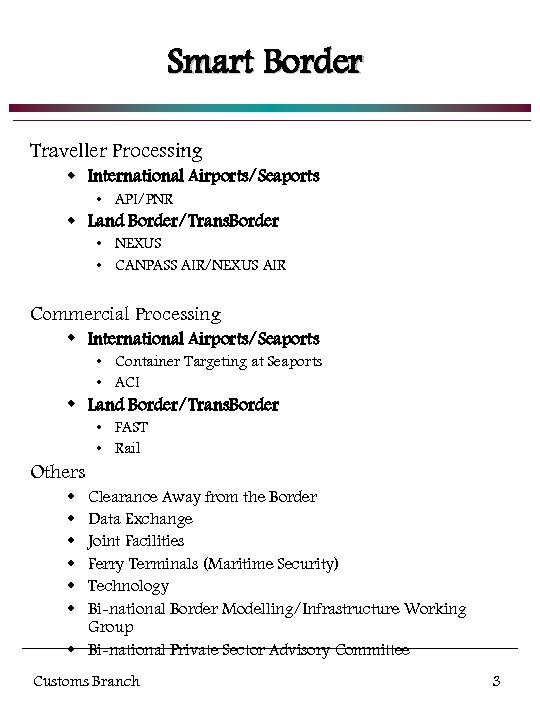
Smart Border Traveller Processing w International Airports/Seaports • API/PNR w Land Border/Trans. Border • NEXUS • CANPASS AIR/NEXUS AIR Commercial Processing w International Airports/Seaports • Container Targeting at Seaports • ACI w Land Border/Trans. Border • FAST • Rail Others w w w Clearance Away from the Border Data Exchange Joint Facilities Ferry Terminals (Maritime Security) Technology Bi-national Border Modelling/Infrastructure Working Group w Bi-national Private Sector Advisory Committee Customs Branch 3
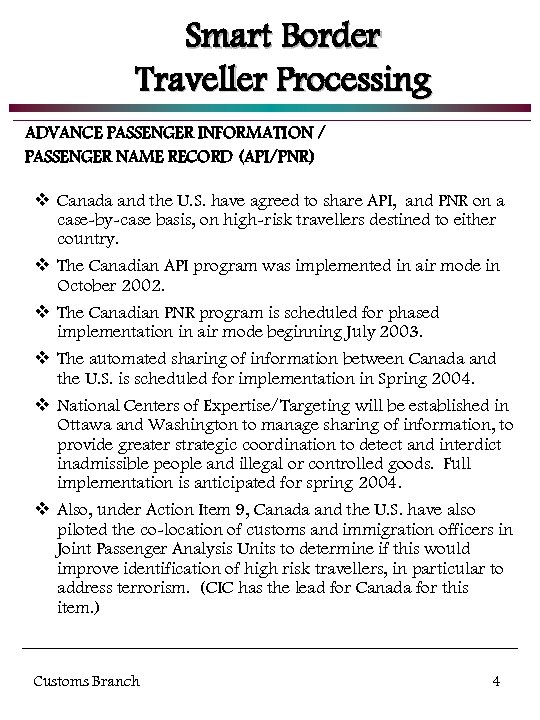
Smart Border Traveller Processing ADVANCE PASSENGER INFORMATION / PASSENGER NAME RECORD (API/PNR) v Canada and the U. S. have agreed to share API, and PNR on a case-by-case basis, on high-risk travellers destined to either country. v The Canadian API program was implemented in air mode in October 2002. v The Canadian PNR program is scheduled for phased implementation in air mode beginning July 2003. v The automated sharing of information between Canada and the U. S. is scheduled for implementation in Spring 2004. v National Centers of Expertise/Targeting will be established in Ottawa and Washington to manage sharing of information, to provide greater strategic coordination to detect and interdict inadmissible people and illegal or controlled goods. Full implementation is anticipated for spring 2004. v Also, under Action Item 9, Canada and the U. S. have also piloted the co-location of customs and immigration officers in Joint Passenger Analysis Units to determine if this would improve identification of high risk travellers, in particular to address terrorism. (CIC has the lead for Canada for this item. ) Customs Branch 4
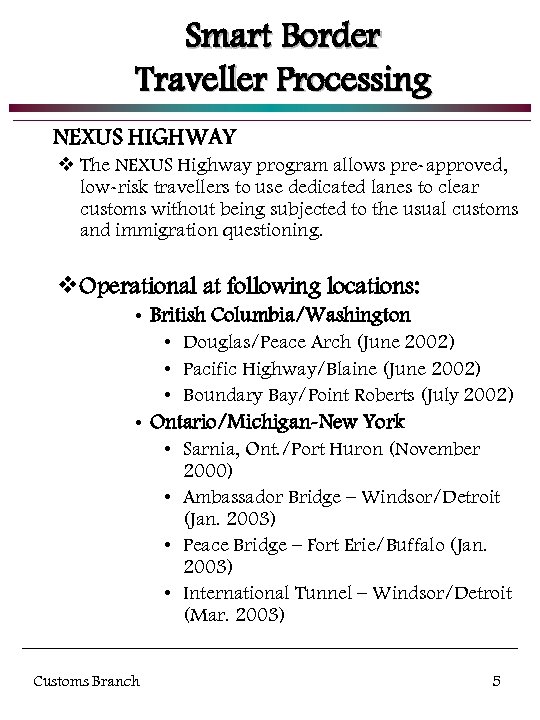
Smart Border Traveller Processing NEXUS HIGHWAY v The NEXUS Highway program allows pre-approved, low-risk travellers to use dedicated lanes to clear customs without being subjected to the usual customs and immigration questioning. v Operational at following locations: • British Columbia/Washington • Douglas/Peace Arch (June 2002) • Pacific Highway/Blaine (June 2002) • Boundary Bay/Point Roberts (July 2002) • Ontario/Michigan-New York • Sarnia, Ont. /Port Huron (November 2000) • Ambassador Bridge – Windsor/Detroit (Jan. 2003) • Peace Bridge – Fort Erie/Buffalo (Jan. 2003) • International Tunnel – Windsor/Detroit (Mar. 2003) Customs Branch 5
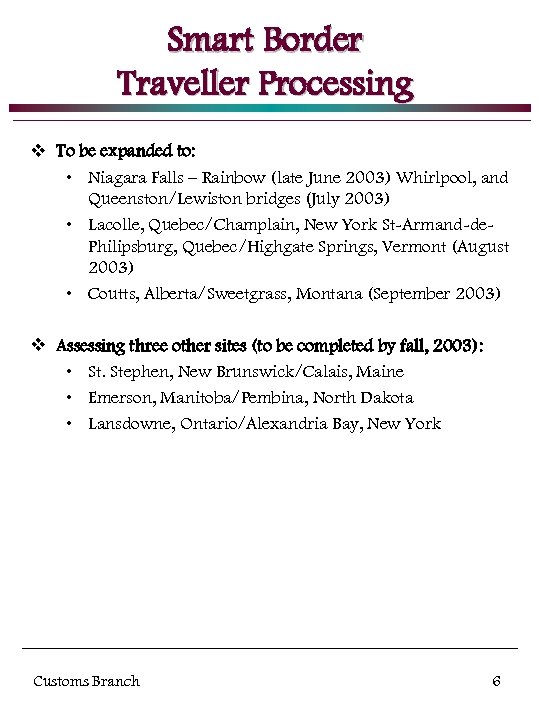
Smart Border Traveller Processing v To be expanded to: • Niagara Falls – Rainbow (late June 2003) Whirlpool, and Queenston/Lewiston bridges (July 2003) • Lacolle, Quebec/Champlain, New York St-Armand-de. Philipsburg, Quebec/Highgate Springs, Vermont (August 2003) • Coutts, Alberta/Sweetgrass, Montana (September 2003) v Assessing three other sites (to be completed by fall, 2003): • St. Stephen, New Brunswick/Calais, Maine • Emerson, Manitoba/Pembina, North Dakota • Lansdowne, Ontario/Alexandria Bay, New York Customs Branch 6
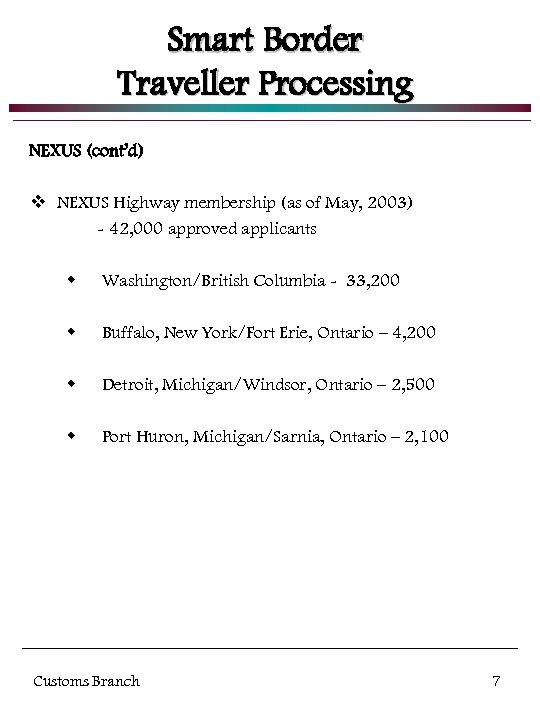
Smart Border Traveller Processing NEXUS (cont’d) v NEXUS Highway membership (as of May, 2003) - 42, 000 approved applicants w Washington/British Columbia - 33, 200 w Buffalo, New York/Fort Erie, Ontario – 4, 200 w Detroit, Michigan/Windsor, Ontario – 2, 500 w Port Huron, Michigan/Sarnia, Ontario – 2, 100 Customs Branch 7
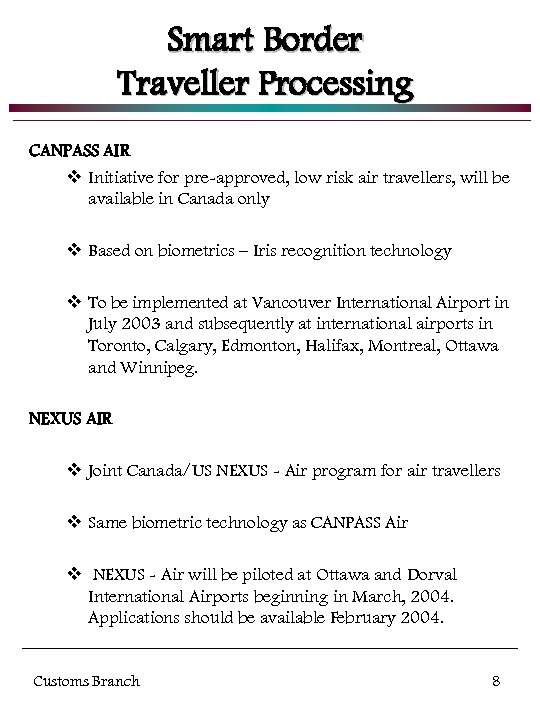
Smart Border Traveller Processing CANPASS AIR v Initiative for pre-approved, low risk air travellers, will be available in Canada only v Based on biometrics – Iris recognition technology v To be implemented at Vancouver International Airport in July 2003 and subsequently at international airports in Toronto, Calgary, Edmonton, Halifax, Montreal, Ottawa and Winnipeg. NEXUS AIR v Joint Canada/US NEXUS - Air program for air travellers v Same biometric technology as CANPASS Air v NEXUS - Air will be piloted at Ottawa and Dorval International Airports beginning in March, 2004. Applications should be available February 2004. Customs Branch 8
Smart Border Commercial Processing CONTAINER TARGETING AT SEAPORTS v Canadian and U. S. Customs agencies - created joint targeting teams at five marine ports in 2002. v Canadian ports of Vancouver, Montreal and Halifax, v US ports of Newark and Seattle-Tacoma v CCRA has participated in several tests of targetting processes to enhance targetting and examination capabilities. Customs Branch 9
Smart Border Commercial Processing ADVANCE COMMERCIAL INFORMATION For high and unknown risk traders, through the Advance Commercial Information (ACI) initiative, we are working to allign customs processes for all commercial shipments by 2005 v Phase 1 – Marine (April 2004) v 24 -hour rule v Automated Targeting Tool v Regulations for Mandatory EDI v Phase 2 – Other Modes v Timeframes to be confirmed Customs Branch 10
Smart Border Commercial Processing FREE AND SECURE TRADE v Free And Secure Trade (FAST) is a joint program for approved carriers, drivers and importers to expedite the movement of low-risk shipments across the border. pre- v Was implemented December 2002 at the following border crossings in: w w w Pacific Highway, British Columbia / Blaine, Washington Sarnia, Ontario / Port Huron, Michigan Windsor, Ontario / Detroit, Michigan Fort Erie, Ontario / Buffalo, New York Queenston, Ontario / Lewiston, New York Lacolle, Quebec / Champlain, New York v The Honourable Elinor Caplan, Minister of National Revenue, recently announced the expansion of 6 additional FAST passage sites by December 2003. The are located at: w w w Rock Island-Stanstead, Quebec/Highgate Springs, Vermont St. Armand-de-Philipsburg, Quebec/Derby Line, Vermont Lansdowne, Ontario/Alexandria Bay, New York Emerson, Manitoba/Pembina, North Dakota North Portal, Saskatchewan/Portal, North Dakota Coutts, Alberta/Sweet Grass, Montana Customs Branch 11
Smart Border Commercial Processing FAST (cont’d) v We have seen a continual growth in interest in the FAST program. FAST Statistics – as of April 2003: w Importers - 13 have submitted PIP Memorandums of Understanding (MOU) • 2 are FAST approved w Carriers - 227 have submitted PIP Memorandums of Understanding (MOU) • 64 are FAST approved w Drivers - Over 12, 000 drivers have applied • Over 6, 000 approved to-date and almost 3, 000 drivers have received their FAST cards v Next Steps w Continued expansion of FAST w Develop and implement proximity card and transponder technology w Display of driver photo at primary inspection line w Streamlining of existing processes Customs Branch 12
Smart Border Commercial Processing RAIL v CCRA and CBP working cooperatively with our industry partners with a goal of improving security and facilitating the flow of trade for the movement of goods by rail. v A Declaration of principles to confirm our roles and responsibilities was signed by CCRA and CBP on April 2, 2003. v Working with our industry partners Canadian National Railway and Canadian Pacific Railway to use detection equipment as the Rail VACIS, we will implement a risk management approach for targeting and screening rail shipments. v The Stationary Rail Vacis which is a Gamma Ray detection device will be installed and operated by CBP at the two locations of Sarnia and Windsor, Ontario. CBP will Vacis XRay 100% of all CN and CP trains. The trains will be required to slow between 3 -5 miles per hour in order to perform this type of examination. v CCRA and CBP are finalizing a protocol that will define the terms and conditions for conducting rail examinations. Customs Branch 13
Smart Border CLEARANCE AWAY FROM THE BORDER v Proposal to move customs and immigration inspection activities away from the border to improve security and relieve congestion where possible. v Pre-clearance v Reverse Inspection v Pre-Processing v Significant legal and sovereignty issues exist with option where one country operates with “full powers” on the soil of the other. Customs Branch 14
Smart Border v JOINT FACILITIES Current joined or joint facilities: v Noyan, P. Q - Alburg Springs, Vermont v Climax, Saskatchewan – Turner, Montana v Carson, BC – Danville, Washington State v Little Gold Creek, Yukon – Poker Creek, Alaska v Agreed to develop a list, with US partners, to be issued in late Spring 2003 and may include following sites pending outcome of feasibility studies: v River de Chute, NB / Easton, ME v Bloomfield, NB / Monticello, ME v St. Croix, NB / Vanceboro, ME v Morses Line, QC / Morses Line, VT v Winkler, MB / Walhalla, ND v Snowflake, MB /Hanna, ND v Chopaka, BC / Nighthawk, WA v Rykerts, BC / Porthill, ID v Joined/ joint facilities template to be completed in September 2003 Customs Branch 15
Smart Border DATA EXCHANGE v Canadian and U. S. Customs agencies have extended the scope of information they share through: • the Cooperation Arrangement for the Exchange of Information for the Purposes of Inquiries Related to Customs Fraud, signed in December 2001; and • Agreement signed in April 2003 on the exchange of NAFTA information including audit plans, audit reports, results of advance rulings, and origin (re)determinations. • Working to identify other potential exchange opportunities Customs Branch 16
Smart Border w FERRY TERMINALS (Maritime Security) v Marine benchmarking exercise completed in May 2002. v Objective is to enhance Canadian and U. S. border security at marine terminals through the adoption of a series of benchmarks for improving security and contraband interception v 42 recommendations ranging in complexity at various stages of implementation. examples as follow: - Creation of a Customs system(potentially a joint US/Canada system) to capture information regarding vessels; - Development of a timely single business window of advance electronic reporting of pre-arrival notification for the vessel, crew list and cargo manifests for use by all applicable agencies to screen for contraband threats to security; and - Establish dedicated Canadian resources to target and examine suspect travelers or crew in the sea passenger environment Customs Branch 17
Smart Border Technology v Mobile VACIS is a truck mounted gamma ray mobile scanning system which captures an image of contents of a marine container, rail car, or truck. v It gives the operators of this equipment an image similar in many ways to an X-ray. v The first three mobile VACISTM units located at the marine ports of Vancouver, Montreal, and Halifax. v Additional units are deployed or scheduled for deployment across Canada Customs Branch 18
Smart Border BI-NATIONAL BORDER INFRASTRUCTURE/MODELLING WORKING GROUP v Ensure effective linkages between border agencies’ specific program initiatives and other appropriate bi-national working groups. v Review border infrastructure proposals on both sides of the border to ensure they are complementary to the new systems being implemented (e. g. FAST, NEXUS, etc. ) and ensure maximum traffic efficiencies. v Analyze border congestion on an ongoing basis using computer simulation technology to identify problems and potential solutions. BI-NATIONAL PRIVATE SECTOR ADVISORY COMMITTEE v In September 2002, US President George Bush and Canadian Prime Minister Jean Chrétien called for private sector consultations on strategic directions for the Canada/U. S. Shared Border Accord (SBA). v The first meeting is not expected before the fall. Customs Branch 19

Smart Border NEXT STEPS FOR THE SMART BORDER DECLARATION PROCESS v Meetings continue between Deputy Prime Minister Manley and Homeland Security Secretary Ridge to ensure progress on all of the Phase 1 initiatives. v Next Shared Border Accord meeting will be hosted by the U. S. Bureau of Customs and Border Protection (USBCBP) in August, 2003. Customs Branch 20
Smart Border CONCLUSION v Significant progress to date in streamlining low risk commercial shipment and traveller (e. g. FAST, NEXUS) and enhancing security at international airports and seaports (Joint Intransit Targeting, API). v More progress to be made during this fiscal year • Expand NEXUS and FAST • Roll out CANPASS Air and NEXUS Air • Roll out Marine ACI and AIR PNR v Most remaining key initiatives will be in place and operating by April, 2005. Customs Branch 21
Скачать презентацию Customs Branch Smart Border Action Plan Update Transportation
01d90437a72579c517bbbffdc2b7debc.ppt