 Скачать презентацию Customs and traditions in Great Britain Ne mchenko
Customs and Traditions pres.pptx
- Количество слайдов: 8



Customs and traditions in Great Britain Ne mchenko Ilya
Оглавление 1 st and 2 nd page - Customs and traditions 3 rd page – Holidays in Gr. Britain 4 th page – Christmas ( some words about 1 holiday ) 5 th page – Other festivals, anniversaries and simply days 6 th page - Conclusion
Customs and traditions • Some ceremonies are traditional, such as a Changing of the Guard at Buckingham Palace, Trooping the Colour, the State Opening of Parlament. The Ceremony of Trooping the Colour is one of the most fascinating. It is staged in front of Buckingham Palace. It is held annually on the monarch’s official birthday which was the second Saturday in June. Her Majesty Queen Elizabeth II was Colonel-in-Chief of the Life Guards. She was escorted by Horse Guards riding to the Parade. The ceremeny is accompanied by the music of bands. The processionis is headed by the Queen.
In the House of Lords, Chancellor sits on the sack of wool. This tradition comes from the old times when sheep wool made England rich and powerful. • In the House of Commons there are two rows benches: one row is for the government and the other one is for the opposition. The benches are divided by a strip of carpet, which is also a tradition from old days, when that division prevented the two parties from fighting during the debates. • The englishmen have love for old things. They prefer houses with a fireplace and a garden to a flat, modern houses with central heating. The houses are traditionally not very high. They are usually two-storied. British buses are double-decked and red, mail-boxes are yellow, the cars keep to the left isde of road-all these are traditions.
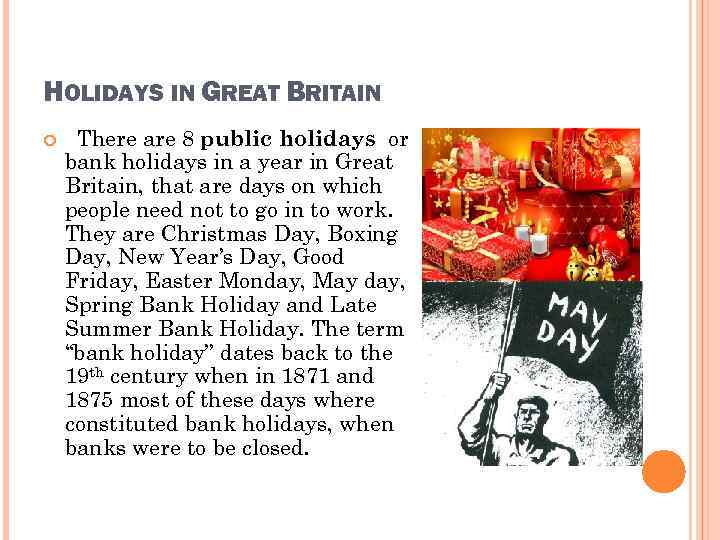
HOLIDAYS IN GREAT BRITAIN There are 8 public holidays or bank holidays in a year in Great Britain, that are days on which people need not to go in to work. They are Christmas Day, Boxing Day, New Year’s Day, Good Friday, Easter Monday, May day, Spring Bank Holiday and Late Summer Bank Holiday. The term “bank holiday” dates back to the 19 th century when in 1871 and 1875 most of these days where constituted bank holidays, when banks were to be closed.
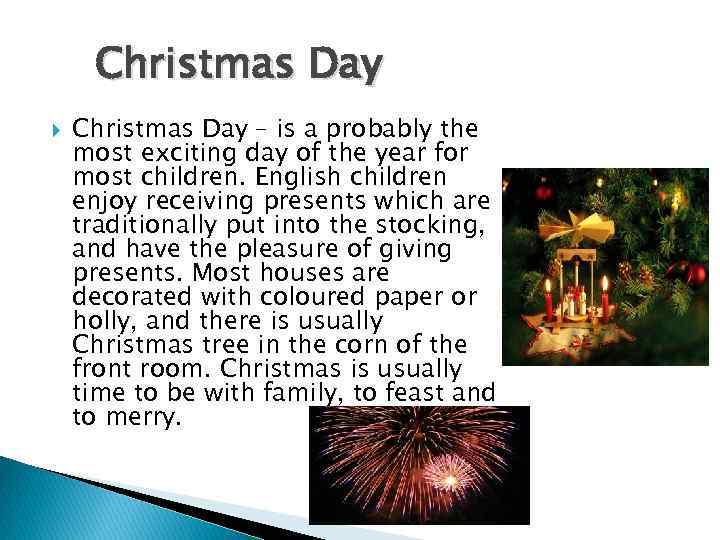
Christmas Day – is a probably the most exciting day of the year for most children. English children enjoy receiving presents which are traditionally put into the stocking, and have the pleasure of giving presents. Most houses are decorated with coloured paper or holly, and there is usually Christmas tree in the corn of the front room. Christmas is usually time to be with family, to feast and to merry.
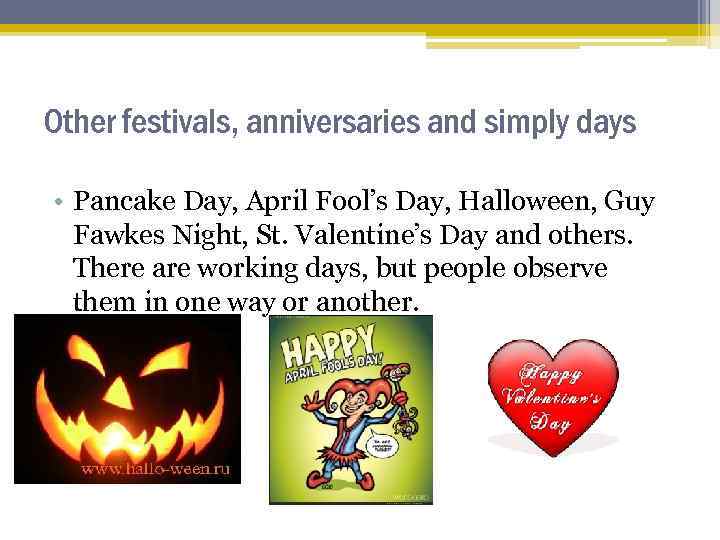
Other festivals, anniversaries and simply days • Pancake Day, April Fool’s Day, Halloween, Guy Fawkes Night, St. Valentine’s Day and others. There are working days, but people observe them in one way or another.

CONCLUSION In Britain traditions play a more important part in the life of the people than in other countries. Englishmen are proud of their traditions and carefully keep them up.
Скачать презентацию Customs and traditions in Great Britain Ne mchenko
Customs and Traditions pres.pptx