


 Скачать презентацию Customizing and Evolving Intrusion Detection A static
7f40d9bc7da6d0bb94fb5f5db23a7ce0.ppt
- Количество слайдов: 23
 Customizing and Evolving Intrusion Detection • A static, globally useful intrusion detection solution is impossible – Good behavior on one system is bad behavior on another – Behaviors change and new vulnerabilities are discovered • Intrusion detection systems must change to meet needs CS 236 Online Lecture 11 Page 1
 How Do Intrusion Detection Systems Evolve? • Manually or semi-automatically – New information added that allows them to detect new kinds of attacks • Automatically – Deduce new problems or things to watch for without human intervention CS 236 Online Lecture 11 Page 2
 A Problem With Manually Evolving Systems • System/network administrator action is required for each change – To be really effective, not just manual installation – More customized to the environment • Too heavy a burden to change very often • So they change slowly, akin to software updates CS 236 Online Lecture 11 Page 3
 A Problem With Evolving Intrusion Detection Systems • Very clever intruders can use the evolution against them • Instead of immediately performing dangerous actions, evolve towards them • If the intruder is more clever than the system, the system gradually accepts the new behavior • Possible with manual changing systems, but harder for attackers to succeed CS 236 Online Lecture 11 Page 4
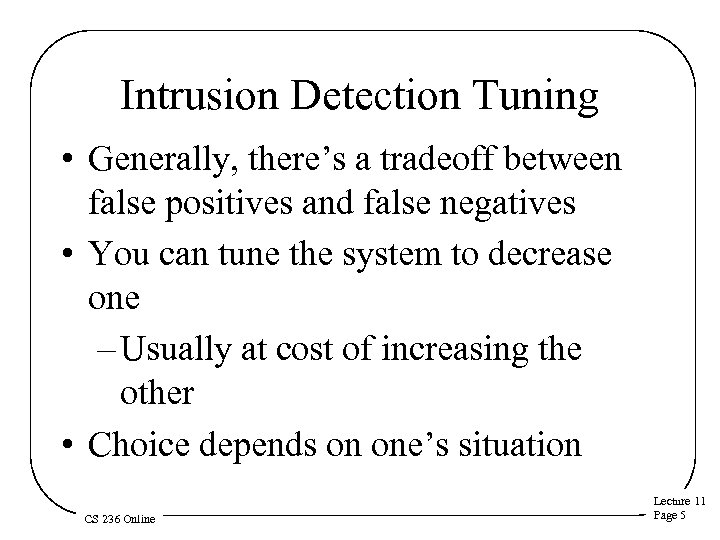 Intrusion Detection Tuning • Generally, there’s a tradeoff between false positives and false negatives • You can tune the system to decrease one – Usually at cost of increasing the other • Choice depends on one’s situation CS 236 Online Lecture 11 Page 5
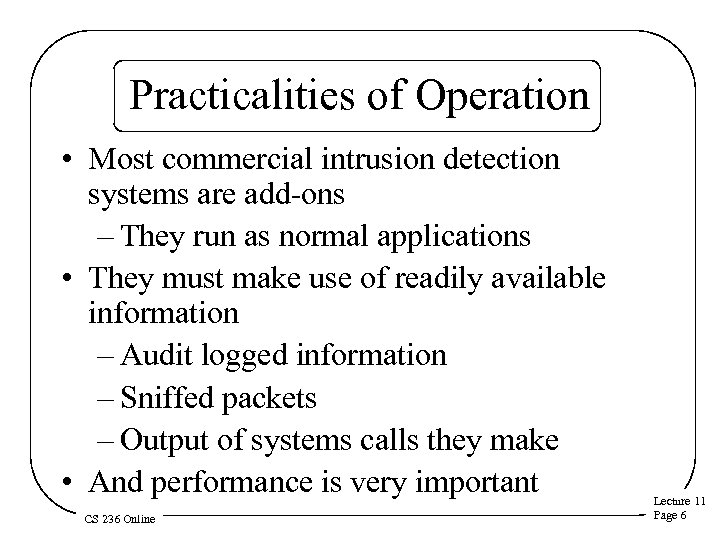 Practicalities of Operation • Most commercial intrusion detection systems are add-ons – They run as normal applications • They must make use of readily available information – Audit logged information – Sniffed packets – Output of systems calls they make • And performance is very important CS 236 Online Lecture 11 Page 6
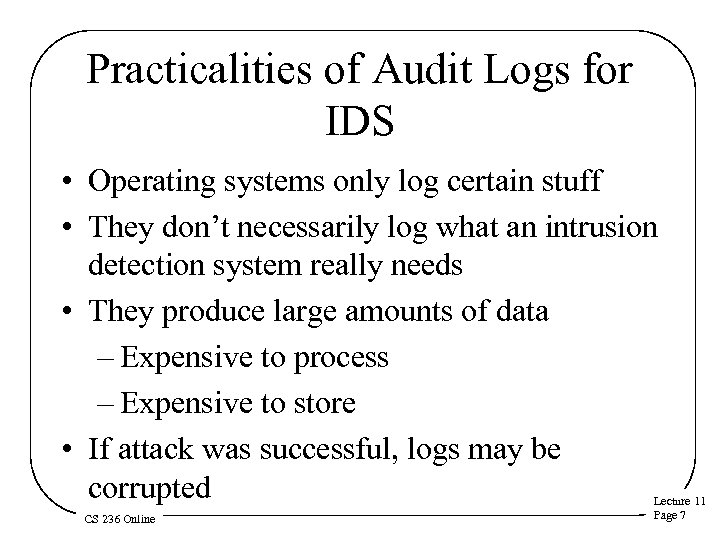 Practicalities of Audit Logs for IDS • Operating systems only log certain stuff • They don’t necessarily log what an intrusion detection system really needs • They produce large amounts of data – Expensive to process – Expensive to store • If attack was successful, logs may be corrupted CS 236 Online Lecture 11 Page 7
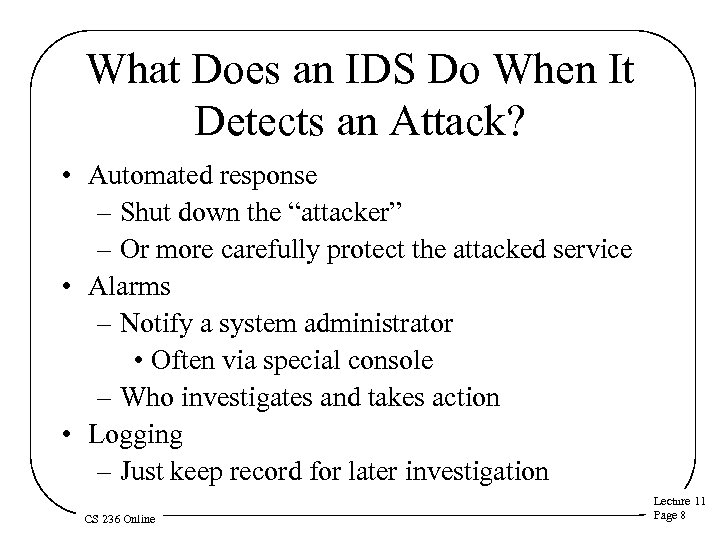 What Does an IDS Do When It Detects an Attack? • Automated response – Shut down the “attacker” – Or more carefully protect the attacked service • Alarms – Notify a system administrator • Often via special console – Who investigates and takes action • Logging – Just keep record for later investigation CS 236 Online Lecture 11 Page 8
 Consequences of the Choices • Automated – Too many false positives and your network stops working – Is the automated response effective? • Alarm – Too many false positives and your administrator ignores them – Is the administrator able to determine what’s going on fast enough? • Logging – Doesn’t necessarily lead to any action CS 236 Online Lecture 11 Page 9
 How Good Does an IDS Have To Be? • Depends on what you’re using it for • Like biometric authentication, need to trade off false positives/false negatives • Each positive signal (real or false) should cause something to happen – What’s the consequence? CS 236 Online Lecture 11 Page 10
 False Positives and IDS Systems • For automated response, what happens? • Something gets shut off that shouldn’t be – May be a lot of work to turn it on again • For manual response, what happens? • Either a human investigates and dismisses it • Or nothing happens • If human looks at it, can take a lot of his time CS 236 Online Lecture 11 Page 11
 Consider a Case for Manual Response • Your web site gets 10 million packets per day • Your IDS has a FPR of. 1% on packets – So you get 10, 000 false positives/day • Say each one takes one minute to handle • That’s 166 man hours per day – You’ll need 20+ full time experts just to weed out false positives CS 236 Online Lecture 11 Page 12
 What Are Your Choices? • Tune to a lower FPR – Usually causing more false negatives – If too many of those, system is useless • Have triage system for signals – If first step is still human, still expensive – Maybe you can automate some of it? • Ignore your IDS’ signals – In which case, why bother with it at all? CS 236 Online Lecture 11 Page 13
 Intrusion Prevention Systems • Essentially a buzzword for IDS that takes automatic action when intrusion is detected • Goal is to quickly take remedial actions to threats • Since IPSs are automated, false positives could be very, very bad • “Poor man’s” version is IDS controlling a firewall CS 236 Online Lecture 11 Page 14
 Sample Intrusion Detection Systems • • Snort Bro Real. Secure ISS Net. Ranger CS 236 Online Lecture 11 Page 15
 Snort • Network intrusion detection system • Public domain – Designed for Linux – But also runs on Windows and Mac • Designed for high extensibility – Allows easy plug-ins for detection – And rule-based description of good & bad traffic • Very widely used CS 236 Online Lecture 11 Page 16
 Bro • Like Snort, public domain network based IDS • Developed at LBL • Includes more sophisticated nonsignature methods than Snort • More general and extensible than Snort • Maybe not as easy to use CS 236 Online Lecture 11 Page 17
 Real. Secure ISS • Commercial IDS • Bundled into IBM security products • Distributed client/server architecture – Incorporates network and host components • Other components report to server on dedicated machine CS 236 Online Lecture 11 Page 18
 Net. Ranger • Bundled into Cisco products – Under a different name • For use in network environments – “Sensors” in promiscuous mode capture packets off the local network • Examines data flows – Raises alarm for suspicious flows • Using misuse detection techniques – Based on a signature database CS 236 Online Lecture 11 Page 19
 Is Intrusion Detection Useful? • 69% of CIS survey respondents (2008) use one – 54% use intrusion prevention • In 2003, Gartner Group analyst called IDS a failed technology – Predicted its death by 2005 – They’re not dead yet • Signature-based IDS especially criticized CS 236 Online Lecture 11 Page 20
 Which Type of Intrusion Detection System Should I Use? • NIST report 1 recommends using multiple IDSs – Preferably multiple types • E. g. , host and network • Each will detect different things – Using different data and techniques • Good defense in depth 1 http: //csrc. nist. gov/publications/nistir-7007. pdf CS 236 Online Lecture 11 Page 21
 The Future of Intrusion Detection? • General concept has never quite lived up to its promise • Yet alternatives are clearly failing – We aren’t keeping the bad guys out • So research and development continues • And most serious people use them – Even if they are imperfect CS 236 Online Lecture 11 Page 22
 Conclusions • Intrusion detection systems are helpful enough that those who care about security should use them • They are not yet terribly sophisticated – Which implies they aren’t that effective • Much research continues to improve them • Not clear if they’ll ever achieve what the original inventors hoped for CS 236 Online Lecture 11 Page 23