


 Скачать презентацию Customized Geospatial Workflows for E-Government Services Richard D
eb542b6fea5aa5cbe50d71c556054e31.ppt
- Количество слайдов: 22
 Customized Geospatial Workflows for E-Government Services Richard D. Holowczak, Ph. D. Dept. of Computer Information Systems Baruch College, CUNY Soon Ae Chun, Francisco J. Artigas and Vijayalakshmi Atluri Rutgers-CIMIC
 E-Government Research • Use E-Commerce technologies to streamline delivery of government services to citizens and between government agencies • NSF and State of NJ Funded E-Government Project: – Rutgers, CUNY, Columbia, UMBC • Automate/Streamline Business Establishment – Geographically and functionally dispersed and autonomous agencies – No Central control on how to open a new business – Burden is on entrepreneur to navigate the process – must also submit duplicate info. to each agency • Over 500 business types requiring license of some kind • 65 Different permit/license forms
 NJ Business Portal Research • GIS Based Business Services – Business location services: Properties, rents, infrastructure, local services, demographics, zoning/building codes, incentives, competitors • Customized Workflow Generation – WF guides entrepreneur through specific steps required based on type of bus. • Workflow Management System – Interacts with agencies on behalf of the entrepreneur, addresses duplicate data submission and consistency problems – Provides accurate status/monitoring
 Focus on GIS Research • Apply what has been developed in the E -Government project to more tightly couple the GIS with Customized Workflow • Area of Focus is the Meadowlands District in northern NJ
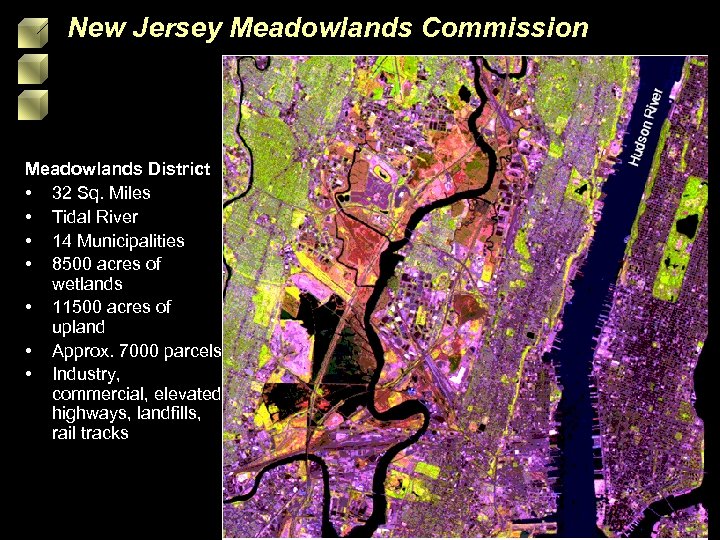 New Jersey Meadowlands Commission Meadowlands District • 32 Sq. Miles • Tidal River • 14 Municipalities • 8500 acres of wetlands • 11500 acres of upland • Approx. 7000 parcels • Industry, commercial, elevated highways, landfills, rail tracks
 Land Preservation and Development • Meadowlands District under intense development pressure • A wide range of projects being proposed all of the time (turn landfills into parks, build hotels/offices, etc. ) • 800 Permit requests per year • Approx. 1000 Open cases per year
 Objectives • Combine GIS and WF technologies to assist development/preservation project management – Assist outside organizations in identifying areas of interest by presenting alternate WF – Assist NJ Meadowlands Commission in managing the permitting and reporting processes
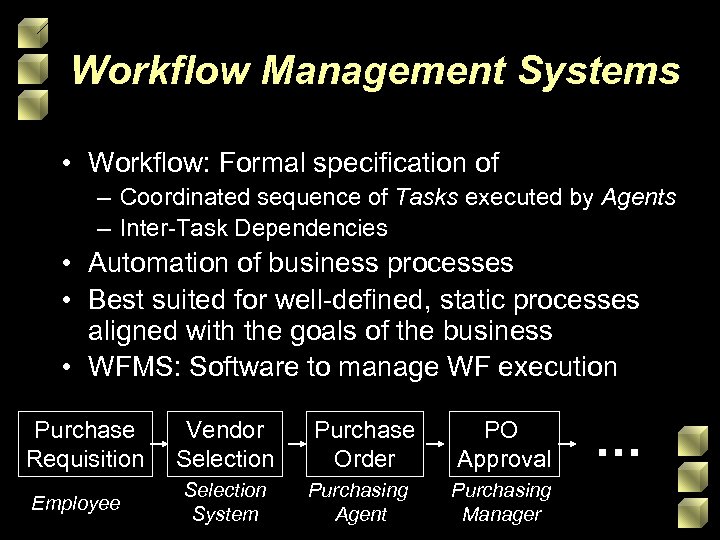 Workflow Management Systems • Workflow: Formal specification of – Coordinated sequence of Tasks executed by Agents – Inter-Task Dependencies • Automation of business processes • Best suited for well-defined, static processes aligned with the goals of the business • WFMS: Software to manage WF execution Purchase Requisition Employee Vendor Selection System Purchase Order Purchasing Agent PO Approval Purchasing Manager …
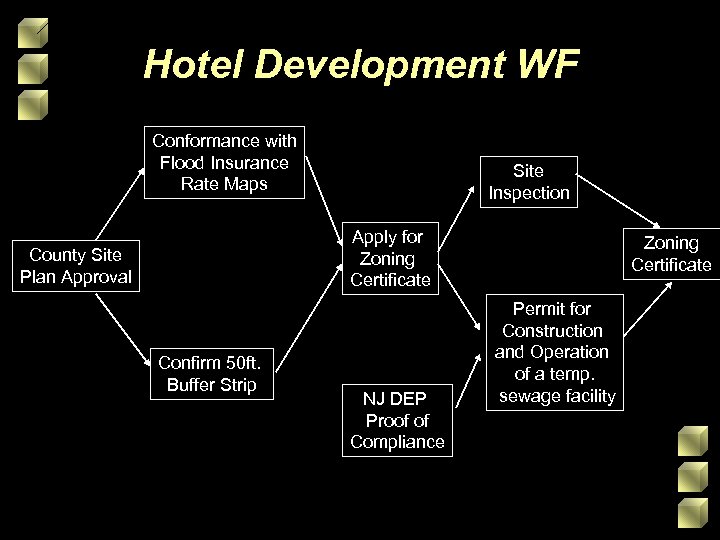 Hotel Development WF Conformance with Flood Insurance Rate Maps Site Inspection Apply for Zoning Certificate County Site Plan Approval Confirm 50 ft. Buffer Strip NJ DEP Proof of Compliance Zoning Certificate Permit for Construction and Operation of a temp. sewage facility
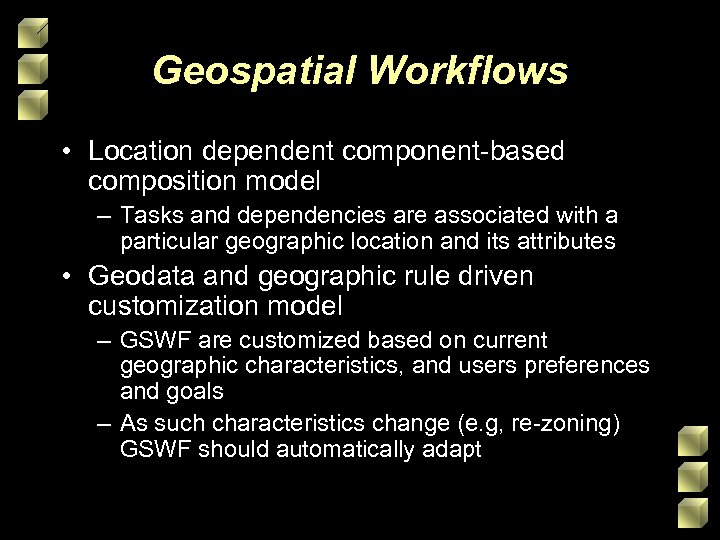 Geospatial Workflows • Location dependent component-based composition model – Tasks and dependencies are associated with a particular geographic location and its attributes • Geodata and geographic rule driven customization model – GSWF are customized based on current geographic characteristics, and users preferences and goals – As such characteristics change (e. g, re-zoning) GSWF should automatically adapt
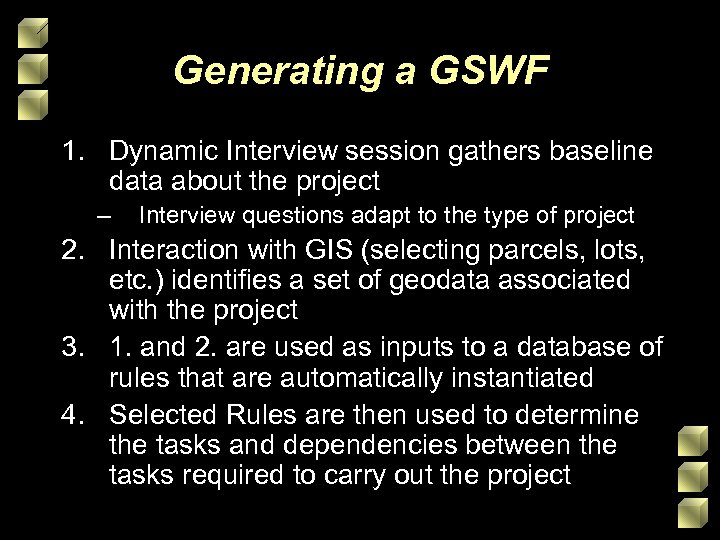 Generating a GSWF 1. Dynamic Interview session gathers baseline data about the project – Interview questions adapt to the type of project 2. Interaction with GIS (selecting parcels, lots, etc. ) identifies a set of geodata associated with the project 3. 1. and 2. are used as inputs to a database of rules that are automatically instantiated 4. Selected Rules are then used to determine the tasks and dependencies between the tasks required to carry out the project
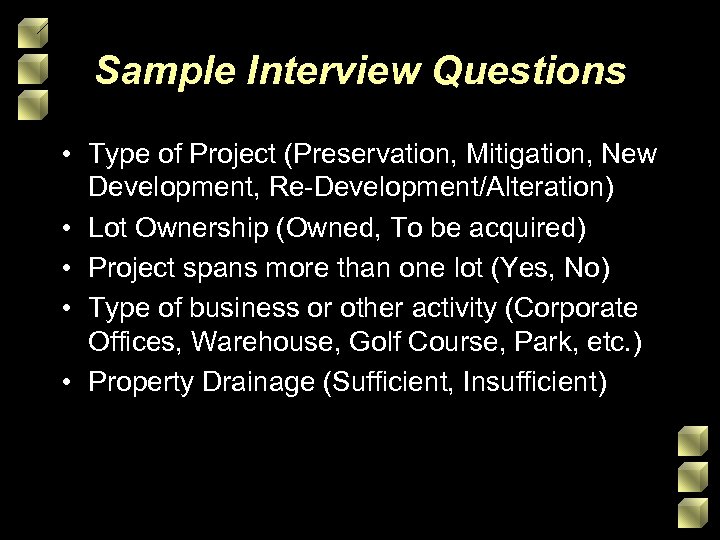 Sample Interview Questions • Type of Project (Preservation, Mitigation, New Development, Re-Development/Alteration) • Lot Ownership (Owned, To be acquired) • Project spans more than one lot (Yes, No) • Type of business or other activity (Corporate Offices, Warehouse, Golf Course, Park, etc. ) • Property Drainage (Sufficient, Insufficient)
 GIS Coverages • • Zoning Land Use Parcel Traffic Patterns Landfill and Contaminated sites Demographics etc.
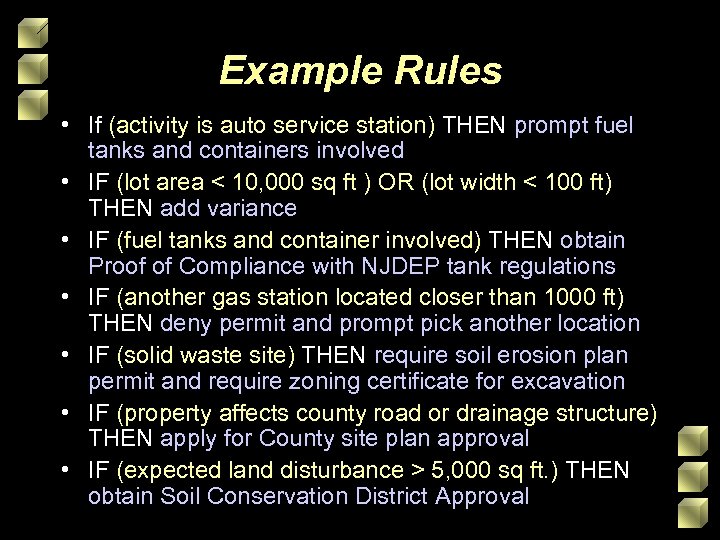 Example Rules • If (activity is auto service station) THEN prompt fuel tanks and containers involved • IF (lot area < 10, 000 sq ft ) OR (lot width < 100 ft) THEN add variance • IF (fuel tanks and container involved) THEN obtain Proof of Compliance with NJDEP tank regulations • IF (another gas station located closer than 1000 ft) THEN deny permit and prompt pick another location • IF (solid waste site) THEN require soil erosion plan permit and require zoning certificate for excavation • IF (property affects county road or drainage structure) THEN apply for County site plan approval • IF (expected land disturbance > 5, 000 sq ft. ) THEN obtain Soil Conservation District Approval
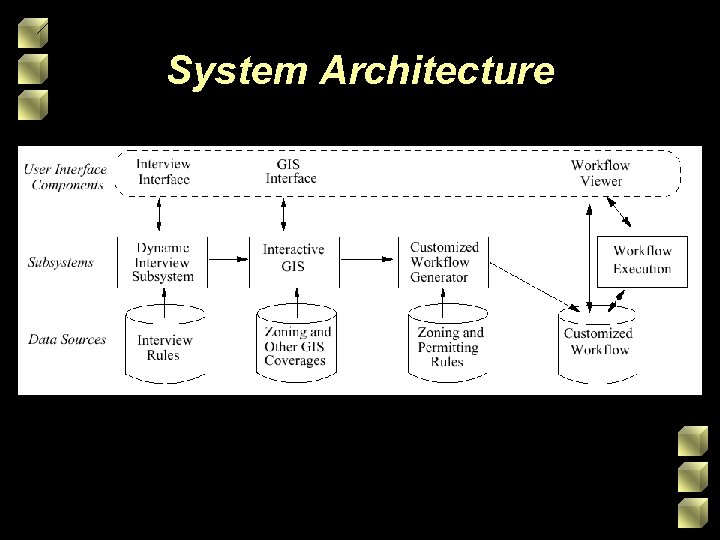 System Architecture
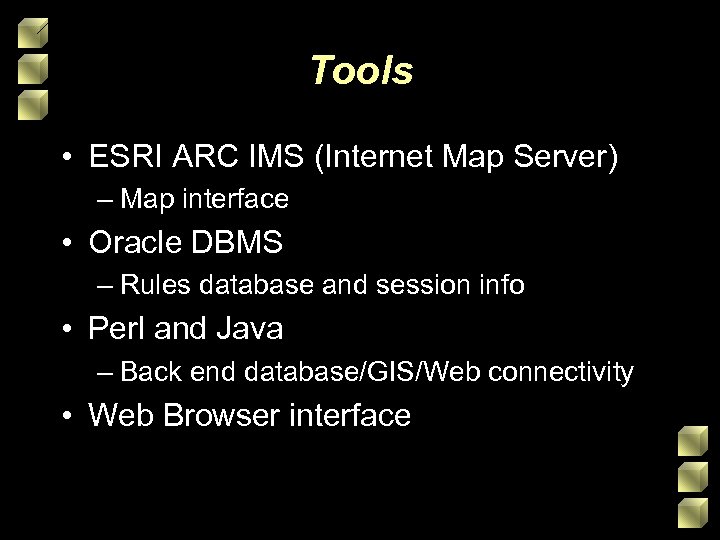 Tools • ESRI ARC IMS (Internet Map Server) – Map interface • Oracle DBMS – Rules database and session info • Perl and Java – Back end database/GIS/Web connectivity • Web Browser interface
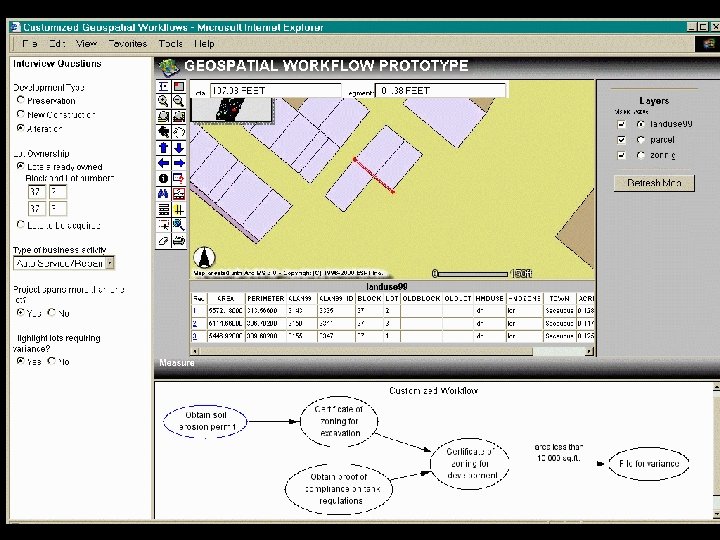 Prototype
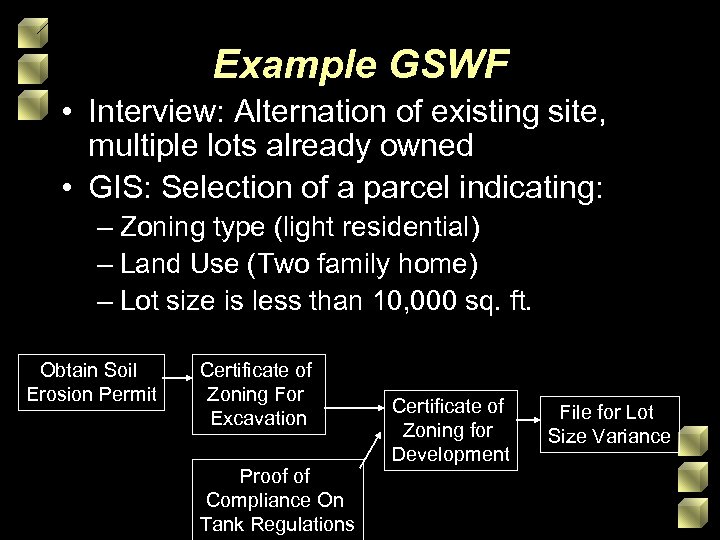 Example GSWF • Interview: Alternation of existing site, multiple lots already owned • GIS: Selection of a parcel indicating: – Zoning type (light residential) – Land Use (Two family home) – Lot size is less than 10, 000 sq. ft. Obtain Soil Erosion Permit Certificate of Zoning For Excavation Proof of Compliance On Tank Regulations Certificate of Zoning for Development File for Lot Size Variance
 Project Management • Selecting different lots automatically produces several GSWF from which a project manager can choose • Once a GSWF is chosen, it can be put into action – Project Managers are guided through each step of the WF – NJ Meadowlands Commission can track progress of the workflow, anticipate workload, etc. • GSWF are dynamic so as Geodata change, WF are automatically updated
 Future Work • Prototype Development – User interface improvements – NJ Meadowlands Commission user interface • Apply this work to the E-Government project
 Acknowledgements • This work is partially supported by the National Science Foundation under grant EIA-9983468 and the Meadowlands Environmental Research Institute (MERI) grant from the New Jersey Meadowlands Commission • Robert Ceberio, Chief Executive Director, NJMC • Irfan Bora, Fiscal Officer, NJMC • Eliana Caffrini, Chief Regulatory Officer, NJMC • Dom Elefante, GIS specialist, NJMC • Timucin Bakirtas, Prototype Development • Pietro Mazzoleni, Prototype Development
 Thank You