


 Скачать презентацию Customer Value Prof Markus Christen INSEAD Singapore May June
28898f488ff563b53d6ada257750ebf4.ppt
- Количество слайдов: 19
 Customer Value Prof. Markus Christen INSEAD Singapore May/June 2007
 Customer Value § How can you determine what customers want to improve customer value? • Attribute-level analysis • Brand-level analysis • Tradeoff analysis 2 Market Driving Strategies - May/June 2007 © Prof. Markus Christen
 Attribute-Level Analysis: Technical Specs 3 Market Driving Strategies - May/June 2007 © Prof. Markus Christen
 Attribute-Level Analysis: Customer Rating Weak Disagree Strong Agree Brand X Brand Y Importance 4 Market Driving Strategies - May/June 2007 © Prof. Markus Christen
 Rule 7: Customer Behavior People act according to their perceptions. 5 Market Driving Strategies - May/June 2007 © Prof. Markus Christen
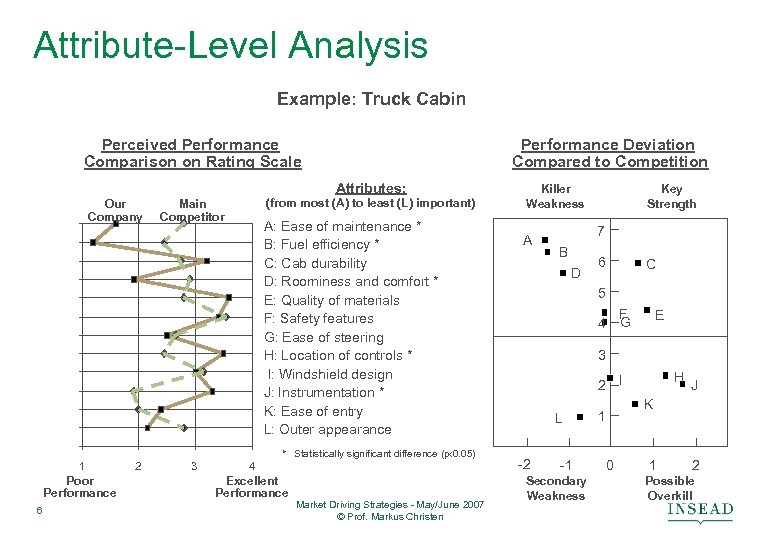 Attribute-Level Analysis Example: Truck Cabin Perceived Performance Comparison on Rating Scale Performance Deviation Compared to Competition Attributes: Our Company (from most (A) to least (L) important) Main Competitor A: Ease of maintenance * B: Fuel efficiency * C: Cab durability D: Roominess and comfort * E: Quality of materials F: Safety features G: Ease of steering H: Location of controls * I: Windshield design J: Instrumentation * K: Ease of entry L: Outer appearance * Statistically significant difference (p‹ 0. 05) 1 Poor Performance 6 2 3 4 Excellent Performance Market Driving Strategies - May/June 2007 © Prof. Markus Christen Killer Weakness A Key Strength 7 B D 6 C 5 F G 4 E 3 H 2 I L -2 -1 Secondary Weakness J K 1 0 1 2 Possible Overkill
 Rule 8: Customer Behavior People’s choices are based on determinant attributes. 7 Market Driving Strategies - May/June 2007 © Prof. Markus Christen
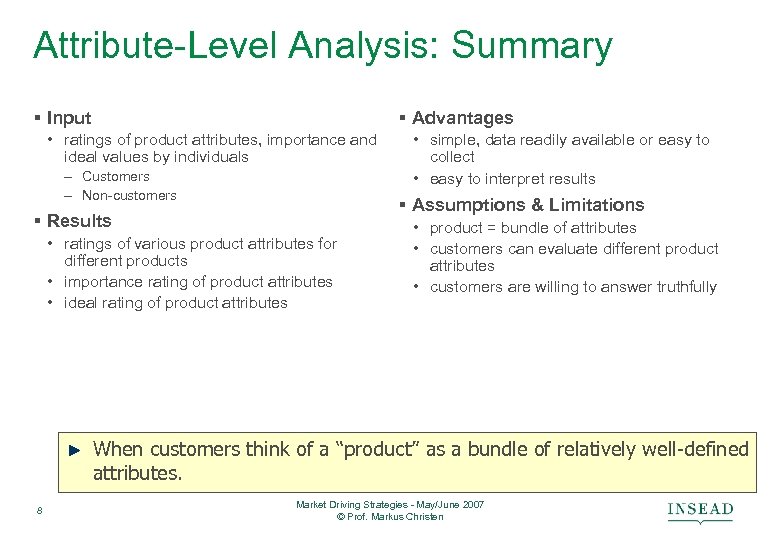 Attribute-Level Analysis: Summary § Input § Advantages • ratings of product attributes, importance and ideal values by individuals – Customers – Non-customers • simple, data readily available or easy to collect • easy to interpret results § Assumptions & Limitations § Results • ratings of various product attributes for different products • importance rating of product attributes • ideal rating of product attributes • product = bundle of attributes • customers can evaluate different product attributes • customers are willing to answer truthfully When customers think of a “product” as a bundle of relatively well-defined attributes. 8 Market Driving Strategies - May/June 2007 © Prof. Markus Christen
 Brand-Level Analysis: Perceptual Maps Multidimensional Scaling (MDS) Let customers rate/rank the similarity of different items Rate each pair using a scale from 1 (very similar) to 9 (very dissimilar). 9 Market Driving Strategies - May/June 2007 © Prof. Markus Christen
 Brand-Level Analysis: Perceptual Maps Example: US Automobile Market 10 Market Driving Strategies - May/June 2007 © Prof. Markus Christen
 Brand-Level Analysis: Perceptual Maps Example: US Automobile Market Ideal 11 Market Driving Strategies - May/June 2007 © Prof. Markus Christen
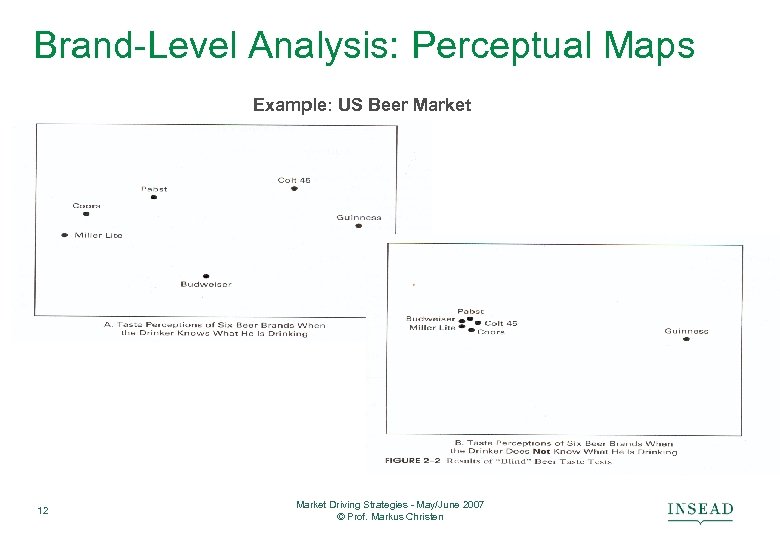 Brand-Level Analysis: Perceptual Maps Example: US Beer Market 12 Market Driving Strategies - May/June 2007 © Prof. Markus Christen
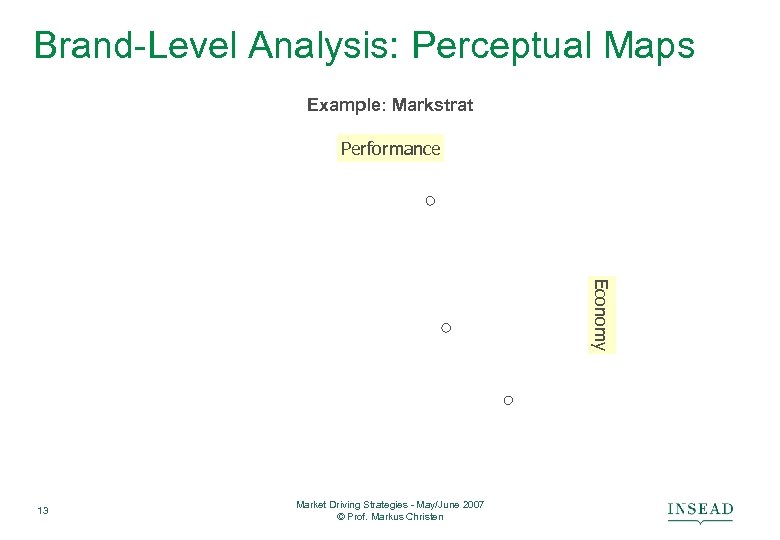 Brand-Level Analysis: Perceptual Maps Example: Markstrat Performance Economy 13 Market Driving Strategies - May/June 2007 © Prof. Markus Christen
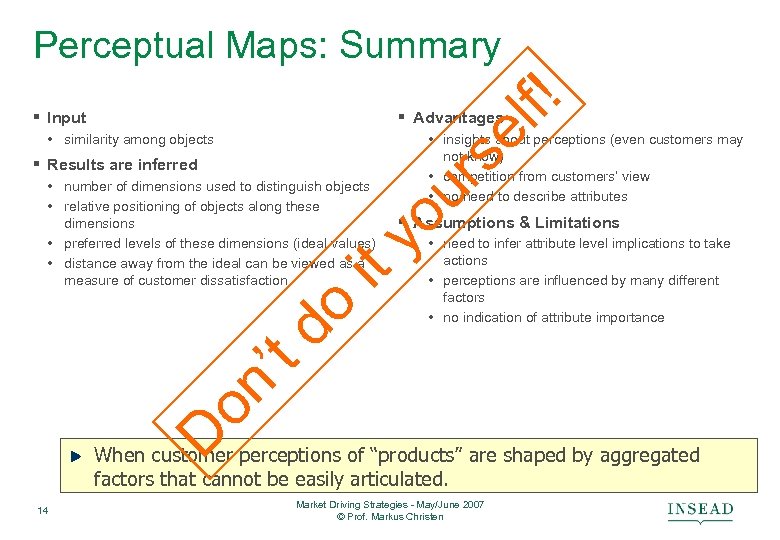 § Input rs el f! Perceptual Maps: Summary § Advantages • similarity among objects • insights about perceptions (even customers may not know) • competition from customers’ view • no need to describe attributes § Results are inferred ou • number of dimensions used to distinguish objects • relative positioning of objects along these dimensions • preferred levels of these dimensions (ideal values) • distance away from the ideal can be viewed as a measure of customer dissatisfaction • need to infer attribute level implications to take actions • perceptions are influenced by many different factors • no indication of attribute importance D on ’t do it y § Assumptions & Limitations When customer perceptions of “products” are shaped by aggregated factors that cannot be easily articulated. 14 Market Driving Strategies - May/June 2007 © Prof. Markus Christen
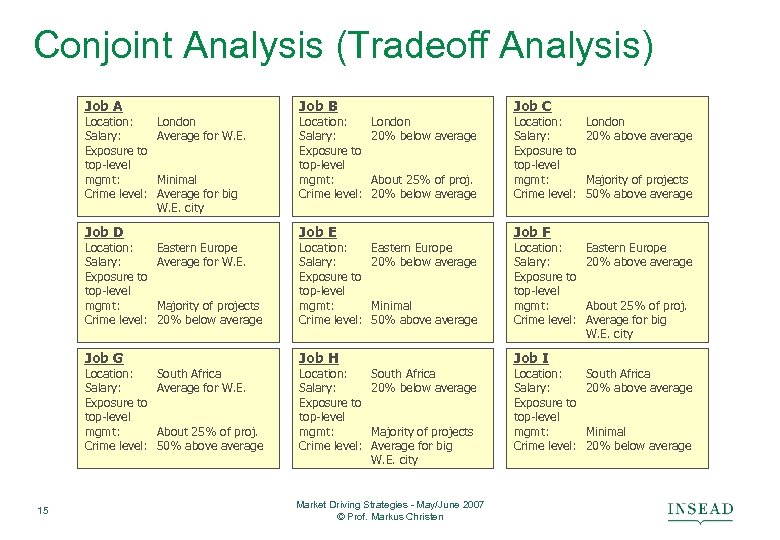 Conjoint Analysis (Tradeoff Analysis) Job A Location: Salary: Exposure to top-level mgmt: Crime level: Job D Location: Salary: Exposure to top-level mgmt: Crime level: Job G Location: Salary: Exposure to top-level mgmt: Crime level: 15 London Average for W. E. Minimal Average for big W. E. city Eastern Europe Average for W. E. Majority of projects 20% below average South Africa Average for W. E. About 25% of proj. 50% above average Job B Location: Salary: Exposure to top-level mgmt: Crime level: Job E Location: Salary: Exposure to top-level mgmt: Crime level: Job H Location: Salary: Exposure to top-level mgmt: Crime level: London 20% below average About 25% of proj. 20% below average Eastern Europe 20% below average Minimal 50% above average South Africa 20% below average Majority of projects Average for big W. E. city Market Driving Strategies - May/June 2007 © Prof. Markus Christen Job C Location: Salary: Exposure to top-level mgmt: Crime level: Job F Location: Salary: Exposure to top-level mgmt: Crime level: Job I Location: Salary: Exposure to top-level mgmt: Crime level: London 20% above average Majority of projects 50% above average Eastern Europe 20% above average About 25% of proj. Average for big W. E. city South Africa 20% above average Minimal 20% below average
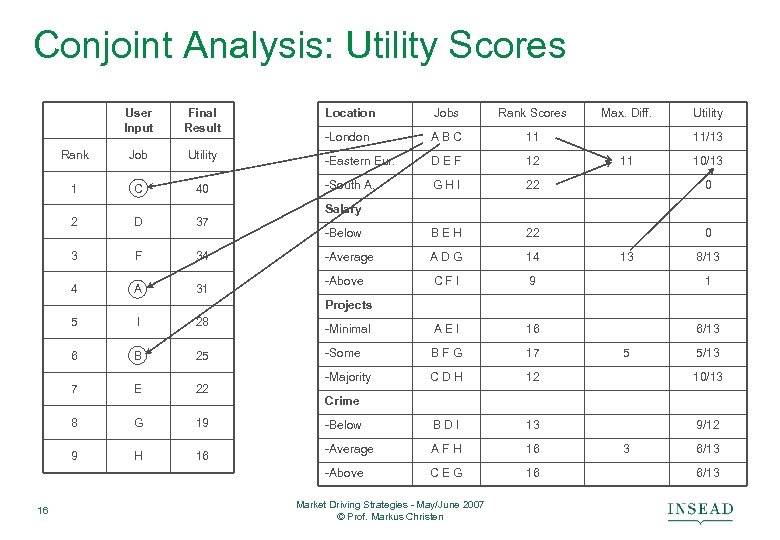 Conjoint Analysis: Utility Scores User Input Final Result Rank Job Utility 1 C 40 2 D 37 3 F 34 4 A 31 Location Jobs Rank Scores Max. Diff. Utility -London ABC 11 -Eastern Eur. DEF 12 -South A. GHI 22 0 -Below BEH 22 0 -Average ADG 14 -Above CFI 9 1 -Minimal AEI 16 6/13 -Some BFG 17 -Majority CDH 12 10/13 -Below BDI 13 9/12 -Average AFH 16 -Above CEG 16 11/13 11 10/13 Salary 13 8/13 Projects 5 28 6 B 25 7 E 22 8 G 19 9 16 I H 16 5 5/13 Crime Market Driving Strategies - May/June 2007 © Prof. Markus Christen 3 6/13
 Conjoint Analysis: Markstrat Example 17 Market Driving Strategies - May/June 2007 © Prof. Markus Christen
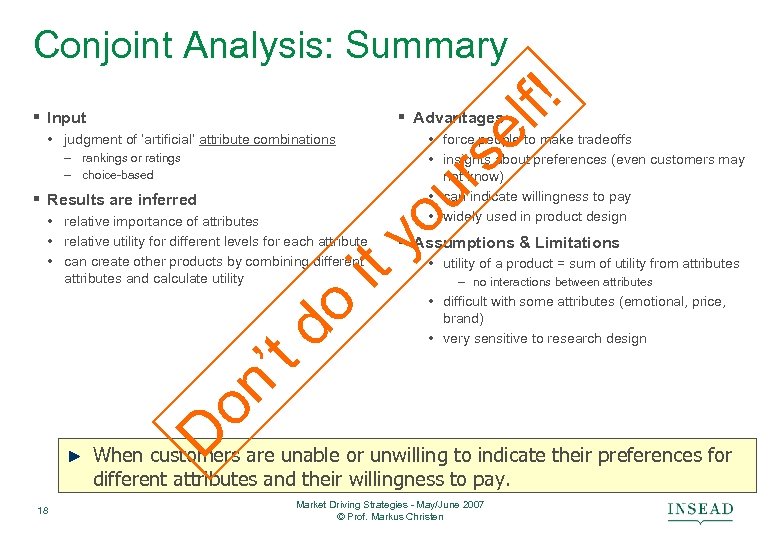 § Input rs el f! Conjoint Analysis: Summary § Advantages • judgment of ‘artificial’ attribute combinations • force people to make tradeoffs • insights about preferences (even customers may not know) • can indicate willingness to pay • widely used in product design § Results are inferred § Assumptions & Limitations • utility of a product = sum of utility from attributes – no interactions between attributes • difficult with some attributes (emotional, price, brand) • very sensitive to research design D on ’t do it y • relative importance of attributes • relative utility for different levels for each attribute • can create other products by combining different attributes and calculate utility ou – rankings or ratings – choice-based When customers are unable or unwilling to indicate their preferences for different attributes and their willingness to pay. 18 Market Driving Strategies - May/June 2007 © Prof. Markus Christen
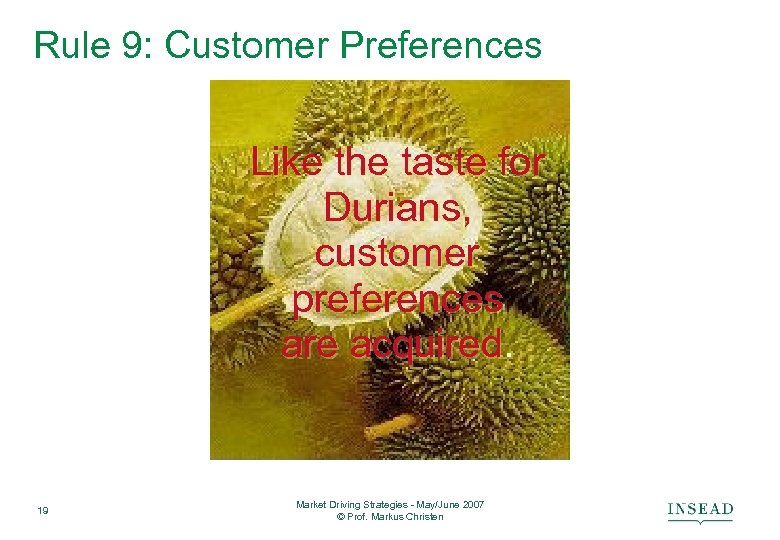 Rule 9: Customer Preferences Like the taste for Durians, customer preferences are acquired. 19 Market Driving Strategies - May/June 2007 © Prof. Markus Christen