


 Скачать презентацию Customer Service in Deregulating Electricity Service Industries
bbe8ab74b8e90254c304354bb8d132f9.ppt
- Количество слайдов: 21
 Customer Service in Deregulating Electricity Service Industries Seun Faluyi Group Head, Power Honeywell Group Limited Lagos
 Introduction n n Deregulation in the Electricity Supply Industry Deregulation and competition in developing countries Merits of Competition in the Electricity Supply Industry Customer Service Opportunities for utilities Recommendations for African economies
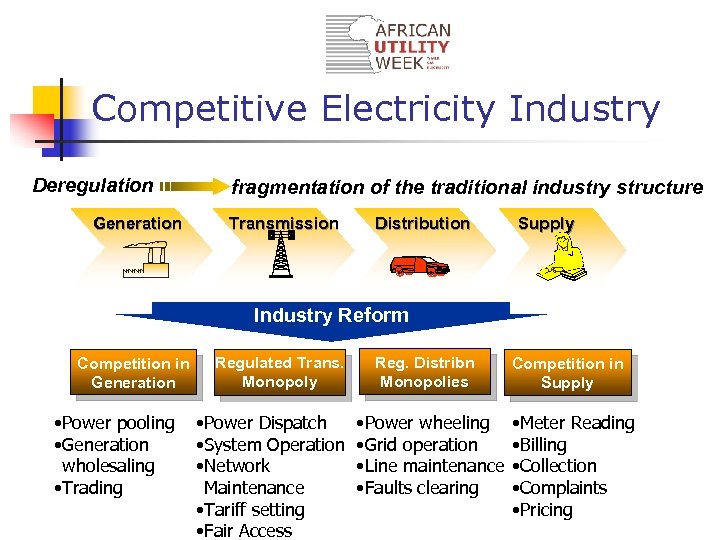 Competitive Electricity Industry Deregulation Generation fragmentation of the traditional industry structure Transmission Distribution Supply Industry Reform Competition in Generation • Power pooling • Generation wholesaling • Trading Regulated Trans. Monopoly • Power Dispatch • System Operation • Network Maintenance • Tariff setting • Fair Access Reg. Distribn Monopolies • Power wheeling • Grid operation • Line maintenance • Faults clearing Competition in Supply • Meter Reading • Billing • Collection • Complaints • Pricing
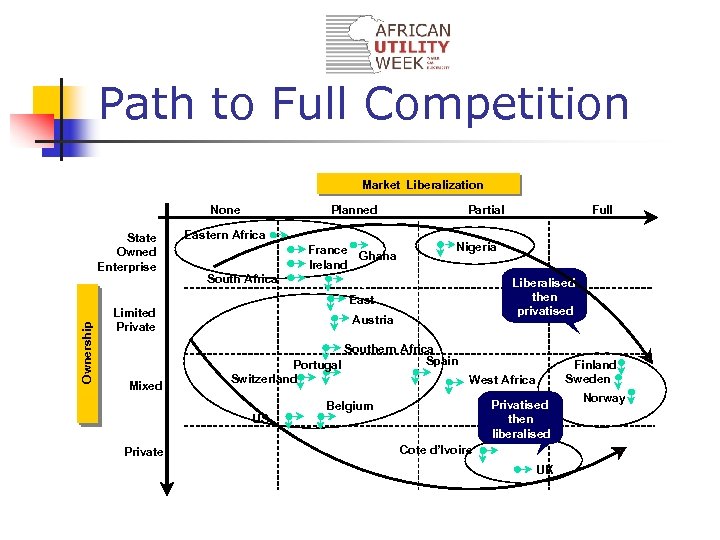 Path to Full Competition Market Liberalisation Market Liberalization None Ownership State Owned Enterprise Planned Eastern Africa France Ghana Ireland Italy South Africa Partial Nigeria Liberalised, then privatised East Limited Private Full Austria Southern Africa Spain Portugal Mixed Switzerland US. Private Finland Sweden West Africa Privatised, then liberalised Belgium Cote d’Ivoire UK Norway
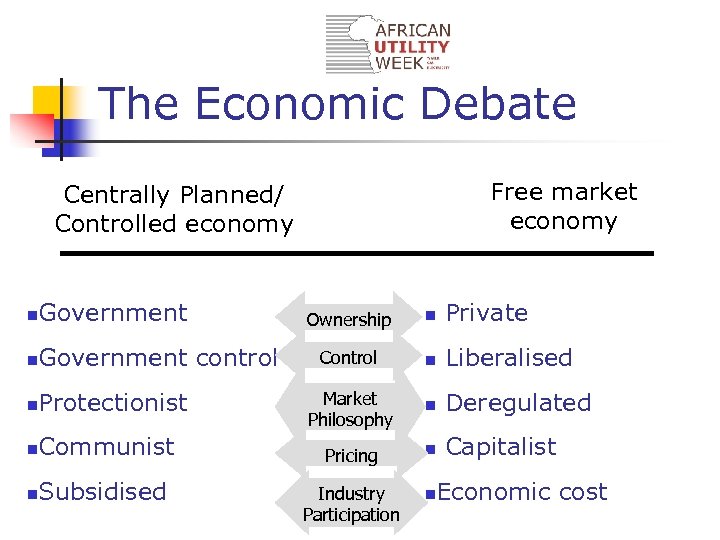 The Economic Debate Free market economy Centrally Planned/ Controlled economy n Government control n Protectionist n Communist n Subsidised Ownership n Private Control n Liberalised Market Philosophy n Deregulated Pricing n Capitalist Industry Participation n Economic cost
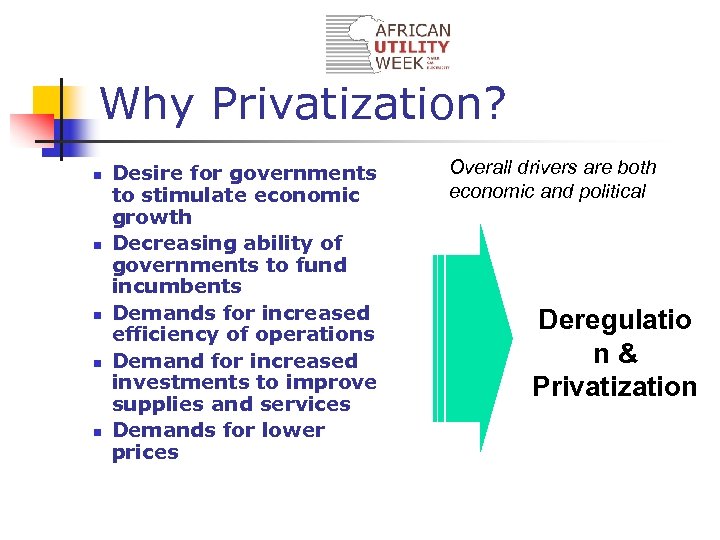 Why Privatization? n n n Desire for governments to stimulate economic growth Decreasing ability of governments to fund incumbents Demands for increased efficiency of operations Demand for increased investments to improve supplies and services Demands for lower prices Overall drivers are both economic and political Deregulatio n& Privatization
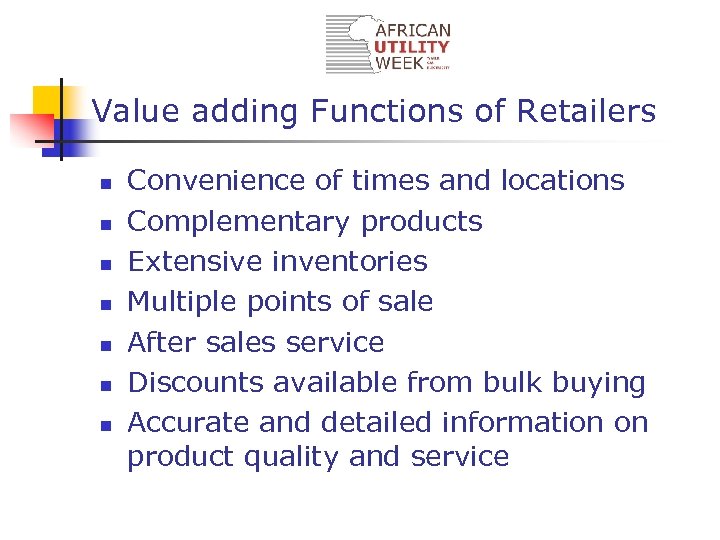 Value adding Functions of Retailers n n n n Convenience of times and locations Complementary products Extensive inventories Multiple points of sale After sales service Discounts available from bulk buying Accurate and detailed information on product quality and service
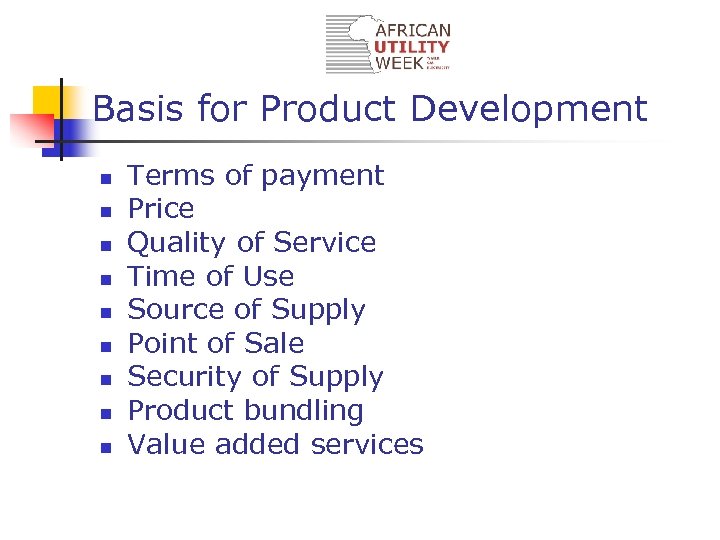 Basis for Product Development n n n n n Terms of payment Price Quality of Service Time of Use Source of Supply Point of Sale Security of Supply Product bundling Value added services
 Retail Competition Challenges n n n Inadequate metering Cost of metering Inadequate load profiles Load profiling rules Product Commoditisation Tariffs
 Social Value of Competition n n Efficient price formation Transparency in pricing determination e. g n n n Time of Use Duration of contract, etc Informed decision making n n n Better customers choice Better supplier offers Choice of plants
 Learning Curve for Utilities n n n Uniform fixed price Time of day, Time of year Interruptible prices Pool prices Hedging contracts Load contracts – Base load, peaking load Contract durations – monthly, yearly, multiyear Portfolio mix Contract Risks Competitive positioning strategies Business policies Market share
 Learning Curve for Customers n n n Total demand Aggregated demand Load factors Seasonal variations Load management scope Supplier offers
 Learning Curve for Wholesalers n n Risks Pool price hedge Nature of contract Duration of contract
 Improved Customer Service n n n n Affinity Deals Loyalty Deals Efficiency tariffs New freezer/fridge trade-in offers Online services Combined billing Insurance offers
 Customer Benefits n n Lower prices for interruptible contracts Billing flexibility n n Fixed price per month n n monthly, quarterly, etc Itemized site-by-site or aggregated bill Usage analysis for energy audits Dependent on size of family, type of house, etc Tariffs for disadvantaged people n E. g. elderly people, less affluent people, Rural customers, students
 Social Benefits Improved price responsiveness n Greater durations of forward contracting n n n Reduces supplier risk, improves stability of supply, reduces price Increased supplier competition n More innovations in supplier offers, greater willingness to take exposed positions, design of new contract forms, willingness to incorporate non-price elements, willingness to seek out new trading partners e. g. embedded generators, distributed generators, entry encouragement for new and efficient suppliers
 Other Benefits n Growth of financial intermediaries n n Brokers who take financial risks, arbitrage positions, deal packaging Transmission and Distribution efficiencies n n Stimulation of distributed generation, onsite generation, construction of more local connections bypassing local network, newer investments in distribution Improved cost allocations
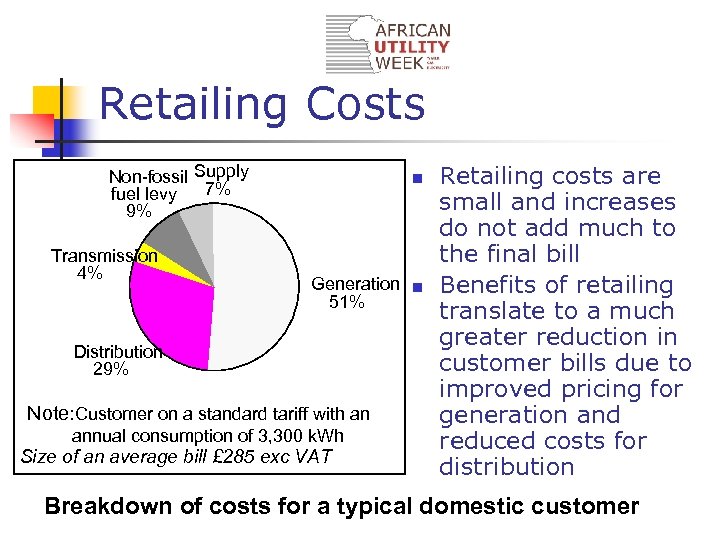 Retailing Costs Non-fossil Supply 7% fuel levy 9% Transmission 4% n Generation n 51% Distribution 29% Note: Customer on a standard tariff with an annual consumption of 3, 300 k. Wh Size of an average bill £ 285 exc VAT Retailing costs are small and increases do not add much to the final bill Benefits of retailing translate to a much greater reduction in customer bills due to improved pricing for generation and reduced costs for distribution Breakdown of costs for a typical domestic customer
 Retailing Costs n n n Advertising Promotion Marketing Half hourly meters Load profiling systems Energy Settlement systems
 Recommendations n Continuously review price control mechanisms n n Deregulation does not mean non. Regulation Promote Competition n Competition leads to improved price discovery
 References n n Beesley, Michael E. 1997. Privatization, Regulation and Deregulation, London and New York: Routledge, second edition (first edition 1992). Beesley, Michael E, and Littlechild, Stephen C. 1989. “The regulation of privatized monopolies in the United Kingdom”, RAND Journal of Economics, Vol. 20, No 3, Autumn, pp. 454 – 72. Goulding, A J, Ruffin, Carlos and Swinand, Gregory. 1999. “The Role of Vibrant Retail Electricity Markets in Assuring that Wholesale Power Markets Operate Effectively”, The Electricity Journal, Vol. 12, No. 10 (December): 61 -73. Hayek, F A. 1948. “The Meaning of Competition”, chapter V in Individualism and Economic Order, Chicago: The University of Chicago Press.