 Скачать презентацию Customer Retention Financed by Supported by Implemented in
a01cfff50a27458cd304e8bef07e2503.ppt
- Количество слайдов: 34



Customer Retention Financed by Supported by Implemented in cooperation with
Customer Retention of profitable customers is crucial to business. However, due to competition and internal / external environmental factors, achieving this goal is difficult. One method that is proving successful for customer retention is the use of CRM programs. Financed by Supported by Implemented in cooperation with
Customer Relationship Management (CRM) is a crossfunctional process for achieving: Financed by a. Continuing dialog with customers across all contact and access points b. Personalized service to the most valuable customers c. Increased customer retention d. Continued marketing effectiveness Supported by Implemented in cooperation with
CRM Technology CRM programs are software systems that capture information and integrate sales, marketing and customer service information. CRM programs can gather information from many sources including email, call centers, service and sales reps. The information is available to the right people in the organization in real time. Financed by Supported by Implemented in cooperation with
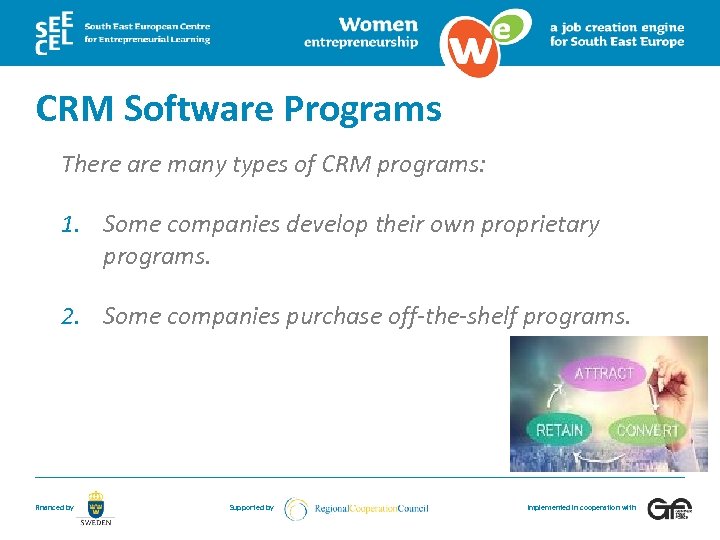
CRM Software Programs There are many types of CRM programs: 1. Some companies develop their own proprietary programs. 2. Some companies purchase off-the-shelf programs. Financed by Supported by Implemented in cooperation with
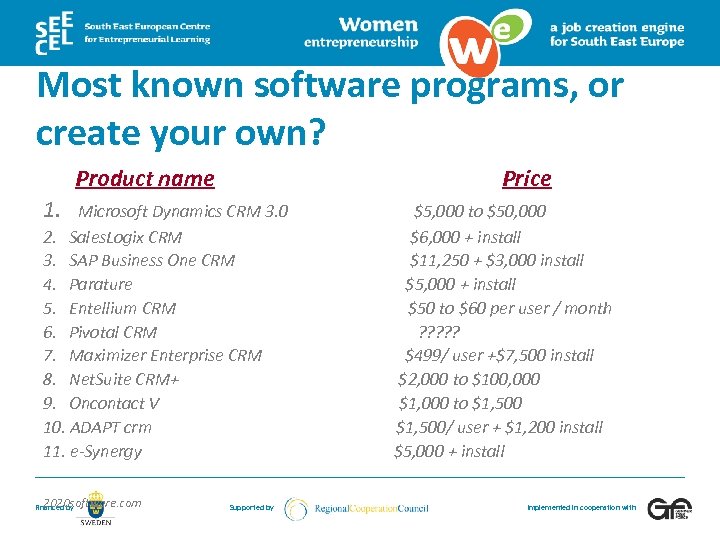
Most known software programs, or create your own? Product name Price 1. Microsoft Dynamics CRM 3. 0 2. Sales. Logix CRM 3. SAP Business One CRM 4. Parature 5. Entellium CRM 6. Pivotal CRM 7. Maximizer Enterprise CRM 8. Net. Suite CRM+ 9. Oncontact V 10. ADAPT crm 11. e-Synergy 2020 software. com Financed by Supported by $5, 000 to $50, 000 $6, 000 + install $11, 250 + $3, 000 install $5, 000 + install $50 to $60 per user / month ? ? ? $499/ user +$7, 500 install $2, 000 to $100, 000 $1, 000 to $1, 500/ user + $1, 200 install $5, 000 + install Implemented in cooperation with
Responsive Strategies A CRM program cannot help unless a company employs the proper strategy to secure and retain profitable customers. Special attention must be given to five areas. Financed by Supported by Implemented in cooperation with
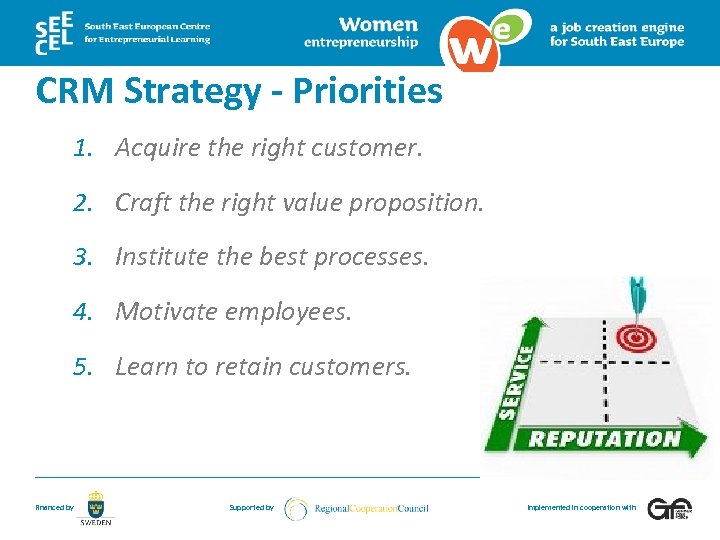
CRM Strategy - Priorities 1. Acquire the right customer. 2. Craft the right value proposition. 3. Institute the best processes. 4. Motivate employees. 5. Learn to retain customers. Financed by Supported by Implemented in cooperation with
#1 - Acquiring the Right Customer Account selection demands a clear understanding of: 1. 2. 3. 4. 5. Financed by Seller’s resources Customer’s needs Cost of serving various groups of customers Potential profit opportunities How customers define value and how to meet those expectations Supported by Implemented in cooperation with
What do customers value? Some demand low price Some demand customer service Some demand quick delivery The question is: “Can the seller deliver it profitably? ” Many sellers try to meet all their customer’s needs, and may do so, but fail to do it profitably. Financed by Supported by Implemented in cooperation with
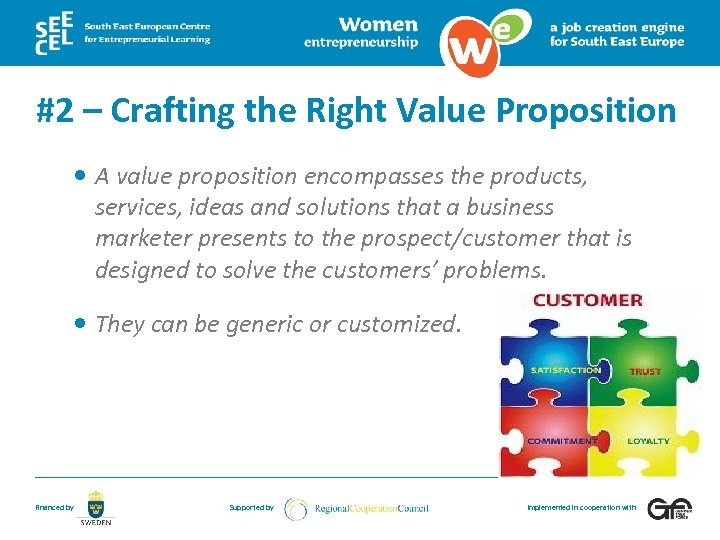
#2 – Crafting the Right Value Proposition A value proposition encompasses the products, services, ideas and solutions that a business marketer presents to the prospect/customer that is designed to solve the customers’ problems. They can be generic or customized. Financed by Supported by Implemented in cooperation with
Value Proposition A value proposition may include: 1. Points of parity to a competitive option 2. Points of difference Best practice suppliers base their value proposition on their target market’s needs by communicating their offering of superior performance in a way that conveys they understand their customer’s business priorities. Financed by Supported by Implemented in cooperation with
Value Proposition Strategies that competitors employ fall into a range referred to as: “Industry Bandwidth of Working Relationships” It ranges from pure transactional to pure collaborative exchanges (see Fig. on the next slide). Financed by Supported by Implemented in cooperation with
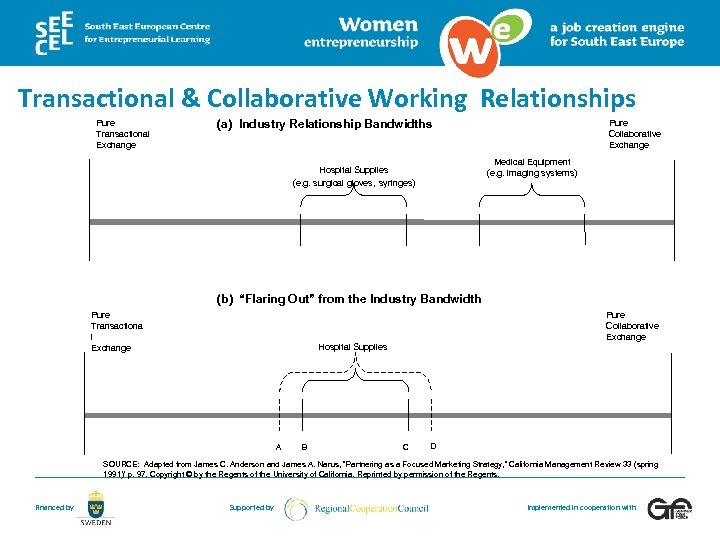
Transactional & Collaborative Working Relationships Pure Transactional Exchange (a) Industry Relationship Bandwidths Pure Collaborative Exchange Medical Equipment (e. g. imaging systems) Hospital Supplies (e. g. surgical gloves, syringes) (b) “Flaring Out” from the Industry Bandwidth Pure Transactiona l Exchange Pure Collaborative Exchange Hospital Supplies A B C D SOURCE: Adapted from James C. Anderson and James A. Narus, “Partnering as a Focused Marketing Strategy, ” California Management Review 33 (spring 1991)’ p. 97. Copyright © by the Regents of the University of California. Reprinted by permission of the Regents. Financed by Supported by Implemented in cooperation with
Flaring Out Strategy ‘Flaring out’ strategy (Fig, b) states that the seller can either unbundle (point A), that is, reduce the service associated with a lower price (transactional in nature), or Augment by adding more services to the core offerings (point D) which adds cost to the services. This is collaborative in nature. Financed by Supported by Implemented in cooperation with
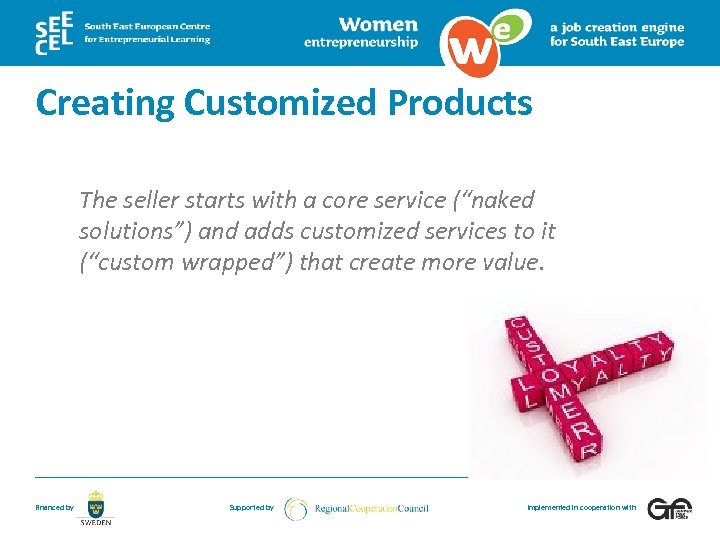
Creating Customized Products The seller starts with a core service (“naked solutions”) and adds customized services to it (“custom wrapped”) that create more value. Financed by Supported by Implemented in cooperation with
Financed by Supported by Implemented in cooperation with
#3 - Institute Best Practices The sales force plays a key role in establishing and growing a customer from a transactional account to a collaborative partnership. They can do this by aligning and deploying technical and service support units to match with their customers’ units. Technical groups can consist of research, logistics and customer service units. Through careful management and screening, transactional accounts can progress to partnerships. Financed by Supported by Implemented in cooperation with
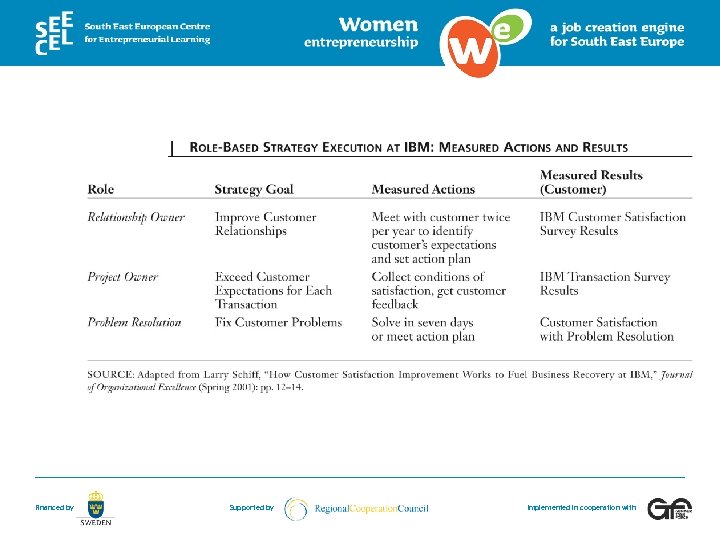
Best Practices Follow-Up • In addition to using best practices, successful organizations (like IBM) employ follow-up techniques such as: 1. Assigning a client representative to take ownership of the relationship. 2. Assigning a Project Owner who completes the project or solves project problems. 3. Developing an in-process feedback and measurement system. Financed by Supported by Implemented in cooperation with
#4 - Motivating Employees Dedicated employees are the key to a successful customer relationship strategy. The best approach is to: 1. Hire good people. 2. Invest in them to increase their value to the company and its customers. 3. Develop challenging careers and align incentives to performance measures. Financed by Supported by Implemented in cooperation with
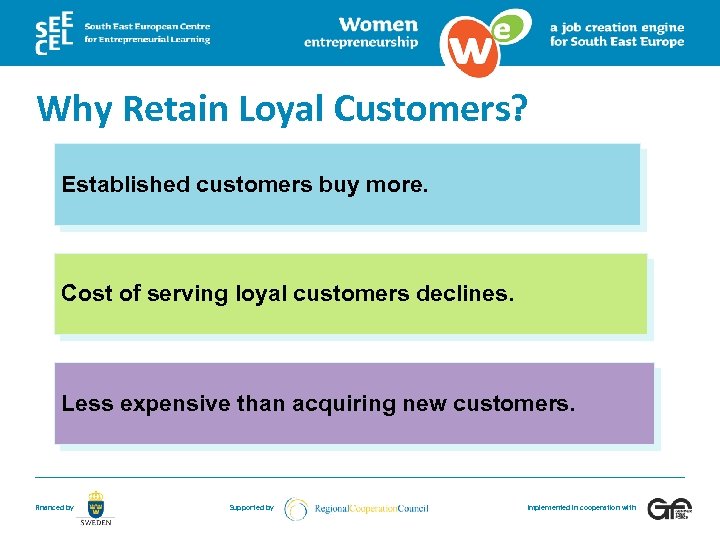
Why Retain Loyal Customers? Established customers buy more. Cost of serving loyal customers declines. Less expensive than acquiring new customers. Financed by Supported by Implemented in cooperation with
#5 - Retaining Customers Retain customers by: Providing superior value (more than expected) to ensure high satisfaction. Nurturing trust. Developing mutual commitment. If possible, helping customers grow their business. Financed by Supported by Implemented in cooperation with
How to Pursue Growth from Existing Customers Identify and cultivate customers that offer the most growth potential by: 1. Estimating current percent “share of wallet” 2. Pursuing opportunities to increase share 3. Projecting and enhancing customer profitability Financed by Supported by Implemented in cooperation with
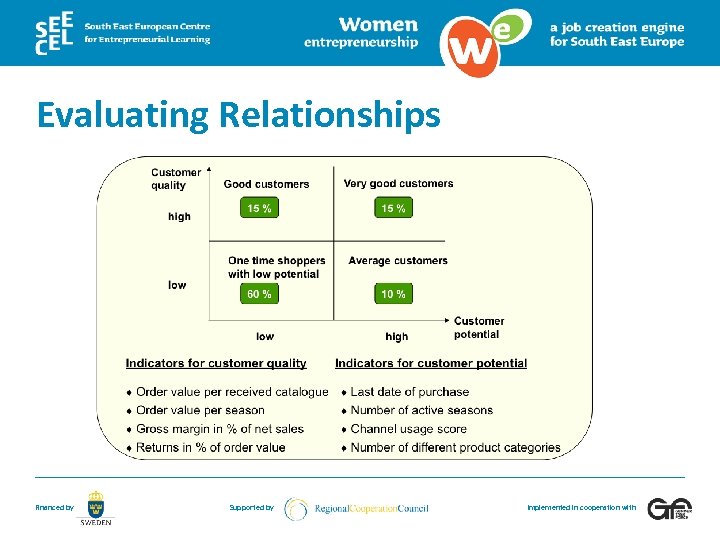
Evaluating Relationships Some relationship-building efforts fail because expectations of the parties don’t mesh. Example: Seller wants a business relationship whereas the customer responds in a transactional mode. By understanding and isolating customer needs, the marketer is better equipped to match their product offerings to a particular customer’s needs. Financed by Supported by Implemented in cooperation with
Evaluating Relationships Financed by Supported by Implemented in cooperation with
Drivers of RM Effectiveness: Definitions • Relationship Quality: High-caliber relational bond characterized by commitment and trust • Relationship Breadth: Number of interpersonal ties that connect the relationship • Relationship Composition: Portfolio of contacts ranging from lowlevel influencers to high-level decision makers • Relationship Strength: The ability of the buyer-seller relationship to withstand stress and/or conflict • Relationship Efficacy: The ability of an inter-firm relationship to achieve desired objectives Financed by Supported by Implemented in cooperation with
RM Programs Social RM Programs Structural RM Programs Financial RM Programs Financed by Supported by Implemented in cooperation with
Social RM Programs Social RM programs: Social engagements (sporting events, meals, etc. ) Frequent and personalized communications that develop bonds Make the relationship special Results: Customers reciprocate with repeat business and referrals Difficult for rivals to duplicate Affect: Has a direct affect on profits & is long lasting Financed by Supported by Implemented in cooperation with

Structural RM Programs Structural RM programs: Provide a service/product to increase productivity and/or efficiency for customers through targeted investment that customers would not make for themselves. For example they provide: Order-processing interfaces Free analysis of operations Results: Creating a structural bond makes it difficult for companies to switch to competitors Financed by Supported by Implemented in cooperation with
Financial RM Programs Financial RM programs provide economic benefits such as: Discounts Free shipping Extended payment terms Results: Companies respond financially to protect customer relationships, but they do not necessarily enhance the relationship because all companies do it. Financed by Supported by Implemented in cooperation with
Targeting RM Programs Some companies are Relationship Oriented (RO), and some are not. RO companies seek to develop relationships with current or potential supplier. RO buyers look for companies that: Offer expertise Are able to be flexible (i. e. , payment terms, R&D, etc. ) Help reduce risk for both parties benefit Help both parties benefit from the relationship Financed by Supported by Implemented in cooperation with
Strategy for Dealing with High and Low RO HIGH RO: Target those with high RO goals since they are looking for and are open to developing relationships LOW RO: For these companies, the strategy is to create high switching cost: Tie them into electronic ordering interfaces Stay in constant contact to keep what exists Align RM resources as closely as possible to the customer’s needs Financed by Supported by Implemented in cooperation with

What do we want to reach? Financed by Supported by Implemented in cooperation with
Useful links http: //www. powershow. com/view/50 Nm. Rk. O/Building_Customer_Loyalty_powerpoint_ppt_presentation http: //www. evergage. com/blog/how-calculate-customer-retention http: //www. inc. com/jeff-haden/best-way-to-calculate-customer-retentionrate. html http: //marketing. about. com/cs/customerservice/a/crmstrategy. htm http: //marketingwizdom. com/strategies/retention-strategies http: //www. inc. com/geoffrey-james/customer-retention-keep-good-customersfrom-leaving. html Drilling Down: Turning Customer Data into Profits with a Spreadsheet Michael W. Lowenstein. Customer Retention: An Integrated Process For Keeping Your Best Customers. Michael W. Lowenstein. Customers Inside, Customers Outside: Designing and Succeeding With Enterprise Customer-Centricity Concepts, Practices, and Applications. 2014 Financed by Supported by Implemented in cooperation with
Скачать презентацию Customer Retention Financed by Supported by Implemented in
a01cfff50a27458cd304e8bef07e2503.ppt