


 Скачать презентацию Customer-Friendly Demand Response Chris King Chief Strategy Officer
c4f0683332b827afad9fbb42ee6b24f8.ppt
- Количество слайдов: 28
 Customer-Friendly Demand Response Chris King Chief Strategy Officer, e. Meter Chair, SVLG Demand Response Subcommittee July 21, 2006
 Who’s e. Meter? Company Background & Qualifications • Founded in Silicon Valley in 1999 by original executive group from Cell. Net – Team pioneered advanced metering infrastructure technology • Develop and sell Advanced Meter Information Systems (AMIS) software 1. Advanced Metering Business Process Management (BPM) 2. Meter Data Management 3. AMI Integration Platform • Experience in all aspects of AMI implementation – AMI technologies, – Software implementation, – Data collection and management, – Deployment & operations, – Business and regulatory strategy Business Focus • Software & professional services • Strategic consulting on AMI issues © e. Meter Corporation 2006 2
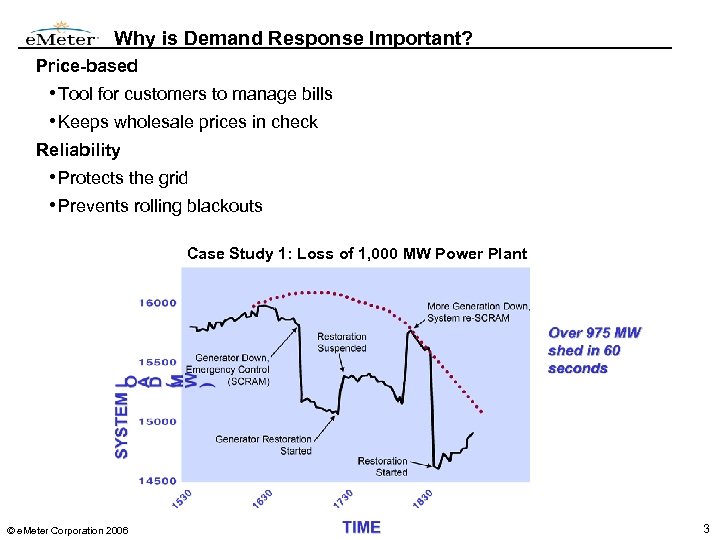 Why is Demand Response Important? Price-based • Tool for customers to manage bills • Keeps wholesale prices in check Reliability • Protects the grid • Prevents rolling blackouts Case Study 1: Loss of 1, 000 MW Power Plant © e. Meter Corporation 2006 3
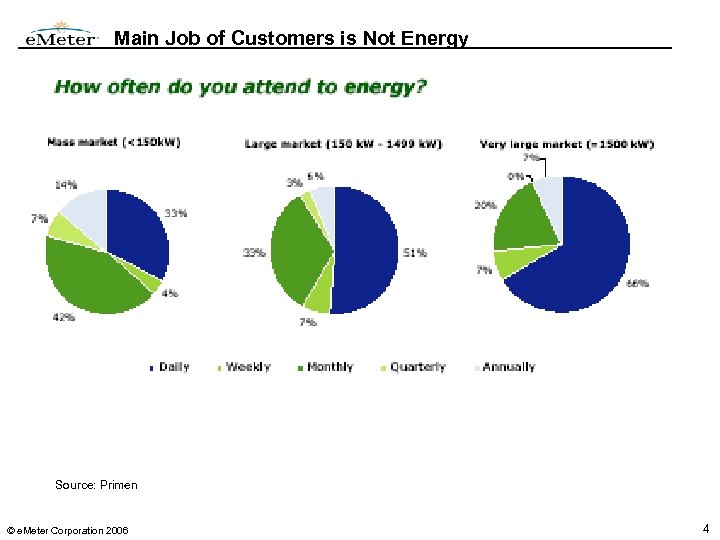 Main Job of Customers is Not Energy Source: Primen © e. Meter Corporation 2006 4
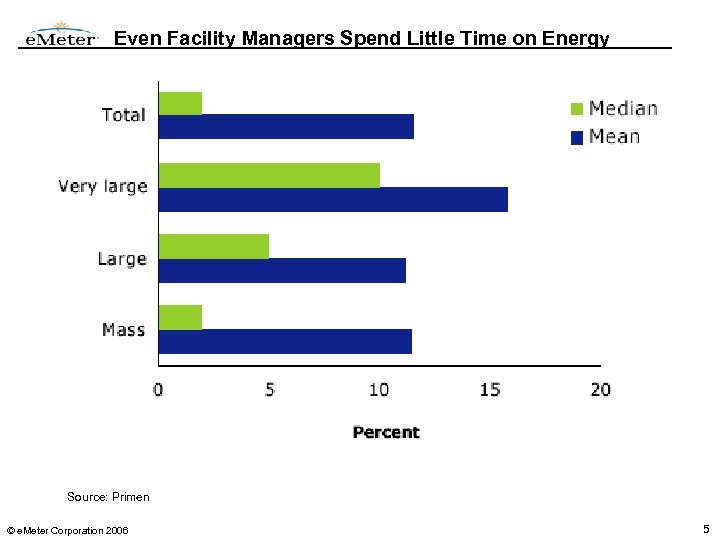 Even Facility Managers Spend Little Time on Energy Source: Primen © e. Meter Corporation 2006 5
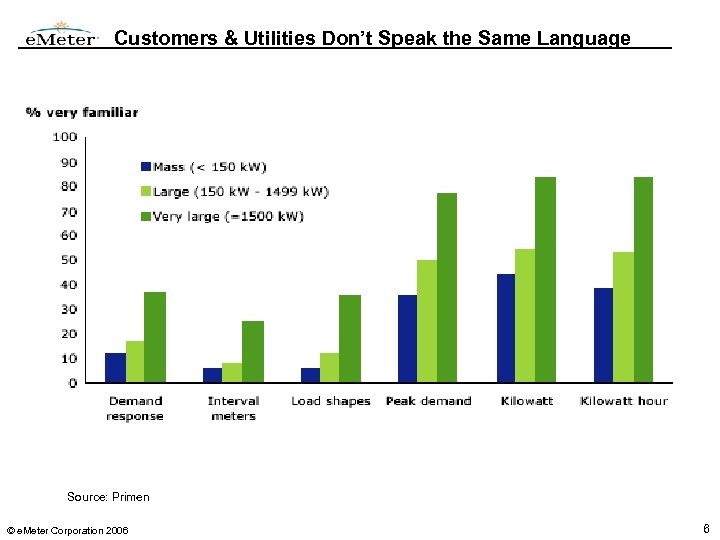 Customers & Utilities Don’t Speak the Same Language Source: Primen © e. Meter Corporation 2006 6
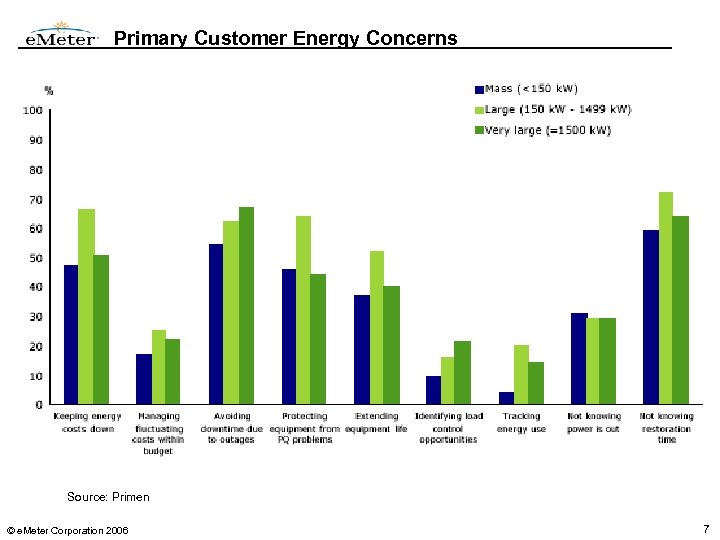 Primary Customer Energy Concerns Source: Primen © e. Meter Corporation 2006 7
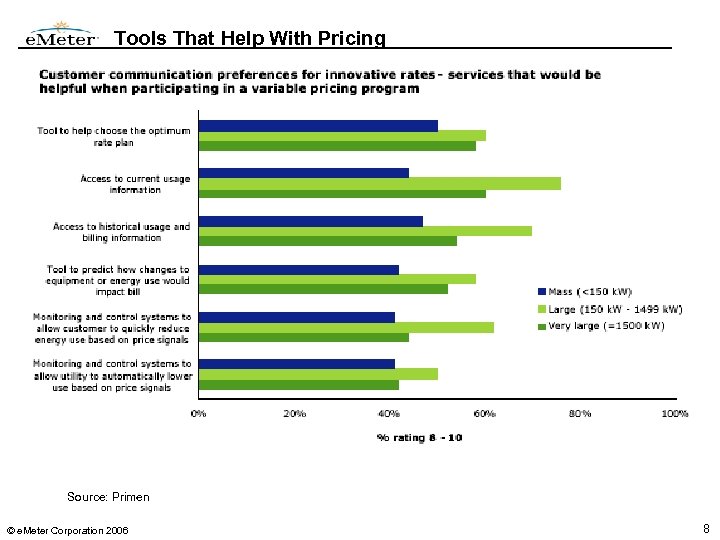 Tools That Help With Pricing Source: Primen © e. Meter Corporation 2006 8
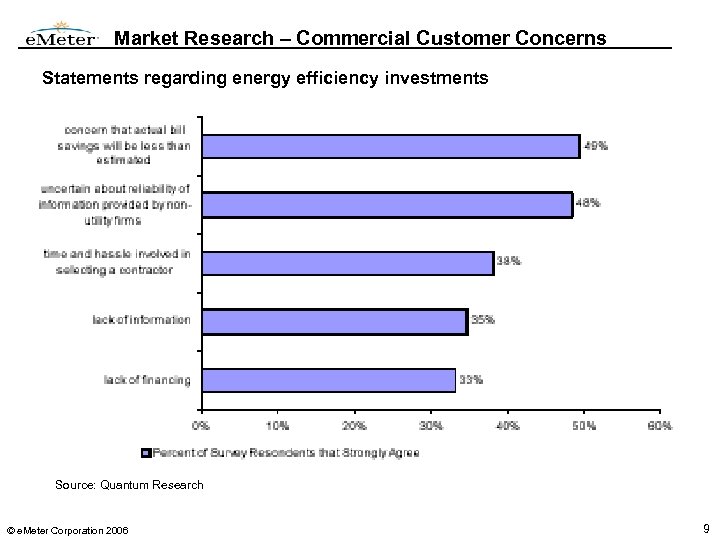 Market Research – Commercial Customer Concerns Statements regarding energy efficiency investments Source: Quantum Research © e. Meter Corporation 2006 9
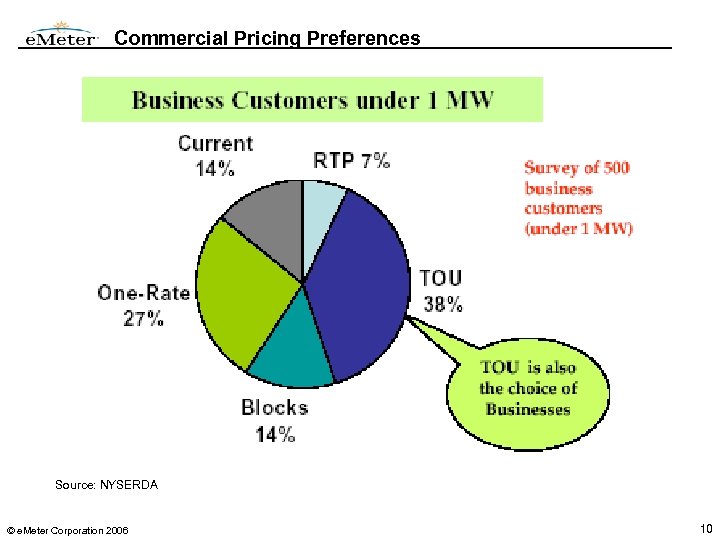 Commercial Pricing Preferences Source: NYSERDA © e. Meter Corporation 2006 10
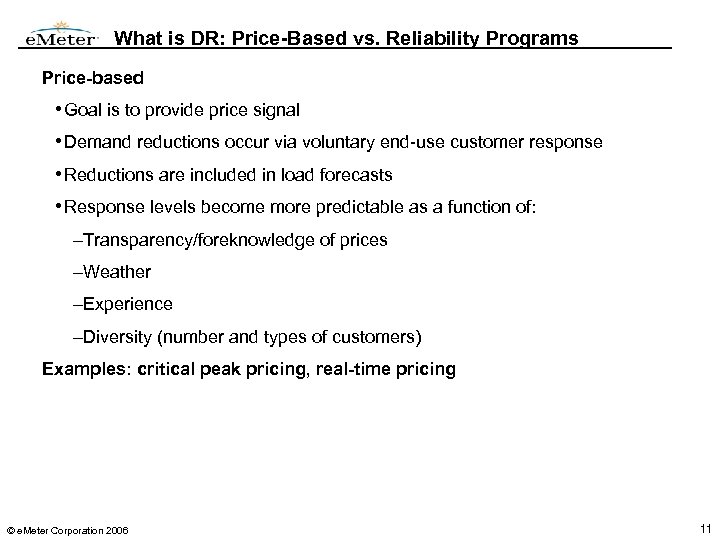 What is DR: Price-Based vs. Reliability Programs Price-based • Goal is to provide price signal • Demand reductions occur via voluntary end-use customer response • Reductions are included in load forecasts • Response levels become more predictable as a function of: –Transparency/foreknowledge of prices –Weather –Experience –Diversity (number and types of customers) Examples: critical peak pricing, real-time pricing © e. Meter Corporation 2006 11
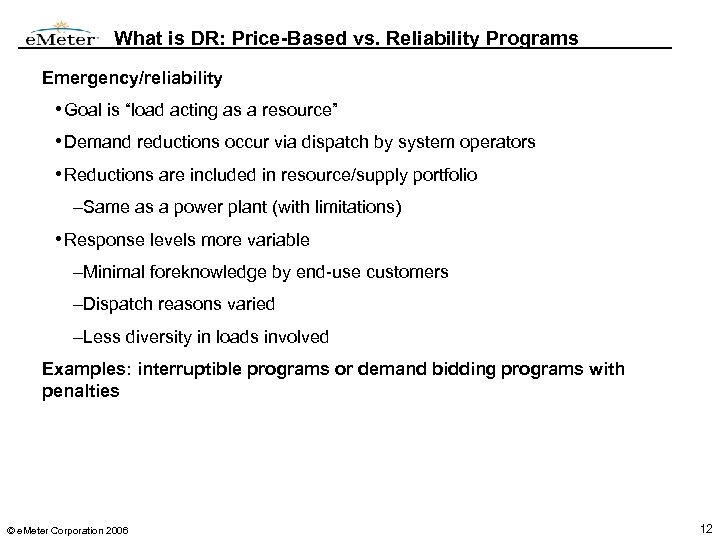 What is DR: Price-Based vs. Reliability Programs Emergency/reliability • Goal is “load acting as a resource” • Demand reductions occur via dispatch by system operators • Reductions are included in resource/supply portfolio –Same as a power plant (with limitations) • Response levels more variable –Minimal foreknowledge by end-use customers –Dispatch reasons varied –Less diversity in loads involved Examples: interruptible programs or demand bidding programs with penalties © e. Meter Corporation 2006 12
 Customer-Friendly Demand Response Principles developed by SLVG (subset) • Voluntary –Default programs must have no penalty for “opting-out” –PUC ruling on critical peak pricing for large commercial customers adopted SVLG’s principle • Easy to participate –Minimize complex forms and procedures –Avoid specific peak reduction targets (e. g. minimum of 100 kilowatts) • Easy to understand –Maintain stable programs over time • Easy to reduce demand –Promote availability of automation technology through incentives and rebates • Good value –Customers should be fairly rewarded for their efforts –The benefits should be maximized relative to the cost © e. Meter Corporation 2006 13
 Case Study 2: CPUC Ruling on Critical Peak Pricing Decision in spring 2006 Requires utilities to implement “default” critical peak pricing for customers above 200 k. W • Decision does not say when • Decision says the rate design will be covered in a “future” rate case –Unlikely to see anything before the summer of 2008 Customer-friendly features • Promoted by SVLG in the proceeding • Adopted in decision Key customer protections • CPP is to be voluntary, meaning customers can opt-out with zero penalty to their current time-of-use rate • Opting out must be very easy – no more than a phone call or email • Customers have bill protection for their first year –Can pay no more on the CPP price than the TOU • Customers must be fully informed as to the likely bill effects © e. Meter Corporation 2006 14
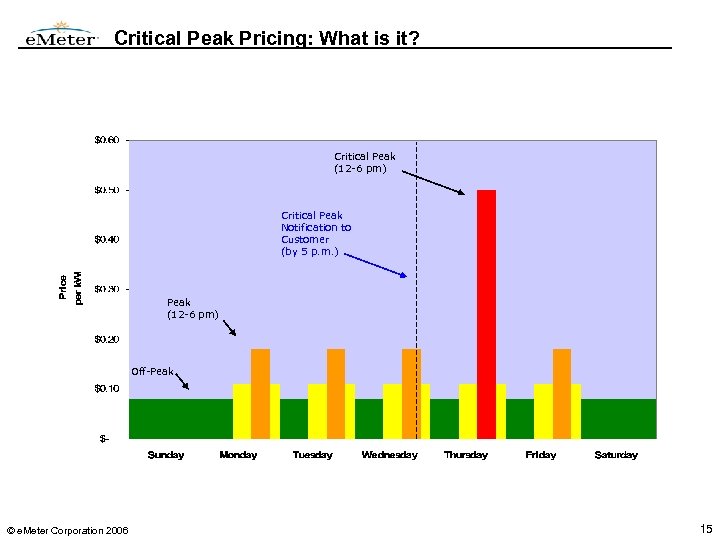 Critical Peak Pricing: What is it? Critical Peak (12 -6 pm) Critical Peak Notification to Customer (by 5 p. m. ) Peak (12 -6 pm) Off-Peak © e. Meter Corporation 2006 15
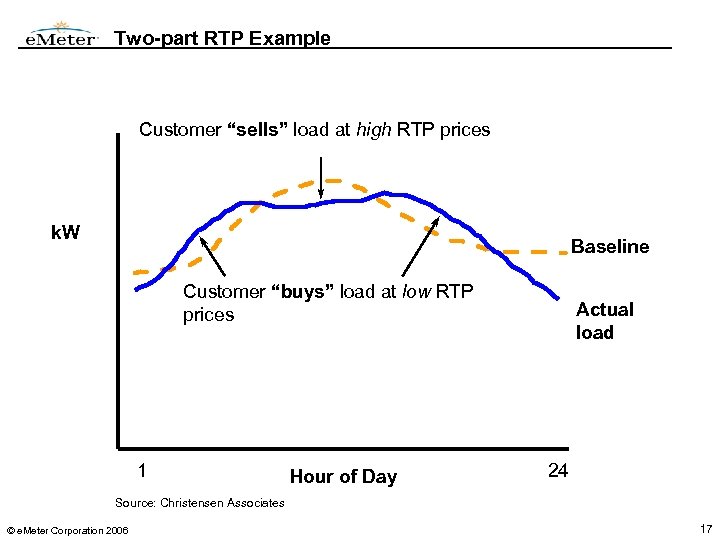
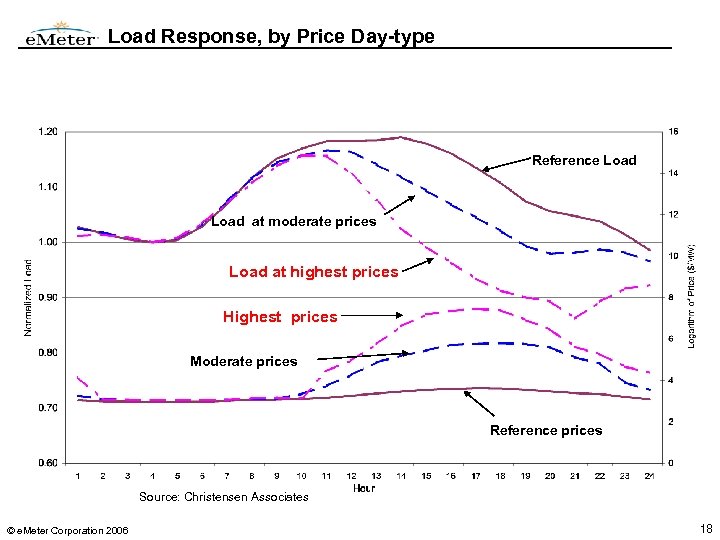
 Case Study 3: Two-Part Real-Time Pricing Georgia Power Company Very high participation • 1, 700 customers (80% of those eligible) • > 5, 000 MW peak load; 500 to 1, 000 MW peak reduction • Voluntary • Day-ahead (75%) and hour-ahead (25%) hourly pricing • Prices based on wholesale market with adjustments Features • Customer pays for baseline level of usage at standard tariff prices • Deviations from baseline – increases or decreases – billed at RTP price © e. Meter Corporation 2006 16
 Two-part RTP Example Customer “sells” load at high RTP prices k. W Baseline Customer “buys” load at low RTP prices 1 Hour of Day Actual load 24 Source: Christensen Associates © e. Meter Corporation 2006 17
 Load Response, by Price Day-type Reference Load at moderate prices Load at highest prices Highest prices Moderate prices Reference prices Source: Christensen Associates © e. Meter Corporation 2006 18
 Price Elasticities: Commercial Office Buildings Elasticity is the amount load is reduced when the on-peak price is doubled Source: Christensen Associates © e. Meter Corporation 2006 19
 Price Response Curve Utility able to predict response accurately based on price level, using historical data Source: Christensen Associates © e. Meter Corporation 2006 20
 Case Study 4: Anaheim Peak Time Rebate Program concept • Identify critical peak days a day in advance based on forecast high temperatures in Anaheim • Notify customers a day in advance via automated telephone and, if desired, email • Customers reduce consumption between noon and 6 p. m. on critical peak days • Reduction is recorded via hourly meters and the data sent back after midnight • Customers receive a rebate of $0. 35 per k. Wh for each k. Wh below their “baseline” usage on the event day (what they normally would have used from noon to 6 p. m. ) Program benefits • Provide customers with choices –Realize bill savings by curtailing peak demand during the top 50 to 100 hours per year (“critical” peaks) • Reduce utility cost to serve –Lower peak capacity needs in the long run once programs are in place, tested, and shown to deliver reliable load reductions © e. Meter Corporation 2006 21
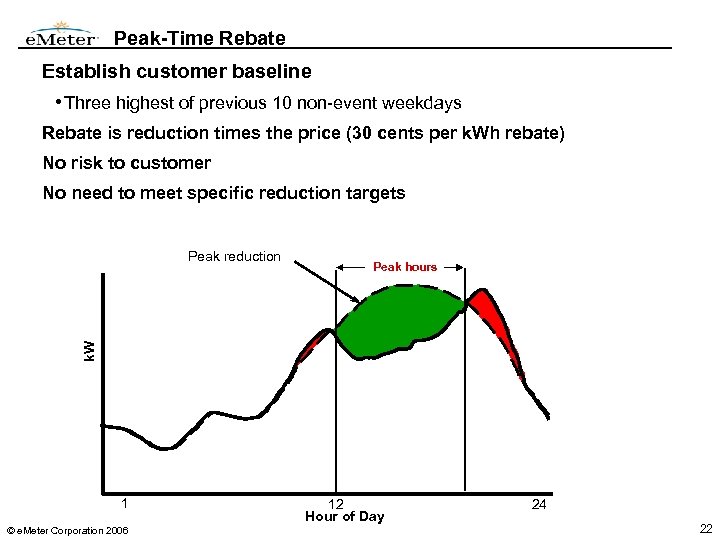 Peak-Time Rebate Establish customer baseline • Three highest of previous 10 non-event weekdays Rebate is reduction times the price (30 cents per k. Wh rebate) No risk to customer No need to meet specific reduction targets Peak hours k. W Peak reduction 1 © e. Meter Corporation 2006 12 Hour of Day 24 22
 Program Operations Experimental sample provided with meters • Sample designed by Professor Frank Wolak of Stanford University Recruitment • Recruitment via direct mail • No incentive payment Customer education • Customers sent fact sheets and a refrigerator magnet • Webpage added to anaheim. net with FAQs and other info • Customer service via 800 number and email enabled Events • 12 events in 2005 • Included both days when California grid had problems Results • 13% peak reduction – same as reduction measured in critical peak price program • SDG&E has proposed rolling this out to all of its small business and residential customers © e. Meter Corporation 2006 23
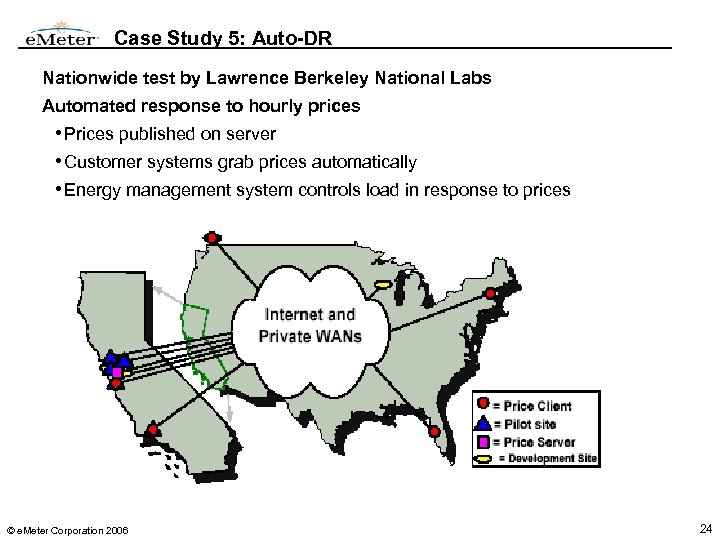 Case Study 5: Auto-DR Nationwide test by Lawrence Berkeley National Labs Automated response to hourly prices • Prices published on server • Customer systems grab prices automatically • Energy management system controls load in response to prices © e. Meter Corporation 2006 24
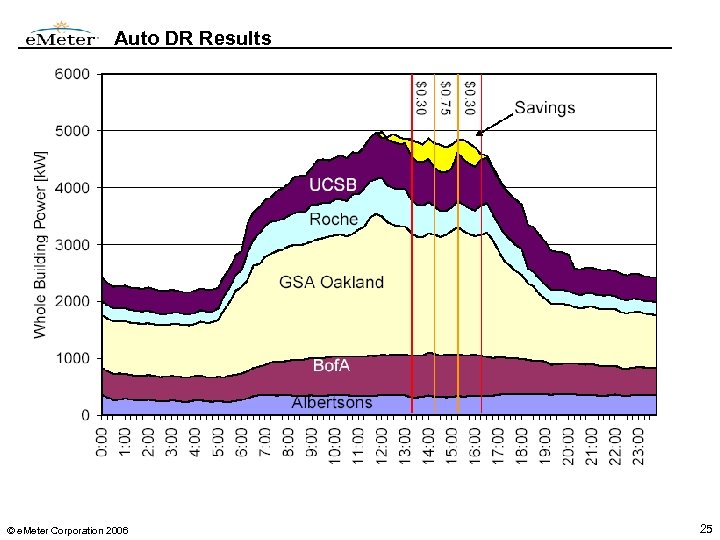 Auto DR Results © e. Meter Corporation 2006 25
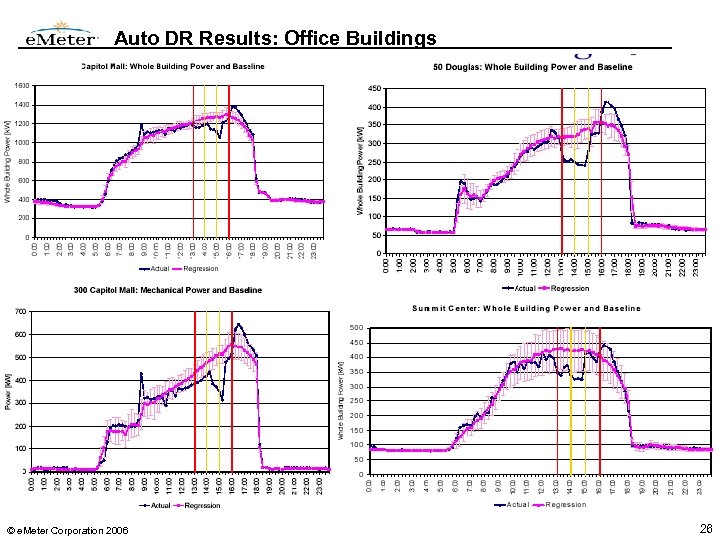 Auto DR Results: Office Buildings © e. Meter Corporation 2006 26
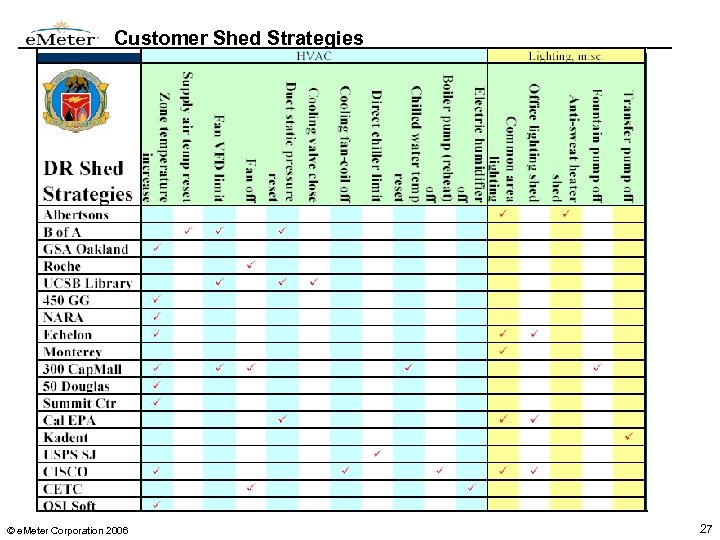 Customer Shed Strategies © e. Meter Corporation 2006 27
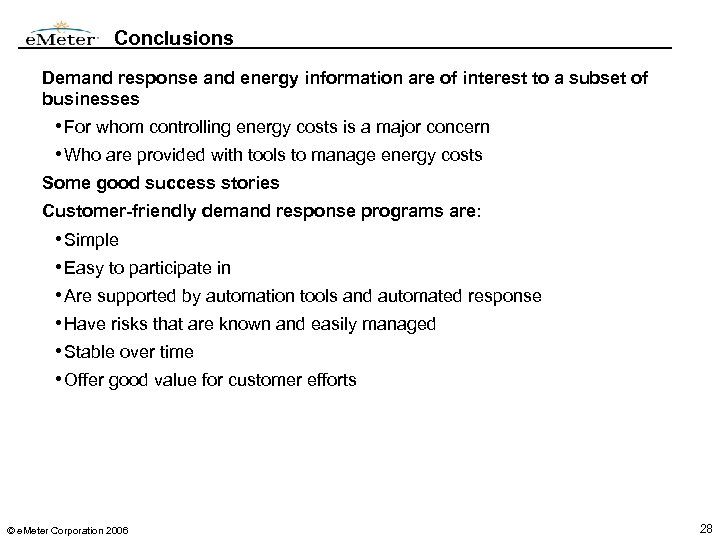 Conclusions Demand response and energy information are of interest to a subset of businesses • For whom controlling energy costs is a major concern • Who are provided with tools to manage energy costs Some good success stories Customer-friendly demand response programs are: • Simple • Easy to participate in • Are supported by automation tools and automated response • Have risks that are known and easily managed • Stable over time • Offer good value for customer efforts © e. Meter Corporation 2006 28