 Скачать презентацию Customer Consumer behaviour and international marketing http
512e7bc31f858cb56f0df0c83599df08.ppt
- Количество слайдов: 25



Customer & Consumer behaviour and international marketing http: //www. youtube. com/watch? v=NA 617 W 6 p. WPQ&feature=related 1
Custmer/Consumer behaviour Customer/Consumer behaviour: • the study of individuals, groups, or organizations and the processes they use to select, secure, use, and dispose of products, services, experiences, or ideas to satisfy needs and the impacts that these processes have on the consumer and society. The Nature of Customer/Consumer Behaviour: • • • External Influences Internal Influences Self-Concept Situations Experiences and acquisitions 2
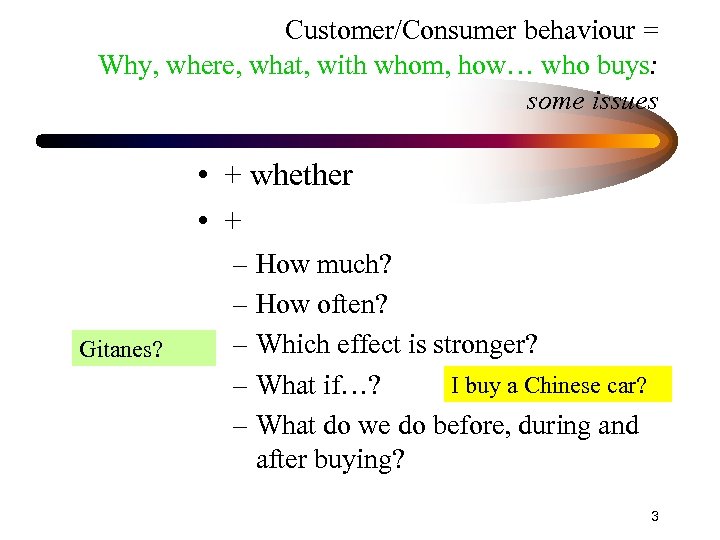
Customer/Consumer behaviour = Why, where, what, with whom, how… who buys: some issues • + whether • + Gitanes? – How much? – How often? – Which effect is stronger? I buy a Chinese car? – What if…? – What do we do before, during and after buying? 3
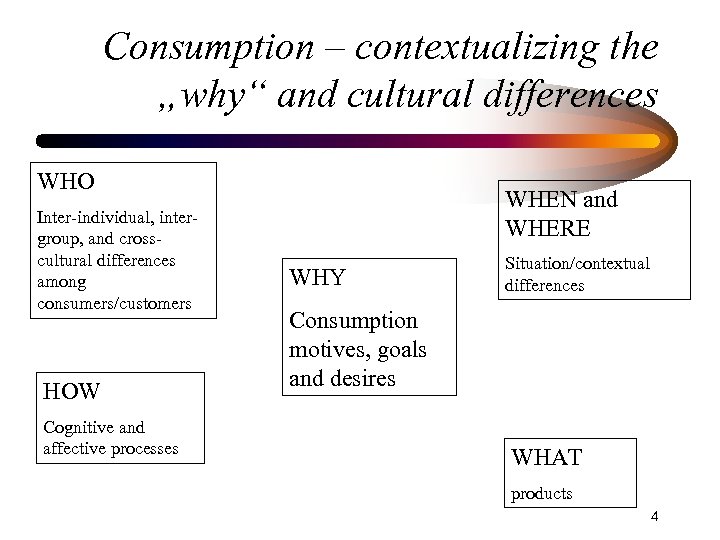
Consumption – contextualizing the „why“ and cultural differences WHO Inter-individual, intergroup, and crosscultural differences among consumers/customers HOW Cognitive and affective processes WHEN and WHERE WHY Situation/contextual differences Consumption motives, goals and desires WHAT products 4
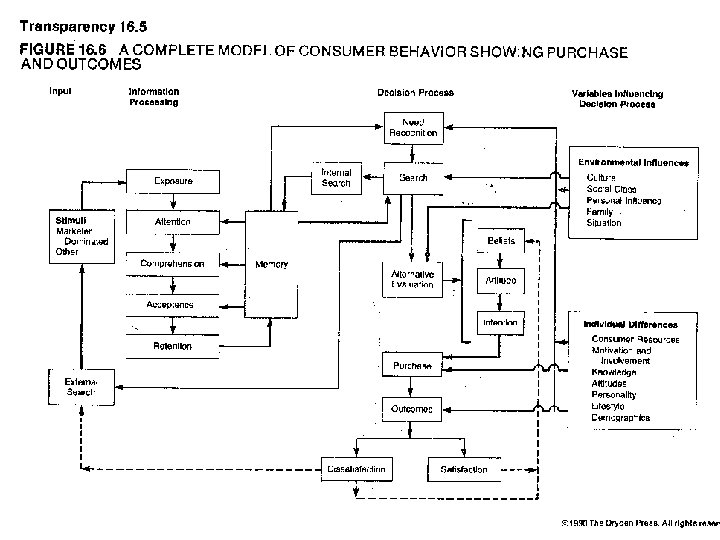
5
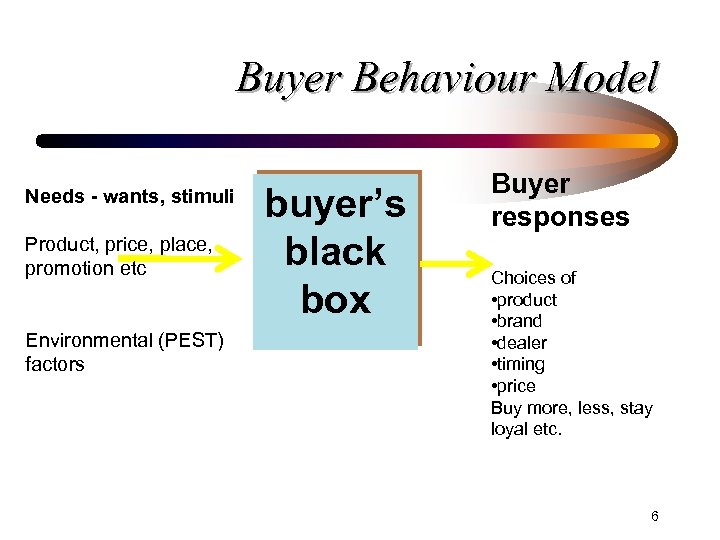
Buyer Behaviour Model Needs - wants, stimuli Product, price, place, promotion etc Environmental (PEST) factors buyer’s black box Buyer responses Choices of • product • brand • dealer • timing • price Buy more, less, stay loyal etc. 6
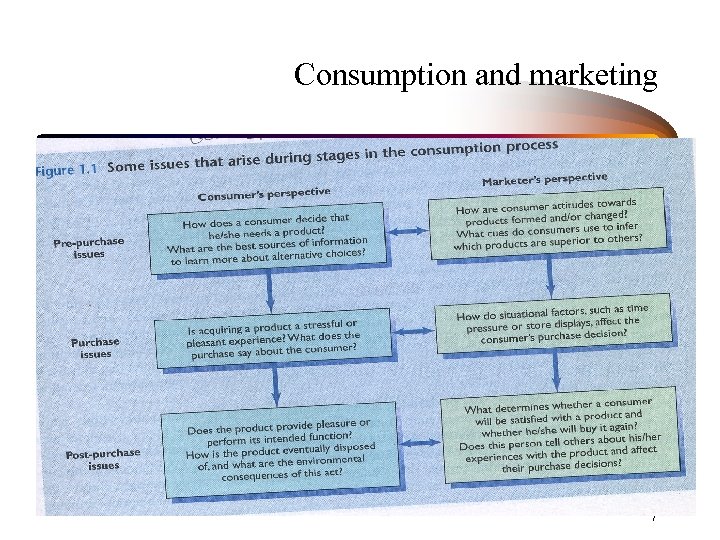
Consumption and marketing 7
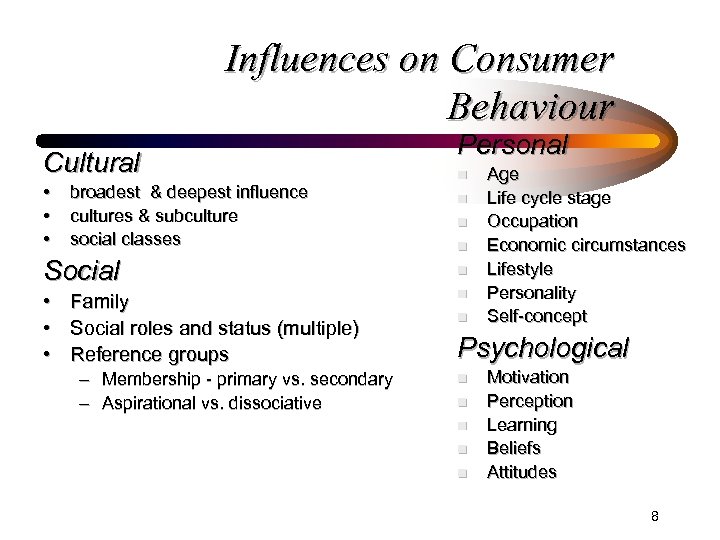
Influences on Consumer Behaviour Cultural • • • broadest & deepest influence cultures & subculture social classes Social • Family • Social roles and status (multiple) • Reference groups – Membership - primary vs. secondary – Aspirational vs. dissociative Personal n n n n Age Life cycle stage Occupation Economic circumstances Lifestyle Personality Self-concept Psychological n n n Motivation Perception Learning Beliefs Attitudes 8
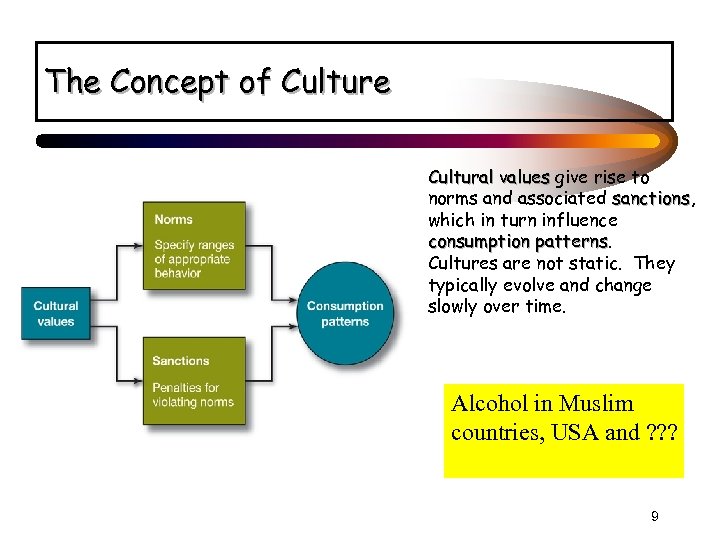
The Concept of Culture Cultural values give rise to norms and associated sanctions, sanctions which in turn influence consumption patterns Cultures are not static. They typically evolve and change slowly over time. Alcohol in Muslim countries, USA and ? ? ? 9
Personal influences Perception • "mind" processes - selection, association, organisation & interpretation. We – only note some things (selective) i. e. what grabs attention + distortion & retention – associate & categorise information into meaningful wholes – interpret/make inferences • information framing e. g. – good news or bad news first ? – accentuate the positives, eliminate the negatives Learning – classical & operant conditioning – cognitive learning • by rote • vicarious (from others) • reasoning • what motivates us • what we believe in – real knowledge, opinion or faith • Our attitudes – relatively consistent evaluations, feelings, tendencies towards something – Three components • • • cognitive (belief), affective (feeling), conative (behavioural) • personality • self-concept, lifestyle & life cycle stages 10
Perceptual, conceptual & related capacities Perceptual - Sensing, measuring, judging – Colour, sound, texture, smell. Interpreting smells, noises, signals – Monitoring sounds, vibrations, data, information – Frames of reference – what is your “vantage point” Conceptual – associating, abstracting, formulating, calculating, inferring – understanding processes in the abstract – deriving ideas & predicting from associated, comparative information – depends on knowledge and know-how (range & level) Made in? – dealing with symbolic information + its associations Relating - Ego + alter-ego oriented: – need for achievement, power, affiliation – sensitivity and empathy, identification and association, objectivesubjective, attitudes and values Physical – Storage, access, processing & transmission capacity, security, privacy 11 11
Lifestyle • Lifestyle = mode of living identified by: – Activities (work, hobbies etc. ) – Interests – Opinions (political, social, etc. ) • Related to personality, but different: – more observable (less deep) – easier to measure • Measured through AIO scales 12
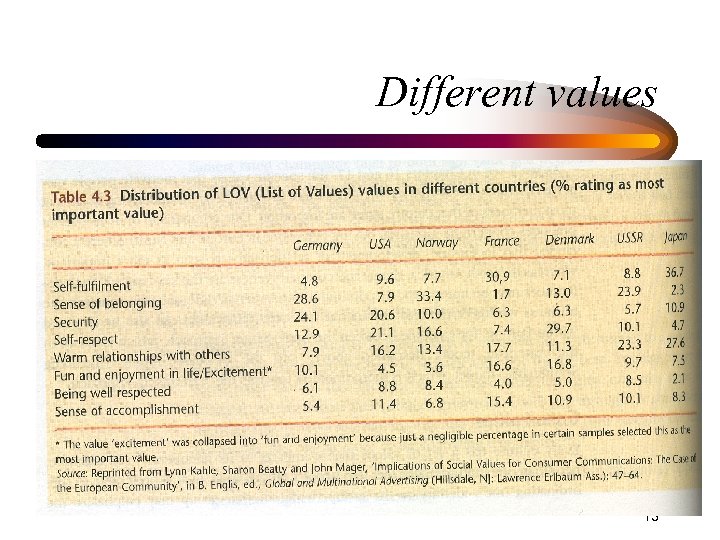
Different values 13
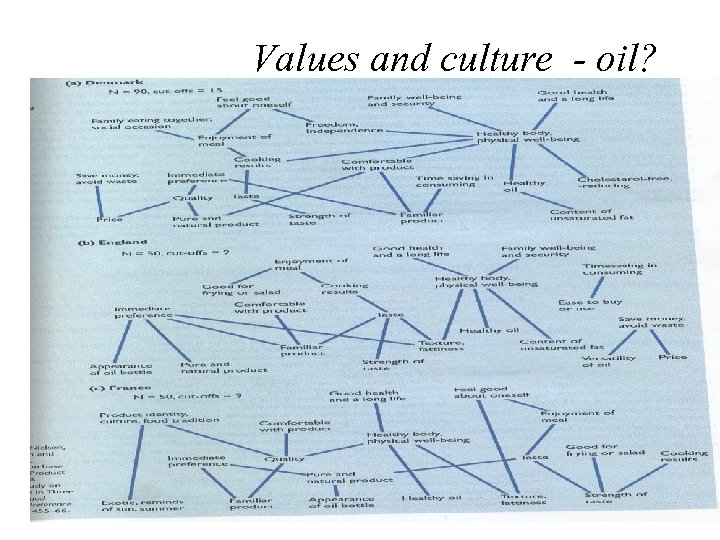
Values and culture - oil? 14
Some factors influencing different Customer/consumer behaviour • • Geography Regulations and rules Migration Employment rate Working part-time Display of wealth and money – egalitarianism Occupational prestige Class structure and social mobility (education, entrepreneurship, income…) • Age 15
And what about cultural dimensions? (Geert Hofstede) • Power distance (equality or inequality in interpersonal interactions? ) – Low power distance (power is equally distributed) West – High power distance (hierarchy is strong) Asia • Uncertainty avoidance (the attitude towards risk in society? ) – Low uncertainty avoidance (calculated risk is necessary) USA – High uncertainty avoidance (risk is threatening & to be avoided) Japan • Individualism versus collectivism (Do people rely on others or themselves? ) – Individualist (self reliance is valued) West – Collectivist (dependence is valued, and society expects individual to subordinate own needs) Asia • Masculinity versus femininity (To what extent and at whose expense should the weaker members of society be cared for? ) – Feminine (caring and nurturing roles are favoured) Scandinavia – Masculine (personal achievement and assertiveness are favoured) Great Britain 16
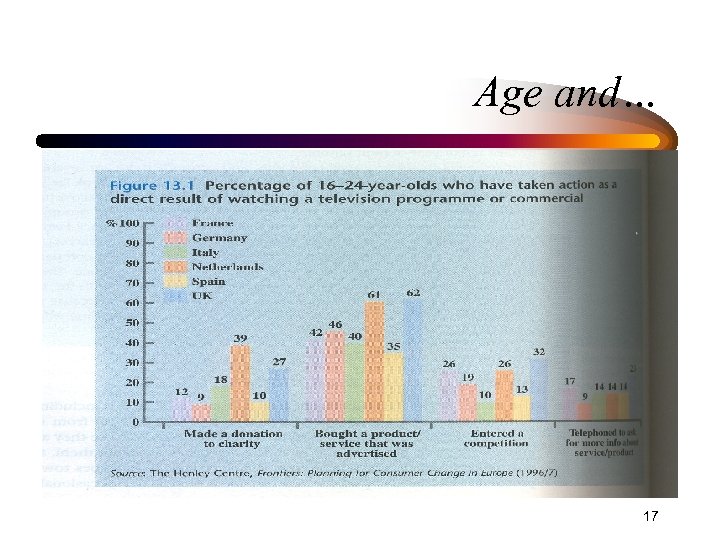
Age and… 17
And what about Hall´s cultural dimensions? • Time • Distance + space • Message Siesta? Bazaar? 18
RITUALS - A typology of ritual experience. . . • cosmological - religious, aesthetic, sacred – places, people, events, items, sacralization – stars • cultural – festivals, holidays (Valentine´s Day…), graduation, wedding, funeral • group - fraternity initiation, business negotiations, gift-giving, New year´s Eve • individual - grooming, household rituals – birthday, eating, Christmas, Halloween… • biological - greeting, mating What Rituals Are • exchange rituals Associated With? ? ? • possession rituals • divestment rituals And selling and shopping rituals? ? ? 19
Buyer Decision Process • • • Problem Recognition Information Search Evaluation of Alternatives Purchase Decision Consumption Postpurchase behaviour • • Consuming as experience Consuming as integration Consuming as classification Consuming as play The Czechs and sushi? The meaning of consumption? Relationship with a product: -self-concept attachment – helps to establish the user´s identity - nostalgic attachment – serves as a link with a past self - interdependence – part of the user´s daily routine -love – elicits bonds of warmth, passion or other strong emotion 20
Buying roles and opinion formers BUYING ROLES • • • Initiator Influencer Decider Buyer User OPINION FORMERS • Trendsetters – influential people in a group who • purchase new products early • serve as information sources for others • The Media • Sellers & Marketers – TV, newspapers, magazines, Internet communication – commentators – the media need "stories" – "seeding" the media. Pay media producers for product placement in "publication channels" – From a Fashion house to Primark – Advertising, promotions & incentives – Word-of-mouth - viral 21
Opinion formers • Trendsetters – influential people in a group who • purchase new products early • serve as information sources for others • The Media – TV, newspapers, magazines, Internet communication – commentators – the media need "stories" • Sellers & Marketers – "seeding" the media. Pay media producers for product placement in "publication channels" – From a Fashion house to Primark – Advertising, promotions & incentives – Word-of-mouth - viral 22 22
Buyer decisions • • • Product Choice Brand Choice Dealer Choice Purchase Timing Purchase Amount 23
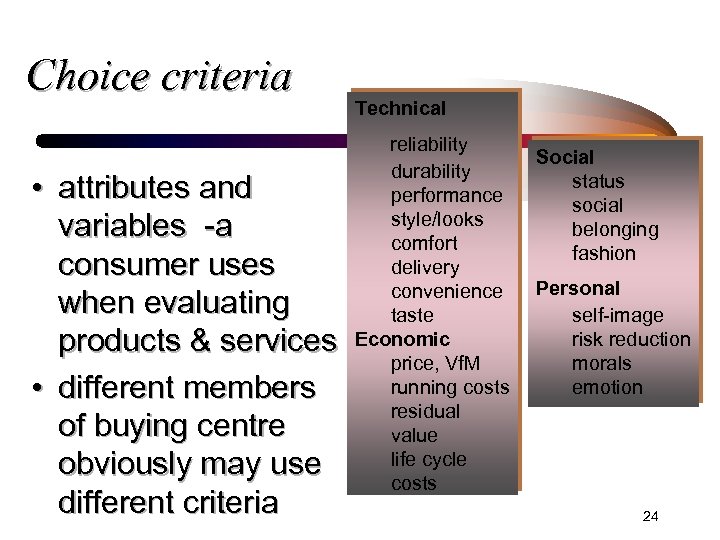
Choice criteria • attributes and variables -a consumer uses when evaluating products & services • different members of buying centre obviously may use different criteria Technical reliability durability performance style/looks comfort delivery convenience taste Economic price, Vf. M running costs residual value life cycle costs Social status social belonging fashion Personal self-image risk reduction morals emotion 24
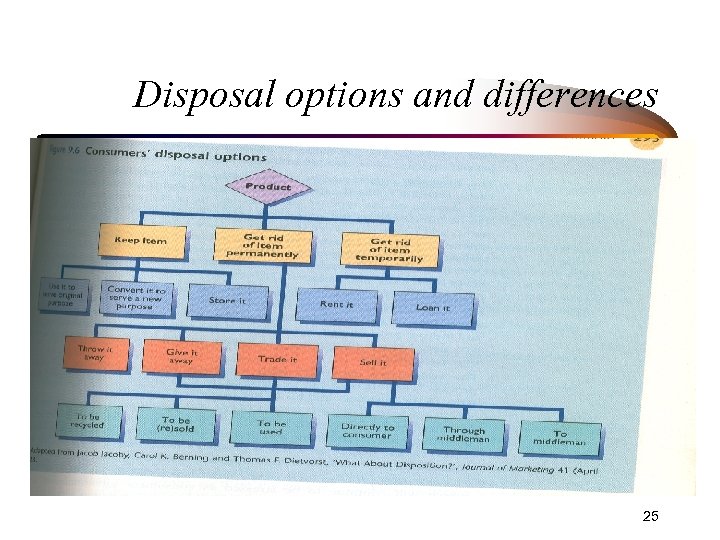
Disposal options and differences 25
Скачать презентацию Customer Consumer behaviour and international marketing http
512e7bc31f858cb56f0df0c83599df08.ppt