 Скачать презентацию CUSTOMARY USE William D Brinton Rogers Towers P
b999fe837ea37d1e49f86a3e73ea6bc6.ppt
- Количество слайдов: 31




CUSTOMARY USE William D. Brinton Rogers Towers, P. A. 1301 Riverplace Blvd. , Ste. 1500 Jacksonville, Florida 32207 wbrinton@rtlaw. com
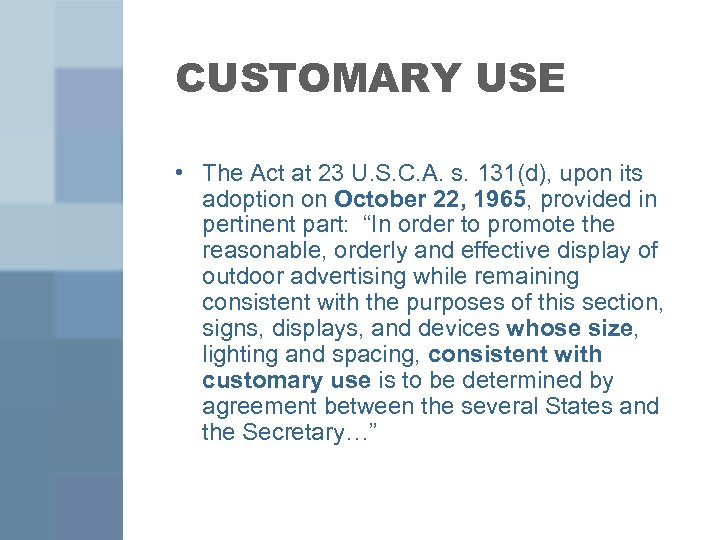
CUSTOMARY USE • The Act at 23 U. S. C. A. s. 131(d), upon its adoption on October 22, 1965, provided in pertinent part: “In order to promote the reasonable, orderly and effective display of outdoor advertising while remaining consistent with the purposes of this section, signs, displays, and devices whose size, lighting and spacing, consistent with customary use is to be determined by agreement between the several States and the Secretary…”
CUSTOMARY USE • On October 7, 1965, during consideration of the HBA legislation that would be signed into law 15 days later, Rep. Tuten of Georgia offered the amendment that added the language, “consistent with customary use, ” to subsection (d) of the proposed Act.
CUSTOMARY USE • The supporters of the amendment pointed to the language of a letter from Commerce Secretary Connor, stating the following: “It is the intention of the administration that the regulations, insofar as they are consistent with the purpose of this act, shall be helpful to the outdoor advertising industry and that, for instance, standards of size which may be adopted would be insofar as possible, consistent with the standard size billboards in customary use. ”
CUSTOMARY USE • Rep. Tuten stated, “If we intend to conform to “customary use”— these are the Secretary’s words— let us word the bill accordingly. ” The Tuten amendment was narrowly adopted upon a vote of 122 -112, and the House passed the legislation the same day. The Highway Beautification Act was enacted into law on October 22, 1965.
CUSTOMARY USE • On January 28, 1966, just 14 weeks after the October 22, 1965 enactment of the HBA, the Bureau of Public Roads published in the Federal Register a “draft standard” for maximum size. The draft maximum sign size was 300 -sf, with an increase in the maximum sign size to 400 -sf if the sign was located more than 150 -feet from the right-ofway.
CUSTOMARY USE • Beginning March 1, 1966 and continuing through May 3, 1966 (over the course of 9 weeks), a total of 52 public hearings were held in the 50 states, Puerto Rico and the District of Columbia. The purpose was to gather information on which to base standards, criteria, and rules and regulations. These hearings began less than five months after the enactment of the HBA and after the initial draft standard had been published. These extensive hearings were part of a process to determine what was customary use.
CUSTOMARY USE • On January 10, 1967, after considering the information from the hearings, the Department of Commerce presented recommended draft standards in a formal report to Congress. The draft standards proposed a maximum size of 650 -sf. This was an increase from the initial recommendation of 400 -sf.
CUSTOMARY USE • In a January 25, 1967 letter to Senator Jennings Randolph, the Acting Under Secretary for Transportation Lowell Bridwell stated, “The proposed standards were developed after hearings had been held in all states [March 1 -May 3, 1966], and represent the national findings. Each State had representatives at its hearing and has been furnished a complete copy of the proceedings. The opportunity is available to the individual State to show any differences between the State and National ‘customary use’ and other aspects. ”
CUSTOMARY USE • On April 5 -6, 12 -13, 18 -20, and May 2 -3, 1967, hearings were held in the Subcommittee on Roads, Committee on Public Works, in the U. S. House of Representatives. • On June 28 -29, and July 18 -20, 1967, hearings were held in the Subcommittee on Roads, Committee on Public Works, in the U. S. Senate.
CUSTOMARY USE • On the issue of “customary use, ” the testimony on May 2, 1967 in the House Subcommittee on Roads was the most informative. It was quite plain in the testimony that the reference to “customary use” in the 1965 Act referred to what was customary then, and not a use that might become customary three years, five years or seven years later.
CUSTOMARY USE • In the Subcommittee Hearing on May 2, 1967, the Federal Highway Administrator Lowell K. Bridwell and Secretary Alan Boyd testified in a hearing on H. R. 7797 about “customary use” and had several exchanges with Congressman Jim Wright:
CUSTOMARY USE • Mr. WRIGHT…I would direct your attention, the law clearly says customary use. Whether that is right or wrong I do not attempt to say, but I do believe I can say to you with some authority that in the absence on the floor of the House of subsection (d), this Highway Beautification Act of 1965 would not have passed the House. That is my opinion. • Secretary BOYD. I believe you, too. • Mr. WRIGHT. Therefore, in fairness to our colleagues on the floor of the House, who considered and voted for the adoption of subsection (d), I think it must be carried out.
CUSTOMARY USE • Secretary BOYD. Well, as I get it, the import of your statement is that subsection (d) means that whatever is in place now stays in place and that this act has no validity whatsoever. • Mr. WRIGHT. Absolutely not. No. It does not mean that at all, that everything has to stay in place. But that which is standard practice, that which is customary use would be allowed to be erected and maintained. Now, there was some discussion on the floor of the House as to what customary use means. I think that it means that it is customarily used. Now, those billboards that are grotesquely out of size, those that are hideously crowded together in an atypical or uncustomary fashion should be subject to the control of these standards; but those that follow the standards of customary use under the law may be erected and maintained.
CUSTOMARY USE • Mr. BRIDWELL. Mr. Wright, may I attempt to make a couple of points here and hopefully shed a little light? As I am sure you are aware, I did follow quite closely the development of this legislation when it passed and the consideration of the amendments on the floor. “Customary use, ” as you are aware, came from a letter which Secretary Connor addressed to this committee, and in that letter —and I know because I drafted it—the attempt was made to use the words “customary use” to illustrate the point of size of signs.
![CUSTOMARY USE • [Mr. BRIDWELL]. In the debate on the floor when Mr. Tuten](https://present5.com/presentation/b999fe837ea37d1e49f86a3e73ea6bc6/image-19.jpg "CUSTOMARY USE • [Mr. BRIDWELL]. In the debate on the floor when Mr. Tuten")
CUSTOMARY USE • [Mr. BRIDWELL]. In the debate on the floor when Mr. Tuten offered the amendment [offered and passed 122 -112 on October 7, 1965 adding the words, “consistent with customary use”], this question was specifically raised, “Does this refer only to size? ” Because the text of the letter from Secretary Connor was read. And Mr. Tuten specifically stated that, no, he was not referring only to size, that he meant it to cover size, spacing, and lighting. So I do not think there has ever been any question on our part or the part of anyone else that we were referring to customary use involving size, spacing, and lighting within zoned and unzoned commercial and industrial areas.
![CUSTOMARY USE • [Mr. BRIDWELL]. Now, we received a lot of testimony [Mary 1](https://present5.com/presentation/b999fe837ea37d1e49f86a3e73ea6bc6/image-20.jpg "CUSTOMARY USE • [Mr. BRIDWELL]. Now, we received a lot of testimony [Mary 1")
CUSTOMARY USE • [Mr. BRIDWELL]. Now, we received a lot of testimony [Mary 1 -May 3, 1966] on what constitutes “customary use, ” and as you might suspect, it was certainly not unanimous in its presentation. We finally wound up with, for example, a size proposal of 650 feet. Just as a matter of interest, this size is larger than all but 1. 85 percent of existing signs. Now, it seems to me that pretty reasonably covers customary use when over 98 percent of the signs are included in the size category. • Secretary BOYD. It is larger. • Mr. BRIDWELL. As a matter of fact, we may be too liberal on it. That [650 square feet] is kind of on the high side of customary use. I think this same type of thing occurred in relation to spacing and lighting.
CUSTOMARY USE • On May 24, 1967, in a letter to the Chairman of the Subcommittee on Roads of the House Public Works Committee, the Secretary announced that “what is determined in good faith by a bona fide local or State zoning authority as ‘customary use’ will be an acceptable basis for standards as to size, spacing, and lighting, in the commercial and industrial areas within the geographical jurisdiction of that State or local authority. ”
CUSTOMARY USE • On August 23, 1968, Congress passed Pub. L. 90 -495 s. 6(a), which amended 23 U. S. C. A. s. 131(d) to add the following sentence between the first and third sentences of subsection (d): “Whenever a bona fide State, county, or local zoning authority has made a determination of customary use, such determination will be accepted in lieu of controls by agreement in the zoned commercial and industrial areas within the geographical jurisdiction of such authority. ”
CUSTOMARY USE • Over the next five years, negotiations continued with individual states as to the standards for what constituted “customary use” as to size, spacing, and lighting. The Federal Highway Association, in cooperation with the Outdoor Advertising Association of America, Inc. , developed a model agreement form that could be utilized by any state during the ongoing negotiations. See Commission on Highway Beautification, Public Hearings Before the Commission on Highway Beautfication, 1973, pp. 410 -419.
CUSTOMARY USE • The model agreement set the maximum size limitation for customary use at 1200 square feet (three times the initial proposal of 400 square feet, and almost twice the second proposal for 650 square feet).
CUSTOMARY USE • It is quite clear that the reference to “customary use” was not a reference to what was “customary” in 1968, 1970, or 1972, but instead it was a reference to what was customary on October 22, 1965, at the time of the enactment of the Highway Beautification Act of 1965.
CUSTOMARY USE • “Customary” does not refer to something in the future, and can only make sense when read in pari materia with the Act itself, passed on October 22, 1965. The goal was to have agreements in place by January 1, 1968. By the end of 1972, nearly all of the agreements were finally in place.
CUSTOMARY USE • Local customary use could be certified, but it would obviously relate back to the adoption of the Act itself. The August 23, 1968 amendment pertaining to a “determination of customary use” only makes sense if the term “customary use” pertains to customary use as of the October 22, 1965 date of enactment of the Highway Beautification Act, whether it was a statewide custom or a more conservative or liberal local custom.
 Скачать презентацию CUSTOMARY USE William D Brinton Rogers Towers P
b999fe837ea37d1e49f86a3e73ea6bc6.ppt