


 Скачать презентацию Custom Reduction of Arithmetic in Linear DSP Transforms
a9b7b95f9a9564fed3bd4932eb9ba516.ppt
- Количество слайдов: 28
 Custom Reduction of Arithmetic in Linear DSP Transforms S. Misra, A. Zelinski, J. C. Hoe, and M. Püschel Dept. of Electrical and Computer Engineering Carnegie Mellon University
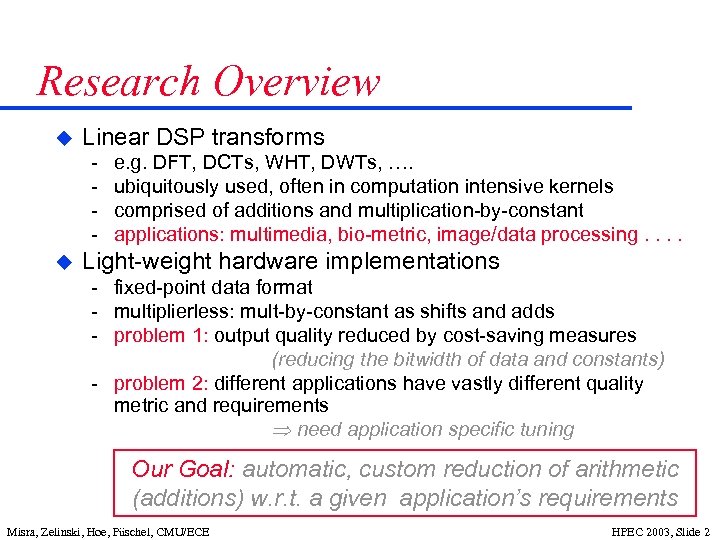 Research Overview u Linear DSP transforms u e. g. DFT, DCTs, WHT, DWTs, …. ubiquitously used, often in computation intensive kernels comprised of additions and multiplication by constant applications: multimedia, bio metric, image/data processing. . Light weight hardware implementations fixed point data format multiplierless: mult by constant as shifts and adds problem 1: output quality reduced by cost saving measures (reducing the bitwidth of data and constants) problem 2: different applications have vastly different quality metric and requirements need application specific tuning Our Goal: automatic, custom reduction of arithmetic (additions) w. r. t. a given application’s requirements Misra, Zelinski, Hoe, Püschel, CMU/ECE HPEC 2003, Slide 2
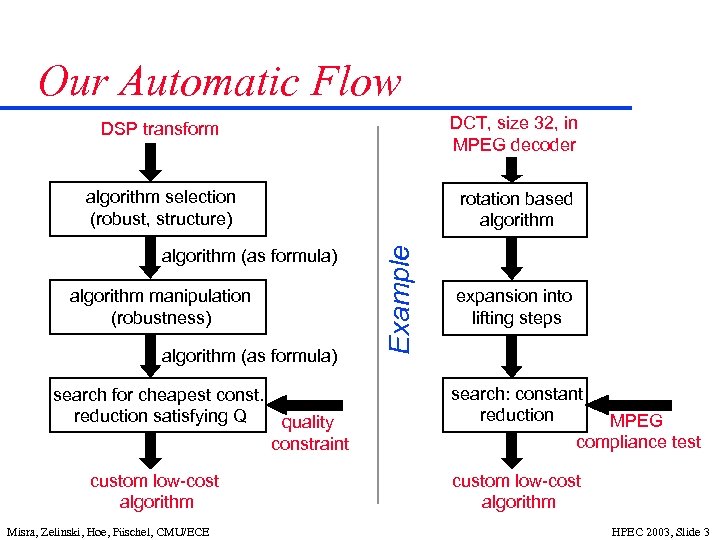 Our Automatic Flow DCT, size 32, in MPEG decoder algorithm selection (robust, structure) rotation based algorithm (as formula) algorithm manipulation (robustness) algorithm (as formula) search for cheapest const. reduction satisfying Q custom low cost algorithm Misra, Zelinski, Hoe, Püschel, CMU/ECE quality constraint Example DSP transform expansion into lifting steps search: constant reduction MPEG compliance test custom low cost algorithm HPEC 2003, Slide 3
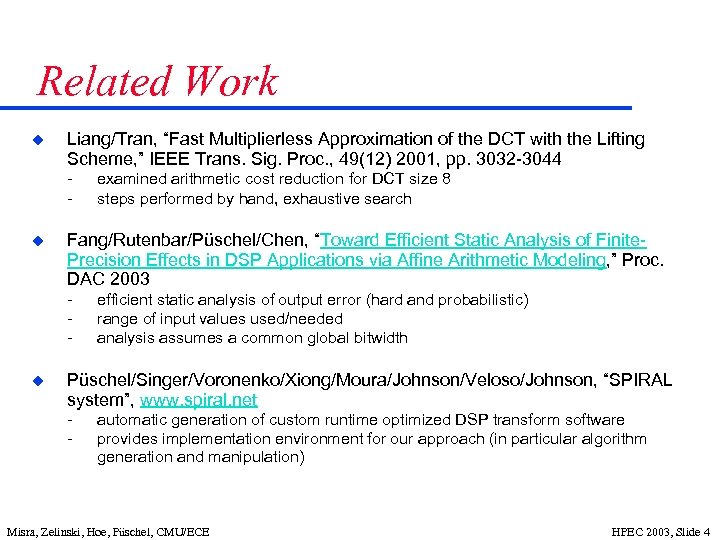 Related Work u Liang/Tran, “Fast Multiplierless Approximation of the DCT with the Lifting Scheme, ” IEEE Trans. Sig. Proc. , 49(12) 2001, pp. 3032 3044 u Fang/Rutenbar/Püschel/Chen, “Toward Efficient Static Analysis of Finite Precision Effects in DSP Applications via Affine Arithmetic Modeling, ” Proc. DAC 2003 u examined arithmetic cost reduction for DCT size 8 steps performed by hand, exhaustive search efficient static analysis of output error (hard and probabilistic) range of input values used/needed analysis assumes a common global bitwidth Püschel/Singer/Voronenko/Xiong/Moura/Johnson/Veloso/Johnson, “SPIRAL system”, www. spiral. net automatic generation of custom runtime optimized DSP transform software provides implementation environment for our approach (in particular algorithm generation and manipulation) Misra, Zelinski, Hoe, Püschel, CMU/ECE HPEC 2003, Slide 4
 Outline u u u DSP transform algorithms Algorithm manipulation for robustness Multiplication by constants Search Methods Results Misra, Zelinski, Hoe, Püschel, CMU/ECE HPEC 2003, Slide 5
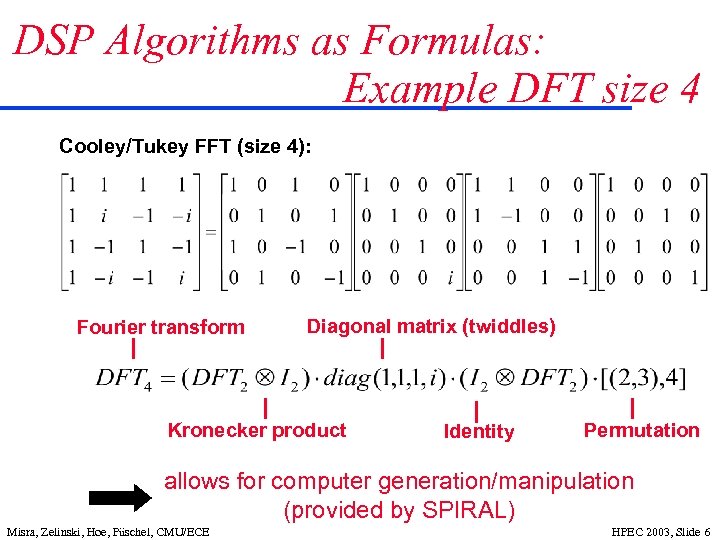 DSP Algorithms as Formulas: Example DFT size 4 Cooley/Tukey FFT (size 4): Fourier transform Diagonal matrix (twiddles) Kronecker product Identity Permutation allows for computer generation/manipulation (provided by SPIRAL) Misra, Zelinski, Hoe, Püschel, CMU/ECE HPEC 2003, Slide 6
![Example: DCT size 8 x[0] + x[1] + + x[2] + + - x[3]](https://present5.com/presentation/a9b7b95f9a9564fed3bd4932eb9ba516/image-7.jpg "Example: DCT size 8 x[0] + x[1] + + x[2] + + - x[3]") Example: DCT size 8 x[0] + x[1] + + x[2] + + - x[3] + x[4] - x[5] - x[6] as formula (generated by SPIRAL) x[7] - - + R-p/4 - x[0] + R 3 p/8 - x[2] + x[1] + + R-p/4 - - x[6] + x[5] R 3 p/16 x[3] + x[4] R 7 p/16 - x[7] as data flow diagram Basic building blocks: 2 x 2 rotations, DFT_2’s (butterflies), permutations, diagonal matrices (sca Algorithm is orthogonal = robust to input errors (from fixed point rep Misra, Zelinski, Hoe, Püschel, CMU/ECE HPEC 2003, Slide 7
Example: DCT size 8 x[0] + x[1] + + x[2] + + - x[3] + x[4] - x[5] - x[6] as formula (generated by SPIRAL) x[7] - - + R-p/4 - x[0] + R 3 p/8 - x[2] + x[1] + + R-p/4 - - x[6] + x[5] R 3 p/16 x[3] + x[4] R 7 p/16 - x[7] as data flow diagram Basic building blocks: 2 x 2 rotations, DFT_2’s (butterflies), permutations, diagonal matrices (sca Algorithm is orthogonal = robust to input errors (from fixed point rep Misra, Zelinski, Hoe, Püschel, CMU/ECE HPEC 2003, Slide 7
 Outline u u u DSP transform algorithms Algorithm manipulation for robustness Multiplication by constants Search Methods Results Misra, Zelinski, Hoe, Püschel, CMU/ECE HPEC 2003, Slide 8
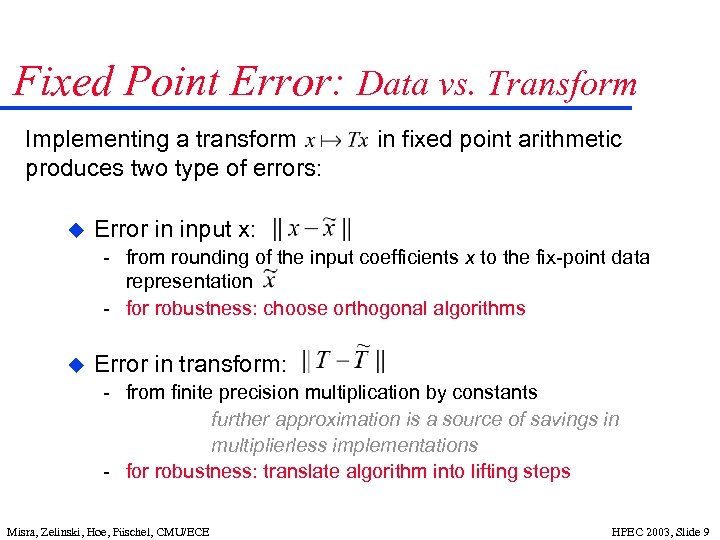 Fixed Point Error: Data vs. Transform Implementing a transform produces two type of errors: u in fixed point arithmetic Error in input x: from rounding of the input coefficients x to the fix point data representation for robustness: choose orthogonal algorithms u Error in transform: from finite precision multiplication by constants further approximation is a source of savings in multiplierless implementations for robustness: translate algorithm into lifting steps Misra, Zelinski, Hoe, Püschel, CMU/ECE HPEC 2003, Slide 9
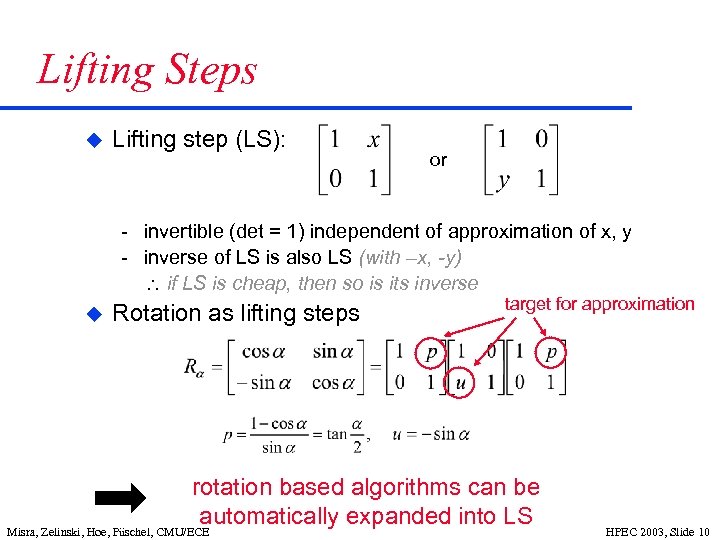 Lifting Steps u Lifting step (LS): or invertible (det = 1) independent of approximation of x, y inverse of LS is also LS (with –x, -y) if LS is cheap, then so is its inverse u Rotation as lifting steps target for approximation rotation based algorithms can be automatically expanded into LS Misra, Zelinski, Hoe, Püschel, CMU/ECE HPEC 2003, Slide 10
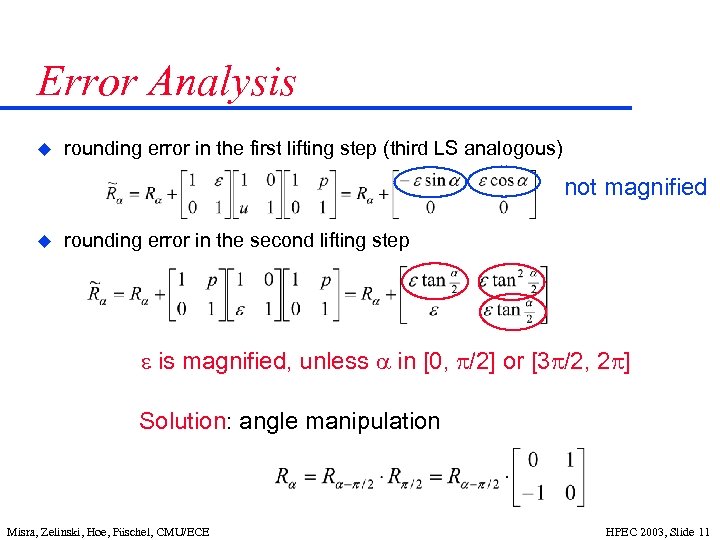 Error Analysis u rounding error in the first lifting step (third LS analogous) not magnified u rounding error in the second lifting step e is magnified, unless in [0, /2] or [3 /2, 2 ] Solution: angle manipulation Misra, Zelinski, Hoe, Püschel, CMU/ECE HPEC 2003, Slide 11
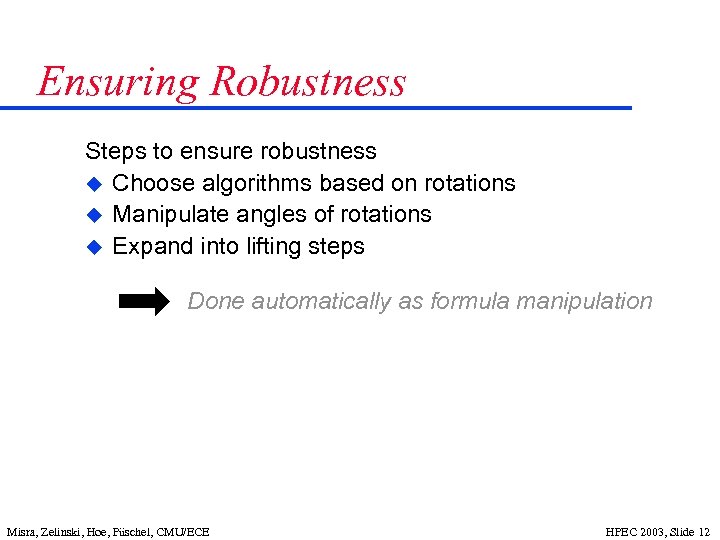 Ensuring Robustness Steps to ensure robustness u Choose algorithms based on rotations u Manipulate angles of rotations u Expand into lifting steps Done automatically as formula manipulation Misra, Zelinski, Hoe, Püschel, CMU/ECE HPEC 2003, Slide 12
 Outline u u u DSP transform algorithms Algorithm manipulation for robustness Multiplication by constants Search Methods Results Misra, Zelinski, Hoe, Püschel, CMU/ECE HPEC 2003, Slide 13
 Multiplication by Constants Operations in transforms: additions multiplication by constant Example: c=0. 1011 = 5 adds (5 shifts) SD recoding 1 c=0. 11001101 4 adds (3 shifts) SD recoding 2 c=0. 11000101 3 adds (3 shifts) simple SD recoding is not optimal Misra, Zelinski, Hoe, Püschel, CMU/ECE HPEC 2003, Slide 14
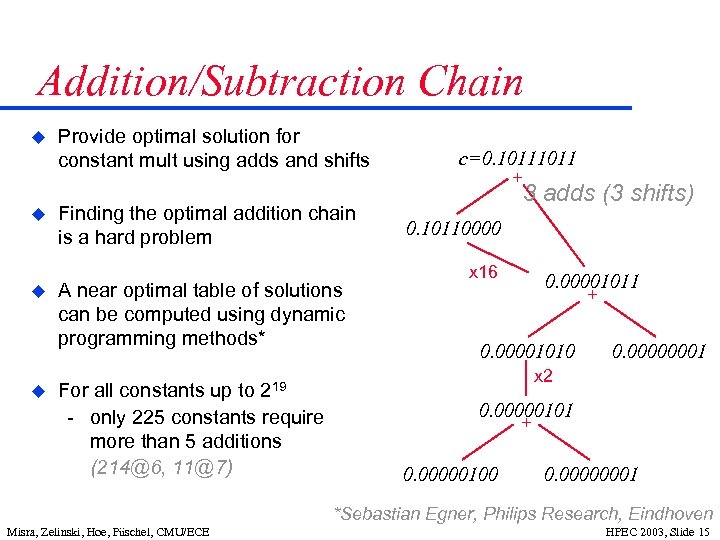 Addition/Subtraction Chain u u Provide optimal solution for constant mult using adds and shifts Finding the optimal addition chain is a hard problem A near optimal table of solutions can be computed using dynamic programming methods* 219 For all constants up to only 225 constants require more than 5 additions (214@6, 11@7) c=0. 1011 + 3 adds (3 shifts) 0. 10110000 x 16 0. 00001011 + 0. 00001010 0. 00000001 x 2 0. 00000101 + 0. 00000100 0. 00000001 *Sebastian Egner, Philips Research, Eindhoven Misra, Zelinski, Hoe, Püschel, CMU/ECE HPEC 2003, Slide 15
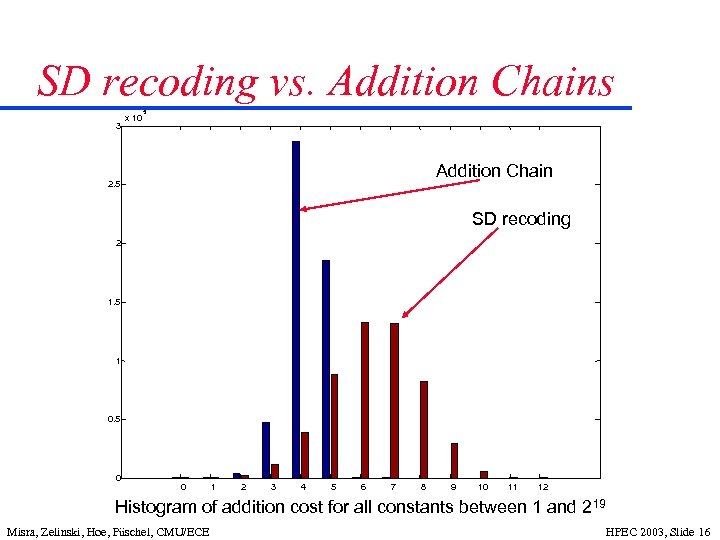 SD recoding vs. Addition Chains 3 x 10 5 Addition Chain 2. 5 SD recoding 2 1. 5 1 0. 5 0 0 1 2 3 4 5 6 7 8 9 10 11 12 Histogram of addition cost for all constants between 1 and 219 Misra, Zelinski, Hoe, Püschel, CMU/ECE HPEC 2003, Slide 16
 Outline u u u DSP transform algorithms Algorithm manipulation for robustness Multiplication by constants Search Methods Results Misra, Zelinski, Hoe, Püschel, CMU/ECE HPEC 2003, Slide 17
 Optimization Problem Given a linear DSP transform and quality measure Q 1. Find the multiplierless implementation with the least arithmetic cost C (number of additions) that satisfies a given Q threshold 2. Find the multiplierless implementation with the highest quality Q for a given arithmetic cost C threshold Misra, Zelinski, Hoe, Püschel, CMU/ECE HPEC 2003, Slide 18
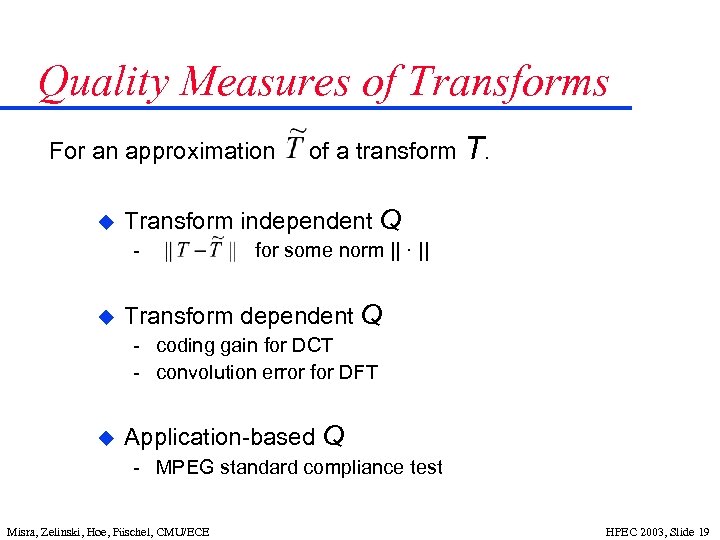 Quality Measures of Transforms For an approximation u Transform independent Q u of a transform T. for some norm || · || Transform dependent Q coding gain for DCT convolution error for DFT u Application based Q MPEG standard compliance test Misra, Zelinski, Hoe, Püschel, CMU/ECE HPEC 2003, Slide 19
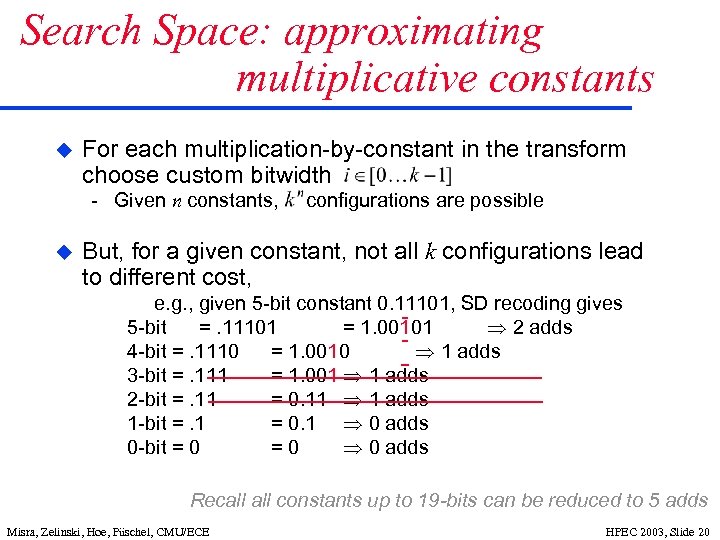 Search Space: approximating multiplicative constants u For each multiplication by constant in the transform choose custom bitwidth Given n constants, u configurations are possible But, for a given constant, not all k configurations lead to different cost, e. g. , given 5 bit constant 0. 11101, SD recoding gives 5 bit =. 11101 = 1. 00101 2 adds 4 bit =. 1110 = 1. 0010 1 adds 3 bit =. 111 = 1. 001 1 adds 2 bit =. 11 = 0. 11 1 adds 1 bit =. 1 = 0. 1 0 adds 0 bit = 0 =0 0 adds Recall constants up to 19 -bits can be reduced to 5 adds Misra, Zelinski, Hoe, Püschel, CMU/ECE HPEC 2003, Slide 20
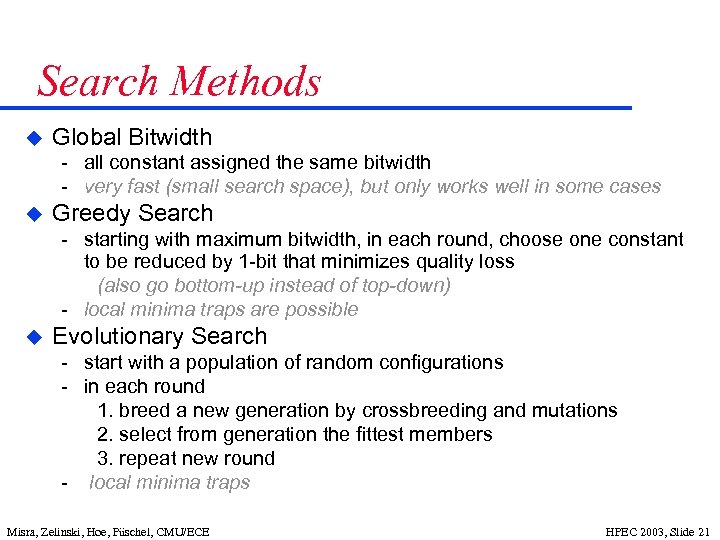 Search Methods u Global Bitwidth all constant assigned the same bitwidth very fast (small search space), but only works well in some cases u Greedy Search starting with maximum bitwidth, in each round, choose one constant to be reduced by 1 bit that minimizes quality loss (also go bottom-up instead of top-down) local minima traps are possible u Evolutionary Search start with a population of random configurations in each round 1. breed a new generation by crossbreeding and mutations 2. select from generation the fittest members 3. repeat new round local minima traps Misra, Zelinski, Hoe, Püschel, CMU/ECE HPEC 2003, Slide 21
 Outline u u u DSP transform algorithms Algorithm manipulation for robustness Multiplication by constants Search Methods Results Misra, Zelinski, Hoe, Püschel, CMU/ECE HPEC 2003, Slide 22
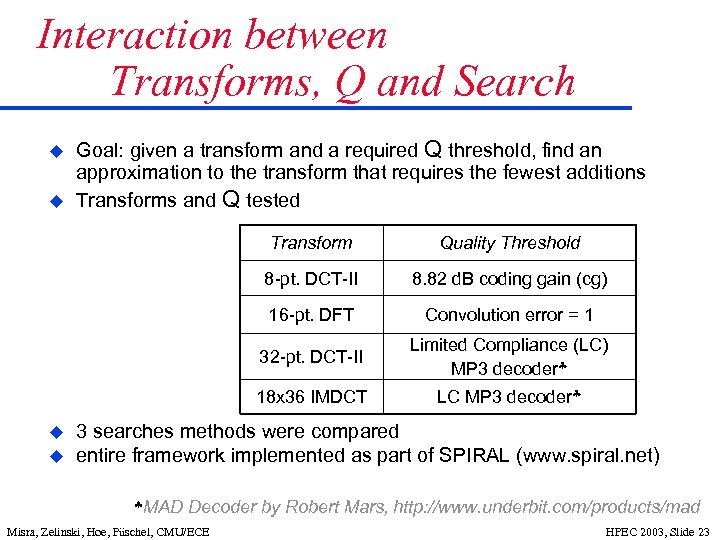 Interaction between Transforms, Q and Search u u Goal: given a transform and a required Q threshold, find an approximation to the transform that requires the fewest additions Transforms and Q tested Transform 8 pt. DCT II Convolution error = 1 32 pt. DCT II Limited Compliance (LC) MP 3 decoder 18 x 36 IMDCT u 8. 82 d. B coding gain (cg) 16 pt. DFT u Quality Threshold LC MP 3 decoder 3 searches methods were compared entire framework implemented as part of SPIRAL (www. spiral. net) MAD Decoder by Robert Mars, http: //www. underbit. com/products/mad Misra, Zelinski, Hoe, Püschel, CMU/ECE HPEC 2003, Slide 23
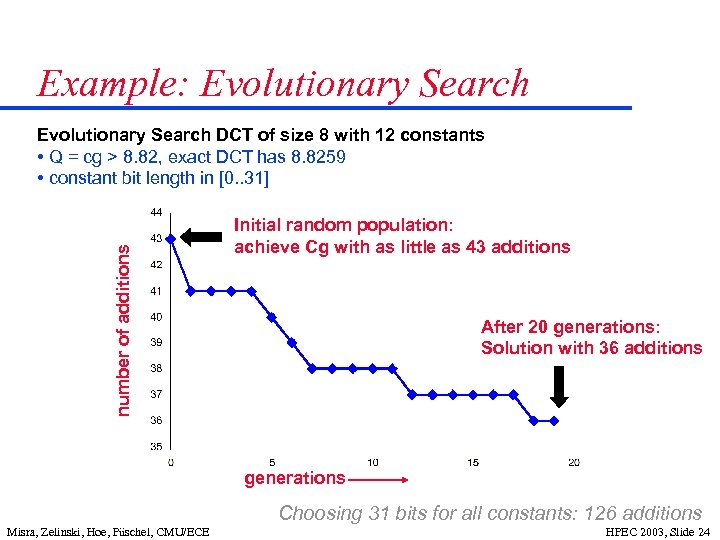 Example: Evolutionary Search number of additions Evolutionary Search DCT of size 8 with 12 constants • Q = cg > 8. 82, exact DCT has 8. 8259 • constant bit length in [0. . 31] Initial random population: achieve Cg with as little as 43 additions After 20 generations: Solution with 36 additions generations Choosing 31 bits for all constants: 126 additions Misra, Zelinski, Hoe, Püschel, CMU/ECE HPEC 2003, Slide 24
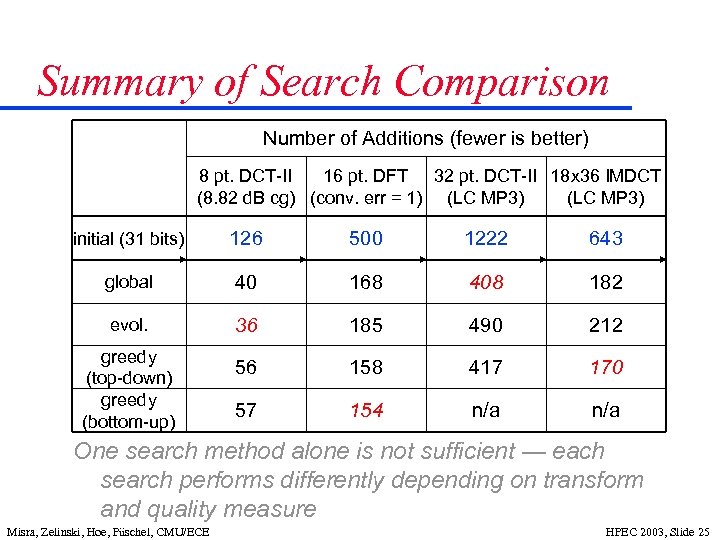 Summary of Search Comparison Number of Additions (fewer is better) 8 pt. DCT II 16 pt. DFT 32 pt. DCT II 18 x 36 IMDCT (8. 82 d. B cg) (conv. err = 1) (LC MP 3) initial (31 bits) 126 500 1222 643 global 40 168 408 182 evol. 36 185 490 212 56 158 417 170 57 154 n/a greedy (top down) greedy (bottom up) One search method alone is not sufficient — each search performs differently depending on transform and quality measure Misra, Zelinski, Hoe, Püschel, CMU/ECE HPEC 2003, Slide 25
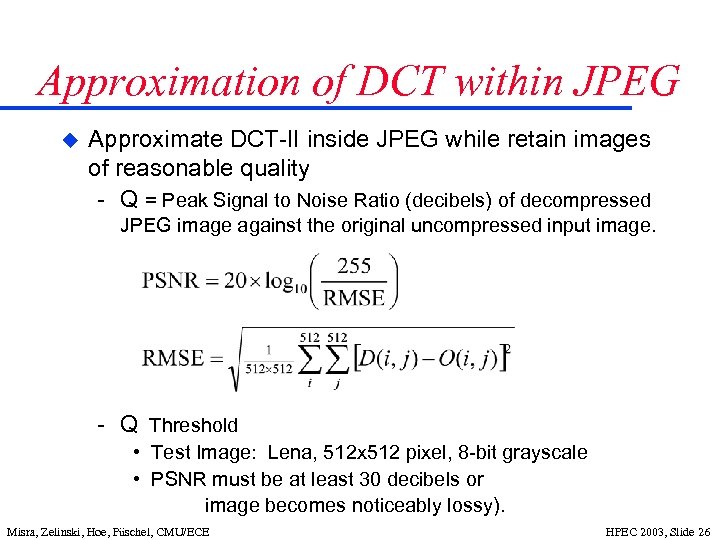 Approximation of DCT within JPEG u Approximate DCT II inside JPEG while retain images of reasonable quality Q = Peak Signal to Noise Ratio (decibels) of decompressed JPEG image against the original uncompressed input image. Q Threshold • Test Image: Lena, 512 x 512 pixel, 8 bit grayscale • PSNR must be at least 30 decibels or image becomes noticeably lossy). Misra, Zelinski, Hoe, Püschel, CMU/ECE HPEC 2003, Slide 26
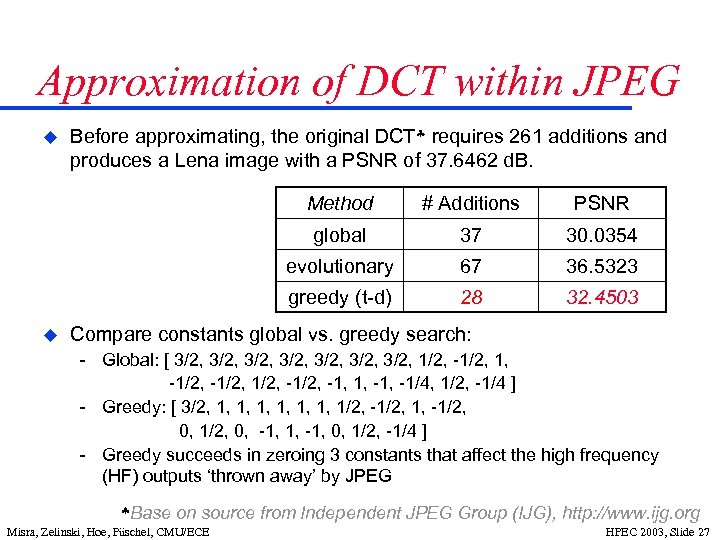 Approximation of DCT within JPEG u Before approximating, the original DCT requires 261 additions and produces a Lena image with a PSNR of 37. 6462 d. B. Method PSNR global 37 30. 0354 evolutionary 67 36. 5323 greedy (t d) u # Additions 28 32. 4503 Compare constants global vs. greedy search: Global: [ 3/2, 3/2, 1/2, 1, 1/2, 1, 1, 1/4, 1/2, 1/4 ] Greedy: [ 3/2, 1, 1, 1, 1/2, 1, 1/2, 0, 1, 1, 0, 1/2, 1/4 ] Greedy succeeds in zeroing 3 constants that affect the high frequency (HF) outputs ‘thrown away’ by JPEG Base on source from Independent JPEG Group (IJG), http: //www. ijg. org Misra, Zelinski, Hoe, Püschel, CMU/ECE HPEC 2003, Slide 27
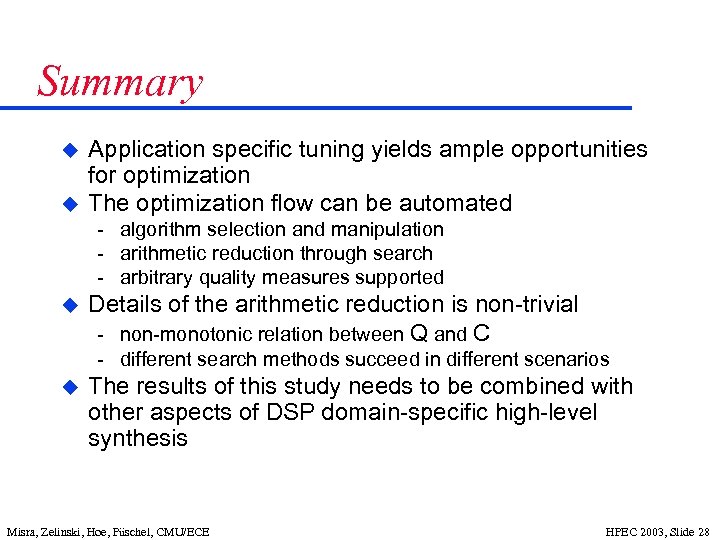 Summary u u Application specific tuning yields ample opportunities for optimization The optimization flow can be automated algorithm selection and manipulation arithmetic reduction through search arbitrary quality measures supported u Details of the arithmetic reduction is non trivial non monotonic relation between Q and C different search methods succeed in different scenarios u The results of this study needs to be combined with other aspects of DSP domain specific high level synthesis Misra, Zelinski, Hoe, Püschel, CMU/ECE HPEC 2003, Slide 28