 Скачать презентацию Cushitic Case Maarten Mous Absolut ive or unmarked
d8ebfabc436c7272b40f8b66b4bae62c.ppt
- Количество слайдов: 20




Cushitic Case Maarten Mous
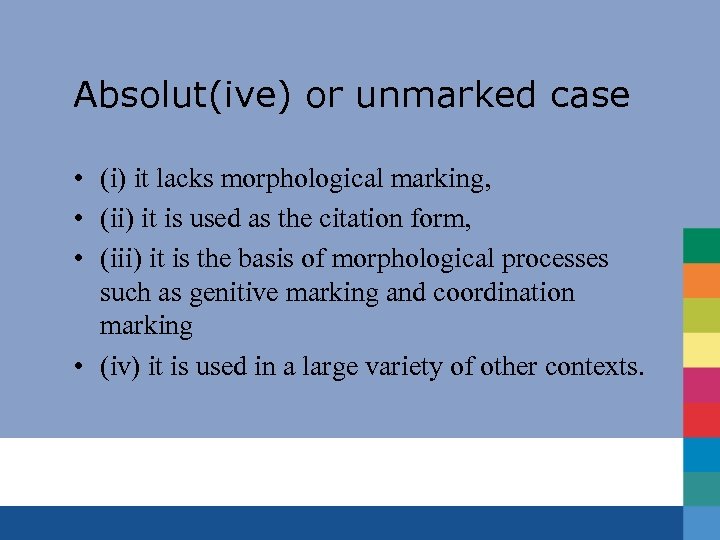
Absolut(ive) or unmarked case • (i) it lacks morphological marking, • (ii) it is used as the citation form, • (iii) it is the basis of morphological processes such as genitive marking and coordination marking • (iv) it is used in a large variety of other contexts.
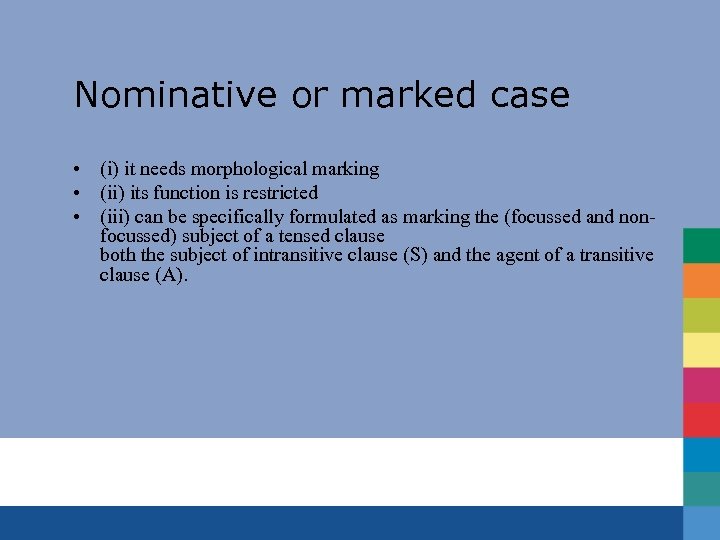
Nominative or marked case • (i) it needs morphological marking • (ii) its function is restricted • (iii) can be specifically formulated as marking the (focussed and nonfocussed) subject of a tensed clause both the subject of intransitive clause (S) and the agent of a transitive clause (A).
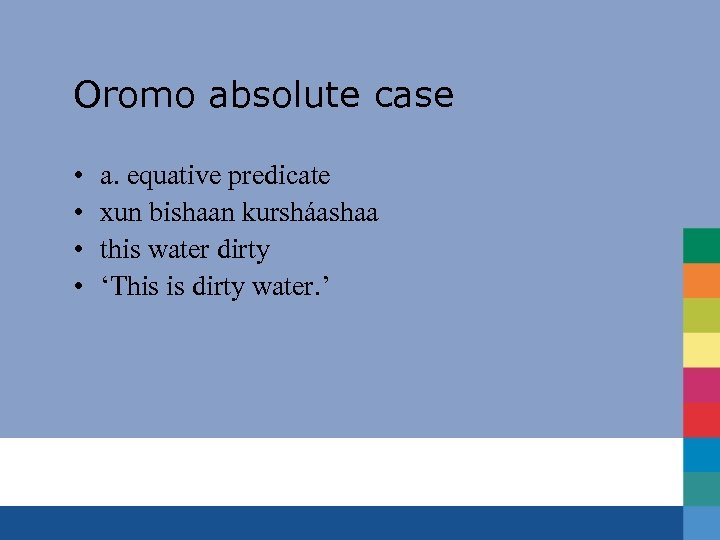
Oromo absolute case • • a. equative predicate xun bishaan kursháashaa this water dirty ‘This is dirty water. ’
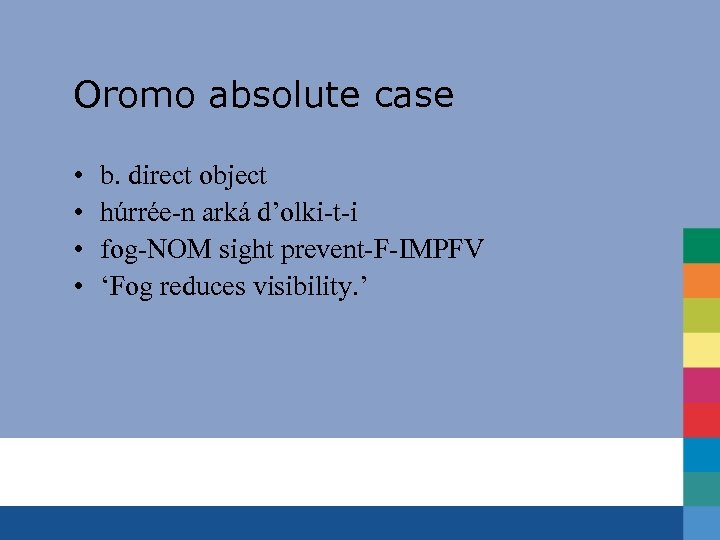
Oromo absolute case • • b. direct object húrrée-n arká d’olki-t-i fog-NOM sight prevent-F-IMPFV ‘Fog reduces visibility. ’
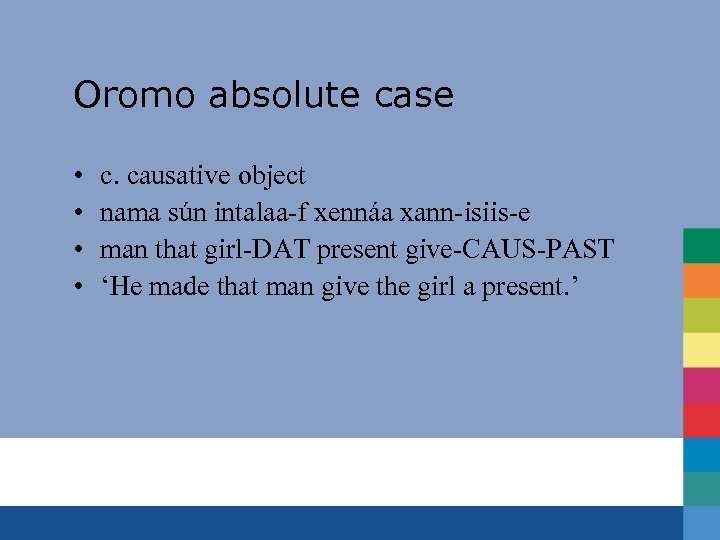
Oromo absolute case • • c. causative object nama sún intalaa-f xennáa xann-isiis-e man that girl-DAT present give-CAUS-PAST ‘He made that man give the girl a present. ’
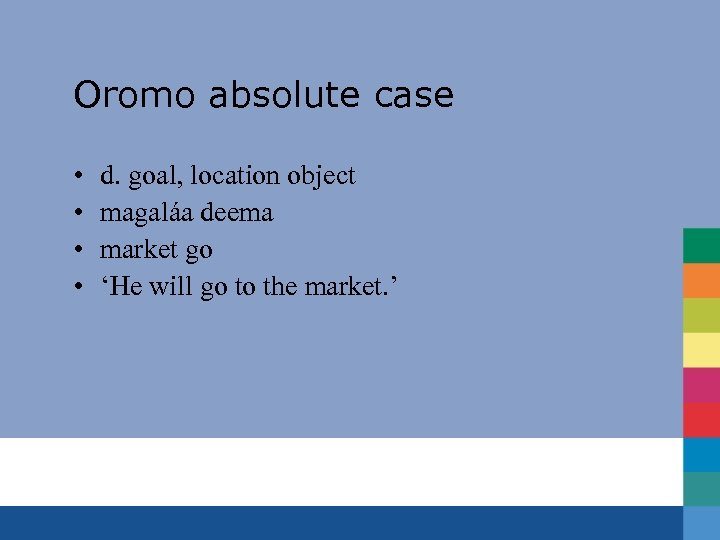
Oromo absolute case • • d. goal, location object magaláa deema market go ‘He will go to the market. ’
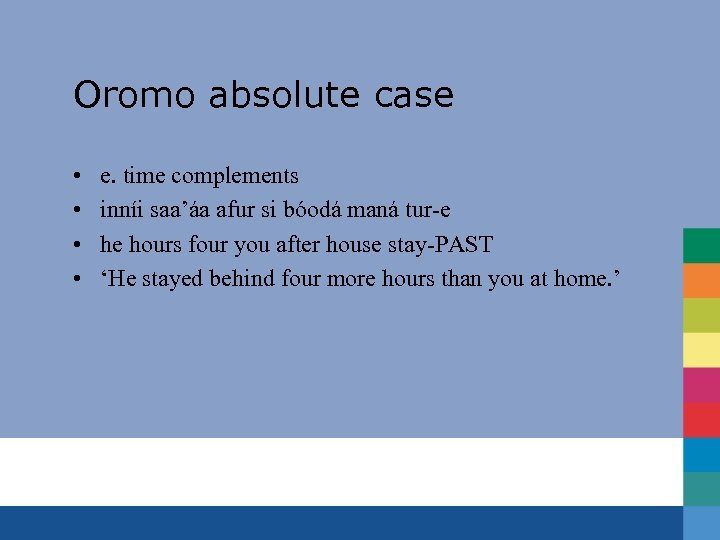
Oromo absolute case • • e. time complements inníi saa’áa afur si bóodá maná tur-e he hours four you after house stay-PAST ‘He stayed behind four more hours than you at home. ’
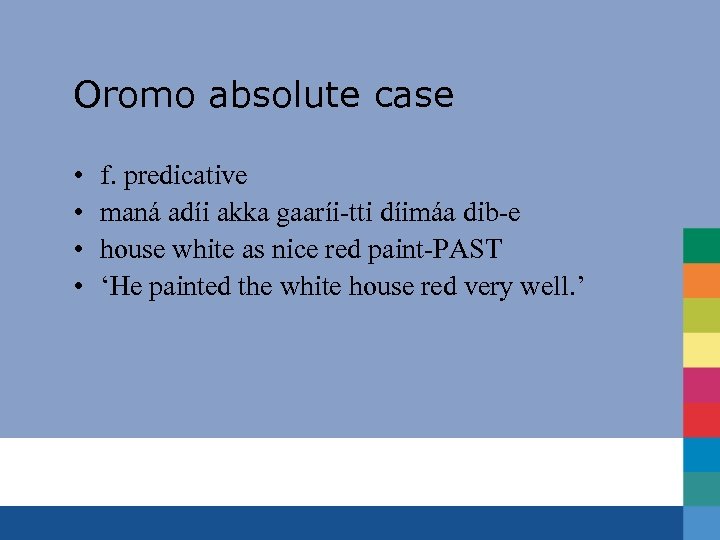
Oromo absolute case • • f. predicative maná adíi akka gaaríi-tti díimáa dib-e house white as nice red paint-PAST ‘He painted the white house red very well. ’
Oromo absolute case • • g. unit of measure xaráa-n ás írráa kilométríi diddám fagata road-NOM here from kilometers twenty far ‘The road is twenty kilometers from here. ’
Oromo absolute case • • h. object of postposition inníi xeesúmmáa sun bírá jira he guest that near exist ‘He is near to that guest. ’
Oromo nominative case • • a. subject of adjectival clause híd’ii-n díim-tuu lip-NOM red-F ‘A lip is red. ’
Oromo nominative case • • a. subject of adjectival clause híd’ii-n díim-tuu lip-NOM red-F ‘A lip is red. ’
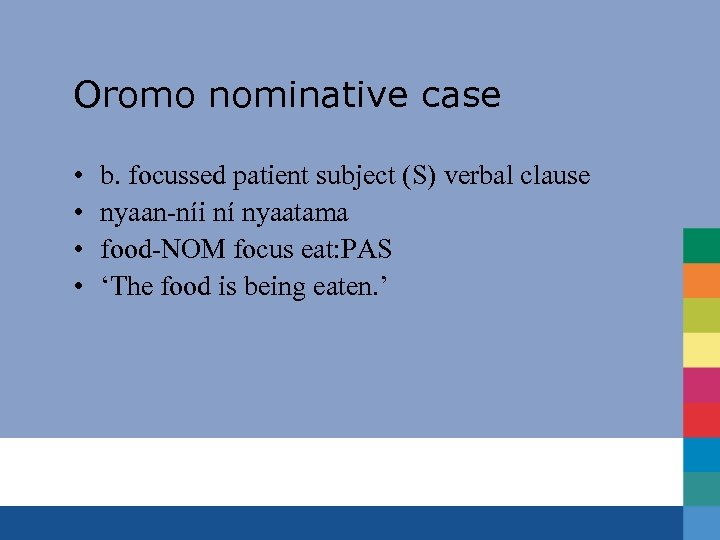
Oromo nominative case • • b. focussed patient subject (S) verbal clause nyaan-níi ní nyaatama food-NOM focus eat: PAS ‘The food is being eaten. ’
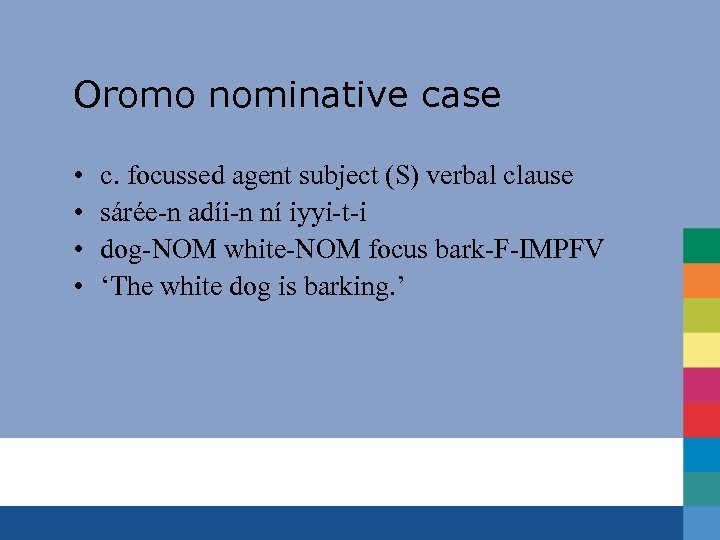
Oromo nominative case • • c. focussed agent subject (S) verbal clause sárée-n adíi-n ní iyyi-t-i dog-NOM white-NOM focus bark-F-IMPFV ‘The white dog is barking. ’
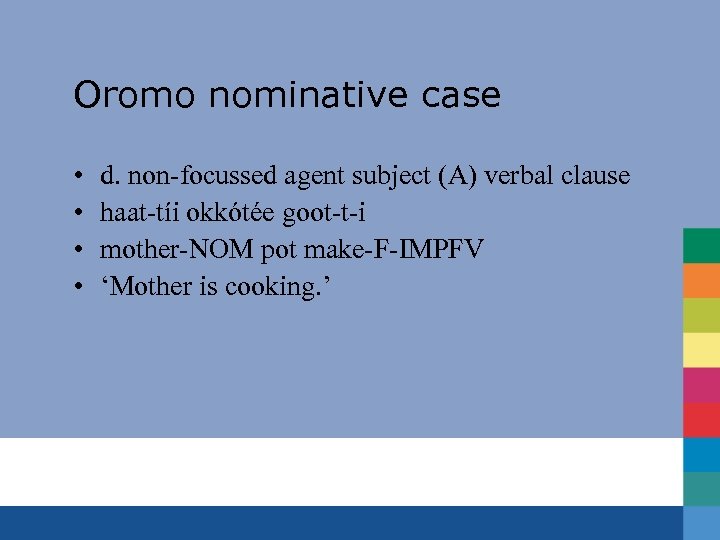
Oromo nominative case • • d. non-focussed agent subject (A) verbal clause haat-tíi okkótée goot-t-i mother-NOM pot make-F-IMPFV ‘Mother is cooking. ’
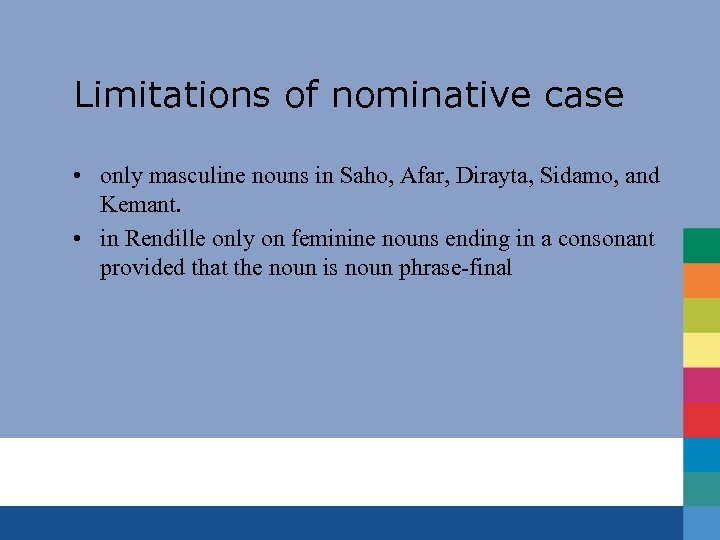
Limitations of nominative case • only masculine nouns in Saho, Afar, Dirayta, Sidamo, and Kemant. • in Rendille only on feminine nouns ending in a consonant provided that the noun is noun phrase-final
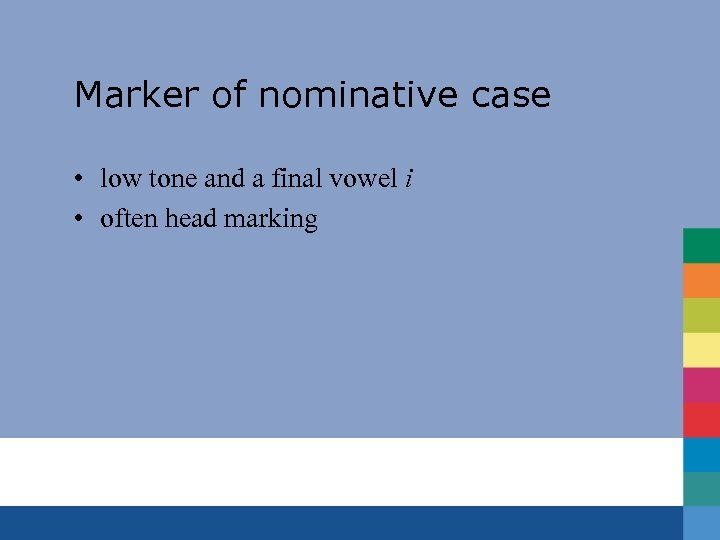
Marker of nominative case • low tone and a final vowel i • often head marking
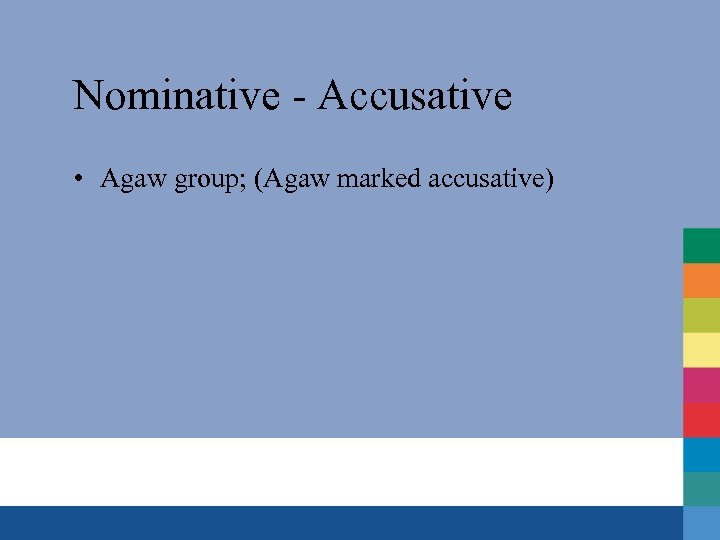
Nominative - Accusative • Agaw group; (Agaw marked accusative)
Case and definiteness
Скачать презентацию Cushitic Case Maarten Mous Absolut ive or unmarked
d8ebfabc436c7272b40f8b66b4bae62c.ppt