


 Скачать презентацию Curs 6 Teorii ale discursului AST şi RST
33d20b253de2633384acfd079d10e176.ppt
- Количество слайдов: 62
 Curs 6: Teorii ale discursului: AST şi RST Dan Cristea Selecţie de slide-uri prezentate în tutoriale (RANLP-03, Borovits, Sept. 2003; ICON-04, Hyderabad, Dec. 2004) şi conferinţe
 Content I. Introduction – What is discourse? Text versus discourse. Coherence and cohesion. II. Theories – attentional state theory – rhetorical structure theory
 What is discourse? Longman: 1. a serious speech or piece or writing on a particular subject: Professor Grant delivered a long discourse on aspects of moral theology. 2. serious conversation between people: You can’t expect meaningful discourse when you two disagree so violently. 3. the language used in particular kinds of speech or writing: scientific discourse.
 What is discourse? Longman: 1. a serious speech or piece or writing on a particular subject: Professor Grant delivered a long discourse on aspects of moral theology. 2. serious conversation between people: You can’t expect meaningful discourse when you two disagree so violently. 3. the language used in particular kinds of speech or writing: scientific discourse.
 Text versus discourse Syntactically – a discourse is more than a single sentence. From Garcia Marquez
 Text versus discourse A text is not a discourse! But it becomes a discourse the very moment it is read or heard by a human. . . or a machine.
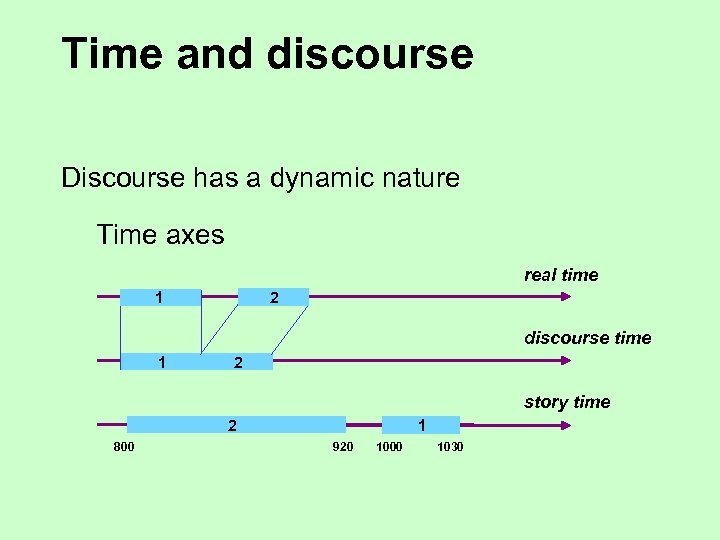 Time and discourse Discourse has a dynamic nature Time axes real time 1 2 discourse time 1 2 story time 2 800 1 920 1000 1030
 Cohesion and coherence A text manifests cohesion when its parts closely correlate. A text is coherent when it makes sense, with respect to an accepted setting, real or virtual.
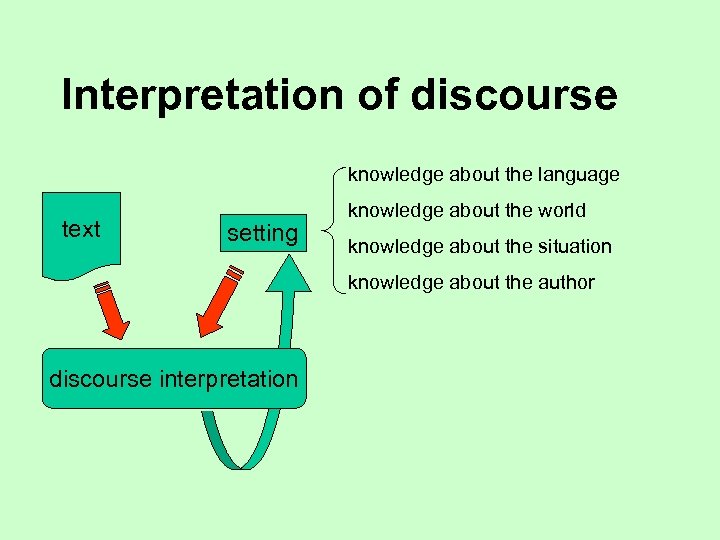 Interpretation of discourse knowledge about the language text setting knowledge about the world knowledge about the situation knowledge about the author discourse interpretation
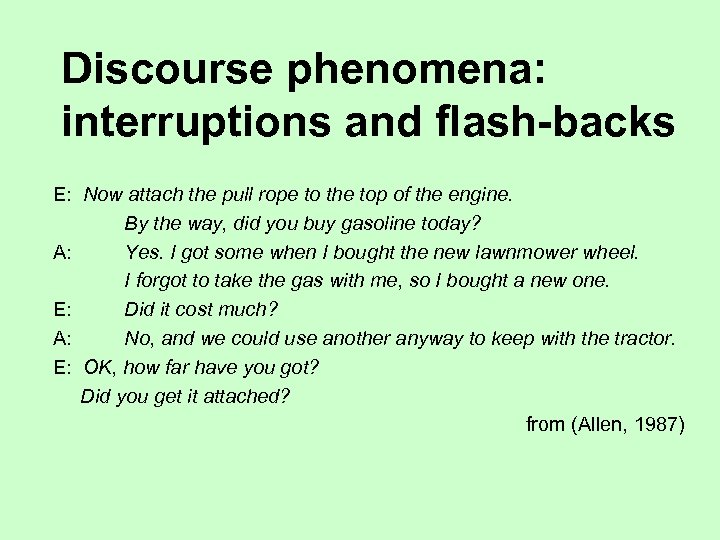 Discourse phenomena: interruptions and flash-backs E: Now attach the pull rope to the top of the engine. By the way, did you buy gasoline today? A: Yes. I got some when I bought the new lawnmower wheel. I forgot to take the gas with me, so I bought a new one. E: Did it cost much? A: No, and we could use another anyway to keep with the tractor. E: OK, how far have you got? Did you get it attached? from (Allen, 1987)
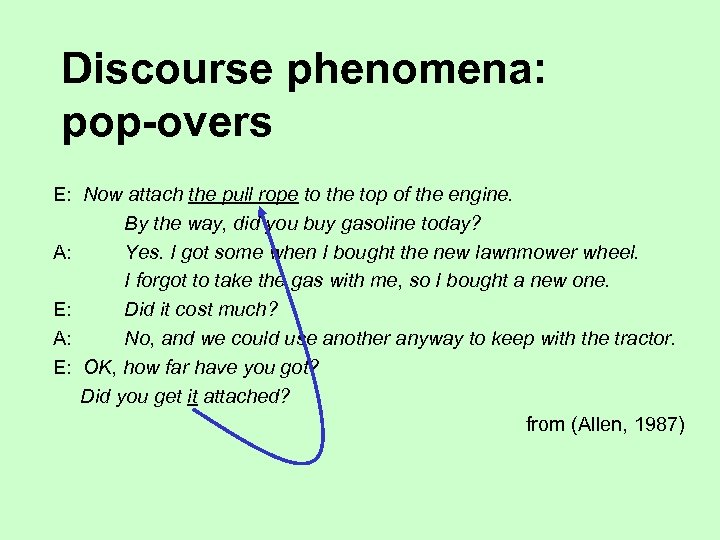 Discourse phenomena: pop-overs E: Now attach the pull rope to the top of the engine. By the way, did you buy gasoline today? A: Yes. I got some when I bought the new lawnmower wheel. I forgot to take the gas with me, so I bought a new one. E: Did it cost much? A: No, and we could use another anyway to keep with the tractor. E: OK, how far have you got? Did you get it attached? from (Allen, 1987)
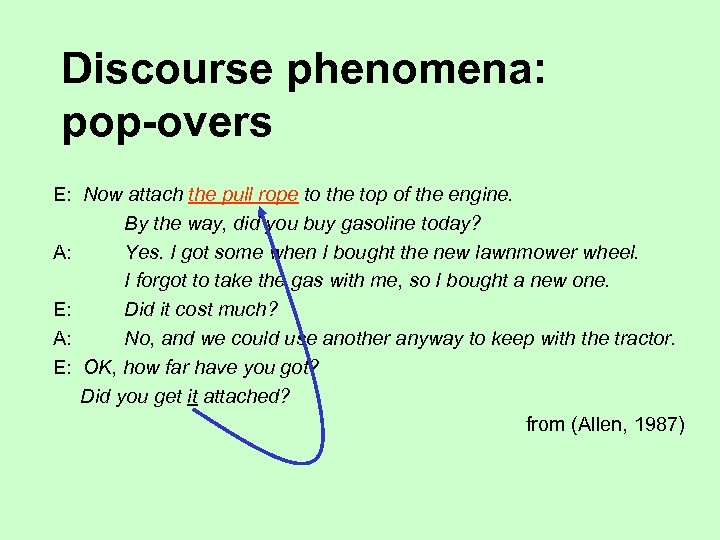 Discourse phenomena: pop-overs E: Now attach the pull rope to the top of the engine. By the way, did you buy gasoline today? A: Yes. I got some when I bought the new lawnmower wheel. I forgot to take the gas with me, so I bought a new one. E: Did it cost much? A: No, and we could use another anyway to keep with the tractor. E: OK, how far have you got? Did you get it attached? from (Allen, 1987)
 Discourse phenomena: inference load and pronoun use Why is it that some discourses seem more difficult to understand than others? localising the setting cohesion is lower coherence is lower Why do we use the pronouns and other anaphoric means the way we do?
 Discourse theories? Sub-domain of Computational Linguistics: searching for the intrinsic laws of the discourse and for models making possible an automated analysis, representation and generation of the discourse.
 II. Discourse theories • • atentional state theory rhetorical structure theory centering theory veins theory
 Attentional state theory (AST) (Barbara Grosz & Candence Sidner, 1987) Models the linguistic structure of the discourse Gives an account on intentions and how they are combined Explains the shift of attention during discourse interpretation Explains interruptions and flash-backs Puts in evidence a dynamic domain of referentiality 3 components
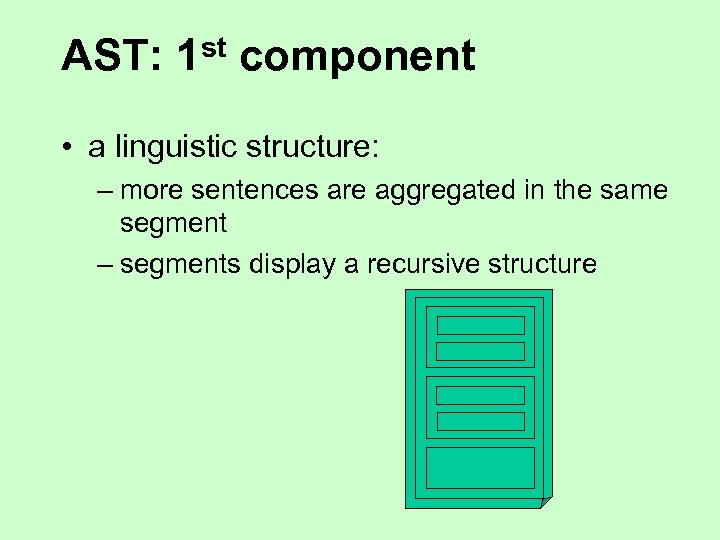 AST: 1 st component • a linguistic structure: – more sentences are aggregated in the same segment – segments display a recursive structure
 AST: nd 2 component • an intentional structure: – a segment communicates an intention, it has a goal to accomplish in the reader; – the goals of the component segments contribute to the realisation of the goal of the overall segment; – two type of relations between segment goals: dominance and satisfaction-precedence
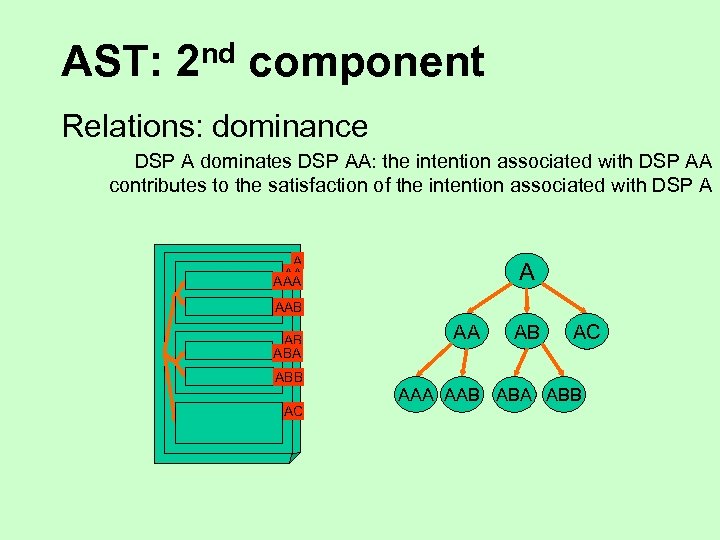 AST: nd 2 component Relations: dominance DSP A dominates DSP AA: the intention associated with DSP AA contributes to the satisfaction of the intention associated with DSP A A AAB AB ABA ABB AC AA AB AC AAA AAB ABA ABB
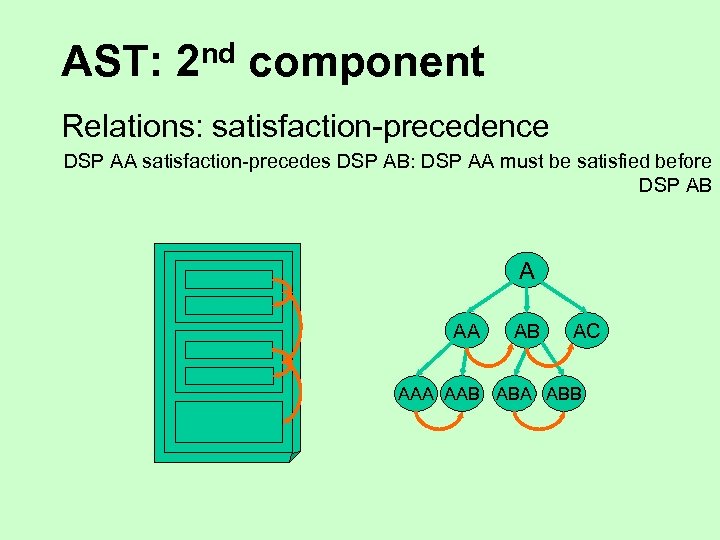 AST: nd 2 component Relations: satisfaction-precedence DSP AA satisfaction-precedes DSP AB: DSP AA must be satisfied before DSP AB A AA AB AC AAA AAB ABA ABB
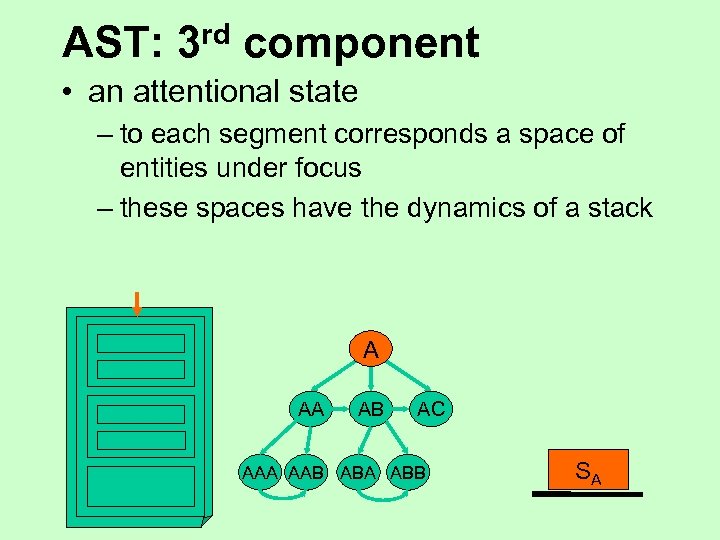 AST: rd 3 component • an attentional state – to each segment corresponds a space of entities under focus – these spaces have the dynamics of a stack A AA AB AC AAA AAB ABA ABB SA
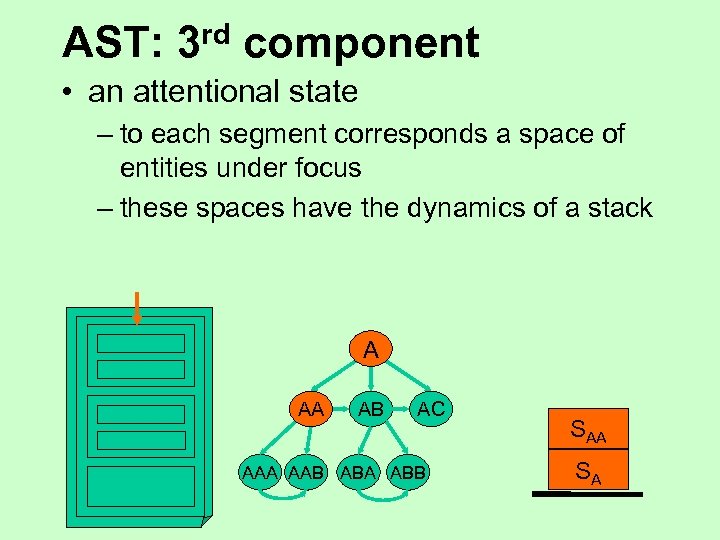 AST: rd 3 component • an attentional state – to each segment corresponds a space of entities under focus – these spaces have the dynamics of a stack A AA AB AC AAA AAB ABA ABB SAA SA
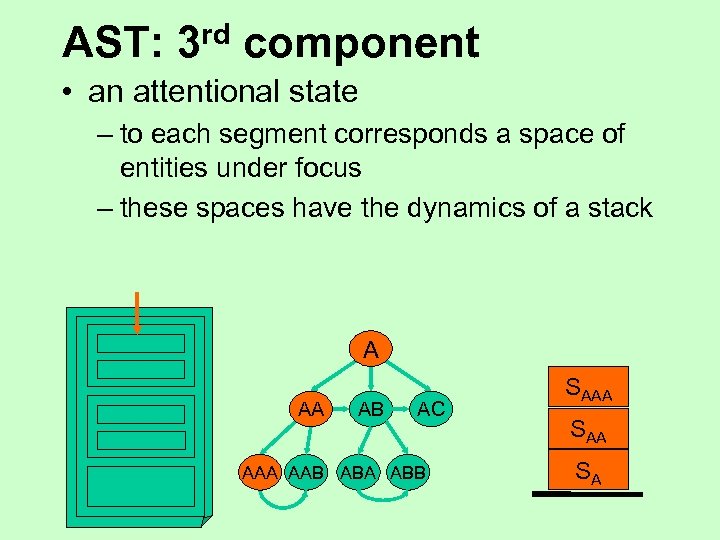 AST: rd 3 component • an attentional state – to each segment corresponds a space of entities under focus – these spaces have the dynamics of a stack A AA AB AC AAA AAB ABA ABB SAAA SA
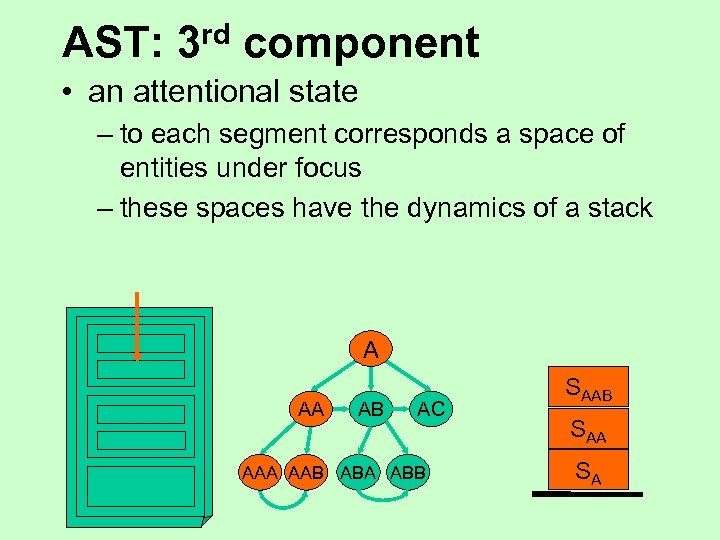 AST: rd 3 component • an attentional state – to each segment corresponds a space of entities under focus – these spaces have the dynamics of a stack A AA AB AC AAA AAB ABA ABB SAA SA
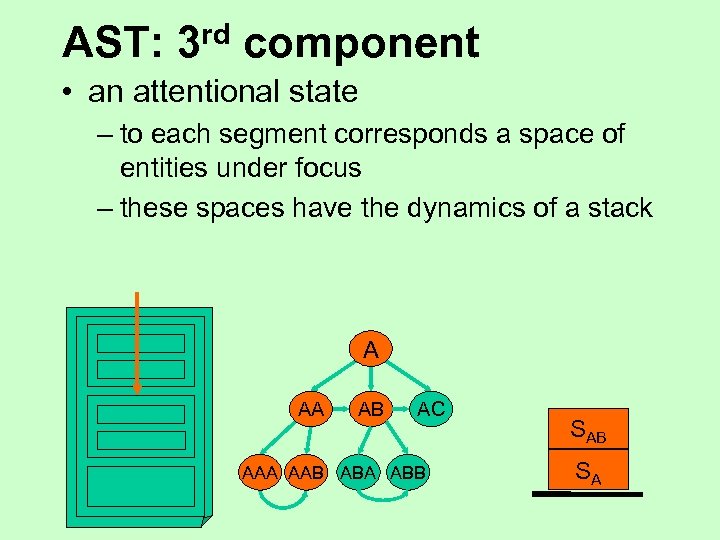 AST: rd 3 component • an attentional state – to each segment corresponds a space of entities under focus – these spaces have the dynamics of a stack A AA AB AC AAA AAB ABA ABB SA
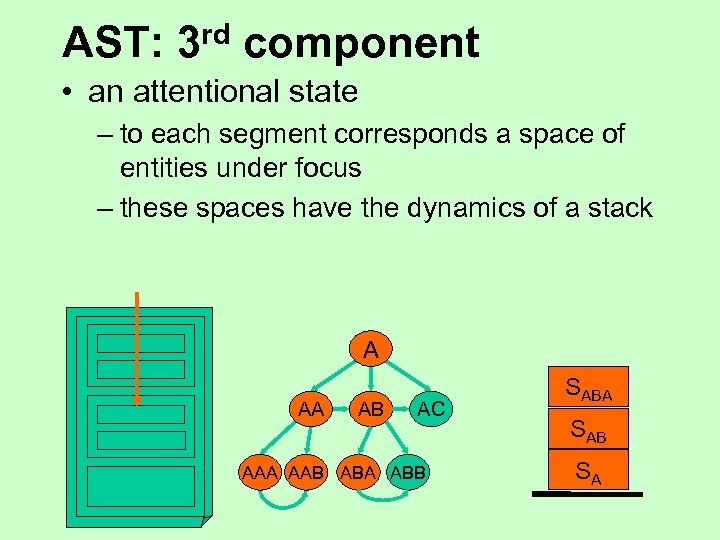 AST: rd 3 component • an attentional state – to each segment corresponds a space of entities under focus – these spaces have the dynamics of a stack A AA AB AC AAA AAB ABA ABB SABA SAB SA
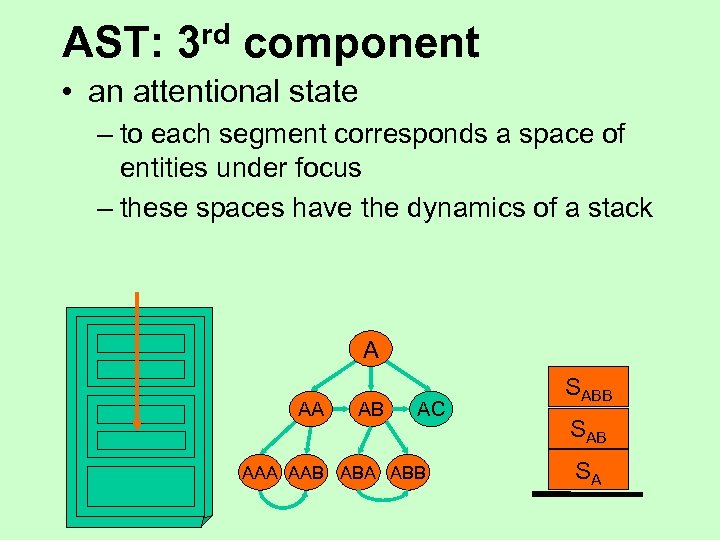 AST: rd 3 component • an attentional state – to each segment corresponds a space of entities under focus – these spaces have the dynamics of a stack A AA AB AC AAA AAB ABA ABB SAB SA
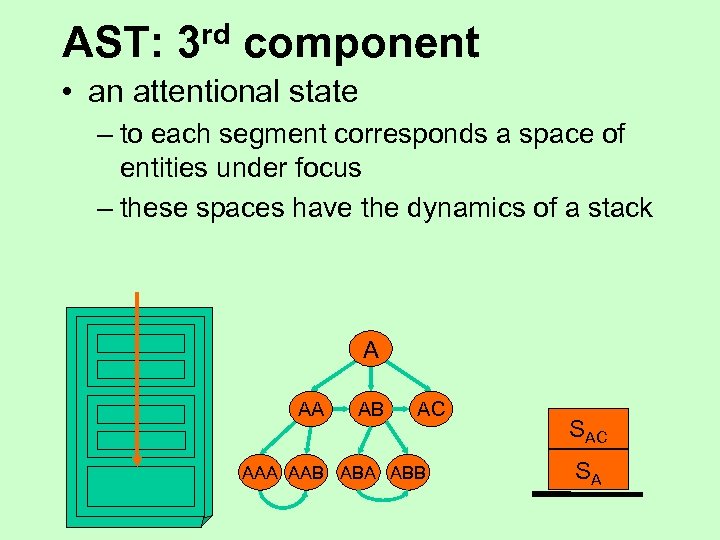 AST: rd 3 component • an attentional state – to each segment corresponds a space of entities under focus – these spaces have the dynamics of a stack A AA AB AC AAA AAB ABA ABB SAC SA
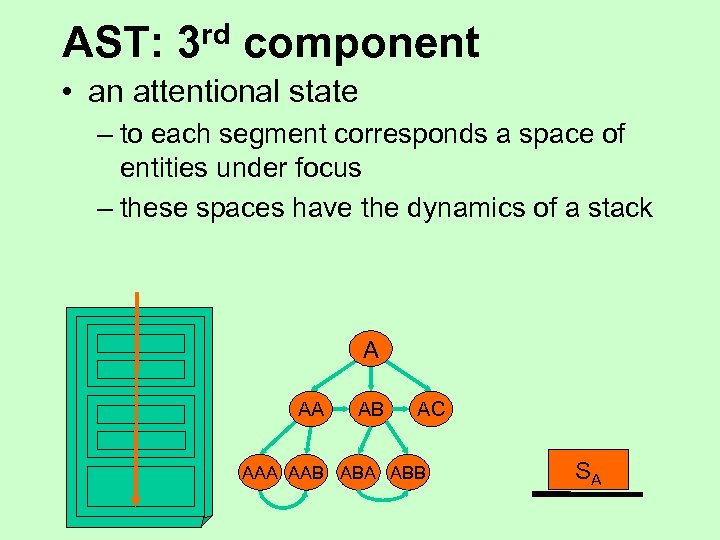 AST: rd 3 component • an attentional state – to each segment corresponds a space of entities under focus – these spaces have the dynamics of a stack A AA AB AC AAA AAB ABA ABB SA
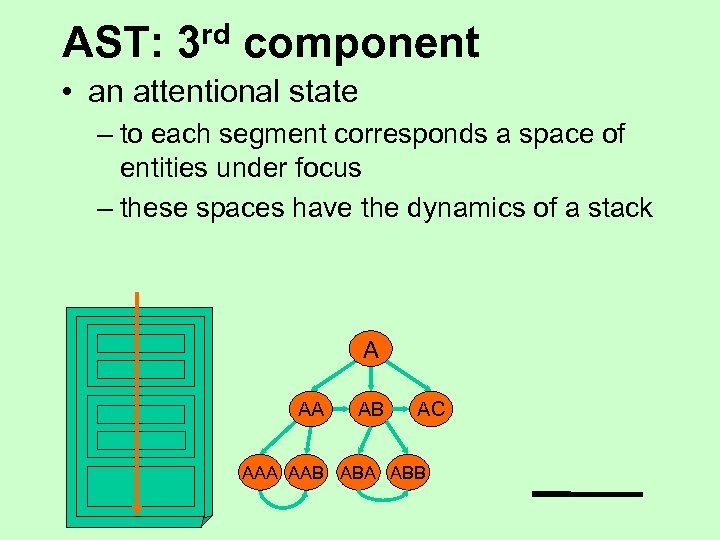 AST: rd 3 component • an attentional state – to each segment corresponds a space of entities under focus – these spaces have the dynamics of a stack A AA AB AC AAA AAB ABA ABB
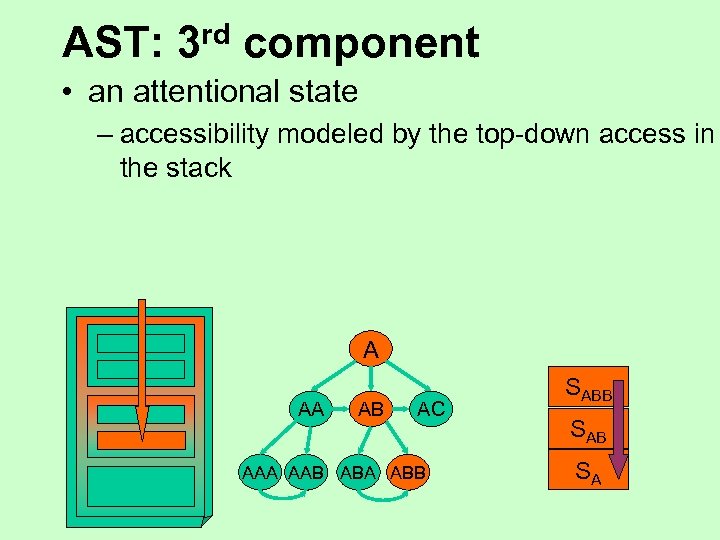 AST: rd 3 component • an attentional state – accessibility modeled by the top-down access in the stack A AA AB AC AAA AAB ABA ABB SAB SA
 AST explains interruptions E: Now attach the pull rope to the top of the engine. By the way, did you buy gasoline today? A: Yes. I got some when I bought the new lawnmower wheel. I forgot to take the gas with me, so I bought a new one. E: Did it cost much? A: No, and we could use another anyway to keep with the tractor. E: OK, how far have you got? Did you get it attached? from (Allen, 1987) An interruption is a discourse segment whose DSP is not dominated nor satisfaction-preceded by the DSP of the immediately proceeding segment.
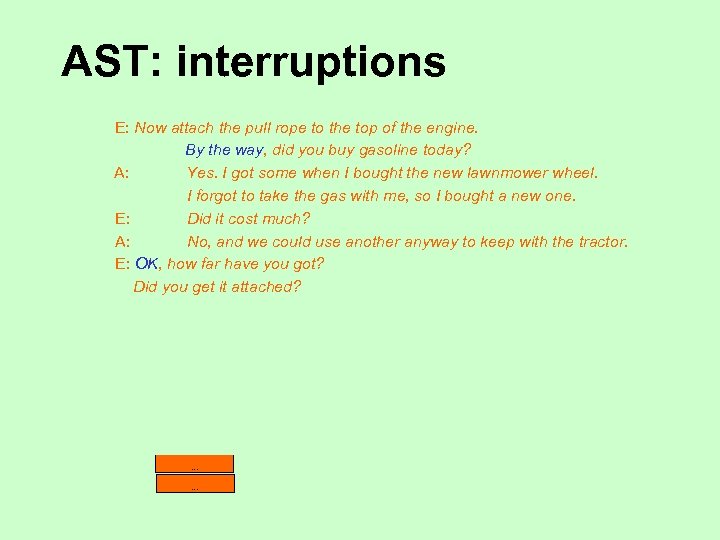 AST: interruptions E: Now attach the pull rope to the top of the engine. By the way, did you buy gasoline today? A: Yes. I got some when I bought the new lawnmower wheel. I forgot to take the gas with me, so I bought a new one. E: Did it cost much? A: No, and we could use another anyway to keep with the tractor. E: OK, how far have you got? Did you get it attached? … …
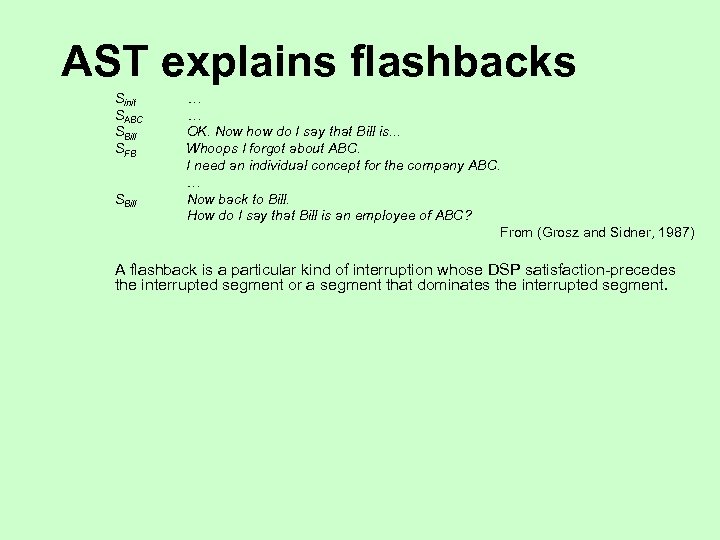 AST explains flashbacks Sinit SABC SBill SFB SBill … … OK. Now how do I say that Bill is. . . Whoops I forgot about ABC. I need an individual concept for the company ABC. … Now back to Bill. How do I say that Bill is an employee of ABC? From (Grosz and Sidner, 1987) A flashback is a particular kind of interruption whose DSP satisfaction-precedes the interrupted segment or a segment that dominates the interrupted segment.
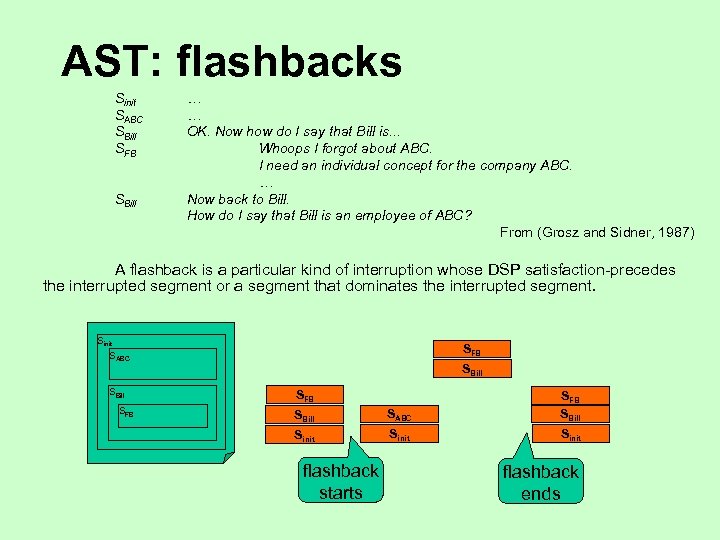 AST: flashbacks Sinit SABC SBill SFB SBill … … OK. Now how do I say that Bill is. . . Whoops I forgot about ABC. I need an individual concept for the company ABC. … Now back to Bill. How do I say that Bill is an employee of ABC? From (Grosz and Sidner, 1987) A flashback is a particular kind of interruption whose DSP satisfaction-precedes the interrupted segment or a segment that dominates the interrupted segment. Sinit SABC SBill SFB SFB SBill SABC SBill Sinit flashback starts flashback ends
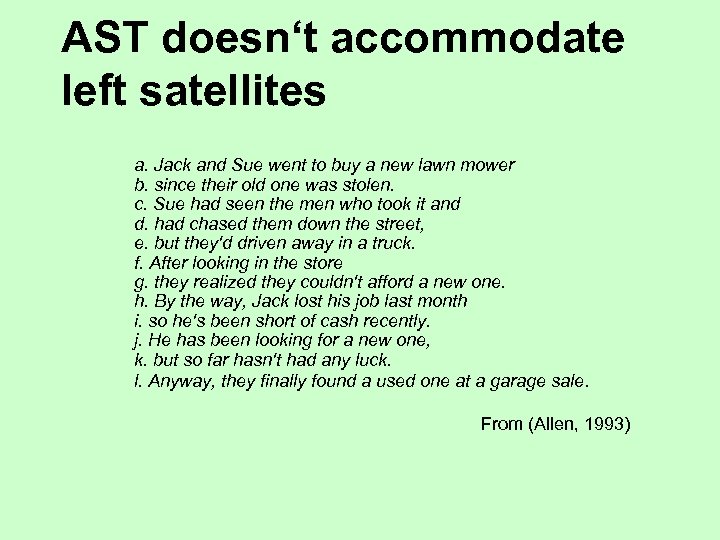 AST doesn‘t accommodate left satellites a. Jack and Sue went to buy a new lawn mower b. since their old one was stolen. c. Sue had seen the men who took it and d. had chased them down the street, e. but they'd driven away in a truck. f. After looking in the store g. they realized they couldn't afford a new one. h. By the way, Jack lost his job last month i. so he's been short of cash recently. j. He has been looking for a new one, k. but so far hasn't had any luck. l. Anyway, they finally found a used one at a garage sale. From (Allen, 1993)
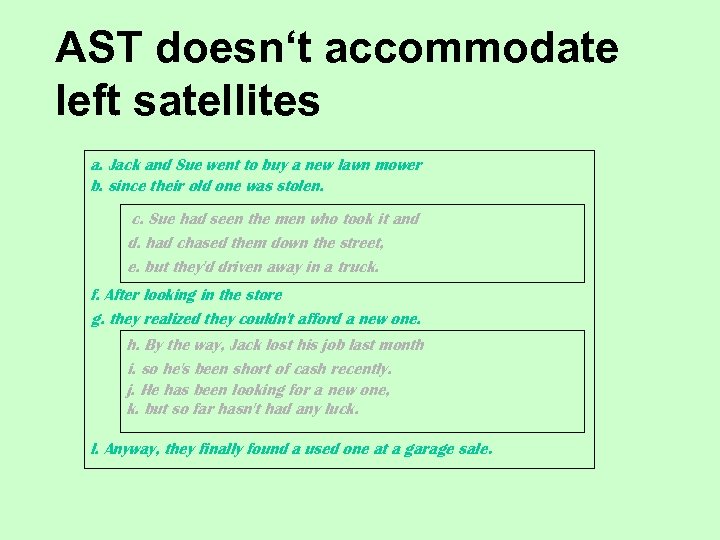 AST doesn‘t accommodate left satellites a. Jack and Sue went to buy a new lawn mower b. since their old one was stolen. c. Sue had seen the men who took it and d. had chased them down the street, e. but they'd driven away in a truck. f. After looking in the store g. they realized they couldn't afford a new one. h. By the way, Jack lost his job last month i. so he's been short of cash recently. j. He has been looking for a new one, k. but so far hasn't had any luck. l. Anyway, they finally found a used one at a garage sale.
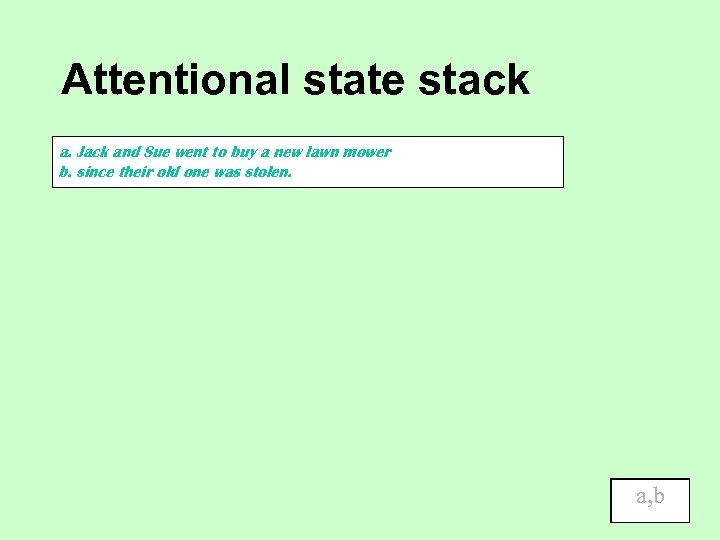 Attentional state stack a. Jack and Sue went to buy a new lawn mower b. since their old one was stolen. aa, b
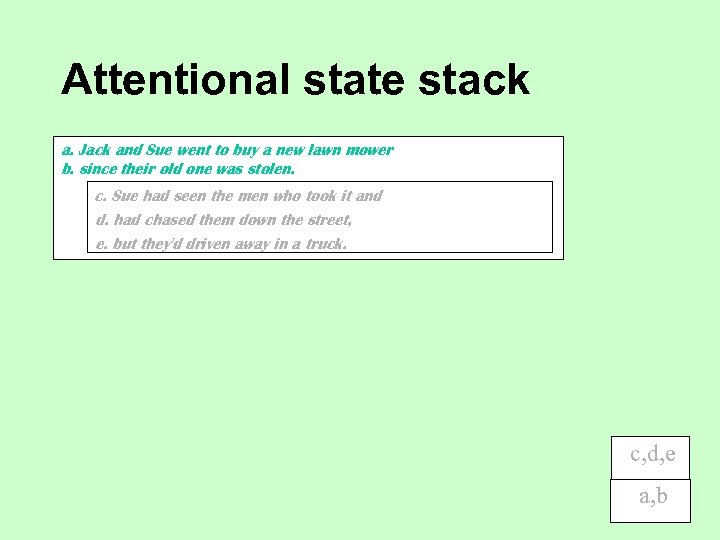 Attentional state stack a. Jack and Sue went to buy a new lawn mower b. since their old one was stolen. c. Sue had seen the men who took it and d. had chased them down the street, e. but they'd driven away in a truck. c, d, e a, b
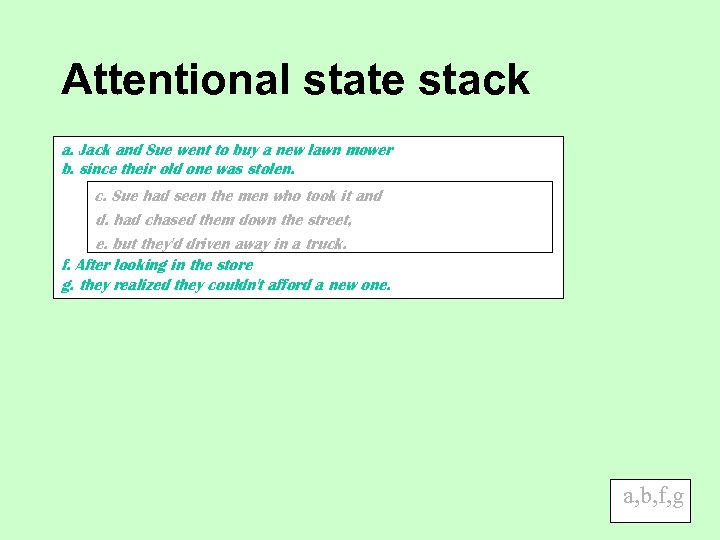 Attentional state stack a. Jack and Sue went to buy a new lawn mower b. since their old one was stolen. c. Sue had seen the men who took it and d. had chased them down the street, e. but they'd driven away in a truck. f. After looking in the store g. they realized they couldn't afford a new one. a, b, f, g
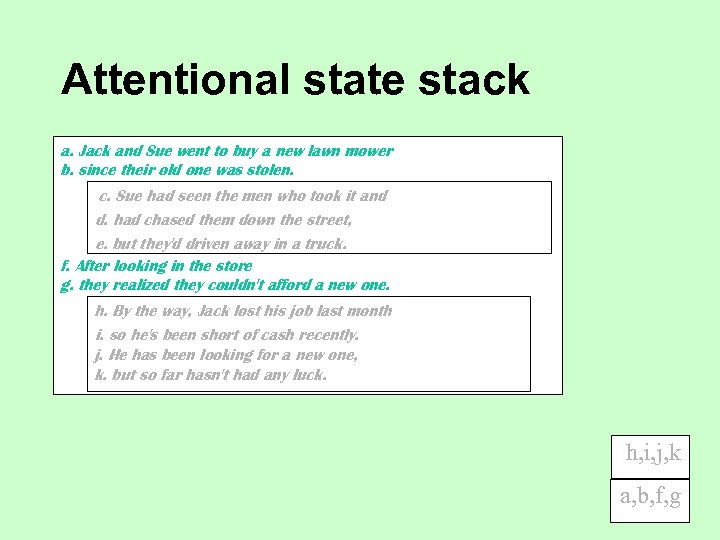 Attentional state stack a. Jack and Sue went to buy a new lawn mower b. since their old one was stolen. c. Sue had seen the men who took it and d. had chased them down the street, e. but they'd driven away in a truck. f. After looking in the store g. they realized they couldn't afford a new one. h. By the way, Jack lost his job last month i. so he's been short of cash recently. j. He has been looking for a new one, k. but so far hasn't had any luck. h, i, j, k a, b, f, g
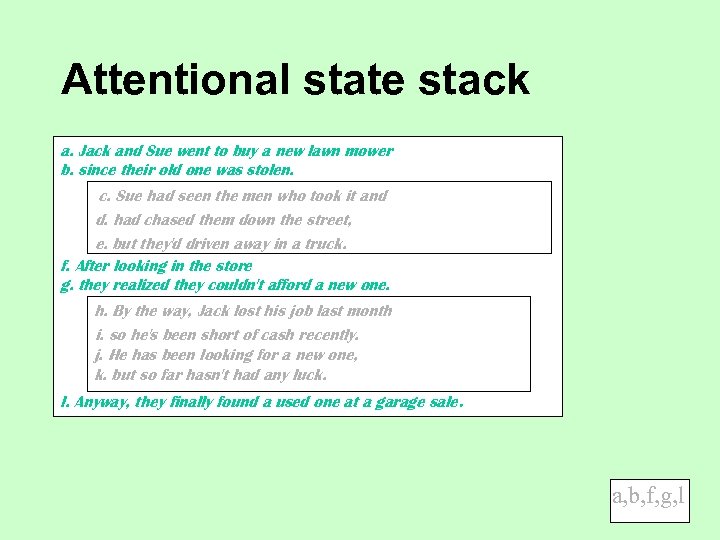 Attentional state stack a. Jack and Sue went to buy a new lawn mower b. since their old one was stolen. c. Sue had seen the men who took it and d. had chased them down the street, e. but they'd driven away in a truck. f. After looking in the store g. they realized they couldn't afford a new one. h. By the way, Jack lost his job last month i. so he's been short of cash recently. j. He has been looking for a new one, k. but so far hasn't had any luck. l. Anyway, they finally found a used one at a garage sale. a, b, f, g, l
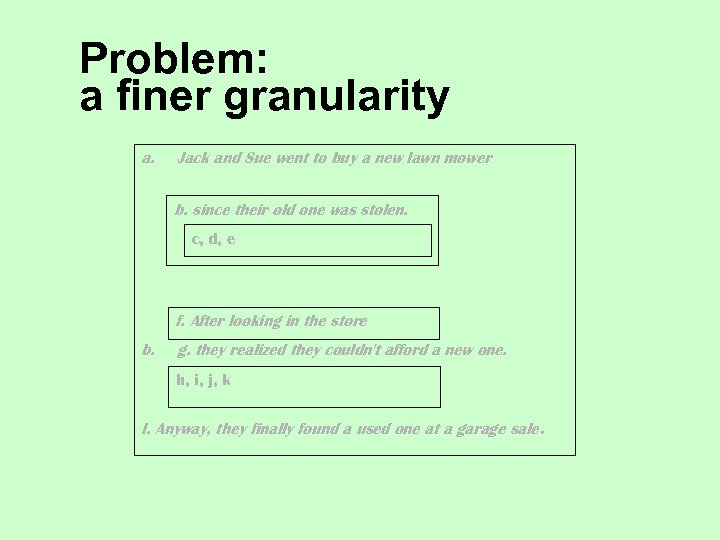 Problem: a finer granularity a. Jack and Sue went to buy a new lawn mower b. since their old one was stolen. c, d, e f. After looking in the store b. g. they realized they couldn't afford a new one. h, i, j, k l. Anyway, they finally found a used one at a garage sale.
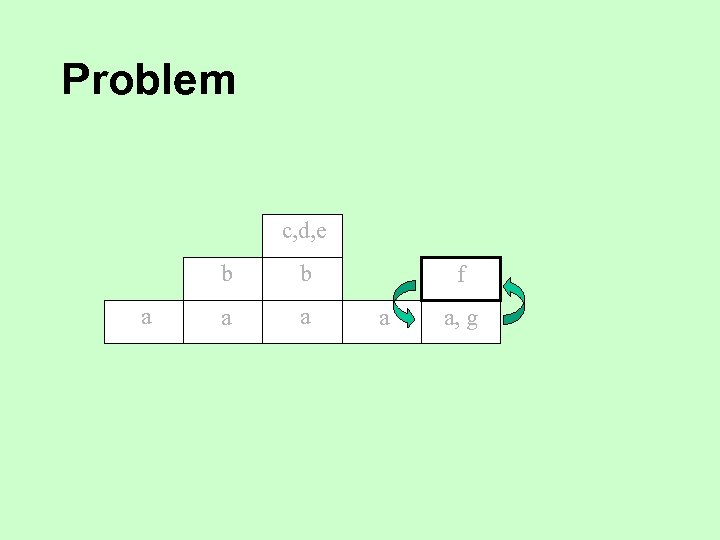 Problem c, d, e b a a f a a, g
 AST: pluses • Discourse structure: – a proposal for discourse structure – stack behavior models hierarchical relationships among text segments • Reference: accounted for by accessibility in the stack • Explains interruptions • Explains flash-backs
 AST: minuses Stack mechanism fails for certain dominant/dominated segment configurations when granularity is sufficiently fine Does not accommodate left satellites The stack model is impurified with an artificial border (in treating interruptions) Do we have an additional memory from where states have to be restored (in treating flashbacks)?
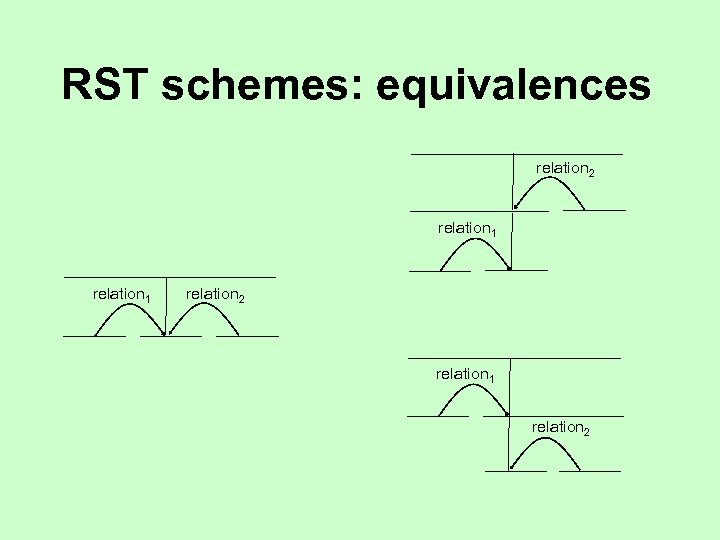
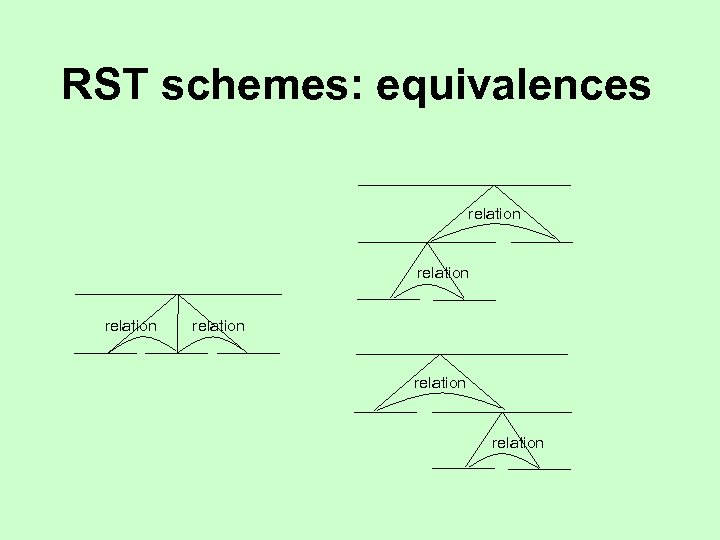
 Rhetorical structure theory (William Mann and Sandra Thompson, 1987) Basics • text span: un uninterrupted linear interval of text • relation: holds between two or more non-overlapping spans • arguments of relations are of a nuclear type and a satellite type – a nucleus is more important than a satellite (deletion and substitution tests) – relations: hypotactic (one nucleus + satellites) and paratactic (all nuclear) • scheme: integrates by a relation two or more text spans (like grammar rules) • RST analysis are trees • they reflect a judge interpretation (therefore could be subjective)
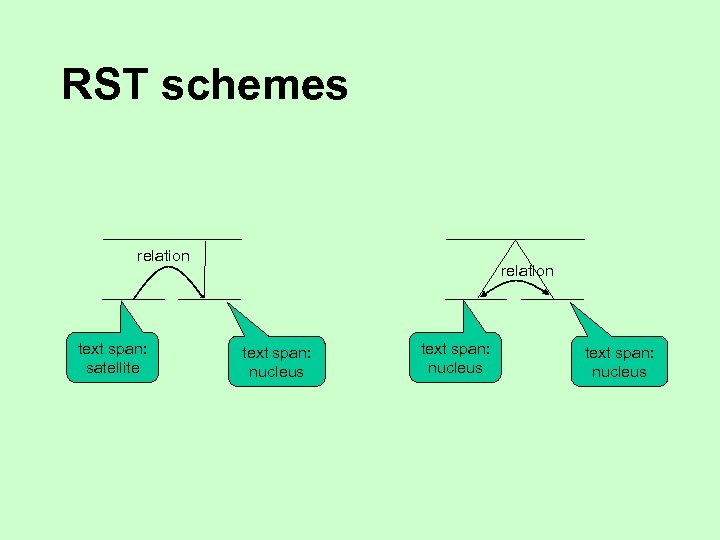 RST schemes relation text span: satellite relation text span: nucleus
 RST schemes: equivalences relation 2 relation 1 relation 2
 RST schemes: equivalences relation relation
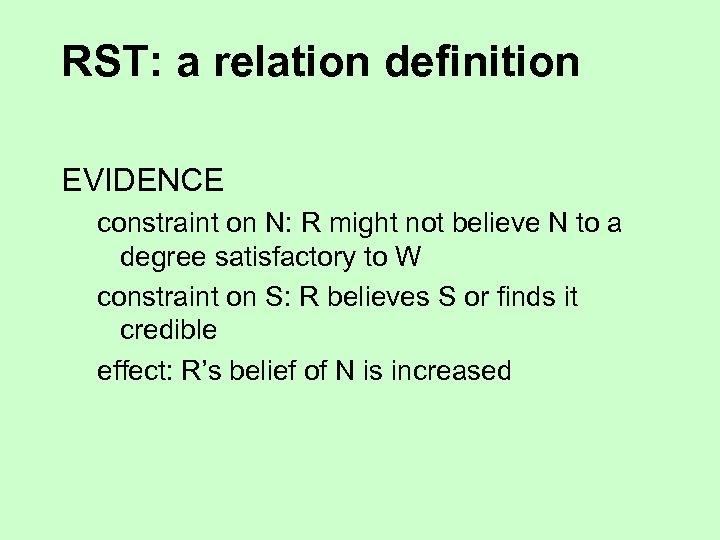 RST: a relation definition EVIDENCE constraint on N: R might not believe N to a degree satisfactory to W constraint on S: R believes S or finds it credible effect: R’s belief of N is increased
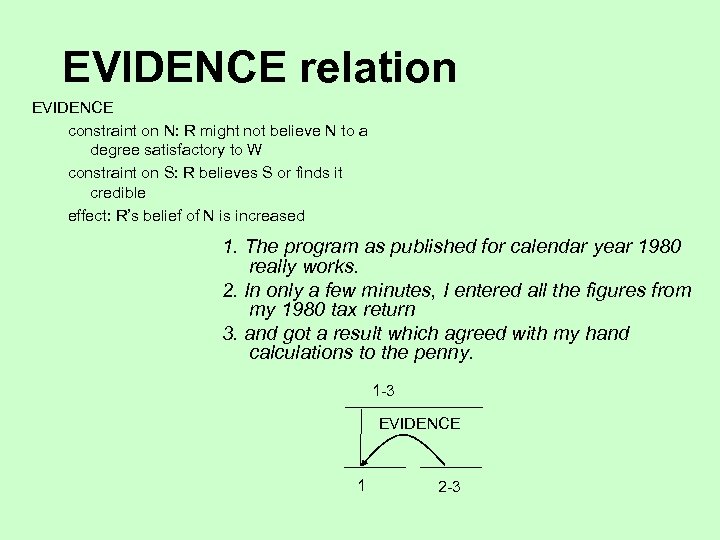 EVIDENCE relation EVIDENCE constraint on N: R might not believe N to a degree satisfactory to W constraint on S: R believes S or finds it credible effect: R’s belief of N is increased 1. The program as published for calendar year 1980 really works. 2. In only a few minutes, I entered all the figures from my 1980 tax return 3. and got a result which agreed with my hand calculations to the penny. 1 -3 EVIDENCE 1 2 -3
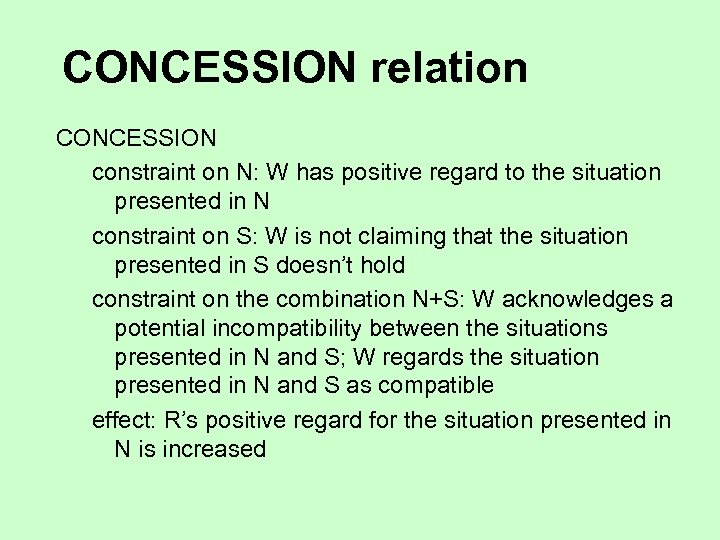 CONCESSION relation CONCESSION constraint on N: W has positive regard to the situation presented in N constraint on S: W is not claiming that the situation presented in S doesn’t hold constraint on the combination N+S: W acknowledges a potential incompatibility between the situations presented in N and S; W regards the situation presented in N and S as compatible effect: R’s positive regard for the situation presented in N is increased
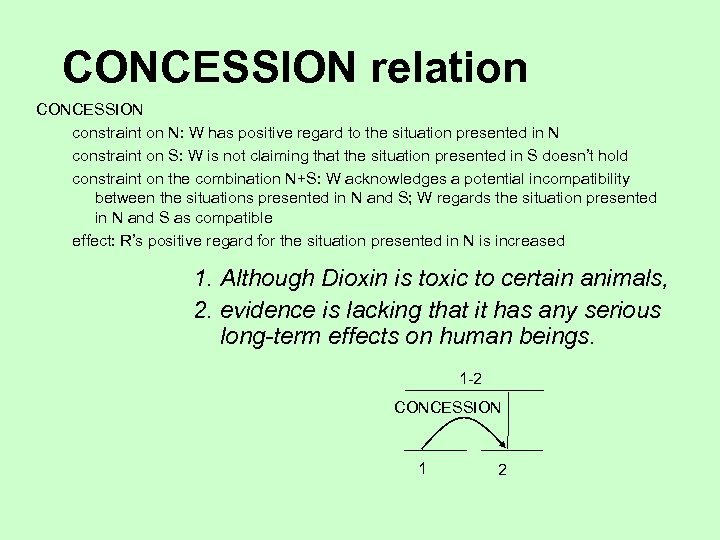 CONCESSION relation CONCESSION constraint on N: W has positive regard to the situation presented in N constraint on S: W is not claiming that the situation presented in S doesn’t hold constraint on the combination N+S: W acknowledges a potential incompatibility between the situations presented in N and S; W regards the situation presented in N and S as compatible effect: R’s positive regard for the situation presented in N is increased 1. Although Dioxin is toxic to certain animals, 2. evidence is lacking that it has any serious long-term effects on human beings. 1 -2 CONCESSION 1 2
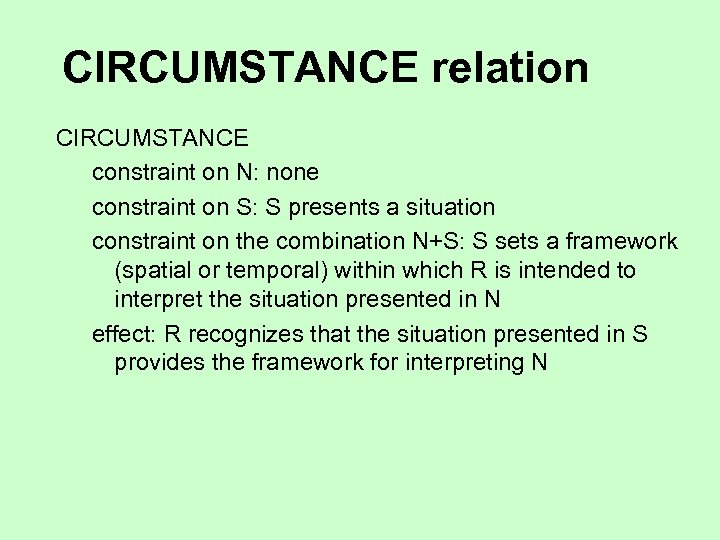 CIRCUMSTANCE relation CIRCUMSTANCE constraint on N: none constraint on S: S presents a situation constraint on the combination N+S: S sets a framework (spatial or temporal) within which R is intended to interpret the situation presented in N effect: R recognizes that the situation presented in S provides the framework for interpreting N
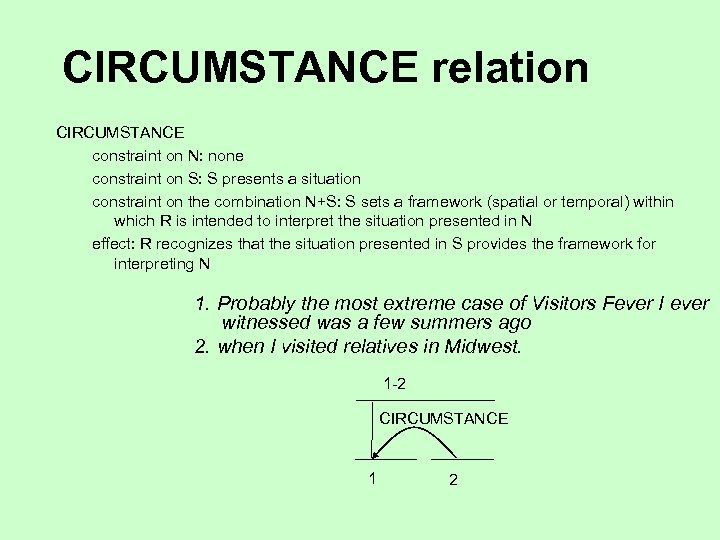 CIRCUMSTANCE relation CIRCUMSTANCE constraint on N: none constraint on S: S presents a situation constraint on the combination N+S: S sets a framework (spatial or temporal) within which R is intended to interpret the situation presented in N effect: R recognizes that the situation presented in S provides the framework for interpreting N 1. Probably the most extreme case of Visitors Fever I ever witnessed was a few summers ago 2. when I visited relatives in Midwest. 1 -2 CIRCUMSTANCE 1 2
 A more complex example 1. Farmington Police had to help control traffic recently 2. when hundreds of people lined up to be among the first applying for jobs at the yet-to-open Marriot Hotel. 3. The hotel’s help-wanted announcement – for 300 openings – was a rare opportunity for many unemployed. 4. The people waiting in line carried a message of claims that the jobless could be employed if only they showed enough moxie. 5. Every rule has exceptions, 6. but the tragic and too-common tableaux of hundreds of people snake-lining up for any task with a paycheck illustrates a lack of jobs, 7 not laziness.
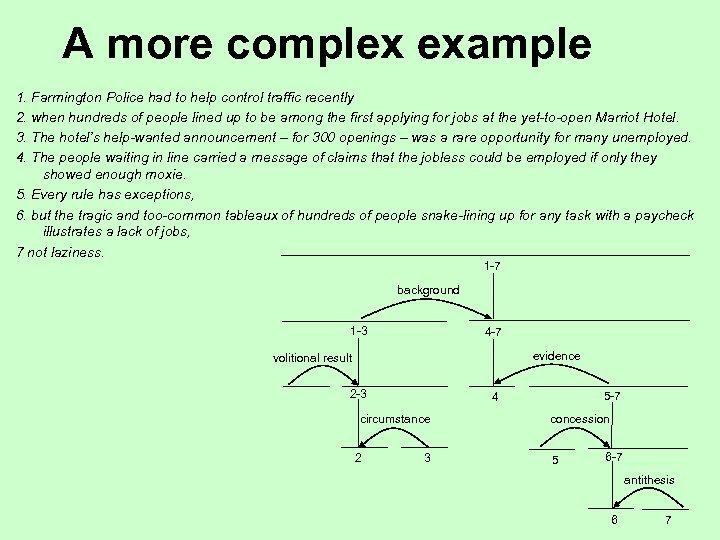 A more complex example 1. Farmington Police had to help control traffic recently 2. when hundreds of people lined up to be among the first applying for jobs at the yet-to-open Marriot Hotel. 3. The hotel’s help-wanted announcement – for 300 openings – was a rare opportunity for many unemployed. 4. The people waiting in line carried a message of claims that the jobless could be employed if only they showed enough moxie. 5. Every rule has exceptions, 6. but the tragic and too-common tableaux of hundreds of people snake-lining up for any task with a paycheck illustrates a lack of jobs, 7 not laziness. 1 -7 background 1 -3 4 -7 evidence volitional result 2 -3 circumstance 2 5 -7 4 3 concession 5 6 -7 antithesis 6 7
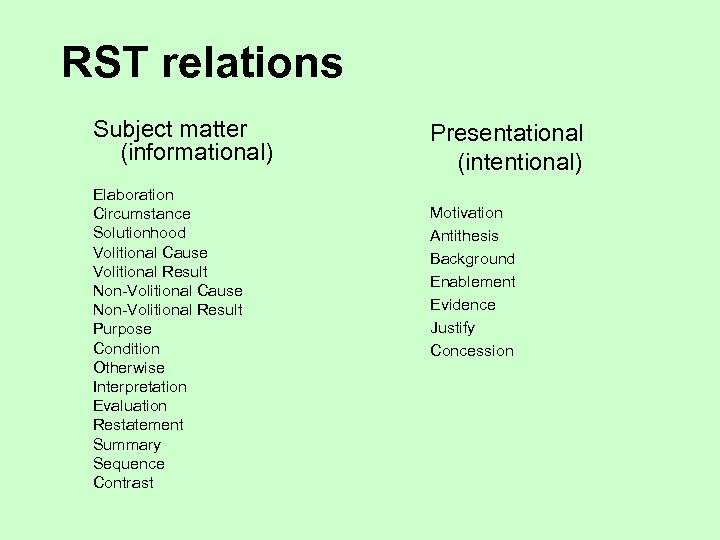 RST relations Subject matter (informational) Elaboration Circumstance Solutionhood Volitional Cause Volitional Result Non-Volitional Cause Non-Volitional Result Purpose Condition Otherwise Interpretation Evaluation Restatement Summary Sequence Contrast Presentational (intentional) Motivation Antithesis Background Enablement Evidence Justify Concession
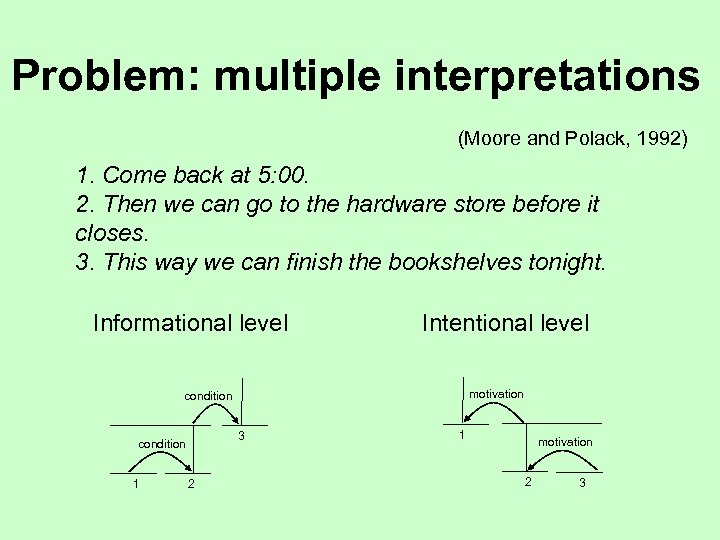 Problem: multiple interpretations (Moore and Polack, 1992) 1. Come back at 5: 00. 2. Then we can go to the hardware store before it closes. 3. This way we can finish the bookshelves tonight. Informational level Intentional level motivation condition 3 condition 1 2 1 motivation 2 3
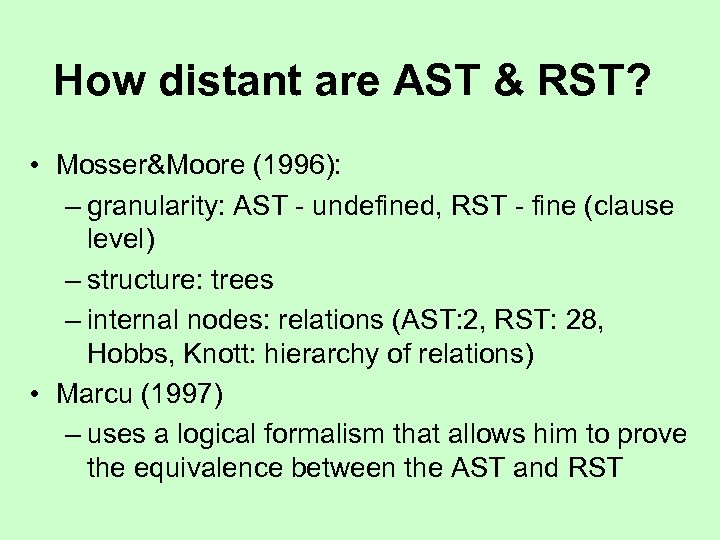 How distant are AST & RST? • Mosser&Moore (1996): – granularity: AST - undefined, RST - fine (clause level) – structure: trees – internal nodes: relations (AST: 2, RST: 28, Hobbs, Knott: hierarchy of relations) • Marcu (1997) – uses a logical formalism that allows him to prove the equivalence between the AST and RST
 RST bibliography or related readings Mann, W. and Thompson, S. (1987): Rhetorical Structure Theory Moore and Polack (1992): A problem for RST: The need for multilevel discourse analysis Mosser and Moore (1996): Towards a synthesis of two accounts of discourse structure Hobbs Jerry – a lot of writings on discourse coherence, but see also the abductive model Knott Alistair: his Ph. D thesis Marcu, D. (1997): The rhetorical parsing of natural language texts Marcu, D. (2000): The theory and practice of discourse parsing and summarization, The MIT Press Carlson, L. , Marcu, D. and Okurowski, M. E. (2003): Building a doscourse-tagged corpus in the framework of Rhetorical Structure Theory.