


 Скачать презентацию Curriculum Design and Special Features of Chinese For
4b30c8bf0c0ffb49e4dfaaf96303ef40.ppt
- Количество слайдов: 34
 Curriculum Design and Special Features of Chinese For Tomorrow Computer Chinese Textbook & Teacher’s Manual Wayne He 何文潮 Wenchao_he@hotmail. com
 I. Computer Chinese (CC) “Computer Chinese (CC)” method starts out by emphasizing the use of Pinyin to teach students how to recognize and write Chinese characters on the computer. This allows students to use the language in a practical and engaging way very early on in their studies.
 Computer Chinese (CC) 2 The guiding principal of CC is that students at the beginning level (Volume 1) use computer input as the focus of their learning, supplemented by character handwriting. At the intermediate stage (Volume 2), students continue to focus on computer input, but gradually increase their handwriting skills; and at the advanced level (Volume 3), handwriting will become the focus, supplemented by computer input.
 The major difference between CC and traditional approaches • The major difference between CC approach and traditional approaches is that our course allows students to more gradually develop their skills at writing Chinese characters by hand, rather than requiring them to memorize how to write large numbers of characters while they are still struggling to grasp the basics of the language.
 Why should we use CC? (1) • Chinese teachers have long realized the high degree of anxiety that learning Chinese characters causes for their students, and this has forced many to de-emphasize literacy skills for lower level students, and to focus instead on speaking and listening skills, writing only in Pinyin. But it does not get around the very real fact that Chinese books, newspapers, magazines, and even street signs, are written in Chinese characters, and that Pinyin is nothing more than a phonological tool.
 Why should we use CC? (2) Students who used the computer to learn vocabulary items simply processed them more quickly and remembered them better. Through our teaching and testing experience, we have found that students using the CC method were able to learn more new words and their reading and writing (composition) skills are much stronger than those with traditional approach. They can use internet resources and on-line tools in learning and communication.
 The Advantages Of CC • Learning to input Pinyin is much like inputting English; if you can say it, you can write it. • It integrates reading and writing. The method saves time, as students only need to recognize Chinese characters, and do not need to write them stroke by stroke, and rapidly increases students’ reading ability. • Using an online Chinese language dictionary makes looking up words incredibly easy, giving even first year students the ability to read a wide range of materials and even surf the Internet in Chinese.
 The Advantages Of CC (2) • CC approach increases the students’ ability to write; even first year students can begin to write compositions--and what they are writing is characters, not just Pinyin. • Students are able to use internet resources and communicate through email and other echannels. • The most important advantage of computer input is that it gets rid of the psychological barrier that Chinese is difficult to learn and increases the confidence of students.
 Do the students need to write Chinese characters by hand at all? § Typing and handwriting can and must complement one another in the process of learning Chinese. § Computer typing and handwriting are two distinct language skills, both of which serve the same written communication purpose. § Writing Chinese characters by hand helps students develop an appreciation for the ways in which characters are structured and helps many students to recognize and remember new words. § Learning how to write a small number of characters by the beginning students is helpful to build up their literacy skills. But the number should be strictly limited. § CC method should be used to deal with majority of the characters by the beginning students.
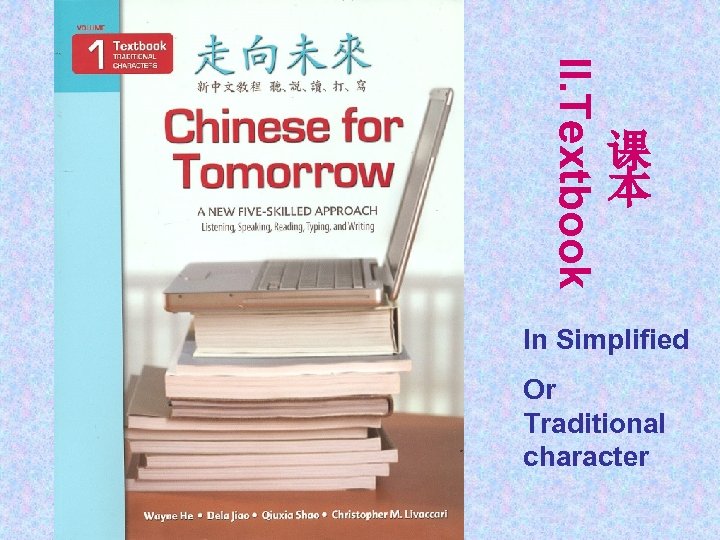 II. Textbook 课 本 In Simplified Or Traditional character
 What Made CFT Different from Other Textbooks on Market • Designed for Computer Chinese approach • It is communication based, not grammar based like most of other textbooks • Treat grammar in a different way • Combine language with culture • Comparison between American and Chinese campus life • The series teaches language that is useful, interesting, natural, and relevant to daily life
 Introduction • 中文介绍 Introduction to the Chinese Language • 拼音系统 The Chinese Pronunciation System • Section 1: Introduction to Mandarin Chinese Pronunciation • Section 2: Finals, Initials and Tones • Section 3: Compound Finals and Special Finals • 汉字系统 The Chinese Writing System • 电脑输入中文 Computer Input in Chinese
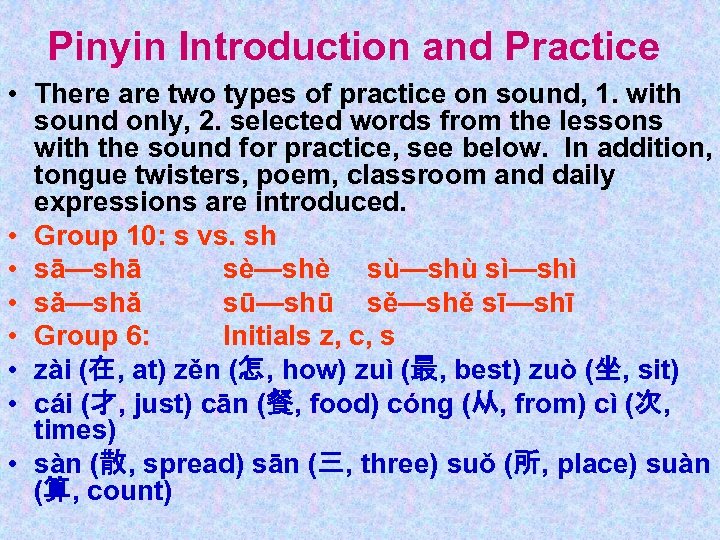 Pinyin Introduction and Practice • There are two types of practice on sound, 1. with sound only, 2. selected words from the lessons with the sound for practice, see below. In addition, tongue twisters, poem, classroom and daily expressions are introduced. • Group 10: s vs. sh • sā—shā sè—shè sù—shù sì—shì • sǎ—shǎ sū—shū sě—shě sī—shī • Group 6: Initials z, c, s • zài (在, at) zěn (怎, how) zuì (最, best) zuò (坐, sit) • cái (才, just) cān (餐, food) cóng (从, from) cì (次, times) • sàn (散, spread) sān (三, three) suǒ (所, place) suàn (算, count)
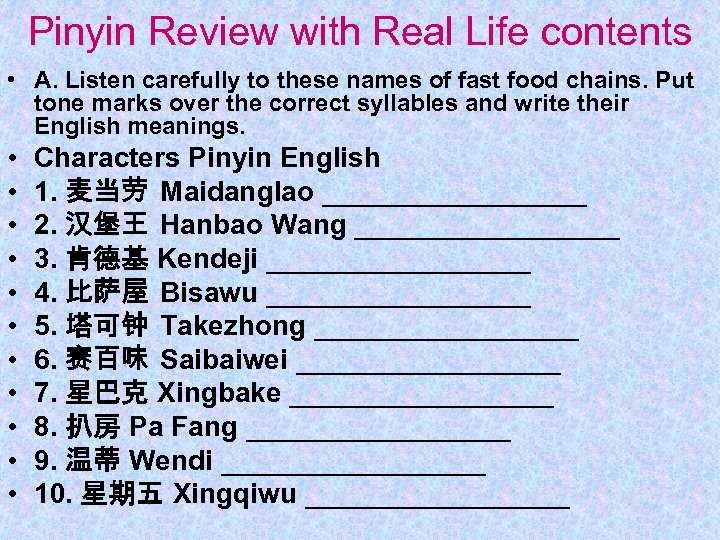 Pinyin Review with Real Life contents • A. Listen carefully to these names of fast food chains. Put tone marks over the correct syllables and write their English meanings. • • • Characters Pinyin English 1. 麦当劳 Maidanglao _________ 2. 汉堡王 Hanbao Wang _________ 3. 肯德基 Kendeji _________ 4. 比萨屋 Bisawu _________ 5. 塔可钟 Takezhong _________ 6. 赛百味 Saibaiwei _________ 7. 星巴克 Xingbake _________ 8. 扒房 Pa Fang _________ 9. 温蒂 Wendi _________ 10. 星期五 Xingqiwu _________
 Computer Input in Chinese
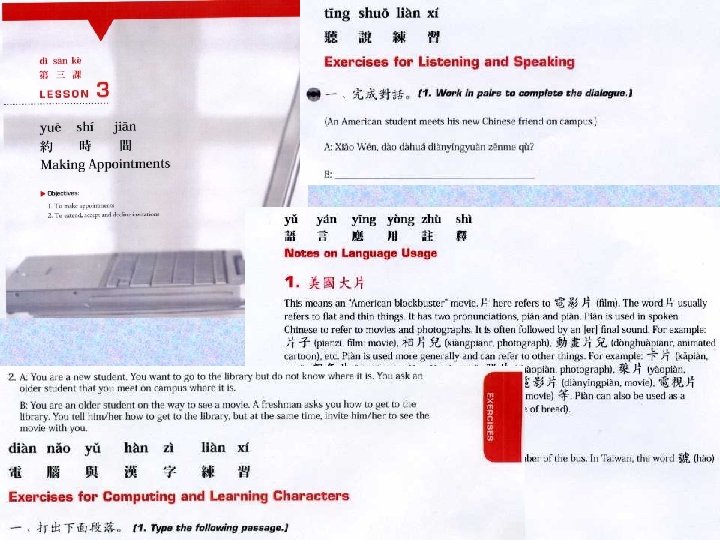
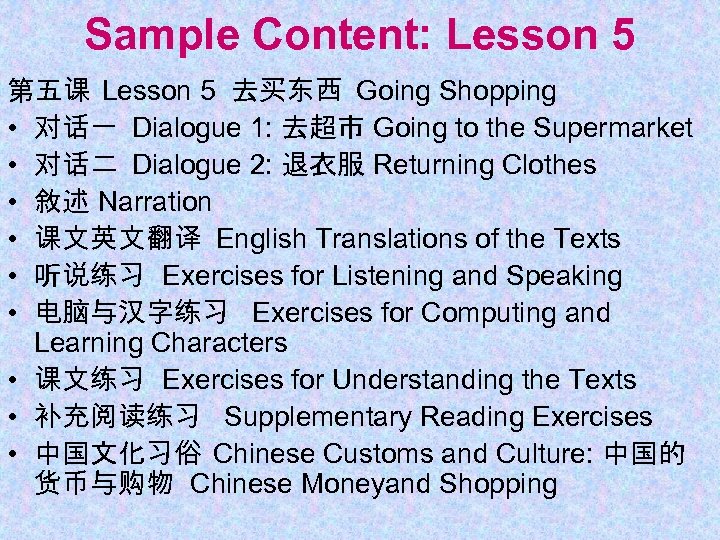 Sample Content: Lesson 5 第五课 Lesson 5 去买东西 Going Shopping • 对话一 Dialogue 1: 去超市 Going to the Supermarket • 对话二 Dialogue 2: 退衣服 Returning Clothes • 敘述 Narration • 课文英文翻译 English Translations of the Texts • 听说练习 Exercises for Listening and Speaking • 电脑与汉字练习 Exercises for Computing and Learning Characters • 课文练习 Exercises for Understanding the Texts • 补充阅读练习 Supplementary Reading Exercises • 中国文化习俗 Chinese Customs and Culture: 中国的 货币与购物 Chinese Moneyand Shopping
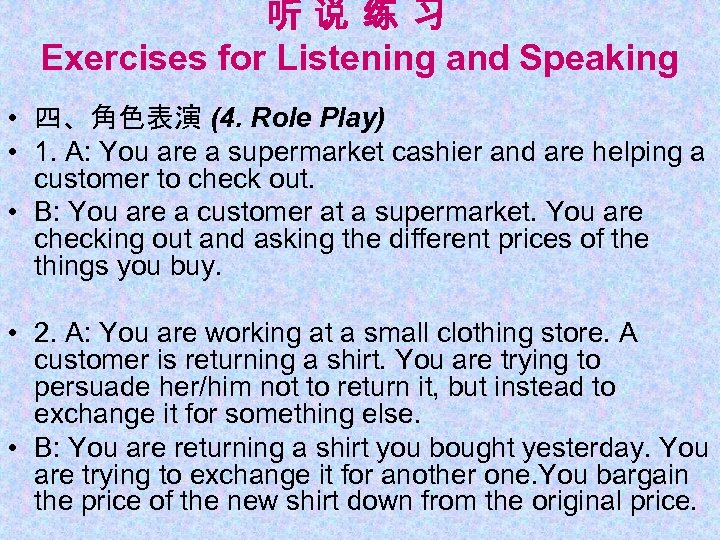 听说 练 习 Exercises for Listening and Speaking • 四、角色表演 (4. Role Play) • 1. A: You are a supermarket cashier and are helping a customer to check out. • B: You are a customer at a supermarket. You are checking out and asking the different prices of the things you buy. • 2. A: You are working at a small clothing store. A customer is returning a shirt. You are trying to persuade her/him not to return it, but instead to exchange it for something else. • B: You are returning a shirt you bought yesterday. You are trying to exchange it for another one. You bargain the price of the new shirt down from the original price.
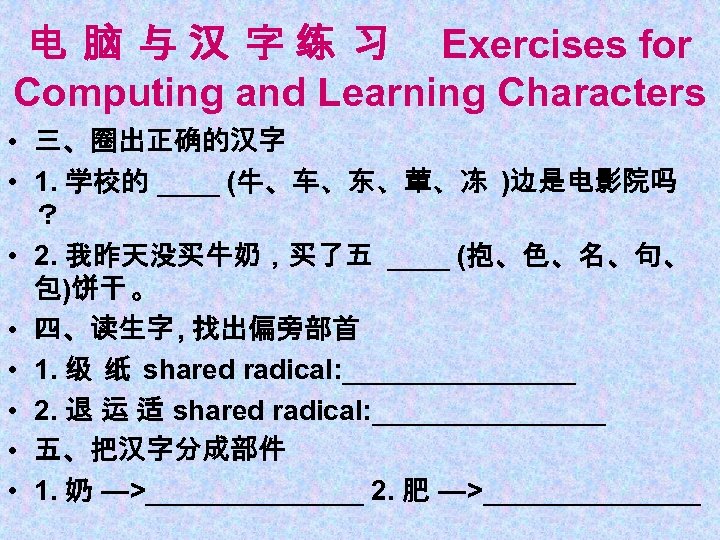 电 脑 与 汉 字 练 习 Exercises for Computing and Learning Characters • 三、圈出正确的汉字 • 1. 学校的 ____ (牛、车、东、莗、冻 )边是电影院吗 ? • 2. 我昨天没买牛奶,买了五 ____ (抱、色、名、句、 包)饼干 。 • 四、读生字 , 找出偏旁部首 • 1. 级 纸 shared radical: ________ • 2. 退 运 适 shared radical: ________ • 五、把汉字分成部件 • 1. 奶 —>_______ 2. 肥 —>_______
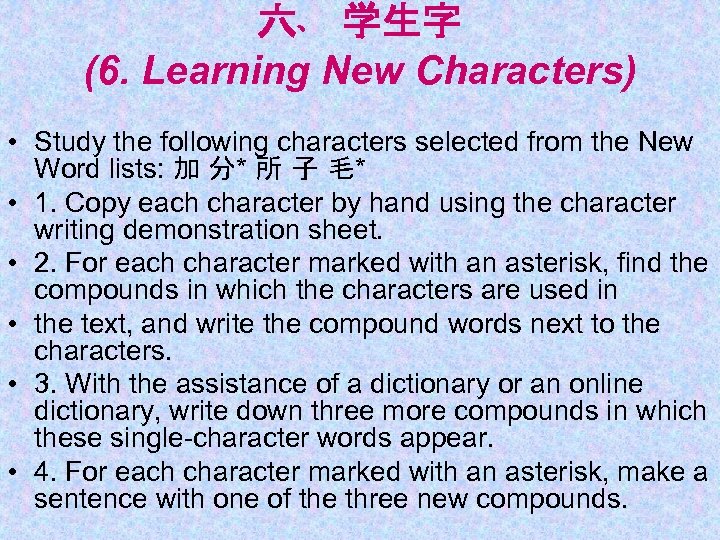 六﹑ 学生字 (6. Learning New Characters) • Study the following characters selected from the New Word lists: 加 分* 所 子 毛* • 1. Copy each character by hand using the character writing demonstration sheet. • 2. For each character marked with an asterisk, find the compounds in which the characters are used in • the text, and write the compound words next to the characters. • 3. With the assistance of a dictionary or an online dictionary, write down three more compounds in which these single-character words appear. • 4. For each character marked with an asterisk, make a sentence with one of the three new compounds.
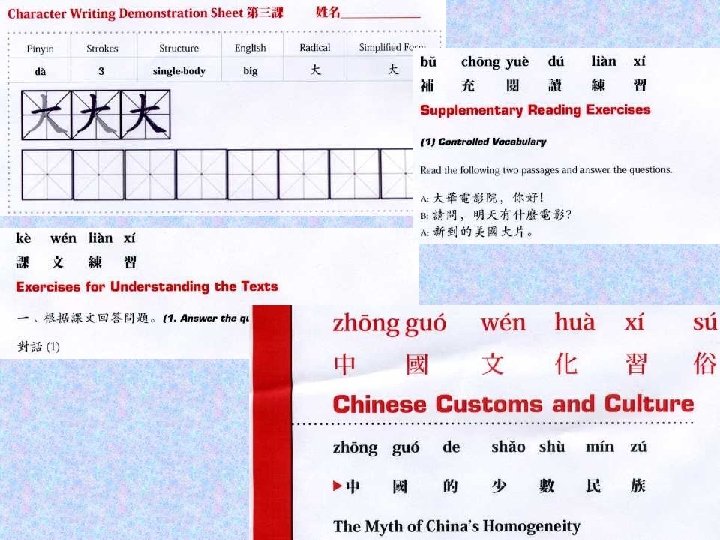
 Character Writing Demonstration Sheet 第六課 姓名_______
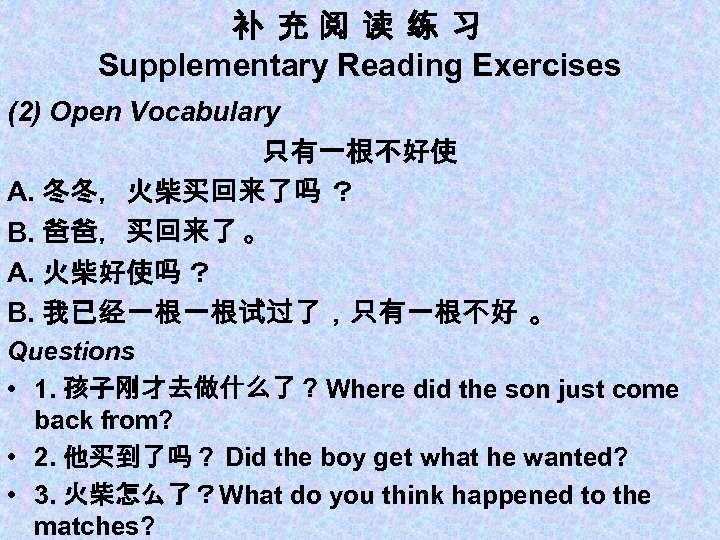 补 充阅 读 练 习 Supplementary Reading Exercises (2) Open Vocabulary 只有一根不好使 A. 冬冬,火柴买回来了吗 ? B. 爸爸,买回来了 。 A. 火柴好使吗 ? B. 我已经一根一根试过了,只有一根不好 。 Questions • 1. 孩子刚才去做什么了? Where did the son just come back from? • 2. 他买到了吗? Did the boy get what he wanted? • 3. 火柴怎么了?What do you think happened to the matches?
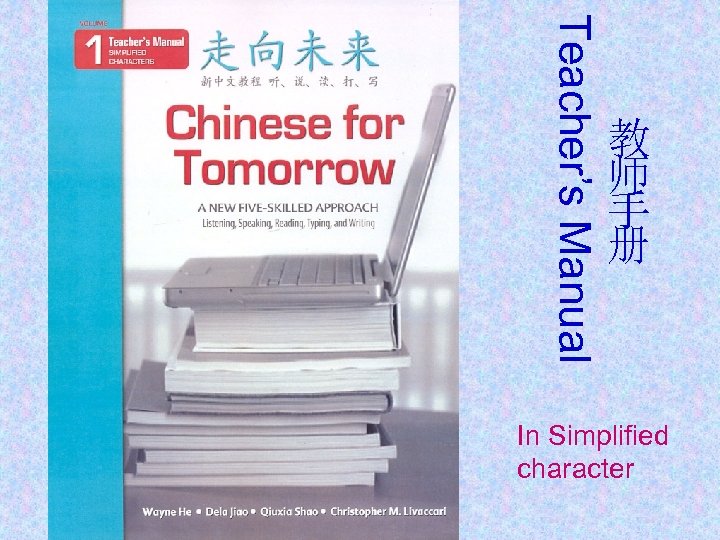 Teacher’s Manual 教 师 手 册 In Simplified character
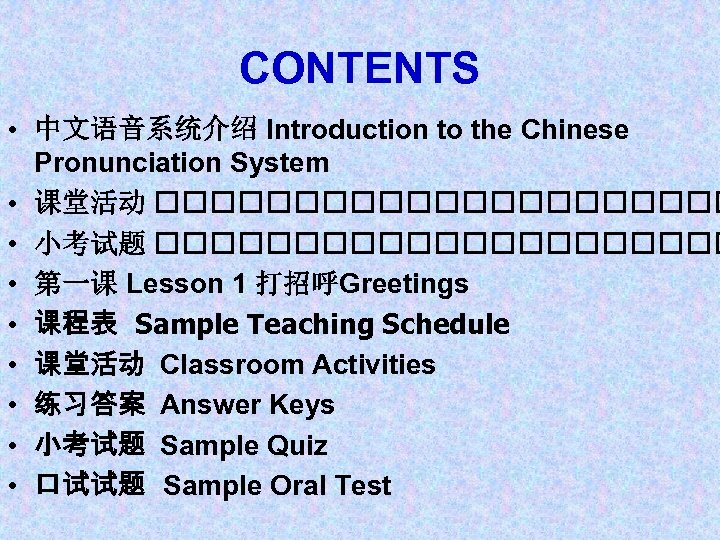 CONTENTS • 中文语音系统介绍 Introduction to the Chinese Pronunciation System • 课堂活动 • 小考试题 • 第一课 Lesson 1 打招呼Greetings • 课程表 Sample Teaching Schedule • 课堂活动 Classroom Activities • 练习答案 Answer Keys • 小考试题 Sample Quiz • 口试试题 Sample Oral Test
 去 购 物 Going Shopping
 Lab Session & Homework
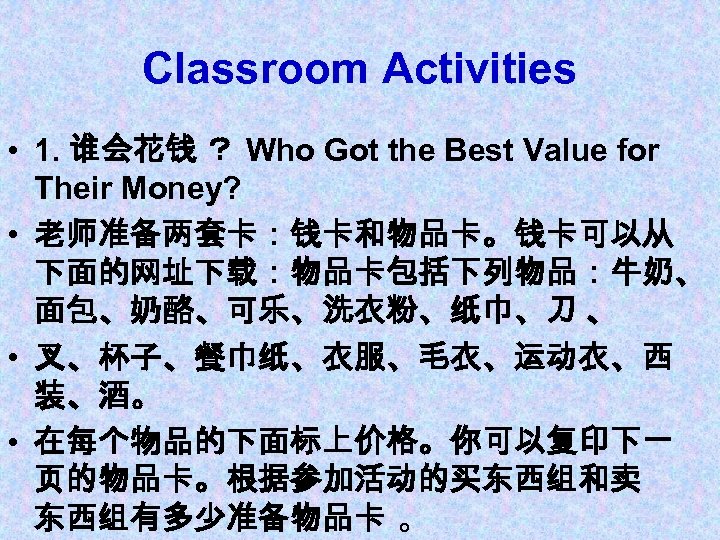 Classroom Activities • 1. 谁会花钱 ? Who Got the Best Value for Their Money? • 老师准备两套卡:钱卡和物品卡。钱卡可以从 下面的网址下载:物品卡包括下列物品:牛奶、 面包、奶酪、可乐、洗衣粉、纸巾、刀 、 • 叉、杯子、餐巾纸、衣服、毛衣、运动衣、西 装、酒。 • 在每个物品的下面标上价格。你可以复印下一 页的物品卡。根据参加活动的买东西组和卖 东西组有多少准备物品卡 。
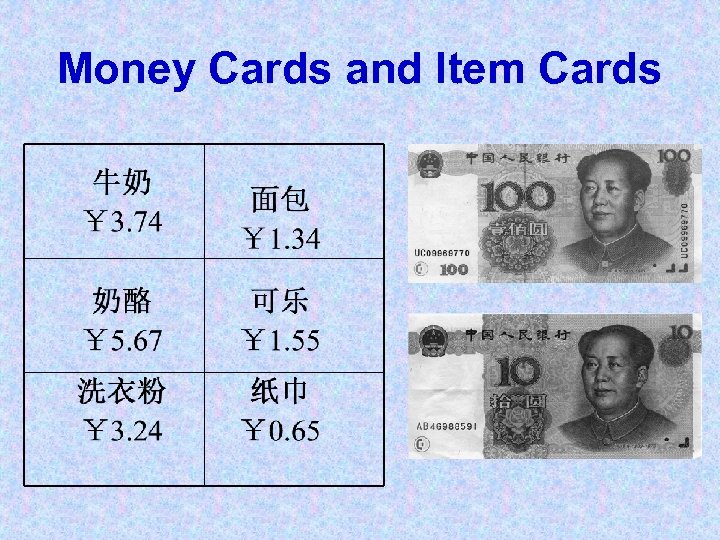 Money Cards and Item Cards
 练习答案 Answer Keys 听说练习 Exercises for Listening and Speaking 一﹑ 完成对话 。 (1. Work in pairs to complete the dialogue. ) • 对话样例 Reference Sample Dialogue • 甲:你去哪儿了? • 乙: 我去超市了。 • 甲:你买了什么好吃的 ? • 乙: 我买了牛奶和可乐 。 • 甲:你还买了什么 ? • 乙: 面包。 • 甲:面包多少钱 ? • 乙: 一块钱一个 。 • 甲:那可乐呢 ?
 Four. 小考试题Sample Quiz • I. Character recognition: • A. Circle the right character to fill in the blanks. 10% • 1. 你从这个校门出去﹐ 往____ (车﹐ 栋﹐ 童﹐ 东)一转就 到电影院了。 • B: Put Pinyin and English meaning next to the Chinese expressions 12% • 1. 东西_____ 2. 奶酪_______ • II. Answer the following questions 15% • 1. 请问您为什么要退这件运动服﹖ • III. Choose the correct words from the list to fill in the blanks. 8% • IV. Translate the following sentences into Chinese 25% • V. Answer the questions based on the paragraph below 12% • VI. Writing: Write a paragraph about your experience of a shopping trip by using the words and expressions you learned in this lesson. 18% • Bonus point: Handwriting each character according to the pinyin 3 -5%
 Five. 口试试题Sample Oral Test • I. Answer Questions 回答问题: (The teacher chooses 5 questions to ask. 老师选5题。) • 1. 你常常去超市吗? • 2. 你在超市可以买什么? • II. Speak in passage based on the situation 成段表 达: (The teacher asks the student to do one situation. 老师选一个情景让学生做。) • 1. You just came back from a supermarket. Tell your friend what you bought (at least five items), how much is each of the items, which item is on sale, what’s the price before and what’s the price now, and how did you pay. • III. Read aloud 朗读:
 Availability of Chinese for Tomorrow Series • Volume 1 Textbook, Grammar Book and Teacher’s Manual were published by Cheng & Tsui Company in August, 2007 • Volume 2 Textbook, Grammar Book and Teacher’s Manual are in production and will be on market in August, 2008 • Volume 3 will be published in summer 2009 • Check http: //www. cheng-tsui. com for purchasing, preview, desk copy and other information
 THANK YOU!