


 Скачать презентацию Current Trends in Workforce and Succession Planning Workforce
3bae273320d61b5f3a855623f8cfac50.ppt
- Количество слайдов: 14
 Current Trends in Workforce and Succession Planning Workforce Planning in Tough Times Perspective in Washington State Government IPMA – HR Training Conference Seattle, Washington October 5, 2010 Eva Santos, Director Department of Personnel State of Washington www. dop. wa. gov
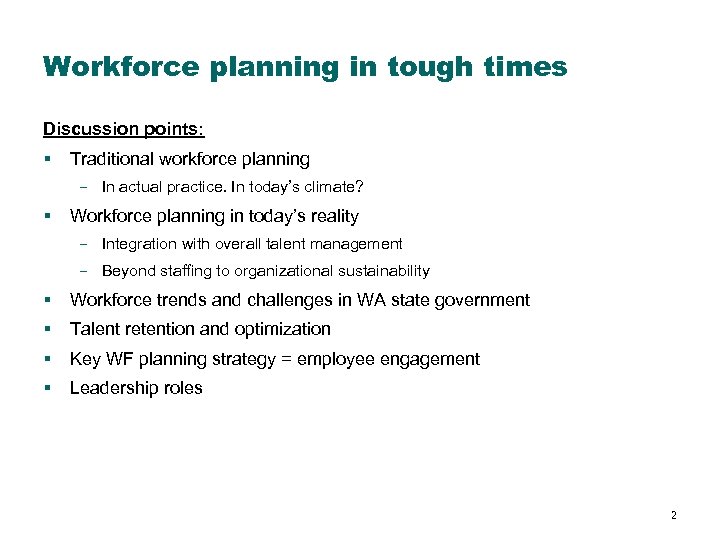 Workforce planning in tough times Discussion points: § Traditional workforce planning In actual practice. In today’s climate? § Workforce planning in today’s reality Integration with overall talent management Beyond staffing to organizational sustainability § Workforce trends and challenges in WA state government § Talent retention and optimization § Key WF planning strategy = employee engagement § Leadership roles 2
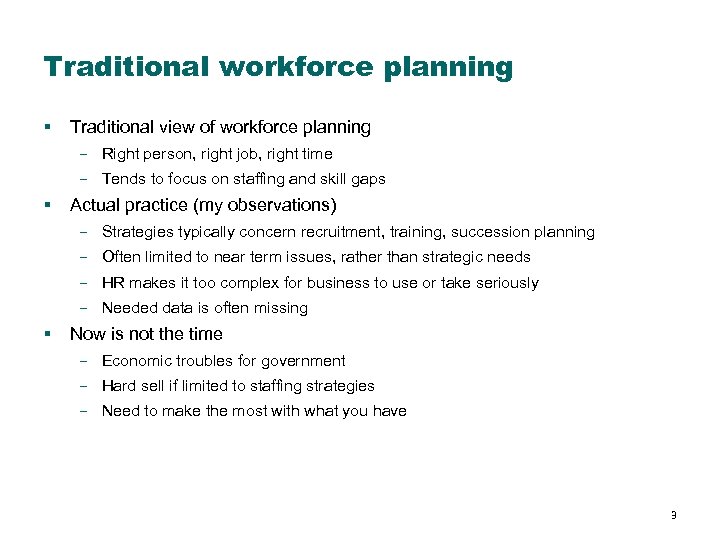 Traditional workforce planning § Traditional view of workforce planning Right person, right job, right time Tends to focus on staffing and skill gaps § Actual practice (my observations) Strategies typically concern recruitment, training, succession planning Often limited to near term issues, rather than strategic needs HR makes it too complex for business to use or take seriously Needed data is often missing § Now is not the time Economic troubles for government Hard sell if limited to staffing strategies Need to make the most with what you have 3
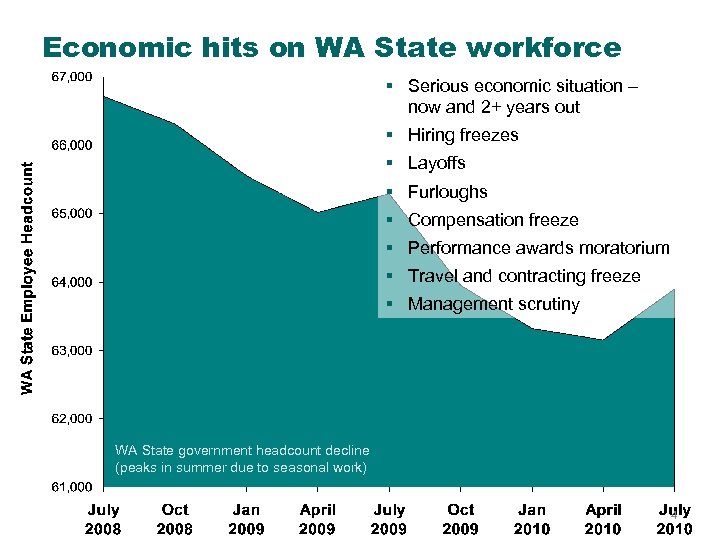 Economic hits on WA State workforce § Serious economic situation – now and 2+ years out § Hiring freezes § Layoffs § Furloughs § Compensation freeze § Performance awards moratorium § Travel and contracting freeze § Management scrutiny WA State government headcount decline (peaks in summer due to seasonal work) 4
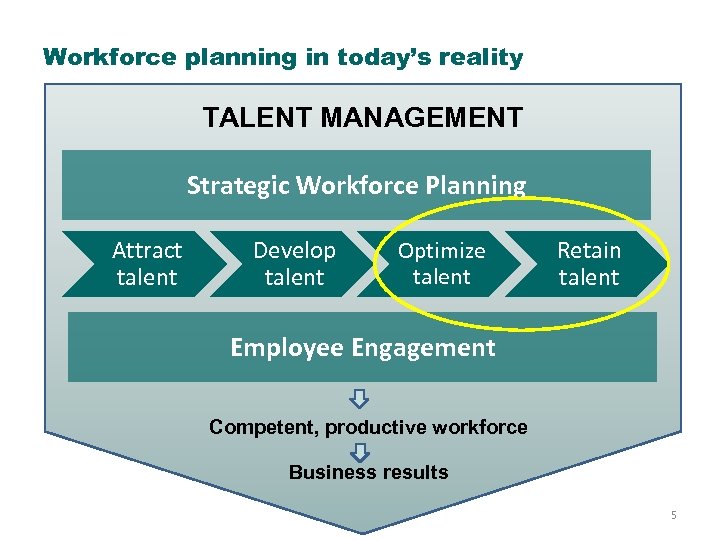 Workforce planning in today’s reality TALENT MANAGEMENT Strategic Workforce Planning Attract talent Develop talent Optimize talent Retain talent Employee Engagement Competent, productive workforce Business results 5
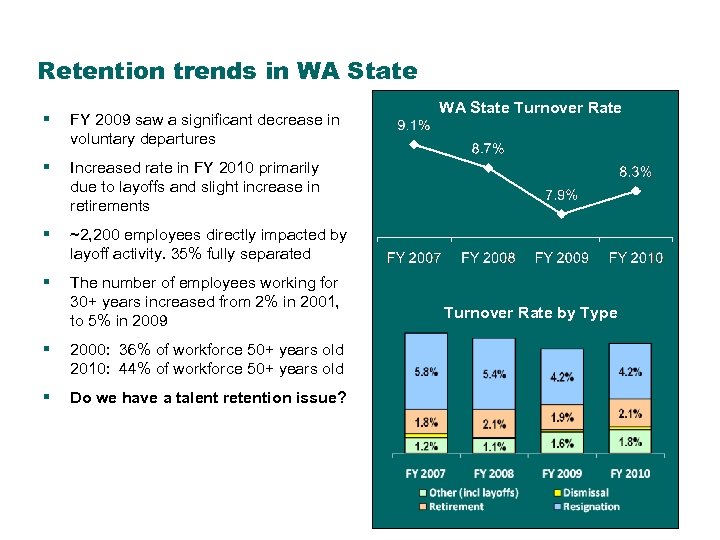 Retention trends in WA State § FY 2009 saw a significant decrease in voluntary departures § Increased rate in FY 2010 primarily due to layoffs and slight increase in retirements § ~2, 200 employees directly impacted by layoff activity. 35% fully separated § The number of employees working for 30+ years increased from 2% in 2001, to 5% in 2009 WA State Turnover Rate § 2000: 36% of workforce 50+ years old 2010: 44% of workforce 50+ years old § Do we have a talent retention issue? Turnover Rate by Type
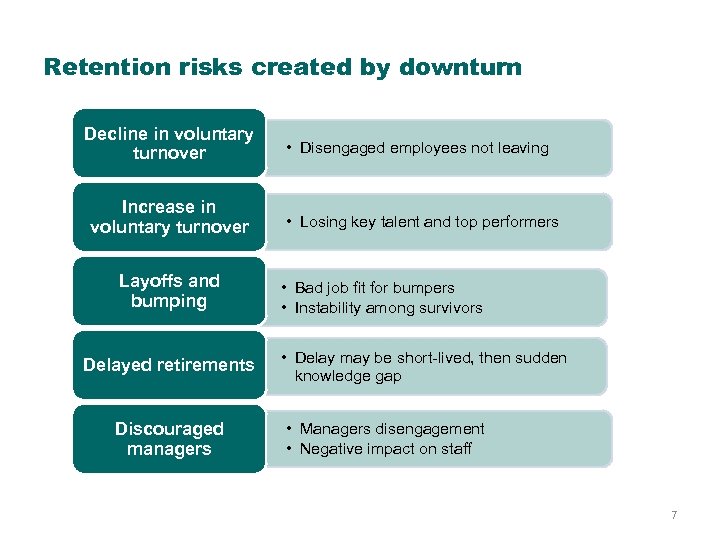 Retention risks created by downturn Decline in voluntary turnover Increase in voluntary turnover Layoffs and bumping Delayed retirements Discouraged managers • Disengaged employees not leaving • Losing key talent and top performers • Bad job fit for bumpers • Instability among survivors • Delay may be short-lived, then sudden knowledge gap • Managers disengagement • Negative impact on staff 7
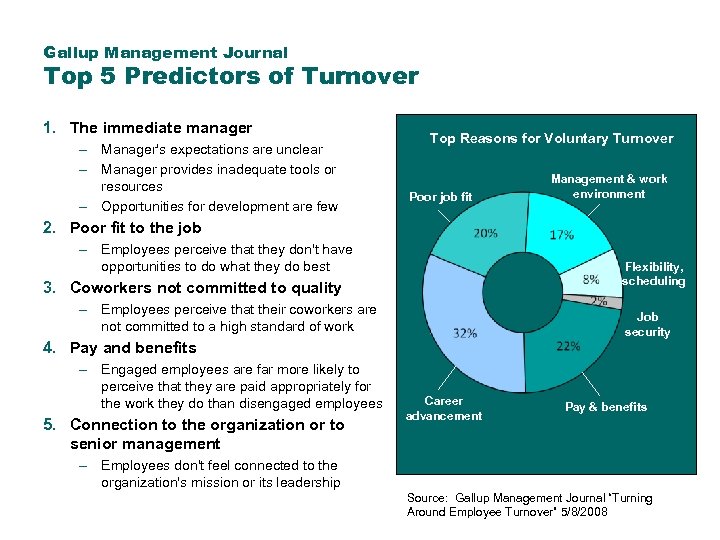 Gallup Management Journal Top 5 Predictors of Turnover 1. The immediate manager – Manager's expectations are unclear – Manager provides inadequate tools or resources – Opportunities for development are few Top Reasons for Voluntary Turnover Poor job fit Management & work environment 2. Poor fit to the job – Employees perceive that they don't have opportunities to do what they do best Flexibility, scheduling 3. Coworkers not committed to quality – Employees perceive that their coworkers are not committed to a high standard of work Job security 4. Pay and benefits – Engaged employees are far more likely to perceive that they are paid appropriately for the work they do than disengaged employees 5. Connection to the organization or to senior management Career advancement Pay & benefits – Employees don't feel connected to the organization's mission or its leadership Source: Gallup Management Journal “Turning Around Employee Turnover” 5/8/2008
 Engagement is key for WF planning in tough times § The typical strategies to deal with economic downturn in government can directly and negatively affect employee engagement § A disengaged workplace translates into: § Talent retention risk § Lack of talent optimization § Employee engagement should be a key objective of today’s workforce planning strategies 9
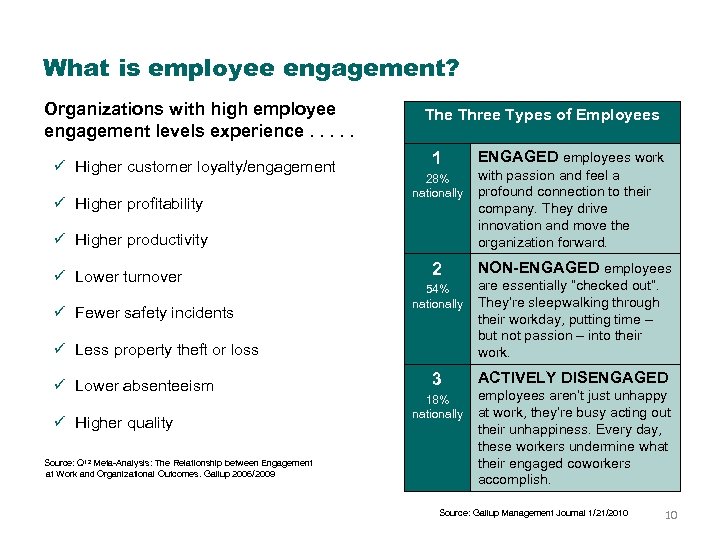 What is employee engagement? Organizations with high employee engagement levels experience. . . ü Higher customer loyalty/engagement ü Higher profitability The Three Types of Employees 1 28% nationally ü Higher productivity ü Lower turnover ü Fewer safety incidents 2 54% nationally ü Less property theft or loss ü Lower absenteeism ü Higher quality Source: Q 12 Meta-Analysis: The Relationship between Engagement at Work and Organizational Outcomes. Gallup 2006/2009 3 18% nationally ENGAGED employees work with passion and feel a profound connection to their company. They drive innovation and move the organization forward. NON-ENGAGED employees are essentially “checked out”. They’re sleepwalking through their workday, putting time – but not passion – into their work. ACTIVELY DISENGAGED employees aren’t just unhappy at work, they’re busy acting out their unhappiness. Every day, these workers undermine what their engaged coworkers accomplish. Source: Gallup Management Journal 1/21/2010 10
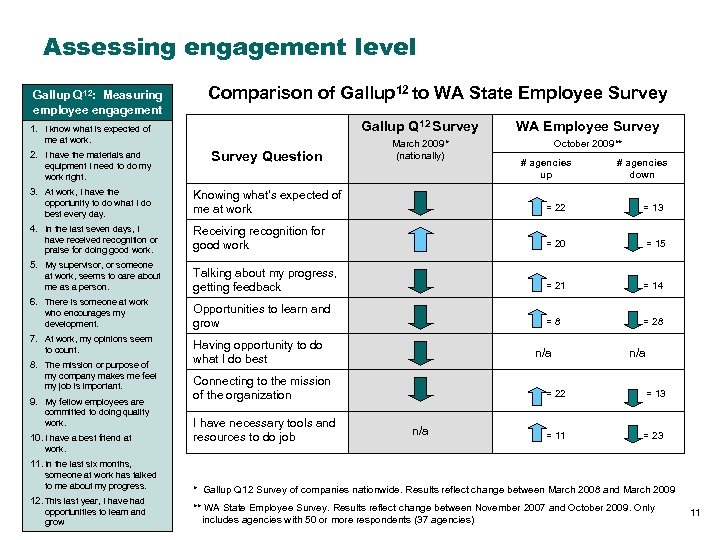 Assessing engagement level Gallup Q 12: Measuring employee engagement Comparison of Gallup 12 to WA State Employee Survey Gallup Q 12 Survey 1. I know what is expected of me at work. 2. I have the materials and equipment I need to do my work right. 3. At work, I have the opportunity to do what I do best every day. 4. In the last seven days, I have received recognition or praise for doing good work. 5. My supervisor, or someone at work, seems to care about me as a person. 6. There is someone at work who encourages my development. 7. At work, my opinions seem to count. 8. The mission or purpose of my company makes me feel my job is important. 9. My fellow employees are committed to doing quality work. 10. I have a best friend at Survey Question WA Employee Survey March 2009* (nationally) October 2009** # agencies up # agencies down Knowing what’s expected of me at work = 22 = 13 Receiving recognition for good work = 20 = 15 Talking about my progress, getting feedback = 21 = 14 Opportunities to learn and grow =8 = 28 Having opportunity to do what I do best n/a Connecting to the mission of the organization I have necessary tools and resources to do job n/a = 22 n/a = 13 = 11 = 23 work. 11. In the last six months, someone at work has talked to me about my progress. 12. This last year, I have had opportunities to learn and grow * Gallup Q 12 Survey of companies nationwide. Results reflect change between March 2008 and March 2009 ** WA State Employee Survey. Results reflect change between November 2007 and October 2009. Only includes agencies with 50 or more respondents (37 agencies) 11
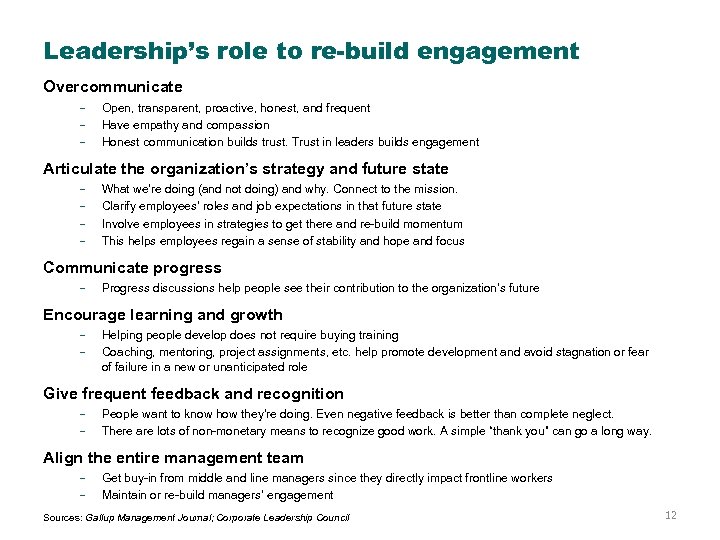 Leadership’s role to re-build engagement Overcommunicate Open, transparent, proactive, honest, and frequent Have empathy and compassion Honest communication builds trust. Trust in leaders builds engagement Articulate the organization’s strategy and future state What we’re doing (and not doing) and why. Connect to the mission. Clarify employees’ roles and job expectations in that future state Involve employees in strategies to get there and re-build momentum This helps employees regain a sense of stability and hope and focus Communicate progress Progress discussions help people see their contribution to the organization’s future Encourage learning and growth Helping people develop does not require buying training Coaching, mentoring, project assignments, etc. help promote development and avoid stagnation or fear of failure in a new or unanticipated role Give frequent feedback and recognition People want to know how they’re doing. Even negative feedback is better than complete neglect. There are lots of non-monetary means to recognize good work. A simple “thank you” can go a long way. Align the entire management team Get buy-in from middle and line managers since they directly impact frontline workers Maintain or re-build managers’ engagement Sources: Gallup Management Journal; Corporate Leadership Council 12
 Suggested resources § Gallup Management Journal - http: //gmj. gallup. com/ A monthly online business publication written for business and management leaders based on proven results from research and data. Includes insightful articles on employee engagement. § CLC Human Resources - https: //clc. executiveboard. com/Members/ Subscription service that provides best practices and quantitative research and education for senior HR executives and staff. Includes a wealth of information on strategic workforce planning and employee engagement. § WA State Department of Personnel - http: //www. dop. wa. gov/strategichr/ Washington State Department of Personnel’s website includes a Strategic HR section that provides state workforce data, resources, and strategic information. Also included are workforce planning models and guidelines, and the state’s recent work on employee engagement. 13
 14
14