


 Скачать презентацию CURRENT TRENDS IN THE COLLECTION AND USE OF
70a7c8563f272522b67ab7c5cf29bde8.ppt
- Количество слайдов: 35
 CURRENT TRENDS IN THE COLLECTION AND USE OF STATISTICS IN AFRICAN LIBRARIES Dr. Elisha R. T. Chiware University of Namibia
 CONTENTS 2 Historical note – academic and public libraries Background to survey Part A: Library statistics collection Part B: Main types of statistics collected by most libraries Part C: Methods for collection of library statistics Conclusion
 Historical note – academic libraries 3 The International African Institute (1997) published three volumes on: University Libraries in Africa: a review of their current state and future potential. The volumes are made up of case studies which include a range of statistical data detailing: Library collection sizes Library staff Expenditure interlibrary loans Donor support Library use
 Historical note – academic libraries 4 The International Network for Availability of Scientific Publications (INASP) organized and funded a Workshop on the Collection and Use of Library Statistics in University Libraries which took place in Zimbabwe in 1997. An Annual Statistical Return was drafted and three libraries took part in a pilot collection project. Statistical data from these libraries was published in a volume entitled Annual Library Statistics 1997/98, available from INASP
 Historical note – academic libraries 5 The Association of African Universities (AAU) based in Ghana promised to continue the work of INASP, but ever since 1999, no other work has emerged from this initiative.
 Historical note – academic libraries 6 A number of African libraries are featured in the Global Library Statistics 1990 -2000 compiled by IFLA using data from UNESCO and Libecon. The Global library Statistics covered areas of: Library servicing the public Library collections New media Usage and users Library staffing Library expenditure
 Historical note – academic libraries 7 INASP has been involved in the provision of electronic services in various countries in Africa. As result of these initiatives many African university libraries have access to various electronic databases. INASP has initiated the monitoring and evaluation of the use of electronic databases (e-journals) in African university libraries. There is a book of case studies on monitoring and evaluation of electronic resources due for publication later this year.
 Historical note – academic libraries 8 Many university libraries in Africa however do not have software to monitor usage and rely on data collected through the following techniques: • Suppliers’ data: usage statistics of electronic resources subscribed through PERI programme is provided by suppliers. • Library user statistics: usage data is collected from e-resource service points within the library. Users are required to register and indicate which e-resources they intend to use. Information collected includes name, status, year of study, faculty/department, title of e-resource, etc. • User queries: librarians monitor and analyze requests and questions from users on specific e-resources. • User surveys: UDSM Library conducts periodic user surveys to gather key information about resources and services.
 Historical note – public libraries 9 South Africa - efforts to standardize the collection of statistics in public libraries. Funding from the Carnegie Corporation of New York Working Group on Public Library Statistics (WGPLS) to facilitate the drafting of a simple form for regular collection of statistics from public libraries so that three databases could be kept up to date ( 1. a library directory containing identification and descriptive data about libraries), 2. a demographic database containing relevant demographic information and 3. A geographic database containing geographical information such as municipal boundaries and location data for the libraries )
 10 Background to survey
 11 Collecting library statistics The objective of collecting library statistics is "to assess the quality and effectiveness of services [and resources] provided by the library" (Poll, 2001, p. 307).
 Importance of collecting statistics 12 The collection of library statistics provides an essential foundation for quality library services is a powerful management tool assisting libraries in establishing good practice, decision-making and user support can be used for securing and allocating funding reflects use patterns influencing collection development
 Importance of collecting statistics 13 Usage statistics can be used to develop performance indicators for outcomes assessment. Annual (national/international) statistical reports allow a library to compare itself to peer libraries, past experience and desirable goals. It allows for self-assessment, benchmarking and improvement of library services.
 Challenges re library statistics 14 Manual collection of statistics is time-consuming Staff lack knowledge and skills in regard to the collecting, analysing and reporting of library statistics Management lack knowledge and skills to integrate statistics into library decision-making
 Purpose of survey 15 Commissioned by the IFLA Section on Statistics and Evaluation Aims to establish current trends in the collection and use of library statistics in African libraries
 Research methodology 16 Data collection took place during July 2008 Target audience: Academic, national and public libraries throughout Africa A descriptive research approach was applied to data collection A self-administered questionnaire was emailed to the target group SPSS (Statistical Package for Social Sciences) was used to analyse the data
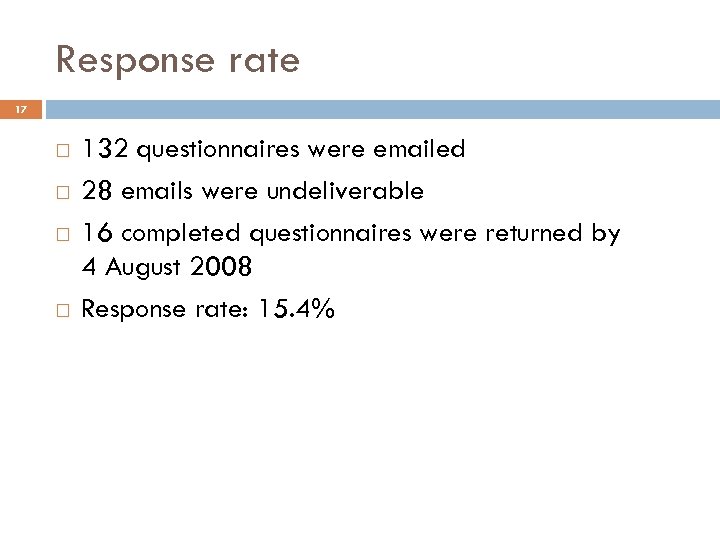 Response rate 17 132 questionnaires were emailed 28 emails were undeliverable 16 completed questionnaires were returned by 4 August 2008 Response rate: 15. 4%
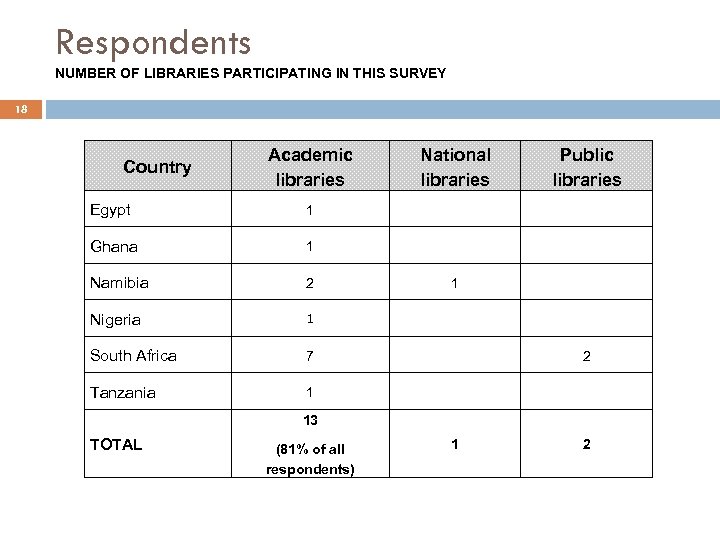 Respondents NUMBER OF LIBRARIES PARTICIPATING IN THIS SURVEY 18 Country Academic libraries Egypt 1 Namibia 2 Nigeria 1 South Africa 7 Tanzania Public libraries 1 Ghana National libraries 1 1 2 13 TOTAL (81% of all respondents) 1 2
 19 Library statistics collection PART A
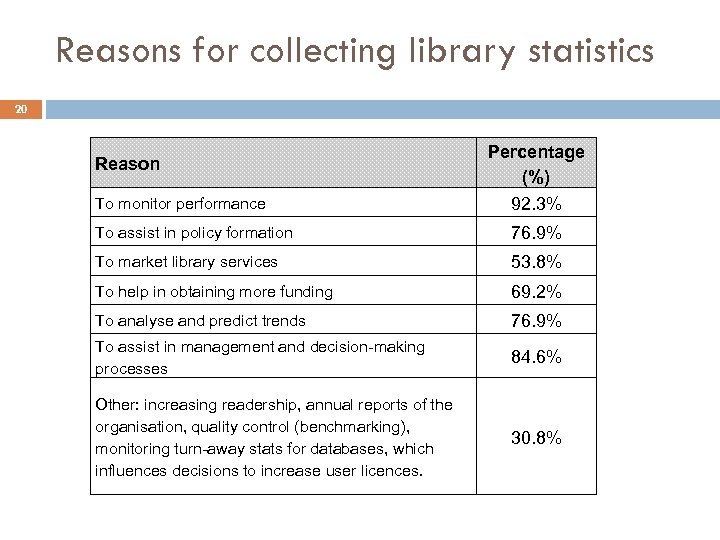 Reasons for collecting library statistics 20 Reason Percentage (%) To monitor performance 92. 3% To assist in policy formation 76. 9% To market library services 53. 8% To help in obtaining more funding 69. 2% To analyse and predict trends 76. 9% To assist in management and decision-making processes 84. 6% Other: increasing readership, annual reports of the organisation, quality control (benchmarking), monitoring turn-away stats for databases, which influences decisions to increase user licences. 30. 8%
 21 Main types of statistics collected by most libraries PART B
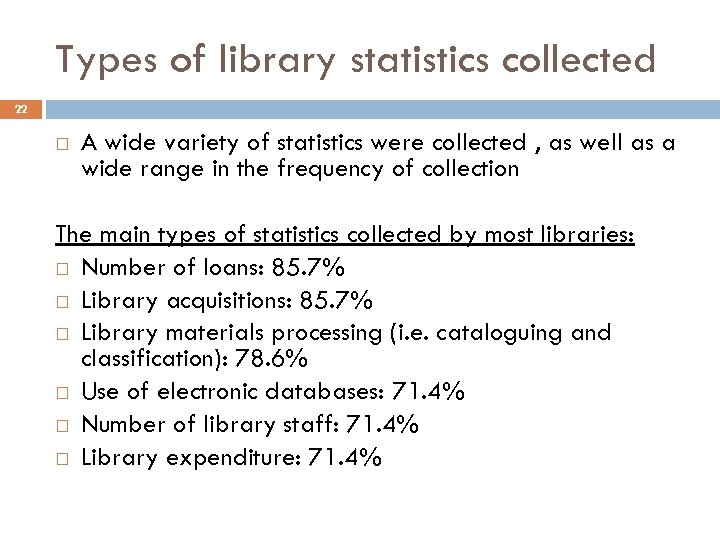 Types of library statistics collected 22 A wide variety of statistics were collected , as well as a wide range in the frequency of collection The main types of statistics collected by most libraries: Number of loans: 85. 7% Library acquisitions: 85. 7% Library materials processing (i. e. cataloguing and classification): 78. 6% Use of electronic databases: 71. 4% Number of library staff: 71. 4% Library expenditure: 71. 4%
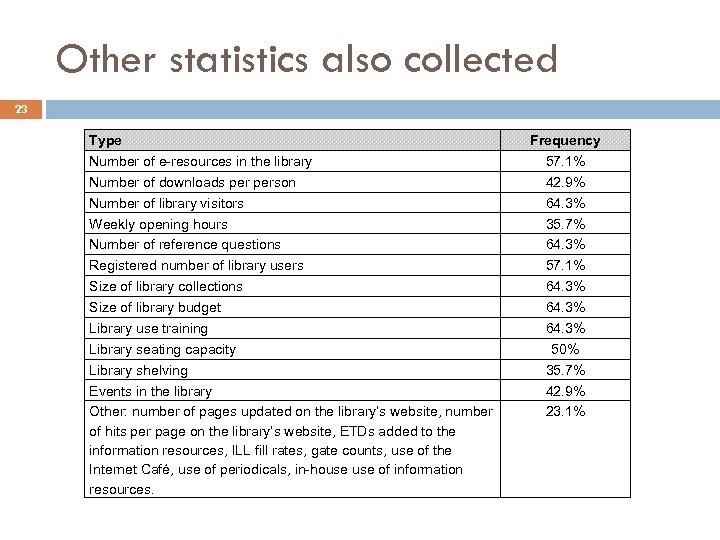 Other statistics also collected 23 Type Number of e-resources in the library Number of downloads person Number of library visitors Weekly opening hours Number of reference questions Registered number of library users Size of library collections Size of library budget Library use training Library seating capacity Library shelving Events in the library Other: number of pages updated on the library’s website, number of hits per page on the library’s website, ETDs added to the information resources, ILL fill rates, gate counts, use of the Internet Café, use of periodicals, in-house of information resources. Frequency 57. 1% 42. 9% 64. 3% 35. 7% 64. 3% 57. 1% 64. 3% 50% 35. 7% 42. 9% 23. 1%
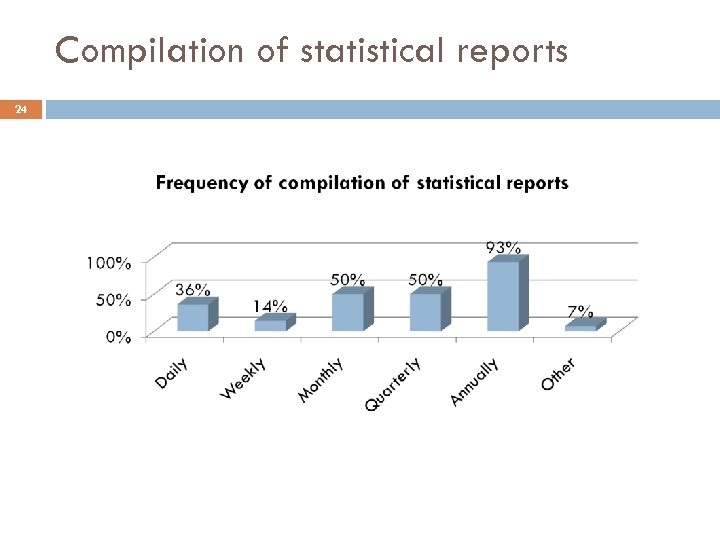 Compilation of statistical reports 24
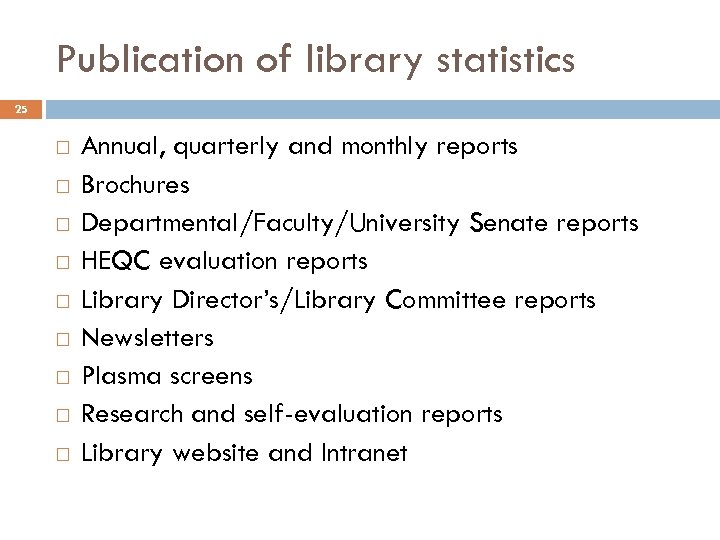 Publication of library statistics 25 Annual, quarterly and monthly reports Brochures Departmental/Faculty/University Senate reports HEQC evaluation reports Library Director’s/Library Committee reports Newsletters Plasma screens Research and self-evaluation reports Library website and Intranet
 26 Methods used for collection of library statistics PART C
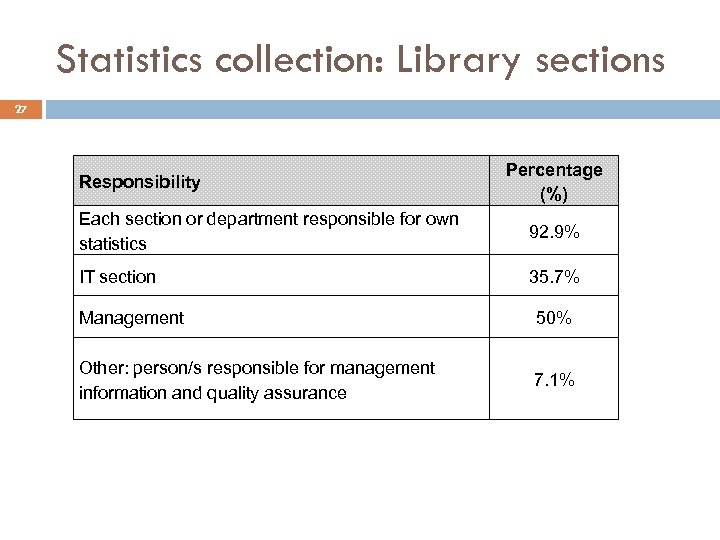 Statistics collection: Library sections 27 Responsibility Percentage (%) Each section or department responsible for own statistics 92. 9% IT section 35. 7% Management 50% Other: person/s responsible for management information and quality assurance 7. 1%
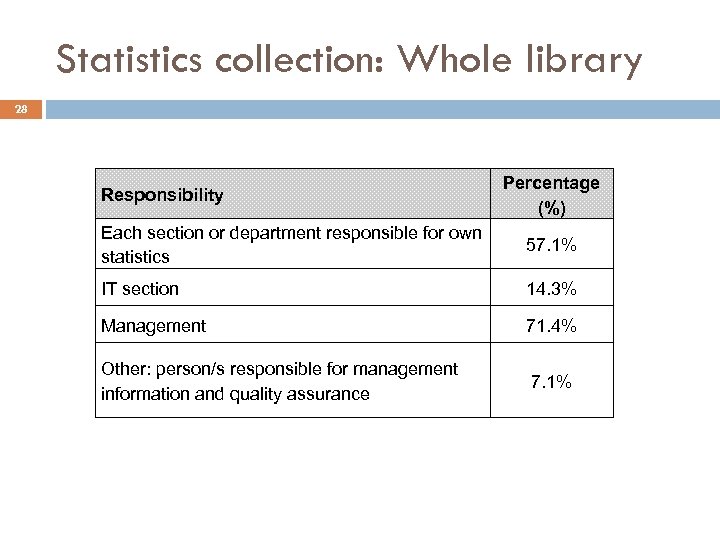 Statistics collection: Whole library 28 Responsibility Percentage (%) Each section or department responsible for own statistics 57. 1% IT section 14. 3% Management 71. 4% Other: person/s responsible for management information and quality assurance 7. 1%
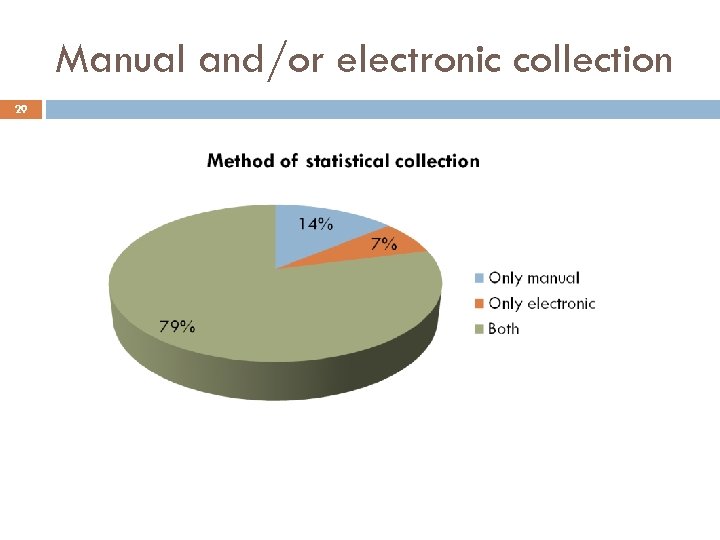 Manual and/or electronic collection 29
 30 Manual collection Usually done on a daily basis by physically counting items/users. These statistics are then forwarded to the person responsible for the Library Management Information System.
 Electronic statistics: Examples of software 31 ADLIB (e. g. Number of loans) Aleph (e. g. Size of collection) CDS ISIS (e. g. Electronic databases) Do. Net (e. g. Reference queries) e. Prints (e. g. Institutional repositories) Excel (e. g. User training) Innopac report Module (e. g. Cataloguing and classification) ITS (e. g. Number of library users) Millennium (e. g. E-resources) OCLC (e. g. Cataloguing and classification) Oracle (e. g. Number of library staff) PALS (e. g. Number of loans) Prolib (e. g. Cataloguing and classification) PROMIS (e. g. Library budget) Question. Point (e. g. Reference queries) 3 M (e. g. Gate counts)
 32 Conclusion
 Positive aspects of this survey 33 It reflects the extent of library services in those African libraries participating in this survey. It provides a current picture of African libraries with regard to the trends in collection and use of statistics. It is an important tool for addressing weaknesses in African library and information services.
 Areas for improvement 34 There is no agreement on the type of library statistics to be collected. There is no consensus on how data must be collected, analysed, presented and applied. There is a wide gap in the type and frequency of statistics collected between technologically advanced libraries and those less fortunate. There is no national or African database of comparative library statistics available.
 ANY QUESTIONS OR COMMENTS? Dr. Elisha R. T. Chiware echiware@unam. na