


 Скачать презентацию Current trends in e-learning and the impact on
b1d2a8be40cdbf98e3b1ed992cc0e350.ppt
- Количество слайдов: 49
 Current trends in e-learning and the impact on the joint SE course Sam Joachim, Klaus Bothe 3 rd Workshop on Software Engineering Education and Reverse Engineering, Ohrid, 2003 joachim@informatik. hu-berlin. de bothe@informatik. hu-berlin. de Institut für Informatik Humboldt Universität zu Berlin Current trends in e-learning and the impact on the joint SE course 1
 Agenda 1. 2. 3. 4. 5. 6. E-learning conferences and their subjects Definitions in the field of e-learning Learning objects and their specification MIT open courseware (Semantic Web) Navigation (logic or associative) and search in course material Summary and conclusions Current trends in e-learning and the impact on the joint SE course 2
 E-Learning Conferences Current trends in e-learning and the impact on the joint SE course 3
 Background of these e-Learning conferences l De. LFI 2003 l l E-Learn l l „German Society of Informatics“, E-Learning group www. De. LFI 2003. de Munich, Germany, 3 days „Association for the Advancement of Computing in Education“ Phoenix, Arizona, USA, 5 days http: //www. aace. org/conf/e. Learn/ Online-Educa l l l more political and business oriented Berlin, Germany, 3 days http: //www. online-educa. com/ Current trends in e-learning and the impact on the joint SE course 4
 Important common subjects of e-learning conferences l l l Didactical Issues l Technology supported team teaching l Virtual university, virtual classroom l ‘blended’ learning l Online collaboration l Mobile and ambient learning l Teacher training Production and management of e-learning content and resources l Content Development l Learning & Content Management Systems l Authoring Tools l Knowledge Management l Electronic Publishing Tools for E-Learning e-Learning and XML l Metadata l Reuse of learning modules Distributed Environments (cross-border collaboration) Case studies of current e-learning projects Quality Issues and Management Current trends in e-learning and the impact on the joint SE course 5
 Current problems of e-learning projects l Virtual Universities in USA Low demand for carged online study l Virtual Universities services from New York, Temple and Cornell University collapsed l source: COMPUTER ZEITUNG 27/30. 07. 2003, p. 20 l e-Learning solutions often with low return on investment Current trends in e-learning and the impact on the joint SE course 6
 Agenda 1. 2. 3. 4. 5. 6. E-learning conferences and their subjects Definitions in the field of e-learning Learning objects and their specification MIT open courseware (Semantic Web) Navigation (logic or associative) and search in course material Summary and conclusions Current trends in e-learning and the impact on the joint SE course 7
 Definitions l No general accepted definition of e-learning. l 3 selected definitions: l Geo. Learning l Leading e-learning platform provider German Society of Informatics (GI) l University of Heidelberg in cooperation with MIT l Current trends in e-learning and the impact on the joint SE course 8
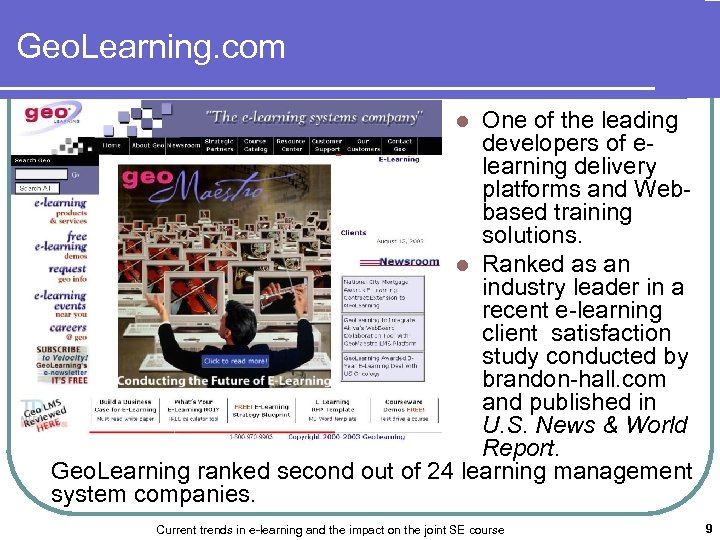 Geo. Learning. com One of the leading developers of elearning delivery platforms and Webbased training solutions. l Ranked as an industry leader in a recent e-learning client satisfaction study conducted by brandon-hall. com and published in U. S. News & World Report. Geo. Learning ranked second out of 24 learning management system companies. l Current trends in e-learning and the impact on the joint SE course 9
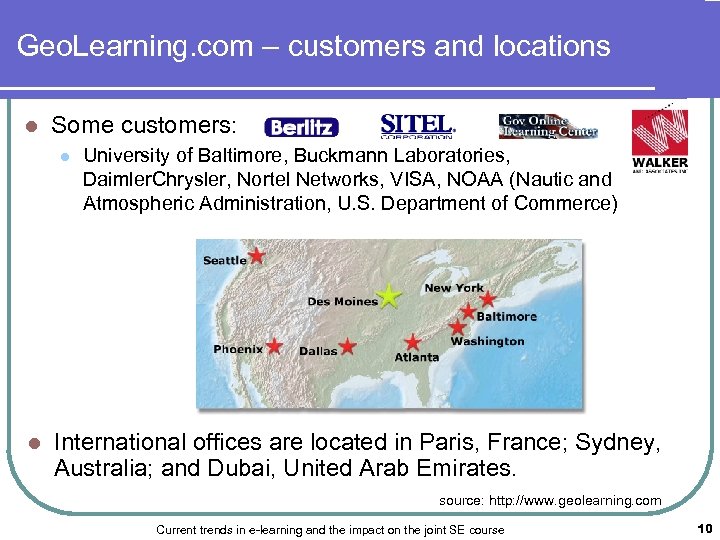 Geo. Learning. com – customers and locations l Some customers: l l University of Baltimore, Buckmann Laboratories, Daimler. Chrysler, Nortel Networks, VISA, NOAA (Nautic and Atmospheric Administration, U. S. Department of Commerce) International offices are located in Paris, France; Sydney, Australia; and Dubai, United Arab Emirates. source: http: //www. geolearning. com Current trends in e-learning and the impact on the joint SE course 10
 Distance Learning – the superordinate concept of e-learning “Educational situation in which the instructor and students are separated by time, location, or both. ” Education or training courses are delivered to remote locations via synchronous or asynchronous means of instruction, including written correspondence, text, graphics, audio and videotape, CD-ROM, online learning, audio and video-conferencing, interactive TV, and facsimile. l Distance learning does not preclude the use of the traditional classroom. The definition of distance learning is broader than and entails the definition of e-learning. l source: http: //www. geolearning. com Current trends in e-learning and the impact on the joint SE course 11
 e-Learning: Definition by Geo. Learning “Covers a wide set of applications and processes such as Web-based learning, computer-based learning, virtual classrooms, and digital collaboration. ” It includes the delivery of content via Internet, intranet/extranet (LAN/WAN), audio/video tape, satellite broadcast, interactive TV, and CD-ROM. source: http: //www. geolearning. com Current trends in e-learning and the impact on the joint SE course 12
 e-Learning: Definition by GI „All aspects of computer-assisted learning“ source: German Society of Informatics, E-Learning group Current trends in e-learning and the impact on the joint SE course 13
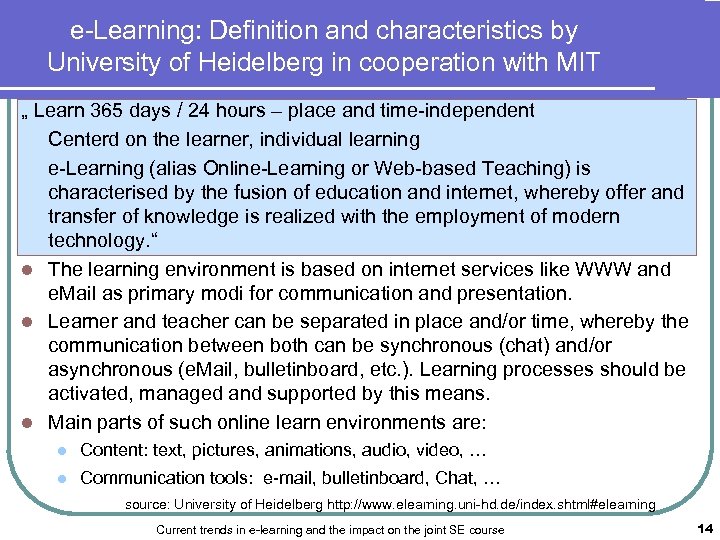 e-Learning: Definition and characteristics by University of Heidelberg in cooperation with MIT „ Learn 365 days / 24 hours – place and time-independent Centerd on the learner, individual learning e-Learning (alias Online-Learning or Web-based Teaching) is characterised by the fusion of education and internet, whereby offer and transfer of knowledge is realized with the employment of modern technology. “ l The learning environment is based on internet services like WWW and e. Mail as primary modi for communication and presentation. l Learner and teacher can be separated in place and/or time, whereby the communication between both can be synchronous (chat) and/or asynchronous (e. Mail, bulletinboard, etc. ). Learning processes should be activated, managed and supported by this means. l Main parts of such online learn environments are: l Content: text, pictures, animations, audio, video, … l Communication tools: e-mail, bulletinboard, Chat, … source: University of Heidelberg http: //www. elearning. uni-hd. de/index. shtml#elearning Current trends in e-learning and the impact on the joint SE course 14
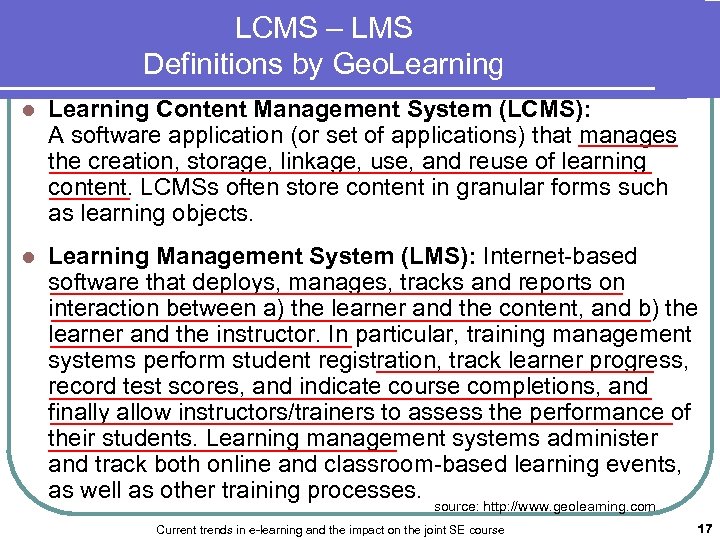 LCMS – LMS Definitions by Geo. Learning l Learning Content Management System (LCMS): A software application (or set of applications) that manages the creation, storage, linkage, use, and reuse of learning content. LCMSs often store content in granular forms such as learning objects. l Learning Management System (LMS): Internet-based software that deploys, manages, tracks and reports on interaction between a) the learner and the content, and b) the learner and the instructor. In particular, training management systems perform student registration, track learner progress, record test scores, and indicate course completions, and finally allow instructors/trainers to assess the performance of their students. Learning management systems administer and track both online and classroom-based learning events, as well as other training processes. source: http: //www. geolearning. com Current trends in e-learning and the impact on the joint SE course 17
 Agenda 1. 2. 3. 4. 5. 6. E-learning conferences and their subjects Definitions in the field of e-learning Learning objects and their specification MIT open courseware (Semantic Web) Navigation (logic or associative) and search in course material Summary and conclusions Current trends in e-learning and the impact on the joint SE course 18
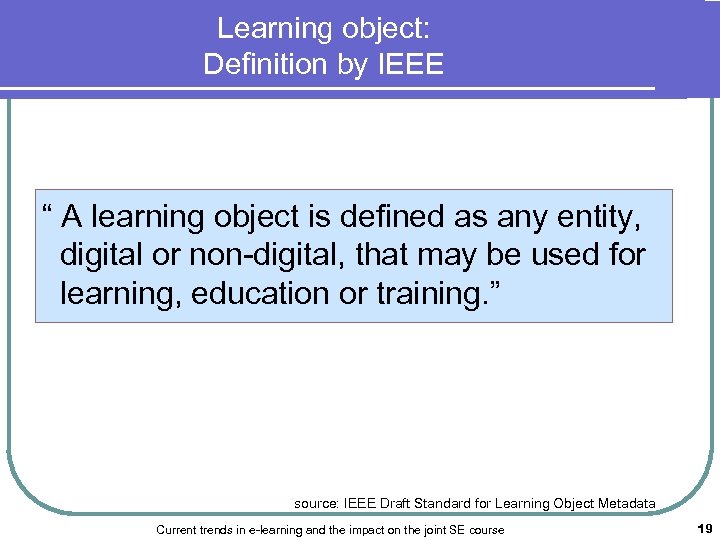 Learning object: Definition by IEEE “ A learning object is defined as any entity, digital or non-digital, that may be used for learning, education or training. ” source: IEEE Draft Standard for Learning Object Metadata Current trends in e-learning and the impact on the joint SE course 19
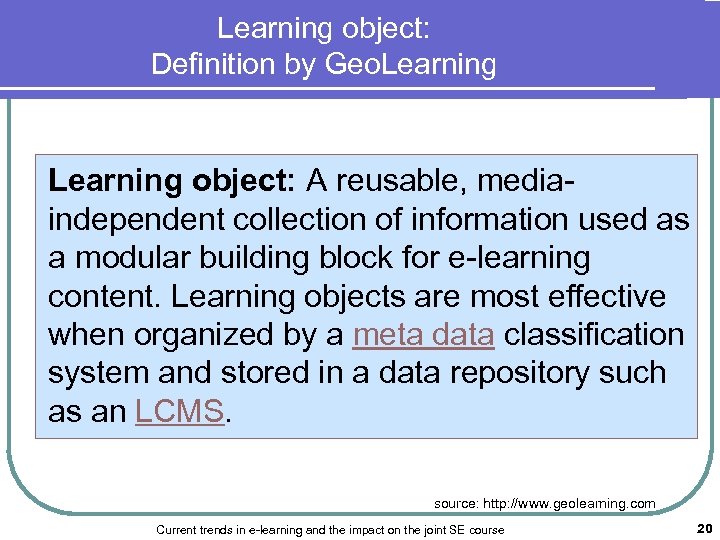 Learning object: Definition by Geo. Learning object: A reusable, mediaindependent collection of information used as a modular building block for e-learning content. Learning objects are most effective when organized by a meta data classification system and stored in a data repository such as an LCMS. source: http: //www. geolearning. com Current trends in e-learning and the impact on the joint SE course 20
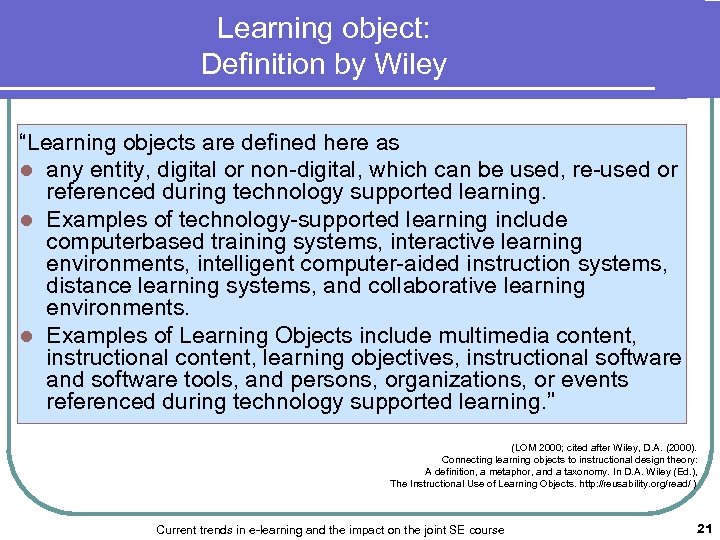 Learning object: Definition by Wiley “Learning objects are defined here as l any entity, digital or non-digital, which can be used, re-used or referenced during technology supported learning. l Examples of technology-supported learning include computerbased training systems, interactive learning environments, intelligent computer-aided instruction systems, distance learning systems, and collaborative learning environments. l Examples of Learning Objects include multimedia content, instructional content, learning objectives, instructional software and software tools, and persons, organizations, or events referenced during technology supported learning. ” (LOM 2000; cited after Wiley, D. A. (2000). Connecting learning objects to instructional design theory: A definition, a metaphor, and a taxonomy. In D. A. Wiley (Ed. ), The Instructional Use of Learning Objects. http: //reusability. org/read/ ) Current trends in e-learning and the impact on the joint SE course 21
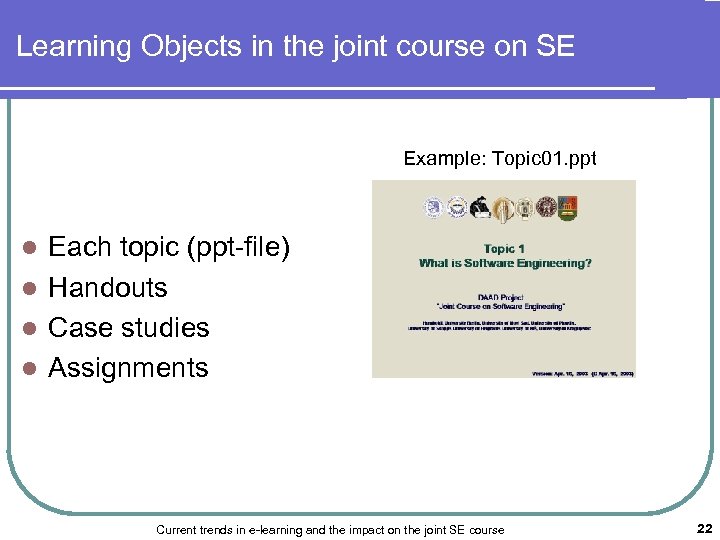 Learning Objects in the joint course on SE Example: Topic 01. ppt Each topic (ppt-file) l Handouts l Case studies l Assignments l Current trends in e-learning and the impact on the joint SE course 22
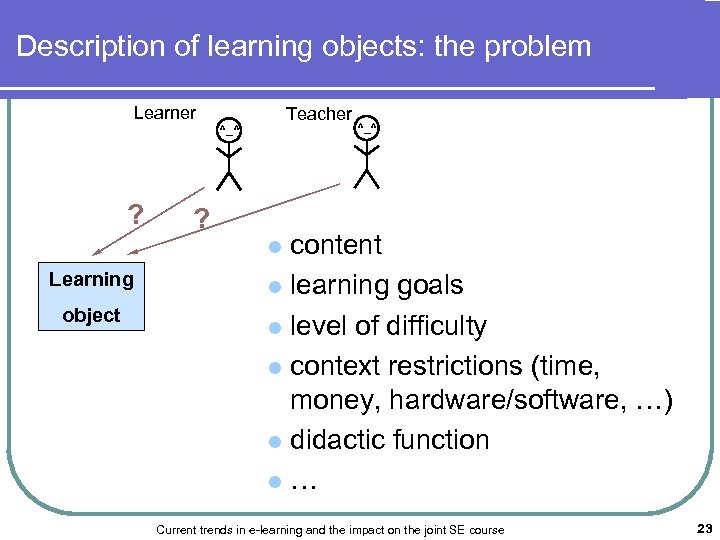 Description of learning objects: the problem Learner Teacher ^_^ ? ? ^_^ content l learning goals l level of difficulty l context restrictions (time, money, hardware/software, …) l didactic function l… l Learning object Current trends in e-learning and the impact on the joint SE course 23
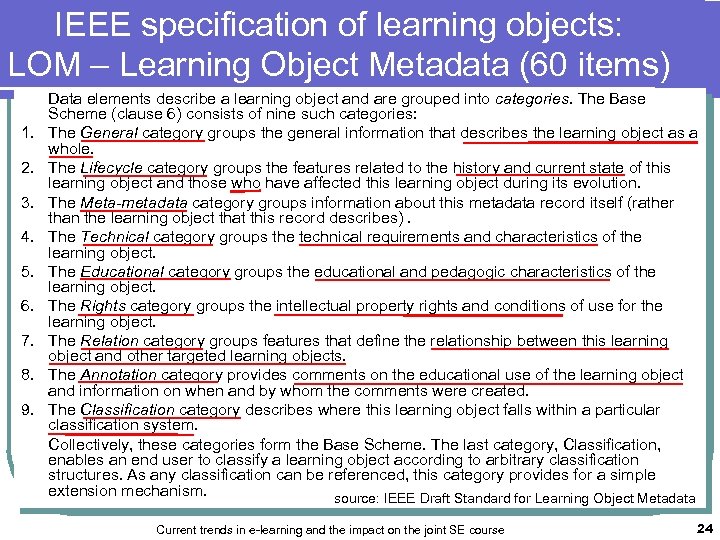 IEEE specification of learning objects: LOM – Learning Object Metadata (60 items) 1. 2. 3. 4. 5. 6. 7. 8. 9. Data elements describe a learning object and are grouped into categories. The Base Scheme (clause 6) consists of nine such categories: The General category groups the general information that describes the learning object as a whole. The Lifecycle category groups the features related to the history and current state of this learning object and those who have affected this learning object during its evolution. The Meta-metadata category groups information about this metadata record itself (rather than the learning object that this record describes). The Technical category groups the technical requirements and characteristics of the learning object. The Educational category groups the educational and pedagogic characteristics of the learning object. The Rights category groups the intellectual property rights and conditions of use for the learning object. The Relation category groups features that define the relationship between this learning object and other targeted learning objects. The Annotation category provides comments on the educational use of the learning object and information on when and by whom the comments were created. The Classification category describes where this learning object falls within a particular classification system. Collectively, these categories form the Base Scheme. The last category, Classification, enables an end user to classify a learning object according to arbitrary classification structures. As any classification can be referenced, this category provides for a simple extension mechanism. source: IEEE Draft Standard for Learning Object Metadata Current trends in e-learning and the impact on the joint SE course 24
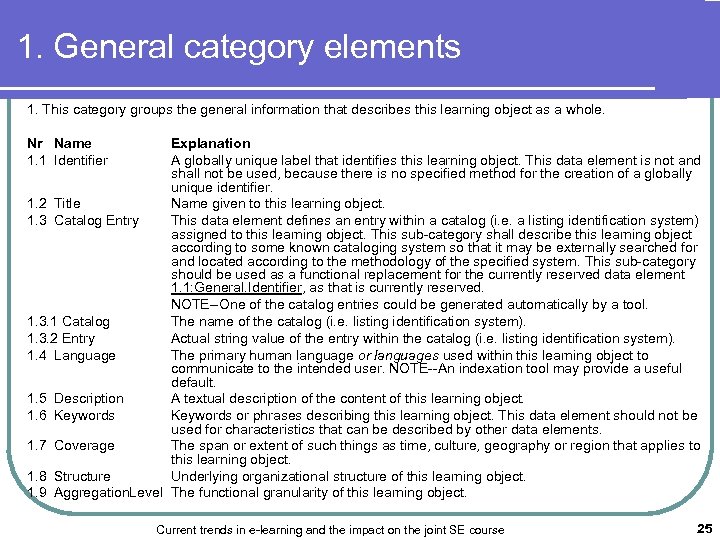 1. General category elements 1. This category groups the general information that describes this learning object as a whole. Nr Name 1. 1 Identifier Explanation A globally unique label that identifies this learning object. This data element is not and shall not be used, because there is no specified method for the creation of a globally unique identifier. 1. 2 Title Name given to this learning object. 1. 3 Catalog Entry This data element defines an entry within a catalog (i. e. a listing identification system) assigned to this learning object. This sub-category shall describe this learning object according to some known cataloging system so that it may be externally searched for and located according to the methodology of the specified system. This sub-category should be used as a functional replacement for the currently reserved data element 1. 1: General. Identifier, as that is currently reserved. NOTE--One of the catalog entries could be generated automatically by a tool. 1. 3. 1 Catalog The name of the catalog (i. e. listing identification system). 1. 3. 2 Entry Actual string value of the entry within the catalog (i. e. listing identification system). 1. 4 Language The primary human language or languages used within this learning object to communicate to the intended user. NOTE--An indexation tool may provide a useful default. 1. 5 Description A textual description of the content of this learning object. 1. 6 Keywords or phrases describing this learning object. This data element should not be used for characteristics that can be described by other data elements. 1. 7 Coverage The span or extent of such things as time, culture, geography or region that applies to this learning object. 1. 8 Structure Underlying organizational structure of this learning object. 1. 9 Aggregation. Level The functional granularity of this learning object. Current trends in e-learning and the impact on the joint SE course 25
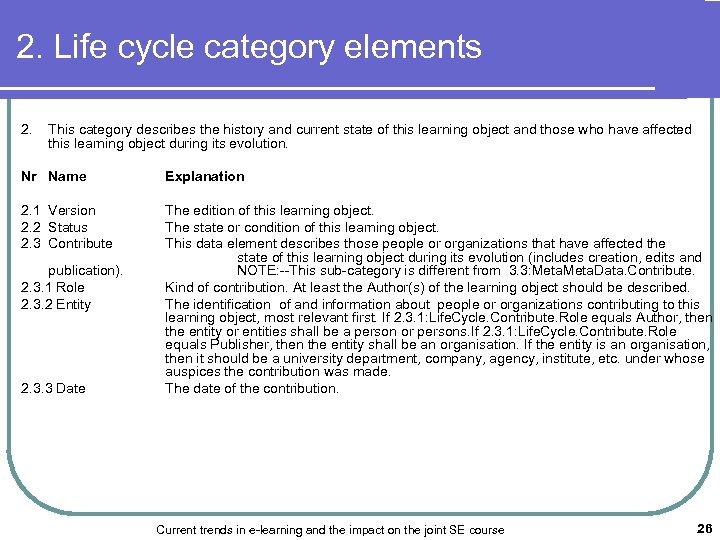 2. Life cycle category elements 2. This category describes the history and current state of this learning object and those who have affected this learning object during its evolution. Nr Name Explanation 2. 1 Version 2. 2 Status 2. 3 Contribute The edition of this learning object. The state or condition of this learning object. This data element describes those people or organizations that have affected the state of this learning object during its evolution (includes creation, edits and NOTE: --This sub-category is different from 3. 3: Meta. Data. Contribute. Kind of contribution. At least the Author(s) of the learning object should be described. The identification of and information about people or organizations contributing to this learning object, most relevant first. If 2. 3. 1: Life. Cycle. Contribute. Role equals Author, then the entity or entities shall be a person or persons. If 2. 3. 1: Life. Cycle. Contribute. Role equals Publisher, then the entity shall be an organisation. If the entity is an organisation, then it should be a university department, company, agency, institute, etc. under whose auspices the contribution was made. The date of the contribution. publication). 2. 3. 1 Role 2. 3. 2 Entity 2. 3. 3 Date Current trends in e-learning and the impact on the joint SE course 26
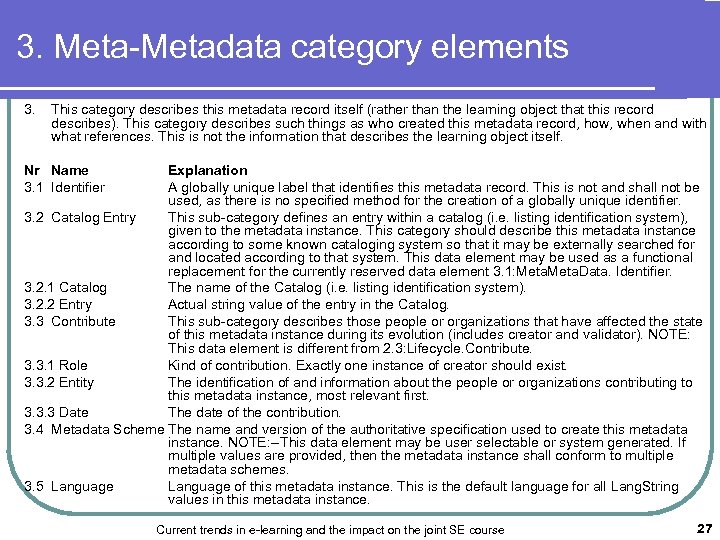 3. Meta-Metadata category elements 3. This category describes this metadata record itself (rather than the learning object that this record describes). This category describes such things as who created this metadata record, how, when and with what references. This is not the information that describes the learning object itself. Nr Name 3. 1 Identifier Explanation A globally unique label that identifies this metadata record. This is not and shall not be used, as there is no specified method for the creation of a globally unique identifier. 3. 2 Catalog Entry This sub-category defines an entry within a catalog (i. e. listing identification system), given to the metadata instance. This category should describe this metadata instance according to some known cataloging system so that it may be externally searched for and located according to that system. This data element may be used as a functional replacement for the currently reserved data element 3. 1: Meta. Data. Identifier. 3. 2. 1 Catalog The name of the Catalog (i. e. listing identification system). 3. 2. 2 Entry Actual string value of the entry in the Catalog. 3. 3 Contribute This sub-category describes those people or organizations that have affected the state of this metadata instance during its evolution (includes creator and validator). NOTE: This data element is different from 2. 3: Lifecycle. Contribute. 3. 3. 1 Role Kind of contribution. Exactly one instance of creator should exist. 3. 3. 2 Entity The identification of and information about the people or organizations contributing to this metadata instance, most relevant first. 3. 3. 3 Date The date of the contribution. 3. 4 Metadata Scheme The name and version of the authoritative specification used to create this metadata instance. NOTE: --This data element may be user selectable or system generated. If multiple values are provided, then the metadata instance shall conform to multiple metadata schemes. 3. 5 Language of this metadata instance. This is the default language for all Lang. String values in this metadata instance. Current trends in e-learning and the impact on the joint SE course 27
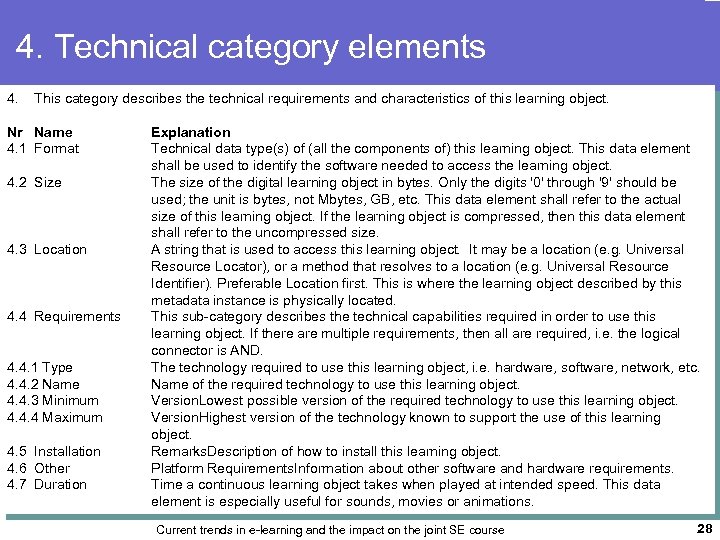 4. Technical category elements 4. This category describes the technical requirements and characteristics of this learning object. Nr Name 4. 1 Format 4. 2 Size 4. 3 Location 4. 4 Requirements 4. 4. 1 Type 4. 4. 2 Name 4. 4. 3 Minimum 4. 4. 4 Maximum 4. 5 Installation 4. 6 Other 4. 7 Duration Explanation Technical data type(s) of (all the components of) this learning object. This data element shall be used to identify the software needed to access the learning object. The size of the digital learning object in bytes. Only the digits '0' through '9' should be used; the unit is bytes, not Mbytes, GB, etc. This data element shall refer to the actual size of this learning object. If the learning object is compressed, then this data element shall refer to the uncompressed size. A string that is used to access this learning object. It may be a location (e. g. Universal Resource Locator), or a method that resolves to a location (e. g. Universal Resource Identifier). Preferable Location first. This is where the learning object described by this metadata instance is physically located. This sub-category describes the technical capabilities required in order to use this learning object. If there are multiple requirements, then all are required, i. e. the logical connector is AND. The technology required to use this learning object, i. e. hardware, software, network, etc. Name of the required technology to use this learning object. Version. Lowest possible version of the required technology to use this learning object. Version. Highest version of the technology known to support the use of this learning object. Remarks. Description of how to install this learning object. Platform Requirements. Information about other software and hardware requirements. Time a continuous learning object takes when played at intended speed. This data element is especially useful for sounds, movies or animations. Current trends in e-learning and the impact on the joint SE course 28
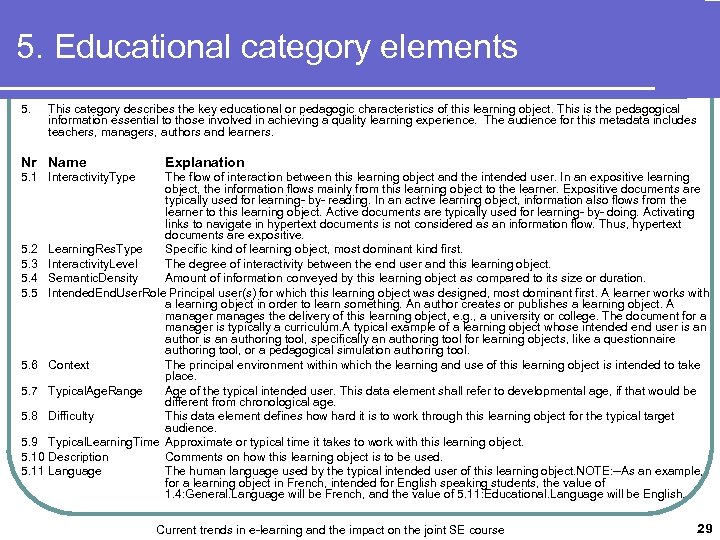 5. Educational category elements 5. This category describes the key educational or pedagogic characteristics of this learning object. This is the pedagogical information essential to those involved in achieving a quality learning experience. The audience for this metadata includes teachers, managers, authors and learners. Nr Name Explanation 5. 1 Interactivity. Type 5. 2 5. 3 5. 4 5. 5 5. 6 5. 7 5. 8 5. 9 5. 10 5. 11 The flow of interaction between this learning object and the intended user. In an expositive learning object, the information flows mainly from this learning object to the learner. Expositive documents are typically used for learning- by- reading. In an active learning object, information also flows from the learner to this learning object. Active documents are typically used for learning- by- doing. Activating links to navigate in hypertext documents is not considered as an information flow. Thus, hypertext documents are expositive. Learning. Res. Type Specific kind of learning object, most dominant kind first. Interactivity. Level The degree of interactivity between the end user and this learning object. Semantic. Density Amount of information conveyed by this learning object as compared to its size or duration. Intended. End. User. Role Principal user(s) for which this learning object was designed, most dominant first. A learner works with a learning object in order to learn something. An author creates or publishes a learning object. A manager manages the delivery of this learning object, e. g. , a university or college. The document for a manager is typically a curriculum. A typical example of a learning object whose intended end user is an authoring tool, specifically an authoring tool for learning objects, like a questionnaire authoring tool, or a pedagogical simulation authoring tool. Context The principal environment within which the learning and use of this learning object is intended to take place. Typical. Age. Range Age of the typical intended user. This data element shall refer to developmental age, if that would be different from chronological age. Difficulty This data element defines how hard it is to work through this learning object for the typical target audience. Typical. Learning. Time Approximate or typical time it takes to work with this learning object. Description Comments on how this learning object is to be used. Language The human language used by the typical intended user of this learning object. NOTE: --As an example, for a learning object in French, intended for English speaking students, the value of 1. 4: General. Language will be French, and the value of 5. 11: Educational. Language will be English. Current trends in e-learning and the impact on the joint SE course 29
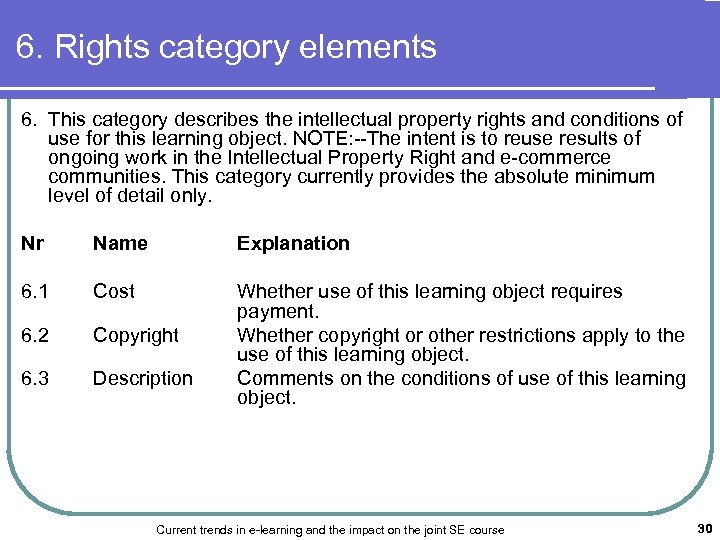 6. Rights category elements 6. This category describes the intellectual property rights and conditions of use for this learning object. NOTE: --The intent is to reuse results of ongoing work in the Intellectual Property Right and e-commerce communities. This category currently provides the absolute minimum level of detail only. Nr Name Explanation 6. 1 Cost 6. 2 Copyright 6. 3 Description Whether use of this learning object requires payment. Whether copyright or other restrictions apply to the use of this learning object. Comments on the conditions of use of this learning object. Current trends in e-learning and the impact on the joint SE course 30
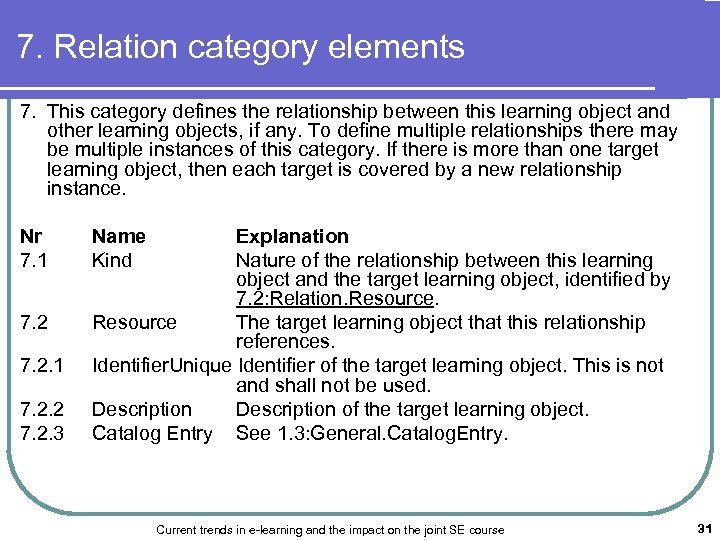 7. Relation category elements 7. This category defines the relationship between this learning object and other learning objects, if any. To define multiple relationships there may be multiple instances of this category. If there is more than one target learning object, then each target is covered by a new relationship instance. Nr 7. 1 7. 2. 2 7. 2. 3 Name Kind Explanation Nature of the relationship between this learning object and the target learning object, identified by 7. 2: Relation. Resource The target learning object that this relationship references. Identifier. Unique Identifier of the target learning object. This is not and shall not be used. Description of the target learning object. Catalog Entry See 1. 3: General. Catalog. Entry. Current trends in e-learning and the impact on the joint SE course 31
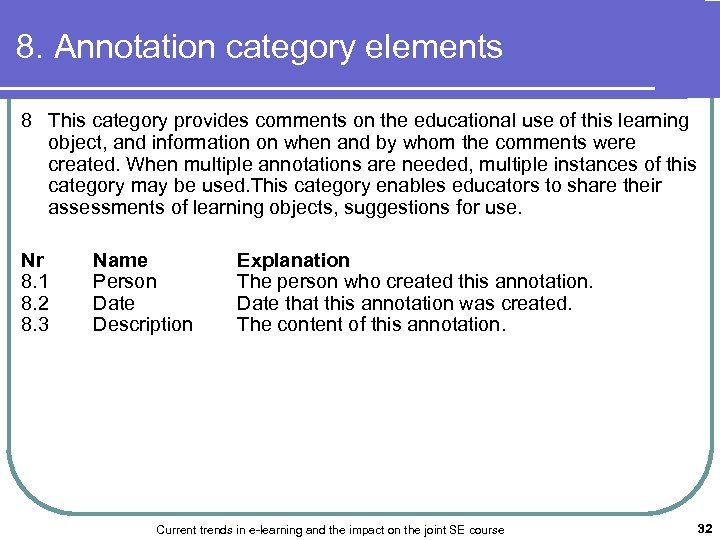 8. Annotation category elements 8 This category provides comments on the educational use of this learning object, and information on when and by whom the comments were created. When multiple annotations are needed, multiple instances of this category may be used. This category enables educators to share their assessments of learning objects, suggestions for use. Nr 8. 1 8. 2 8. 3 Name Person Date Description Explanation The person who created this annotation. Date that this annotation was created. The content of this annotation. Current trends in e-learning and the impact on the joint SE course 32
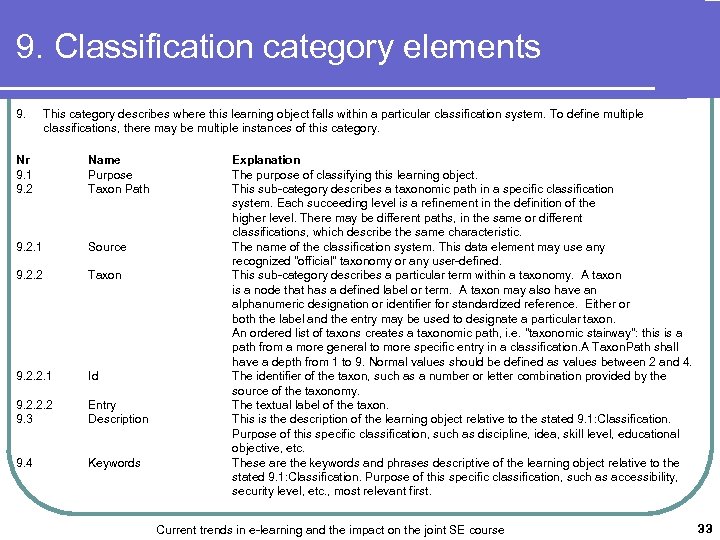 9. Classification category elements 9. This category describes where this learning object falls within a particular classification system. To define multiple classifications, there may be multiple instances of this category. Nr 9. 1 9. 2 Name Purpose Taxon Path 9. 2. 1 Source 9. 2. 2 Taxon 9. 2. 2. 1 Id 9. 2. 2. 2 9. 3 Entry Description 9. 4 Keywords Explanation The purpose of classifying this learning object. This sub-category describes a taxonomic path in a specific classification system. Each succeeding level is a refinement in the definition of the higher level. There may be different paths, in the same or different classifications, which describe the same characteristic. The name of the classification system. This data element may use any recognized "official" taxonomy or any user-defined. This sub-category describes a particular term within a taxonomy. A taxon is a node that has a defined label or term. A taxon may also have an alphanumeric designation or identifier for standardized reference. Either or both the label and the entry may be used to designate a particular taxon. An ordered list of taxons creates a taxonomic path, i. e. "taxonomic stairway": this is a path from a more general to more specific entry in a classification. A Taxon. Path shall have a depth from 1 to 9. Normal values should be defined as values between 2 and 4. The identifier of the taxon, such as a number or letter combination provided by the source of the taxonomy. The textual label of the taxon. This is the description of the learning object relative to the stated 9. 1: Classification. Purpose of this specific classification, such as discipline, idea, skill level, educational objective, etc. These are the keywords and phrases descriptive of the learning object relative to the stated 9. 1: Classification. Purpose of this specific classification, such as accessibility, security level, etc. , most relevant first. Current trends in e-learning and the impact on the joint SE course 33
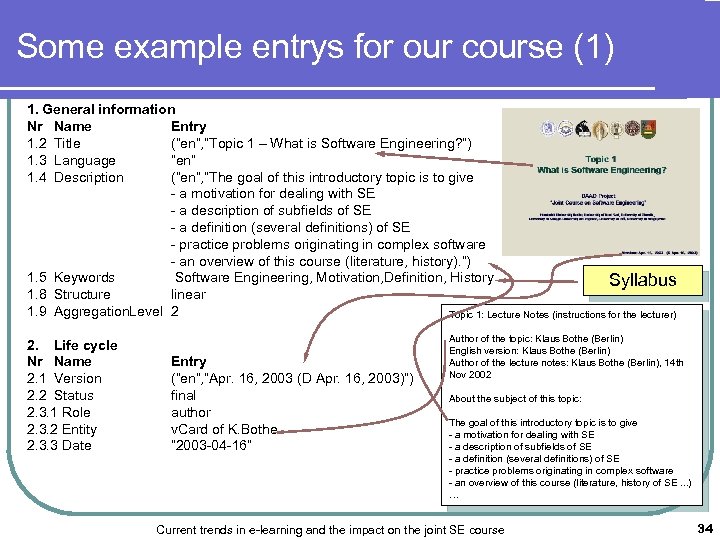 Some example entrys for our course (1) 1. General information Nr Name Entry 1. 2 Title (“en“, ”Topic 1 – What is Software Engineering? ”) 1. 3 Language “en” 1. 4 Description (“en”, “The goal of this introductory topic is to give - a motivation for dealing with SE - a description of subfields of SE - a definition (several definitions) of SE - practice problems originating in complex software - an overview of this course (literature, history). ”) 1. 5 Keywords Software Engineering, Motivation, Definition, History Syllabus 1. 8 Structure linear 1. 9 Aggregation. Level 2 Topic 1: Lecture Notes (instructions for the lecturer) 2. Life cycle Nr Name 2. 1 Version 2. 2 Status 2. 3. 1 Role 2. 3. 2 Entity 2. 3. 3 Date Entry (“en”, ”Apr. 16, 2003 (D Apr. 16, 2003)”) final author v. Card of K. Bothe “ 2003 -04 -16” Author of the topic: Klaus Bothe (Berlin) English version: Klaus Bothe (Berlin) Author of the lecture notes: Klaus Bothe (Berlin), 14 th Nov 2002 About the subject of this topic: The goal of this introductory topic is to give - a motivation for dealing with SE - a description of subfields of SE - a definition (several definitions) of SE - practice problems originating in complex software - an overview of this course (literature, history of SE. . . ) … Current trends in e-learning and the impact on the joint SE course 34
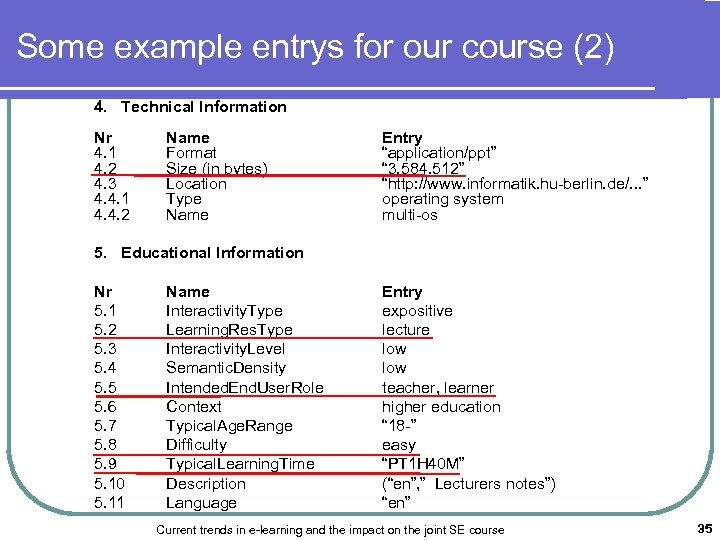 Some example entrys for our course (2) 4. Technical Information Nr 4. 1 4. 2 4. 3 4. 4. 1 4. 4. 2 Name Format Size (in bytes) Location Type Name Entry “application/ppt” “ 3. 584. 512” “http: //www. informatik. hu-berlin. de/. . . ” operating system multi-os 5. Educational Information Nr 5. 1 5. 2 5. 3 5. 4 5. 5 5. 6 5. 7 5. 8 5. 9 5. 10 5. 11 Name Interactivity. Type Learning. Res. Type Interactivity. Level Semantic. Density Intended. End. User. Role Context Typical. Age. Range Difficulty Typical. Learning. Time Description Language Entry expositive lecture low teacher, learner higher education “ 18 -” easy “PT 1 H 40 M” (“en”, ” Lecturers notes”) “en” Current trends in e-learning and the impact on the joint SE course 35
 Agenda 1. 2. 3. 4. 5. 6. E-learning conferences and their subjects Definitions in the field of e-learning Learning objects and their specification MIT open courseware (Semantic Web) Navigation (logic or associative) and search in course material Summary and conclusions Current trends in e-learning and the impact on the joint SE course 36
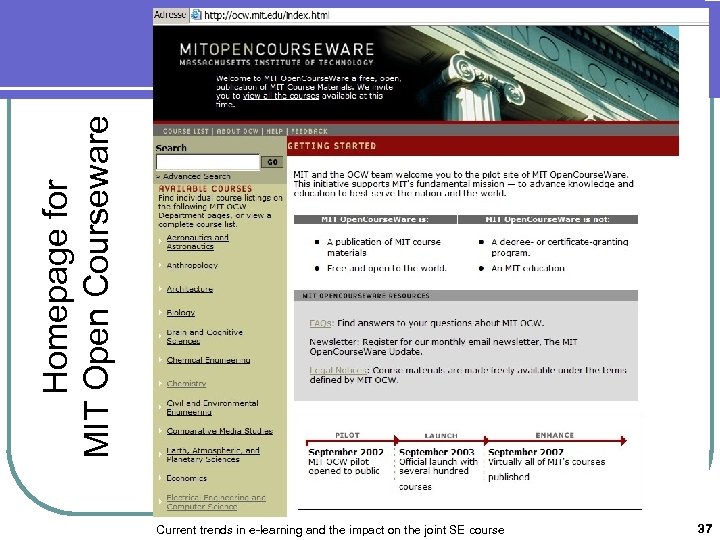 Homepage for MIT Open Courseware Current trends in e-learning and the impact on the joint SE course 37
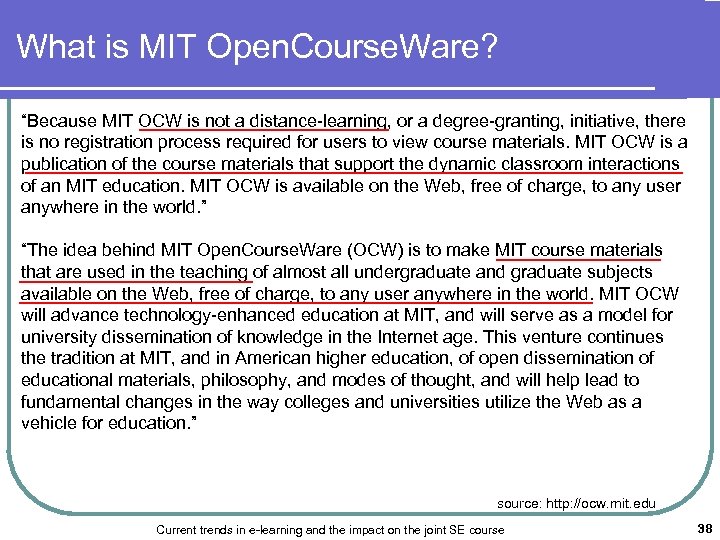 What is MIT Open. Course. Ware? “Because MIT OCW is not a distance-learning, or a degree-granting, initiative, there is no registration process required for users to view course materials. MIT OCW is a publication of the course materials that support the dynamic classroom interactions of an MIT education. MIT OCW is available on the Web, free of charge, to any user anywhere in the world. ” “The idea behind MIT Open. Course. Ware (OCW) is to make MIT course materials that are used in the teaching of almost all undergraduate and graduate subjects available on the Web, free of charge, to any user anywhere in the world. MIT OCW will advance technology-enhanced education at MIT, and will serve as a model for university dissemination of knowledge in the Internet age. This venture continues the tradition at MIT, and in American higher education, of open dissemination of educational materials, philosophy, and modes of thought, and will help lead to fundamental changes in the way colleges and universities utilize the Web as a vehicle for education. ” source: http: //ocw. mit. edu Current trends in e-learning and the impact on the joint SE course 38
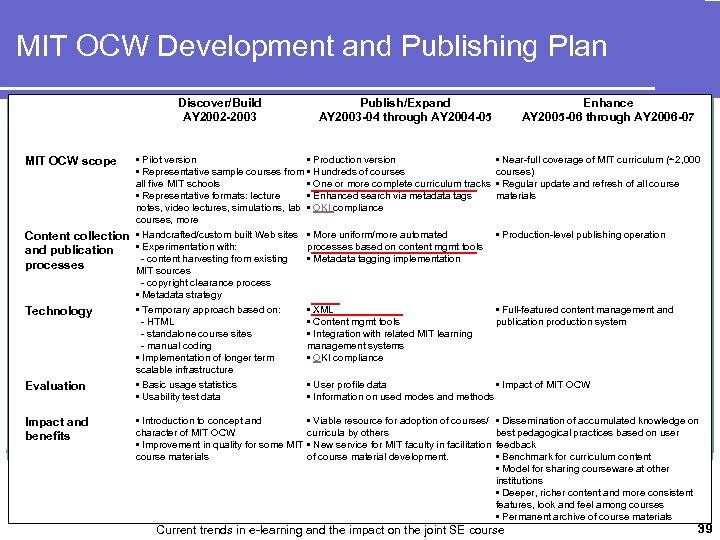 MIT OCW Development and Publishing Plan Discover/Build AY 2002 -2003 Publish/Expand AY 2003 -04 through AY 2004 -05 Enhance AY 2005 -06 through AY 2006 -07 • Pilot version • Production version • Near-full coverage of MIT curriculum (~2, 000 • Representative sample courses from • Hundreds of courses) all five MIT schools • One or more complete curriculum tracks • Regular update and refresh of all course • Representative formats: lecture • Enhanced search via metadata tags materials notes, video lectures, simulations, lab • OKI compliance courses, more • Production-level publishing operation Content collection • Handcrafted/custom built Web sites • More uniform/more automated • Experimentation with: processes based on content mgmt tools and publication - content harvesting from existing • Metadata tagging implementation processes MIT sources - copyright clearance process • Metadata strategy • Temporary approach based on: • XML • Full-featured content management and Technology - HTML • Content mgmt tools publication production system - standalone course sites • Integration with related MIT learning - manual coding management systems • Implementation of longer term • OKI compliance scalable infrastructure • Basic usage statistics • User profile data • Impact of MIT OCW Evaluation • Usability test data • Information on used modes and methods MIT OCW scope Impact and benefits • Introduction to concept and • Viable resource for adoption of courses/ • Dissemination of accumulated knowledge on character of MIT OCW curricula by others best pedagogical practices based on user • Improvement in quality for some MIT • New service for MIT faculty in facilitation feedback course materials of course material development. • Benchmark for curriculum content • Model for sharing courseware at other institutions • Deeper, richer content and more consistent features, look and feel among courses • Permanent archive of course materials Current trends in e-learning and the impact on the joint SE course 39
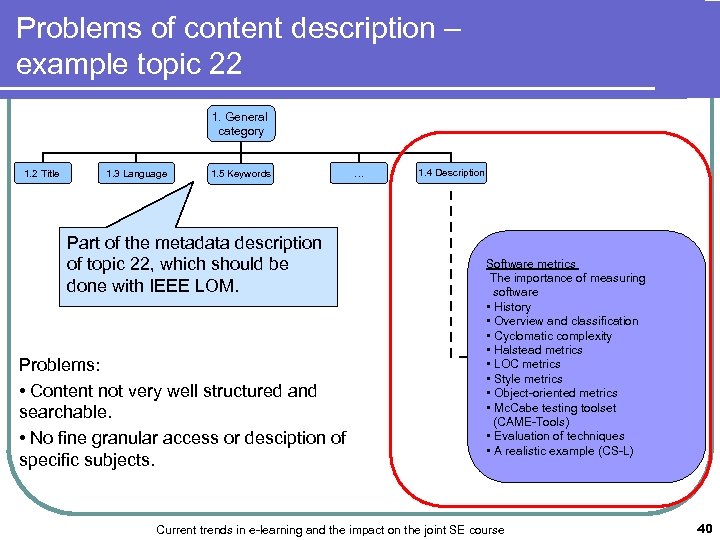 Problems of content description – example topic 22 1. General category 1. 2 Title 1. 3 Language 1. 5 Keywords Part of the metadata description of topic 22, which should be done with IEEE LOM. Problems: • Content not very well structured and searchable. • No fine granular access or desciption of specific subjects. … 1. 4 Description Software metrics The importance of measuring software • History • Overview and classification • Cyclomatic complexity • Halstead metrics • LOC metrics • Style metrics • Object-oriented metrics • Mc. Cabe testing toolset (CAME-Tools) • Evaluation of techniques • A realistic example (CS-L) Current trends in e-learning and the impact on the joint SE course 40
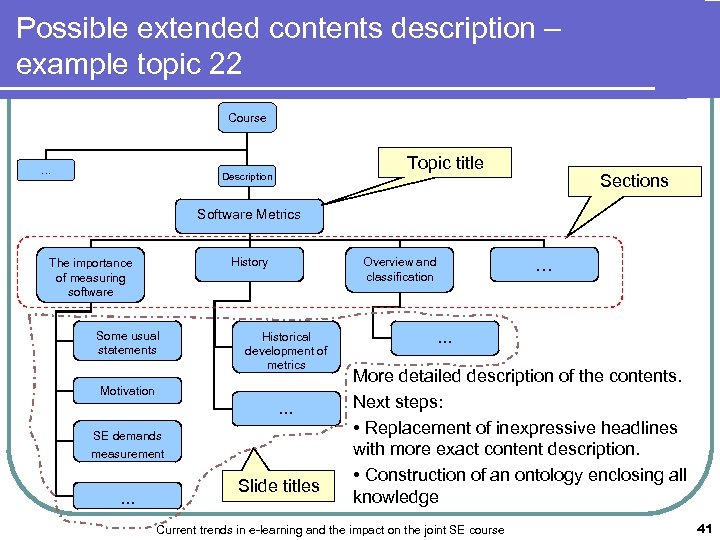 Possible extended contents description – example topic 22 Course … Topic title Description Sections Software Metrics History The importance of measuring software Some usual statements Overview and classification Historical development of metrics Motivation … SE demands measurement … Slide titles … … More detailed description of the contents. Next steps: • Replacement of inexpressive headlines with more exact content description. • Construction of an ontology enclosing all knowledge Current trends in e-learning and the impact on the joint SE course 41
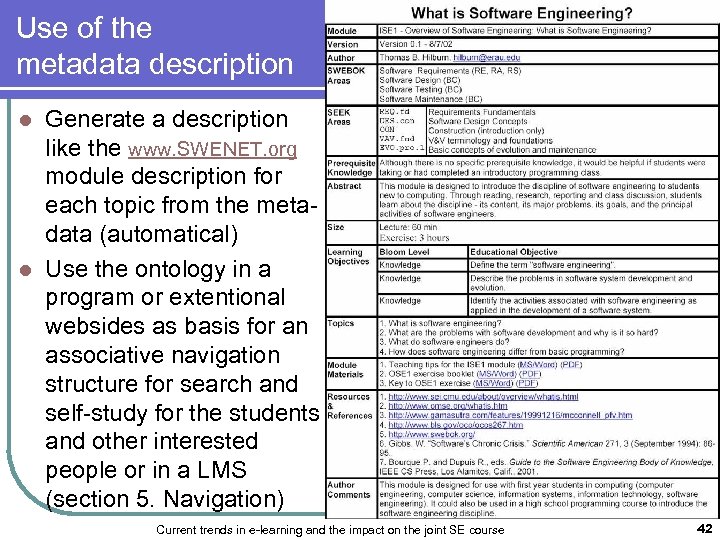 Use of the metadata description Generate a description like the www. SWENET. org module description for each topic from the metadata (automatical) l Use the ontology in a program or extentional websides as basis for an associative navigation structure for search and self-study for the students and other interested people or in a LMS (section 5. Navigation) l Current trends in e-learning and the impact on the joint SE course 42
 Agenda 1. 2. 3. 4. 5. 6. E-learning conferences and their subjects Definitions in the field of e-learning Learning objects and their specification MIT open courseware (Semantic Web) Navigation (logic or associative) and search in course material Summary and conclusions Current trends in e-learning and the impact on the joint SE course 43
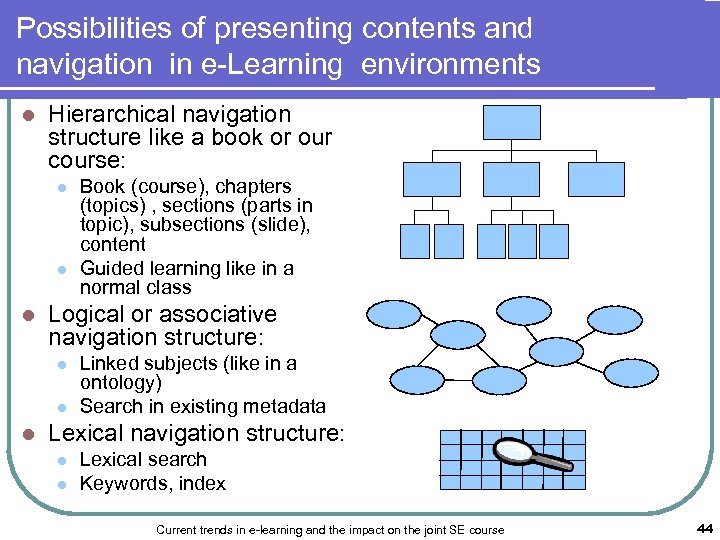 Possibilities of presenting contents and navigation in e-Learning environments l Hierarchical navigation structure like a book or our course: l l l Logical or associative navigation structure: l l l Book (course), chapters (topics) , sections (parts in topic), subsections (slide), content Guided learning like in a normal class Linked subjects (like in a ontology) Search in existing metadata Lexical navigation structure: l l Lexical search Keywords, index Current trends in e-learning and the impact on the joint SE course 44
 The example of the Virtu. Ohm LMS l Virtual learning environment l Developer: Georg-Simon-Ohm- Fachhochschule Nürnberg l Source: SEUH 8, “Virtu. Ohm – Konzept einer virtuellen Lernumgebung”, Prof. Hans Georg Hopf l www. Virtu. Ohm. de Current trends in e-learning and the impact on the joint SE course 45
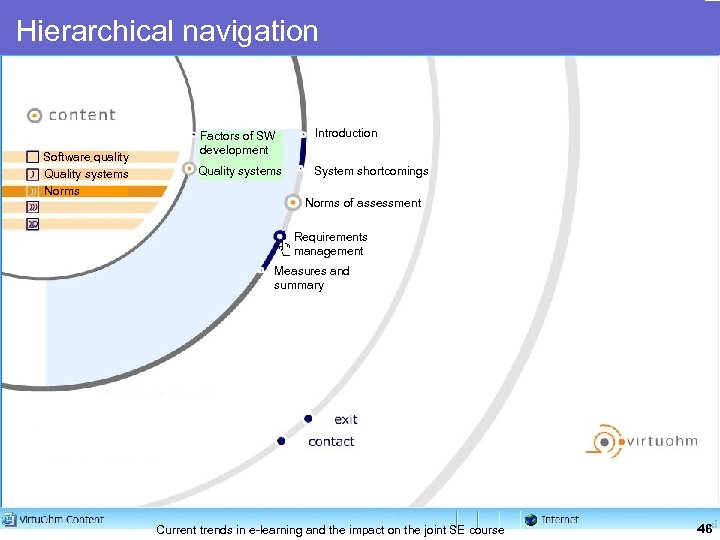 Hierarchical navigation Software quality Quality systems Norms Factors of SW development Introduction Quality systems System shortcomings Norms of assessment Requirements management Measures and summary Current trends in e-learning and the impact on the joint SE course 46
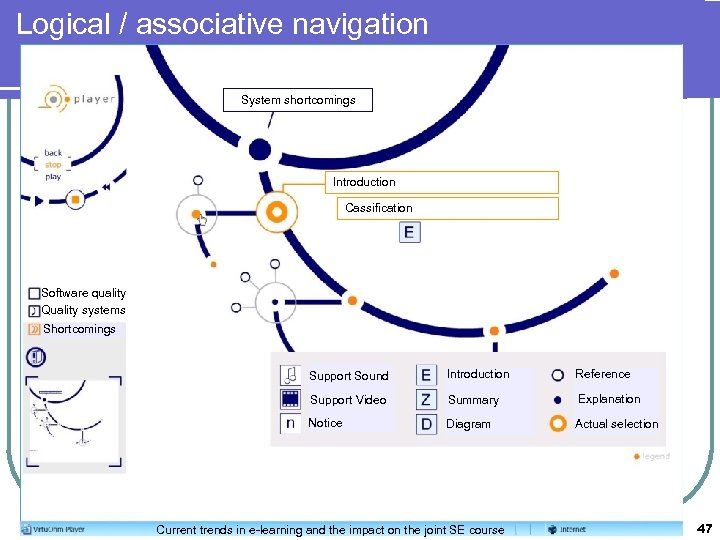 Logical / associative navigation System shortcomings Introduction Cassification Software quality Quality systems Shortcomings Support Sound Introduction Reference Support Video Summary Explanation Notice Diagram Actual selection Current trends in e-learning and the impact on the joint SE course 47
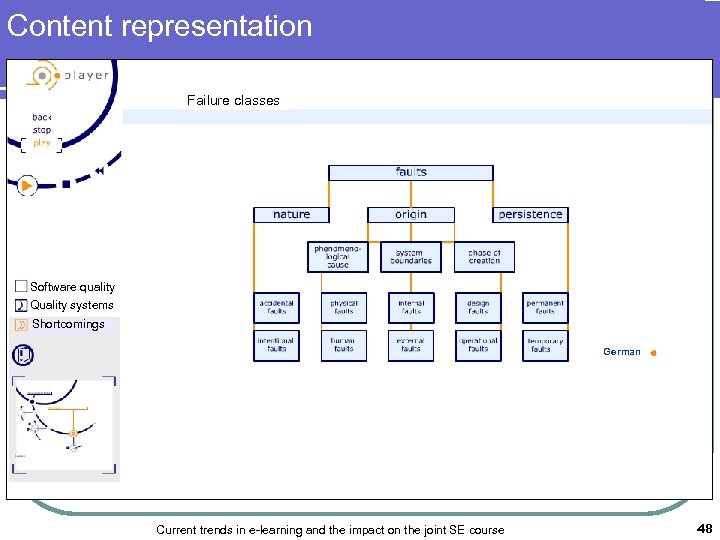 Content representation Failure classes Software quality Quality systems Shortcomings German Current trends in e-learning and the impact on the joint SE course 48
 Agenda 1. 2. 3. 4. 5. 6. E-learning conferences and their subjects Definitions in the field of e-learning Learning objects and their specification MIT open courseware (Semantic Web) Navigation (logic or associative) and search in course material Summary and conclusions Current trends in e-learning and the impact on the joint SE course 49
 Summary: advantages of using learning object metadata desciptions l Reuseability l l l Access l l Independent from place, time and source Search and navigation l l l Contents can be used in various applications Other authors can adapt contents More exact query results Support of self-study Interoperability l Different platforms can cooperate with other systems and author tools Current trends in e-learning and the impact on the joint SE course 50
 Possible research directions in our project l Use of metadata l l l Usage of LOM for topic and course description Building an ontology for each topic / the whole course LMS for our course l l Representation Search in contents Content development support l Translation support (multilinguality) l Current trends in e-learning and the impact on the joint SE course 51