


 Скачать презентацию Current Trends Future Visions of the Virtual
fd2813bb60d4707781e01f36b8b1189c.ppt
- Количество слайдов: 24
 Current Trends & Future Visions of the Virtual Botanical Library Douglas Holland Librarian doug. holland@mobot. org
 Introduction and Overview • Representative of the Library and Digital Library Community. • Changing role of librarians. . . or is it? Librarians have a long historical precedent of organizing, preserving and providing access to information and as early adopters of new technology. How they fit in to informatics is still evolving. • Cross pollination between Biodiversity Informatics and Digital Library initiatives. • Survey of current digital books and floras as models. • Changing paradigms in scholarly communications.
 Digital Libraries and Librarians l l l Many large scale initiatives from the library and computer science communities. Multi-Million $$ NSF Grants for DL development (National Science Digital Library) and $$ from IMLS. gov Implications for standards, interoperability, preservation and funding. Completely different suite of inscrutable acronyms. OCLC (online since 1971) contains 45 Million bibliographic records! Framework document: http: //www. imls. gov/pubs/forumframework. htm
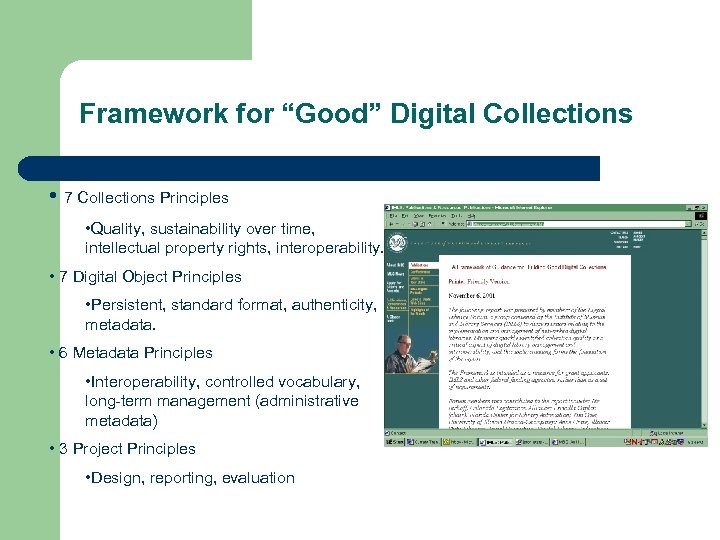 Framework for “Good” Digital Collections • 7 Collections Principles • Quality, sustainability over time, intellectual property rights, interoperability. • 7 Digital Object Principles • Persistent, standard format, authenticity, metadata. • 6 Metadata Principles • Interoperability, controlled vocabulary, long-term management (administrative metadata) • 3 Project Principles • Design, reporting, evaluation
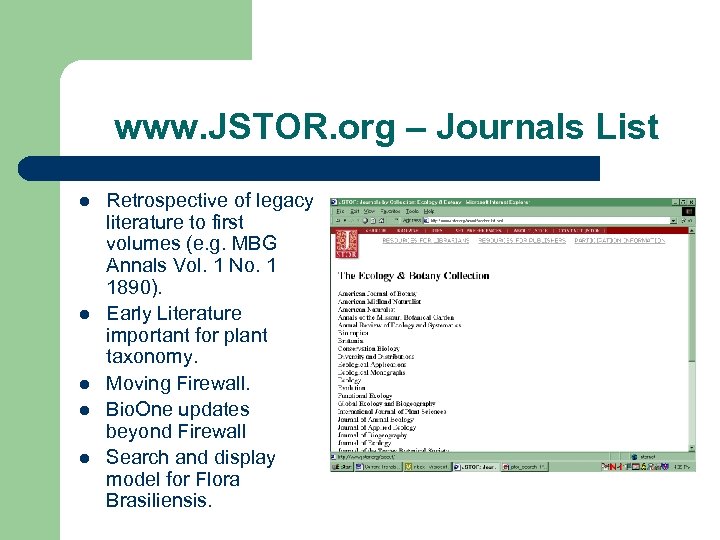 www. JSTOR. org – Journals List l l l Retrospective of legacy literature to first volumes (e. g. MBG Annals Vol. 1 No. 1 1890). Early Literature important for plant taxonomy. Moving Firewall. Bio. One updates beyond Firewall Search and display model for Flora Brasiliensis.
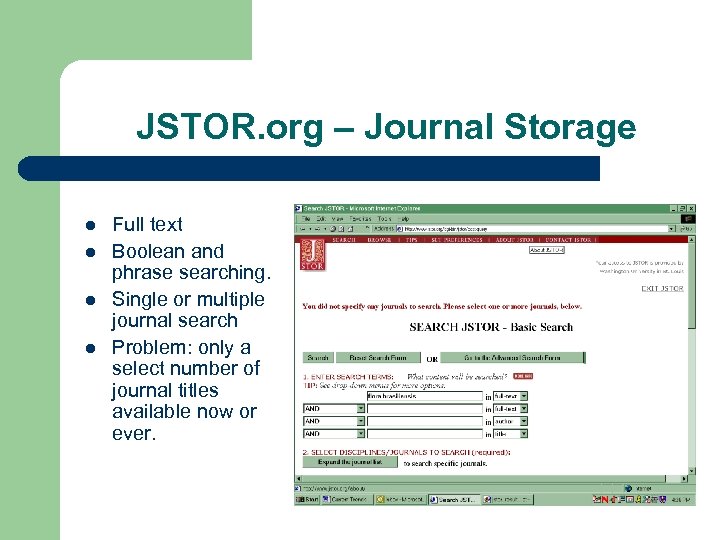 JSTOR. org – Journal Storage l l Full text Boolean and phrase searching. Single or multiple journal search Problem: only a select number of journal titles available now or ever.
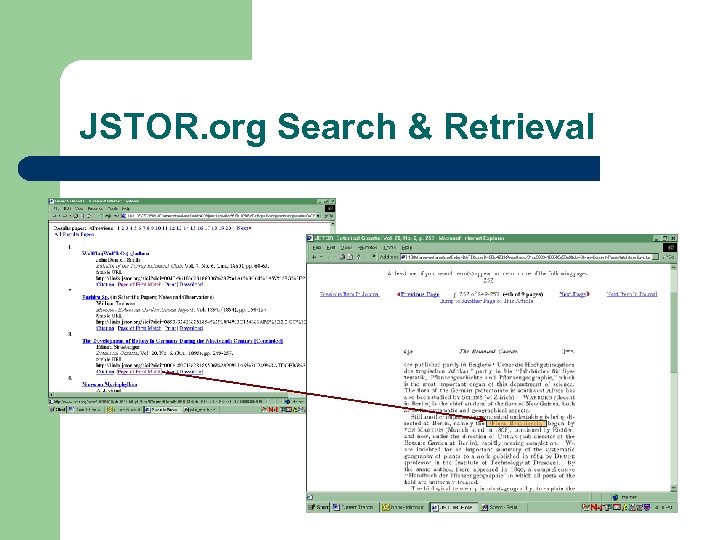 JSTOR. org Search & Retrieval
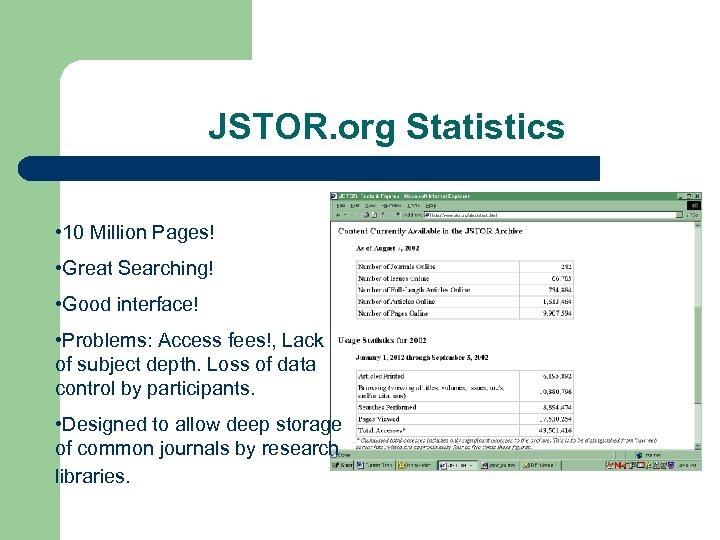 JSTOR. org Statistics • 10 Million Pages! • Great Searching! • Good interface! • Problems: Access fees!, Lack of subject depth. Loss of data control by participants. • Designed to allow deep storage of common journals by research libraries.
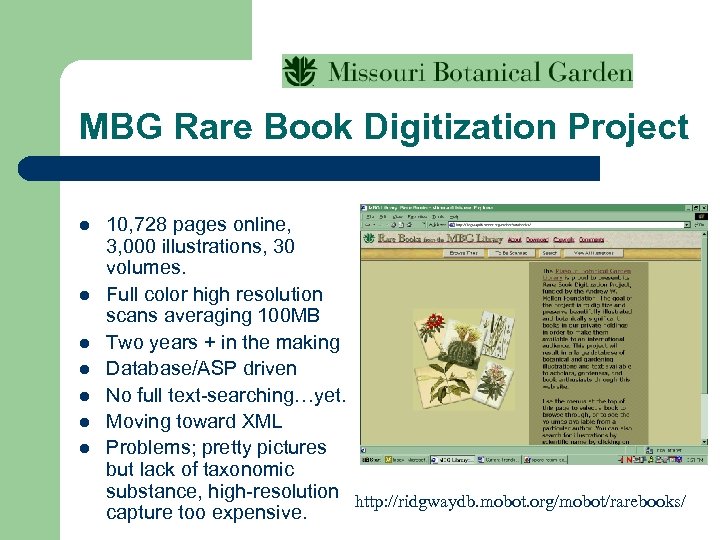 MBG Rare Book Digitization Project l l l l 10, 728 pages online, 3, 000 illustrations, 30 volumes. Full color high resolution scans averaging 100 MB Two years + in the making Database/ASP driven No full text-searching…yet. Moving toward XML Problems; pretty pictures but lack of taxonomic substance, high-resolution http: //ridgwaydb. mobot. org/mobot/rarebooks/ capture too expensive.
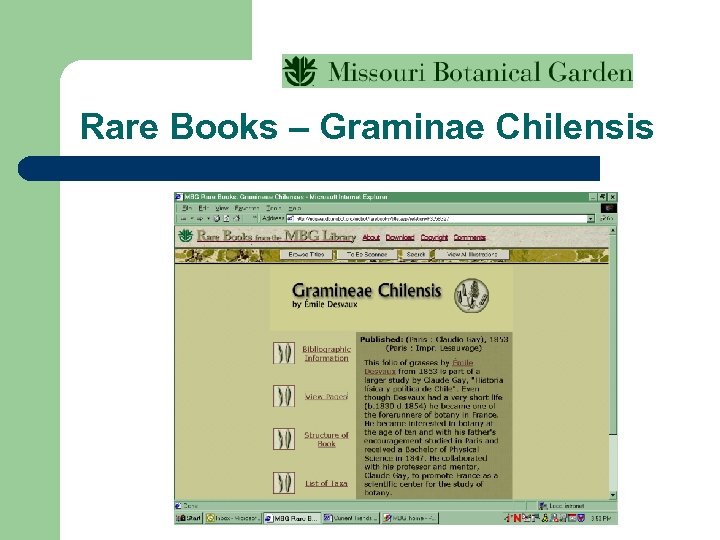 Rare Books – Graminae Chilensis
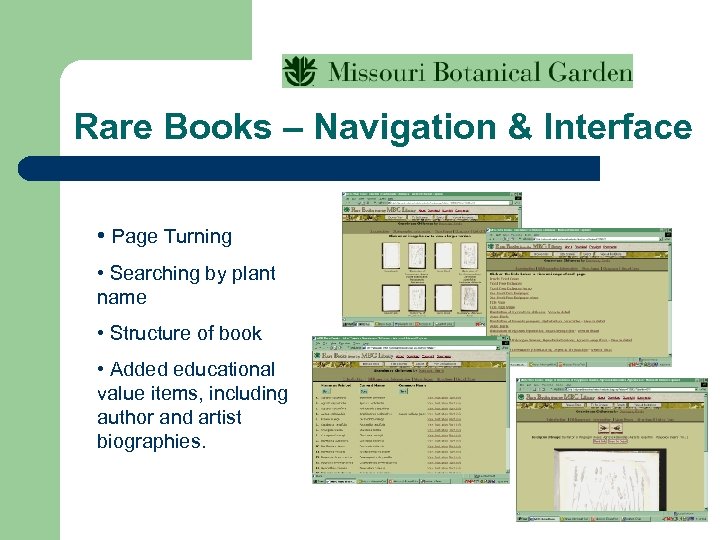 Rare Books – Navigation & Interface • Page Turning • Searching by plant name • Structure of book • Added educational value items, including author and artist biographies.
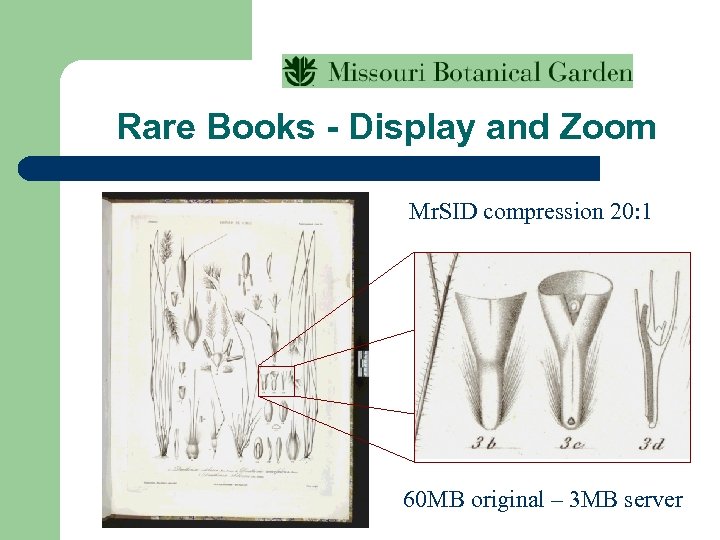 Rare Books - Display and Zoom Mr. SID compression 20: 1 60 MB original – 3 MB server
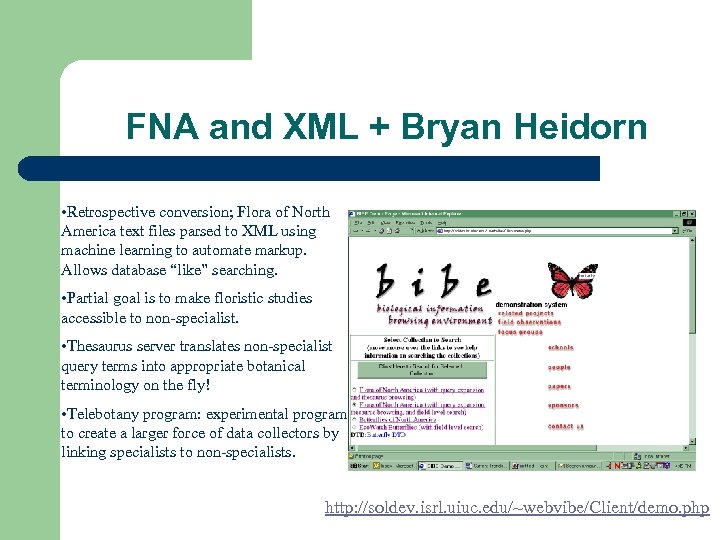 FNA and XML + Bryan Heidorn • Retrospective conversion; Flora of North America text files parsed to XML using machine learning to automate markup. Allows database “like” searching. • Partial goal is to make floristic studies accessible to non-specialist. • Thesaurus server translates non-specialist query terms into appropriate botanical terminology on the fly! • Telebotany program: experimental program to create a larger force of data collectors by linking specialists to non-specialists. http: //soldev. isrl. uiuc. edu/~webvibe/Client/demo. php
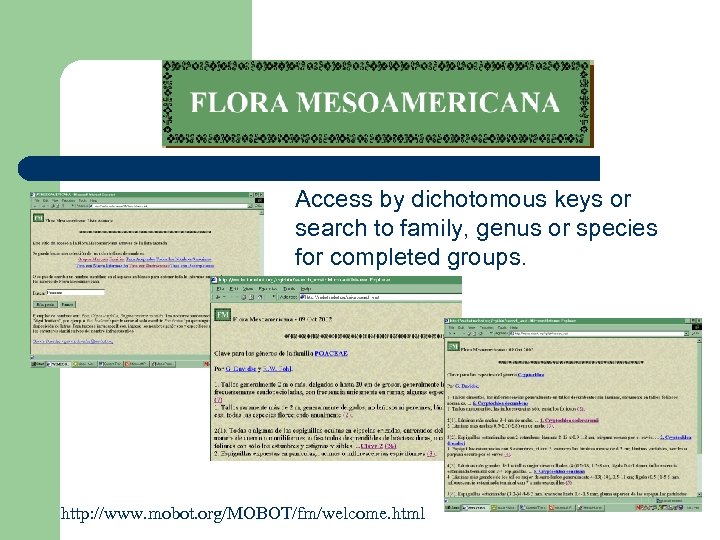 Access by dichotomous keys or search to family, genus or species for completed groups. http: //www. mobot. org/MOBOT/fm/welcome. html
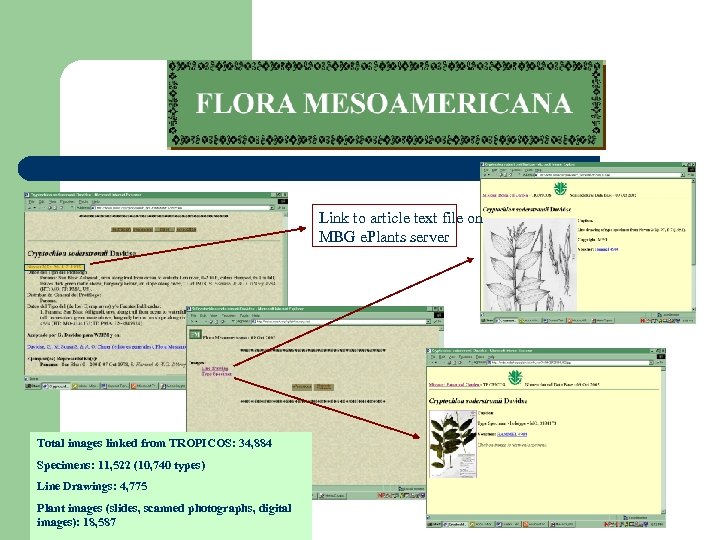 Link to article text file on MBG e. Plants server Total images linked from TROPICOS: 34, 884 Specimens: 11, 522 (10, 740 types) Line Drawings: 4, 775 Plant images (slides, scanned photographs, digital images): 18, 587
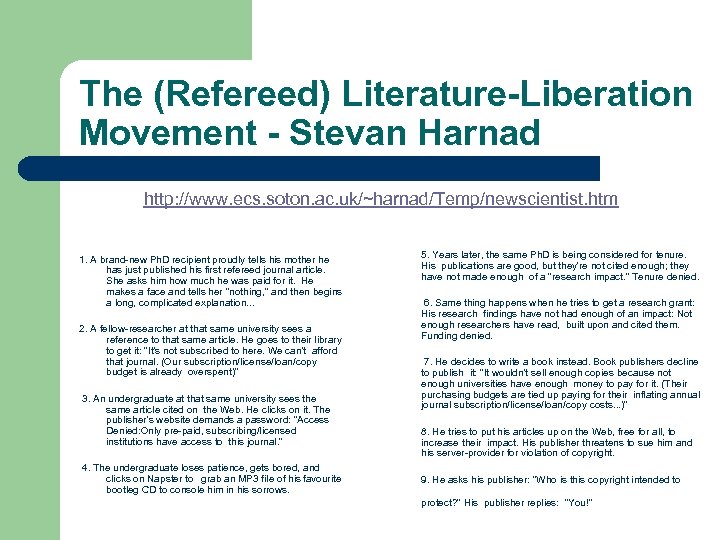 The (Refereed) Literature-Liberation Movement - Stevan Harnad http: //www. ecs. soton. ac. uk/~harnad/Temp/newscientist. htm 1. A brand-new Ph. D recipient proudly tells his mother he has just published his first refereed journal article. She asks him how much he was paid for it. He makes a face and tells her "nothing, " and then begins a long, complicated explanation. . . 2. A fellow-researcher at that same university sees a reference to that same article. He goes to their library to get it: "It's not subscribed to here. We can't afford that journal. (Our subscription/license/loan/copy budget is already overspent)" 3. An undergraduate at that same university sees the same article cited on the Web. He clicks on it. The publisher's website demands a password: "Access Denied: Only pre-paid, subscribing/licensed institutions have access to this journal. " 4. The undergraduate loses patience, gets bored, and clicks on Napster to grab an MP 3 file of his favourite bootleg CD to console him in his sorrows. 5. Years later, the same Ph. D is being considered for tenure. His publications are good, but they're not cited enough; they have not made enough of a "research impact. " Tenure denied. 6. Same thing happens when he tries to get a research grant: His research findings have not had enough of an impact: Not enough researchers have read, built upon and cited them. Funding denied. 7. He decides to write a book instead. Book publishers decline to publish it: "It wouldn't sell enough copies because not enough universities have enough money to pay for it. (Their purchasing budgets are tied up paying for their inflating annual journal subscription/license/loan/copy costs. . . )" 8. He tries to put his articles up on the Web, free for all, to increase their impact. His publisher threatens to sue him and his server-provider for violation of copyright. 9. He asks his publisher: "Who is this copyright intended to protect? " His publisher replies: "You!"
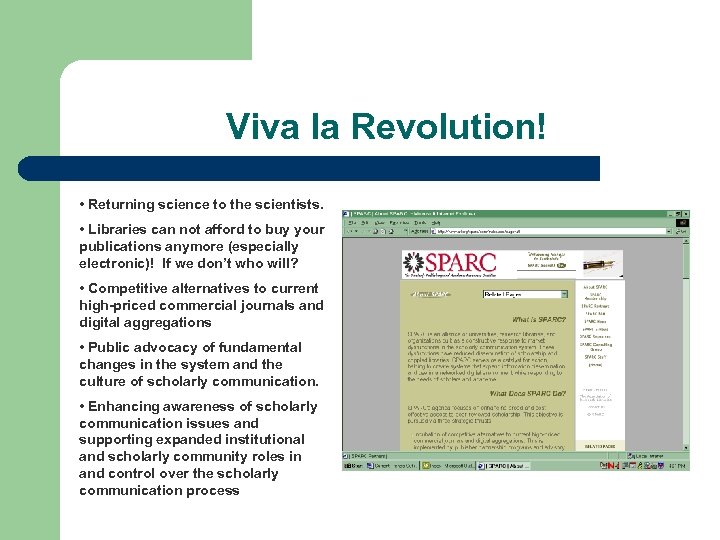 Viva la Revolution! • Returning science to the scientists. • Libraries can not afford to buy your publications anymore (especially electronic)! If we don’t who will? • Competitive alternatives to current high-priced commercial journals and digital aggregations • Public advocacy of fundamental changes in the system and the culture of scholarly communication. • Enhancing awareness of scholarly communication issues and supporting expanded institutional and scholarly community roles in and control over the scholarly communication process
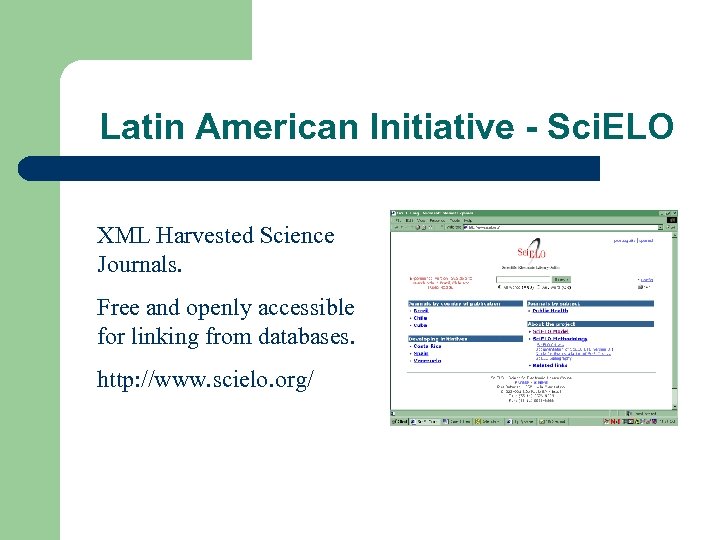 Latin American Initiative - Sci. ELO XML Harvested Science Journals. Free and openly accessible for linking from databases. http: //www. scielo. org/
 MBG – e. Plants Server “Electronic Publications and Literature Archive for Nomenclature, Taxonomy, and Systematics” l l l Repository for textual materials with self “archiving” metadata for discovery. Will make available recent copies of MBG Annals and Novon as PDF files Will experiment with housing digitized (out of copyright) journal articles and protologues for linking to TROPICOS (or from outside by any user) Also for preprints, reviewed (or unreviewed) papers, works that do not fit in to MBG press publication schedules or budgets, or work authors do not necessarily need or want published in print. www. eprints. org
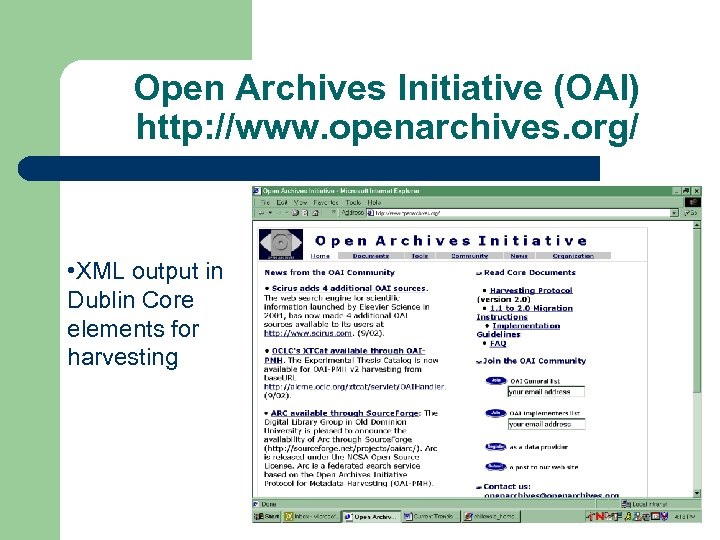 Open Archives Initiative (OAI) http: //www. openarchives. org/ • XML output in Dublin Core elements for harvesting
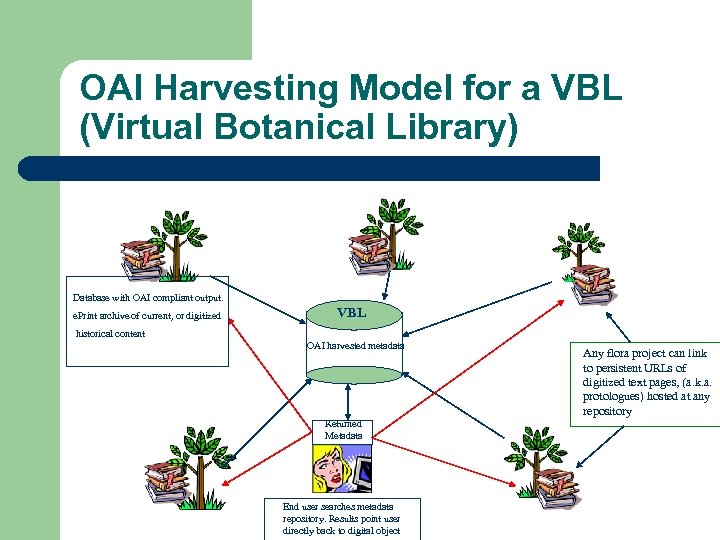 OAI Harvesting Model for a VBL (Virtual Botanical Library) Database with OAI compliant output. e. Print archive of current, or digitized VBL historical content OAI harvested metadata Returned Metadata End user searches metadata repository. Results point user directly back to digital object Any flora project can link to persistent URLs of digitized text pages, (a. k. a. protologues) hosted at any repository
 METS and OAIS l The METS schema is a standard for encoding descriptive, administrative, and structural metadata regarding objects within a digital library, expressed using the XML schema language. http: //www. loc. gov/standards/mets/ l Part of the ISO - International Organization for Standardization, OAIS - Open Archival Information System (not to be confused with OAI) is a framework for long term preservation of digital objects. http: //ssdoo. gsfc. nasa. gov/nost/isoas/ being supported by the US National Archives.
 Conclusions l l There is no unified vision or technology…yet. The “standards” and protocols are constantly evolving Separate insular efforts will eventually grow to one large body of interlinked information. Need to: – – – – Avoid redundant efforts. Create list of endangered and important literature for priority. Strive for interoperability and potential “repurposing “ Strive for retrievability Keep things freely available Keep things high (enough) quality Strive for permanence and persistence of objects and URLs. Do not forget copyright and intellectual property issues!
 Current Trends & Future Visions of the Virtual Botanical Library Douglas Holland Librarian doug. holland@mobot. org