


 Скачать презентацию Current and Future Use of Satellite Data in
3e046aadebc8460c9b42bf45e2249287.ppt
- Количество слайдов: 18
 Current and Future Use of Satellite Data in NWP at Environment Canada Satellite Direct Readout Conference 2011 Miami, USA David Bradley, Gilles Verner, Mike Manore Meteorological Service of Canada April 4 -8, 2011
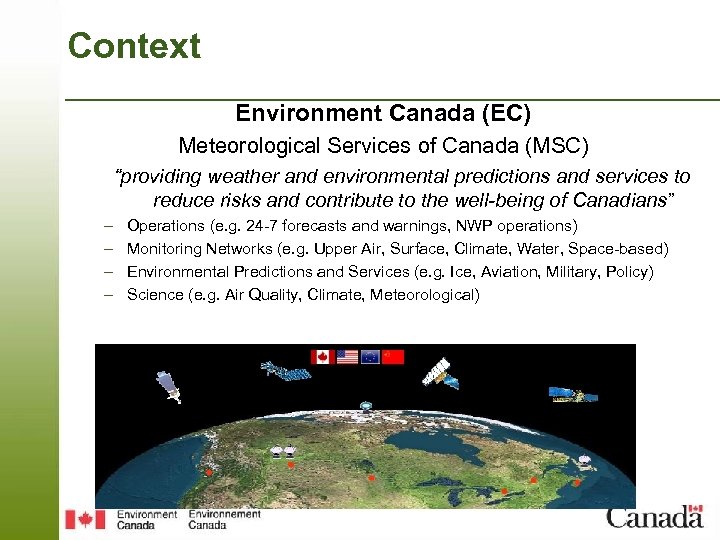 Context Environment Canada (EC) Meteorological Services of Canada (MSC) “providing weather and environmental predictions and services to reduce risks and contribute to the well-being of Canadians” – – Operations (e. g. 24 -7 forecasts and warnings, NWP operations) Monitoring Networks (e. g. Upper Air, Surface, Climate, Water, Space-based) Environmental Predictions and Services (e. g. Ice, Aviation, Military, Policy) Science (e. g. Air Quality, Climate, Meteorological)
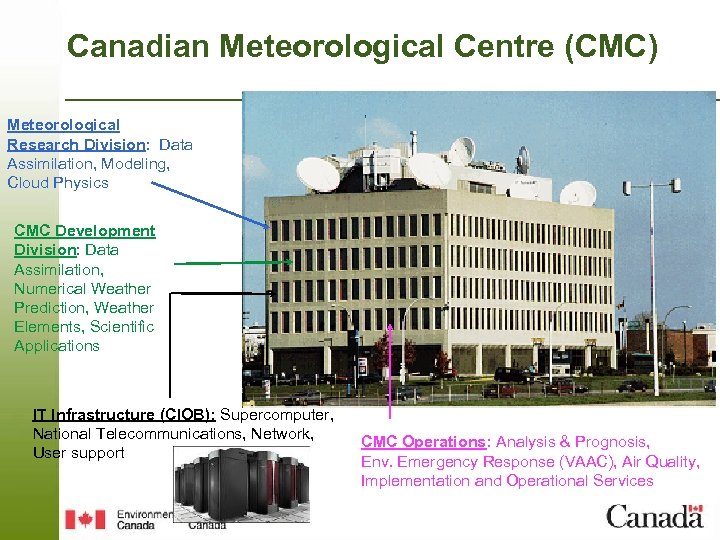 Canadian Meteorological Centre (CMC) Meteorological Research Division: Data Assimilation, Modeling, Cloud Physics CMC Development Division: Data Assimilation, Numerical Weather Prediction, Weather Elements, Scientific Applications IT Infrastructure (CIOB): Supercomputer, National Telecommunications, Network, User support CMC Operations: Analysis & Prognosis, Env. Emergency Response (VAAC), Air Quality, Implementation and Operational Services
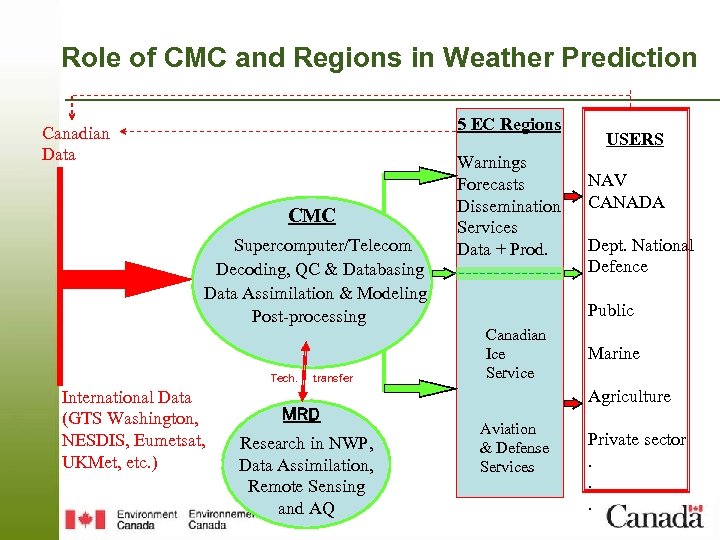 Role of CMC and Regions in Weather Prediction 5 EC Regions Canadian Data CMC Supercomputer/Telecom Decoding, QC & Databasing Data Assimilation & Modeling Post-processing Tech. International Data (GTS Washington, NESDIS, Eumetsat, UKMet, etc. ) transfer MRD Research in NWP, Data Assimilation, Remote Sensing and AQ Warnings Forecasts Dissemination Services Data + Prod. USERS NAV CANADA Dept. National Defence Public Canadian Ice Service Marine Agriculture Aviation & Defense Services Private sector. . .
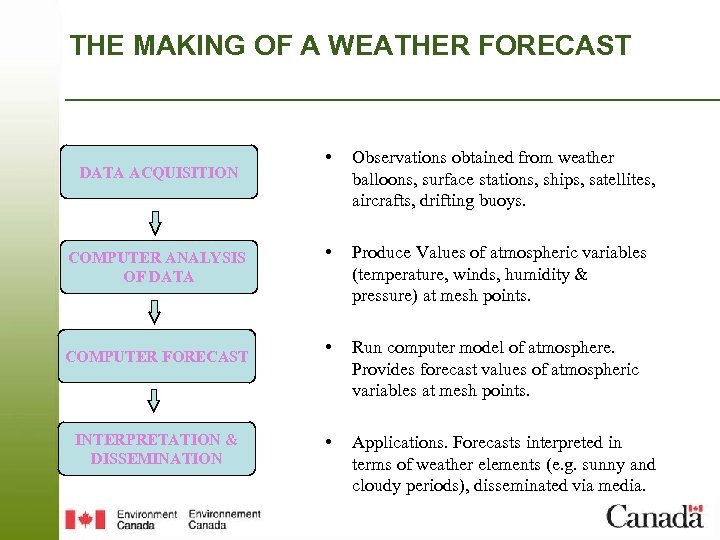 THE MAKING OF A WEATHER FORECAST DATA ACQUISITION COMPUTER ANALYSIS OF DATA COMPUTER FORECAST INTERPRETATION & DISSEMINATION • Observations obtained from weather balloons, surface stations, ships, satellites, aircrafts, drifting buoys. • Produce Values of atmospheric variables (temperature, winds, humidity & pressure) at mesh points. • Run computer model of atmosphere. Provides forecast values of atmospheric variables at mesh points. • Applications. Forecasts interpreted in terms of weather elements (e. g. sunny and cloudy periods), disseminated via media.
 Data Assimilation Process Data Acquisition Error Statistics (Observation and Forecast) Data Quality Control Analysis (Spatial QC) Cost First Guess Use (6 hr fcst) NWP model J(xi-1) to find xi MIN J(x) xa
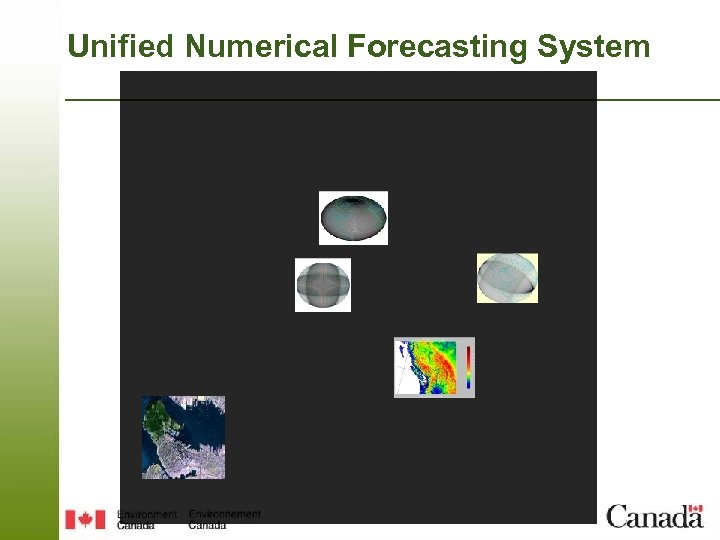 Unified Numerical Forecasting System
 Main Uses of Observational Data at CMC • CMC is a major user of observational data, both Canadian and foreign, main uses are: Data Assimilation: Blending of observations with other information to generate initial conditions (the analysis) to run the NWP forecast models. Radiosonde and Satellite data are of crucial importance • Forecast Verification: Observations (upper air, surface, satellite) considered as truth (after QC), and used to verify the accuracy of forecasts (both model and Scribe) and perform diagnostic studies. • Weather Element Forecast: Observations used in generation of statistical equations which are used to produce forecasts of weather elements, important input to SCRIBE and forecast system. • Applications: EER (volcanic ash, spills, fires, etc. ), air pollution and atmospheric chemistry, nowcasting, surface fields (SST, ice, snow, etc. )
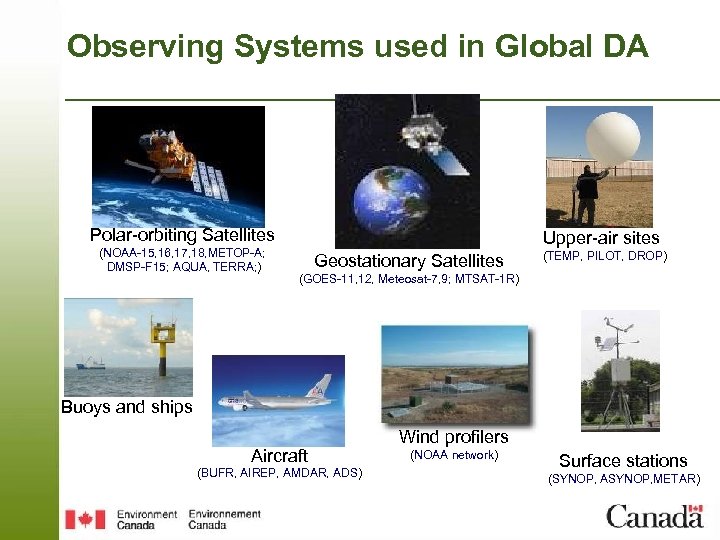 Observing Systems used in Global DA Polar-orbiting Satellites (NOAA-15, 16, 17, 18, METOP-A; DMSP-F 15; AQUA, TERRA; ) Upper-air sites Geostationary Satellites (TEMP, PILOT, DROP) (GOES-11, 12, Meteosat-7, 9; MTSAT-1 R) Buoys and ships Aircraft (BUFR, AIREP, AMDAR, ADS) Wind profilers (NOAA network) Surface stations (SYNOP, ASYNOP, METAR)
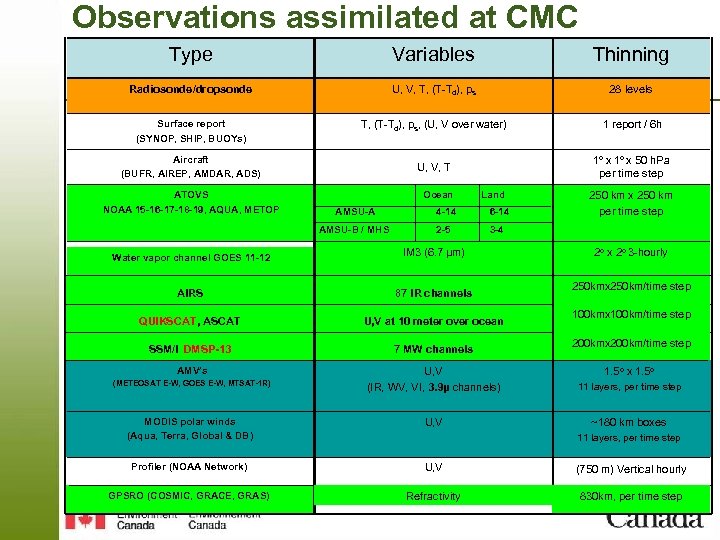 Observations assimilated at CMC Type Variables Thinning Radiosonde/dropsonde U, V, T, (T-Td), ps 28 levels Surface report (SYNOP, SHIP, BUOYs) T, (T-Td), ps, (U, V over water) 1 report / 6 h U, V, T 1 o x 50 h. Pa per time step Aircraft (BUFR, AIREP, AMDAR, ADS) ATOVS NOAA 15 -16 -17 -18 -19, AQUA, METOP Ocean Land AMSU-A 4 -14 6 -14 AMSU-B / MHS 2 -5 250 km x 250 km per time step 3 -4 Water vapor channel GOES 11 -12 IM 3 (6. 7 µm) AIRS 87 IR channels QUIKSCAT, ASCAT U, V at 10 meter over ocean SSM/I DMSP-13 7 MW channels AMV’s U, V (IR, WV, VI, 3. 9μ channels) 11 layers, per time step MODIS polar winds (Aqua, Terra, Global & DB) U, V ~180 km boxes Profiler (NOAA Network) U, V (750 m) Vertical hourly GPSRO (COSMIC, GRACE, GRAS) Refractivity 830 km, per time step (METEOSAT E-W, GOES E-W, MTSAT-1 R) 2 o x 2 o 3 -hourly 250 kmx 250 km/time step 100 kmx 100 km/time step 200 kmx 200 km/time step 1. 5 o x 1. 5 o 11 layers, per time step
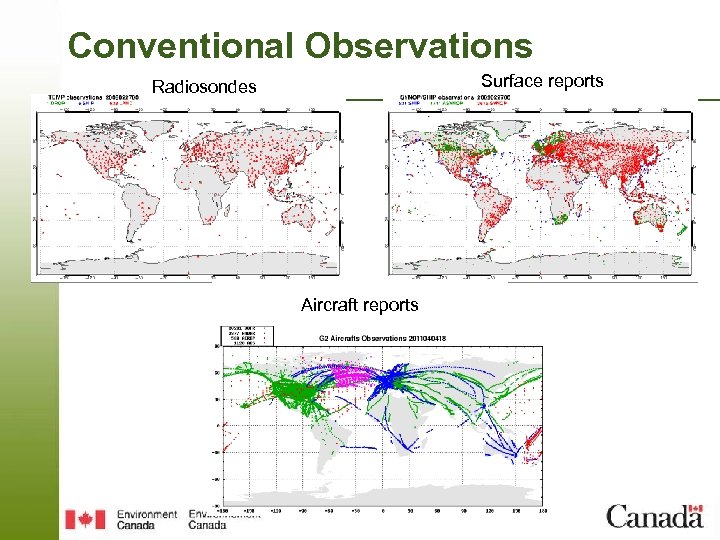 Conventional Observations Surface reports Radiosondes Aircraft reports
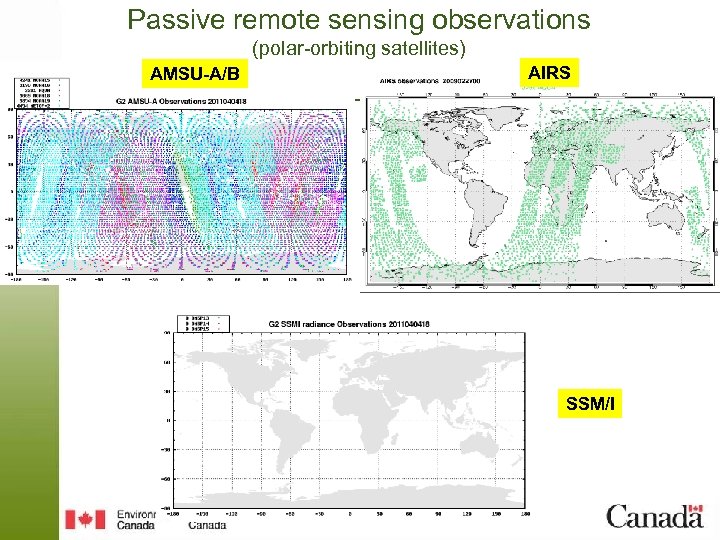 Passive remote sensing observations (polar-orbiting satellites) AMSU-A/B AIRS SSM/I
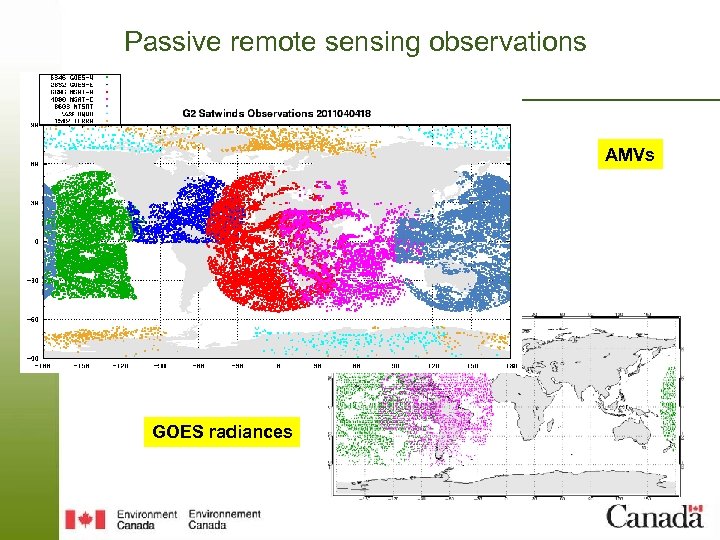 Passive remote sensing observations AMVs GOES radiances
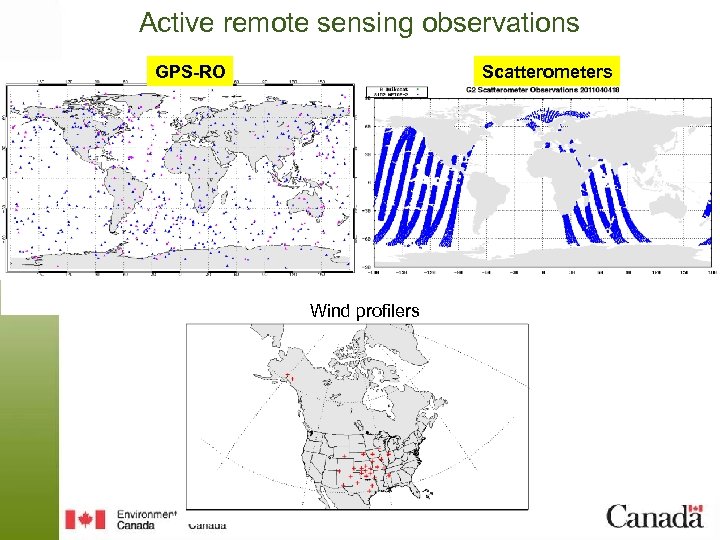 Active remote sensing observations GPS-RO Scatterometers Wind profilers
 Data Quality Monitoring • Meteorological Centres such as CMC that run Numerical Weather • • • Prediction (NWP) models can monitor the performance of instruments (e. g. aircraft sensors used in AMDAR) on a continuous and near real-time basis Monitoring is based on observed minus first guess values (innovations), as well as data rejection statistics, extracted from the operational data assimilation system Monitoring is performed for individual platform, station, as well as by various programs (e. g. E-AMDAR, NOAA Satellites, etc). Time evolution of innovations, as well as their statistical distribution are extremely powerful and useful tools
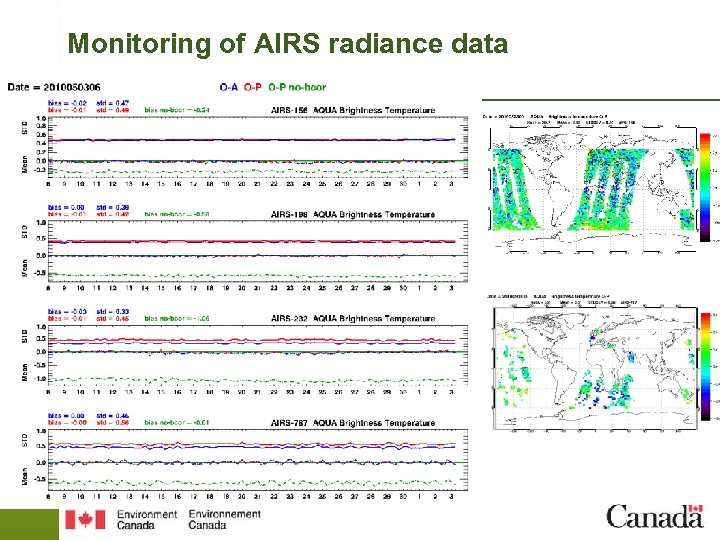 Monitoring of AIRS radiance data
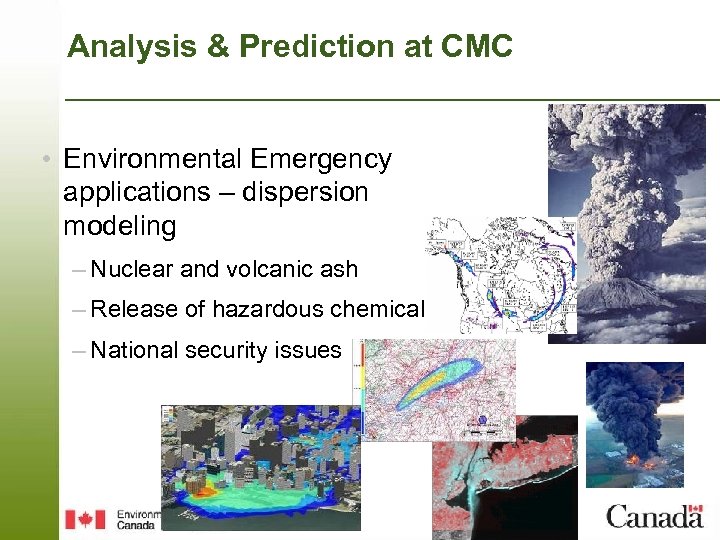 Analysis & Prediction at CMC • Environmental Emergency applications – dispersion modeling – Nuclear and volcanic ash – Release of hazardous chemicals – National security issues
 Challenges • Data Access – Despite numerous dissemination channels – Unique solutions for each new observation/product • Data Timeliness – Require data less than one hour old – Weather Waits For No Man. . or Satellite. . or Data Delivery System • Maintaining a Super-Computer facility – Many modeling programs require access – Keeping up with computing advances • Assimilation of new data – Takes a long time to assimilate new data – Human resources - Finding, hiring and keeping operational staff, researchers etc.