 Скачать презентацию Current 8 lanes Bigger is better Coastal Commission
bf3f0b4e192a525ca4ff02f690ee8bca.ppt
- Количество слайдов: 85



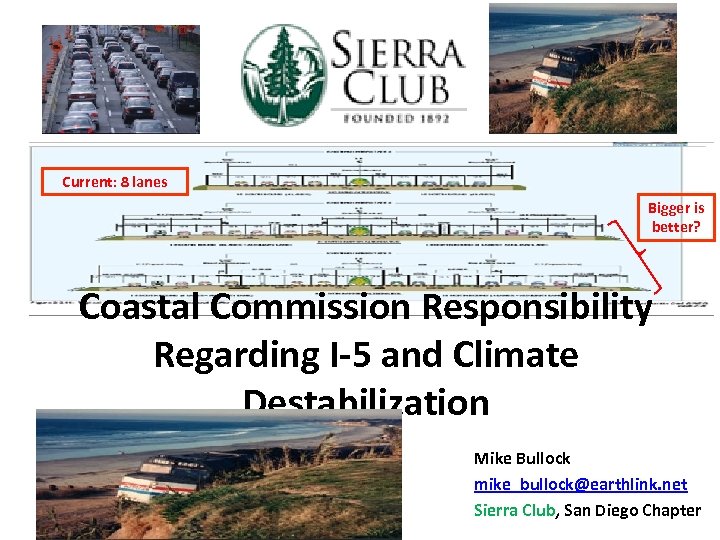
Current: 8 lanes Bigger is better? Coastal Commission Responsibility Regarding I-5 and Climate Destabilization Mike Bullock mike_bullock@earthlink. net Sierra Club, San Diego Chapter
The Coastal Commission’s Responsibility Considering Climate Change Coastal Act mandates • Protect coastal resources 1 • Work to reduce greenhouse gas emissions 1 • Work to reduce detrimental impacts of global warming on our coast 1 • Protect coastal access (by people!) Reduce? By how much? Is 1% OK? 1 http: //www. coastal. ca. gov/climate/whyinvolved. html
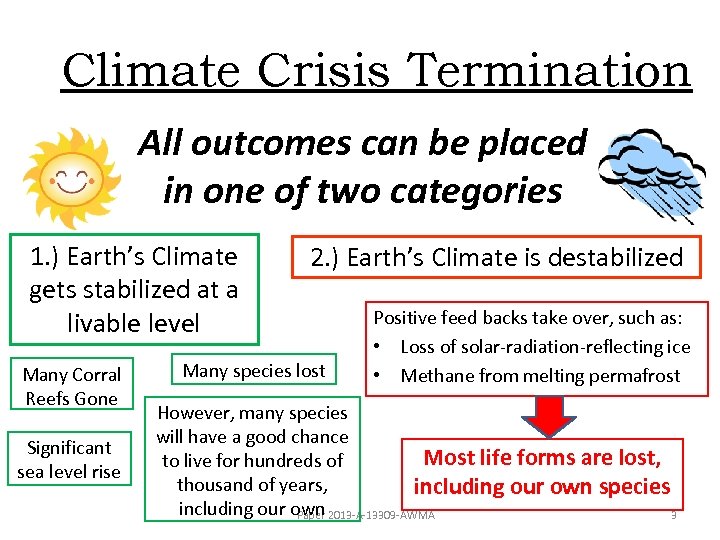
Climate Crisis Termination All outcomes can be placed in one of two categories 1. ) Earth’s Climate gets stabilized at a livable level Many Corral Reefs Gone Significant sea level rise 2. ) Earth’s Climate is destabilized Many species lost Positive feed backs take over, such as: • Loss of solar-radiation-reflecting ice • Methane from melting permafrost However, many species will have a good chance Most life forms are lost, to live for hundreds of thousand of years, including our own species including our own 2013 -A-13309 -AWMA Paper 3
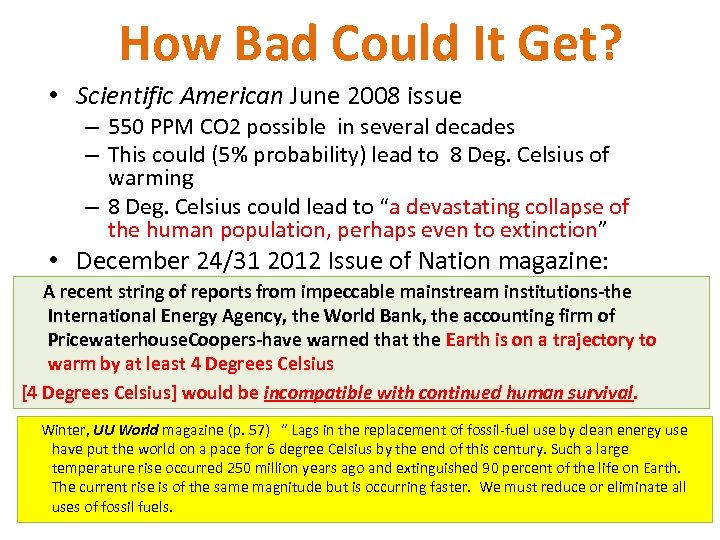
How Bad Could It Get? • Scientific American June 2008 issue – 550 PPM CO 2 possible in several decades – This could (5% probability) lead to 8 Deg. Celsius of warming – 8 Deg. Celsius could lead to “a devastating collapse of the human population, perhaps even to extinction” • December 24/31 2012 Issue of Nation magazine: A recent string of reports from impeccable mainstream institutions-the International Energy Agency, the World Bank, the accounting firm of Pricewaterhouse. Coopers-have warned that the Earth is on a trajectory to warm by at least 4 Degrees Celsius [4 Degrees Celsius] would be incompatible with continued human survival. Winter, UU World magazine (p. 57) “ Lags in the replacement of fossil-fuel use by clean energy use have put the world on a pace for 6 degree Celsius by the end of this century. Such a large temperature rise occurred 250 million years ago and extinguished 90 percent of the life on Earth. The current rise is of the same magnitude but is occurring faster. We must reduce or eliminate all uses of fossil fuels. Paper 2013 -A-13309 -AWMA 4
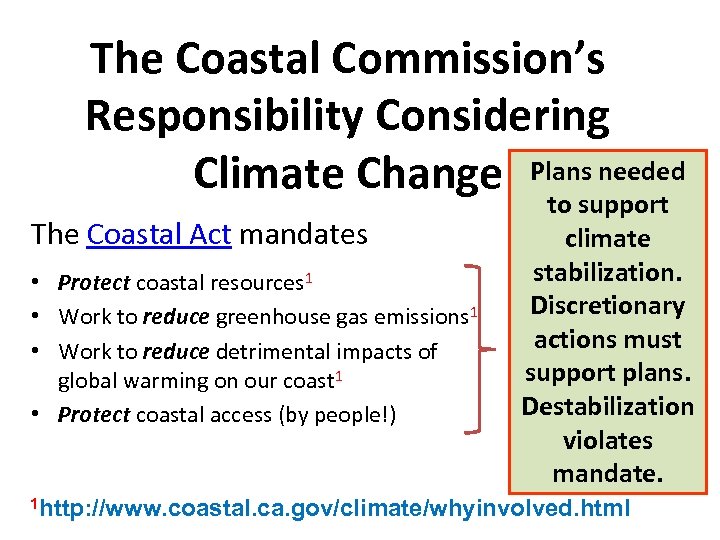
The Coastal Commission’s Responsibility Considering Climate Change Plans needed The Coastal Act mandates • Protect coastal resources 1 • Work to reduce greenhouse gas emissions 1 • Work to reduce detrimental impacts of global warming on our coast 1 • Protect coastal access (by people!) to support climate stabilization. Discretionary actions must support plans. Destabilization violates mandate. 1 http: //www. coastal. ca. gov/climate/whyinvolved. html
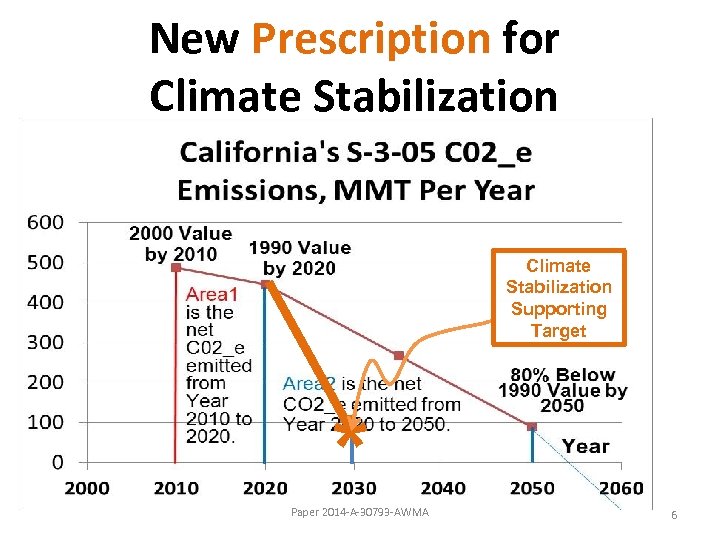
New Prescription for Climate Stabilization Supporting Target * Paper 2014 -A-30793 -AWMA 6
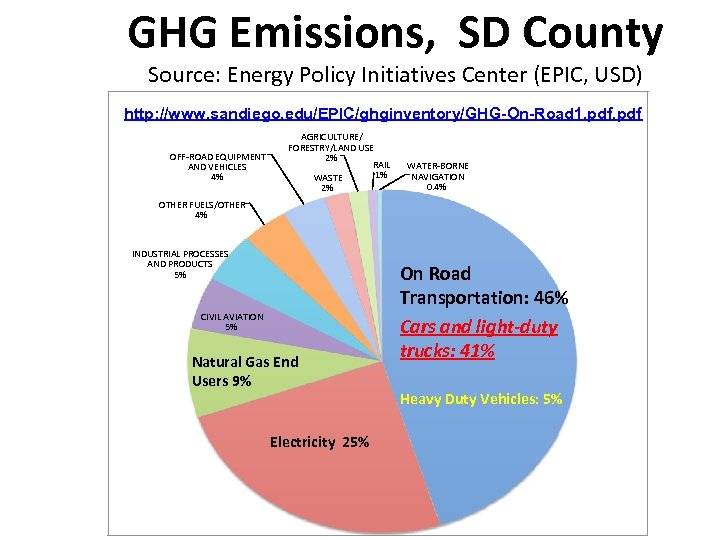
GHG Emissions, SD County Source: Energy Policy Initiatives Center (EPIC, USD) http: //www. sandiego. edu/EPIC/ghginventory/GHG-On-Road 1. pdf OFF-ROAD EQUIPMENT AND VEHICLES 4% AGRICULTURE/ FORESTRY/LAND USE 2% RAIL 1% WASTE 2% WATER-BORNE NAVIGATION 0. 4% OTHER FUELS/OTHER 4% INDUSTRIAL PROCESSES AND PRODUCTS 5% CIVIL AVIATION 5% Natural Gas End Users 9% Electricity 25% On Road Transportation: 46% Cars and light-duty trucks: 41% Heavy Duty Vehicles: 5%
What to Do About Driving: The Development of California Light-Duty Vehicle (LDV) Requirements to Support Climate Stabilization: Fleet-Emission Rates & Per-Capita Driving Air and Waste Management Paper 2014 -A-30793 -AWMA 8
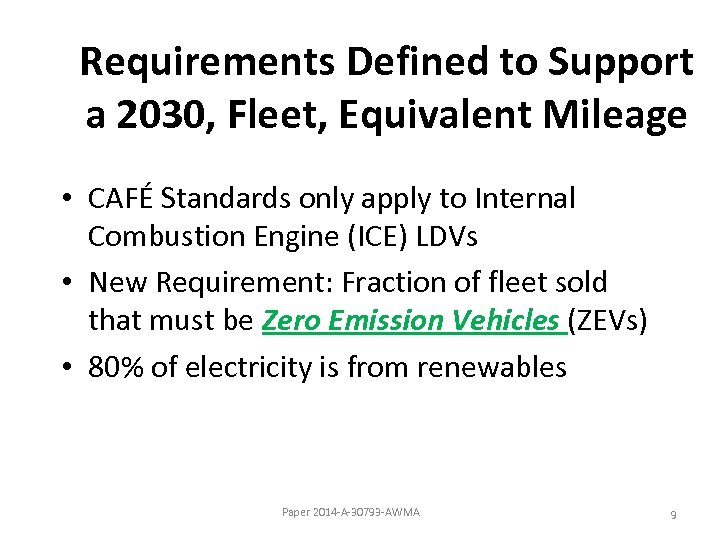
Requirements Defined to Support a 2030, Fleet, Equivalent Mileage • CAFÉ Standards only apply to Internal Combustion Engine (ICE) LDVs • New Requirement: Fraction of fleet sold that must be Zero Emission Vehicles (ZEVs) • 80% of electricity is from renewables Paper 2014 -A-30793 -AWMA 9
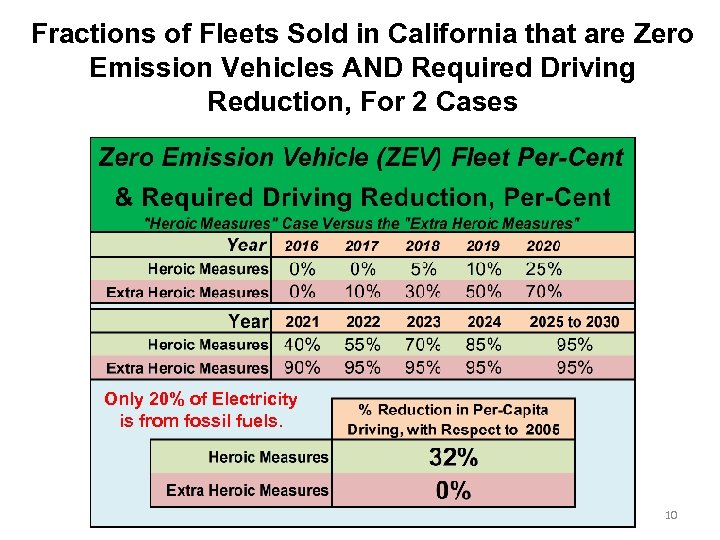
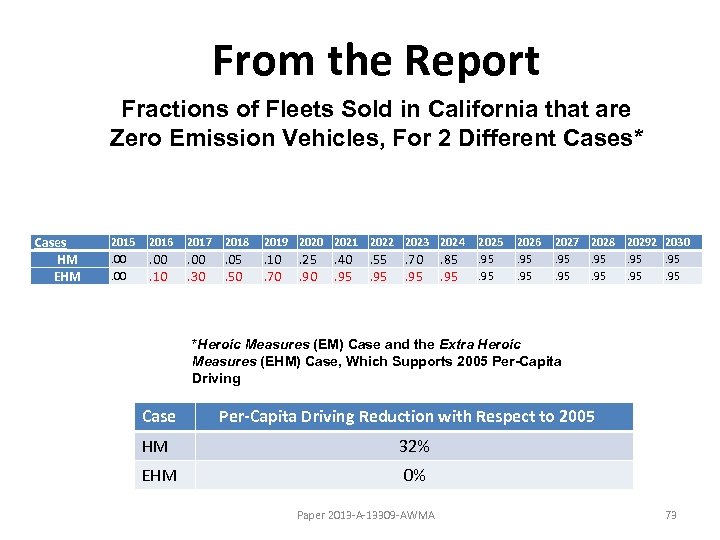
Fractions of Fleets Sold in California that are Zero Emission Vehicles AND Required Driving Reduction, For 2 Cases Only 20% of Electricity is from fossil fuels. Paper 2013 -A-13309 -AWMA 10
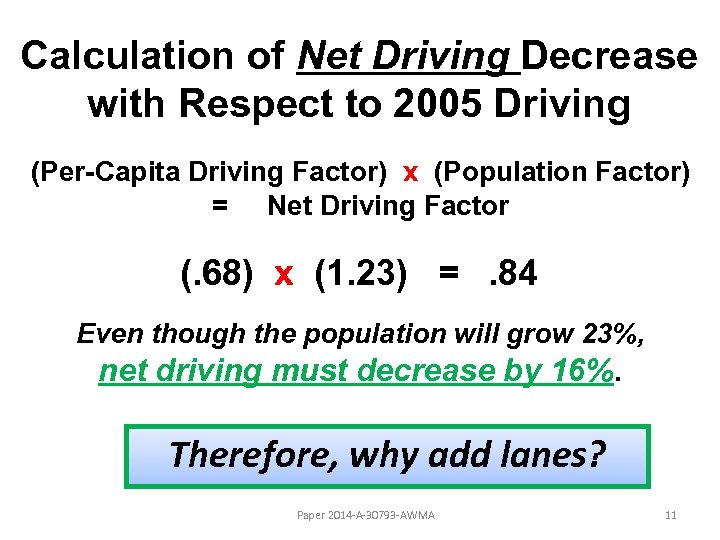
Calculation of Net Driving Decrease with Respect to 2005 Driving (Per-Capita Driving Factor) x (Population Factor) = Net Driving Factor (. 68) x (1. 23) =. 84 Even though the population will grow 23%, net driving must decrease by 16%. Therefore, why add lanes? Paper 2014 -A-30793 -AWMA 11
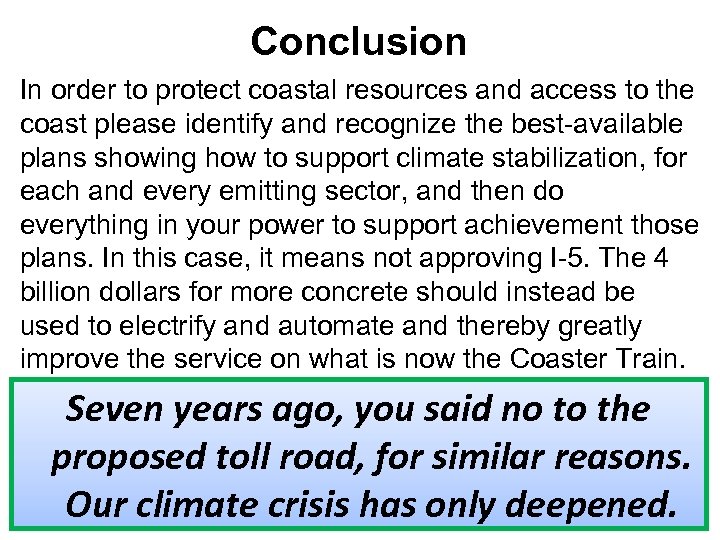
Conclusion In order to protect coastal resources and access to the coast please identify and recognize the best-available plans showing how to support climate stabilization, for each and every emitting sector, and then do everything in your power to support achievement those plans. In this case, it means not approving I-5. The 4 billion dollars for more concrete should instead be used to electrify and automate and thereby greatly improve the service on what is now the Coaster Train. Seven years ago, you said no to the proposed toll road, for similar reasons. Our climate crisis has only deepened. Paper 2014 -A-30793 -AWMA 12

Background Charts Questions? Paper 2014 -A-30793 -AWMA 13
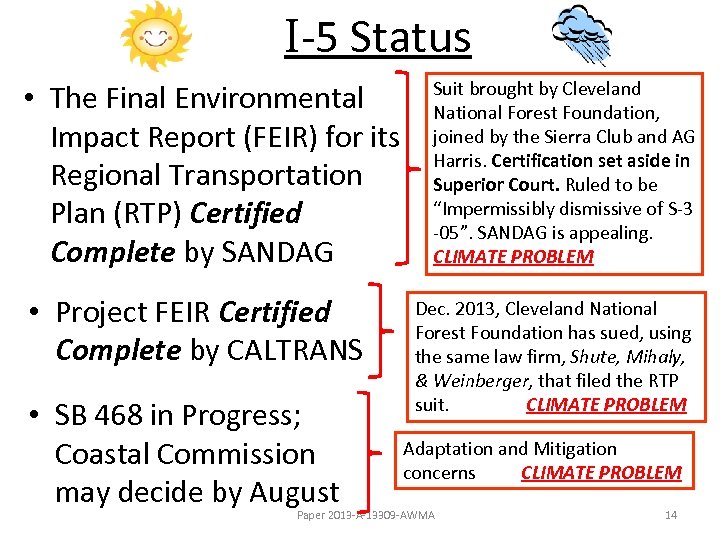
I-5 Status • The Final Environmental Impact Report (FEIR) for its Regional Transportation Plan (RTP) Certified Complete by SANDAG • Project FEIR Certified Complete by CALTRANS • SB 468 in Progress; Coastal Commission may decide by August Suit brought by Cleveland National Forest Foundation, joined by the Sierra Club and AG Harris. Certification set aside in Superior Court. Ruled to be “Impermissibly dismissive of S-3 -05”. SANDAG is appealing. CLIMATE PROBLEM Dec. 2013, Cleveland National Forest Foundation has sued, using the same law firm, Shute, Mihaly, & Weinberger, that filed the RTP suit. CLIMATE PROBLEM Adaptation and Mitigation concerns CLIMATE PROBLEM Paper 2013 -A-13309 -AWMA 14
The Coastal Commission’s Responsibility Regarding Climate Change http: //www. coastal. ca. gov/climate/whyinvolved. html The Coastal Act mandates the California Coastal Commission to “protect, conserve, restore, and enhance” the state’s coastal resources. As a result, the Commission must consider climate change, including global warming and potential sea level rise, through its planning, regulatory, and educational activities, and work to reduce greenhouse gas emissions and the detrimental impacts of global warming on our coast.
The Coastal Commission’s Responsibility Regarding Climate Change http: //www. coastal. ca. gov/climate/whyinvolved. html The Coastal Act mandates the California Coastal Commission to “protect, conserve, restore, and enhance” the state’s coastal resources. As a result, the Commission must consider climate change, including global warming and potential sea level rise, through its planning, regulatory, and educational activities, and work to reduce greenhouse gas emissions and the detrimental impacts of global warming on our coast.
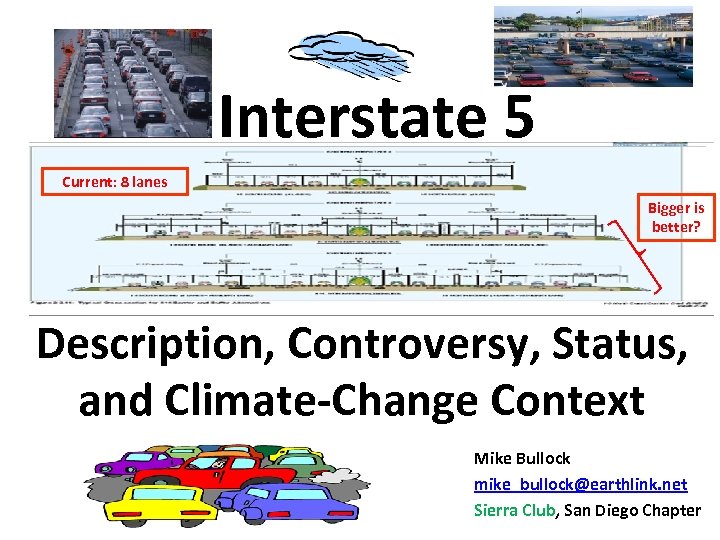
Interstate 5 Current: 8 lanes Bigger is better? Description, Controversy, Status, and Climate-Change Context Mike Bullock mike_bullock@earthlink. net Sierra Club, San Diego Chapter
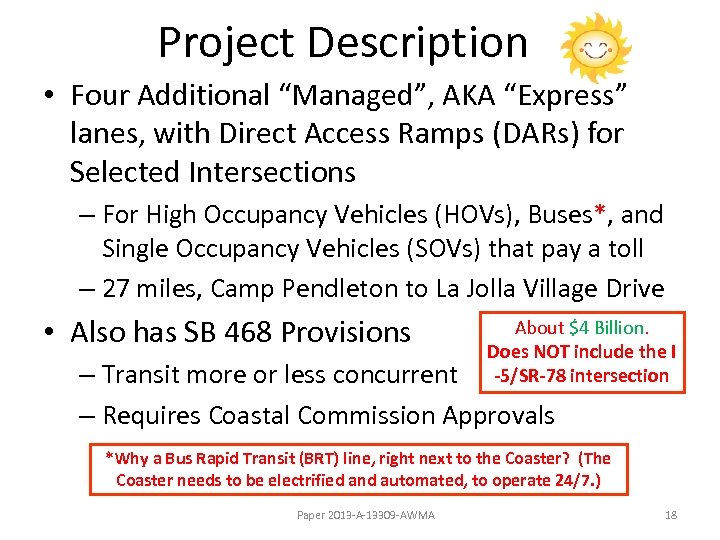
Project Description • Four Additional “Managed”, AKA “Express” lanes, with Direct Access Ramps (DARs) for Selected Intersections – For High Occupancy Vehicles (HOVs), Buses*, and Single Occupancy Vehicles (SOVs) that pay a toll – 27 miles, Camp Pendleton to La Jolla Village Drive • Also has SB 468 Provisions About $4 Billion. Does NOT include the I -5/SR-78 intersection – Transit more or less concurrent – Requires Coastal Commission Approvals *Why a Bus Rapid Transit (BRT) line, right next to the Coaster? (The Coaster needs to be electrified and automated, to operate 24/7. ) Paper 2013 -A-13309 -AWMA 18
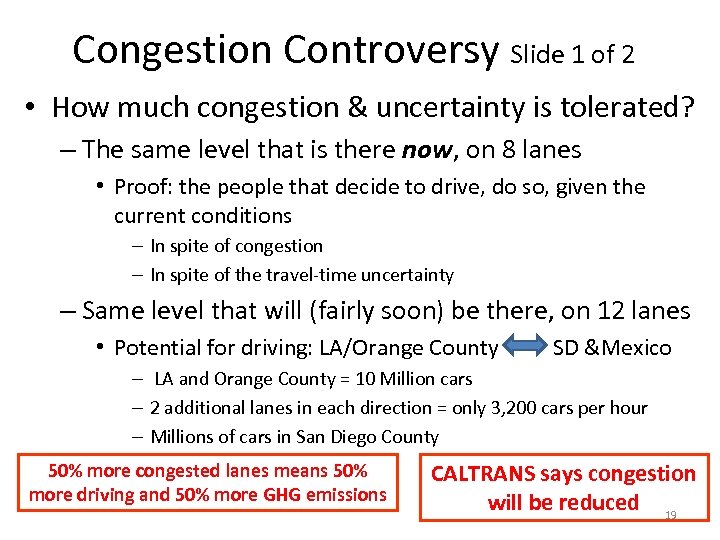
Congestion Controversy Slide 1 of 2 • How much congestion & uncertainty is tolerated? – The same level that is there now, on 8 lanes • Proof: the people that decide to drive, do so, given the current conditions – In spite of congestion – In spite of the travel-time uncertainty – Same level that will (fairly soon) be there, on 12 lanes • Potential for driving: LA/Orange County SD &Mexico – LA and Orange County = 10 Million cars – 2 additional lanes in each direction = only 3, 200 cars per hour – Millions of cars in San Diego County 50% more congested lanes means 50% more driving and 50% more GHG emissions CALTRANS says congestion will be reduced 19
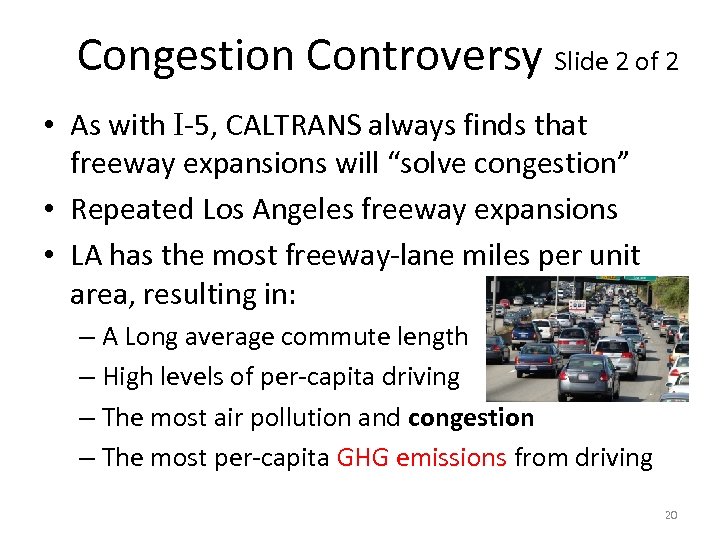
Congestion Controversy Slide 2 of 2 • As with I-5, CALTRANS always finds that freeway expansions will “solve congestion” • Repeated Los Angeles freeway expansions • LA has the most freeway-lane miles per unit area, resulting in: – A Long average commute length – High levels of per-capita driving – The most air pollution and congestion – The most per-capita GHG emissions from driving 20
The Development of California Light-Duty Vehicle (LDV) Requirements to Support Climate Stabilization: Fleet-Emission Rates & Per-Capita Driving Paper 2014 -A-30793 -AWMA Mike Bullock mike_bullock@earthlink. net
The Climate Problem Any Earth Science text book* contains the following facts: • Atmospheric CO 2 traps heat – CO 2 Molecules absorb and then emit, in a random direction, infrared radiation, heat given off by the Earth’s surface – This effect is significant • Combustion of fossil fuels adds great quantities of CO 2 to our Earth’s atmosphere – The amount of C 02 in the atmosphere is well known – Our yearly emissions are well known * For example, Page 539 of Earth Science, Tarbuck and Lutgens, Tenth Edition, published by Prentice Hall, 2003. Paper 2014 -A-30793 -AWMA 22
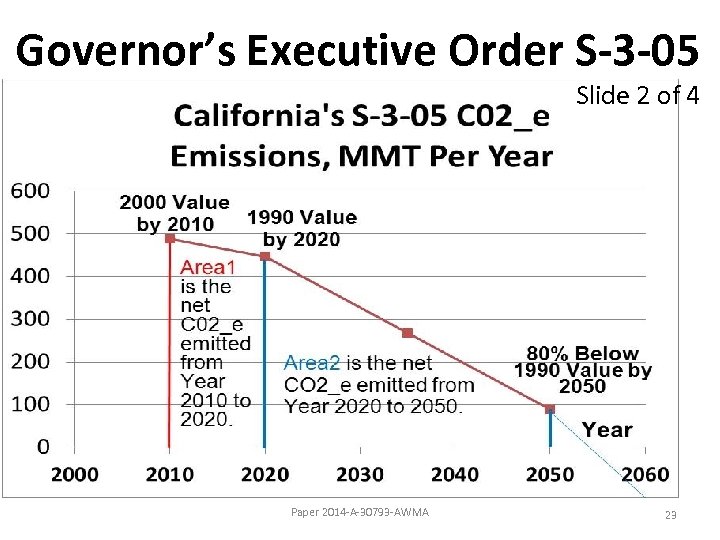
Governor’s Executive Order S-3 -05 Slide 2 of 4 Paper 2014 -A-30793 -AWMA 23
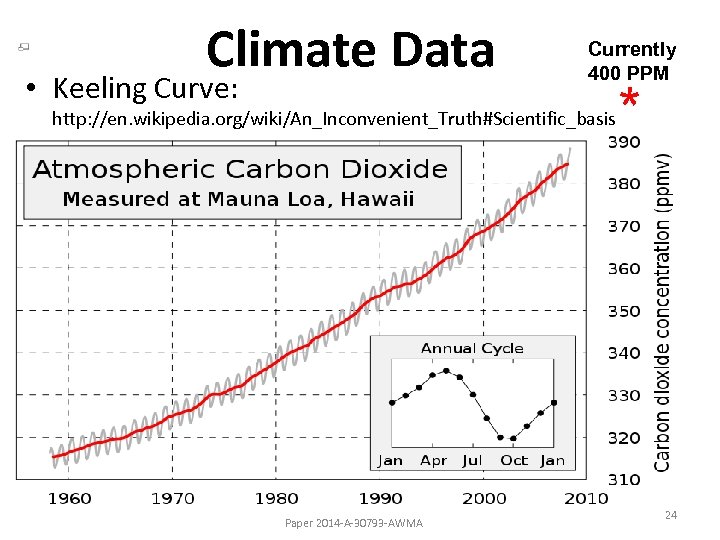
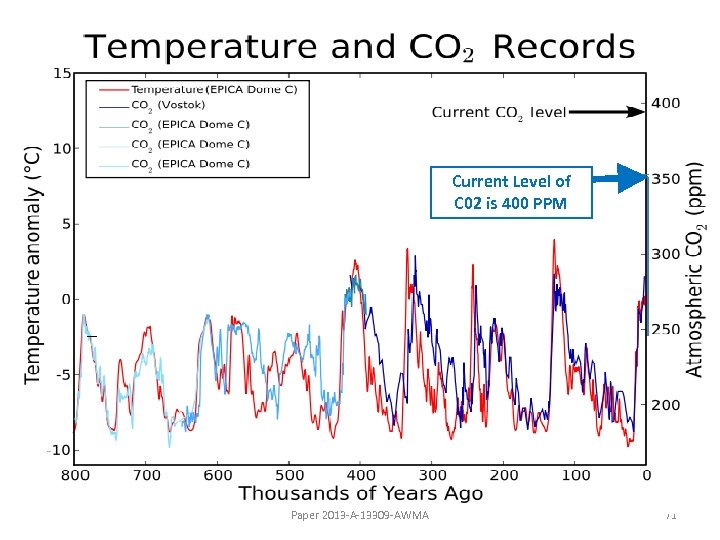
Climate Data • Keeling Curve: Currently 400 PPM http: //en. wikipedia. org/wiki/An_Inconvenient_Truth#Scientific_basis Paper 2014 -A-30793 -AWMA * 24
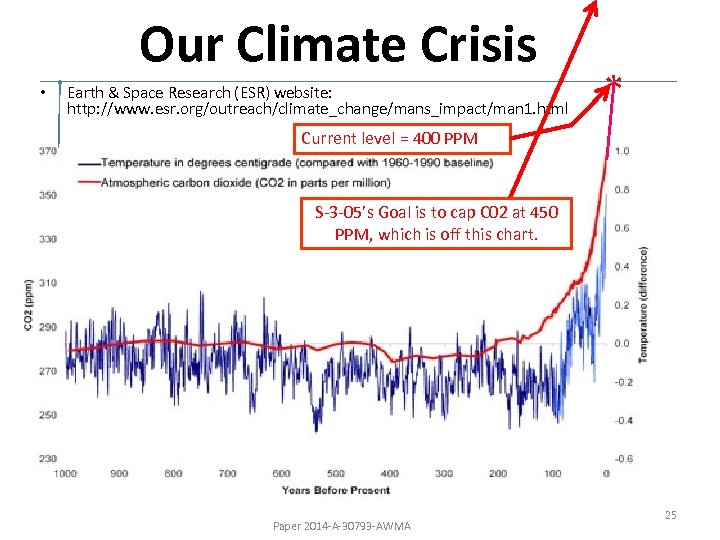
Our Climate Crisis • Earth & Space Research (ESR) website: http: //www. esr. org/outreach/climate_change/mans_impact/man 1. html * Current level = 400 PPM S-3 -05’s Goal is to cap C 02 at 450 PPM, which is off this chart. Paper 2014 -A-30793 -AWMA 25
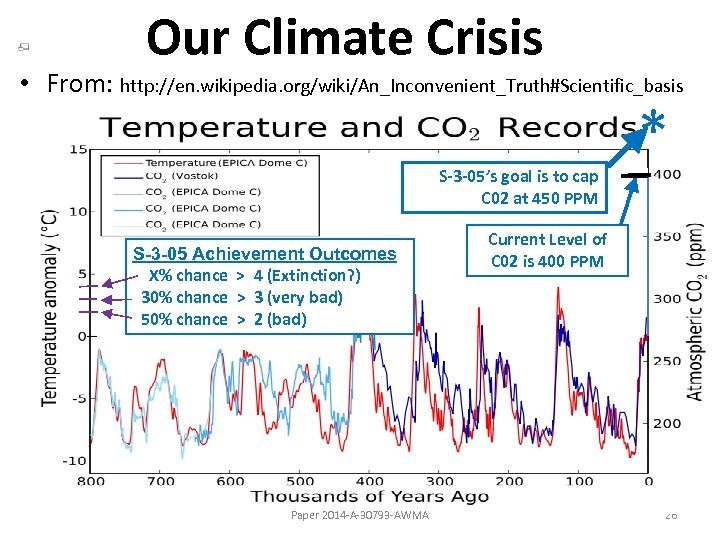
Our Climate Crisis • From: http: //en. wikipedia. org/wiki/An_Inconvenient_Truth#Scientific_basis S-3 -05’s goal is to cap C 02 at 450 PPM S-3 -05 Achievement Outcomes X% chance > 4 (Extinction? ) 30% chance > 3 (very bad) 50% chance > 2 (bad) Paper 2014 -A-30793 -AWMA * Current Level of C 02 is 400 PPM 26
BRIEF OF SCIENTISTS AMICUS GROUP AS AMICI CURIAE IN SUPPORT OF PLAINTIFFSAPPELLANTS SEEKING REVERSAL DANIEL M. GALPERN Law Offices of Charles M. Tebbutt, P. C. 941 Lawrence St. Eugene, OR 97401 -2815 USCA Case #13 -5192 Document #1465822 Filed: 11/12/2013 A. Parties and Amici. Except for the following, all parties, intervenors, and amici appearing before the district court and in this Court are listed in the Brief for Plaintiffs-Appellants. James Hansen, David Beerling, Paul J. Hearty, Ove Hoegh. Guldberg, Pushker Kharecha, Valérie Masson-Delmotte, Camille Parmesan, Eelco Rohling, Makiko Sato, Pete Smith, and Lise Van Susteren are amici curiae in this appeal (referred to hereinafter as “Amici Scientists. ”). Paper 2014 -A-30793 -AWMA 27
From the Climate Scientists From Page 21: . . . the required rate of emissions reduction would have been about 3. 5% per year if reductions had started in 2005, while the required rate of reduction, if commenced in 2020, will be approximately 15% per year. • My math: – 15% means a factor of 0. 85, year after year – Consider the 10 years from 2020 to 2030 – (. 85)10 =. 20, which is 80% down – Other articles, describing Hansen’s work: “decarbonization by 2030” Paper 2014 -A-30793 -AWMA 28
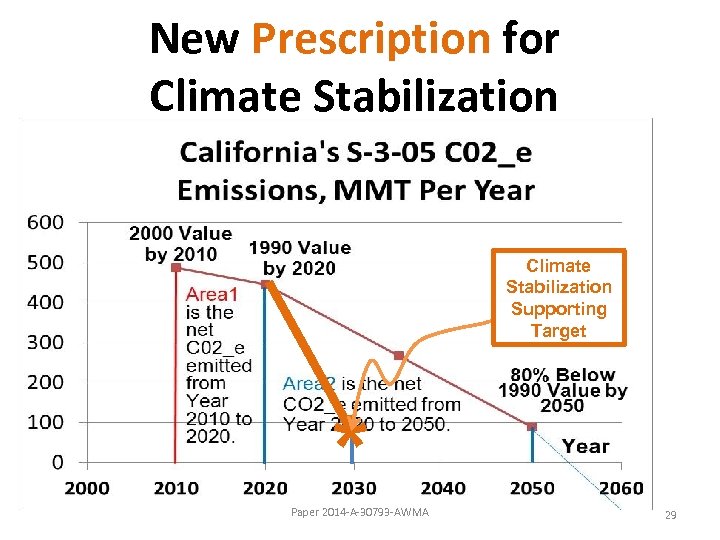
New Prescription for Climate Stabilization Supporting Target * Paper 2014 -A-30793 -AWMA 29
How, for LDVs: The Development of California Light-Duty Vehicle (LDV) Requirements to Support Climate Stabilization: Fleet-Emission Rates & Per-Capita Driving Note: Skip through the next 9 Charts. Paper 2014 -A-30793 -AWMA 30
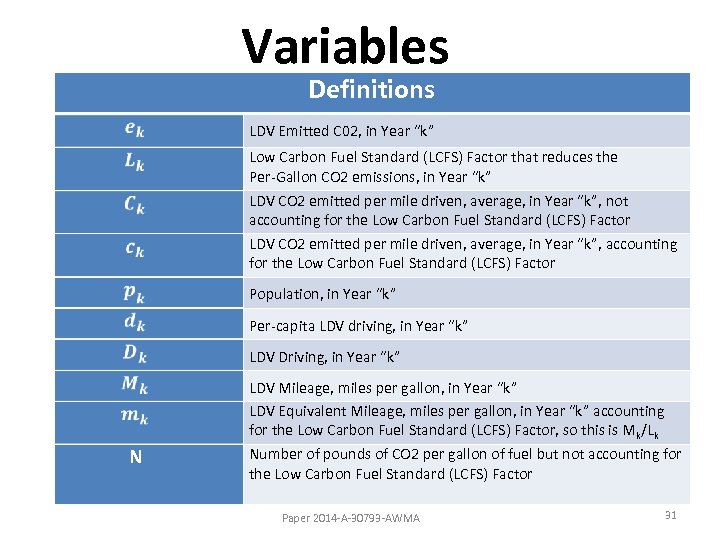
Variables Definitions LDV Emitted C 02, in Year “k” Low Carbon Fuel Standard (LCFS) Factor that reduces the Per-Gallon CO 2 emissions, in Year “k” LDV CO 2 emitted per mile driven, average, in Year “k”, not accounting for the Low Carbon Fuel Standard (LCFS) Factor LDV CO 2 emitted per mile driven, average, in Year “k”, accounting for the Low Carbon Fuel Standard (LCFS) Factor Population, in Year “k” Per-capita LDV driving, in Year “k” LDV Driving, in Year “k” LDV Mileage, miles per gallon, in Year “k” LDV Equivalent Mileage, miles per gallon, in Year “k” accounting for the Low Carbon Fuel Standard (LCFS) Factor, so this is Mk/Lk N Number of pounds of CO 2 per gallon of fuel but not accounting for the Low Carbon Fuel Standard (LCFS) Factor Paper 2014 -A-30793 -AWMA 31
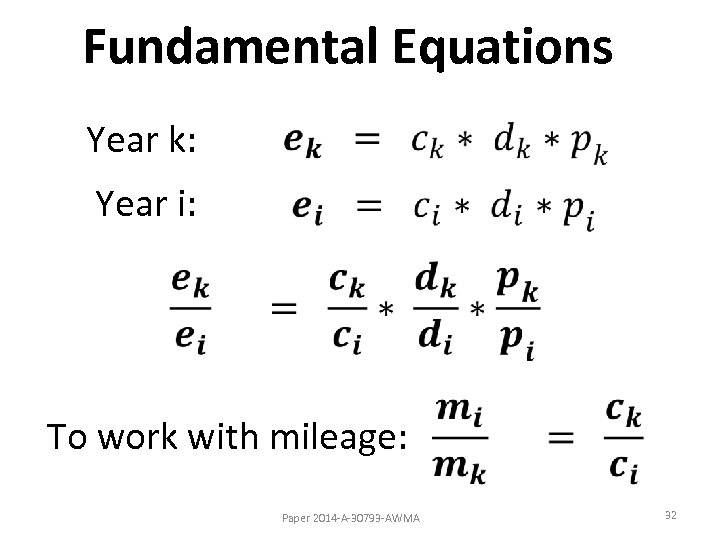
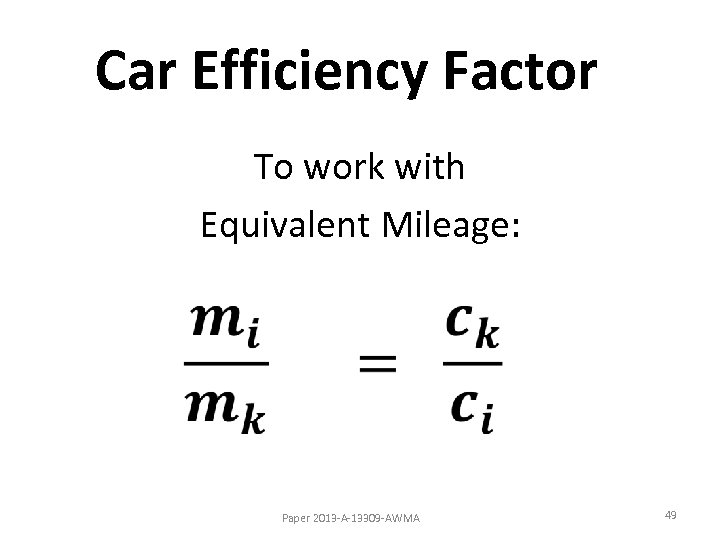
Fundamental Equations Year k: Year i: To work with mileage: Paper 2014 -A-30793 -AWMA 32
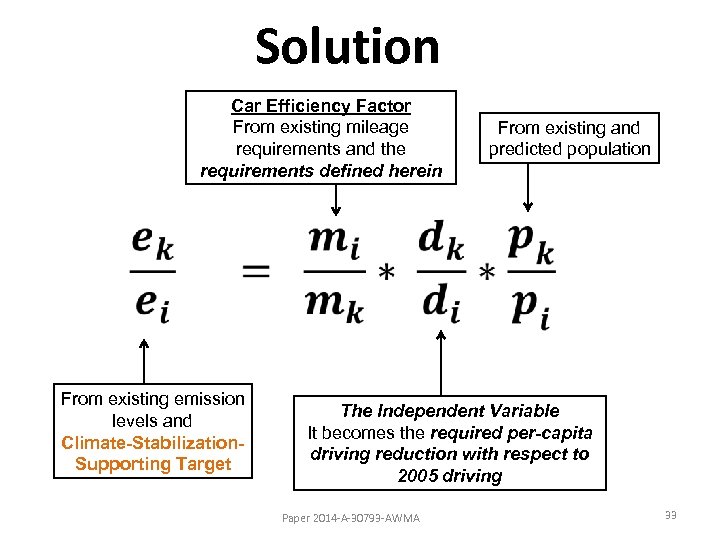
Solution Car Efficiency Factor From existing mileage requirements and the requirements defined herein From existing and predicted population From existing emission levels and Climate-Stabilization. Supporting Target The Independent Variable It becomes the required per-capita driving reduction with respect to 2005 driving Paper 2014 -A-30793 -AWMA 33
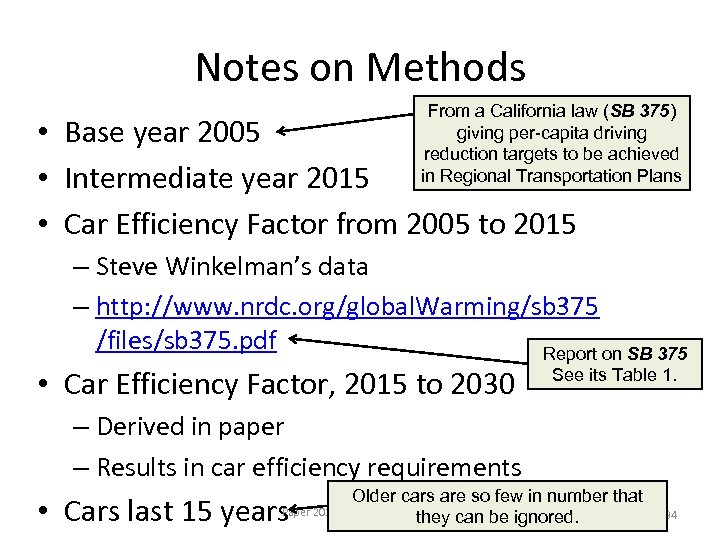
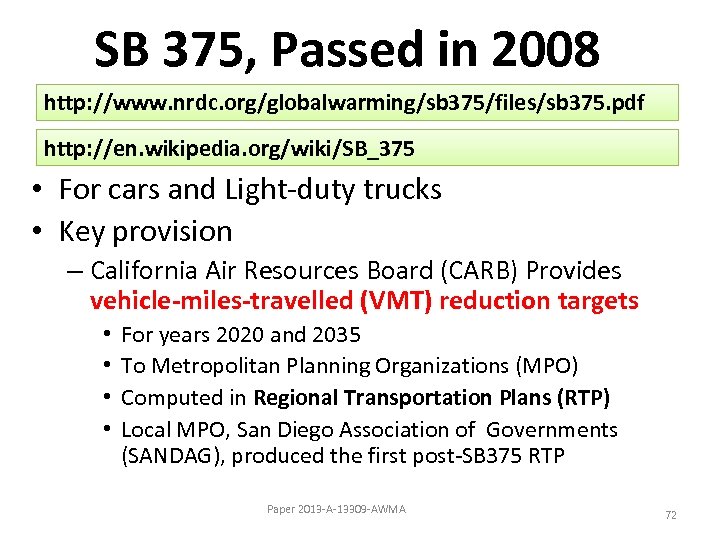
Notes on Methods From a California law (SB 375) giving per-capita driving reduction targets to be achieved in Regional Transportation Plans • Base year 2005 • Intermediate year 2015 • Car Efficiency Factor from 2005 to 2015 – Steve Winkelman’s data – http: //www. nrdc. org/global. Warming/sb 375 /files/sb 375. pdf Report on SB 375 • Car Efficiency Factor, 2015 to 2030 See its Table 1. – Derived in paper – Results in car efficiency requirements Older cars are so few in number that Paper 2013 -A-13309 -AWMA they can be ignored. • Cars last 15 years 34
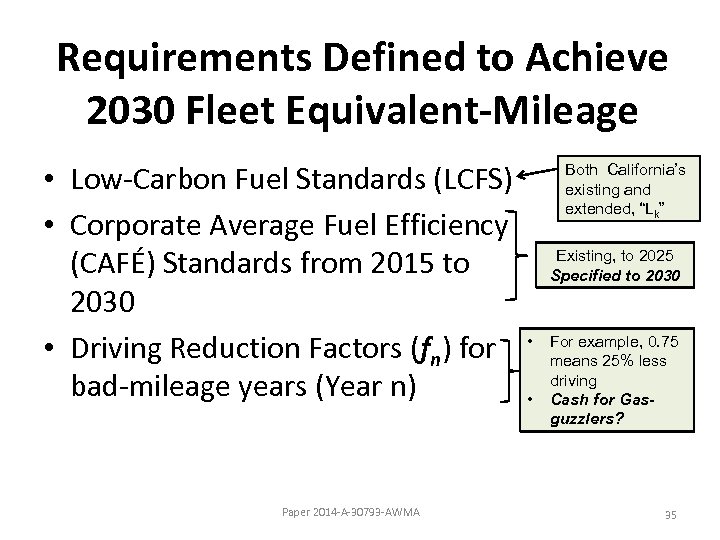
Requirements Defined to Achieve 2030 Fleet Equivalent-Mileage • Low-Carbon Fuel Standards (LCFS) • Corporate Average Fuel Efficiency (CAFÉ) Standards from 2015 to 2030 • Driving Reduction Factors (fn) for bad-mileage years (Year n) Paper 2014 -A-30793 -AWMA Both California’s existing and extended, “Lk” Existing, to 2025 Specified to 2030 • • For example, 0. 75 means 25% less driving Cash for Gasguzzlers? 35
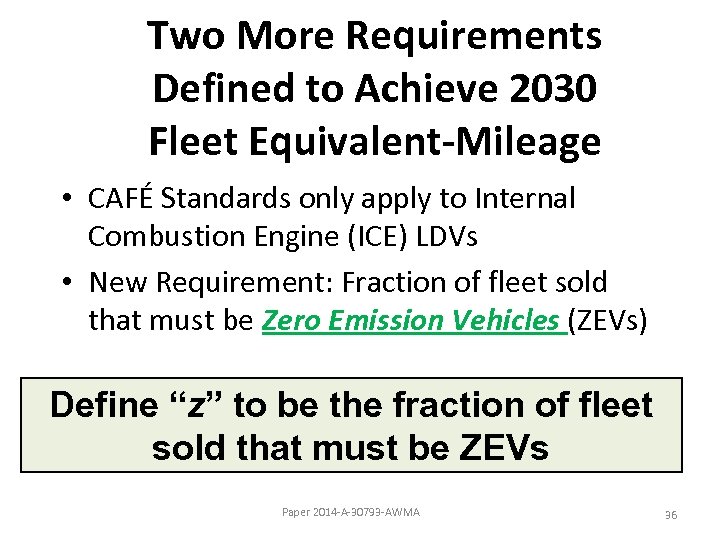
Two More Requirements Defined to Achieve 2030 Fleet Equivalent-Mileage • CAFÉ Standards only apply to Internal Combustion Engine (ICE) LDVs • New Requirement: Fraction of fleet sold that must be Zero Emission Vehicles (ZEVs) Define “z” to be the fraction of fleet sold that must be ZEVs Paper 2014 -A-30793 -AWMA 36
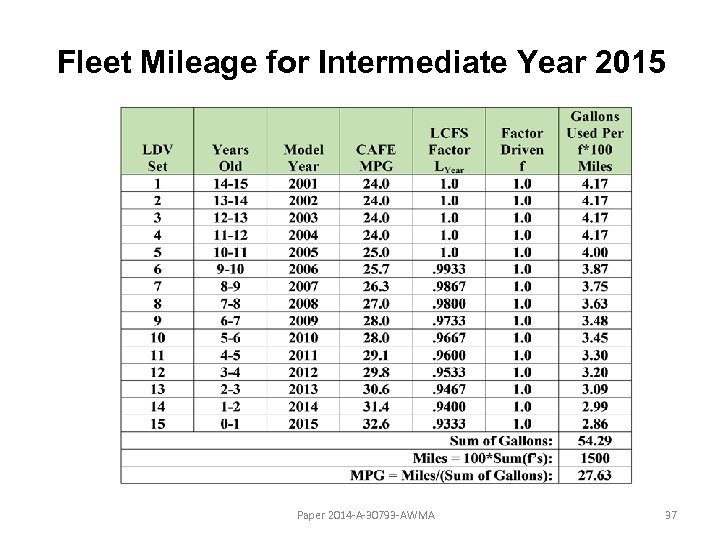
Fleet Mileage for Intermediate Year 2015 Paper 2014 -A-30793 -AWMA 37
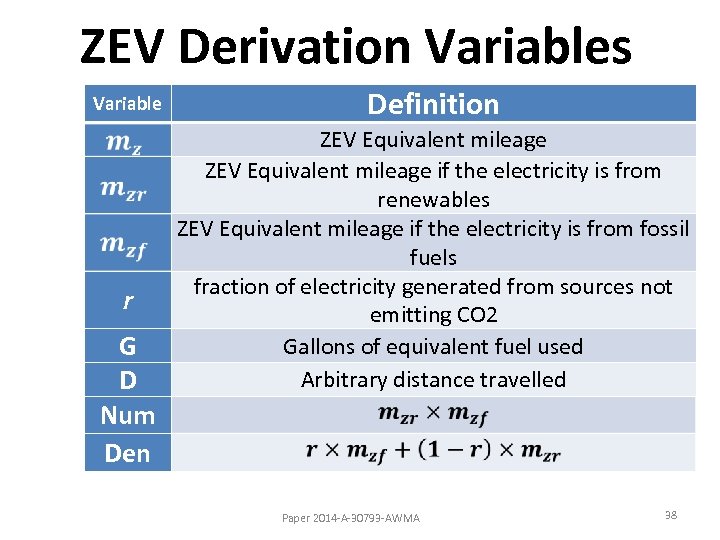
ZEV Derivation Variables Variable r G D Num Den Definition ZEV Equivalent mileage if the electricity is from renewables ZEV Equivalent mileage if the electricity is from fossil fuels fraction of electricity generated from sources not emitting CO 2 Gallons of equivalent fuel used Arbitrary distance travelled Paper 2014 -A-30793 -AWMA 38
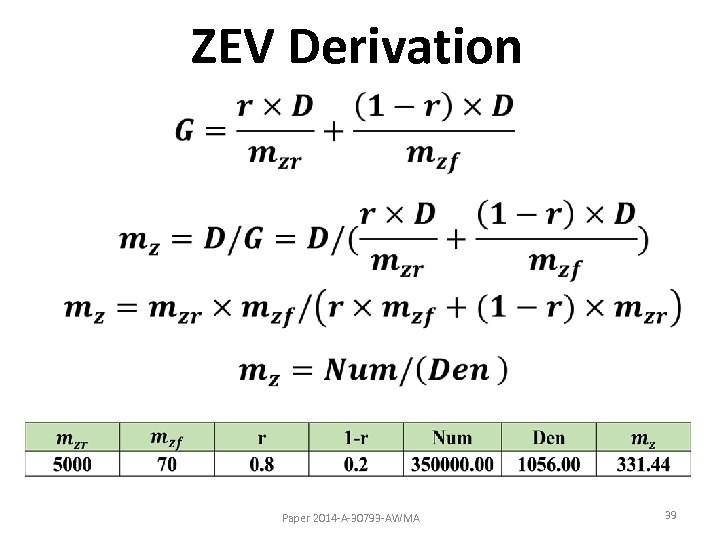
ZEV Derivation Paper 2014 -A-30793 -AWMA 39
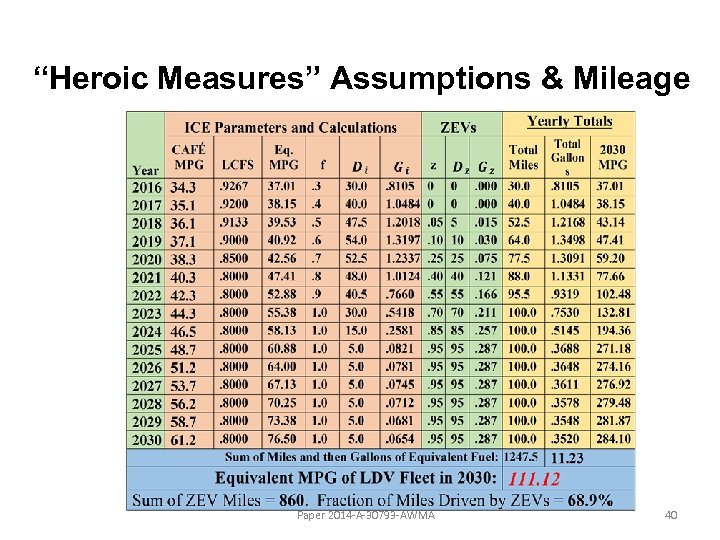
“Heroic Measures” Assumptions & Mileage Paper 2014 -A-30793 -AWMA 40
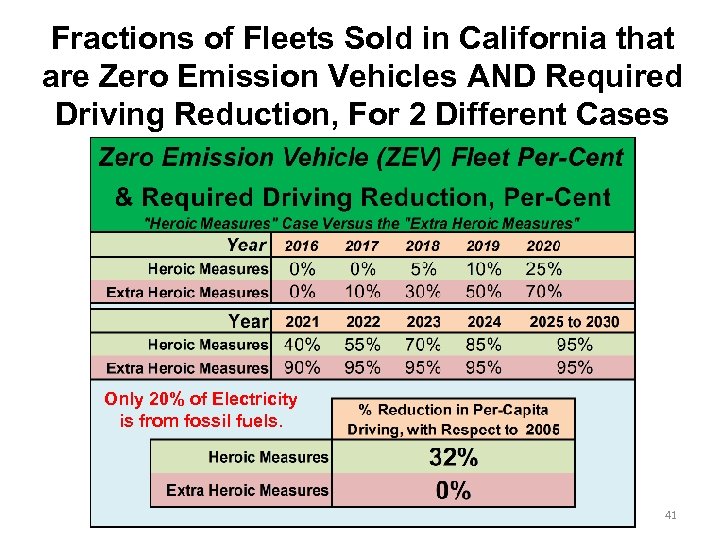
Fractions of Fleets Sold in California that are Zero Emission Vehicles AND Required Driving Reduction, For 2 Different Cases Only 20% of Electricity is from fossil fuels. Paper 2013 -A-13309 -AWMA 41
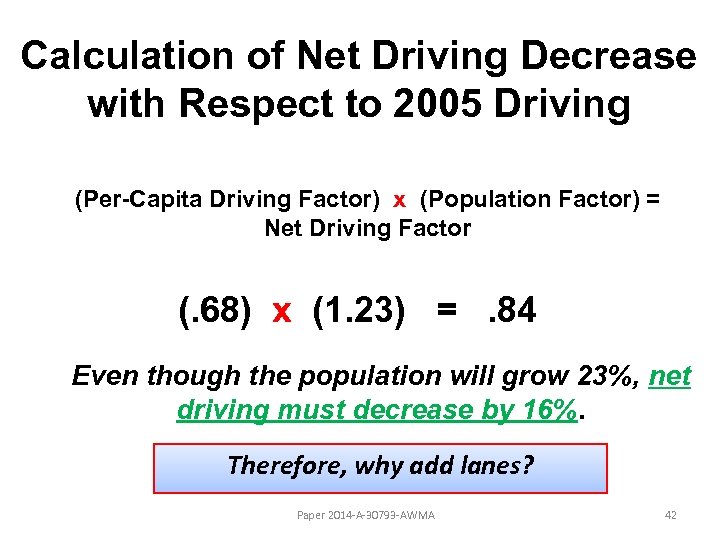
Calculation of Net Driving Decrease with Respect to 2005 Driving (Per-Capita Driving Factor) x (Population Factor) = Net Driving Factor (. 68) x (1. 23) =. 84 Even though the population will grow 23%, net driving must decrease by 16%. Therefore, why add lanes? Paper 2014 -A-30793 -AWMA 42
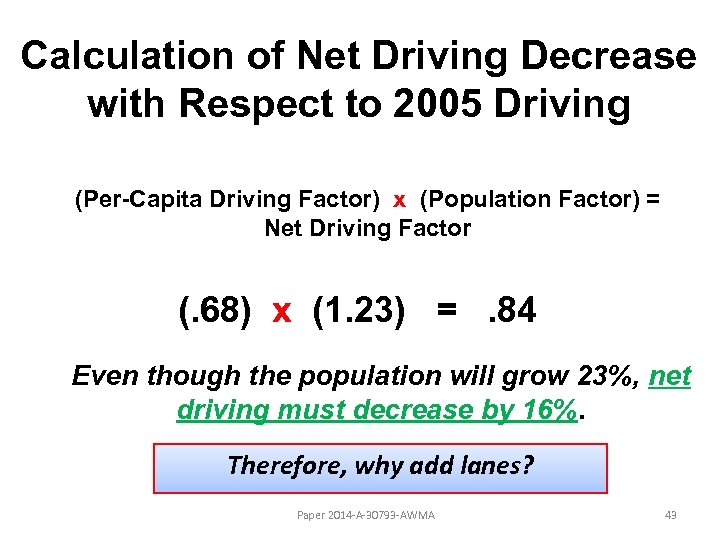
Calculation of Net Driving Decrease with Respect to 2005 Driving (Per-Capita Driving Factor) x (Population Factor) = Net Driving Factor (. 68) x (1. 23) =. 84 Even though the population will grow 23%, net driving must decrease by 16%. Therefore, why add lanes? Paper 2014 -A-30793 -AWMA 43
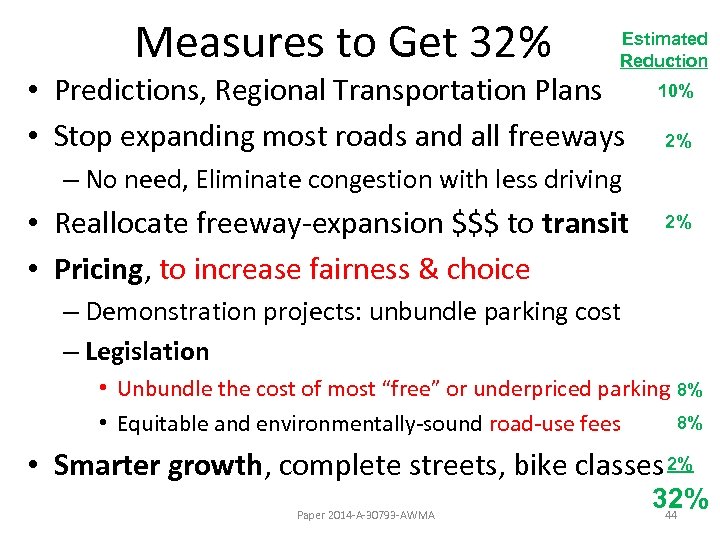
Measures to Get 32% Estimated Reduction • Predictions, Regional Transportation Plans • Stop expanding most roads and all freeways 10% 2% – No need, Eliminate congestion with less driving • Reallocate freeway-expansion $$$ to transit • Pricing, to increase fairness & choice 2% – Demonstration projects: unbundle parking cost – Legislation • Unbundle the cost of most “free” or underpriced parking 8% 8% • Equitable and environmentally-sound road-use fees • Smarter growth, complete streets, bike classes 2% Paper 2014 -A-30793 -AWMA 32% 44

Background Charts Questions? Paper 2014 -A-30793 -AWMA 45
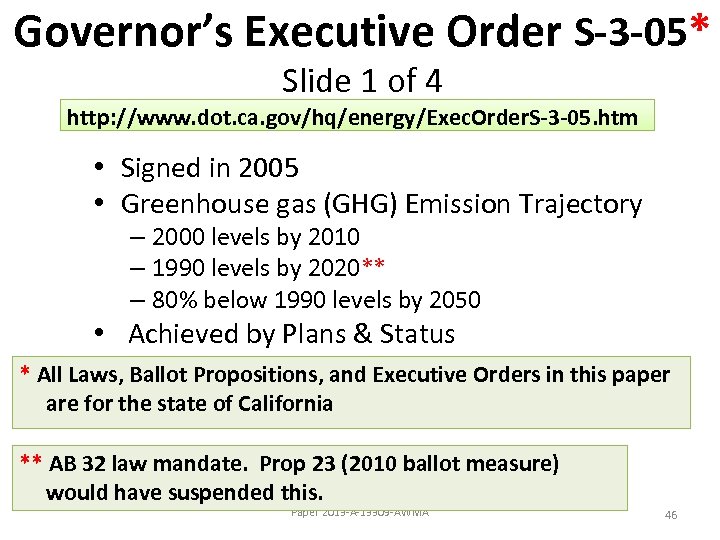
Governor’s Executive Order S-3 -05* Slide 1 of 4 http: //www. dot. ca. gov/hq/energy/Exec. Order. S-3 -05. htm • Signed in 2005 • Greenhouse gas (GHG) Emission Trajectory – 2000 levels by 2010 – 1990 levels by 2020** – 80% below 1990 levels by 2050 • Achieved by Plans & Status * All Laws, Ballot Propositions, and Executive Orders in this paper are for the state of California ** AB 32 law mandate. Prop 23 (2010 ballot measure) would have suspended this. Paper 2013 -A-13309 -AWMA 46
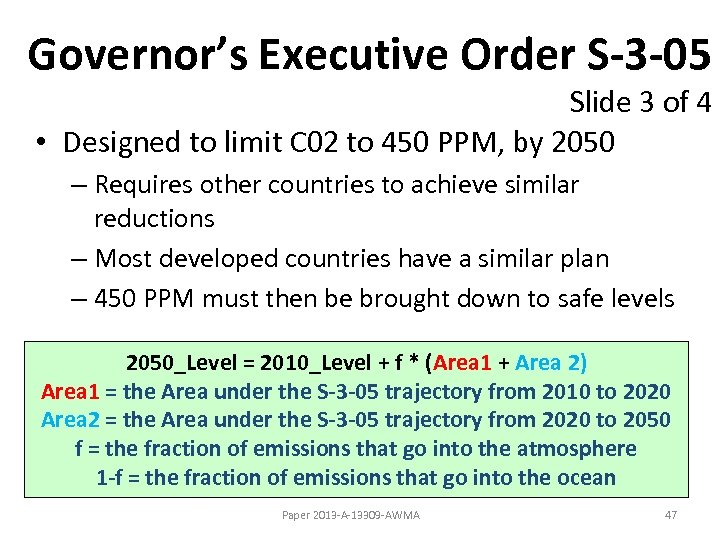
Governor’s Executive Order S-3 -05 Slide 3 of 4 • Designed to limit C 02 to 450 PPM, by 2050 – Requires other countries to achieve similar reductions – Most developed countries have a similar plan – 450 PPM must then be brought down to safe levels 2050_Level = 2010_Level + f * (Area 1 + Area 2) Area 1 = the Area under the S-3 -05 trajectory from 2010 to 2020 Area 2 = the Area under the S-3 -05 trajectory from 2020 to 2050 f = the fraction of emissions that go into the atmosphere 1 -f = the fraction of emissions that go into the ocean Paper 2013 -A-13309 -AWMA 47
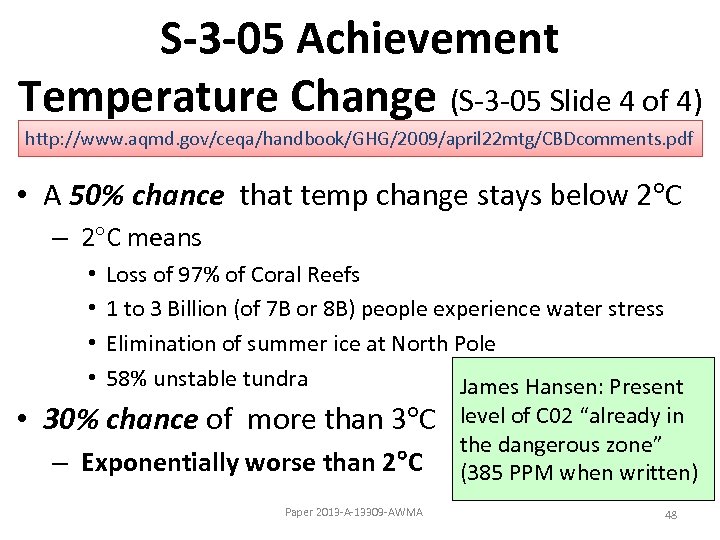
S-3 -05 Achievement Temperature Change (S-3 -05 Slide 4 of 4) http: //www. aqmd. gov/ceqa/handbook/GHG/2009/april 22 mtg/CBDcomments. pdf • A 50% chance that temp change stays below 2°C – 2°C means • • Loss of 97% of Coral Reefs 1 to 3 Billion (of 7 B or 8 B) people experience water stress Elimination of summer ice at North Pole 58% unstable tundra James Hansen: Present • 30% chance of more than 3°C – Exponentially worse than 2°C Paper 2013 -A-13309 -AWMA level of C 02 “already in the dangerous zone” (385 PPM when written) 48
Car Efficiency Factor To work with Equivalent Mileage: Paper 2013 -A-13309 -AWMA 49
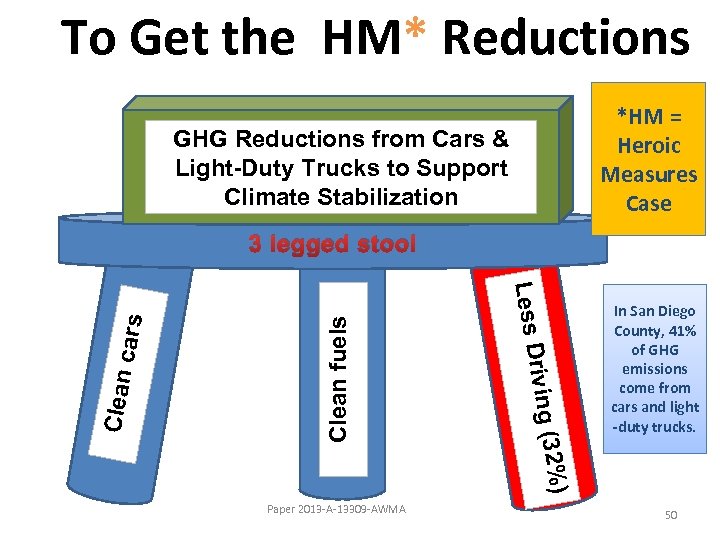
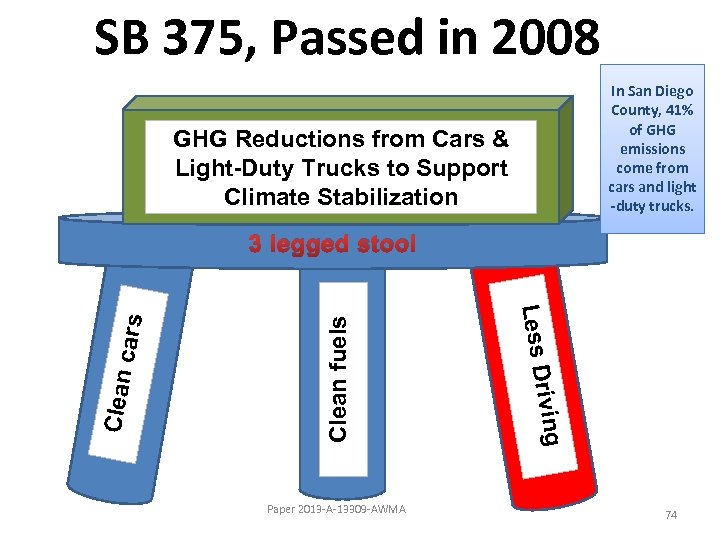
To Get the HM* Reductions *HM = Heroic Measures Case GHG Reductions from Cars & Light-Duty Trucks to Support Climate Stabilization Clean fuels (32%) Clean riving Paper 2013 -A-13309 -AWMA Less D cars 3 legged stool In San Diego County, 41% of GHG emissions come from cars and light -duty trucks. 50
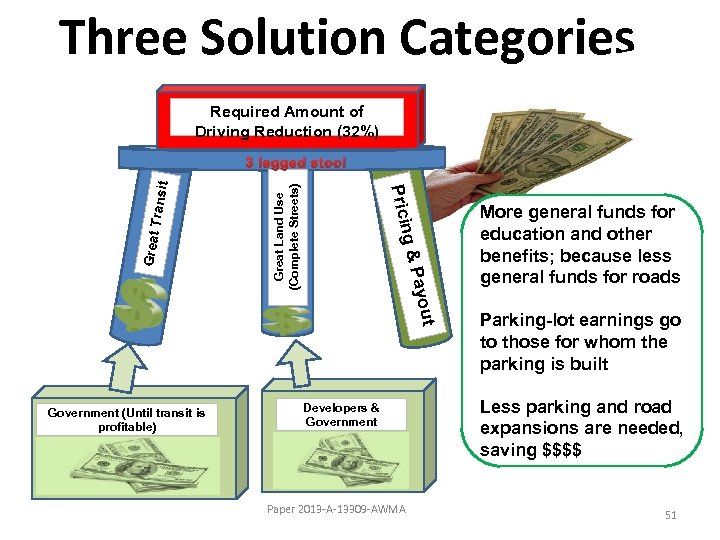
Three Solution Categories Required Amount of Driving Reduction (32%) Great Land Use (Complete Streets) Great t ayou g&P Pricin Transi t 3 legged stool Government (Until transit is profitable) Developers & Government Paper 2013 -A-13309 -AWMA More general funds for education and other benefits; because less general funds for roads Parking-lot earnings go to those for whom the parking is built Less parking and road expansions are needed, saving $$$$ 51
Background: paper presented at the A&WMA Conference in 2010 A Plan to Efficiently and Conveniently Unbundle Car Parking Costs • • Motivation (1 slide) Goals (2 slides) Definitions and Methods (7 slides) Implementation (2 slides)
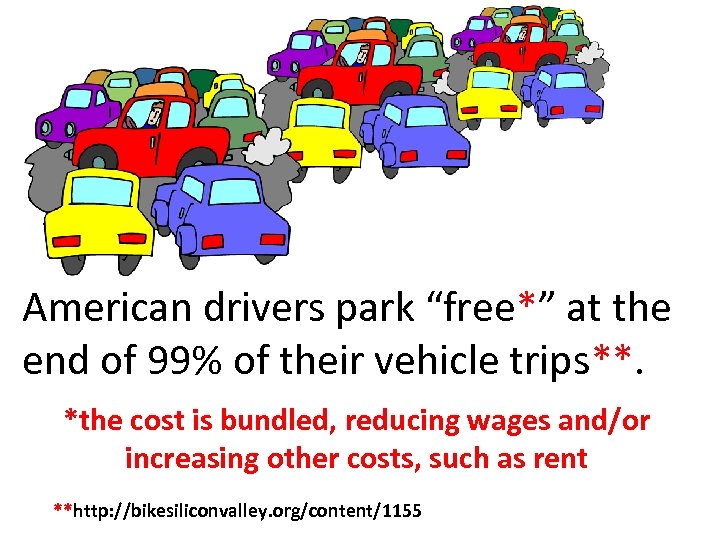
American drivers park “free*” at the end of 99% of their vehicle trips**. *the cost is bundled, reducing wages and/or increasing other costs, such as rent **http: //bikesiliconvalley. org/content/1155
Motivation • Fairness to individuals – Costs no longer hidden – Costs mostly recovered, by not using parking • Less driving, to reduce environmental harm – Motivates choosing alternative modes – Less driving to find parking • More Efficient Development – Less parking needed reduces land building costs Paper 2013 -A-13309 -AWMA 54
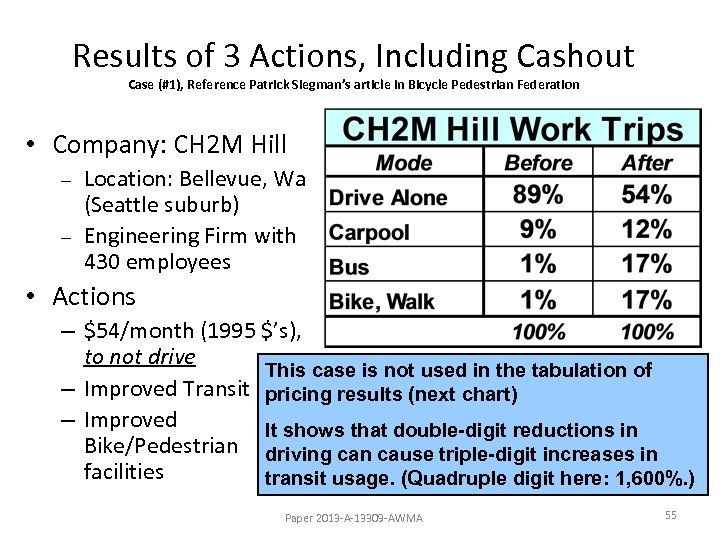
Results of 3 Actions, Including Cashout Case (#1), Reference Patrick Siegman’s article in Bicycle Pedestrian Federation • Company: CH 2 M Hill – – Location: Bellevue, Wa (Seattle suburb) Engineering Firm with 430 employees • Actions – $54/month (1995 $’s), to not drive This case is not used in the tabulation of – Improved Transit pricing results (next chart) – Improved It shows that double-digit reductions in Bike/Pedestrian driving can cause triple-digit increases in facilities transit usage. (Quadruple digit here: 1, 600%. ) Paper 2013 -A-13309 -AWMA 55
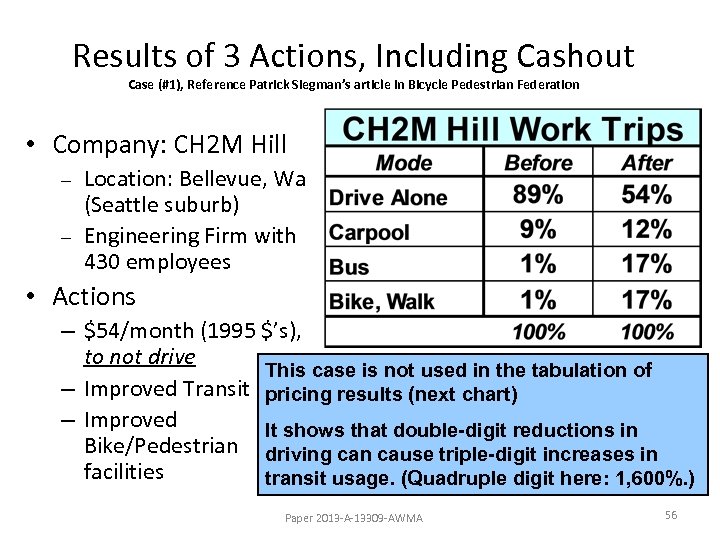
Results of 3 Actions, Including Cashout Case (#1), Reference Patrick Siegman’s article in Bicycle Pedestrian Federation • Company: CH 2 M Hill – – Location: Bellevue, Wa (Seattle suburb) Engineering Firm with 430 employees • Actions – $54/month (1995 $’s), to not drive This case is not used in the tabulation of – Improved Transit pricing results (next chart) – Improved It shows that double-digit reductions in Bike/Pedestrian driving can cause triple-digit increases in facilities transit usage. (Quadruple digit here: 1, 600%. ) Paper 2013 -A-13309 -AWMA 56
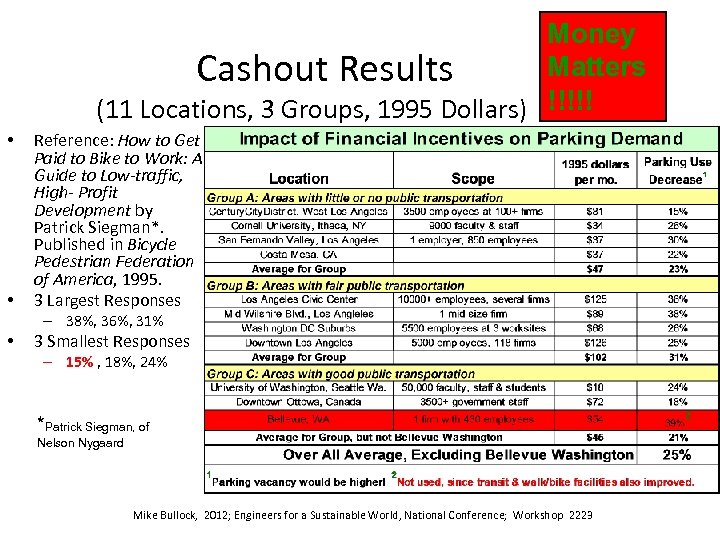
Money Matters Cashout Results (11 Locations, 3 Groups, 1995 Dollars) !!!!! • • Reference: How to Get Paid to Bike to Work: A Guide to Low-traffic, High- Profit Development by Patrick Siegman*. Published in Bicycle Pedestrian Federation of America, 1995. 3 Largest Responses – 38%, 36%, 31% • 3 Smallest Responses – 15% , 18%, 24% *Patrick Siegman, of Nelson Nygaard Mike Bullock, 2012; Engineers for a Sustainable World, National Conference; Workshop 2223
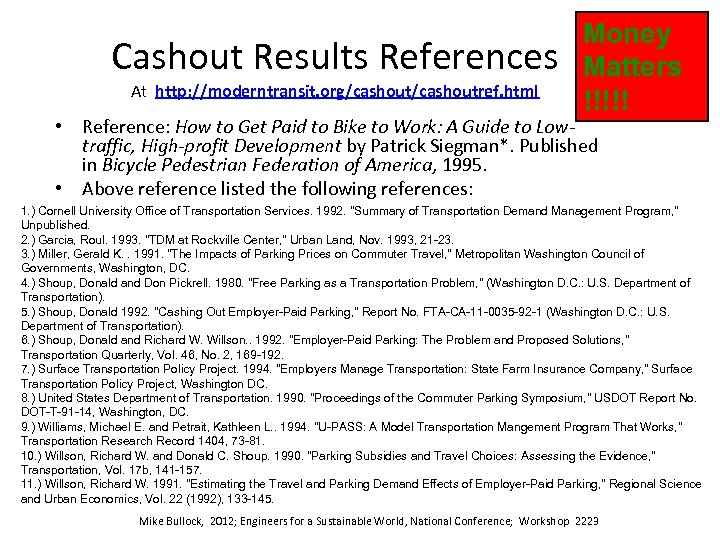
Cashout Results References At http: //moderntransit. org/cashoutref. html Money Matters !!!!! • Reference: How to Get Paid to Bike to Work: A Guide to Lowtraffic, High-profit Development by Patrick Siegman*. Published in Bicycle Pedestrian Federation of America, 1995. • Above reference listed the following references: 1. ) Cornell University Office of Transportation Services. 1992. "Summary of Transportation Demand Management Program, " Unpublished. 2. ) Garcia, Roul. 1993. "TDM at Rockville Center, " Urban Land, Nov. 1993, 21 -23. 3. ) Miller, Gerald K. . 1991. "The Impacts of Parking Prices on Commuter Travel, " Metropolitan Washington Council of Governments, Washington, DC. 4. ) Shoup, Donald and Don Pickrell. 1980. "Free Parking as a Transportation Problem, " (Washington D. C. : U. S. Department of Transportation). 5. ) Shoup, Donald 1992. "Cashing Out Employer-Paid Parking, " Report No. FTA-CA-11 -0035 -92 -1 (Washington D. C. : U. S. Department of Transportation). 6. ) Shoup, Donald and Richard W. Willson. . 1992. "Employer-Paid Parking: The Problem and Proposed Solutions, " Transportation Quarterly, Vol. 46, No. 2, 169 -192. 7. ) Surface Transportation Policy Project. 1994. "Employers Manage Transportation: State Farm Insurance Company, " Surface Transportation Policy Project, Washington DC. 8. ) United States Department of Transportation. 1990. "Proceedings of the Commuter Parking Symposium, " USDOT Report No. DOT-T-91 -14, Washington, DC. 9. ) Williams, Michael E. and Petrait, Kathleen L. . 1994. "U-PASS: A Model Transportation Mangement Program That Works, " Transportation Research Record 1404, 73 -81. 10. ) Willson, Richard W. and Donald C. Shoup. 1990. "Parking Subsidies and Travel Choices: Assessing the Evidence, " Transportation, Vol. 17 b, 141 -157. 11. ) Willson, Richard W. 1991. "Estimating the Travel and Parking Demand Effects of Employer-Paid Parking, " Regional Science and Urban Economics, Vol. 22 (1992), 133 -145. Mike Bullock, 2012; Engineers for a Sustainable World, National Conference; Workshop 2223
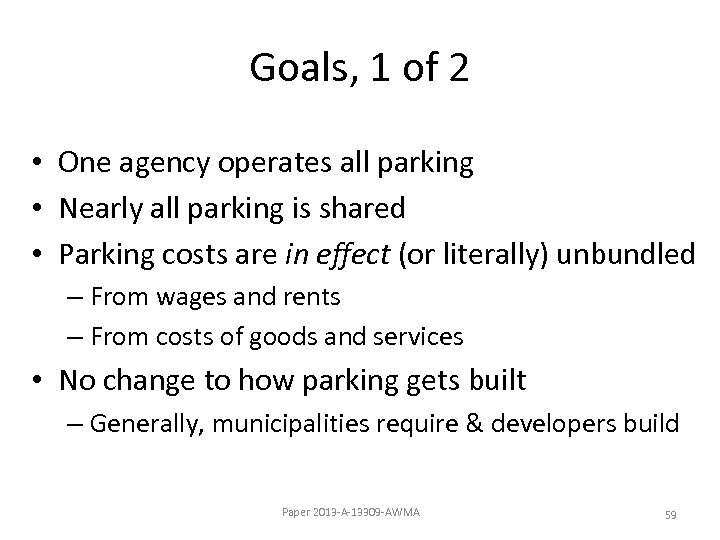
Goals, 1 of 2 • One agency operates all parking • Nearly all parking is shared • Parking costs are in effect (or literally) unbundled – From wages and rents – From costs of goods and services • No change to how parking gets built – Generally, municipalities require & developers build Paper 2013 -A-13309 -AWMA 59
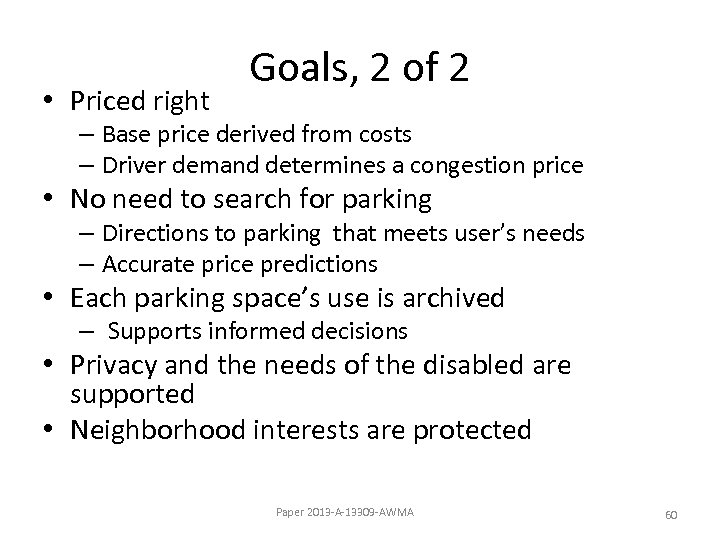
• Priced right Goals, 2 of 2 – Base price derived from costs – Driver demand determines a congestion price • No need to search for parking – Directions to parking that meets user’s needs – Accurate price predictions • Each parking space’s use is archived – Supports informed decisions • Privacy and the needs of the disabled are supported • Neighborhood interests are protected Paper 2013 -A-13309 -AWMA 60
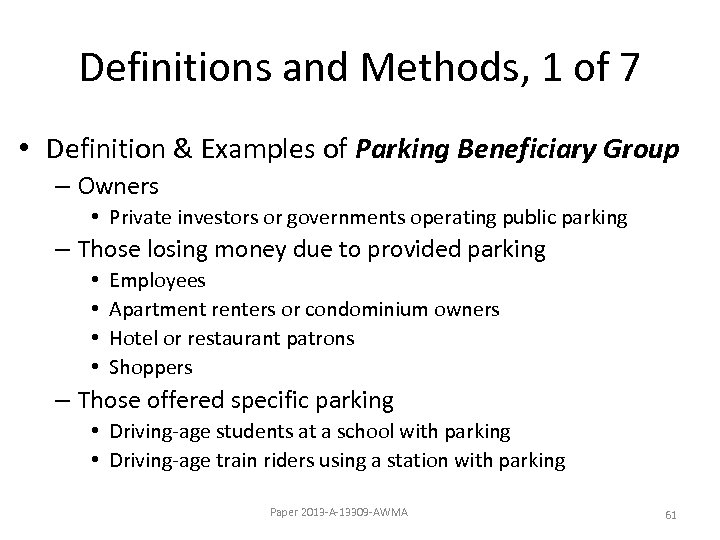
Definitions and Methods, 1 of 7 • Definition & Examples of Parking Beneficiary Group – Owners • Private investors or governments operating public parking – Those losing money due to provided parking • • Employees Apartment renters or condominium owners Hotel or restaurant patrons Shoppers – Those offered specific parking • Driving-age students at a school with parking • Driving-age train riders using a station with parking Paper 2013 -A-13309 -AWMA 61
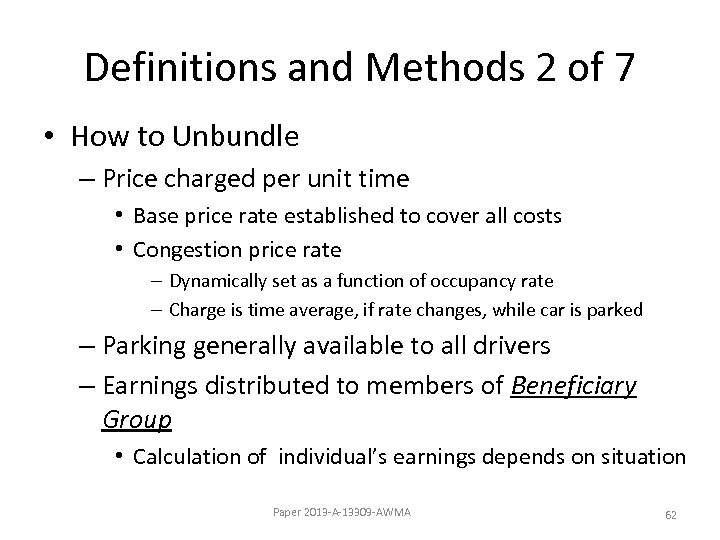
Definitions and Methods 2 of 7 • How to Unbundle – Price charged per unit time • Base price rate established to cover all costs • Congestion price rate – Dynamically set as a function of occupancy rate – Charge is time average, if rate changes, while car is parked – Parking generally available to all drivers – Earnings distributed to members of Beneficiary Group • Calculation of individual’s earnings depends on situation Paper 2013 -A-13309 -AWMA 62
Definitions and Methods, 3 of 7 • Calculation of monthly earnings – If parking is provided for several groups, each group’s portion of the earnings is proportional to its original contribution to cost (Mixed use case) – Each beneficiary group’s total is divided up among its members • Condominium owners: proportional to spaces effectively purchased • Renters: proportional to spaces effectively renting • Shoppers: proportional to money spent • Employees or students of driving age: proportional to time spent at work or school • Train riders of driving age: proportional to time spent on round trips Paper 2013 -A-13309 -AWMA 63
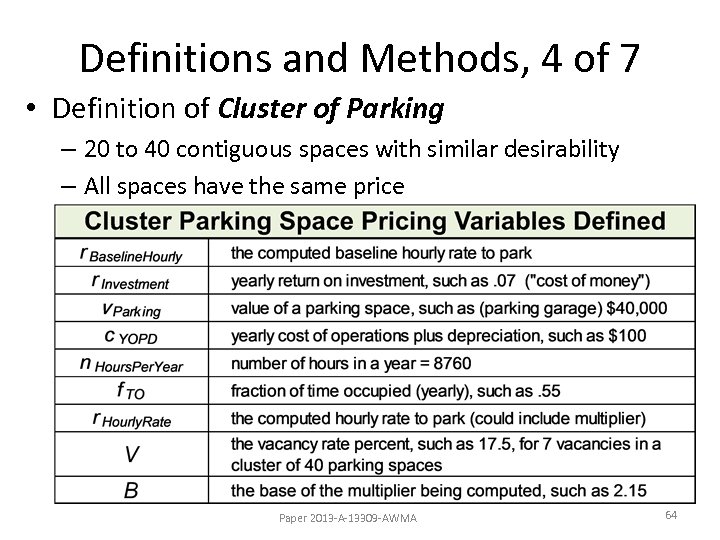
Definitions and Methods, 4 of 7 • Definition of Cluster of Parking – 20 to 40 contiguous spaces with similar desirability – All spaces have the same price Paper 2013 -A-13309 -AWMA 64
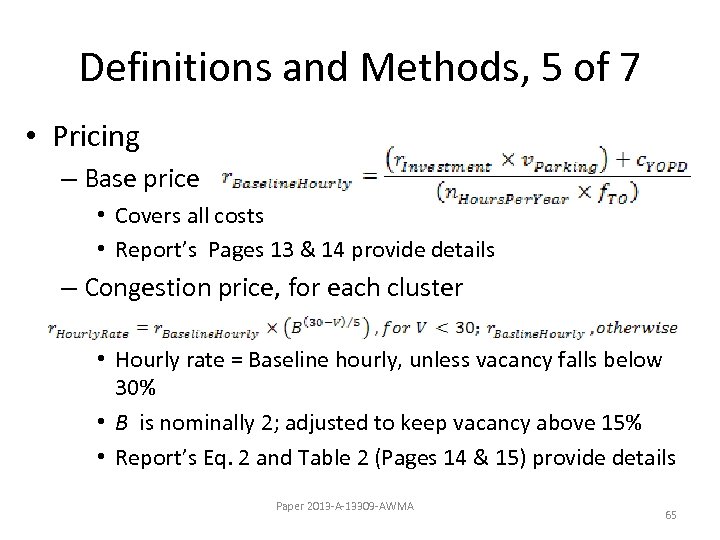
Definitions and Methods, 5 of 7 • Pricing – Base price • Covers all costs • Report’s Pages 13 & 14 provide details – Congestion price, for each cluster • Hourly rate = Baseline hourly, unless vacancy falls below 30% • B is nominally 2; adjusted to keep vacancy above 15% • Report’s Eq. 2 and Table 2 (Pages 14 & 15) provide details Paper 2013 -A-13309 -AWMA 65
Definitions and Methods, 6 of 7 • Pricing predictions – For any set of dates, start times, durations, and destinations – Availability of predictions • Broadcast into navigational units • Website or phone • Pay stations • Help to find desired parking – Driver gives times and locations and stipulates. . . • Max price, to get space at minimum walk distance • Max walk distance, to get space at minimum price – Voice-activated navigational system for ease and safety Paper 2013 -A-13309 -AWMA 66
Definitions and Methods, 7 of 7 • Monthly statements – All parking charges and earnings – Customer selects presentation detail • Less detail for ease and more privacy • More detail to know and adjust parking decisions – Packaged with other statements • All utilities, transit use, road use Paper 2013 -A-13309 -AWMA 67
Implementation Plan, 1 of 2 • Reduced- feature, demonstration project – No congestion pricing and no predictions – Automated car detection – Automated monthly statements – Success allows next steps • Write a requirements document to support a request for proposal (RFP) • Winning proposal leads to design Paper 2013 -A-13309 -AWMA 68
Implementation Plan, 2 of 2 • Government agency develops and executes installation strategy – To minimize impact on institutions – To maximize early success and driving reductions • Large employment centers with “free” parking • Train stations with large, “free” parking lots – Supported by new laws requiring cooperation but very little effort, from. . . • Private and public institutions • Individuals Paper 2013 -A-13309 -AWMA 69
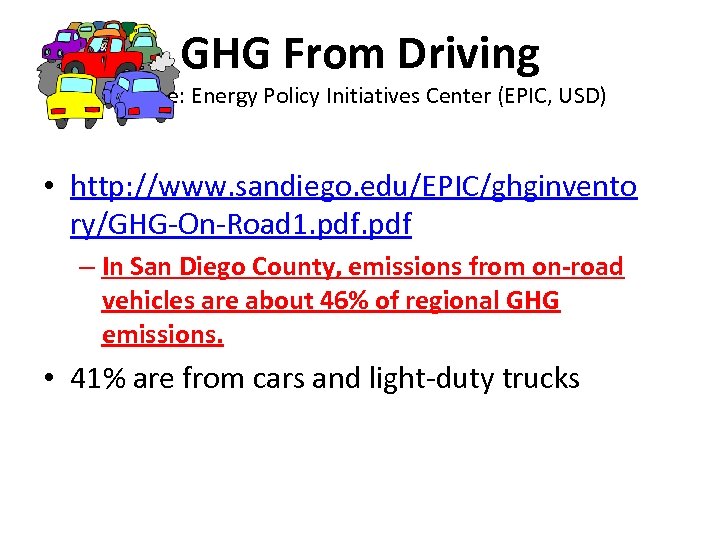
GHG From Driving Source: Energy Policy Initiatives Center (EPIC, USD) • http: //www. sandiego. edu/EPIC/ghginvento ry/GHG-On-Road 1. pdf – In San Diego County, emissions from on-road vehicles are about 46% of regional GHG emissions. • 41% are from cars and light-duty trucks
Current Level of C 02 is 400 PPM Paper 2013 -A-13309 -AWMA 71
SB 375, Passed in 2008 http: //www. nrdc. org/globalwarming/sb 375/files/sb 375. pdf http: //en. wikipedia. org/wiki/SB_375 • For cars and Light-duty trucks • Key provision – California Air Resources Board (CARB) Provides vehicle-miles-travelled (VMT) reduction targets • • For years 2020 and 2035 To Metropolitan Planning Organizations (MPO) Computed in Regional Transportation Plans (RTP) Local MPO, San Diego Association of Governments (SANDAG), produced the first post-SB 375 RTP Paper 2013 -A-13309 -AWMA 72
From the Report Fractions of Fleets Sold in California that are Zero Emission Vehicles, For 2 Different Cases* Cases HM EHM 2015. 00 2016 2017 2018 2019 2020 2021 2022 2023 2024 . 00. 10 . 00. 30 . 05. 50 . 10. 70 . 25. 90 . 40. 95 . 55. 95 . 70. 95 . 85. 95 2025. 95 2026. 95 2027 2028 20292 2030. 95. 95 *Heroic Measures (EM) Case and the Extra Heroic Measures (EHM) Case, Which Supports 2005 Per-Capita Driving Case Per-Capita Driving Reduction with Respect to 2005 HM 32% EHM 0% Paper 2013 -A-13309 -AWMA 73
SB 375, Passed in 2008 In San Diego County, 41% of GHG emissions come from cars and light -duty trucks. GHG Reductions from Cars & Light-Duty Trucks to Support Climate Stabilization Clean fuels Paper 2013 -A-13309 -AWMA riving Less D cars 3 legged stool 74
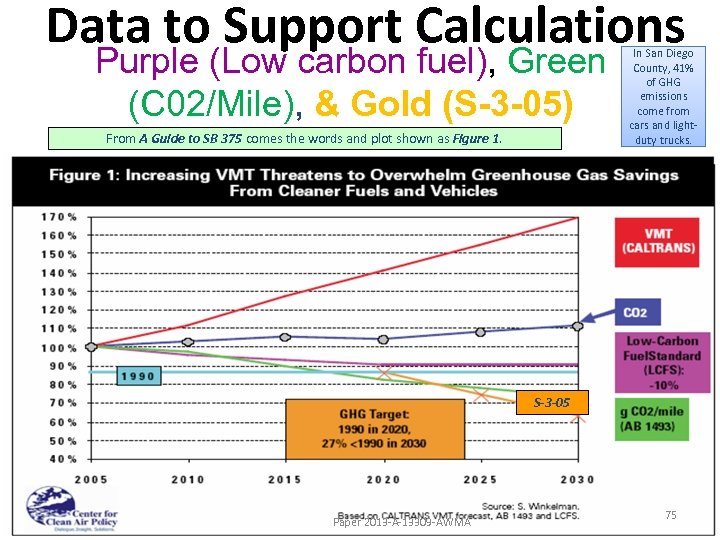
Data to Support Calculations Purple (Low carbon fuel), Green (C 02/Mile), & Gold (S-3 -05) From A Guide to SB 375 comes the words and plot shown as Figure 1. In San Diego County, 41% of GHG emissions come from cars and lightduty trucks. S-3 -05 Paper 2013 -A-13309 -AWMA 75
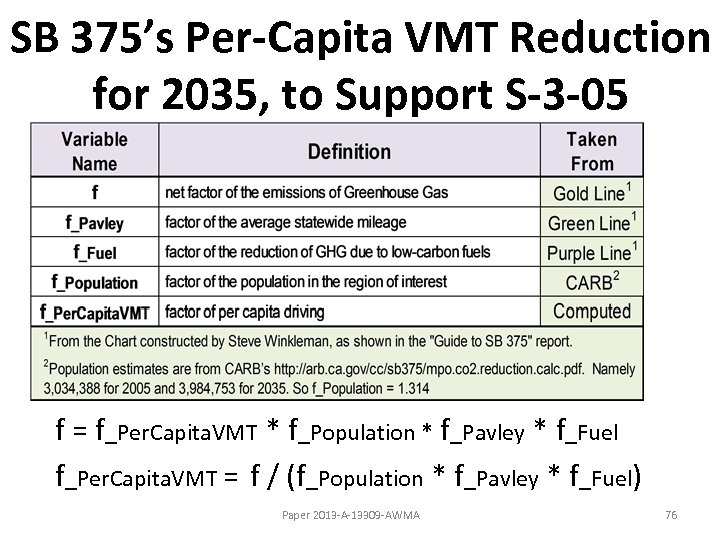
SB 375’s Per-Capita VMT Reduction for 2035, to Support S-3 -05 f = f_Per. Capita. VMT * f_Population * f_Pavley * f_Fuel f_Per. Capita. VMT = f / (f_Population * f_Pavley * f_Fuel) Paper 2013 -A-13309 -AWMA 76
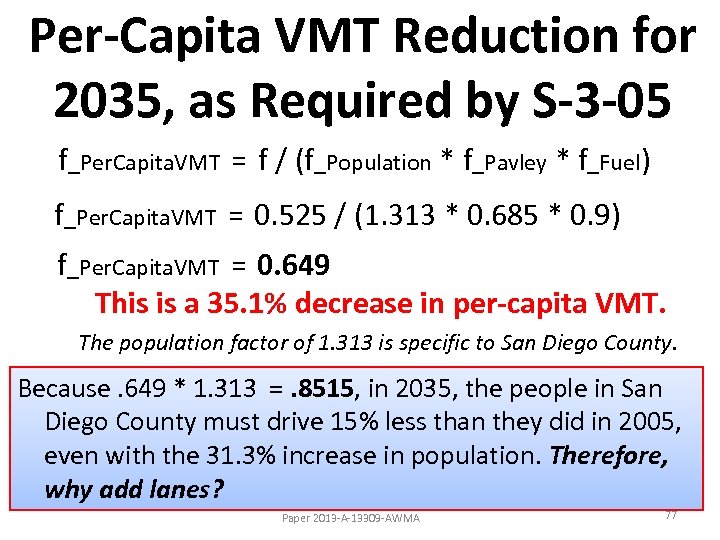
Per-Capita VMT Reduction for 2035, as Required by S-3 -05 f_Per. Capita. VMT = f / (f_Population * f_Pavley * f_Fuel) f_Per. Capita. VMT = 0. 525 / (1. 313 * 0. 685 * 0. 9) f_Per. Capita. VMT = 0. 649 This is a 35. 1% decrease in per-capita VMT. The population factor of 1. 313 is specific to San Diego County. Because. 649 * 1. 313 =. 8515, in 2035, the people in San Diego County must drive 15% less than they did in 2005, even with the 31. 3% increase in population. Therefore, why add lanes? Paper 2013 -A-13309 -AWMA 77
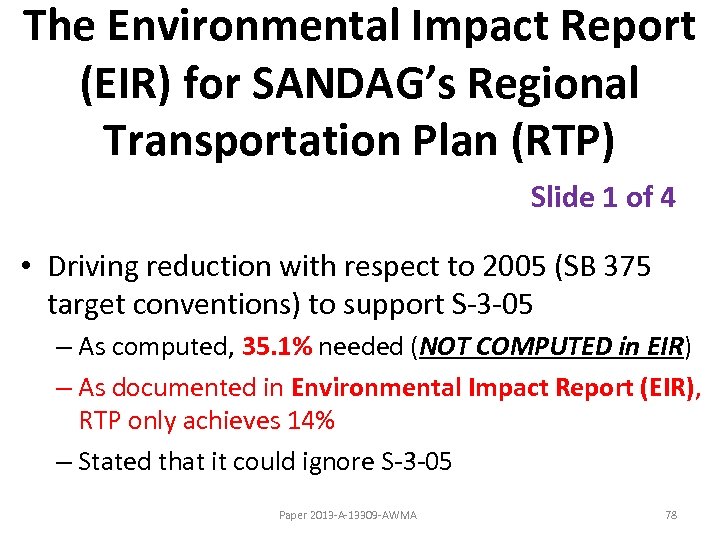
The Environmental Impact Report (EIR) for SANDAG’s Regional Transportation Plan (RTP) Slide 1 of 4 • Driving reduction with respect to 2005 (SB 375 target conventions) to support S-3 -05 – As computed, 35. 1% needed (NOT COMPUTED in EIR) – As documented in Environmental Impact Report (EIR), RTP only achieves 14% – Stated that it could ignore S-3 -05 Paper 2013 -A-13309 -AWMA 78
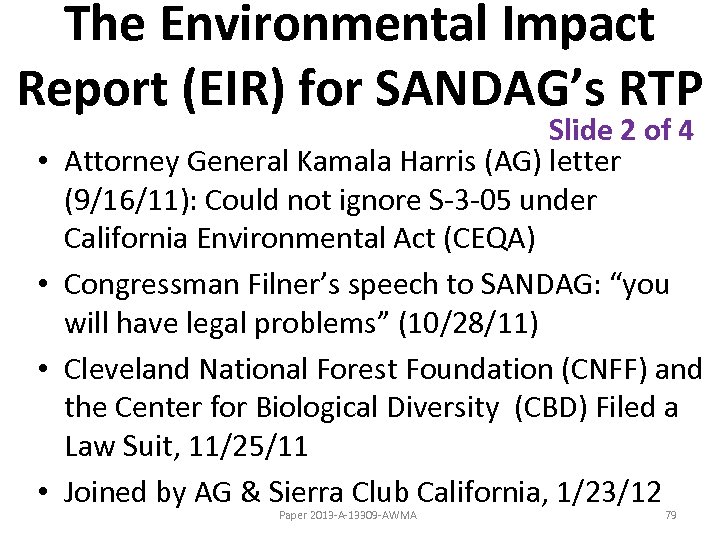
The Environmental Impact Report (EIR) for SANDAG’s RTP • • Slide 2 of 4 Attorney General Kamala Harris (AG) letter (9/16/11): Could not ignore S-3 -05 under California Environmental Act (CEQA) Congressman Filner’s speech to SANDAG: “you will have legal problems” (10/28/11) Cleveland National Forest Foundation (CNFF) and the Center for Biological Diversity (CBD) Filed a Law Suit, 11/25/11 Joined by AG & Sierra Club California, 1/23/12 Paper 2013 -A-13309 -AWMA 79
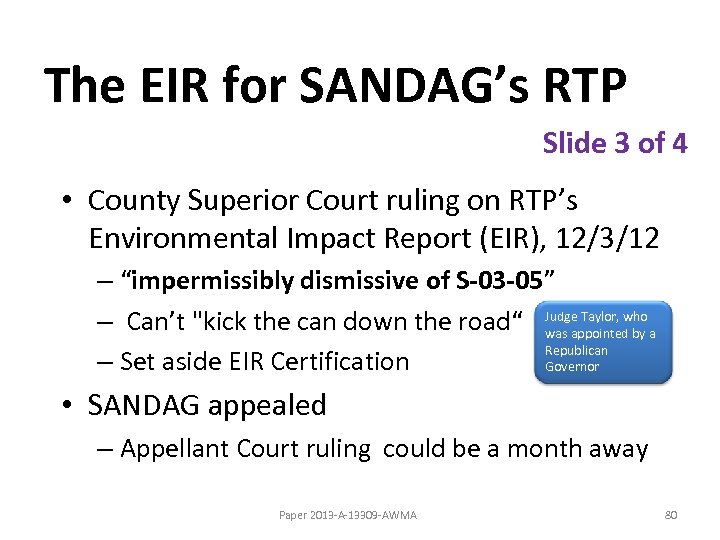
The EIR for SANDAG’s RTP Slide 3 of 4 • County Superior Court ruling on RTP’s Environmental Impact Report (EIR), 12/3/12 – “impermissibly dismissive of S-03 -05” – Can’t "kick the can down the road“ Judge Taylor, who a was appointed by Republican – Set aside EIR Certification Governor • SANDAG appealed – Appellant Court ruling could be a month away Paper 2013 -A-13309 -AWMA 80
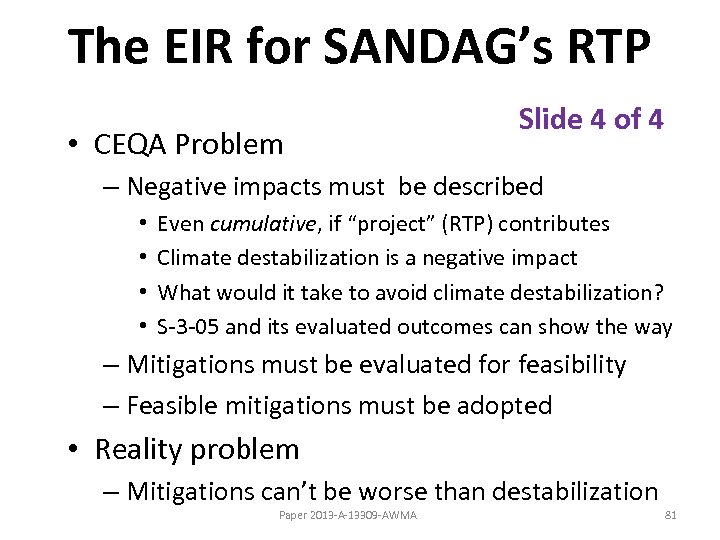
The EIR for SANDAG’s RTP • CEQA Problem Slide 4 of 4 – Negative impacts must be described • • Even cumulative, if “project” (RTP) contributes Climate destabilization is a negative impact What would it take to avoid climate destabilization? S-3 -05 and its evaluated outcomes can show the way – Mitigations must be evaluated for feasibility – Feasible mitigations must be adopted • Reality problem – Mitigations can’t be worse than destabilization Paper 2013 -A-13309 -AWMA 81
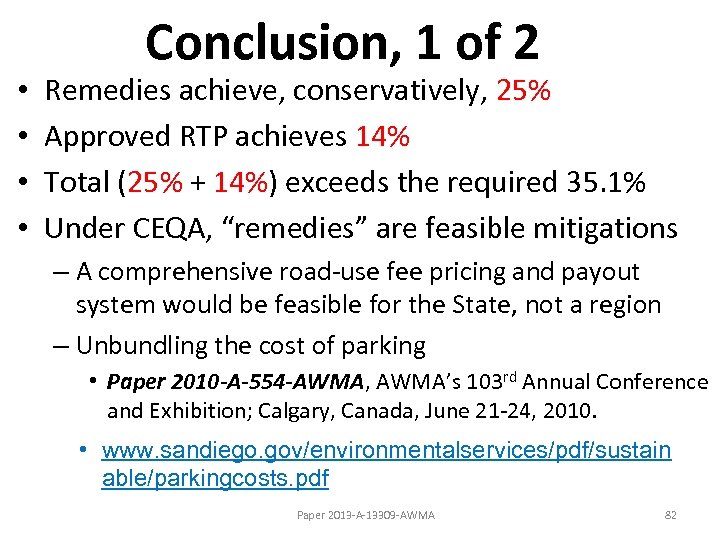
• • Conclusion, 1 of 2 Remedies achieve, conservatively, 25% Approved RTP achieves 14% Total (25% + 14%) exceeds the required 35. 1% Under CEQA, “remedies” are feasible mitigations – A comprehensive road-use fee pricing and payout system would be feasible for the State, not a region – Unbundling the cost of parking • Paper 2010 -A-554 -AWMA, AWMA’s 103 rd Annual Conference and Exhibition; Calgary, Canada, June 21 -24, 2010. • www. sandiego. gov/environmentalservices/pdf/sustain able/parkingcosts. pdf Paper 2013 -A-13309 -AWMA 82
Conclusion, 2 of 2 From the Paper This paper shows how Steve Winkelman’s data (from Reference 6) can be used to compute driving reductions that support S-3 -05 and how those reductions can be achieved (the remedies). When MPO’s prepare an environmental impact report for their RTP, they are taking a legal risk if they can’t show, quantitatively, that their proposed plan supports climate stabilization. After all, climate destabilization is an overwhelming negative environmental impact. Our survival depends on all governments adopting the golden rule, applied to climate: emit GHG as you would have others emit GHG. The trajectories provided by climate scientists must be achieved in every region, state, and country; in each economic sector. Cars and lightduty trucks in San Diego County are no exception. The San Diego County Superior Court Judge was correct. SANDAG was “impermissibly dismissive of S-3 -05” and it is far too late to be “kicking the can down the road”. Questions? Paper 2013 -A-13309 -AWMA 83
An Important Pricing Strategy A Privacy-Protecting, Road-Use-Fee Pricing & Payout System to Help Solve Climate, Congestion, Deferred Road Maintenance, and the Social Inequity of Using General Funds to Maintain Roads, Since that Money is Needed for Such Things as Transit, Food Stamps, and Education THEREFORE, BE IT RESOLVED, that DEMCCO supports a road-use fee pricing and payout system that (1) would cover all road-use costs, including the environmental and health costs caused by driving; (2) could still include a fuel tax or fee; (3) would mitigate impacts on low-income users; (4) would protect privacy; (5) would include congestion pricing when that technology becomes feasible; (6) would keep the per-mile price incentive to drive energy-efficient cars at least as large as it is with today’s fuel excise tax; and (7) would send its earnings to all citizens and institutions that are losing money under the current system, with the goal being to achieve a full and just compensation. Paper 2014 -A-30793 -AWMA 84
Another Important Pricing Strategy Funding for a Demonstration Project of an Equitable and Environmentally. Sound Car-Parking Policy THEREFORE, BE IT RESOLVED, that DEMCCO supports funding the development and prototype installation of car-parking systems with at least the last two features (numbered 7 and 8), so as to demonstrate useful feasibility, with the full set of features as follows: (1) have full-cost base pricing; (2) have congestion pricing; (3) have charge and payout policies that will minimize money lost by non-drivers, due to parking facilities; (4) will support sharing of parking facilities; (5) will provide retrievable knowledge of the use of each parking space; (6) have a data interface that will support on-demand predictions of parking-space price and availability; (7) have automatic car detection; and (8) will do efficient mailing of invoices, containing both parking charges and parking earnings. Paper 2014 -A-30793 -AWMA 85
Скачать презентацию Current 8 lanes Bigger is better Coastal Commission
bf3f0b4e192a525ca4ff02f690ee8bca.ppt