 Скачать презентацию Currency Wars Global Money in 2011 Jeffrey Frankel
abc1ac8f4f05adb01d80b1c940aaa5ff.ppt
- Количество слайдов: 90



Currency Wars: Global Money in 2011 Jeffrey Frankel Harpel Professor of Capital Formation & Growth, Harvard University MAS Sponsored Public Lecture, Singapore, March 2011 1
n What are the currency wars? • Review of the last 6 months. • Is the currency war metaphor appropriate? n Which emerging markets are intervening the most to dampen the appreciation of their currencies? • What is the right way to measure it? • What should they be doing? Lessons from recent crises. n The 3 big currencies • • • $ RMB € 2
n Who is doing how much? • It is not enough to look at increases in FX reserves. • The question: for a given increase in Exchange Market Pressure (EMP), how much does the central bank absorb as an rise in the value of its currency (exchange rate) versus how much as an increase in the quantity (reserves). n How much should it intervene, vs. appreciate? • What can we learn from recent crises? 3
Currency Wars chronology, 2010 June China announces more flexibility in RMB, n • after postponement of Treasury report on undervaluation, thereby saving face; • but little appreciation follows. (Repeat of 2005. ) n September 15 Japan buys $20 b for ¥, • after 6 -year absence from FX markets; • thereby joining Switzerland, the other floater to have appreciated in 2008 -09 GFC and to have fought it by FX intervention. 4
Currency Wars chronology, continued September 27 warning from Brazil’s Finance Minister Guido Mantega: “We’re in the midst of an international currency war, a general weakening of currency. This threatens us because it takes away our competitiveness. ” n I. e. , countries everywhere are trying to push down the value of their currencies, to gain exports and employment, n • a goal that is not globally consistent. 5
n n n Some consider FRB policy another instance. Renewed flows to emerging markets have met with intervention • e. g. , by Korea, host of November G 20 summit. • Brazil, Thailand, India & others must decide how to manage inflows: n n Capital controls? Appreciation? Buying $ to prevent appreciation China’s RMB remains the dominant issue. 6
Currency Wars chronology, n Nov. 2010 As European sovereign debt crisis resurfaces in Ireland, (1. 3 $/€ ). Nov. 17 n Chinese government, responding to 4. 4% inflation • • • n in October raises i, reserve requirements, & price controls. US core inflation falls to 0. 6% for year, • the lowest since 1957. 7
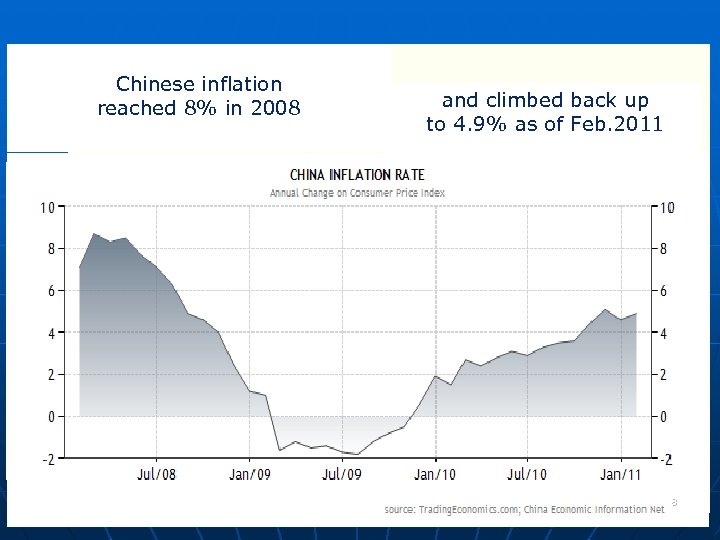
Chinese inflation reached 8% in 2008 and climbed back up to 4. 9% as of Feb. 2011 Source: WSJ 8
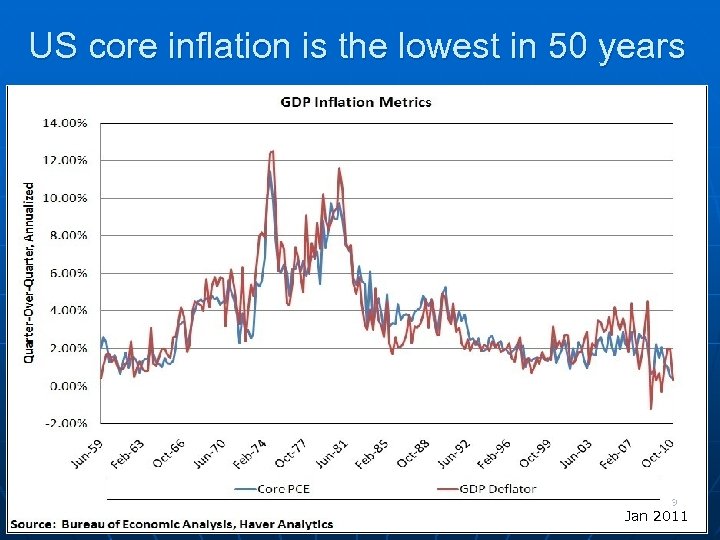
US core inflation is the lowest in 50 years 9 Jan 2011
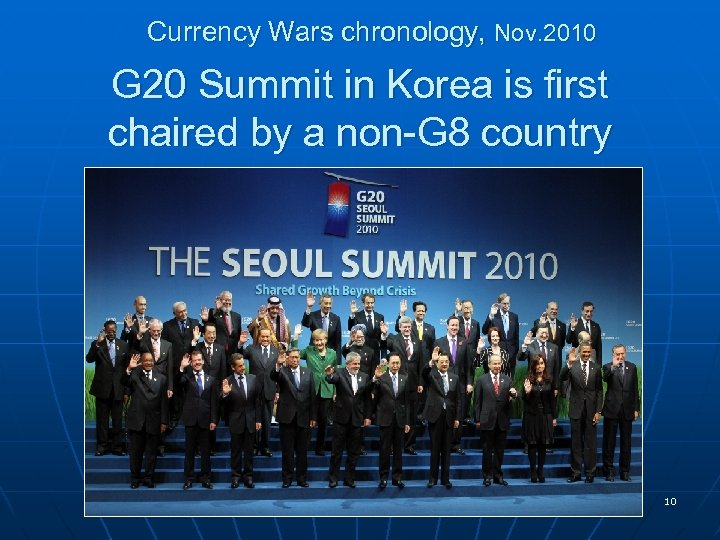
Currency Wars chronology, Nov. 2010 G 20 Summit in Korea is first chaired by a non-G 8 country 10
Currency Wars chronology, Nov. 2010 n Nov. 12: G-20 Summit in Seoul judged a failure, at least for Obama: • Rebuff of US proposal for cap on Current Account surpluses at 4% of GDP. • No pledge to refrain from “competitive undervaluation” • A suggestion to countries with widely used currencies like the $ to “be vigilant against excess volatility, ” a warning against loose monetary policy. 11
Currency Wars chronology, Nov. 2010 n Nov. 21: Fed announces QE 2 decision - • Will purchase $600 b in bonds. • Short-term market reaction -- $ depreciates. • Critiques -Sarah Palin & John Taylor: “US is debauching its currency. ” n Germany, China & Brazil: “$ depreciation = deliberate salvo in currency wars. ” n 12
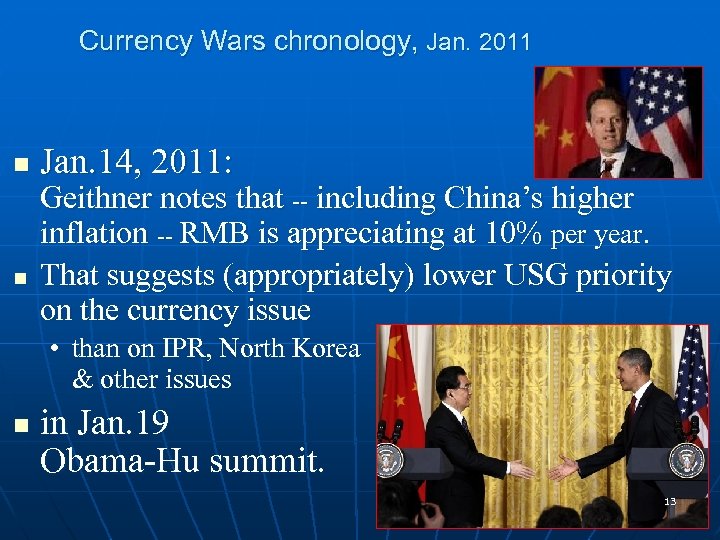
Currency Wars chronology, Jan. 2011 n n Jan. 14, 2011: Geithner notes that -- including China’s higher inflation -- RMB is appreciating at 10% per year. That suggests (appropriately) lower USG priority on the currency issue • than on IPR, North Korea & other issues n in Jan. 19 Obama-Hu summit. 13
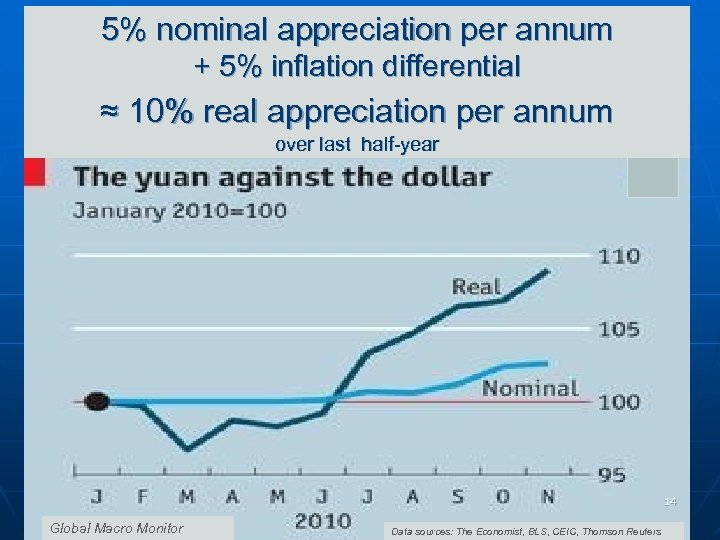
5% nominal appreciation per annum + 5% inflation differential ≈ 10% real appreciation per annum over last half-year 14 Global Macro Monitor Data sources: The Economist, BLS, CEIC, Thomson Reuters
Currency Wars chronology, 2011 n Feb. 4, 2011 • In biannual report to Congress, U. S. Treasury calls RMB "substantially undervalued. " • But it once again refrains from naming China a currency manipulator. • and points out real appreciation is at 10%. 15
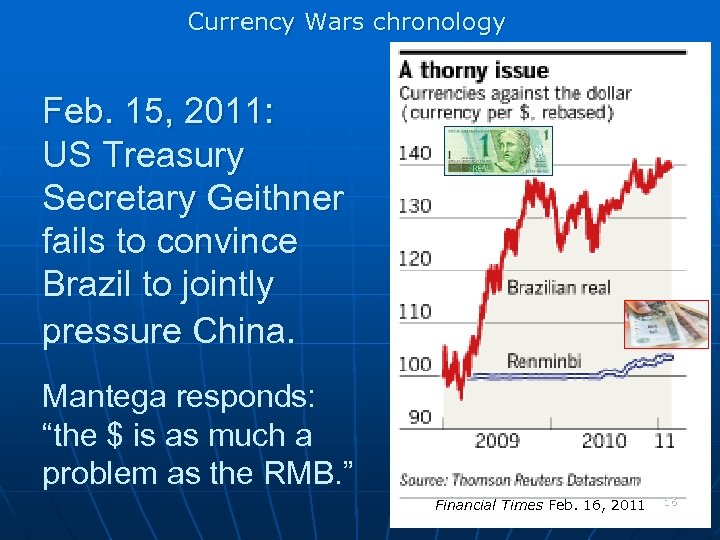
Currency Wars chronology Feb. 15, 2011: US Treasury Secretary Geithner fails to convince Brazil to jointly pressure China. Mantega responds: “the $ is as much a problem as the RMB. ” Financial Times Feb. 16, 2011 16
Feb. 18 -19, 2011: n n n First meeting of G 20 ministers in France’s year as host. Sarkozy no longer talking of “a new Bretton Woods. ” But G 20 goes ahead with a system of indicators, • including probably currency reserves, exchange rates, current account balances, budget deficits and sovereign debt levels. 17
Is the currency war metaphor applicable? n Fear of non-cooperative “competitive devaluation” is an argument for fixed exchange rates • rooted in the 1930 s. • That is why the architects of the post-war monetary order chose fixed exchange rates at Bretton Woods, NH, in 1944. n But it is now used to argue that China should move from fixing to floating. • US Congressmen don’t care about regimes; • they just want a stronger RMB vs. $. 18
Intervention in emerging markets to fight currency appreciation n Who is doing how much? • It is not enough to look at increases in FX reserves. • The question: for a given increase in Exchange Market Pressure (EMP), how much does the central bank absorb as an rise in the value of its currency (exchange rate) versus how much as an increase in the quantity (reserves). n How much should it intervene, vs. appreciate? • What can we learn from recent crises? 19
Is the currency war metaphor applicable? n n Meanwhile, fear of “competitive devaluation” is also used as an argument against US monetary expansion. But monetary expansion is not a “beggar-thy-neighbor” policy: • Although in theory it should depreciate $, • at the same time it boosts US growth & so imports. • The net of the two effects on trade balance is ambiguous in theory and ≈ 0 in practice. • Do other countries want a U. S. “double dip” ? 20
Is the currency war metaphor applicable? n n n continued Economic historians have decided competitive devaluation under 1930 s conditions was not a problem after all. True, countries couldn’t all devalue against each other, But they could and did all devalue against gold • which worked to ease global monetary policy, n n just what was needed. The same was needed in 2008 -09 21
Is the currency war metaphor applicable? n continued The currency war talk – especially the criticism of US monetary policy -- seems to forget the point of floating rates: • Different countries will always have different needs at any point in time e. g. , high unemployment in US & European periphery, n while China & Brazil & India are overheating. n • The point of a floating rate system is that US can choose its easy monetary policy and Brazil its tight monetary system, with appreciation of $ vs. real accommodating the divergence. n Multilateral cooperation is not necessary for this. 22
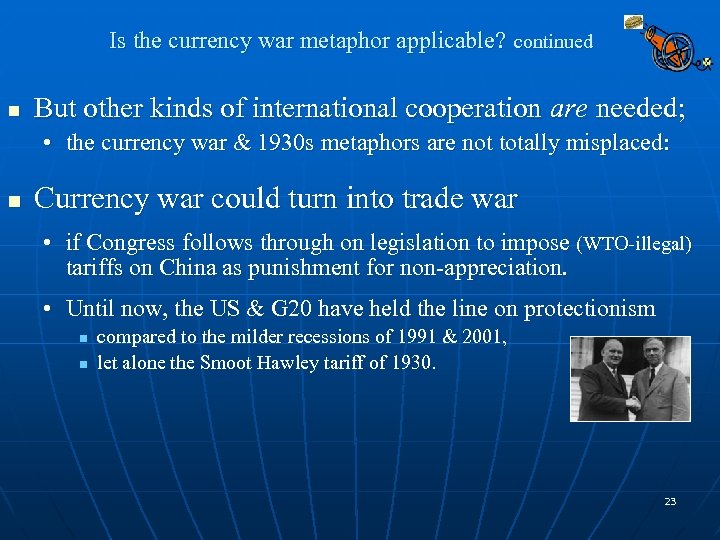
Is the currency war metaphor applicable? continued n But other kinds of international cooperation are needed; • the currency war & 1930 s metaphors are not totally misplaced: n Currency war could turn into trade war • if Congress follows through on legislation to impose (WTO-illegal) tariffs on China as punishment for non-appreciation. • Until now, the US & G 20 have held the line on protectionism n n compared to the milder recessions of 1991 & 2001, let alone the Smoot Hawley tariff of 1930. 23
Ideally the US & China would reach agreement on how to address current account imbalances: n China would take some responsibility • to reallocate its economy away from exclusive reliance on exports & manufacturing n toward domestic consumption & services, • health, education, housing, environment, insurance & other services. • How? By allowing the RMB to appreciate, • but also by increasing domestic demand. n Meanwhile, the US would ideally also take responsibility. • Even while prolonging expansionary policy this year, n including fiscal expansion designed with high bang-for-the-buck, • the US should take steps today to lock in a future return to fiscal responsibility, n e. g. , by putting Social Security on a firm footing. 24
Intervention in emerging markets to fight currency appreciation n Who is doing how much? • It is not enough to look at increases in FX reserves. • The question: for a given increase in Exchange Market Pressure (EMP), how much does the central bank absorb as an rise in the value of its currency (exchange rate) versus how much as an increase in the quantity (reserves). n How much should it intervene, vs. appreciate? • What can we learn from recent crises? 25
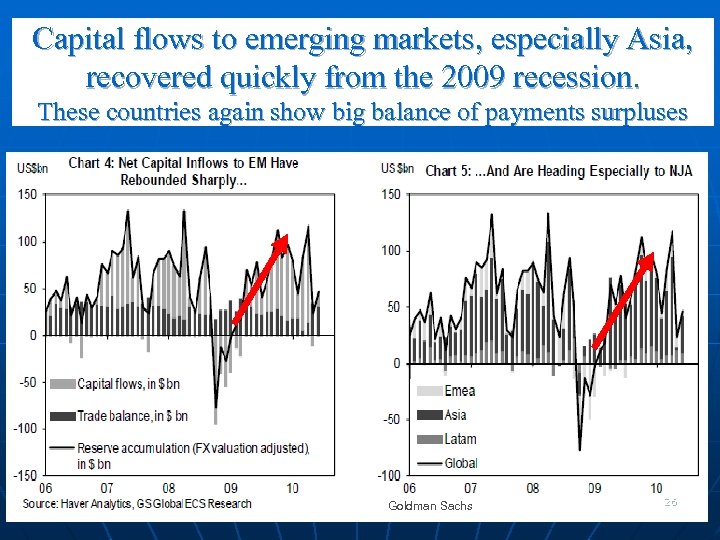
Capital flows to emerging markets, especially Asia, recovered quickly from the 2009 recession. These countries again show big balance of payments surpluses Goldman Sachs 26
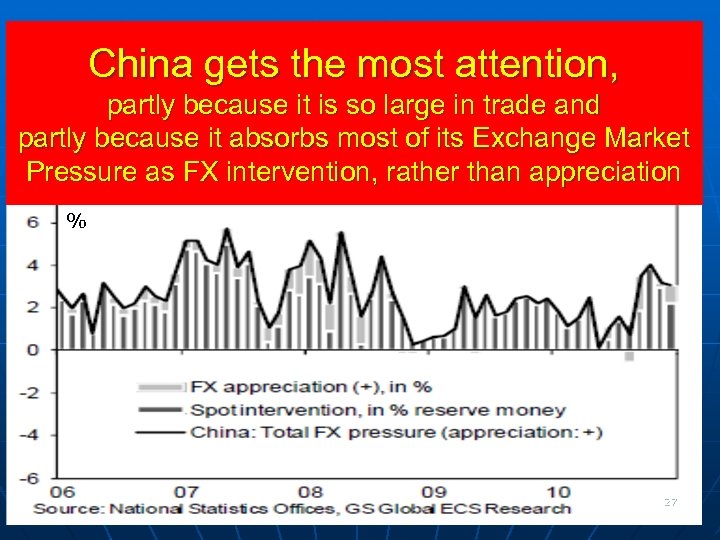
China gets the most attention, partly because it is so large in trade and partly because it absorbs most of its Exchange Market Pressure as FX intervention, rather than appreciation % 27
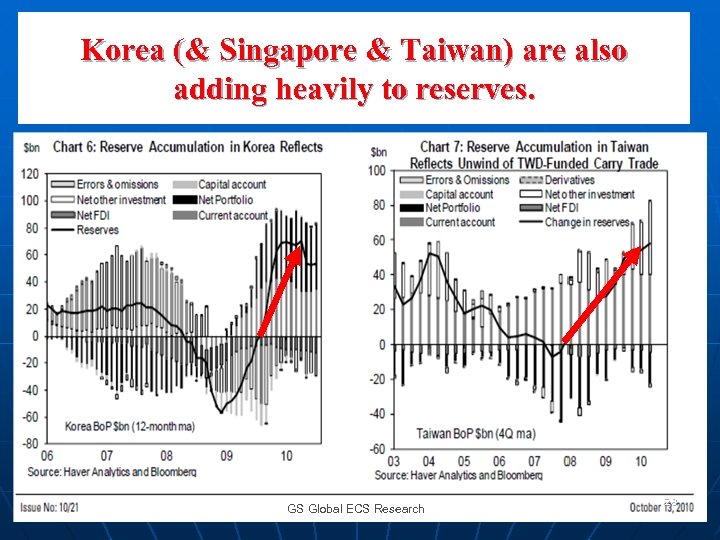
Korea (& Singapore & Taiwan) are also adding heavily to reserves. GS Global ECS Research 28
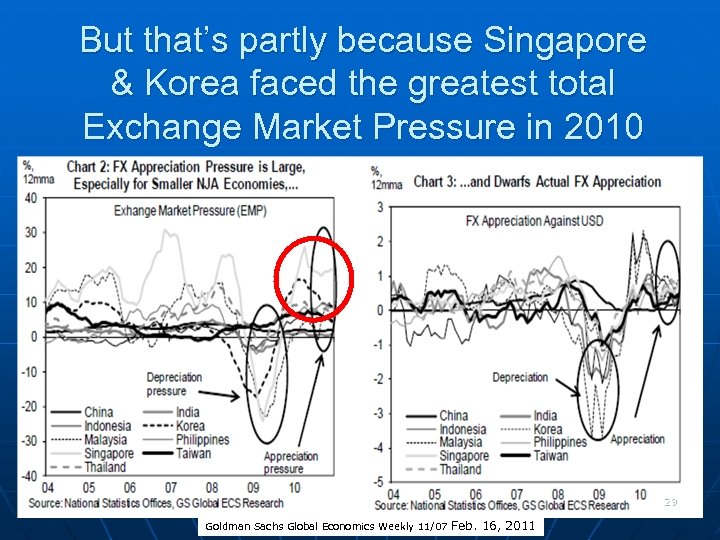
But that’s partly because Singapore & Korea faced the greatest total Exchange Market Pressure in 2010 29 Goldman Sachs Global Economics Weekly 11/07 Feb. 16, 2011
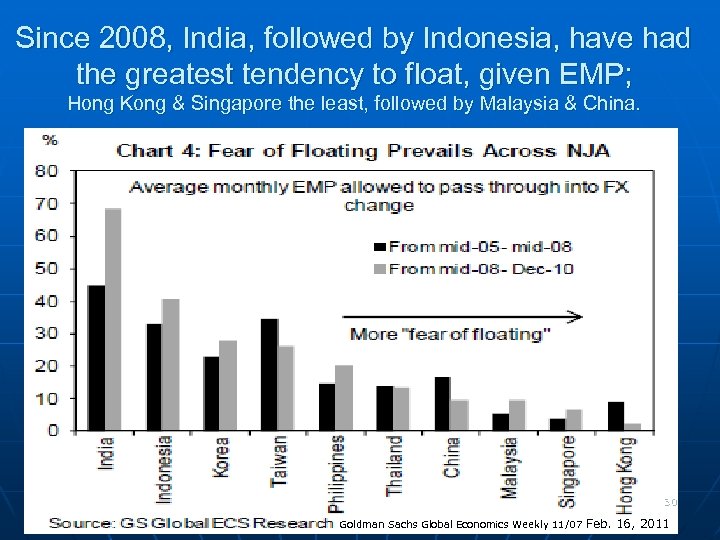
Since 2008, India, followed by Indonesia, have had the greatest tendency to float, given EMP; Hong Kong & Singapore the least, followed by Malaysia & China. 30 Goldman Sachs Global Economics Weekly 11/07 Feb. 16, 2011
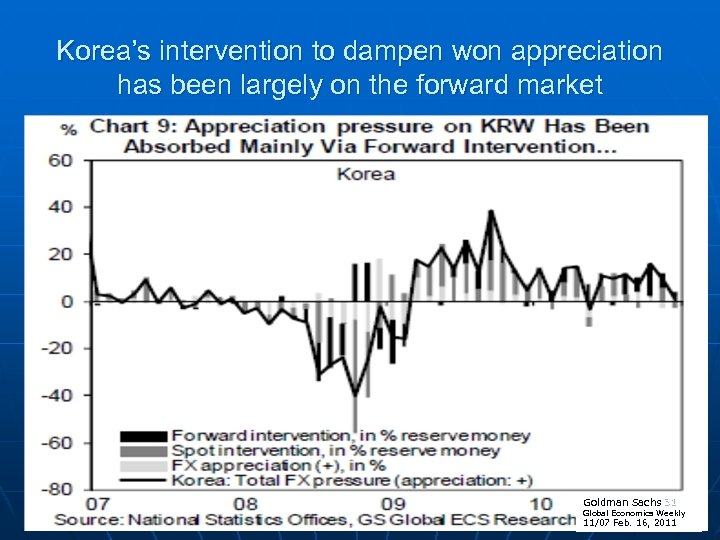
Korea’s intervention to dampen won appreciation has been largely on the forward market Goldman Sachs 31 Global Economics Weekly 11/07 Feb. 16, 2011
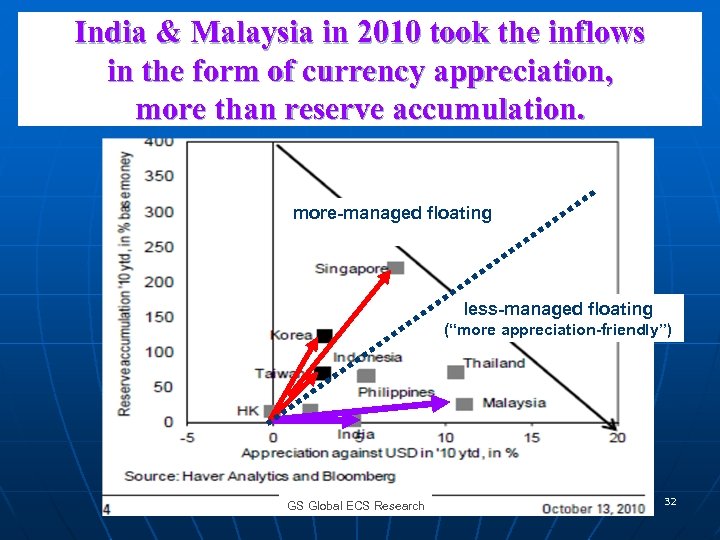
India & Malaysia in 2010 took the inflows in the form of currency appreciation, more than reserve accumulation. more-managed floating less-managed floating (“more appreciation-friendly”) GS Global ECS Research 32
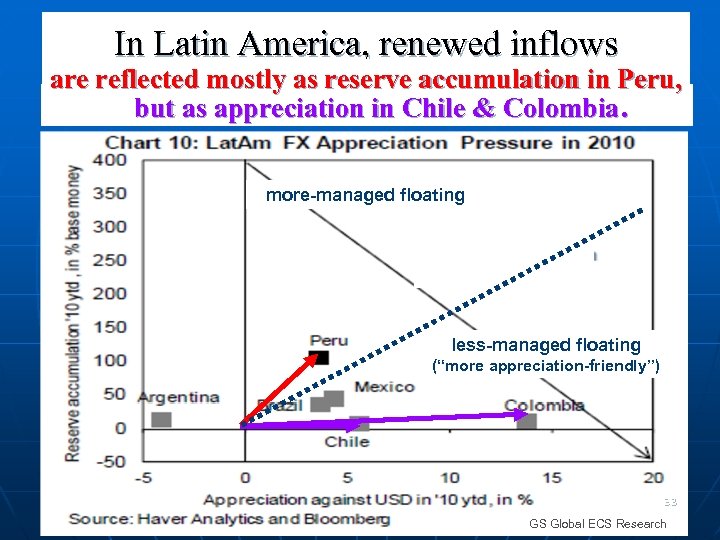
In Latin America, renewed inflows are reflected mostly as reserve accumulation in Peru, but as appreciation in Chile & Colombia. more-managed floating less-managed floating (“more appreciation-friendly”) 33 GS Global ECS Research
If a country faces an increase in exchange market pressure, should it appreciate? Or intervene? n n It is the old debate over floating versus fixed exchange rate. What can we learn about the answer from recent crises? 34
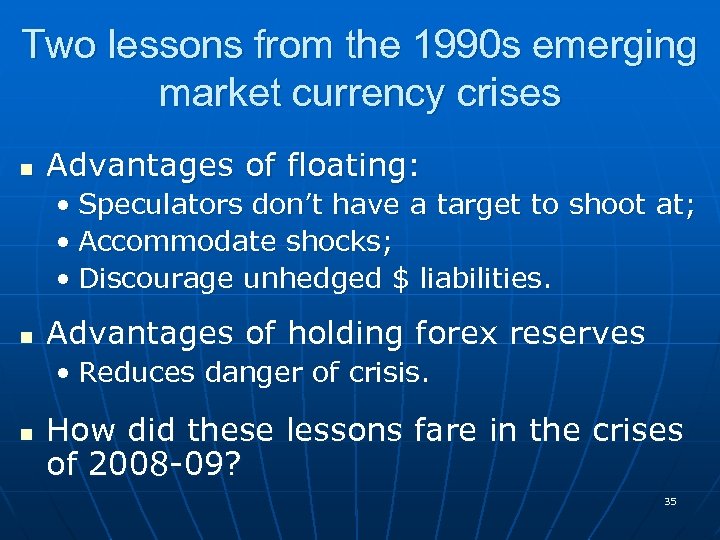
Two lessons from the 1990 s emerging market currency crises n Advantages of floating: • Speculators don’t have a target to shoot at; • Accommodate shocks; • Discourage unhedged $ liabilities. n Advantages of holding forex reserves • Reduces danger of crisis. n How did these lessons fare in the crises of 2008 -09? 35
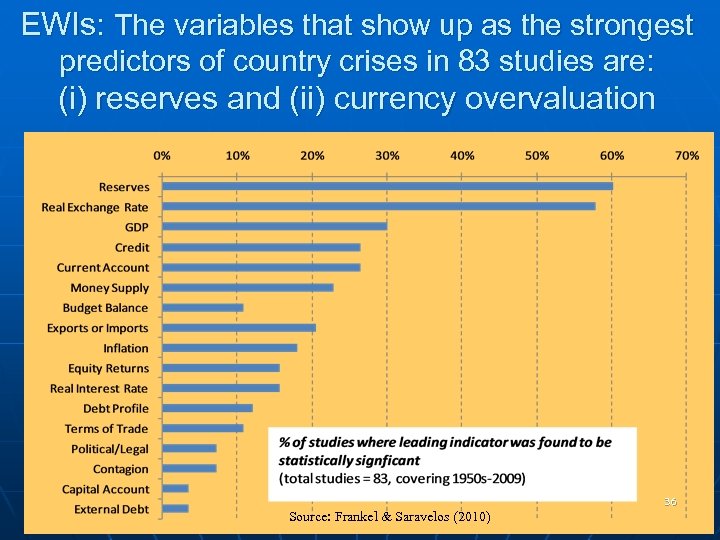
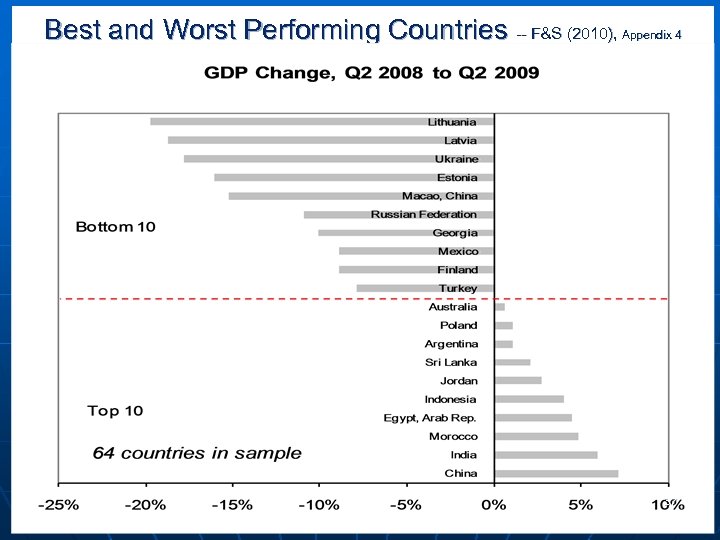
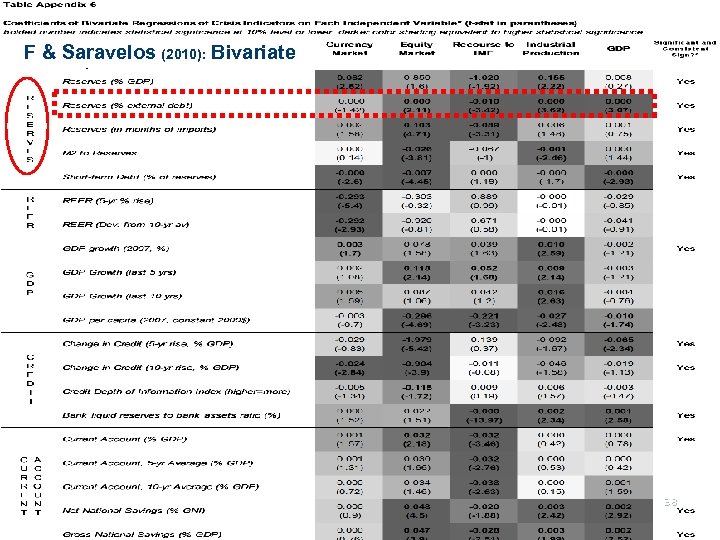
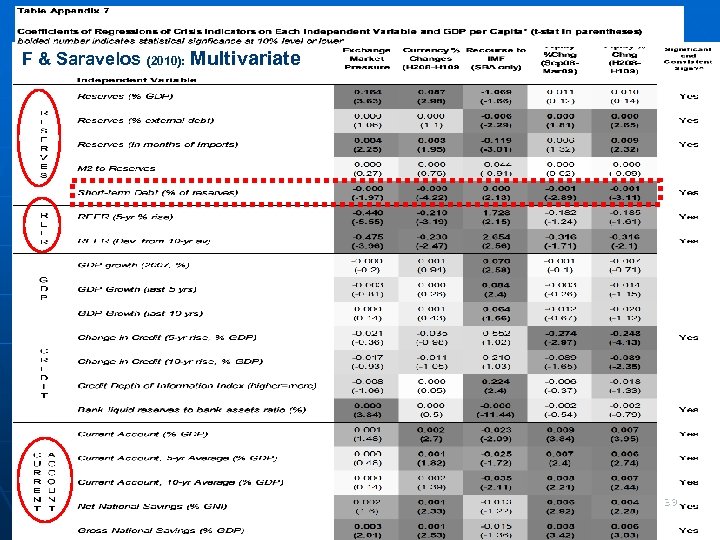
EWIs: The variables that show up as the strongest predictors of country crises in 83 studies are: (i) reserves and (ii) currency overvaluation 36 Source: Frankel & Saravelos (2010)
Best and Worst Performing Countries -- F&S (2010), Appendix 4 37
F & Saravelos (2010): Bivariate 38
F & Saravelos (2010): Multivariate 39
Reserves n n Even though many developing & emerging market countries described themselves as floating, most took advantage of the boom of 2003 -2008 to build up reserves to unheard of heights, • in the aftermath of the crises of 1994 -2001. n in contrast to past capital booms (1975 -81, 1990 -97). 40
n When the 2008 -09 global financial crisis hit, • those countries that had taken advantage of the 2003 -08 boom to build up reserves did better. E. g. , Obstfeld, Shambaugh & Taylor (2009) n Frankel & Saravelos (2010), n n This had also been the most common finding in the many studies of Early Warning Indicators in past emerging market crises. 41
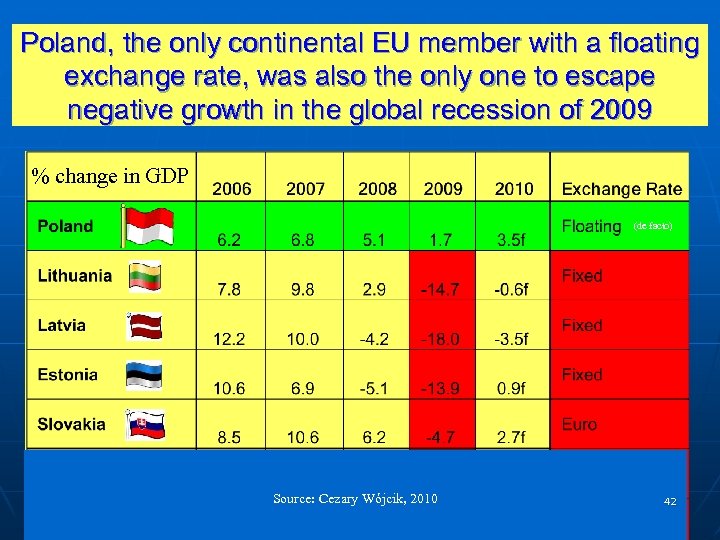
Poland, the only continental EU member with a floating exchange rate, was also the only one to escape negative growth in the global recession of 2009 % change in GDP (de facto) Source: Cezary Wójcik, 2010 42
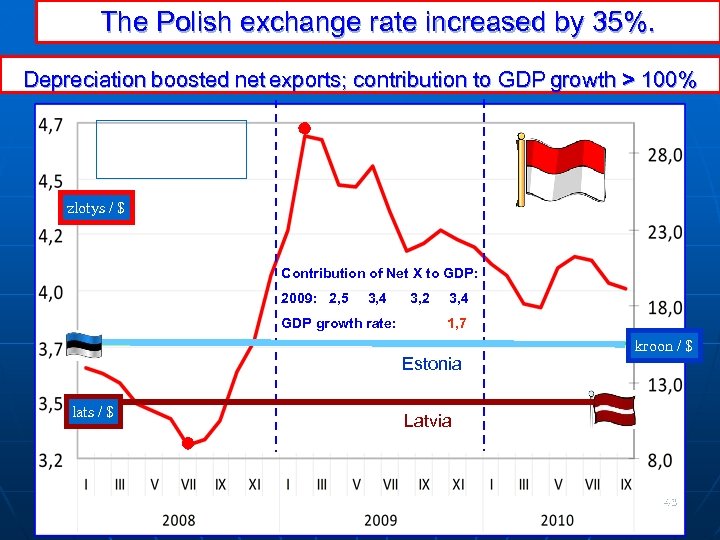
The Polish exchange rate increased by 35%. Depreciation boosted net exports; contribution to GDP growth > 100% Source: Cezary Wójcik zlotys / $ Contribution of Net X to GDP: 2009: 2, 5 3, 4 GDP growth rate: 3, 2 3, 4 1, 7 Estonia lats / $ kroon / $ Latvia 43
44
Appendices: The 3 big currencies Appendix I: The end of $ hegemony? Appendix II: Is RMB appreciation in China’s own interest? Appendix III: Predictions – Sovereign debt troubles & the € Appendix IV: More on the trend to a multiple reserve system 45
Appendix 1: The end of dollar hegemony ? n Some argue the US current account deficit is sustainable indefinitely. • They believe that the US will continue to enjoy its unique “exorbitant privilege, ” able to borrow unlimited amounts in its own currency n because it is the dominant international reserve asset. n 46
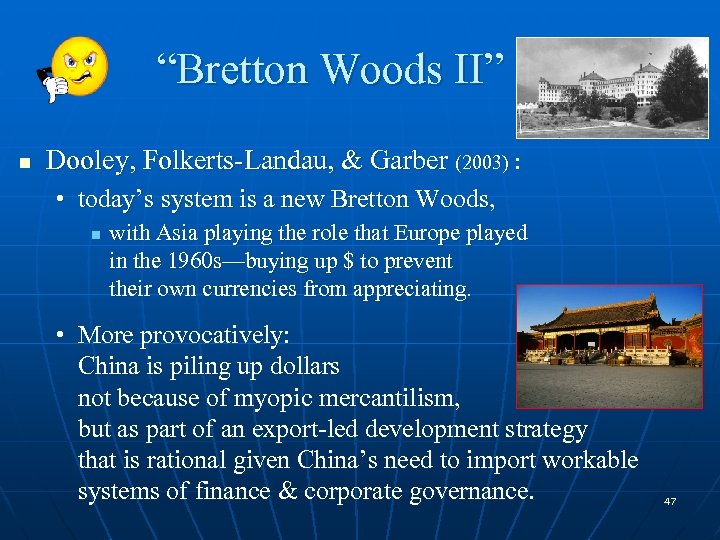
“Bretton Woods II” n Dooley, Folkerts-Landau, & Garber (2003) : • today’s system is a new Bretton Woods, n with Asia playing the role that Europe played in the 1960 s—buying up $ to prevent their own currencies from appreciating. • More provocatively: China is piling up dollars not because of myopic mercantilism, but as part of an export-led development strategy that is rational given China’s need to import workable systems of finance & corporate governance. 47
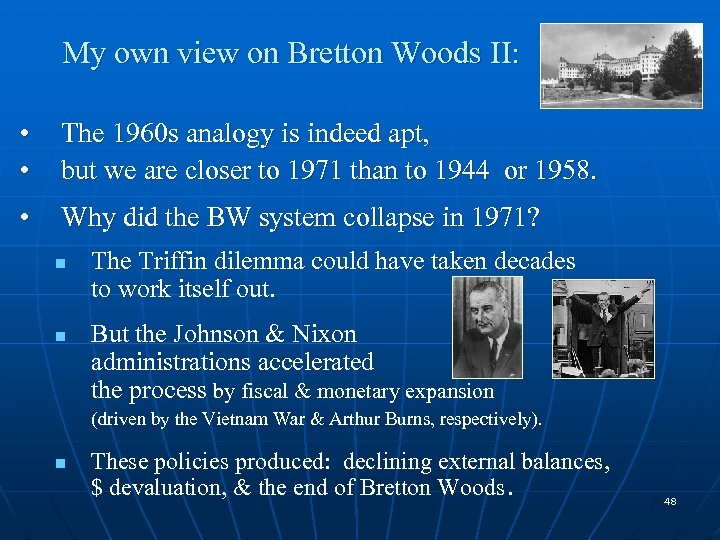
My own view on Bretton Woods II: • • The 1960 s analogy is indeed apt, but we are closer to 1971 than to 1944 or 1958. • Why did the BW system collapse in 1971? n n The Triffin dilemma could have taken decades to work itself out. But the Johnson & Nixon administrations accelerated the process by fiscal & monetary expansion (driven by the Vietnam War & Arthur Burns, respectively). n These policies produced: declining external balances, $ devaluation, & the end of Bretton Woods. 48
There is no reason to expect better today: 1) 2) Capital mobility is much higher now than in the 1960 s. The US can no longer rely on support of foreign central banks: n neither on economic grounds (they are not now, as they were then, organized into a cooperative framework where each agrees explicitly to hold $ if the others do), n nor on political grounds (these creditors are not the staunch allies the US had in the 1960 s). 49
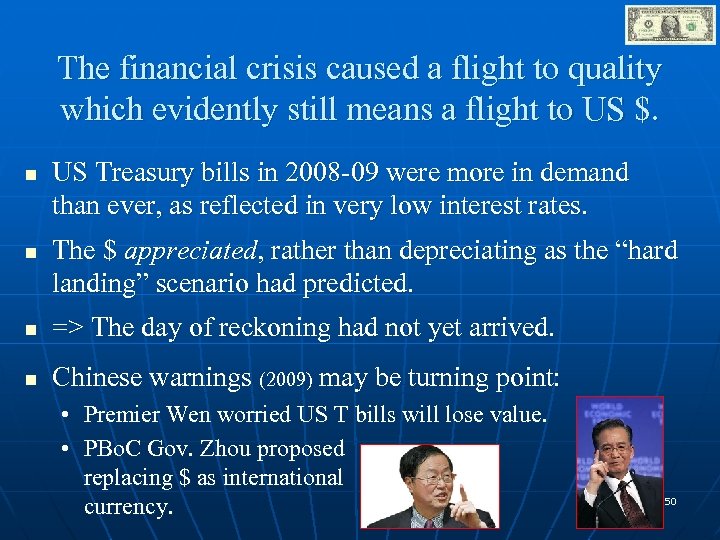
The financial crisis caused a flight to quality which evidently still means a flight to US $. n n US Treasury bills in 2008 -09 were more in demand than ever, as reflected in very low interest rates. The $ appreciated, rather than depreciating as the “hard landing” scenario had predicted. n => The day of reckoning had not yet arrived. n Chinese warnings (2009) may be turning point: • Premier Wen worried US T bills will lose value. • PBo. C Gov. Zhou proposed replacing $ as international currency. 50
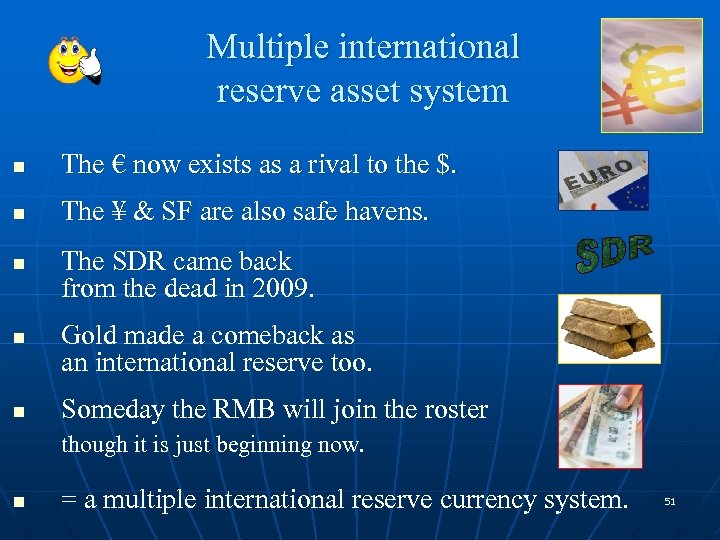
Multiple international reserve asset system n The € now exists as a rival to the $. n The ¥ & SF are also safe havens. n n n The SDR came back from the dead in 2009. Gold made a comeback as an international reserve too. Someday the RMB will join the roster though it is just beginning now. n = a multiple international reserve currency system. 51
Appendix II: What is in China’s interest? n Countries should have the right to fix their exchange rate if they want to. True, the IMF Articles of Agreement and the US Omnibus Trade Act of 1988 call for action in the event that a country is “unfairly manipulating its currency”. n But n • Few countries have been forced to appreciate. • Pressure on surplus countries to appreciate will inevitably be less than pressure on deficit countries to depreciate. • I support ending the language of “manipulation. ” n n n Usually, it is hard to say when a currency is undervalued. Don’t cheapen the language that is appropriate to WTO rules. China should do what is in its own long-term interest. 52
Five reasons why China should let the RMB appreciate, in its own interest 1. Overheating of economy 2. Reserves are excessive. • 3. Attaining internal and external balance. • • 4. 5. It gets harder to sterilize the inflow over time. To attain both, need 2 policy instruments. In a large country like China, expenditure-switching policy should be the exchange rate. Avoiding future crashes. RMB undervalued, judged by Balassa-Samuelson relationship. 53
1. Overheating of economy: n Bottlenecks. Pace of economic growth is outrunning: • raw material supplies, and • labor supply in coastal provinces • Also: • physical infrastructure • environmental capacity • level of sophistication of financial system. n Asset bubbles. • Shanghai stock market bubble in 2007. n Inflation 6 -7% in 2007 => price controls Þ shortages & social unrest. n All of the above was suspended in late 2008, • due to global recession. • But it is back again now; skyrocketing real estate prices. 54
Attempts at “sterilization, ” to insulate domestic economy from the inflows n n Sterilization is defined as offsetting of international reserve inflows, so as to prevent them from showing up domestically as excessive money growth & inflation. For awhile PBo. C successfully sterilized… • • until 2007 -08. The usual limitations finally showed up: n n Prolongation of capital inflows <= self-equilibrating mechanism shut off. Quasi-fiscal deficit: gap between domestic interest rates & US T bill rate Failure to sterilize: money supply rising faster than income Rising inflation (admittedly due not only to rising money supply) 55
2. Foreign Exchange Reserves Excessive: n • • • n Though a useful shield against currency crises, China has enough reserves: $2 ½ trillion by April 2010; & US treasury securities do not pay high returns. Harder to sterilize the inflow over time. 56
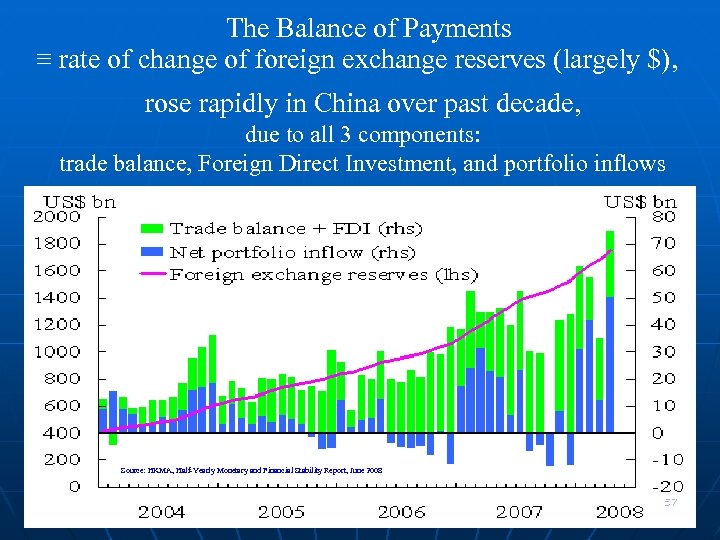
The Balance of Payments ≡ rate of change of foreign exchange reserves (largely $), rose rapidly in China over past decade, due to all 3 components: trade balance, Foreign Direct Investment, and portfolio inflows Source: HKMA, Half-Yearly Monetary and Financial Stability Report, June 2008 57
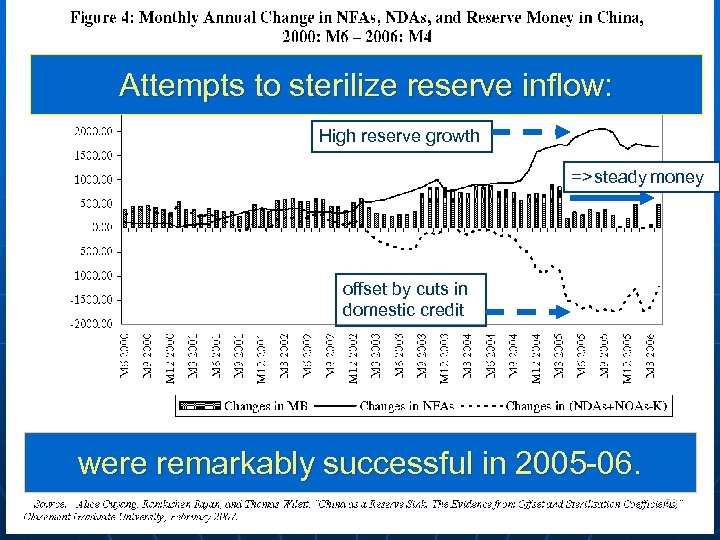
Attempts tosterilization in China: 2005 -06 Successful sterilize reserve inflow: High reserve growth => steady money offset by cuts in domestic credit While reserves (NFA) rose rapidly, the growth of the monetary base was kept to the growth of the real economy – even reduced in 2005 -06. were remarkably successful in 2005 -06. 58
In 2007 -08 China began to have more trouble sterilizing the reserve inflow n n PBo. C began to pay higher interest rate domestically, & receive lower interest rate on US T bills => quasi-fiscal deficit. Inflation became a serious problem. • True, global increases in food & energy prices were much of the explanation. • But n n n China’s overly rapid growth itself contributed. Appreciation is a good way to put immediate downward pressure on local prices of farm & energy commodities. Price controls are inefficient and ultimately ineffective. 59
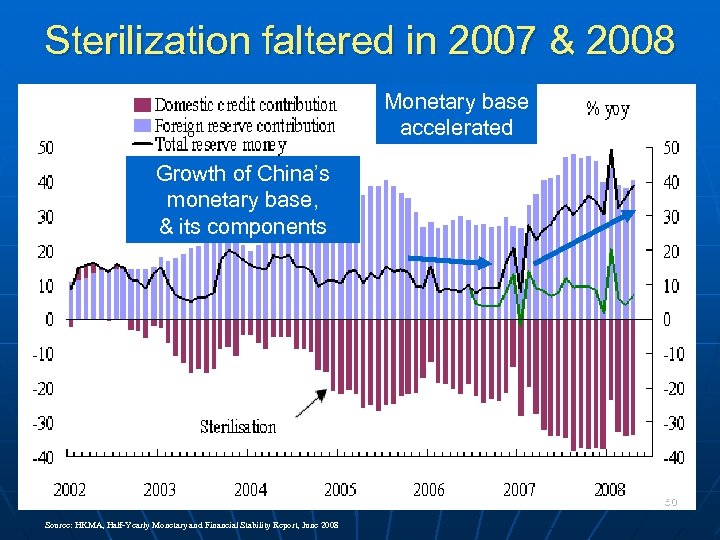
Sterilization faltered in 2007 & 2008 Monetary base accelerated Growth of China’s monetary base, & its components 60 Source: HKMA, Half-Yearly Monetary and Financial Stability Report, June 2008
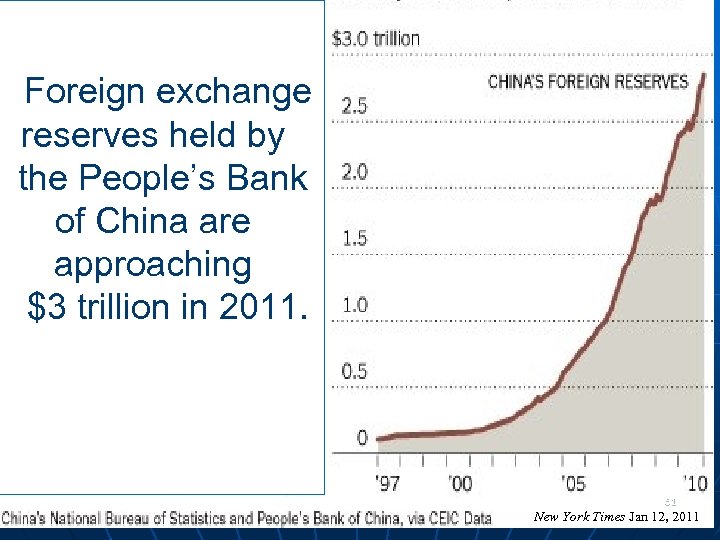
Foreign exchange reserves held by the People’s Bank of China are approaching $3 trillion in 2011. 61 New York Times Jan 12, 2011
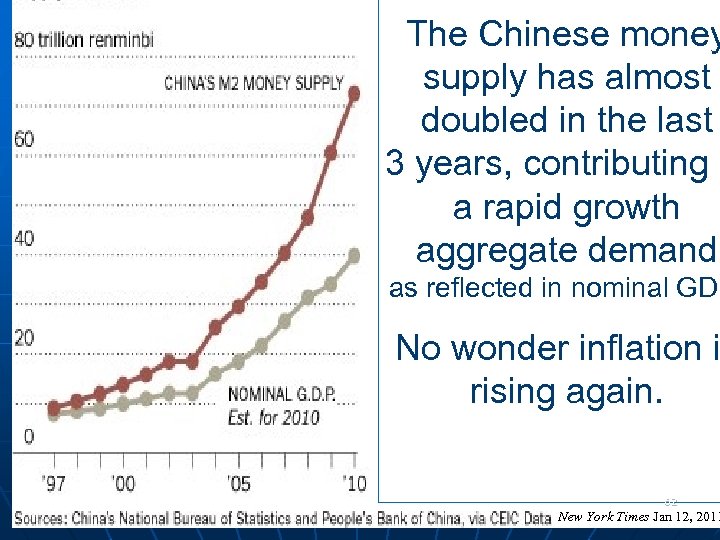
The Chinese money supply has almost doubled in the last 3 years, contributing t a rapid growth aggregate demand as reflected in nominal GDP No wonder inflation i rising again. 62 New York Times Jan 12, 2011
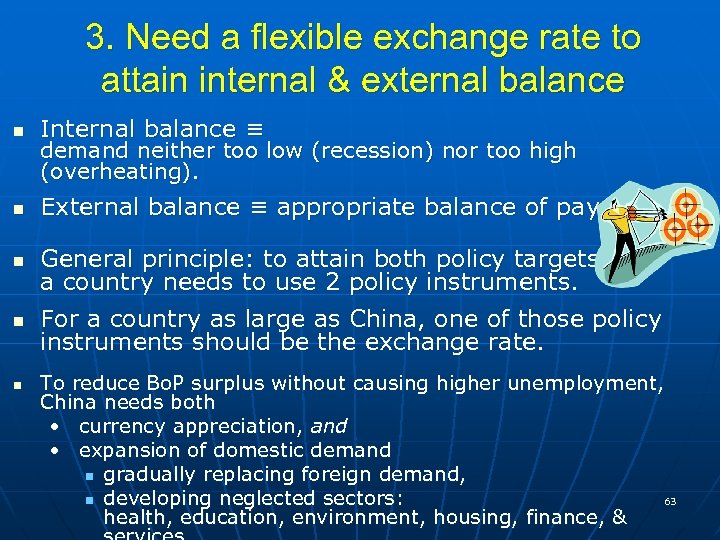
3. Need a flexible exchange rate to attain internal & external balance n Internal balance ≡ n External balance ≡ appropriate balance of payments. n n n demand neither too low (recession) nor too high (overheating). General principle: to attain both policy targets, a country needs to use 2 policy instruments. For a country as large as China, one of those policy instruments should be the exchange rate. To reduce Bo. P surplus without causing higher unemployment, China needs both • currency appreciation, and • expansion of domestic demand n gradually replacing foreign demand, n developing neglected sectors: 63 health, education, environment, housing, finance, &
4. Avoiding future crashes Experience of other emerging markets suggests it is better to exit from a peg in good times, when the Bo. P is strong, than to wait until the currency is under attack. Introducing some flexibility now, even though not ready for free floating. 64
5. Longer-run perspective: Balassa-Samuelson relationship n Prices of goods & services in China are low • compared at the nominal exchange rate. • Of course they are a fraction of those in the U. S. : < ¼. • This is to be expected, explained by the Balassa-Samuelson effect n n which says that low-income countries have lower price levels. As countries’ real income grows, their currencies experience 65 real appreciation: approx. . 3% for every 1 % in income per capita.
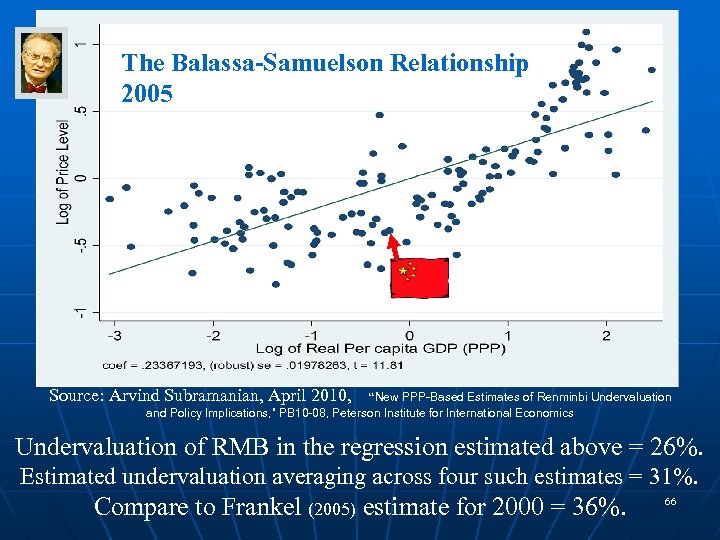
The Balassa-Samuelson Relationship 2005 Source: Arvind Subramanian, April 2010, “New PPP-Based Estimates of Renminbi Undervaluation and Policy Implications, ” PB 10 -08, Peterson Institute for International Economics Undervaluation of RMB in the regression estimated above = 26%. Estimated undervaluation averaging across four such estimates = 31%. Compare to Frankel (2005) estimate for 2000 = 36%. 66
Appendix III: Debt Predictions n n Greece will need to re-structure its debt. The euro will survive. • There is no legal provision for members to leave the euro zone. n Prices of government bonds in advanced countries in general will fall. 67
The euro project is looking far less successful than just a few years ago n Many predictions of euro skeptics have come true: • Periphery countries and core countries have had trouble reconciling asymmetric monetary needs. • Euro members have not had enough labor mobility or flexibility to make up for it. • Efforts to prevent excessive debt & bailouts have failed: The Stability & Growth Pact failed with members big & small. n The “No bailout clause” has failed with Greece. n 68
Frankfurt & Brussels made 4 mistakes regarding Greece n 2001: They let Greece into the euro n 2002 -09: ECB accepted Greek debt as collateral • despite consistent violation of SGP. • => Did not allow interest rate spreads to open up. n n Winter 2010: Did not tell Greece to go to the IMF. Preferred instead to “handle it internally. ” Still today: No “Plan B” to restructure Greek debt (and save the bailout fund for more deserving banks & PIIGs). 69
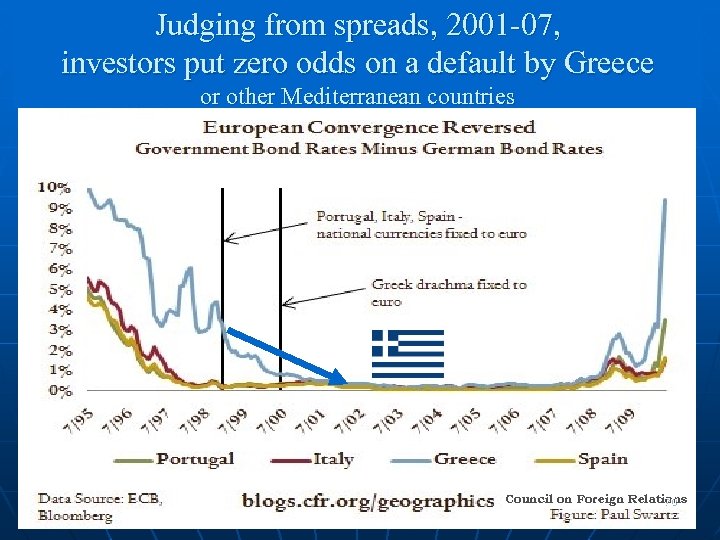
Judging from spreads, 2001 -07, investors put zero odds on a default by Greece or other Mediterranean countries Council on Foreign Relations 70
n n Suddenly, in 2010, the Greek sovereign spread shot up, exceeding 800% by June. Even when the Greek crisis erupted, leaders in Brussels & Frankfurt seemed to view it as a black swan, • instead of recognizing it as a close cousin of the Argentine crisis of ten years earlier, n and many others in history, • including among European countries. 71
Sovereign debt worries. . . • The next big asset market to fall • after the stock market in 2000 • the housing market in 2006 • and banking in 2008 • will likely be sovereign debt • among the advanced economies. • The major emerging market countries are in much better shape, • in an amazing & historic role reversal. 72
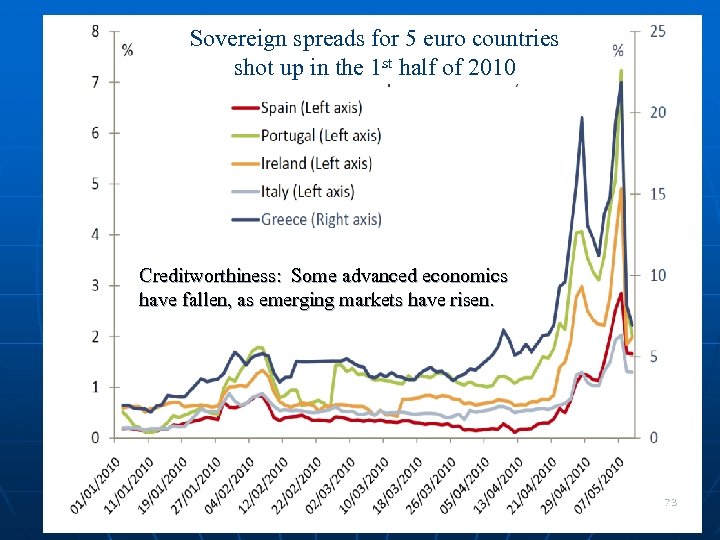
Sovereign spreads for 5 euro countries shot up in the 1 st half of 2010 Creditworthiness: Some advanced economics have fallen, as emerging markets have risen. 73
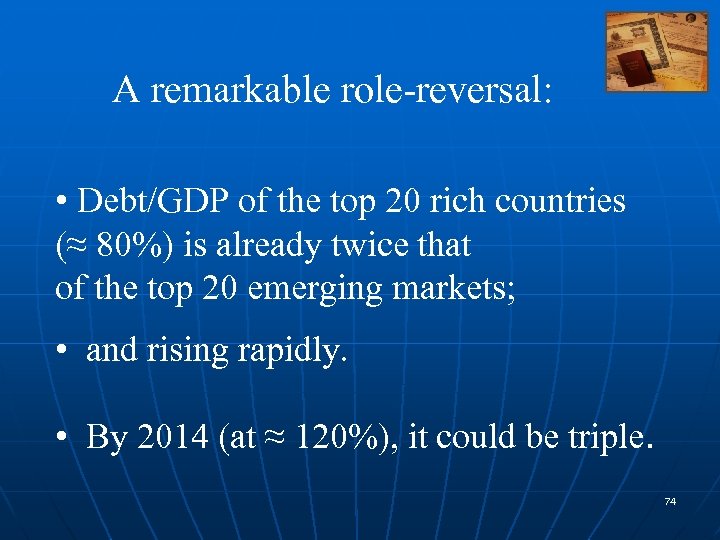
A remarkable role-reversal: • Debt/GDP of the top 20 rich countries (≈ 80%) is already twice that of the top 20 emerging markets; • and rising rapidly. • By 2014 (at ≈ 120%), it could be triple. 74
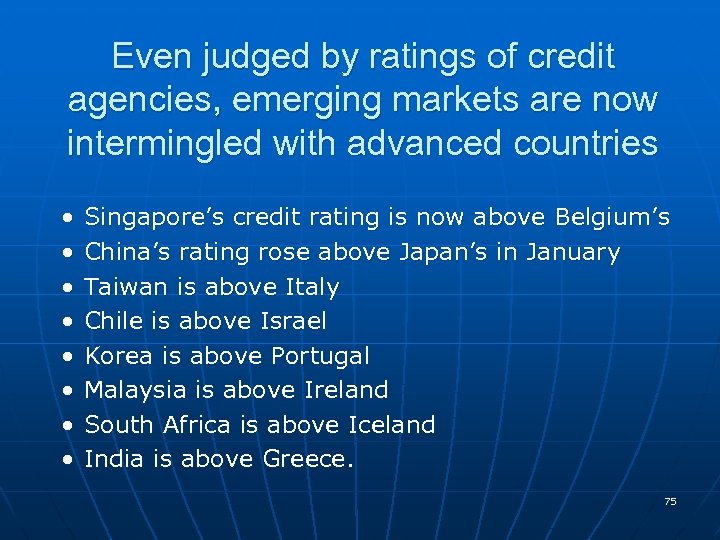
Even judged by ratings of credit agencies, emerging markets are now intermingled with advanced countries • • Singapore’s credit rating is now above Belgium’s China’s rating rose above Japan’s in January Taiwan is above Italy Chile is above Israel Korea is above Portugal Malaysia is above Ireland South Africa is above Iceland India is above Greece. 75
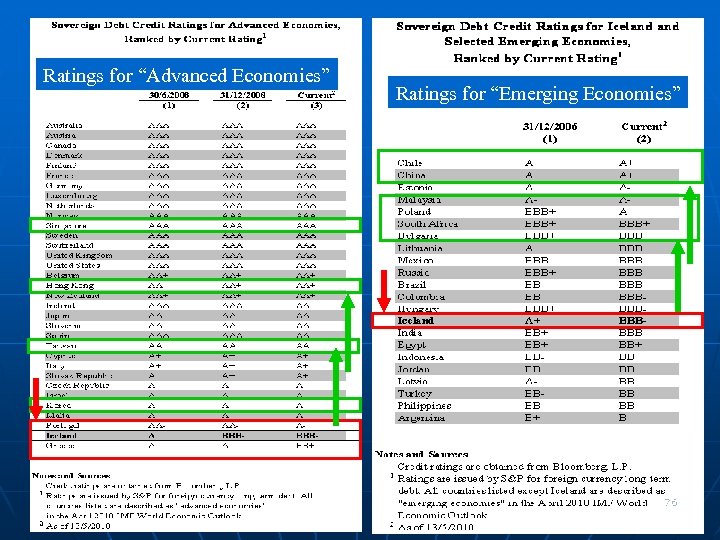
Ratings for “Advanced Economies” Ratings for “Emerging Economies” 76
Appendix IV: More on the trend from $ hegemony to a multiple reserve system When does the “privilege” become “exorbitant? ” n n n if it accrues solely because of size and history, without the US having done anything to earn the benefit by virtuous policies such as budget discipline, price stability & a stable exchange rate. Since 1973, the US has racked up $10 trillion in debt and the $ has experienced a 30% loss in value compared to other major currencies. It seems unlikely that macroeconomic policy discipline is what has earned the US its privilege ! 77
Some argue that the privilege to incur $ liabilities has been earned in a different way: n n Global savings glut (Bernanke) The US appropriately exploits comparative advantage in supplying high-quality assets to the rest of the world. • “Intermediation rents…pay for the trade deficits. ” -- Caballero, Farhi & Gourinchas (2008) • In one version, the US has been operating as the World’s Venture Capitalist, accepting short-term liquid deposits and making long-term or risky investments -- Gourinchas & Rey (2008). • US supplies high-quality assets: Cooper (2005); Forbes (2008); Ju & Wei (2008); Hausmann & Sturzenegger (2006 a, b); Mendoza, Quadrini & Rios-Rull (2007 a, b)… 78

n n The argument that the US offers assets of superior quality, and so has earned the right to finance its deficits, was undermined by the dysfunctionality revealed in the financial crisis of 2007 -08. American financial institutions suffered a severe loss of credibility (corporate governance, accounting standards, rating agencies, derivatives, etc. ), n How could sub-prime mortgages be the superior type of assets that uniquely merit the respect of the world’s investors? 79
But the events of 2008 -09 also undermined the opposing interpretation, the unsustainability position: n n Why no hard landing for the $, as long feared? The $ appreciated after Lehman Brothers’ bankruptcy, & US T bill interest rates fell. n Clearly in 2008 the world still viewed n • the US Treasury market as a safe haven and • the US $ as the premier international currency. 80
Though arguments about the unique high quality of US private assets have been tarnished, the idea of America as World Banker is still alive: the $ is the world’s reserve currency, by virtue of US size & history. n n Is the $’s unique role an eternal god-given constant? Or will a sufficiently long record of deficits & depreciation induce investors to turn elsewhere? 81
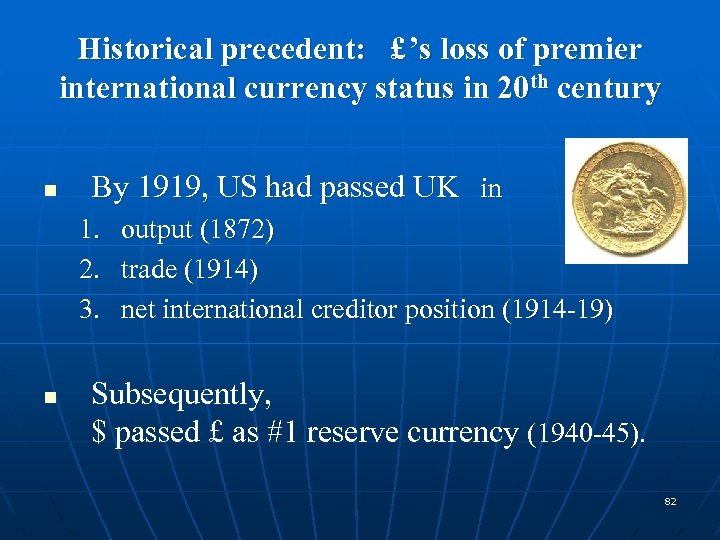
Historical precedent: £ ’s loss of premier international currency status in 20 th century n By 1919, US had passed UK in 1. output (1872) 2. trade (1914) 3. net international creditor position (1914 -19) n Subsequently, $ passed £ as #1 reserve currency (1940 -45). 82
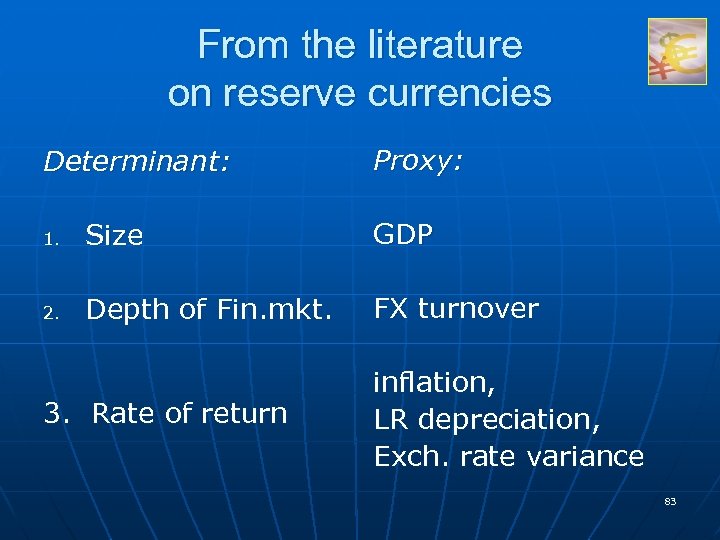
From the literature on reserve currencies Determinant: Proxy: 1. Size GDP 2. Depth of Fin. mkt. FX turnover 3. Rate of return inflation, LR depreciation, Exch. rate variance 83
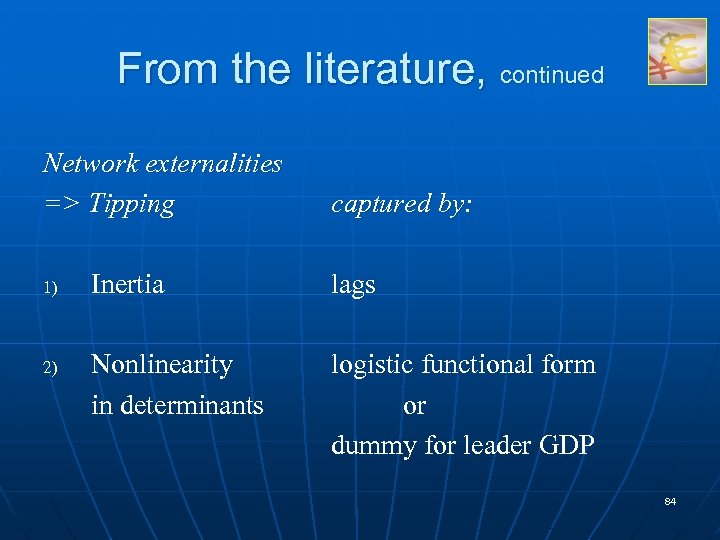
From the literature, continued Network externalities => Tipping 1) 2) captured by: Inertia lags Nonlinearity in determinants logistic functional form or dummy for leader GDP 84
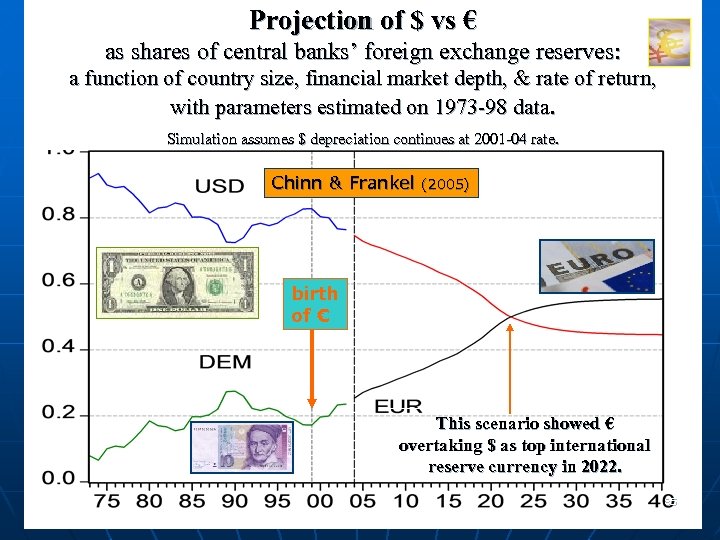
Projection of $ vs € as shares of central banks’ foreign exchange reserves: a function of country size, financial market depth, & rate of return, with parameters estimated on 1973 -98 data. Simulation assumes $ depreciation continues at 2001 -04 rate. Chinn & Frankel (2005) birth of € This scenario showed € overtaking $ as top international reserve currency in 2022. 85
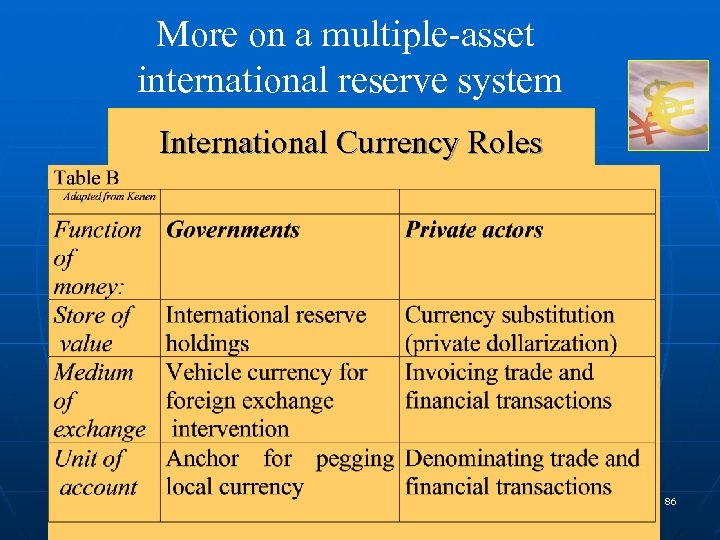
More on a multiple-asset international reserve system International Currency Roles 86
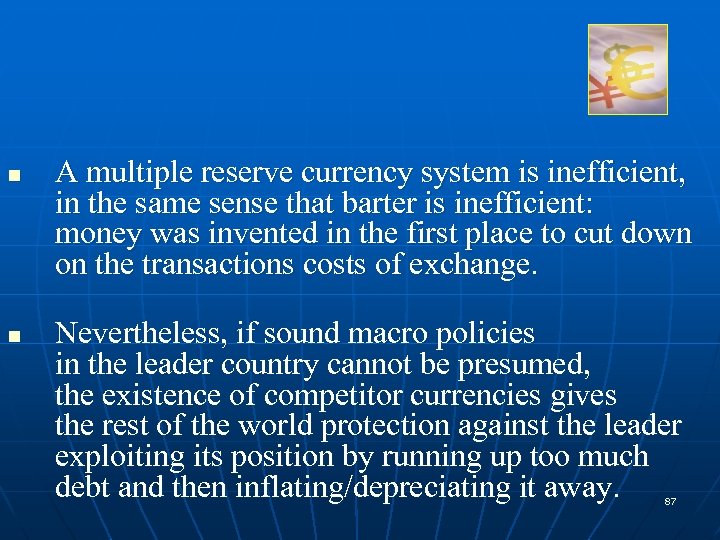
n n A multiple reserve currency system is inefficient, in the same sense that barter is inefficient: money was invented in the first place to cut down on the transactions costs of exchange. Nevertheless, if sound macro policies in the leader country cannot be presumed, the existence of competitor currencies gives the rest of the world protection against the leader exploiting its position by running up too much debt and then inflating/depreciating it away. 87
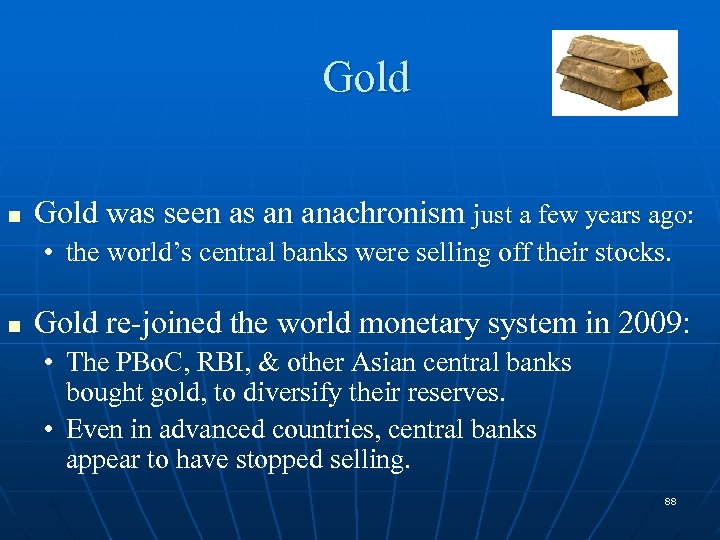
Gold n Gold was seen as an anachronism just a few years ago: • the world’s central banks were selling off their stocks. n Gold re-joined the world monetary system in 2009: • The PBo. C, RBI, & other Asian central banks bought gold, to diversify their reserves. • Even in advanced countries, central banks appear to have stopped selling. 88
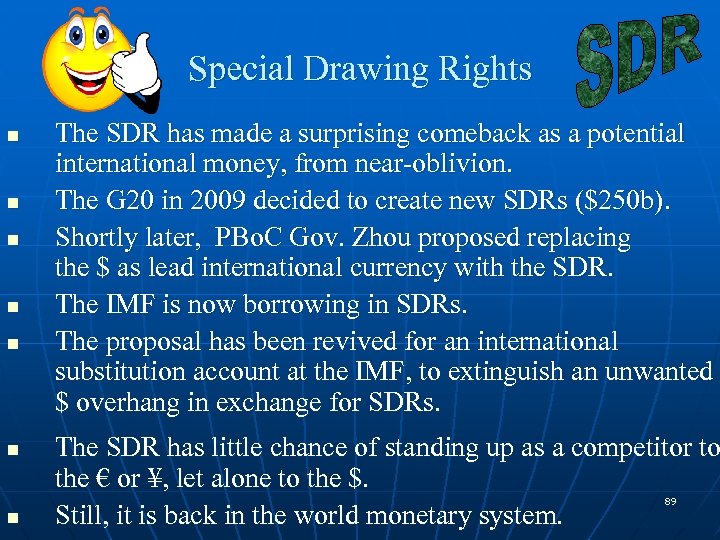
Special Drawing Rights n n n The SDR has made a surprising comeback as a potential international money, from near-oblivion. The G 20 in 2009 decided to create new SDRs ($250 b). Shortly later, PBo. C Gov. Zhou proposed replacing the $ as lead international currency with the SDR. The IMF is now borrowing in SDRs. The proposal has been revived for an international substitution account at the IMF, to extinguish an unwanted $ overhang in exchange for SDRs. The SDR has little chance of standing up as a competitor to the € or ¥, let alone to the $. Still, it is back in the world monetary system. 89 n

http: //ksghome. harvard. edu/~jfrankel/index. htm 90
Скачать презентацию Currency Wars Global Money in 2011 Jeffrey Frankel
abc1ac8f4f05adb01d80b1c940aaa5ff.ppt