 Скачать презентацию CURRENCY FAILURES FROM ARGENTINA TO ZIMBABWE A BRIEF
91286a65dc322dc2934c3d1bdcced9ab.ppt
- Количество слайдов: 39



CURRENCY FAILURES FROM ARGENTINA TO ZIMBABWE A BRIEF HISTORY OF INFLATION Mises Circle Greenville 2010
GOVERNMENT SOURCES OF FUNDS Taxes Borrow (implies a tax, inflation, or default later) Inflate (seigniorage; tax on money holdings) 2
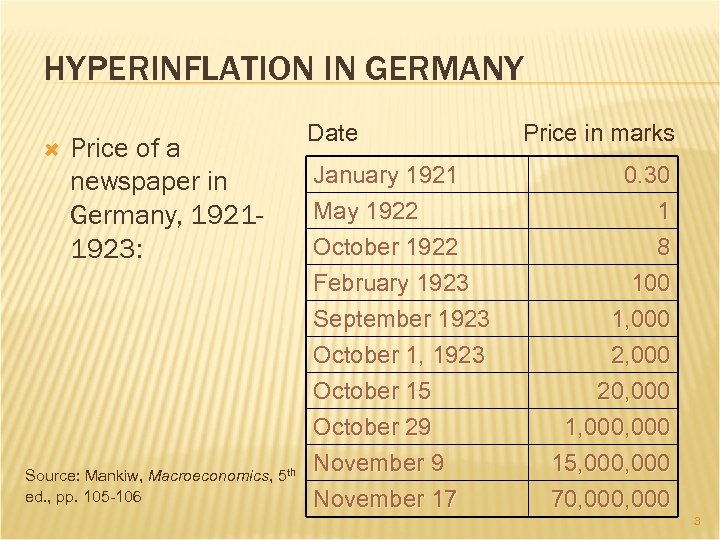
HYPERINFLATION IN GERMANY Price of a newspaper in Germany, 19211923: Source: Mankiw, Macroeconomics, 5 th ed. , pp. 105 -106 Date January 1921 May 1922 October 1922 February 1923 September 1923 October 1, 1923 October 15 October 29 November 17 Price in marks 0. 30 1 8 100 1, 000 20, 000 1, 000 15, 000 70, 000 3
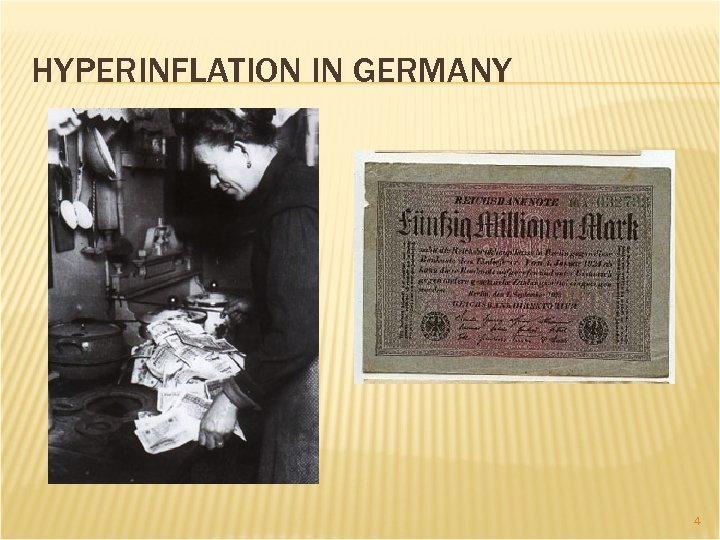
HYPERINFLATION IN GERMANY 4
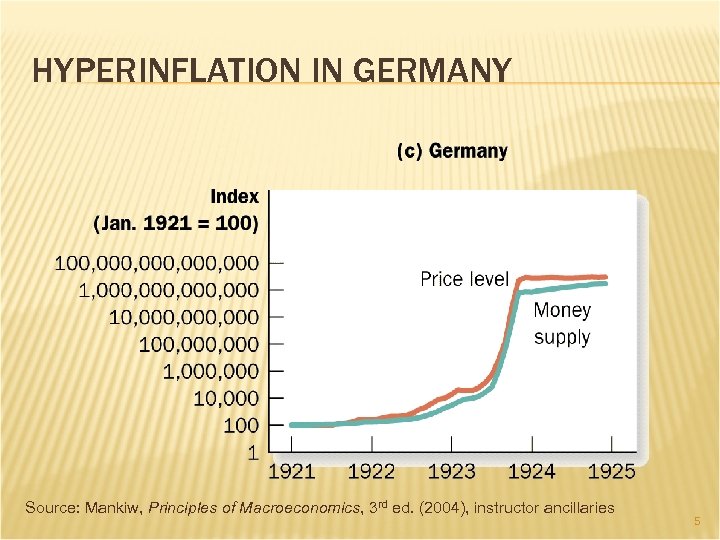
HYPERINFLATION IN GERMANY Source: Mankiw, Principles of Macroeconomics, 3 rd ed. (2004), instructor ancillaries 5
HYPERINFLATION IN GERMANY In 1923, highest denomination was 100 trillion marks Fiscal reform ended the inflation At the end of 1923, the number of government employees was cut by a third A new central bank was created This demonstrated a commitment to not printing money Source: Mankiw, Macroeconomics, 5 th ed. , pp. 105 -106 6
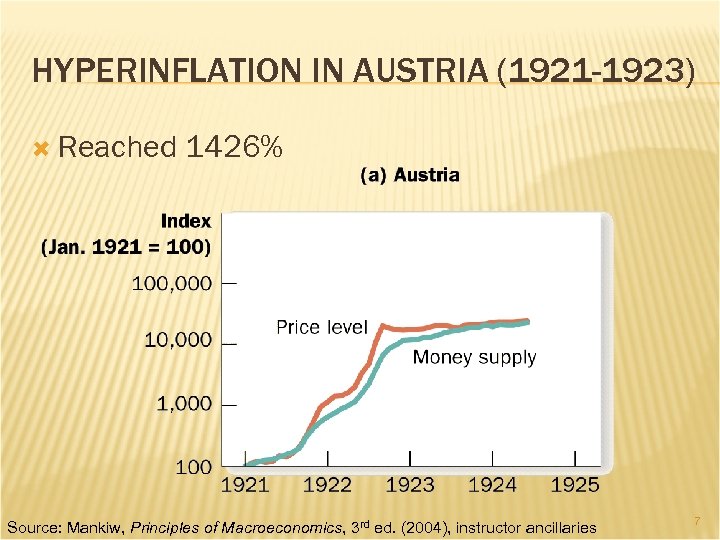
HYPERINFLATION IN AUSTRIA (1921 -1923) Reached 1426% Source: Mankiw, Principles of Macroeconomics, 3 rd ed. (2004), instructor ancillaries 7
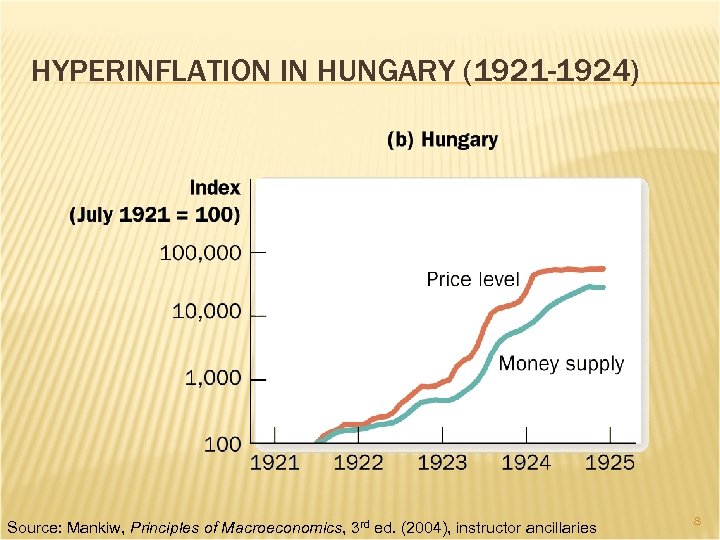
HYPERINFLATION IN HUNGARY (1921 -1924) Source: Mankiw, Principles of Macroeconomics, 3 rd ed. (2004), instructor ancillaries 8
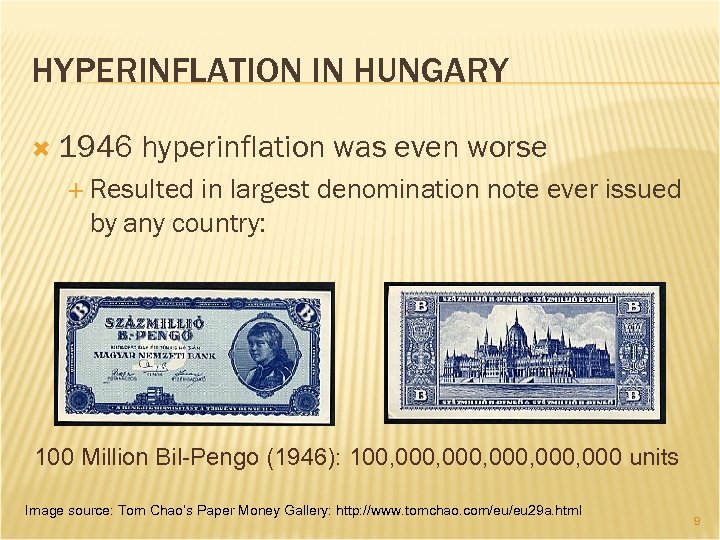
HYPERINFLATION IN HUNGARY 1946 hyperinflation was even worse Resulted in largest denomination note ever issued by any country: 100 Million Bil-Pengo (1946): 100, 000, 000 units Image source: Tom Chao’s Paper Money Gallery: http: //www. tomchao. com/eu/eu 29 a. html 9
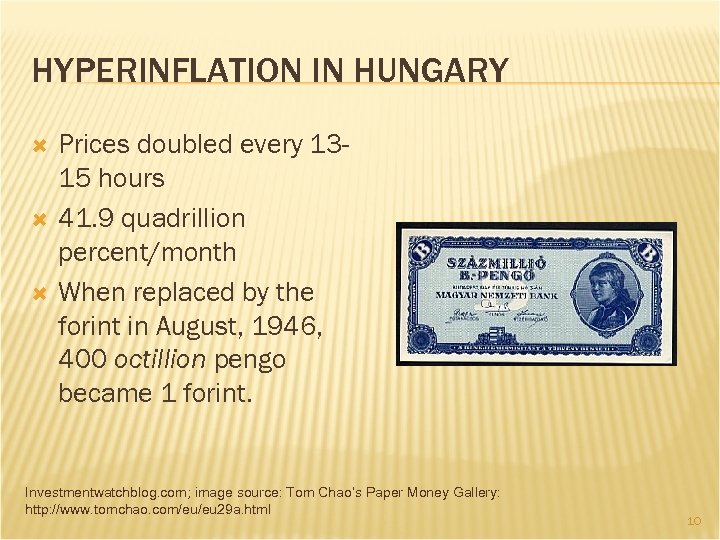
HYPERINFLATION IN HUNGARY Prices doubled every 1315 hours 41. 9 quadrillion percent/month When replaced by the forint in August, 1946, 400 octillion pengo became 1 forint. Investmentwatchblog. com; image source: Tom Chao’s Paper Money Gallery: http: //www. tomchao. com/eu/eu 29 a. html 10
INFLATION IN ARGENTINA By the end of the 1980 s, inflation was about 200 percent a month. In December 1989, peak annualized inflation was 4, 923. 3 percent. http: //cdnedge. bbc. co. uk/1/hi/business/1721061. stm; investmentwatchblog. com 11
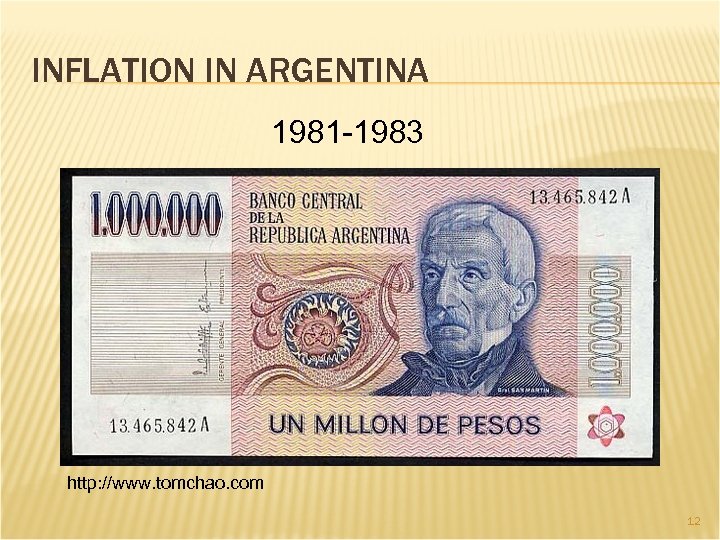
INFLATION IN ARGENTINA 1981 -1983 http: //www. tomchao. com 12
INFLATION IN ARGENTINA 1990: Move toward markets/privatization In April 1991, Argentina linked its currency to the dollar (a “currency board”). From 1991 -1994, Argentina’s economy grew at a rate of about 7. 7 percent a year. 1989: Gov’t expenditure was 35. 6% of GDP 1995: Gov’t expenditure was 27% of GDP http: //cdnedge. bbc. co. uk/1/hi/business/1721061. stm; investmentwatchblog. com 13
INFLATION IN ARGENTINA “Growth” was another inflationary boom, however. Argentina’s money supply rose by 60 percent a year from 1991 -1994. Money creation abruptly stopped in 1998, triggering a corrective recession. http: //mises. org/article. aspx? control=890 14
INFLATION IN ARGENTINA The money supply contracted from 1999 -2001. Banking confidence fell, and there was a run on Argentine banks. Bank withdrawals were restricted, while the peso devalued. Prices rose significantly in 2002 (not hyperinflation this time) http: //mises. org/article. aspx? control=890 15
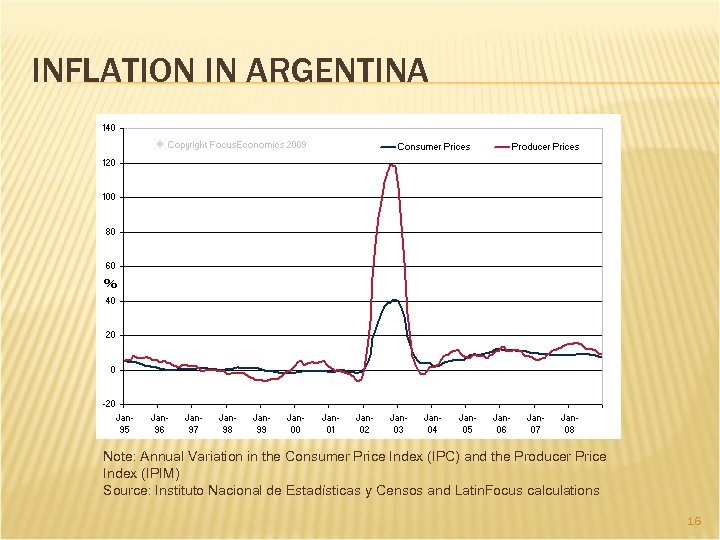
INFLATION IN ARGENTINA Note: Annual Variation in the Consumer Price Index (IPC) and the Producer Price Index (IPIM) Source: Instituto Nacional de Estadísticas y Censos and Latin. Focus calculations 16
INFLATION IN ARGENTINA Estimates at the beginning of 2010 indicated that Argentinian inflation in 2009 was the 3 rd highest inflation worldwide (after the Congo and Venezuela). Actual inflation may be much higher than official reports—maybe 20 -30 percent in 2010. http: //www. xe. com/news/2010 -1015%2017: 10: 00. 0/1462621. htm 17
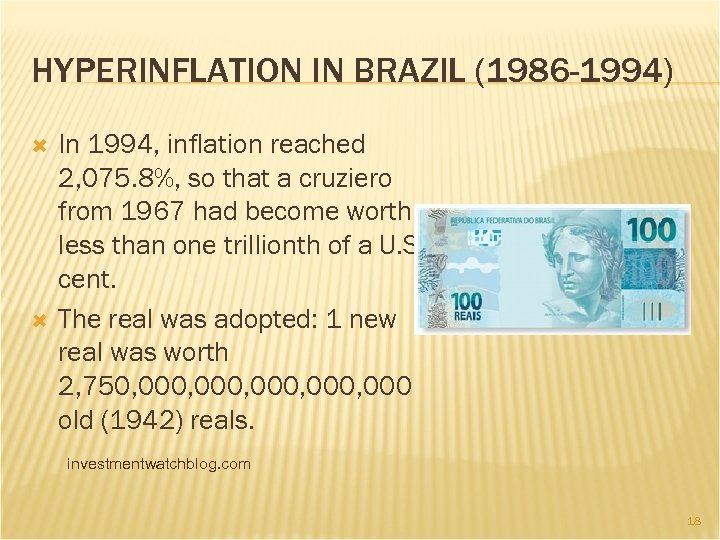
HYPERINFLATION IN BRAZIL (1986 -1994) In 1994, inflation reached 2, 075. 8%, so that a cruziero from 1967 had become worth less than one trillionth of a U. S. cent. The real was adopted: 1 new real was worth 2, 750, 000, 000 old (1942) reals. investmentwatchblog. com 18
“REPRESSED” INFLATION IN BRAZIL “In 1986, President José Sarney of Brazil… froze prices, controlled wages, and lopped three zeroes off the Brazilian currency. …Higher prices were quickly replaced by other problems. Severe shortages of daily necessities such as eggs, meat, and milk developed. Black markets quickly filled the vacuum, resulting in higher prices that didn’t show up in official inflation figures. ” http: //www. thefreemanonline. org/columns/hyperi nflation-lessons-from-south-america/ 19
HYPERINFLATION IN ANGOLA Hyperinflation from 1991 -1995. Two currency reforms: kwanza to novo kwanza back to kwanza. Overall impact to date: 1 current kwanza = 1, 000, 000 old kwanza. 20
HYPERINFLATION IN YUGOSLAVIA From 1971 -1991, Yugoslavia had an average annual inflation rate of 76% Only Zaire and Brazil had a higher inflation rate. In December 1990, the Serbian parliament ordered the Serbian National Bank (a regional central bank) to issue large amounts of credits to friends of Slobodan Milosevic. Source: Steve Hanke in April 28, 1999 Wall Street Journal 21
HYPERINFLATION IN YUGOSLAVIA This amounted to more than half the planned increase in the money supply for all of Yugoslavia in 1991 Croatia and Slovenia broke away In January 1992, hyperinflation began Source: Steve Hanke in April 28, 1999 Wall Street Journal 22
HYPERINFLATION IN YUGOSLAVIA In January 1994, the official monthly inflation rate reached 313 million percent This was the second-highest monthly rate (after Hungary in 1946) …and the second-longest (after the Soviet hyperinflation of the early 1920 s) People spent their time trying to exchange dinars for marks or dollars on the black market Source: Steve Hanke in April 28, 1999 Wall Street Journal 23
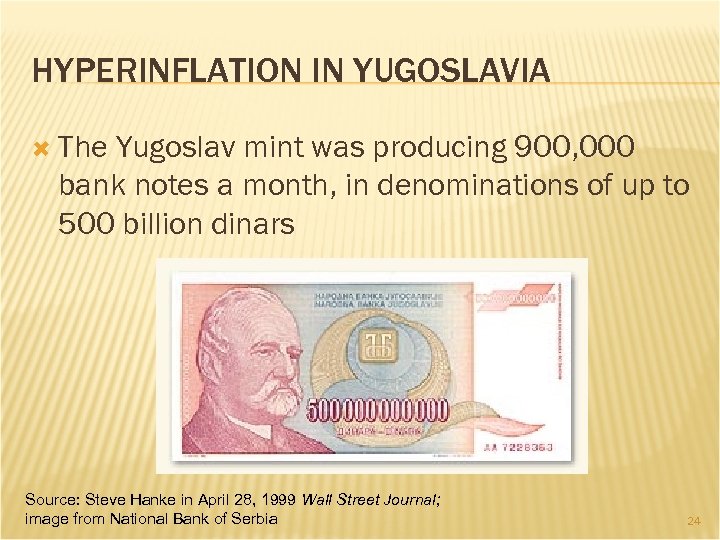
HYPERINFLATION IN YUGOSLAVIA The Yugoslav mint was producing 900, 000 bank notes a month, in denominations of up to 500 billion dinars Source: Steve Hanke in April 28, 1999 Wall Street Journal; image from National Bank of Serbia 24
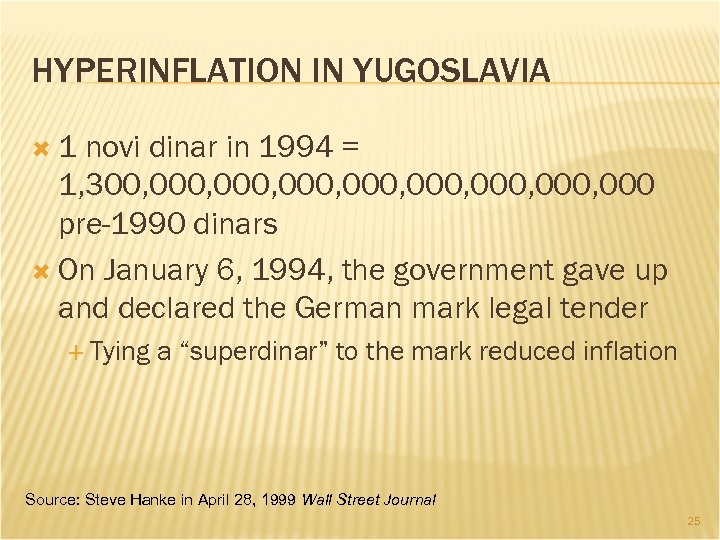
HYPERINFLATION IN YUGOSLAVIA 1 novi dinar in 1994 = 1, 300, 000, 000, 000 pre-1990 dinars On January 6, 1994, the government gave up and declared the German mark legal tender Tying a “superdinar” to the mark reduced inflation Source: Steve Hanke in April 28, 1999 Wall Street Journal 25
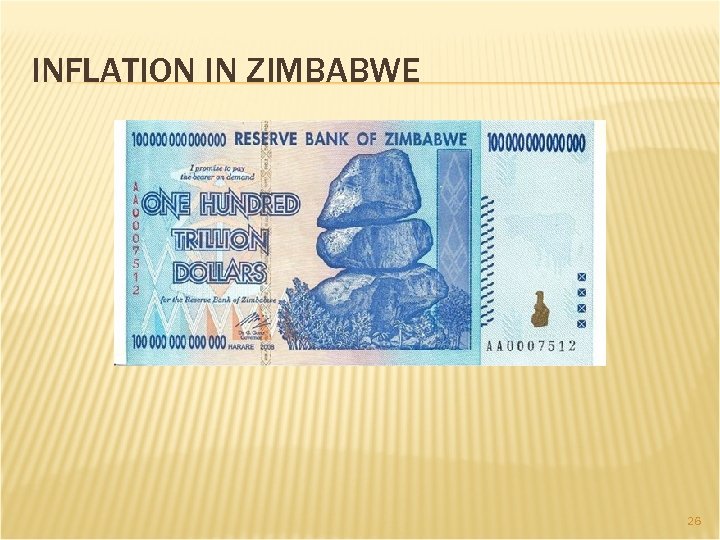
INFLATION IN ZIMBABWE 26
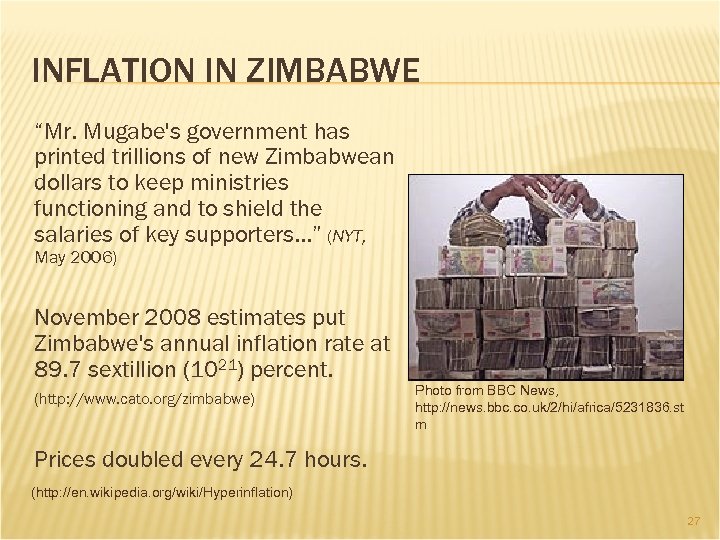
INFLATION IN ZIMBABWE “Mr. Mugabe's government has printed trillions of new Zimbabwean dollars to keep ministries functioning and to shield the salaries of key supporters. . . ” (NYT, May 2006) November 2008 estimates put Zimbabwe's annual inflation rate at 89. 7 sextillion (1021) percent. (http: //www. cato. org/zimbabwe) Photo from BBC News, http: //news. bbc. co. uk/2/hi/africa/5231836. st m Prices doubled every 24. 7 hours. (http: //en. wikipedia. org/wiki/Hyperinflation) 27
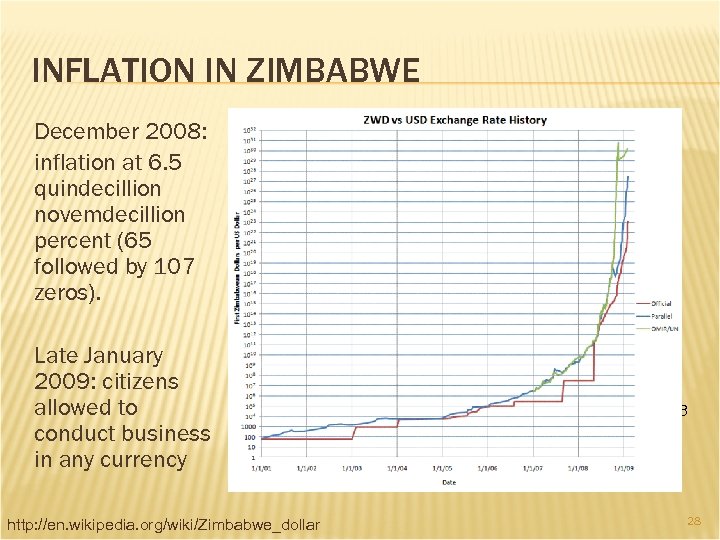
INFLATION IN ZIMBABWE December 2008: inflation at 6. 5 quindecillion novemdecillion percent (65 followed by 107 zeros). Late January 2009: citizens allowed to conduct business in any currency http: //en. wikipedia. org/wiki/Zimbabwe_dollar Photo from BBC News, http: //news. bbc. co. uk/2/hi/africa/52318 36. stm 28
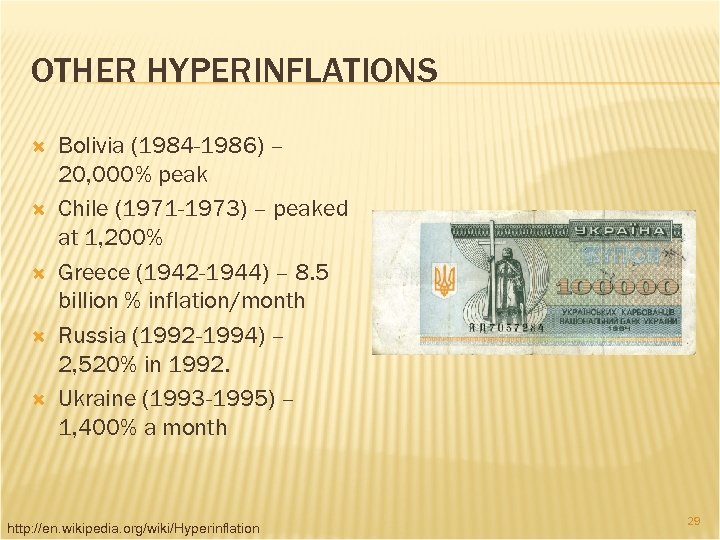
OTHER HYPERINFLATIONS Bolivia (1984 -1986) – 20, 000% peak Chile (1971 -1973) – peaked at 1, 200% Greece (1942 -1944) – 8. 5 billion % inflation/month Russia (1992 -1994) – 2, 520% in 1992. Ukraine (1993 -1995) – 1, 400% a month http: //en. wikipedia. org/wiki/Hyperinflation 29
COSTS OF INFLATION “When people talk of a ‘price level, ’ they have in mind the image of a level of a liquid which goes up or down according to the increase or decrease in its quantity, but which, like a liquid in a tank, always rises evenly. Ludwig von Mises 30
COSTS OF INFLATION “But with prices, there is no such thing as a ‘level. ’ Prices do not change to the same extent at the same time. There always prices that are changing more rapidly, rising or falling more rapidly than other prices. ” Ludwig von Mises 31
COSTS OF INFLATION Ø Where the new money enters the economy is important (“Cantillon Effects”). If the government spends the new money first, then the things government buys will see price increases first Who gains? People who sell to the government Who loses? People who are in competition with the government, who buy what it buys 32
COSTS OF INFLATION Unexpectedly high inflation is redistributive With fixed interest rates, lenders lose, as purchasing power of repayment is lower than was anticipated. Borrowers gain Unexpectedly low inflation redistributes as well Lenders gain, borrowers lose 33
COSTS OF INFLATION Inflation can create business cycles Pushing interest rates down can create the impression that long-term projects are more profitable People invest in those long-term projects by buying capital for them When the interest rate comes back up from its artificially low levels, the capital investments lose value Stock prices drop, people are laid off. 34
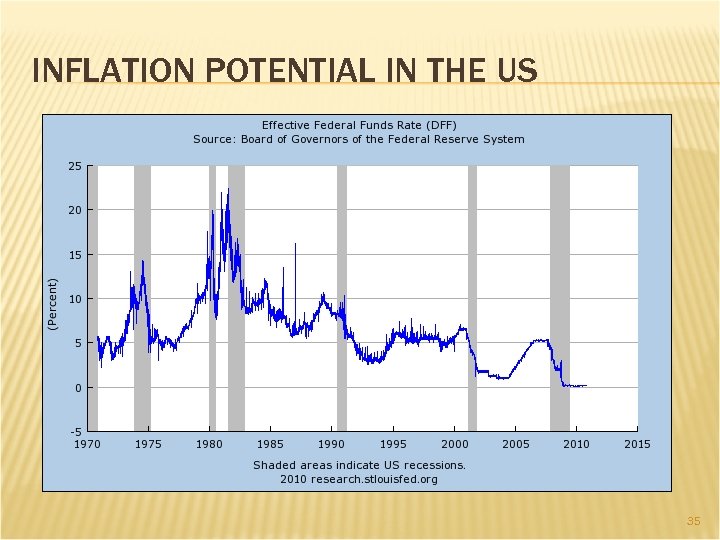
INFLATION POTENTIAL IN THE US 35
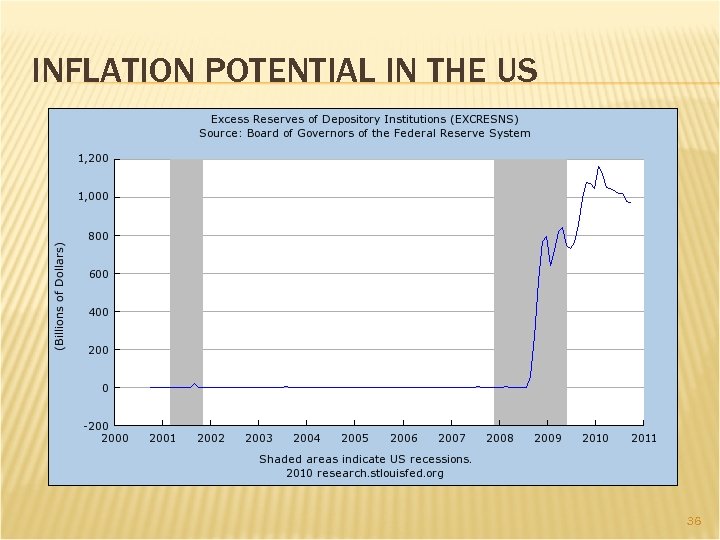
INFLATION POTENTIAL IN THE US 36
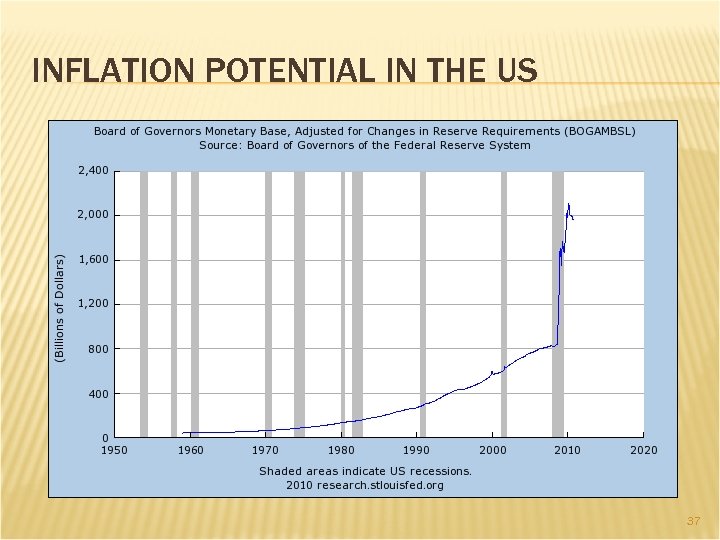
INFLATION POTENTIAL IN THE US 37
STOPPING INFLATION Commodity standards Price controls Hidden inflation—monetary price increases but is not measured Black market transactions Hidden quality deterioration Repressed inflation—shortages and queues develop 38

QUESTIONS? tterrell@mises. com 39
Скачать презентацию CURRENCY FAILURES FROM ARGENTINA TO ZIMBABWE A BRIEF
91286a65dc322dc2934c3d1bdcced9ab.ppt