


 Скачать презентацию Culture of Learning What Why How Enhancing the
28cbbfe4bd26459eaf227b5aee20c677.ppt
- Количество слайдов: 30
 Culture of Learning What? Why? How? ‘Enhancing the Academic Experience of CHC Students’ Dr Anwei Feng School of Education, Durham University
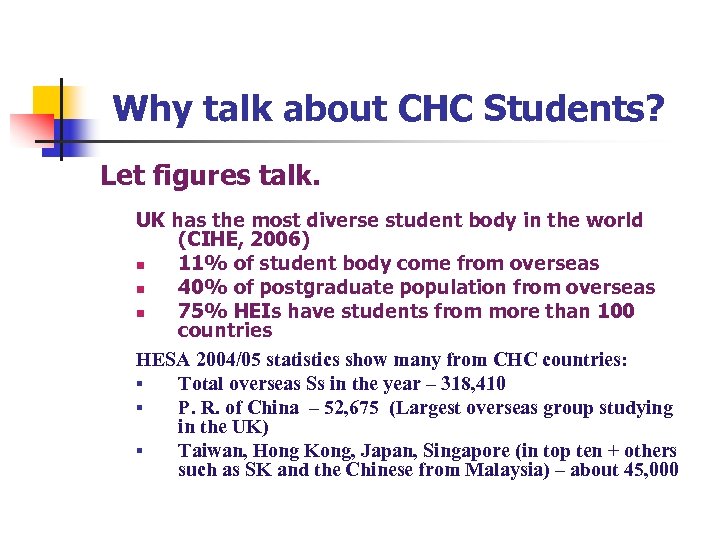 Why talk about CHC Students? Let figures talk. UK has the most diverse student body in the world (CIHE, 2006) n 11% of student body come from overseas n 40% of postgraduate population from overseas n 75% HEIs have students from more than 100 countries HESA 2004/05 statistics show many from CHC countries: § Total overseas Ss in the year – 318, 410 § P. R. of China – 52, 675 (Largest overseas group studying in the UK) § Taiwan, Hong Kong, Japan, Singapore (in top ten + others such as SK and the Chinese from Malaysia) – about 45, 000
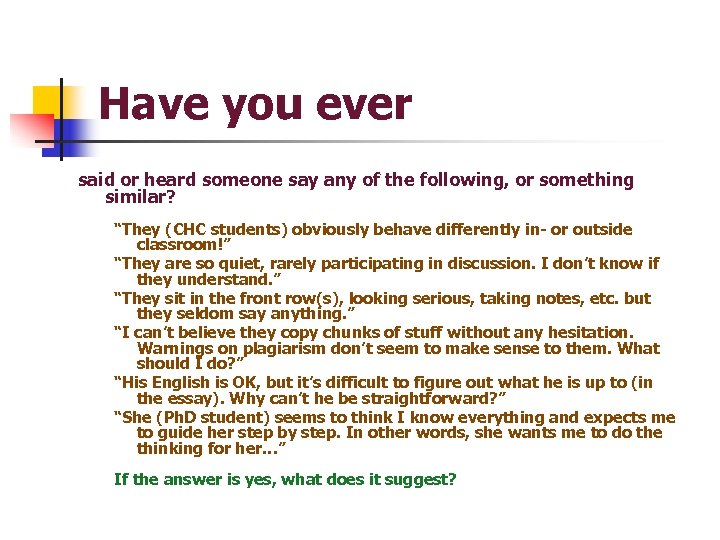 Have you ever said or heard someone say any of the following, or something similar? “They (CHC students) obviously behave differently in- or outside classroom!” “They are so quiet, rarely participating in discussion. I don’t know if they understand. ” “They sit in the front row(s), looking serious, taking notes, etc. but they seldom say anything. ” “I can’t believe they copy chunks of stuff without any hesitation. Warnings on plagiarism don’t seem to make sense to them. What should I do? ” “His English is OK, but it’s difficult to figure out what he is up to (in the essay). Why can’t he be straightforward? ” “She (Ph. D student) seems to think I know everything and expects me to guide her step by step. In other words, she wants me to do the thinking for her…” If the answer is yes, what does it suggest?
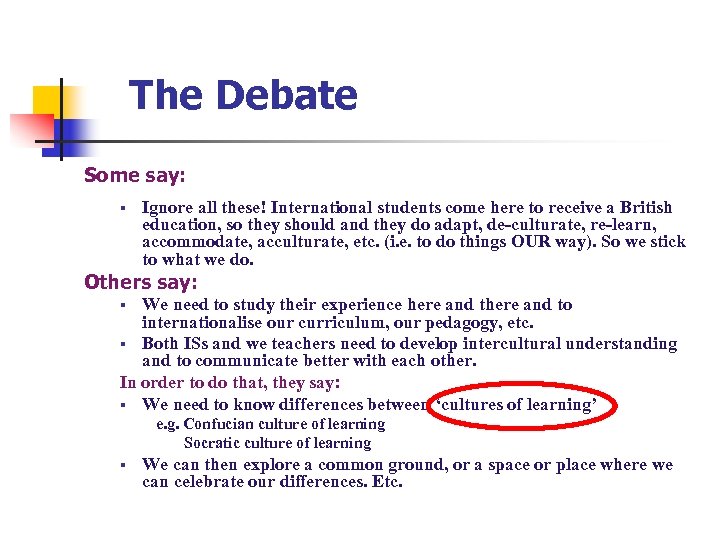 The Debate Some say: § Ignore all these! International students come here to receive a British education, so they should and they do adapt, de-culturate, re-learn, accommodate, acculturate, etc. (i. e. to do things OUR way). So we stick to what we do. Others say: We need to study their experience here and to internationalise our curriculum, our pedagogy, etc. § Both ISs and we teachers need to develop intercultural understanding and to communicate better with each other. In order to do that, they say: § We need to know differences between ‘cultures of learning’ § e. g. Confucian culture of learning Socratic culture of learning § We can then explore a common ground, or a space or place where we can celebrate our differences. Etc.
 What’s Culture of Learning? n Working definition of ‘culture of learning’ (one form of culture): Values and beliefs of quality teaching and learning shared by a particular national group and the norms or behaviours that are built on them (cf. Cortazzi & Jin, 1996) Philosophical assumptions about the nature of teaching and learning, perceptions of the respective roles of and responsibilities of teachers and students, learning strategies encouraged, and qualities valued in teachers and students (Hu, 2002)
 How is it studied? Often through comparative or contrastive Studies. Literature documenting such studies with a focus on East Vs West conceptions of learning includes: n n n n n Cortazzi and Jin (1996 a; 1996 b; 2001) Fullen (2001) Hammond and Gao (2002) Harris (1995) Jin and Cortazzi (1993; 1995; 1998) Kember (1997; 2000) Littlewood (2001; 2003) Tweed and Lehman (2002) Watkins and Biggs (1996; 2001)
 Comparative Studies Socratic versus Confucian Conceptions of Learning n n Socratic Conception of quality learning which is widely discussed as learning philosophy for all is a western exemplar that values questioning of accepted knowledge and generate and express own hypotheses on such bases. Confucian Conception values effortful, respectful, and pragmatic leaning of knowledge as well as behavioral reform. (Tweed and Lehman, 2002)
 Socratic conceptions Main theories of learning n Constructivism (Steffe & Gale, 1995; Biggs 1999) n Phenomenography (Marton & Booth, 1997) Core argument: Learning is a way in which learners interact with the world. Quality learning takes place only when they generate their own knowledge on the basis of the existing and when they engage themselves with higher cognitive-level processes.
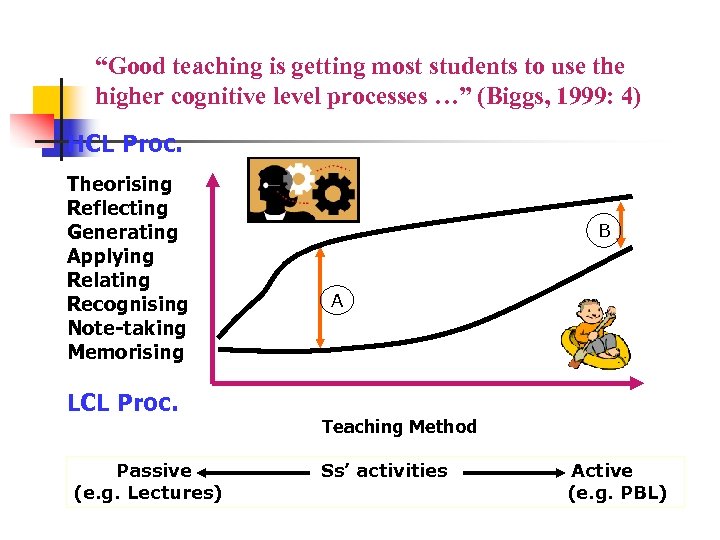 “Good teaching is getting most students to use the higher cognitive level processes …” (Biggs, 1999: 4) HCL Proc. Theorising Reflecting Generating Applying Relating Recognising Note-taking Memorising LCL Proc. Passive (e. g. Lectures) B A Teaching Method Ss’ activities Active (e. g. PBL)
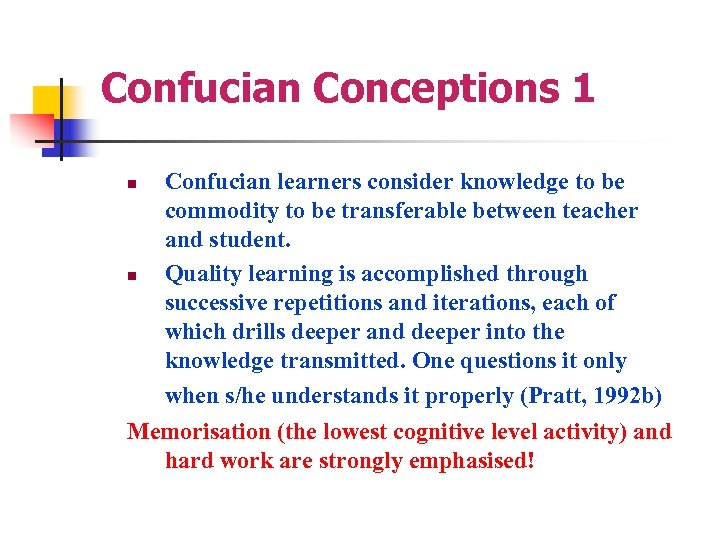 Confucian Conceptions 1 n n Confucian learners consider knowledge to be commodity to be transferable between teacher and student. Quality learning is accomplished through successive repetitions and iterations, each of which drills deeper and deeper into the knowledge transmitted. One questions it only when s/he understands it properly (Pratt, 1992 b) Memorisation (the lowest cognitive level activity) and hard work are strongly emphasised!
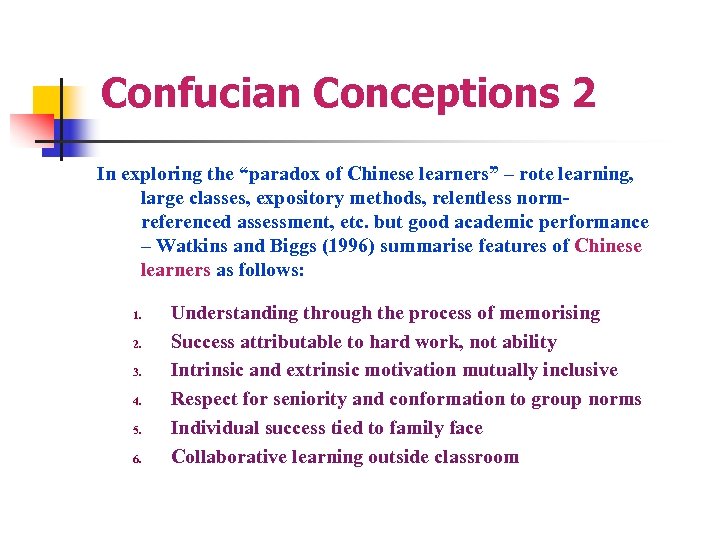 Confucian Conceptions 2 In exploring the “paradox of Chinese learners” – rote learning, large classes, expository methods, relentless normreferenced assessment, etc. but good academic performance – Watkins and Biggs (1996) summarise features of Chinese learners as follows: 1. 2. 3. 4. 5. 6. Understanding through the process of memorising Success attributable to hard work, not ability Intrinsic and extrinsic motivation mutually inclusive Respect for seniority and conformation to group norms Individual success tied to family face Collaborative learning outside classroom
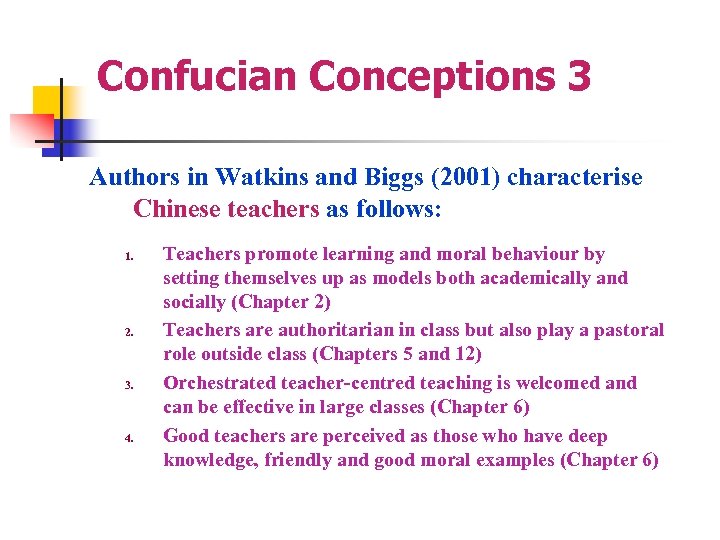 Confucian Conceptions 3 Authors in Watkins and Biggs (2001) characterise Chinese teachers as follows: 1. 2. 3. 4. Teachers promote learning and moral behaviour by setting themselves up as models both academically and socially (Chapter 2) Teachers are authoritarian in class but also play a pastoral role outside class (Chapters 5 and 12) Orchestrated teacher-centred teaching is welcomed and can be effective in large classes (Chapter 6) Good teachers are perceived as those who have deep knowledge, friendly and good moral examples (Chapter 6)
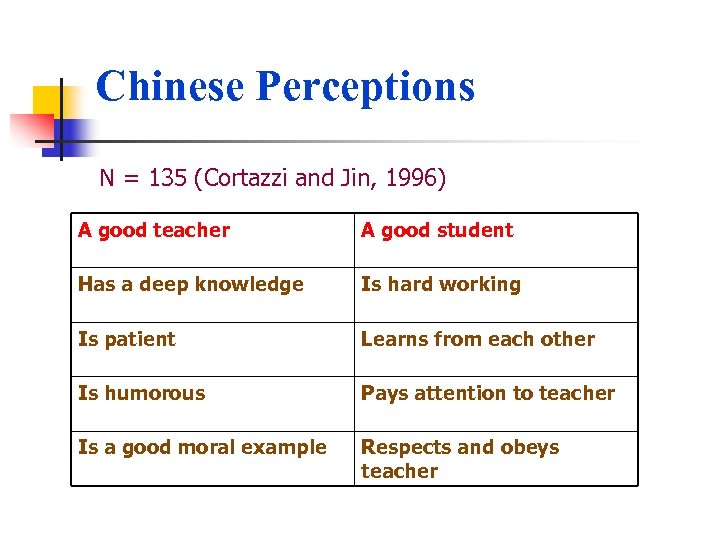 Chinese Perceptions N = 135 (Cortazzi and Jin, 1996) A good teacher A good student Has a deep knowledge Is hard working Is patient Learns from each other Is humorous Pays attention to teacher Is a good moral example Respects and obeys teacher
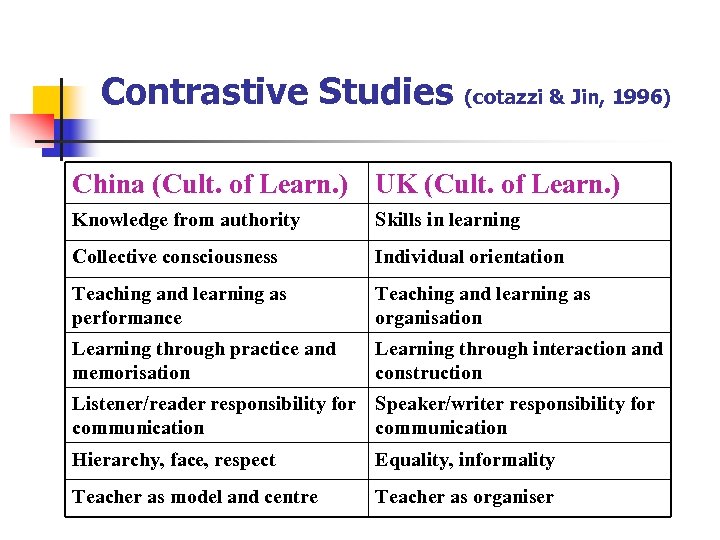 Contrastive Studies (cotazzi & Jin, 1996) China (Cult. of Learn. ) UK (Cult. of Learn. ) Knowledge from authority Skills in learning Collective consciousness Individual orientation Teaching and learning as performance Teaching and learning as organisation Learning through practice and memorisation Learning through interaction and construction Listener/reader responsibility for Speaker/writer responsibility for communication Hierarchy, face, respect Equality, informality Teacher as model and centre Teacher as organiser
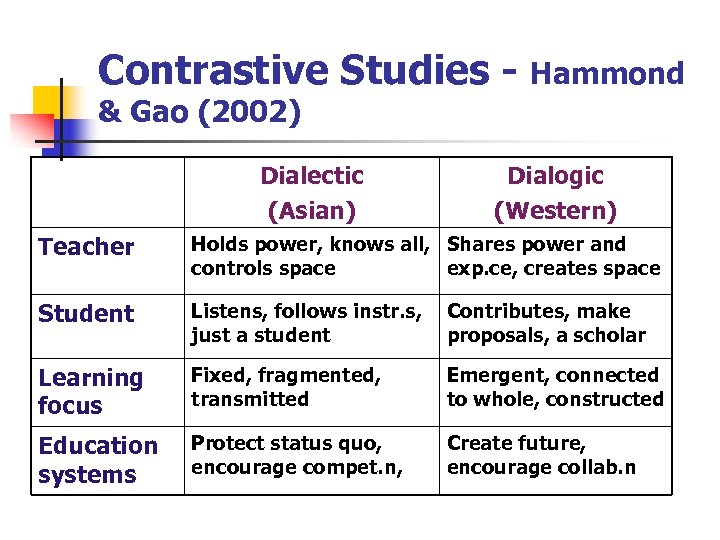 Contrastive Studies - Hammond & Gao (2002) Dialectic (Asian) Dialogic (Western) Teacher Holds power, knows all, Shares power and controls space exp. ce, creates space Student Listens, follows instr. s, just a student Contributes, make proposals, a scholar Learning focus Fixed, fragmented, transmitted Emergent, connected to whole, constructed Education systems Protect status quo, encourage compet. n, Create future, encourage collab. n
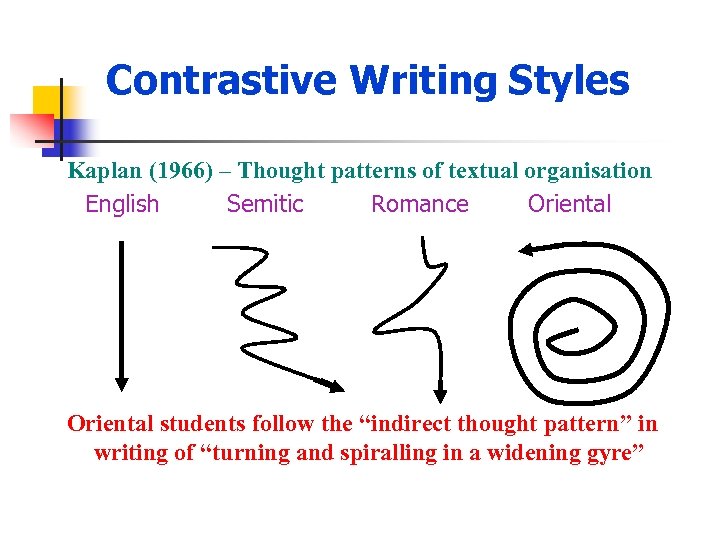 Contrastive Writing Styles Kaplan (1966) – Thought patterns of textual organisation English Semitic Romance Oriental students follow the “indirect thought pattern” in writing of “turning and spiralling in a widening gyre”
 Chinese Style of Writing (1) Hu and Gao’s (1997) three observations 1. Authors write in “reader-responsibility language” (it is the writer’s job to show profound knowledge but the reader’s job to understand it), so writers don’t have to n define specialised terminology justify statements with facts or evidence acknowledge sources of arguments n analyse the purpose of writing n n
 Chinese Style of Writing (2) 2. Authors often: • prefer low-frequency vocabulary and lengthy sentences, taking them as real academic writing; • take idioms and proverbs as truth; n “Practice makes perfect” n “No pain, no gain” • use strong wording and model verbs to conclude n “It is important (crucial, essential) to …”, n “We should (not)”, “ We must …” n “In short, there is no such thing as …”
 Chinese Style of Writing (3) 3. “Pangzheng Boying” (Citing copiously from many sources (without acknowledging them) – virtue of writers in China but taken as ‘plagiarism’ in West. Argument: • • Well-known ideas Well-known people If in-text referencing is used, it may appear like: • • • ‘A famous scientist once said, …’ ‘according to latest studies, …’ ‘some researches [sic] show that …’
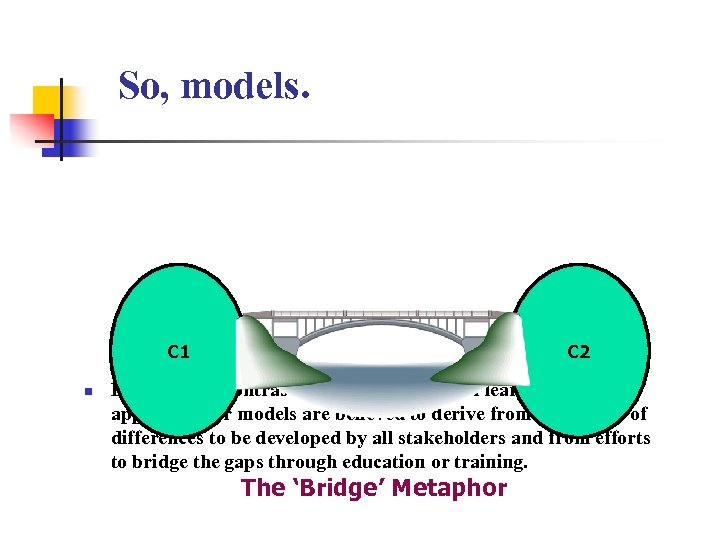 So, models. C 2 C 1 n Based on the contrastive view of cultures of learning, effective approaches or models are believed to derive from awareness of differences to be developed by all stakeholders and from efforts to bridge the gaps through education or training. The ‘Bridge’ Metaphor
 Counter Arguments Against the claims of contrasts: n n Biggs (1999) Kember (1997; 2000) Littlewood (2001; 2003) Stephens (1997) Against ‘essentialist’ conceptions that lead to models based on the bridge metaphor: n n n Holliday, et al. (2004) Keesing (1994) Bhabha (1994)
 Binary contrasts challenged (Biggs 1999; Kember, 2000; Littlewood, 2001) n n “Myths”, “misconceptions”, or only “partially true” (Littlewood, 2001) Sample size: 2656 students in eleven countries (8 Asian and 3 European) Research tool: 12 -item questionnaire on perceptions and attitudes in learning (similar to Cortazzi and Jin) Major finding n No significant difference in perceptions and attitudes Contrasts such as those given before are criticised as an essentialist or reductionist approach to theorising culture (Holiday, et al. 2004)
 Reconceptualising Culture should not be limited to essential features of a particular social group, i. e. , to ‘shared values, established norms and patterned behaviours’. Bhabha (1994) argues that: n On the one hand, culture is “heimlich” with its n n seriality, generalisability and coherence. On the other hand, it is “unheimlich” , heterogeneous and ambivalent, with its openness: permeable by otherness, susceptible to context and even selfcontradictory. Cultural differences, thus, “should not be understood as the free play of polarities and pluralities in the homogeneous empty time of the national community. ” (p. 162).
 Third Space Perspective n Bhabha, H. (1990; 1994) n n All forms of culture are subject to hybridity which leads to a third space that “constitutes the discursive conditions of enunciation that ensure that the meaning and symbols of culture have no primordial unity or fixity; that even the same signs can be appropriated, translated, rehistoricised and read anew. ” This space “displaces the histories” and “gives rise to something different, something new and unrecognisable, a new area of negotiation of meaning and representation. ” (1990: 211)
 Discussion n n Culture of learning is elusive and extremely hard to pin down. No form of culture, e. g. Socratic or Confucian culture of learning, is homogeneous, fixed or unified as it is subject to cultural hybridity (Bhabha, 1994) and depends on the context in which individuals negotiate their cultural identities. Therefore, a culture of learning can never be over-generalised. However, few disagree that the notion of culture of learning is useful because: n n individuals including us lecturers and ISs themselves rely on their perceptions of the cultures in interaction to make sense of specific contexts and to ADJUST accordingly institutions that host ISs depend on their perceptions of the differences between cultures of learning to make pedagogical decisions.
 The Gaps – Study Shocks! n Academic Roles (Mc. Clure, 2005) n n Student expects supervisor to give precise guidance; supervisor expects student to work and think independently. As a result, student feels unsupported. Research n International postgraduate students lack research skills as few were trained at home, but the training courses may be cast solely in terms of research culture in the host country (Trice, 2007)
 The Gaps – Study Shocks! n Writing (Ryan, 2007) n n Very difficult for students who use English as an additional language Difficulty in writing extensive pieces of work even in exams Reproductive writing vs independent and critical writing Access to academic cultures n International postgraduate students are less likely to integrate into the departmental research culture (Trice, 2005)
 ‘Good’ or ‘Bad’ Responses What should we do to respond to issues that arise from internationalisation of education? n Beware of Eurocentric mentality n n n Make teaching and learning relevant to them n n ‘There is no need to do anything because they come for our British education’ ‘Why should I adjust? They should!’ ‘Do theories and concepts I’m talking about make sense to them? ’ Be aware of the differences in cultures of learning n n ‘There seems to be lack of communication between us. Are they caused by different values and beliefs such as face, respect? ’ ‘There is something odd in his/her learning behaviour. Is it the result of internalised beliefs through early socialisation? ’
 ‘Good’ or ‘Bad’ Responses What should we do to respond to issues such as plagiarism and passive learning? n Improve practice to deal with issues in classroom participation, language, plagiarism, etc. n n n Intercultural communication module (Singapore) Academic writing to deal directly with plagiarism by learning referencing skills (Hong Kong) Tandem learning (Sheffield) Intercultural Forum and Bildung. Kaffe (Durham) Other institutional or individual actions …
 Thanks! Comments and Questions