


 Скачать презентацию Culture Change through Lean Six Sigma Education Sue
0213828bafbacb7b44f80cfe6e8ec2d9.ppt
- Количество слайдов: 65
 Culture Change through Lean Six Sigma Education Sue Kozlowski MSA, MT(ASCP)SBB DLM CSSBB(ASQ) Presentation sponsored by: The Team and Workplace Excellence Forum
 Lean Six Sigma “Begin with the end in mind. ” --Stephen Covey What are the outcome measures for your Lean / Six Sigma Deployment? Discussion! Slide 2
 Lean Six Sigma Are you a Lean / Six Sigma organization if… • You have Belts / Facilitators? • You have projects? • You have bottom line savings? What’s missing? Slide 3
 Lean Six Sigma What about: • Driving the philosophy through the organization? • Not waiting for project approval before identifying improvements? • Finding cost-avoidance and DO-IT projects? “I can’t fix that yet, the project’s not slated until 2011!” Slide 4
 Objectives After this session, you will be able to: • Understand the basic concepts of business culture transformation • Describe three approaches to culture change using Lean Six Sigma concepts • List three positive outcomes that can be used to measure culture change through Lean Six Sigma education Slide 5
 Business Culture Change to What?
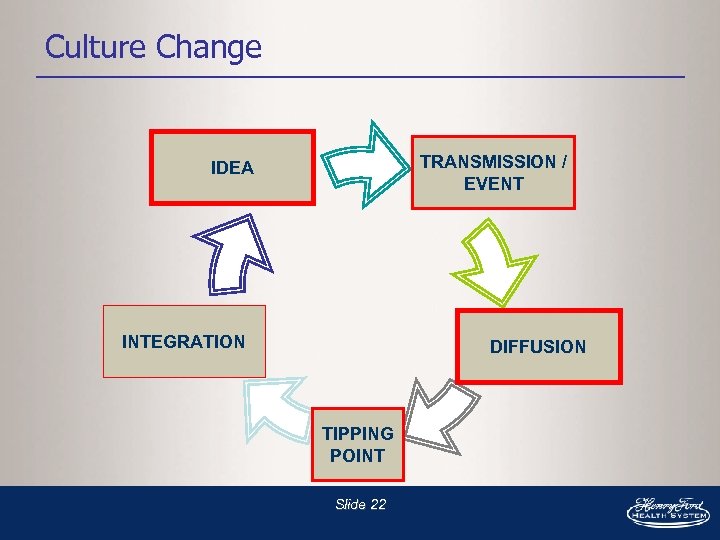
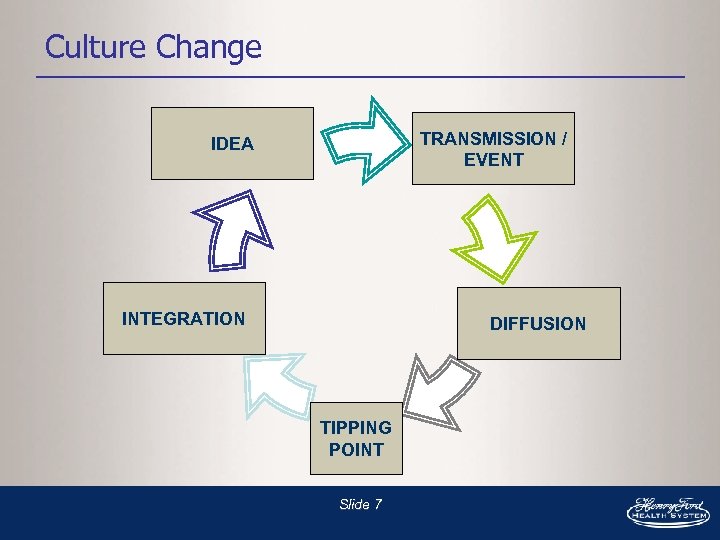 Culture Change TRANSMISSION / EVENT IDEA INTEGRATION DIFFUSION TIPPING POINT Slide 7
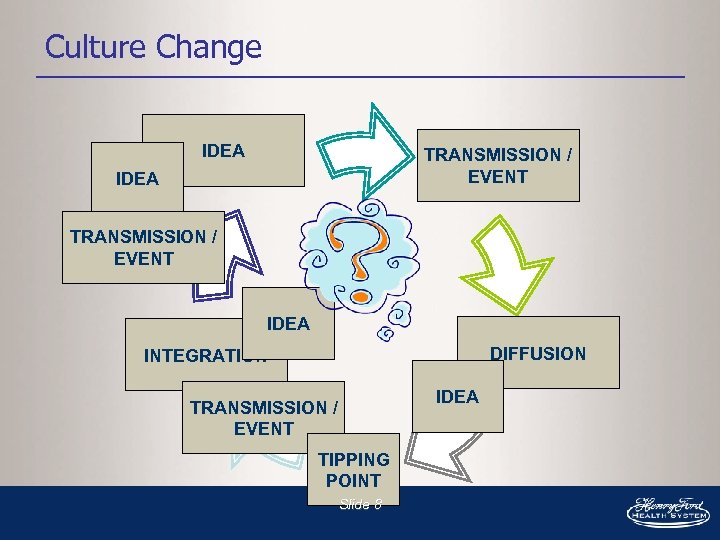 Culture Change IDEA TRANSMISSION / EVENT IDEA DIFFUSION INTEGRATION IDEA TRANSMISSION / EVENT TIPPING POINT Slide 8
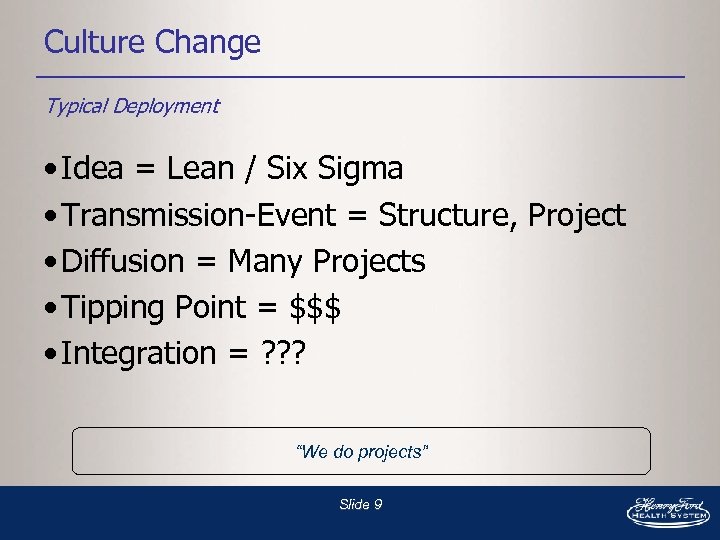 Culture Change Typical Deployment • Idea = Lean / Six Sigma • Transmission-Event = Structure, Project • Diffusion = Many Projects • Tipping Point = $$$ • Integration = ? ? ? “We do projects” Slide 9
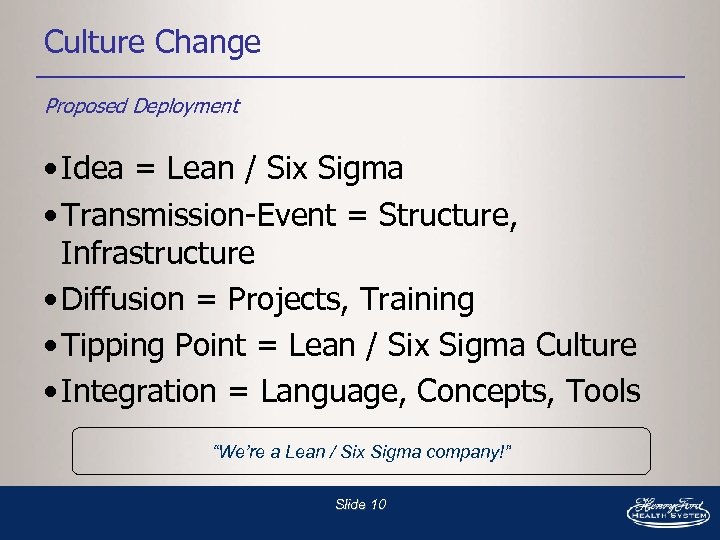 Culture Change Proposed Deployment • Idea = Lean / Six Sigma • Transmission-Event = Structure, Infrastructure • Diffusion = Projects, Training • Tipping Point = Lean / Six Sigma Culture • Integration = Language, Concepts, Tools “We’re a Lean / Six Sigma company!” Slide 10
 Projects vs Training Can you have your cake and eat it too?
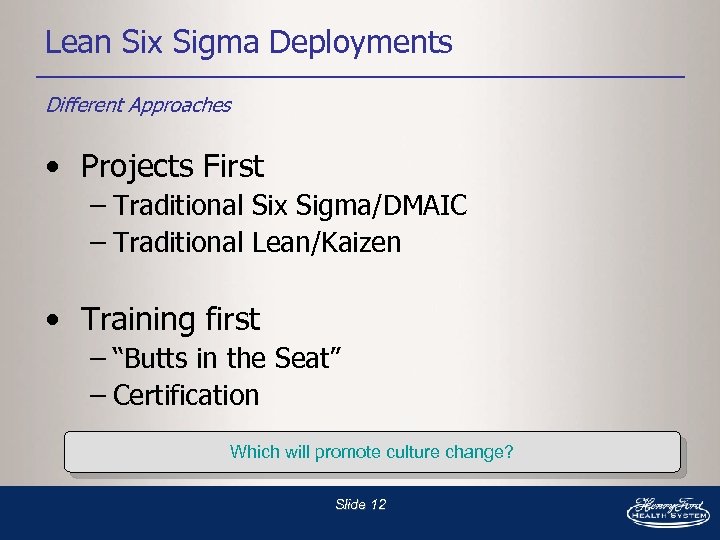 Lean Six Sigma Deployments Different Approaches • Projects First – Traditional Six Sigma/DMAIC – Traditional Lean/Kaizen • Training first – “Butts in the Seat” – Certification Which will promote culture change? Slide 12
 Projects First • Limit training to project leaders and team members • May have some training for Project Sponsors and/or Process Owners Slide 13
 Impact of Projects First How many people have been trained after 3 waves? • • 20 BBs / Lean Facilitators 47 GBs 104 Project Team Members 20 Executives / Champions Slide 14 WOW!
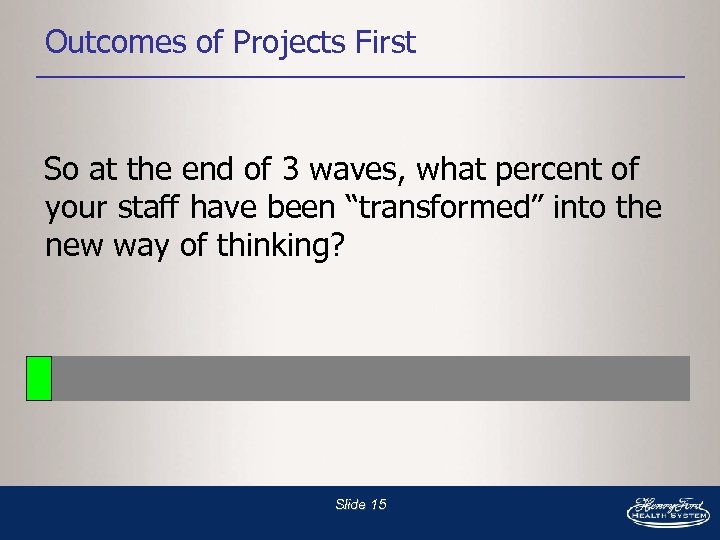 Outcomes of Projects First So at the end of 3 waves, what percent of your staff have been “transformed” into the new way of thinking? Slide 15
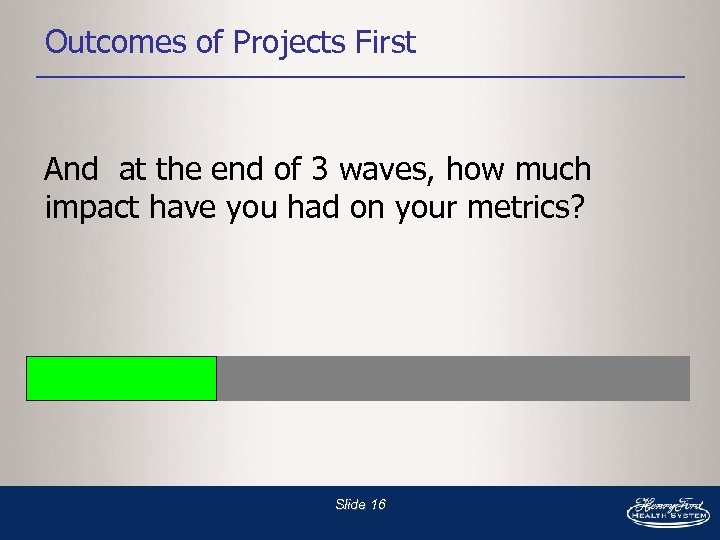 Outcomes of Projects First And at the end of 3 waves, how much impact have you had on your metrics? Slide 16
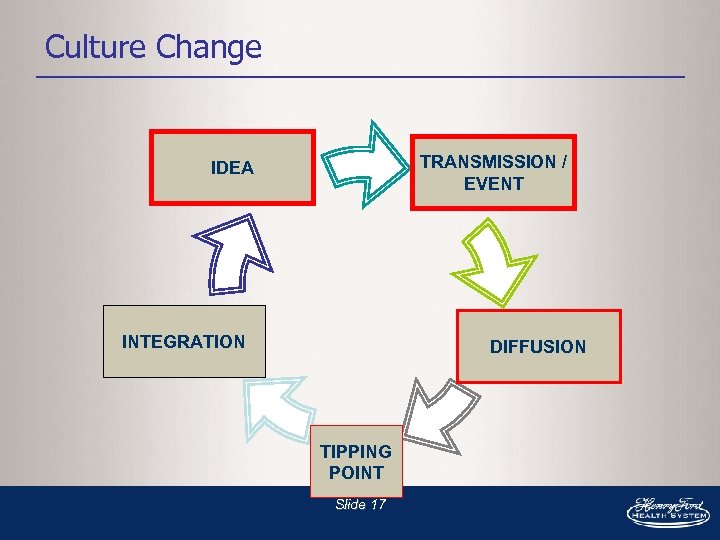 Culture Change TRANSMISSION / EVENT IDEA INTEGRATION DIFFUSION TIPPING POINT Slide 17
 Training First • Lots of people who “know” lots of things • Lots of certificates • But, use it or lose it! Slide 18
 Training First, continued How many people have been trained after 3 waves? • • All Senior Leaders Most Directors Some Managers / Supervisors Some Leads/Coordinators Slide 19 WOW!
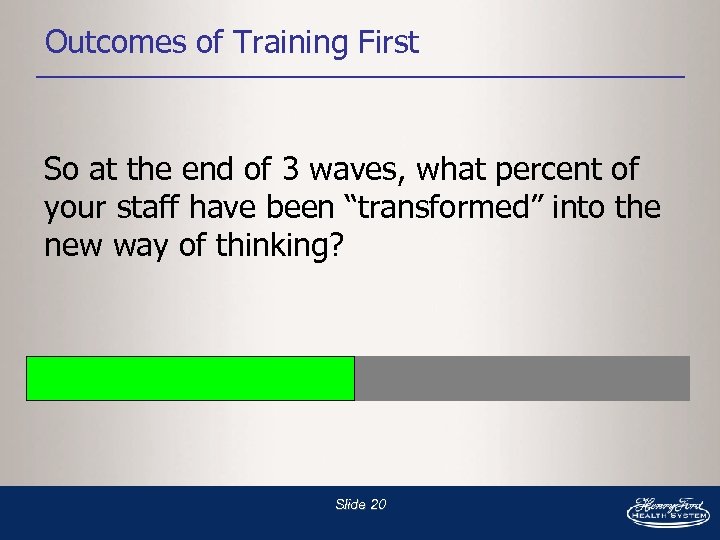 Outcomes of Training First So at the end of 3 waves, what percent of your staff have been “transformed” into the new way of thinking? Slide 20
 Outcomes of Training First • And at the end of 3 waves, how much impact have you had on your metrics? Slide 21
 Culture Change TRANSMISSION / EVENT IDEA INTEGRATION DIFFUSION TIPPING POINT Slide 22
 The Middle Way • Projects – Quick start – Develop metrics – Attack problems – “Best and Brightest” for project leaders • Training – Build momentum – Develop metrics – Manage processes – “Learn to see” – Early adopters will be evident (next wave of BBs / Lean Facilitators) Slide 23
 Outcomes of Training First So at the end of 3 waves, what percent of your staff have been “transformed” into the new way of thinking? Slide 24
 Outcomes of Training First • And at the end of 3 waves, how much impact have you had on your metrics? Slide 25
 Projects + Training • Run projects – Get financial gains • Change culture – Learn to see processes, value & waste – Data-based decisions – Clear goals and targets – Team-building – Break down barriers and silos Slide 26
 Projects + Training Program Objectives Ability to… • Lead Project Teams to validated gains • Coach Project Team Members • Teach LSS tools and concepts • Mentor upcoming leaders Slide 27
 Projects + Training Objectives The skills and abilities for teaching, coaching, and mentoring should be included with your Black Belt / Lean Facilitator TRAINING – in addition to project management skills and statistics. Slide 28
 Black Belts as Agents of Culture Change More Than Just Project Facilitators
 BB / Lean Facilitator Selection The skills and abilities for teaching, coaching, and mentoring should be included with your Black Belt / Lean Facilitator SELECTION – in addition to project management skills and statistics. Slide 30
 BB / Lean Facilitator Training Suggested training guideline • Training project – LSS methodology, project management, team facilitation – Assessment: Project deliverables, team effectiveness • Follow-up training – Teaching, coaching, and mentoring skills – Assessment: Teaching, GB coaching / mentoring, team facilitation Slide 31
 BB / Lean Facilitator Training Advantages Career path after Black Belt / Lean Facilitator may take one of two directions: • Master Black Belt / Sensei role • Operational Leadership role Slide 32
 BB / Lean Facilitator Training Advantages Master Black Belt / Sensei role • Primary Responsibility shifts to teaching, coaching, mentoring, administrative roles Operational Leadership role • Primary responsibility shifts to accomplishments through teams of people Slide 33
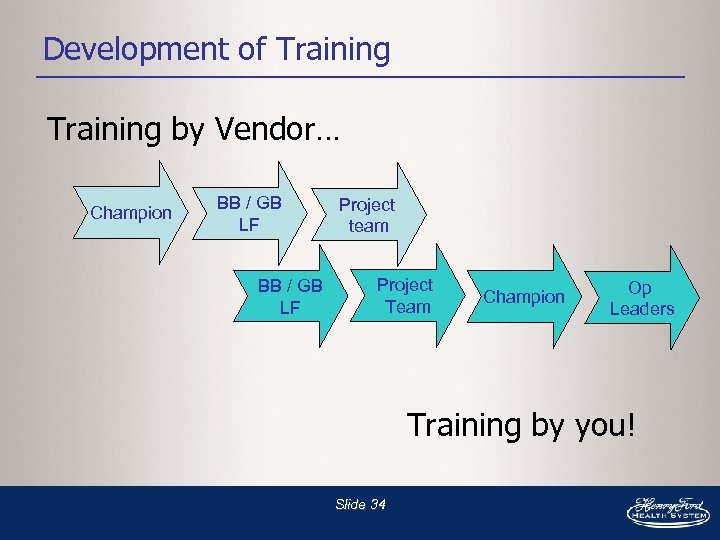 Development of Training by Vendor… Champion BB / GB LF Project team Project Team Champion Op Leaders Training by you! Slide 34
 BB / Lean Facilitator Training Vendor-led training may be $15, 000 person (BB, GB, LF) not including transportation, printing, etc. Internally-led training: • 2 BBs • Avg 30 per class • Eight days of training (2 days per month) • $250 person Slide 35
 BB / Lean Facilitator Training Cost of internal training BBs/LFs who are training may need a reduced project load Logistics: • Binders, tabs, & handouts • AV, flip charts, markers, sticky-notes etc. • Dietary Course development Slide 36
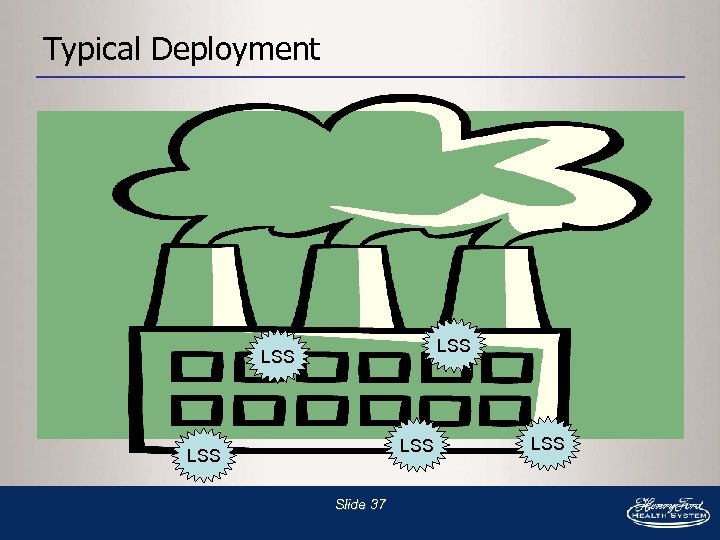 Typical Deployment LSS LSS Slide 37 LSS
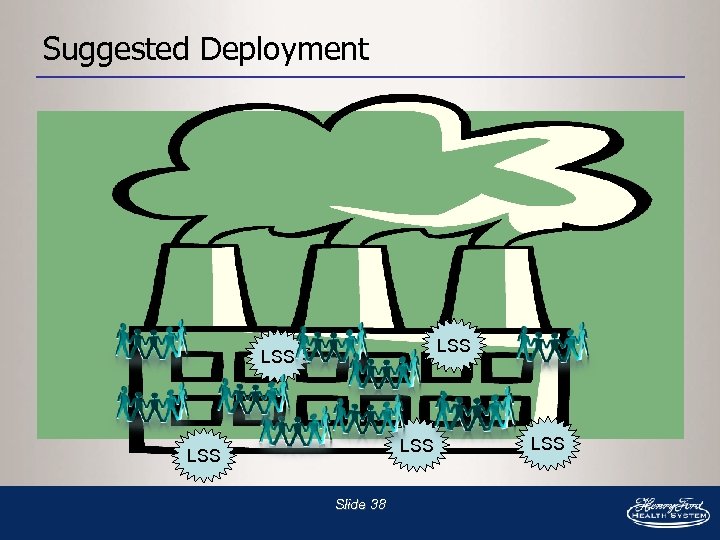 Suggested Deployment LSS LSS Slide 38 LSS
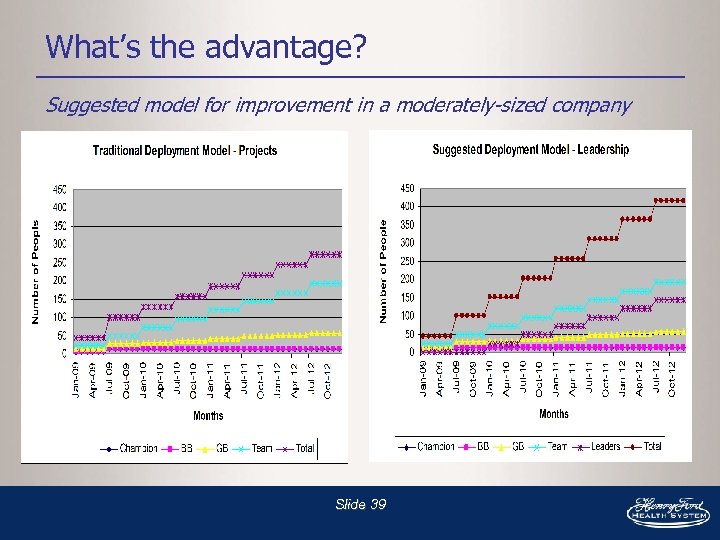 What’s the advantage? Suggested model for improvement in a moderately-sized company Slide 39
 The Tipping Point… When cultural transformation occurs Executives walk the walk… • Attend training classes, lead projects Leaders talk the talk… • Use LSS terminology in daily operations Employees walk & talk! • Look for wastes, suggest improvements Slide 40
 We’ll know we’ve been successful when… • Executives… • Leaders… • Employees… • BBs/GBs/Lean Facilitators… Slide 41
 Planning for Culture Change Get More Than Projects Out Of Your Deployment!
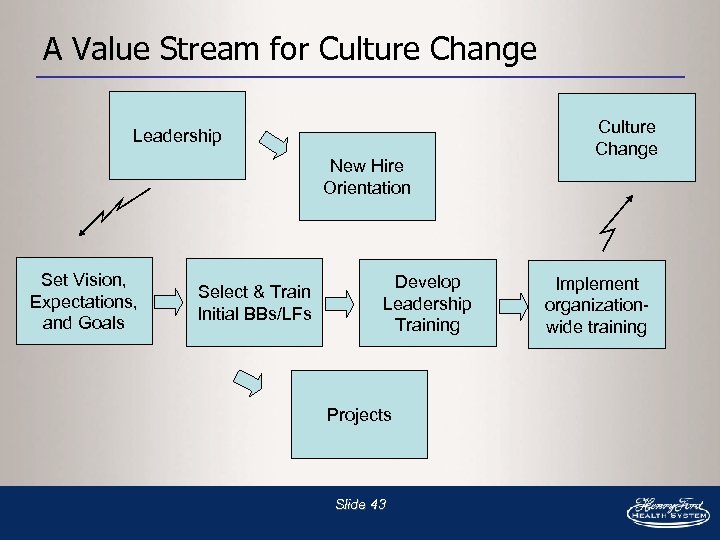 A Value Stream for Culture Change Leadership New Hire Orientation Set Vision, Expectations, and Goals Select & Train Initial BBs/LFs Develop Leadership Training Projects Slide 43 Culture Change Implement organizationwide training
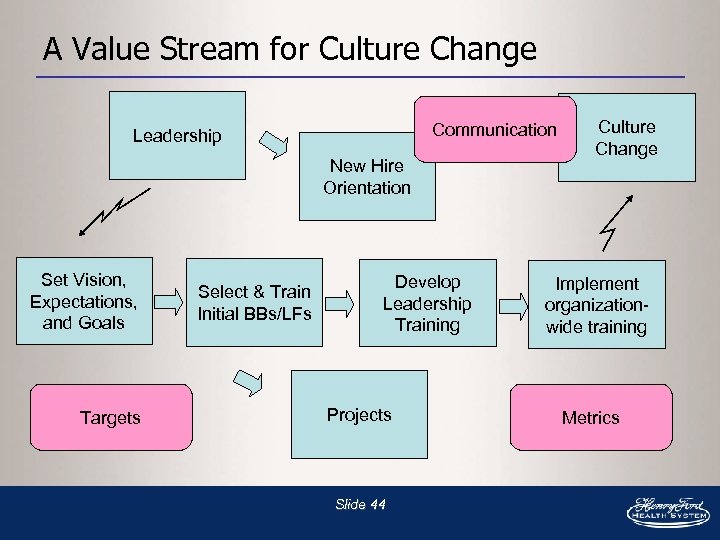 A Value Stream for Culture Change Communication Leadership New Hire Orientation Set Vision, Expectations, and Goals Targets Select & Train Initial BBs/LFs Develop Leadership Training Projects Slide 44 Culture Change Implement organizationwide training Metrics
 Barriers to Culture Change • Strange concepts – Front-line workers as process experts – Team not led by the boss – Set milestones • New tools – SPIOC, Value Stream Map – Statistical tools – Lean tools Slide 45
 Barriers to Culture Change • Process awareness / understanding – Upstream, downstream – Suboptimizing – Wastes – Next process as customer • Unique language – DMAIC: Darned Multiple Acronyms In Class! – Lean: Let’s learn Japanese! Slide 46
 A Note about Belts • Belts “Pro” – Easy to understand – People like it – Can build structure (Green, Yellow, White) • Belts “Con” – May not be appropriate for culture – Lean approach, teach everyone the tools – Overuse/abuse of terms (Grandmaster Black Belt? Gold Belt? ) Slide 47
 A Note about Certification • Certification “Pro” – Standard body of knowledge – People like it – Should require project plus book learning • Certification “Con” – May become a paper chase – Body of knowledge may not be appropriate for organizational needs – May mask lack of skills Slide 48
 A Note about Black Belt Career Paths • In & Out – Not a good fit for skills (consider trial period) – Superficial stepping stone to next career path • Lifers – Love it – Good project managers and teachers • Careerists – Gain skills and knowledge for next level of responsibility Slide 49
 A Note about Black Belt Career Paths • Novice – Training + 1 year (can define “x” completed projects) • Practitioner – Next 1 - 3 years before transition – Develop and master the skills • Sensei / Master – Remain as teacher, coach, methodology expert, involved in strategic planning Slide 50
 Developing a Lean Six Sigma Culture
 New Hire Orientation • • 15 Minutes will do it LSS philosophy and approach Simple game or exercise List of who’s involved (Champions, BBs, BGs, LFx) • Invitation to contribute ideas Slide 52
 Leadership Orientation Content • • DMAIC or Lean Approach History, success stories Types of projects Expectations of leaders (roles, participation, training) • Resources for further details • Select a project to get them involved in Slide 53
 Leadership Course Content • Will the leadership course also serve as the GB/LF course? • What do leaders, who are not LSS project managers, need to know in their daily operations? • BB/LF consensus • Develop an outline • Use available resources, or buy them Slide 54
 Course Organization • Select a Primary Instructor (BB or MBB) • All BBs should teach – some will need more coaching than others • Start with teaching modules – then move to exercises – then whole days of class • Have Executives / MBBs “drop in” for informal discussion & asking how they will use what they have learned Slide 55
 Course Organization • Set and keep an attendance policy • Include homework (VSM, SIPOC, etc. ) • Make an exam to force review of earlier concepts and study • Give a certificate, pin, etc. to indicate accomplishment • Optional – project work or GB-level classes for people who want to get deeper into it Slide 56
 Black Belt Development • Set criteria for BB career path • Select / develop BB and MBB level training and certification requirements • Require portfolio of projects, professional development, and accomplishments • Post-project review should include feedback from team members • Annual eval should include career planning Slide 57
 Outcome Measures • Executive behavior – Supportive, Committed, or Engaged? • Leader behavior – Sponsors, participation on teams, use of tools in daily operations? • Front-line leaders – Participation on teams, use of tools in daily operations? • Belts/Facilitators Slide 58
 Closing
 Return on Investment • Training as essential to culture change – Connected to organizational mission – Less expensive than external training – Quicker diffusion to tipping point – Create a new culture for your organization • Support projects – Develop future project leaders • Improve operations – Get leaders using the tools in daily operations Slide 60
 Sustain the Gains • Lean / Six Sigma becomes “the way we work. ” – Executives – Mid-level Leaders – Front-line leaders – Staff Slide 61
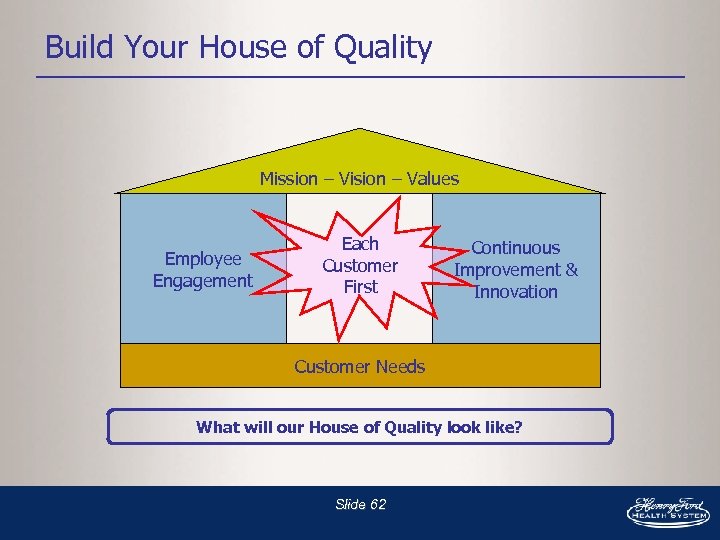 Build Your House of Quality Mission – Vision – Values Employee Engagement Each Customer First Continuous Improvement & Innovation Customer Needs What will our House of Quality look like? Slide 62
 Acknowledgements Chuck Debusk, Master Black Belt, GE now VP, Performance & Process Improvement, United Healthcare Todd Sperl, Master Black Belt, St. John Health now President, Lean Fox Solutions, LLC Ron Bercaw, Sensei now Sensei, Breakthrough Horizons, LLC Slide 63
 Sponsored by: ASQ Team and Workplace Excellence Forum Mike Whisman, Chair Slide 64
 The End Questions? Thanks! Slide 65