 Скачать презентацию CULTURE BEHAVIOR Psyc 432 Soci 432 Prof
b255e641bd545d1aee5a2bab93ee5b58.ppt
- Количество слайдов: 59



CULTURE & BEHAVIOR Psyc 432 Soci 432 Prof. Çiğdem Kağıtçıbaşı 1
• Hell is other people … J. P. Sartre • Hell is exclusion … T. Doi 2
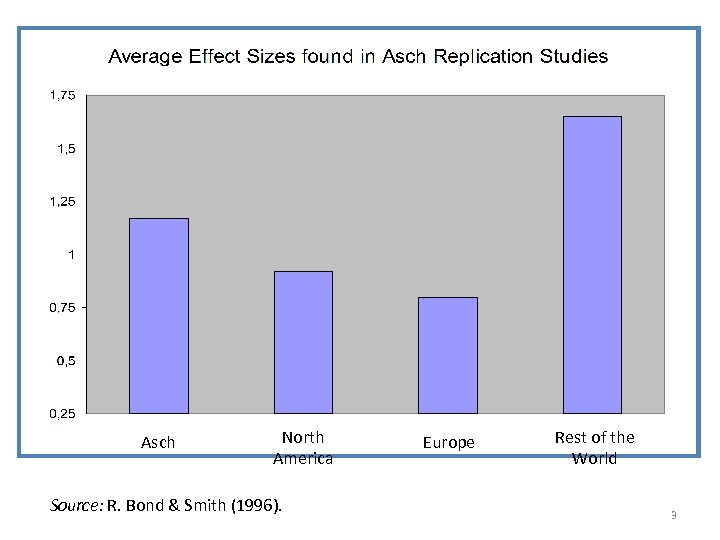
Asch North America Source: R. Bond & Smith (1996). Europe Rest of the World 3
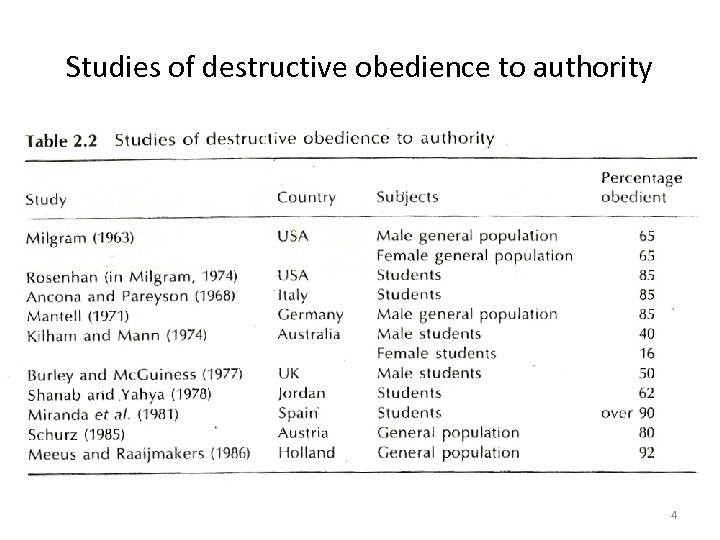
Studies of destructive obedience to authority 4
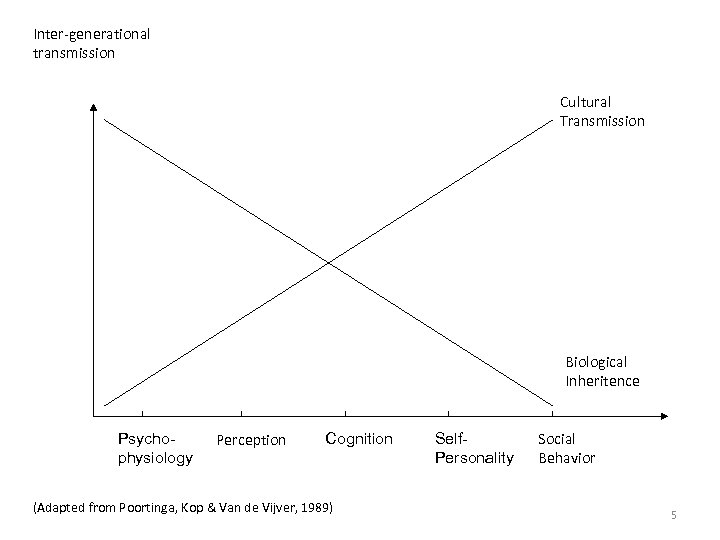
Inter-generational transmission Cultural Transmission Biological Inheritence Psychophysiology Perception Cognition (Adapted from Poortinga, Kop & Van de Vijver, 1989) Self. Personality Social Behavior 5
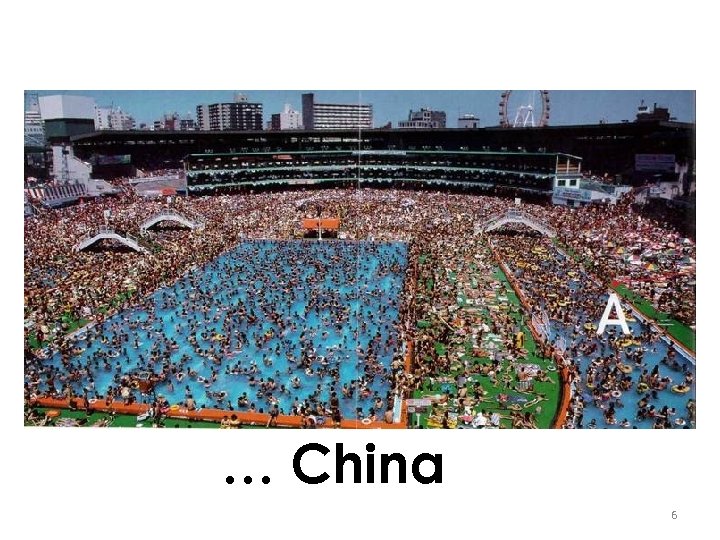
… China 6
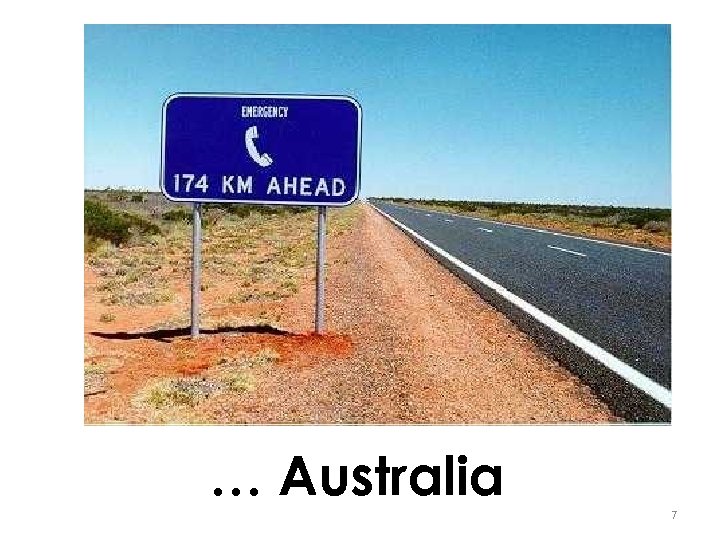
… Australia 7
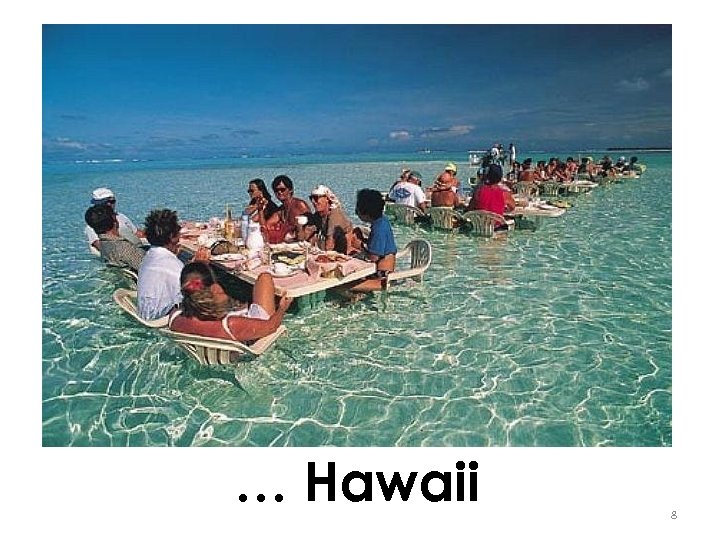
… Hawaii 8
… India 9

… Texas 10
… London 11
… Caribbean 12
… USA 13
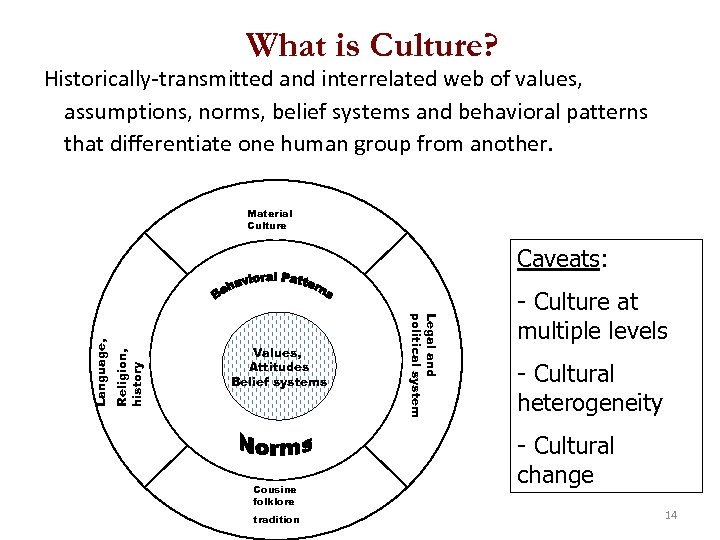
What is Culture? Historically-transmitted and interrelated web of values, assumptions, norms, belief systems and behavioral patterns that differentiate one human group from another. Material Culture Religion, history Values, Attitudes Belief systems Cousine folklore tradition Legal and political system Language, Caveats: - Culture at multiple levels - Cultural heterogeneity - Cultural change 14
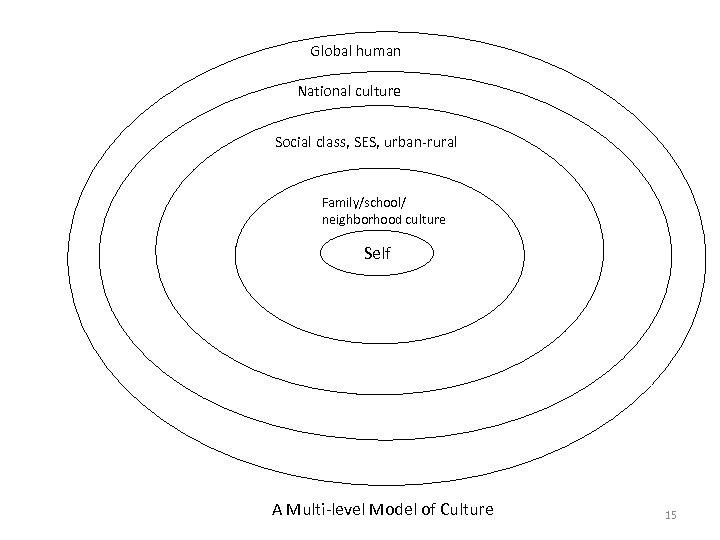
Global human National culture Social class, SES, urban-rural Family/school/ neighborhood culture Self A Multi-level Model of Culture 15
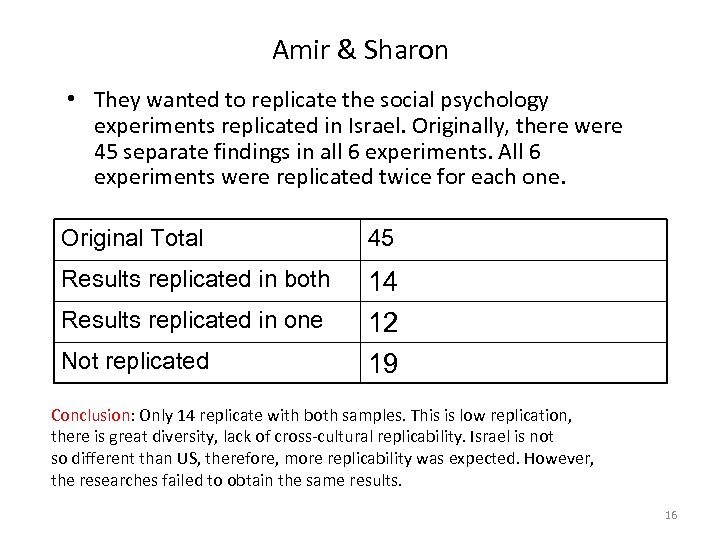
Amir & Sharon • They wanted to replicate the social psychology experiments replicated in Israel. Originally, there were 45 separate findings in all 6 experiments. All 6 experiments were replicated twice for each one. Original Total 45 Results replicated in both 14 12 19 Results replicated in one Not replicated Conclusion: Only 14 replicate with both samples. This is low replication, there is great diversity, lack of cross-cultural replicability. Israel is not so different than US, therefore, more replicability was expected. However, the researches failed to obtain the same results. 16
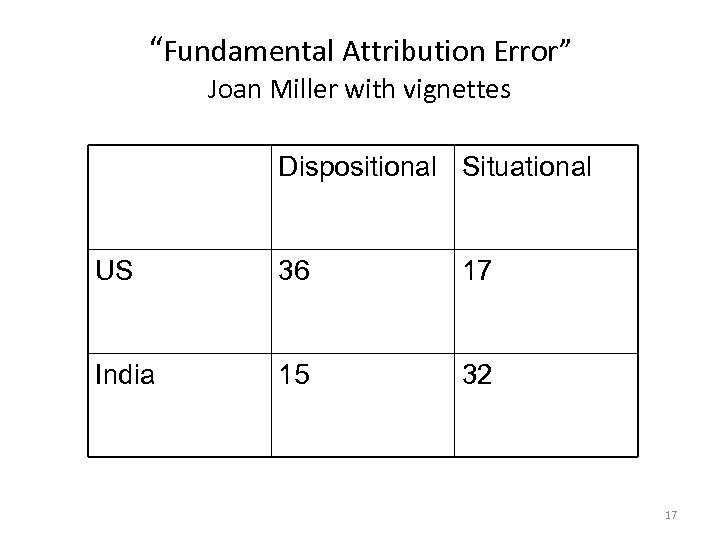
“Fundamental Attribution Error” Joan Miller with vignettes Dispositional Situational US 36 17 India 15 32 17
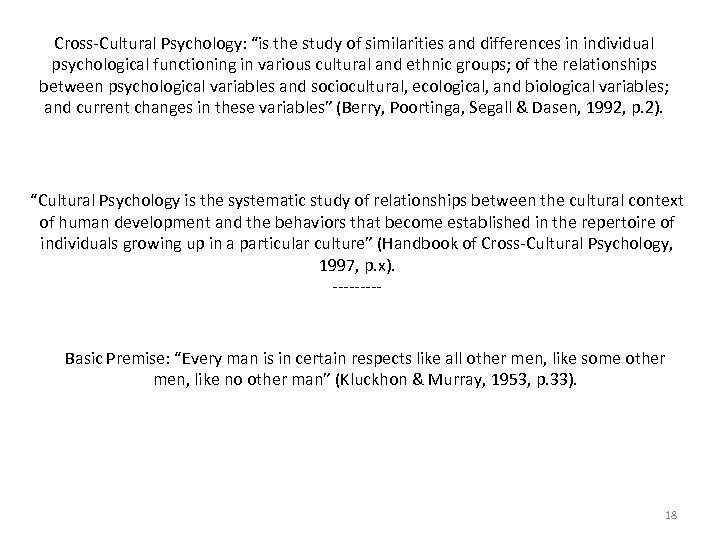
Cross-Cultural Psychology: “is the study of similarities and differences in individual psychological functioning in various cultural and ethnic groups; of the relationships between psychological variables and sociocultural, ecological, and biological variables; and current changes in these variables” (Berry, Poortinga, Segall & Dasen, 1992, p. 2). “Cultural Psychology is the systematic study of relationships between the cultural context of human development and the behaviors that become established in the repertoire of individuals growing up in a particular culture” (Handbook of Cross-Cultural Psychology, 1997, p. x). ----- Basic Premise: “Every man is in certain respects like all other men, like some other men, like no other man” (Kluckhon & Murray, 1953, p. 33). 18
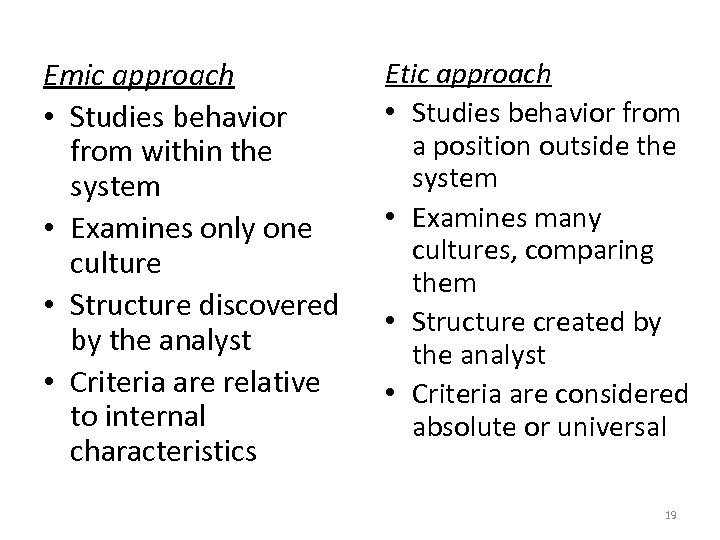
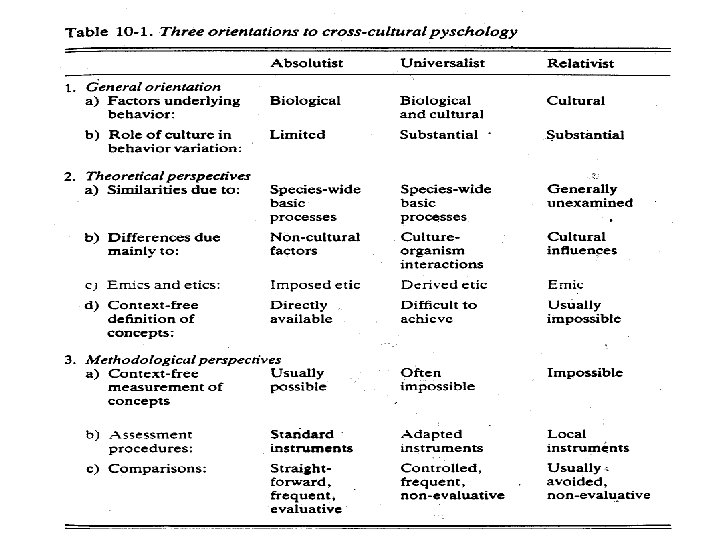
Emic approach • Studies behavior from within the system • Examines only one culture • Structure discovered by the analyst • Criteria are relative to internal characteristics Etic approach • Studies behavior from a position outside the system • Examines many cultures, comparing them • Structure created by the analyst • Criteria are considered absolute or universal 19
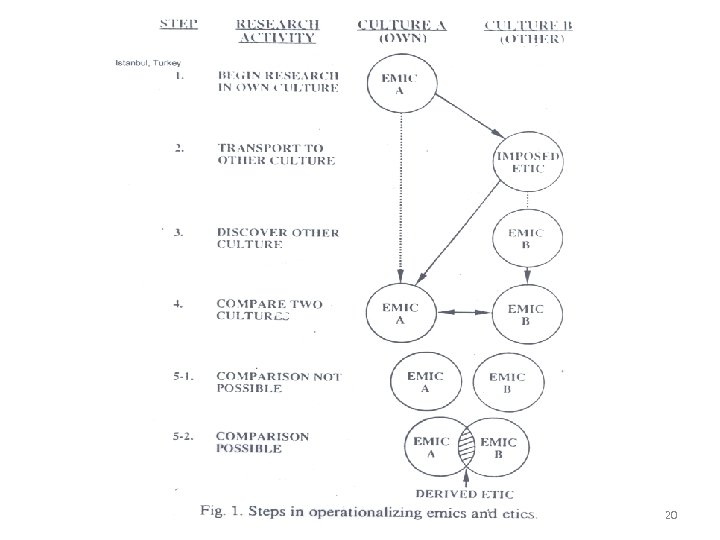
20
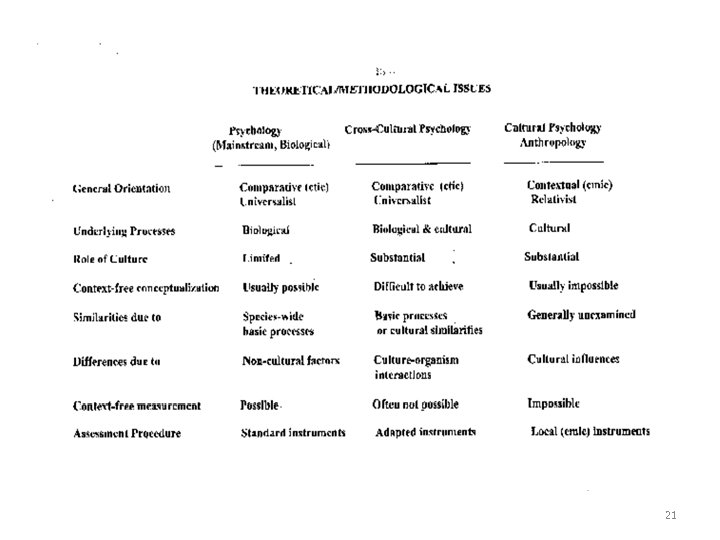
21
22
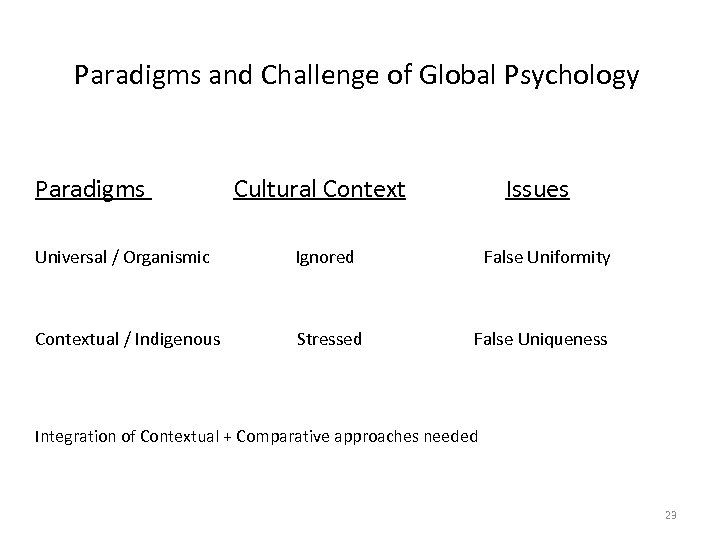
Paradigms and Challenge of Global Psychology Paradigms Cultural Context Universal / Organismic Ignored Contextual / Indigenous Stressed Issues False Uniformity False Uniqueness Integration of Contextual + Comparative approaches needed 23
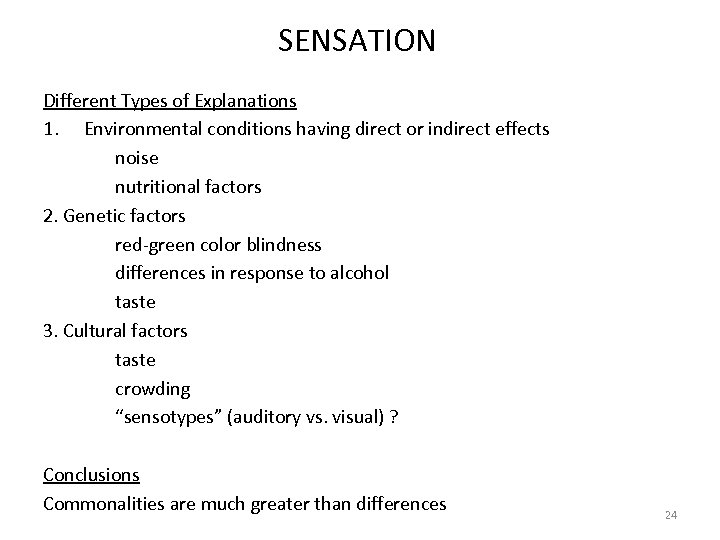
SENSATION Different Types of Explanations 1. Environmental conditions having direct or indirect effects noise nutritional factors 2. Genetic factors red-green color blindness differences in response to alcohol taste 3. Cultural factors taste crowding “sensotypes” (auditory vs. visual) ? Conclusions Commonalities are much greater than differences 24
25
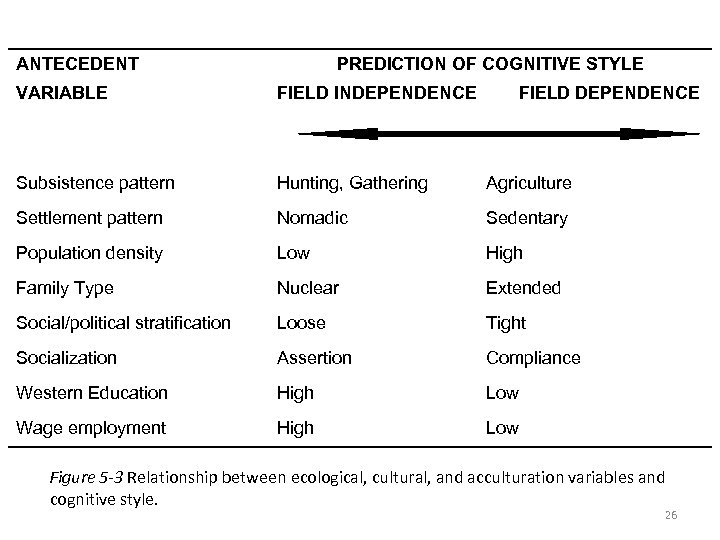
ANTECEDENT PREDICTION OF COGNITIVE STYLE VARIABLE FIELD INDEPENDENCE FIELD DEPENDENCE Subsistence pattern Hunting, Gathering Agriculture Settlement pattern Nomadic Sedentary Population density Low High Family Type Nuclear Extended Social/political stratification Loose Tight Socialization Assertion Compliance Western Education High Low Wage employment High Low Figure 5 -3 Relationship between ecological, cultural, and acculturation variables and cognitive style. 26
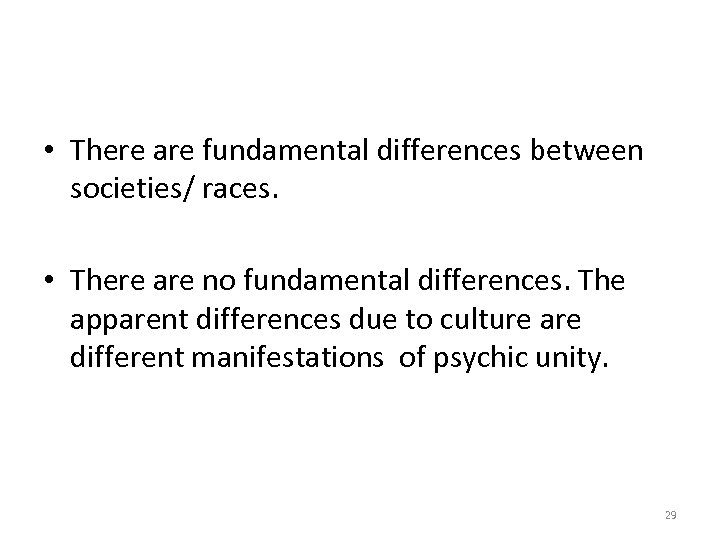
• There are fundamental differences between societies/ races. • There are no fundamental differences. The apparent differences due to culture are different manifestations of psychic unity. 29
30
Communication Experiment 31
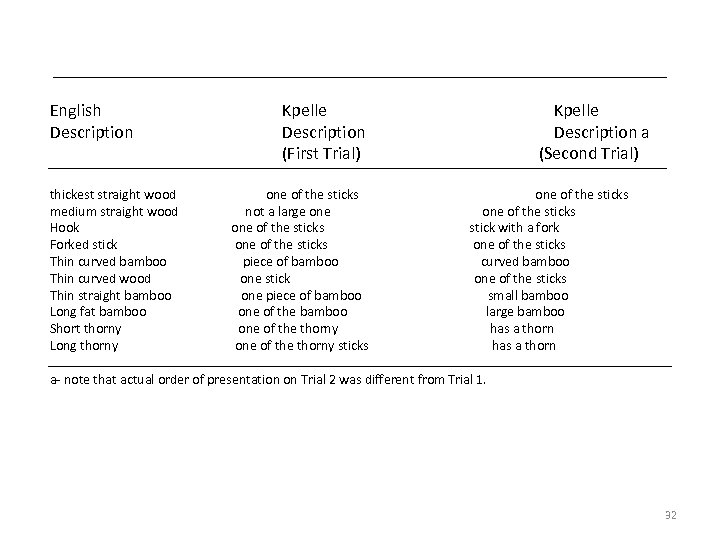
English Description thickest straight wood medium straight wood Hook Forked stick Thin curved bamboo Thin curved wood Thin straight bamboo Long fat bamboo Short thorny Long thorny Kpelle Description (First Trial) one of the sticks not a large one of the sticks piece of bamboo one stick one piece of bamboo one of the thorny sticks Kpelle Description a (Second Trial) one of the sticks stick with a fork one of the sticks curved bamboo one of the sticks small bamboo large bamboo has a thorn a- note that actual order of presentation on Trial 2 was different from Trial 1. 32
Sanza A man says in the presence of his wife to his friend “friend, those swallows, how they flit about there. ” He is speaking about the flightiness of his wife and in case should understand the allusion, he covers himself by looking up at the swallows as he makes his seemingly innocent remark. His friend understands what he means and replies “yes, sir, do not talk to me about those swallows, how they come here, sir!” (What you say is only too true). His wife also understands what he means and says tartly, “yes, sir, you leave that she (wife) to take a good she (wife), sir, since you married a swallow, sir!” (Marry someone else if that is the way you feel about it. ) The husband looks surprised and pained that his wife would take umbrage at a harmless remark about swallows. He says to her, “does one get touchy about what is above (swallows), madam? ” She replies, “Ai, sir. Deceiving me is not agreeable to me. You speak about me. You will fall from my tree. ” The sense of this reply is, “you are a fool to try and deceive me in my presence. It is me you speak about and you are always going at me. I will run away and something will happen to you when you try and follow me” (p. 211). Evans-Pritchard 33
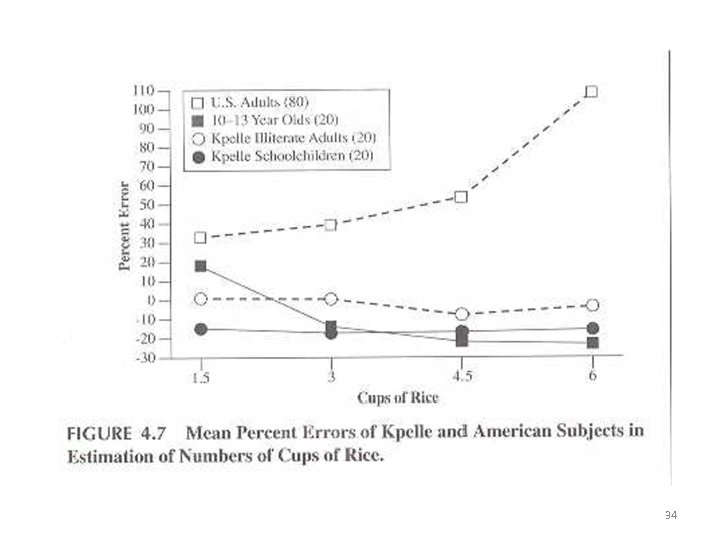
34
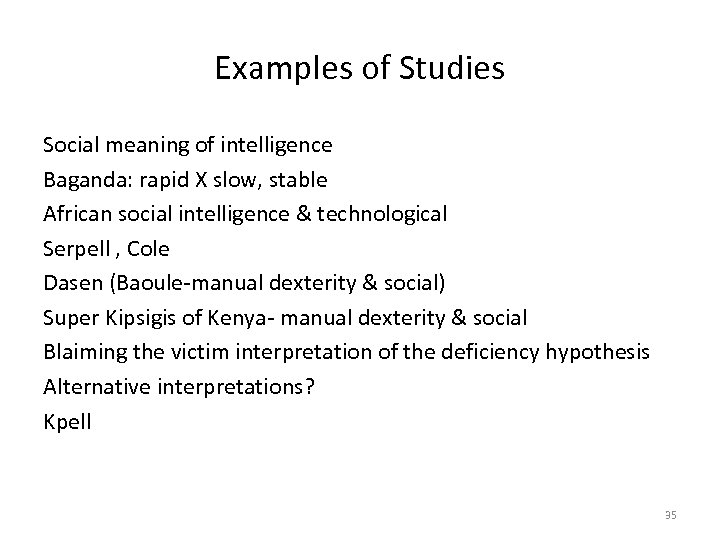
Examples of Studies Social meaning of intelligence Baganda: rapid X slow, stable African social intelligence & technological Serpell , Cole Dasen (Baoule-manual dexterity & social) Super Kipsigis of Kenya- manual dexterity & social Blaiming the victim interpretation of the deficiency hypothesis Alternative interpretations? Kpell 35
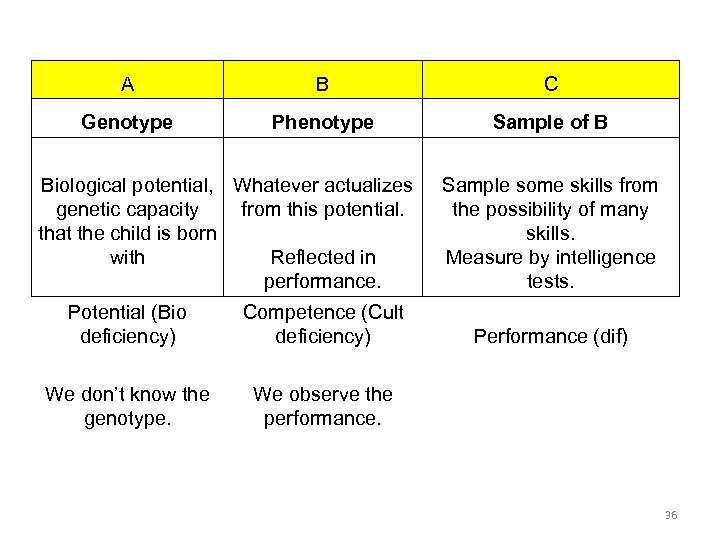
A B C Genotype Phenotype Sample of B Biological potential, Whatever actualizes genetic capacity from this potential. that the child is born with Reflected in performance. Potential (Bio deficiency) Competence (Cult deficiency) We don’t know the genotype. Sample some skills from the possibility of many skills. Measure by intelligence tests. We observe the performance. Performance (dif) 36
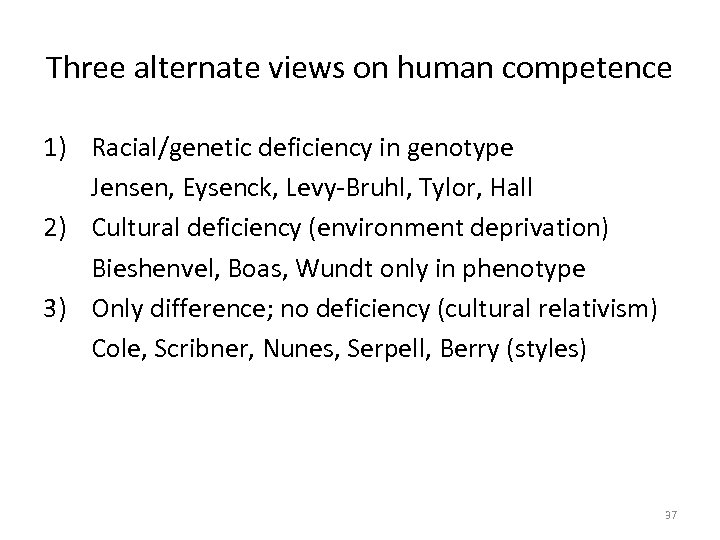
Three alternate views on human competence 1) Racial/genetic deficiency in genotype Jensen, Eysenck, Levy-Bruhl, Tylor, Hall 2) Cultural deficiency (environment deprivation) Bieshenvel, Boas, Wundt only in phenotype 3) Only difference; no deficiency (cultural relativism) Cole, Scribner, Nunes, Serpell, Berry (styles) 37
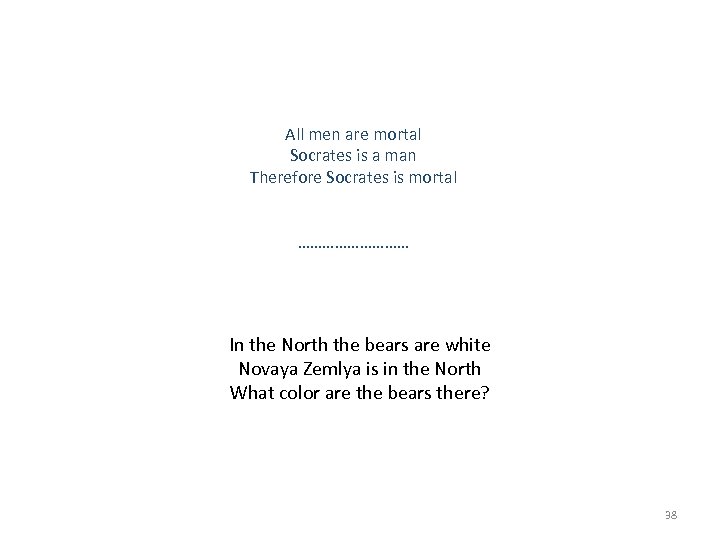
All men are mortal Socrates is a man Therefore Socrates is mortal …………… In the North the bears are white Novaya Zemlya is in the North What color are the bears there? 38
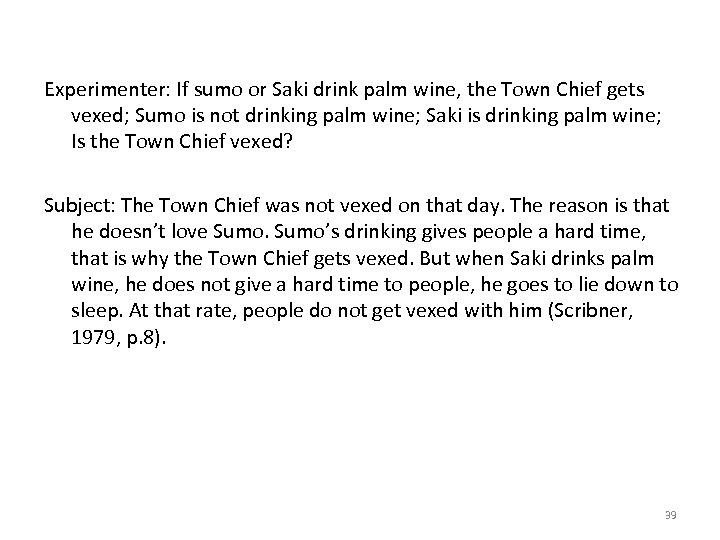
Experimenter: If sumo or Saki drink palm wine, the Town Chief gets vexed; Sumo is not drinking palm wine; Saki is drinking palm wine; Is the Town Chief vexed? Subject: The Town Chief was not vexed on that day. The reason is that he doesn’t love Sumo’s drinking gives people a hard time, that is why the Town Chief gets vexed. But when Saki drinks palm wine, he does not give a hard time to people, he goes to lie down to sleep. At that rate, people do not get vexed with him (Scribner, 1979, p. 8). 39
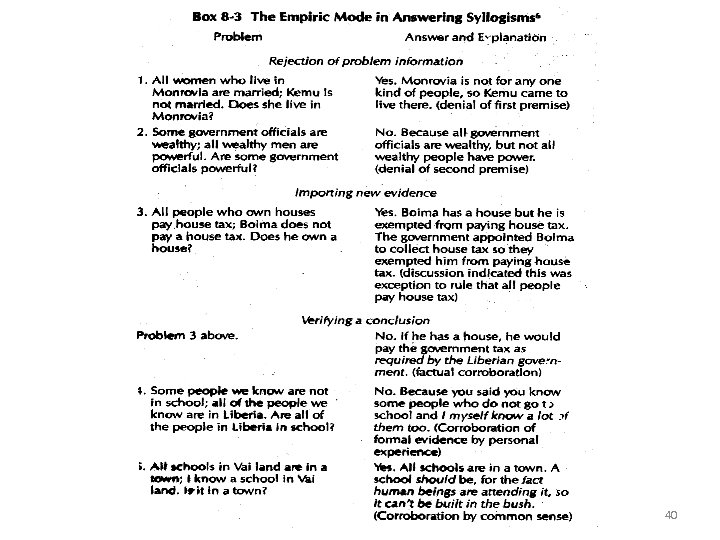
40
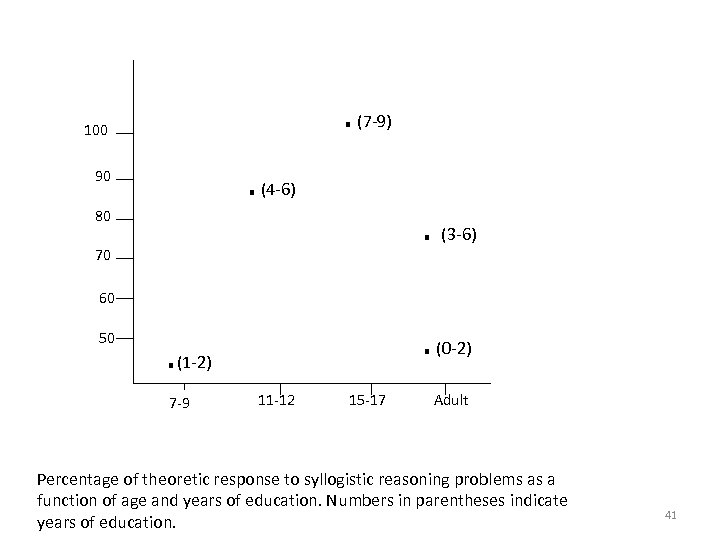
. (7 -9) 100 . (4 -6) 90 80 . (3 -6) 70 60 50 . (0 -2) . (1 -2) 7 -9 11 -12 15 -17 Adult Percentage of theoretic response to syllogistic reasoning problems as a function of age and years of education. Numbers in parentheses indicate years of education. 41
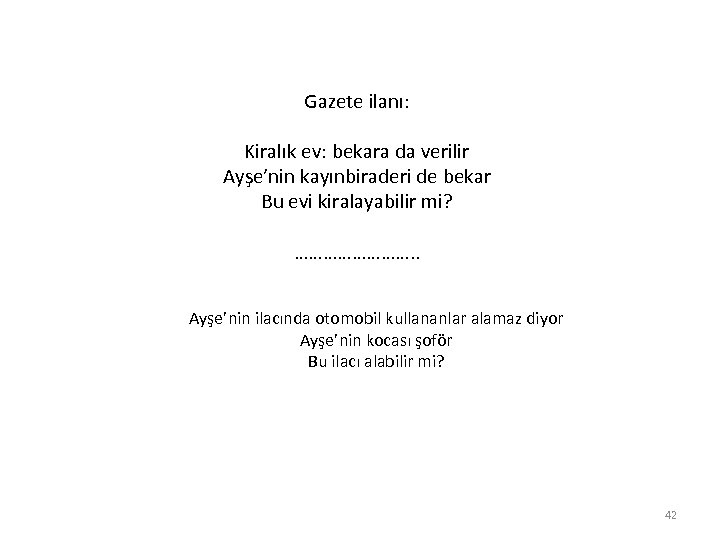
Gazete ilanı: Kiralık ev: bekara da verilir Ayşe’nin kayınbiraderi de bekar Bu evi kiralayabilir mi? …………. . Ayşe’nin ilacında otomobil kullananlar alamaz diyor Ayşe’nin kocası şoför Bu ilacı alabilir mi? 42
• There are fundamental differences between societies/ races. • There are no fundamental differences. The apparent differences due to culture are different manifestations of psychic unity. 43
44
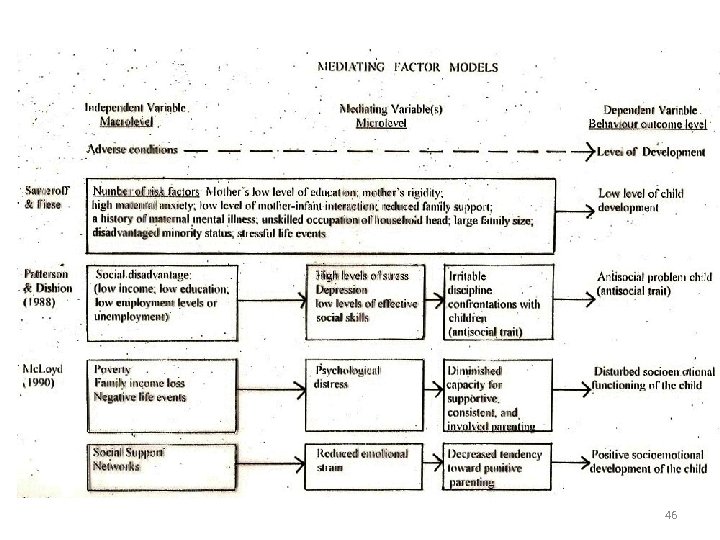
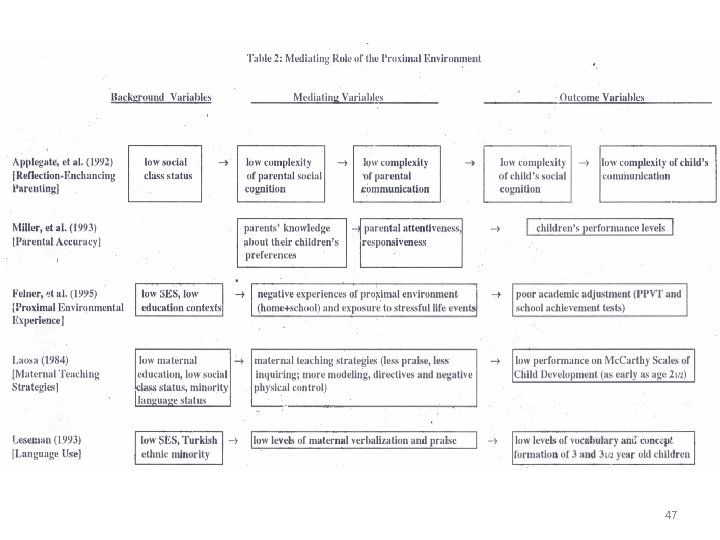
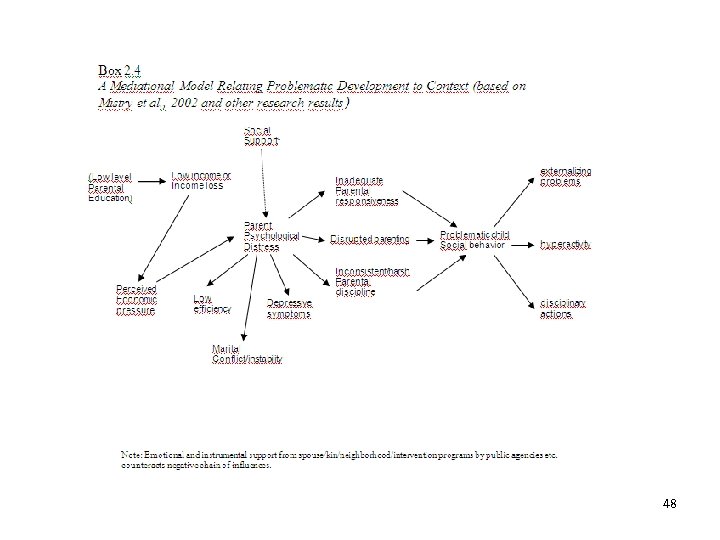
Effects of Growing Up in Poverty • Children at younger ages are more at risk (Duncan & Magnuson, 2003; Hoffman, 2003). • The greater negative impact of family economic hardship on boys than on girls (Bolger, Patterson, Thomson & Kupersmidt, 1995; Huston, Duncan, Granger, Bos, Mc. Loyd, Mistry et al, 2001). • The positive effects of welfare programs on all the children. (i. e; Gennetian & Miller (2002)) • The neighborhood embeds the family and the child. (i. e; Kohen, Brooks. Gunn, Leventhal & Hertzman (2002)) • The moderating role of the neighborhood between social support and parenting behaviors. (Ceballo & Mc. Loyd, 2002) 45
46
47
48
Misfits with Changing Life Styles • • Nunes- Mexican parents in the U. S. A. Okagaki & Sternberg- Immigrants in the U. S. A Dekovic et al- Immigrants in the Europe Aksu-Koc – Work in Turkey 49
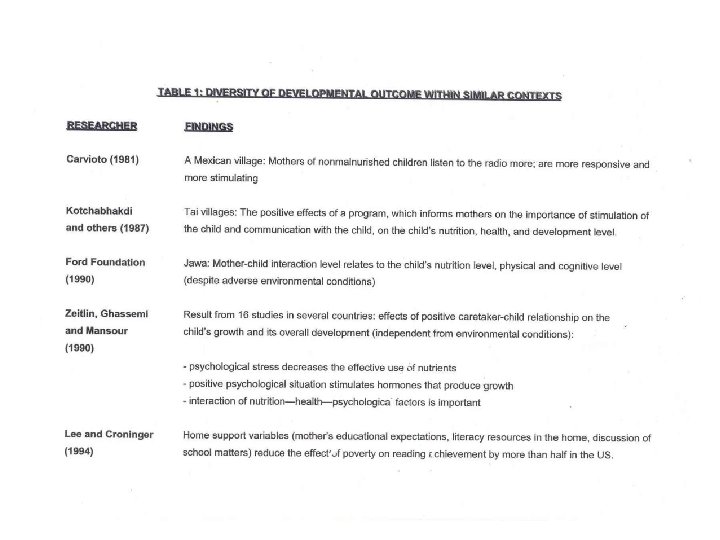
50
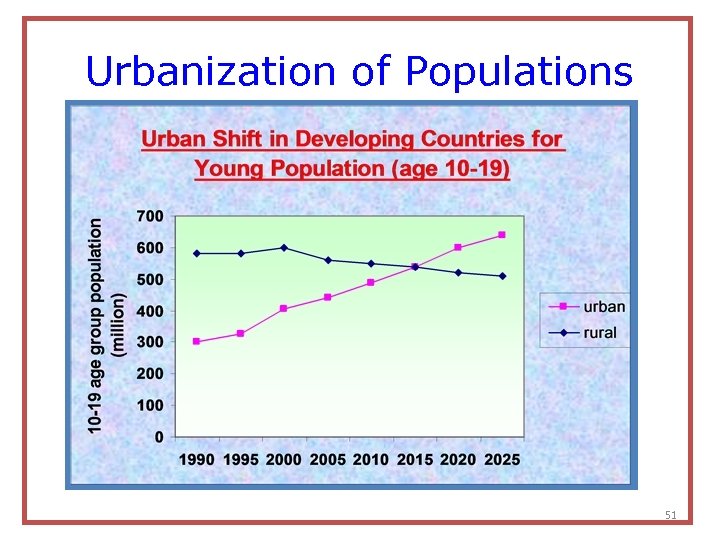
Urbanization of Populations 51
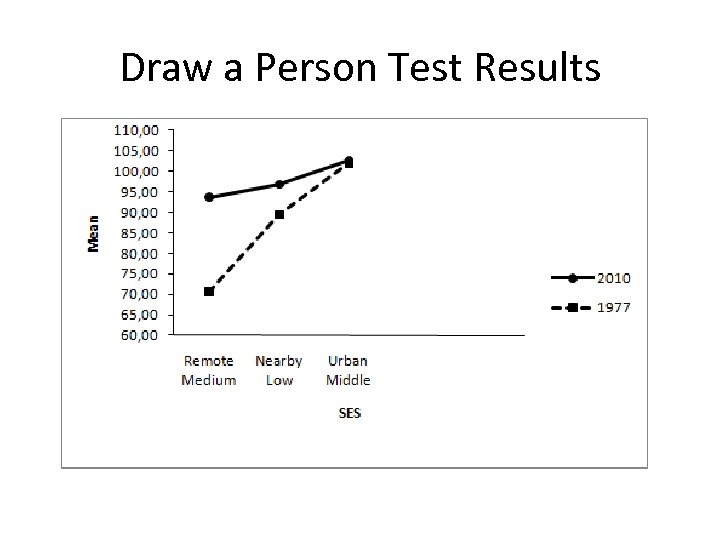
Draw a Person Test Results
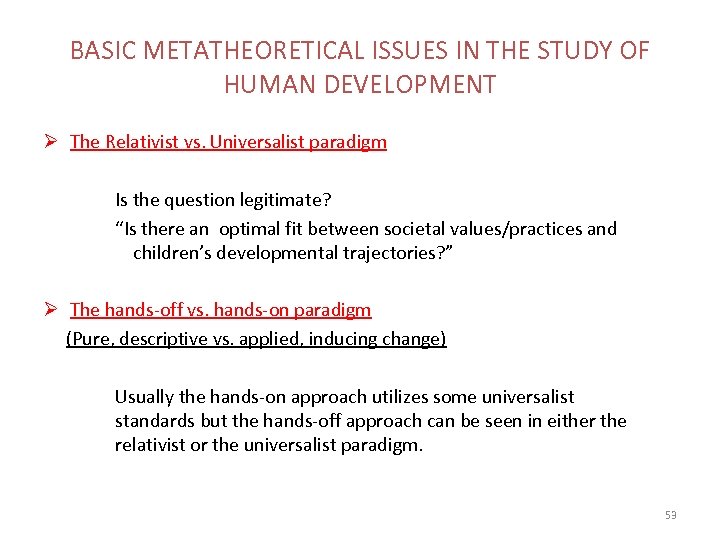
BASIC METATHEORETICAL ISSUES IN THE STUDY OF HUMAN DEVELOPMENT Ø The Relativist vs. Universalist paradigm Is the question legitimate? “Is there an optimal fit between societal values/practices and children’s developmental trajectories? ” Ø The hands-off vs. hands-on paradigm (Pure, descriptive vs. applied, inducing change) Usually the hands-on approach utilizes some universalist standards but the hands-off approach can be seen in either the relativist or the universalist paradigm. 53
Ø An integrative Perspective involves – Cultural contextualism and – Shared (universal) standards of human development Ø How can it be materialized? – An innovative conceptualization and methodology For example: • Construing culturally valid and relevant human development and environmental indicators pointing to possibly universally shared attributes • Depicting what is adaptive (functional) and what is not and the changes in these as a result of changing environmental demands • Conductive culturally sensitive research involving local experts informed by indigenous knowledge and research subjects as participants sharing in the decision making • Utilizing naturally sensitive and valid assessment • Considering contextual factors in the interpretation of the research results 54
VALUE OF CHILDREN (VOC) STUDY • A Three-Decade Portrait from Turkey 1975 -2003. Provides evidence for change over time with socioeconomic development and urbanization. • Recent VOC study results from Korea, South Africa, France, Germany, Israel, India, Indonesia and China concur. Kagitcibasi, C. & Ataca, B. (2005) Value of children and family change : A three-decade portrait from Turkey. Applied Psychology: An International Review, 54, 3, 317 -337 (and the whole special issue: G. Trommsdorff, U. Kim & B. Nauck, Eds. ) 55
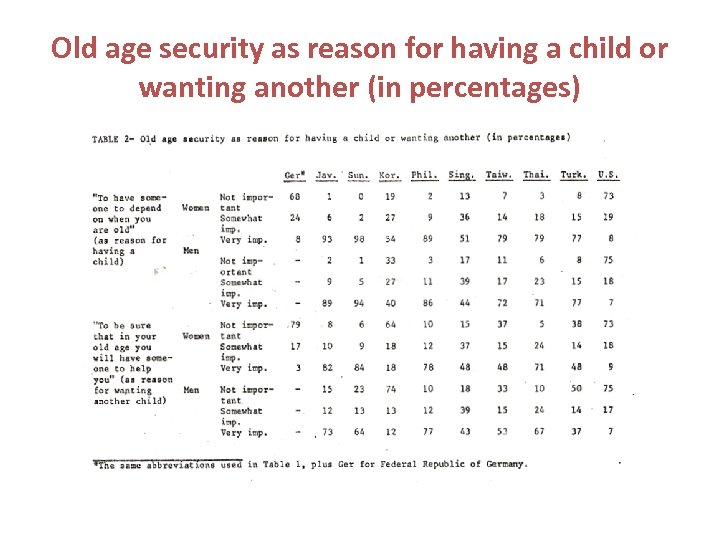
Old age security as reason for having a child or wanting another (in percentages)
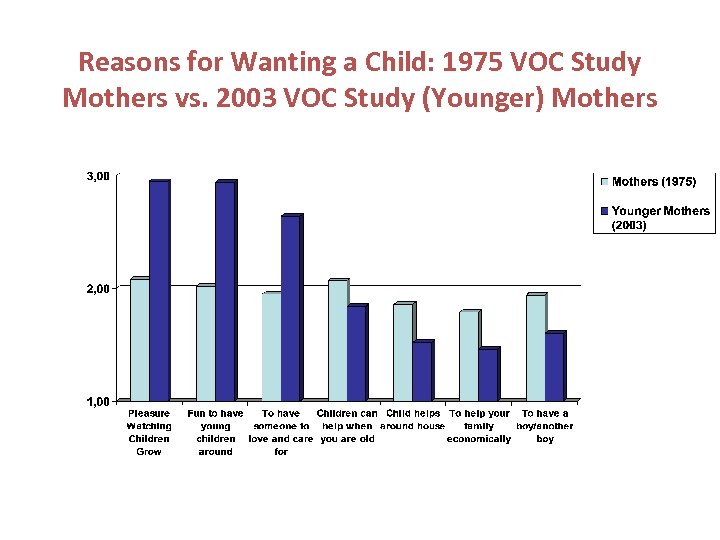
Reasons for Wanting a Child: 1975 VOC Study Mothers vs. 2003 VOC Study (Younger) Mothers
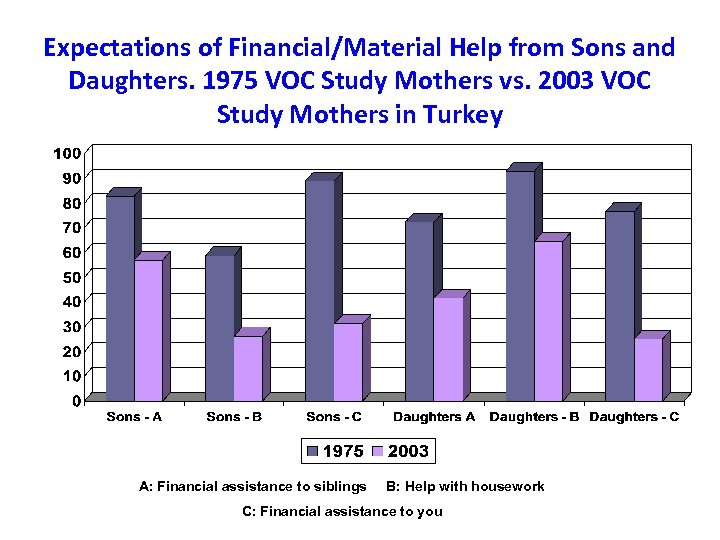
Expectations of Financial/Material Help from Sons and Daughters. 1975 VOC Study Mothers vs. 2003 VOC Study Mothers in Turkey A: Financial assistance to siblings B: Help with housework C: Financial assistance to you
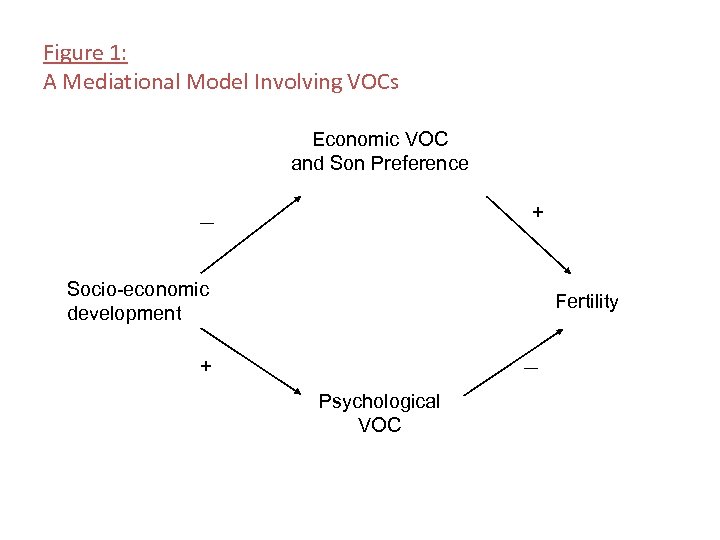
Figure 1: A Mediational Model Involving VOCs Economic VOC and Son Preference + __ Socio-economic development Fertility + __ Psychological VOC
Скачать презентацию CULTURE BEHAVIOR Psyc 432 Soci 432 Prof
b255e641bd545d1aee5a2bab93ee5b58.ppt