


 Скачать презентацию Cultural Studies Lecture 1 What is culture Cultural
Cult_Stud_Lec_1.pptx
- Количество слайдов: 13
 Cultural Studies Lecture 1 What is culture? Cultural studies as a scientific discipline 1. 1. Cultural studies as a scientific discipline 1. 2. Main categories of the cultural studies. 1. 3. Main functions of culture
 1. 1. Cultural studies as a scientific discipline The word –culture- descends from Latin –cultura- that means cultivation, the plowing the field. In the first century B. C. Cicero the Roman philosopher at first said of necessity of one’s own soul cultivation. From that time on the word went in Latin and later all other European and other languages. What is the culture? A lot of different definitions of culture exist. Some scholars number 200 or even 500 definitions of culture. Among them are the following: I. Kant said that culture is ability to ascend from the animal to high -moral existing. F. Schiller – culture is a harmony and reconcilement of physical and moral natures. H. Hegel – culture is overcoming of the biologic beginning in human and its (human) familiarizing to the World Whole. Culture is the set of the achievements in the society as a result of material and spiritual development.
 The subject matter of the cultural studies is culture and its different aspects. Cultural studies may be subdivided into theory and history of culture. The theory of culture considers what the phenomenon of culture is, its role in human life, laws and mechanisms of cultural development, diffusion, intercultural communication etc.
 Cultural studies were pointed out into a separate scientific discipline by an American anthropologist Leslie White. He defined this discipline as an integrative knowledge about the holistic (целостный) phenomenon of culture in the real historic time of its existence as well as a set of particular scientific disciplines studying separate sublevels of culture according to specialized types of human activity (economic, politic, religious, artistic)
 1. 2. Main categories of culture Material culture - include items with physical substance, they are primarily shaped or produced by human action (think about the examples) Spiritual culture – consists of the value reconsideration of all the knowledge, common tastes and priorities the person has obtained, all forms of social consciousness are used (philosophy, science, morality, art) Its elements – intellectual (your examples) - aesthetical (e. g. ) - social (e. g. ) - religious (e. g. )
 There are different approaches to the problem what culture is. They are the following: • technological conceptions of culture ( the base of culture is reduced to tools and instruments human makes and uses; one of the principal differences of human from animals consists in it); • activity conceptions (the sense of culture consists in some or other types of human activities: for example, the playing activity Huizinga, that on restraining one’s own instincts and destructive impulses etc. ); • value conceptions (culture is identified with morals, moral or any other values or achievements of human in different spheres); • semiotic conceptions (culture is defined as a semiotic system (the system of signs)).
 • World culture – synthesis of the best achievement of all national cultures. • National culture – the value system and pride associated with a nation. Many people deny their national culture when they move to a new location, and embrace the national culture of their new home • Mass culture – is popular culture produced by mass production industrial techniques and is marketed for a profit to a mass public of consumers. • Elite(high) culture – it is the culture of an elite such as the aristocracy or intelligentsia, but also defined as a repository of a broad cultural knowledge, as a way of transcending the class system. • Subculture – is a group of people with a culture (whether distinct or hidden) which differentiates them from the larger culture to which they belong • Counterculture – term used to describe the values and norms of behavior of a cultural group, or subculture, that run counter to those of the social mainstream of the day
 1. 3. Main functions of culture • • • Informative function Cognitive function Regulatory function Value function Function of socialization
 Ancient Civilizations Sumer civilization
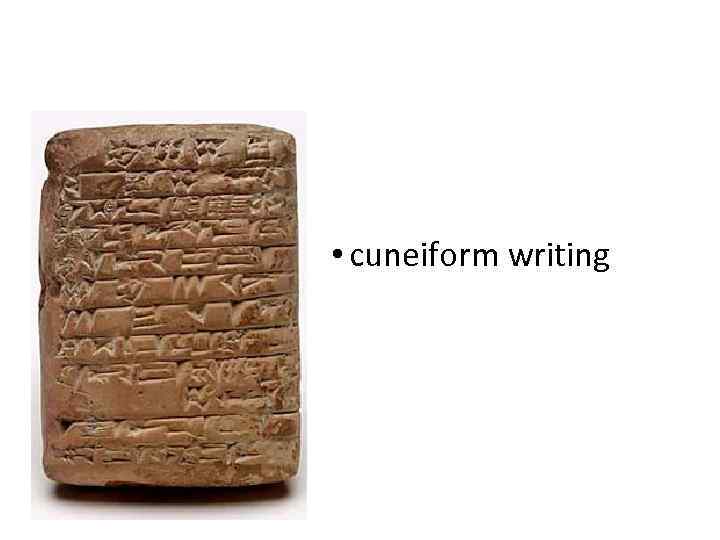 • cuneiform writing
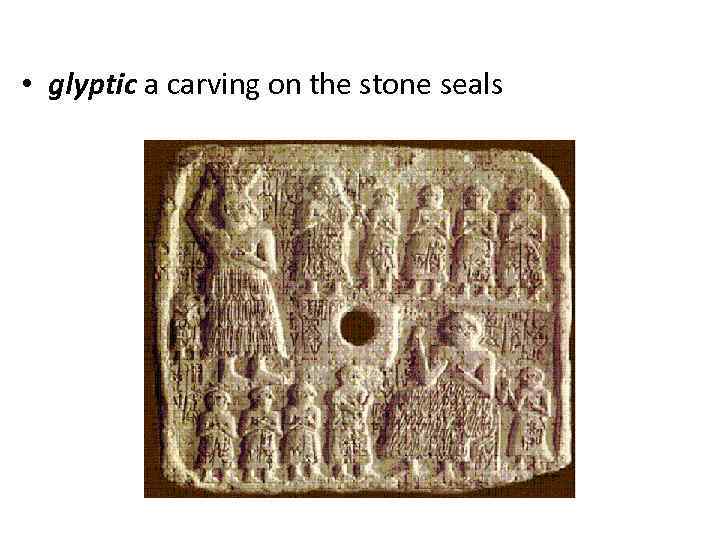 • glyptic a carving on the stone seals
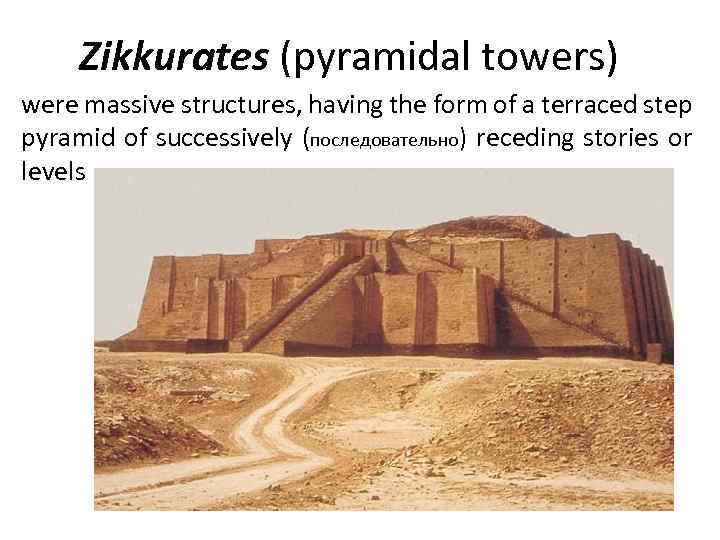 Zikkurates (pyramidal towers) were massive structures, having the form of a terraced step pyramid of successively (последовательно) receding stories or levels
 Ancient Egypt