 Скачать презентацию Cultural Norms It seems to be obvious that
84b459d474db15b5d0c84dad29b6a223.ppt
- Количество слайдов: 44



Cultural Norms It seems to be obvious that one must consider culture when making decisions The culture in one’s workplace The cultures in the world
Pre s e nta t ion Cre d its This p t o Pr r esentat i on b of ess elong N ava or R i s char d rr o. H e o A. copy wns t right and t o t he he t he w mat erial the m ay of pres at eri a entin l. g We ar re us pr ese i ng t h ntat i e on to hi s p er mi s day w sion. it h

F ogg y P oin t s?
Cultural … Why Do We Care? Culture may be defined as the existential t ha outcome or results of the conditioning we w e all receive by living in our physical and ll … by th f a n social environment a ? t o ” irs e me lture The values, beliefs, norms, and behavioral F patterns of a group … Leung et. al. 2003 w “cu do ord The collective programming of the mind that w distinguishes the members of one group from another … Hofstede 1994
Cultures … Why Do We Care? Countries are different Cultures are different People are different Ways of doing business are different We must understand how such differences impact the processes our business use to create optimum outcomes
…W hy D o We Ca re ? Cu ltu re C ultu res a re di f fer en How t do we d A wo efi ne b ea nder ut y? ful pe i s wi thin rso A pre An in tty face? s pi rin g vie Som w? at? n … beau ty ethin g p le asan t t o l o ok
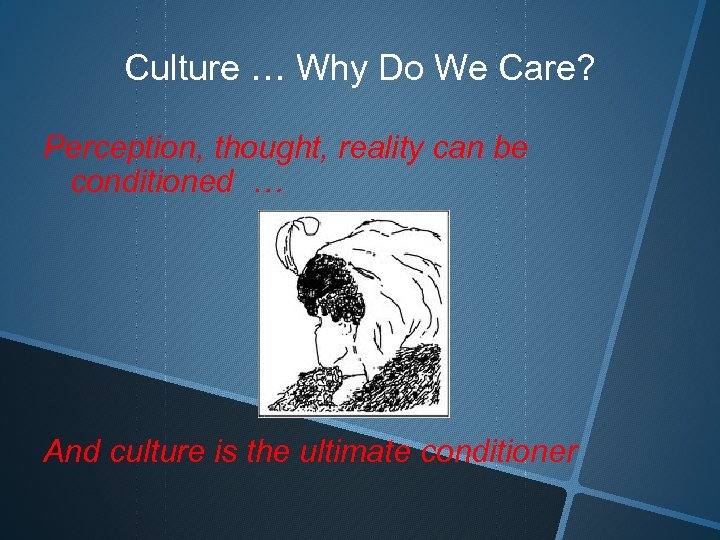
Culture … Why Do We Care? Perception, thought, reality can be conditioned … And culture is the ultimate conditioner
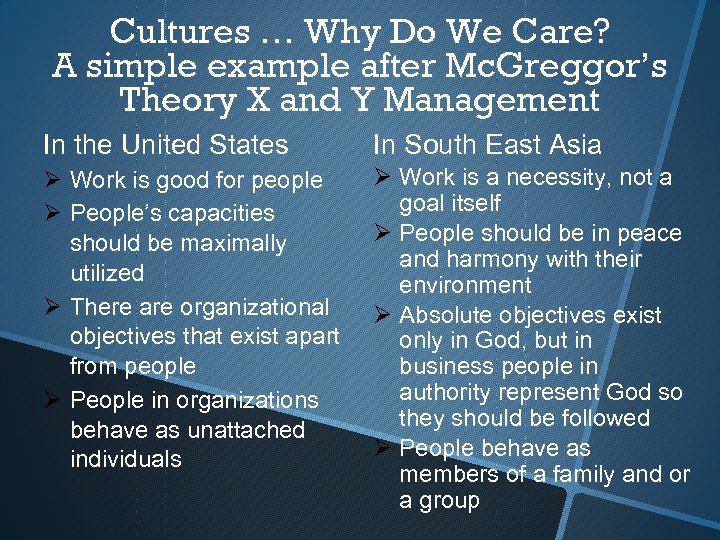
Cultures … Why Do We Care? A simple example after Mc. Greggor’s Theory X and Y Management In the United States In South East Asia Work is good for people People’s capacities should be maximally utilized There are organizational objectives that exist apart from people People in organizations behave as unattached individuals Work is a necessity, not a goal itself People should be in peace and harmony with their environment Absolute objectives exist only in God, but in business people in authority represent God so they should be followed People behave as members of a family and or a group
Cult u ral N orm s Busi n ess Rel at io nsh I n Ja ips p an . . term . Lon r ela t g i onsh and par tn i ps e ri ng In th e U n it ed S. . . C omp e ti ti o t ates dr ive n a n to wa d comm rds oditi z ati on
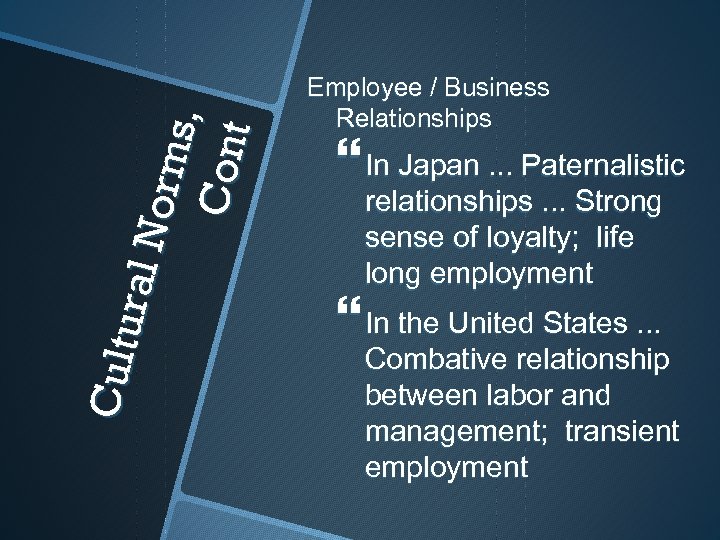
Cu ltu ra l N orm s , Con t Employee / Business Relationships In Japan. . . Paternalistic relationships. . . Strong sense of loyalty; life long employment In the United States. . . Combative relationship between labor and management; transient employment
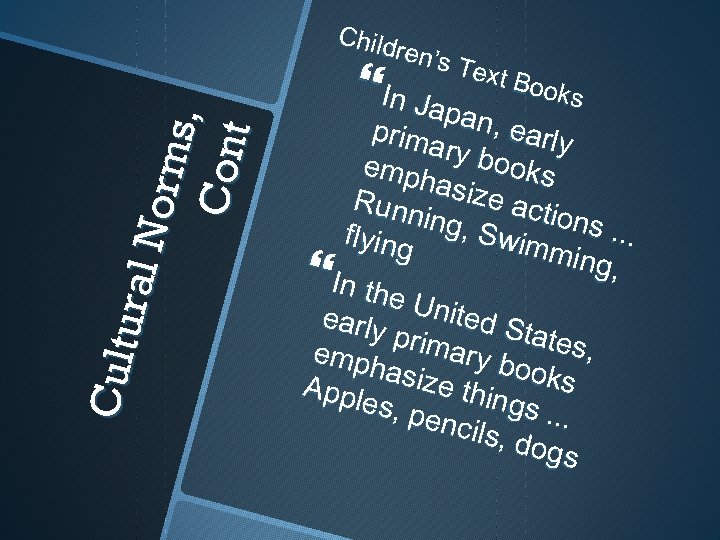
C hild ren ’s Tex t Boo ks In J a Cu ltu ra l N orm s , Con t apan , ea r pri m l y ary b ooks emp hasi z e ac Run n t ions ing, . . . S wim fl yin g m ing , In th e Un ited S early tat es pr im , ary b em ph ooks asiz e thin App l es, p enci gs . . . l s, do gs
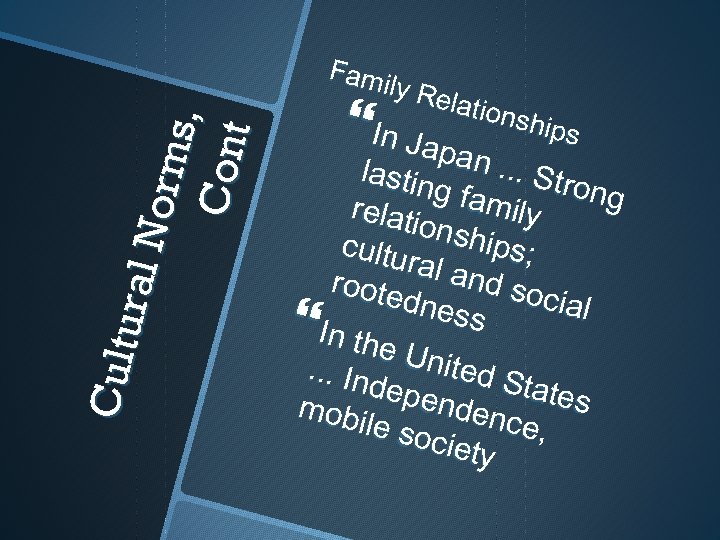
Cu ltu ra l N orm s , Con t Fam ily R e latio ns hip In s Japa n. . . lasti n g fa S trong m il y r ela t i onsh ip s; cu lt u ra l a nd so roo te cial dn es s I n th e Un it ed . . . In Sta te d epe s nde n mo b ce, il e s o ciet y
Cultural Why Do We Care What does this all mean? Are there implications to be considered when one thinks about BI?
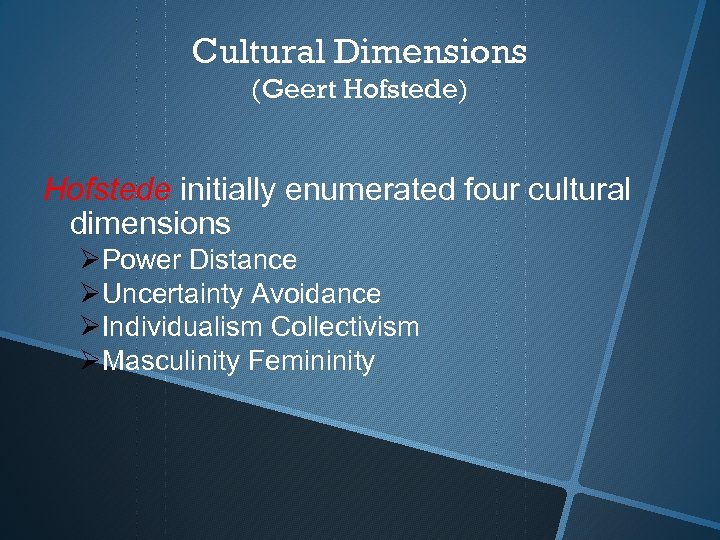
Cultural Dimensions (Geert Hofstede) Hofstede initially enumerated four cultural dimensions Power Distance Uncertainty Avoidance Individualism Collectivism Masculinity Femininity
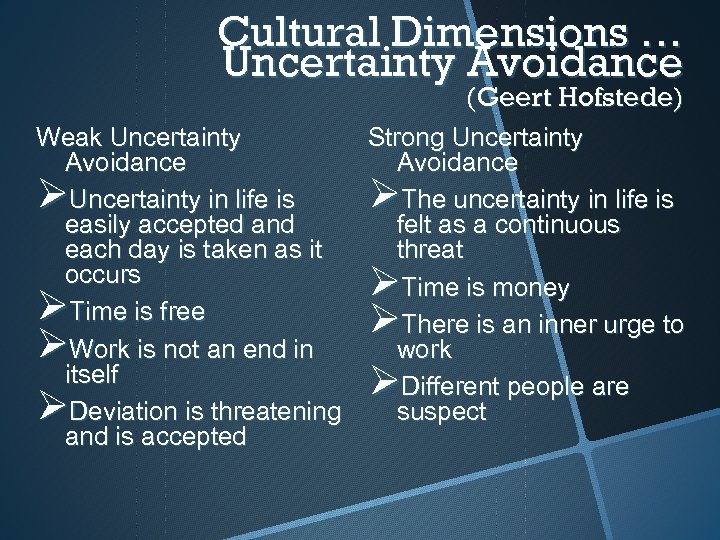
Cultural Dimensions … Uncertainty Avoidance (Geert Hofstede) Weak Uncertainty Strong Uncertainty Avoidance Uncertainty in life is The uncertainty in life is easily accepted and felt as a continuous each day is taken as it threat occurs Time is money Time is free There is an inner urge to Work is not an end in work itself Different people are Deviation is threatening suspect and is accepted
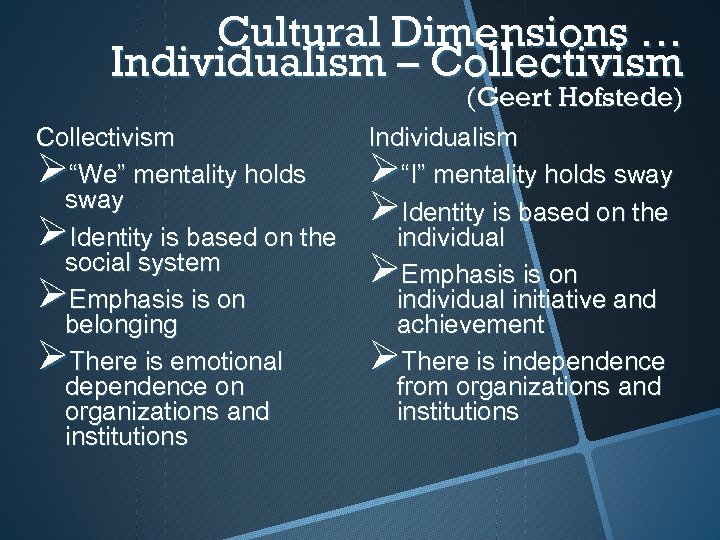
Cultural Dimensions … Individualism – Collectivism (Geert Hofstede) Collectivism Individualism “We” mentality holds “I” mentality holds sway Identity is based on the individual social system Emphasis is on individual initiative and belonging achievement There is emotional There is independence on from organizations and institutions
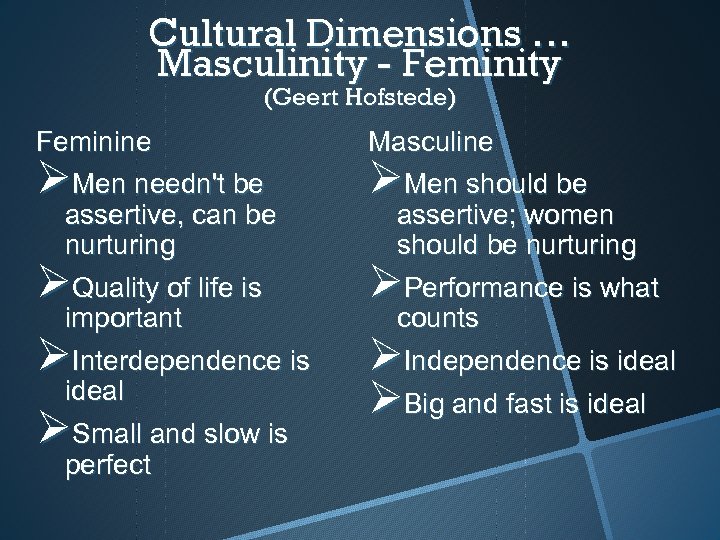
Cultural Dimensions … Masculinity - Feminity (Geert Hofstede) Feminine Men needn't be assertive, can be nurturing Quality of life is important Interdependence is ideal Small and slow is perfect Masculine Men should be assertive; women should be nurturing Performance is what counts Independence is ideal Big and fast is ideal
Cultural Norms, Cont What does this all mean? Are there implications to be considered when one thinks about BI?
Cultural Dimensions (Owens and Mc. Laurin 1993) Owens and Mc. Laurin offered a framework for considering cultural impacts on decision making Six cultural dimensions in decision making Power Distance Uncertainty ( Risk ) Avoidance Individualization vs Collectivism Concept of Time Masculinity vs Femininity Life Focus
Cultural Dimensions (Owens and Mc. Laurin 1993) Power Distance. . . different cultures handle human inequalities differently “Higher” power distance cultures tend to prefer autocracy “Lower” power distance cultures rend to prefer collaboration and lower levels or less formal forms of hierarchical organizations
Cultural Dimensions (Owens and Mc. Laurin 1993) Uncertainty Avoidance. . . Different cultures are inherently more risk or uncertainty adverse than are others Uncertainty adverse cultures may be more cautious when taking actions, take longer to make decisions, and or avoid razor edge (hence unproven) technologies or practices
Cultural Dimensions (Owens and Mc. Laurin 1993) Individualism / Collectivism In “Collectivistic” cultures peer or social pressures impact decision making and actions In “Individualistic” cultures people tend to act independently
Cultural Dimensions (Owens and Mc. Laurin 1993) Concept of Time. . . time is a very culture dependent concept Long time frame cultures take a long view of the word, with appreciation of the future and future consequences Short time frame cultures tend to be more interested in the now and present
Cultural Dimensions (Owens and Mc. Laurin 1993) Masculinity / Femininity Masculine cultures tend to demonstrate, reinforce, and act with 'masculine' characftersits such as assertiveness Feminine cultures tend to exhibit, demonstrate, reinforce, and act with 'feminine' or 'soft' characteristics such as support and nurturance
Cultural Dimensions (Owens and Mc. Laurin 1993) Life-focus. . . people have very different value structures Quantity of life oriented cultures are competitive and generally gain oriented Quality of life oriented cultures are typified by valuing relationships, interdependence, and feelings
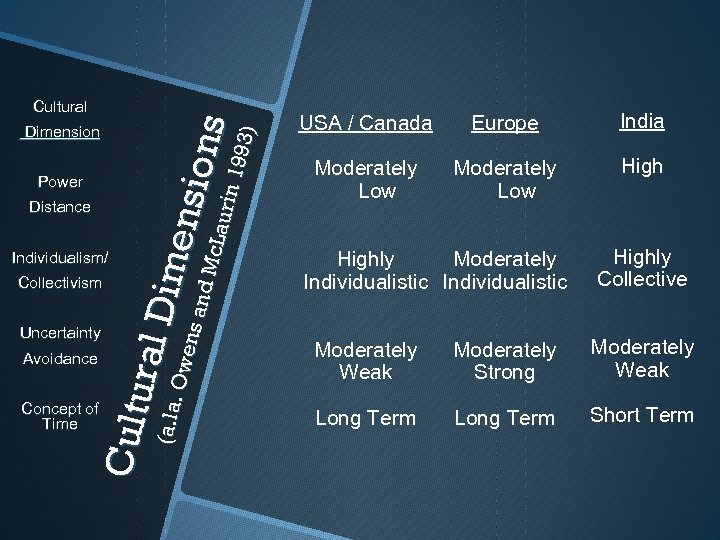
Dimension Power Distance Individualism/ Collectivism Uncertainty n 1 99 3) Cu ltu ral D ( a. la ime n. Ow en s a sio ns nd M c. Lau ri n Cultural USA / Canada Europe India Moderately Low Highly Moderately Individualistic Highly Collective Avoidance Moderately Weak Moderately Strong Moderately Weak Concept of Time Long Term Short Term
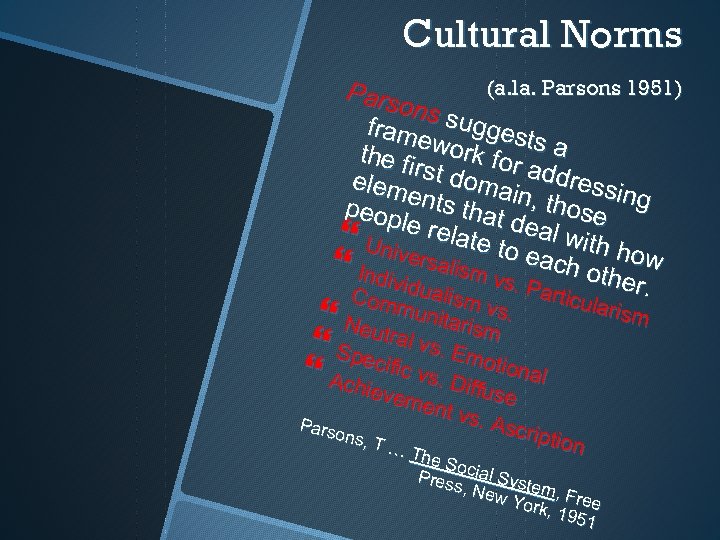
Cultural Norms (a. la. Parsons 1951) Pars ons s ugge fram sts a ewor the f k for i elem rst doma addressi i peop ents that n, those ng d Univle relate t o eal with h Indiv ersalism vs each otheow . Par idual r. C t Comm ism v ticula rism s. unita Neut rism ral vs. Em Spec otion ific v a s. Di Achi ffuse l evem ent v s. As Pars cripti ons, on T … The Soc Pres ial Syst s, Ne e w Yo m, Free rk, 1 951
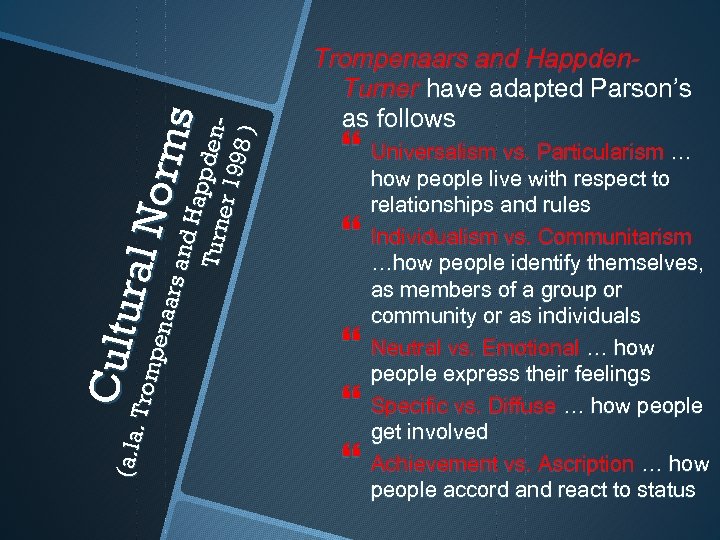
den. Tu rn er 19 98 ) Cult (a. l a. u ral Trom No rm pena ars a nd H s app Trompenaars and Happden. Turner have adapted Parson’s as follows Universalism vs. Particularism … how people live with respect to relationships and rules Individualism vs. Communitarism …how people identify themselves, as members of a group or community or as individuals Neutral vs. Emotional … how people express their feelings Specific vs. Diffuse … how people get involved Achievement vs. Ascription … how people accord and react to status
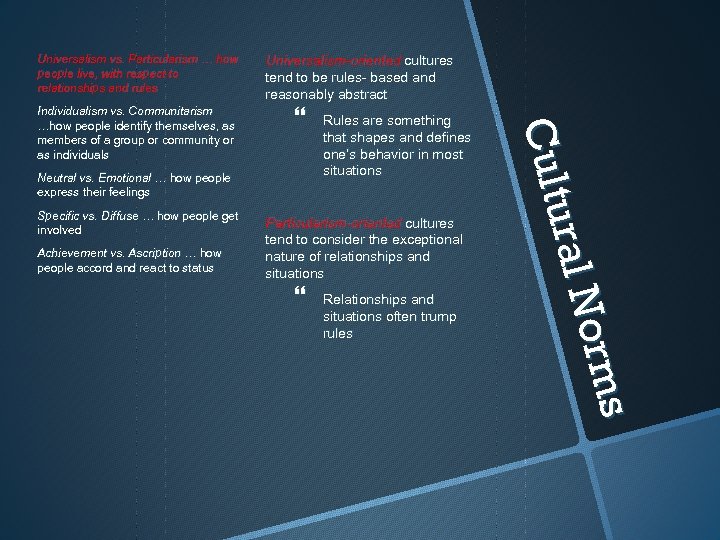
Universalism vs. Particularism … how people live, with respect to relationships and rules Universalism-oriented cultures tend to be rules- based and reasonably abstract Emotional … how people Neutral vs. Emotional … how people express their feelings Specific vs. Diffuse … how people get involved Achievement vs. Ascription … how people accord and react to status Rules are something that shapes and defines one’s behavior in most situations Particularism-oriented cultures tend to consider the exceptional nature of relationships and situations Relationships and situations often trump rules orms ral N Cultu Individualism vs. Communitarism …how people identify themselves, as members of a group or community or as individuals
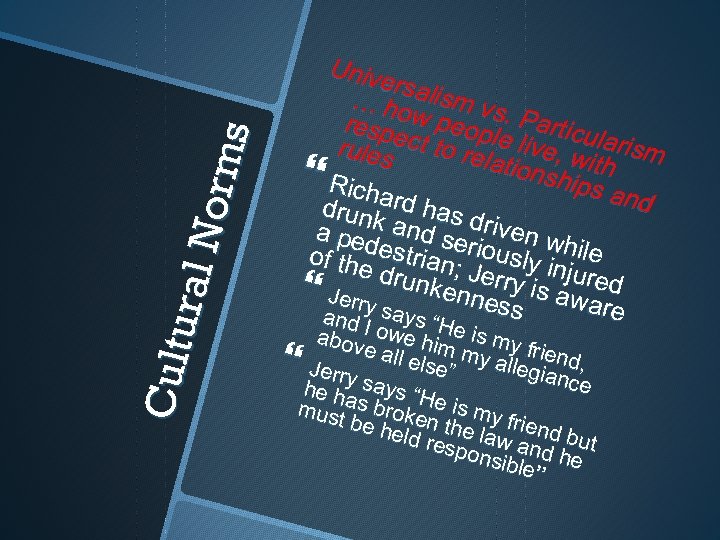
Cult u ral N orm s Univ ersa … ho l is m vs resp e w peop. Parti cu rules ct to re le live, w la ri sm lat ion i th s hips R ich and drun a rd has a pe k and se dri ven w of th d estr ian ; r iously i hile e dr u n nken. Jerr y is ajur ed Jerr ware ness y s ay and I s “ H abov I owe hi e is m y m f e a ll else my alle rie nd, Jerry gianc ” s ay e he h s “ He mu s as broke is m y t be he ld n the l awfr ie nd bu r esp o nsiba nd he t l e”
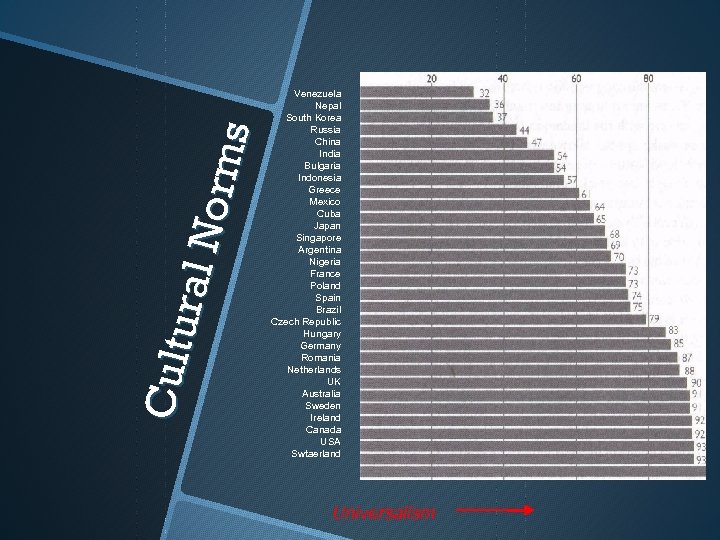
Cult u ral N o rms Venezuela Nepal South Korea Russia China India Bulgaria Indonesia Greece Mexico Cuba Japan Singapore Argentina Nigeria France Poland Spain Brazil Czech Republic Hungary Germany Romania Netherlands UK Australia Sweden Ireland Canada USA Swtaerland Universalism
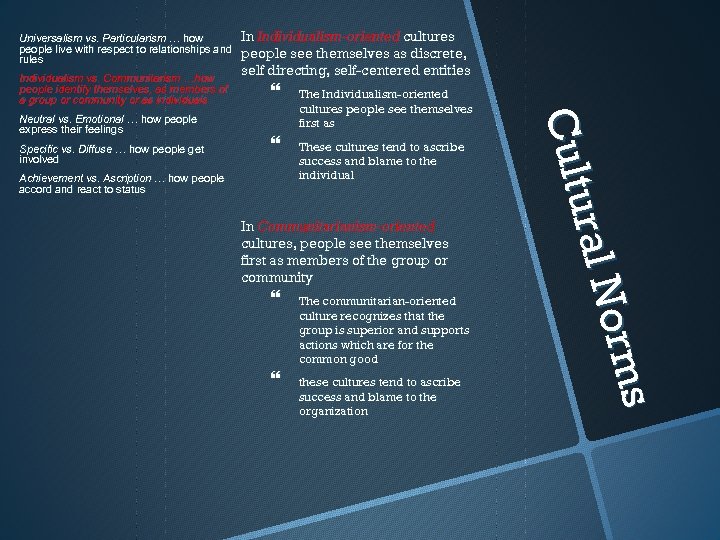
Universalism vs. Particularism … how people live with respect to relationships and rules Individualism vs. Communitarism …how people identify themselves, as members of a group or community or as individuals In Individualism-oriented cultures people see themselves as discrete, self directing, self-centered entities Specific vs. Diffuse … how people get involved Achievement vs. Ascription … how people accord and react to status These cultures tend to ascribe success and blame to the individual In Communitarianism-oriented cultures, people see themselves first as members of the group or community The communitarian-oriented culture recognizes that the group is superior and supports actions which are for the common good these cultures tend to ascribe success and blame to the organization orms ral N Cultu Neutral vs. Emotional … how people express their feelings The Individualism-oriented cultures people see themselves first as
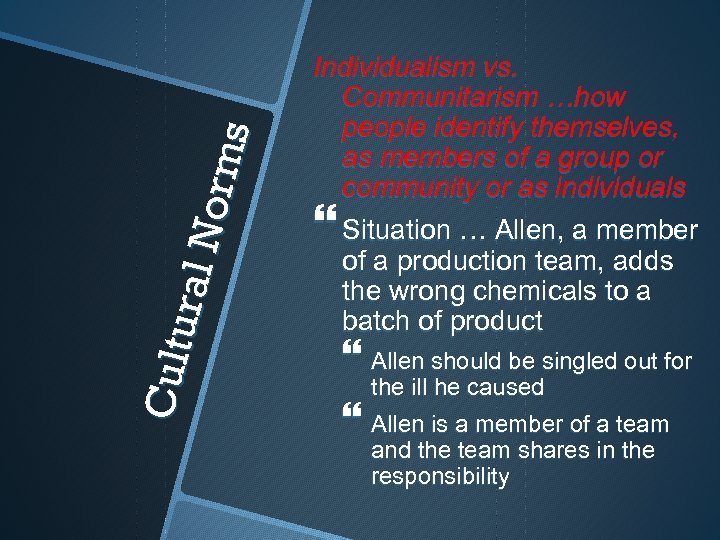
Cult u ral N orm s Individualism vs. Communitarism …how people identify themselves, as members of a group or community or as individuals Situation … Allen, a member of a production team, adds the wrong chemicals to a batch of product Allen should be singled out for the ill he caused Allen is a member of a team and the team shares in the responsibility
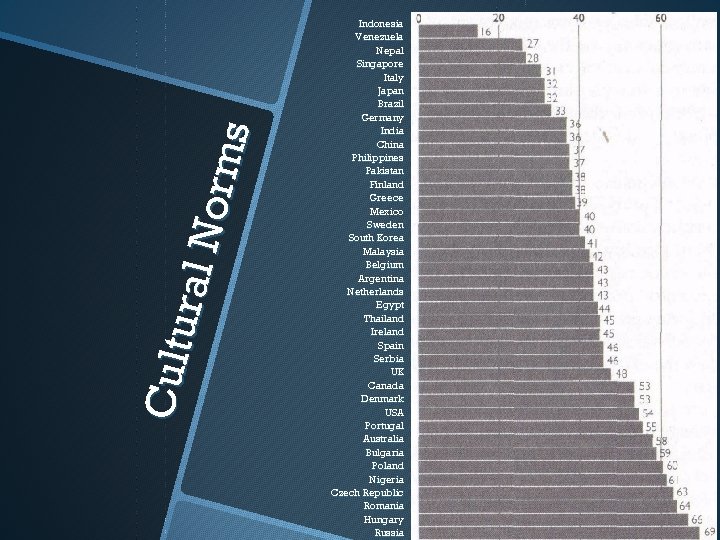
Cult u ral N orm s Indonesia Venezuela Nepal Singapore Italy Japan Brazil Germany India China Philippines Pakistan Finland Greece Mexico Sweden South Korea Malaysia Belgium Argentina Netherlands Egypt Thailand Ireland Spain Serbia UK Canada Denmark USA Portugal Australia Bulgaria Poland Nigeria Czech Republic Romania Hungary Russia
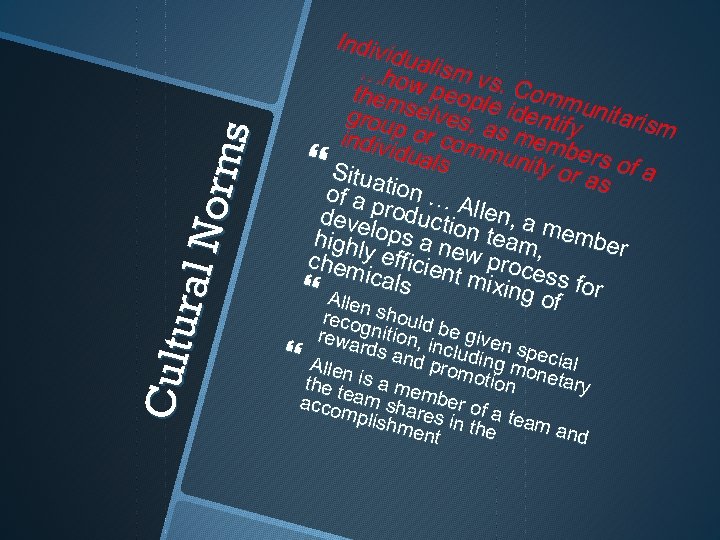
Cult u ral N orm s Indiv idual …h o i sm vs them w peo pl. Comm gr ou selves , e identify unit arism indiv p or comas me m b idual s mu nity ore rs of a Si tua as ti on … o f a A deve p roduc tio llen, a m highl lops a n n tea m emb er chemy effi ci enew proc , i cal s t m ix ess fo ing o r Allen f s ho o re co g ni tio uld be g rewa rds a n, includiv en spe c nd p i Allen r omong moneial t ar y t io n the t is a me eam acc o sh armb er of a mpli s hmee s in the te am an nt d
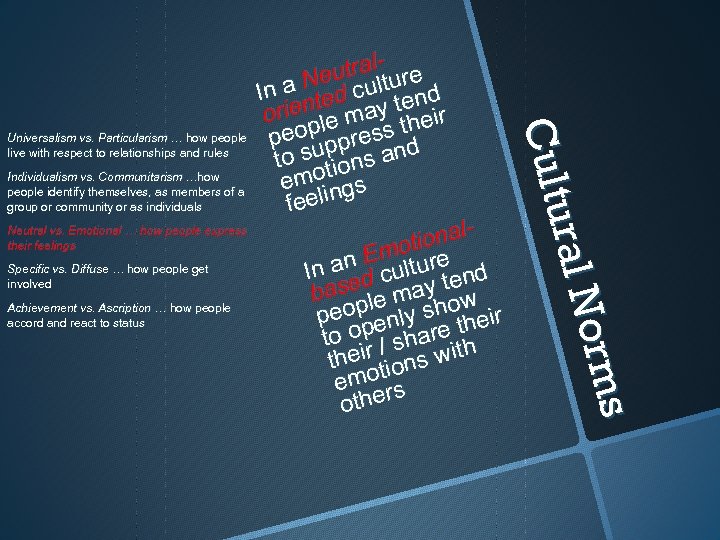
Individualism vs. Communitarism …how people identify themselves, as members of a group or community or as individuals Neutral vs. Emotional … how people express their feelings Specific vs. Diffuse … how people get involved Achievement vs. Ascription … how people accord and react to status orms ral N Cultu Universalism vs. Particularism … how people live with respect to relationships and rules tral - ure eu a N e d c ult nd In nt e ori e ple m ay tt hei r peo ppress d to su t ions an emo ngs feeli onal i Emoture In an d c ult t end base l e may ow peop enl y s h t hei r t o op / s hare t h their tio ns wi emo rs oth e
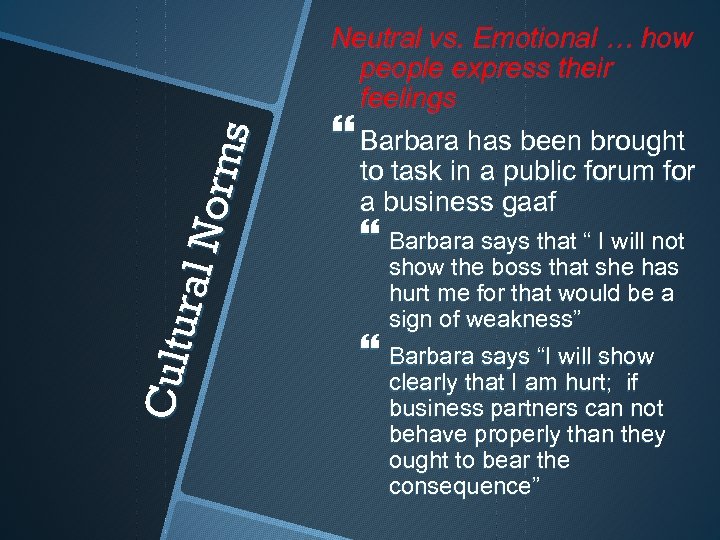
Cult u ral N orm s Neutral vs. Emotional … how people express their feelings Barbara has been brought to task in a public forum for a business gaaf Barbara says that “ I will not show the boss that she has hurt me for that would be a sign of weakness” Barbara says “I will show clearly that I am hurt; if business partners can not behave properly than they ought to bear the consequence”
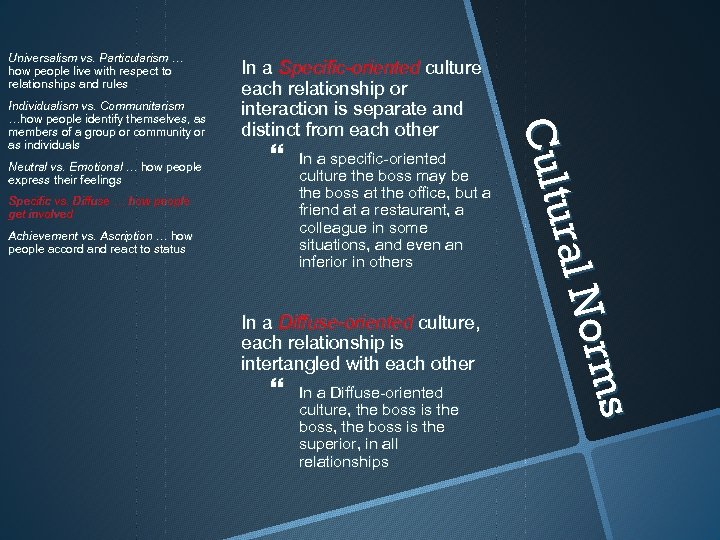
Universalism vs. Particularism … how people live with respect to relationships and rules Neutral vs. Emotional … how people express their feelings Specific vs. Diffuse … how people get involved Achievement vs. Ascription … how people accord and react to status In a specific-oriented culture the boss may be the boss at the office, but a friend at a restaurant, a colleague in some situations, and even an inferior in others In a Diffuse-oriented culture, each relationship is intertangled with each other In a Diffuse-oriented culture, the boss is the boss, the boss is the superior, in all relationships orms ral N Cultu Individualism vs. Communitarism …how people identify themselves, as members of a group or community or as individuals In a Specific-oriented culture each relationship or interaction is separate and distinct from each other
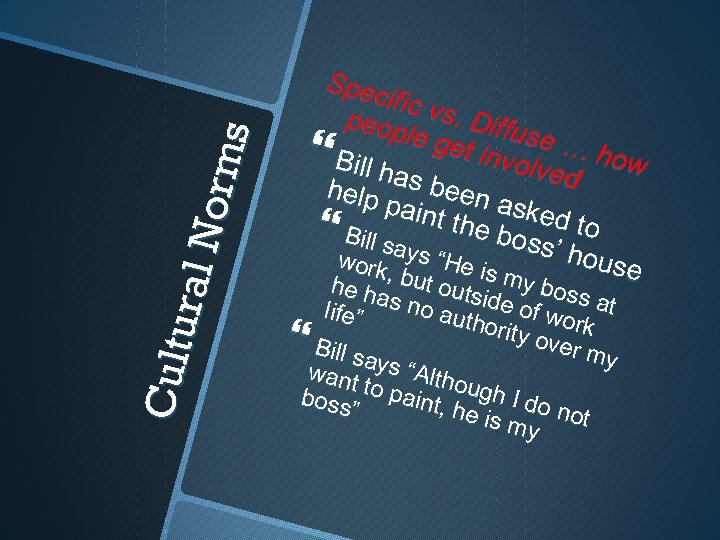
Cult u ral N orm s Sp ec ifi c v peop s. Di ff u se … le ge t inv o Bill h lved how as b hel p een a paint sked Bill s the bos to s’ ho work ays “He use i s my , but h e h a s n o outsi de o boss at li fe” f w o auth rk ority over Bi ll s my ays “ w ant t o p Alt hough boss aint, ” he i s I do not my
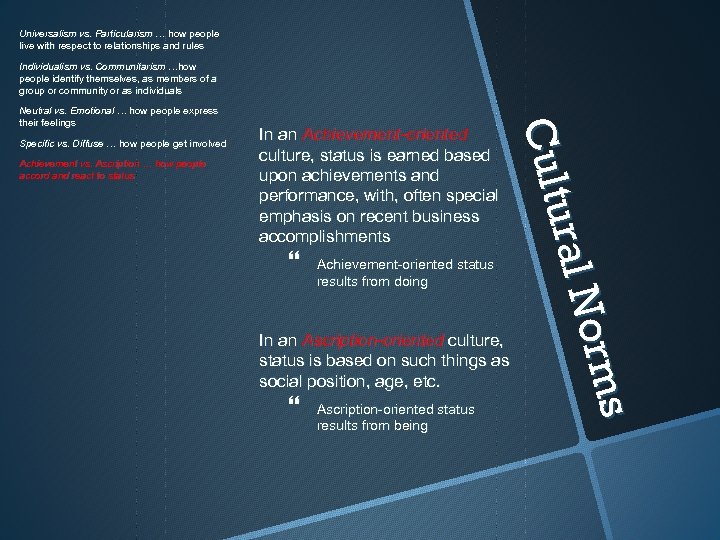
Universalism vs. Particularism … how people live with respect to relationships and rules Individualism vs. Communitarism …how people identify themselves, as members of a group or community or as individuals Specific vs. Diffuse … how people get involved Achievement vs. Ascription … how people accord and react to status In an Achievement-oriented culture, status is earned based upon achievements and performance, with, often special emphasis on recent business accomplishments Achievement-oriented status results from doing orms ral N Cultu Neutral vs. Emotional … how people express their feelings In an Ascription-oriented culture, status is based on such things as social position, age, etc. Ascription-oriented status results from being
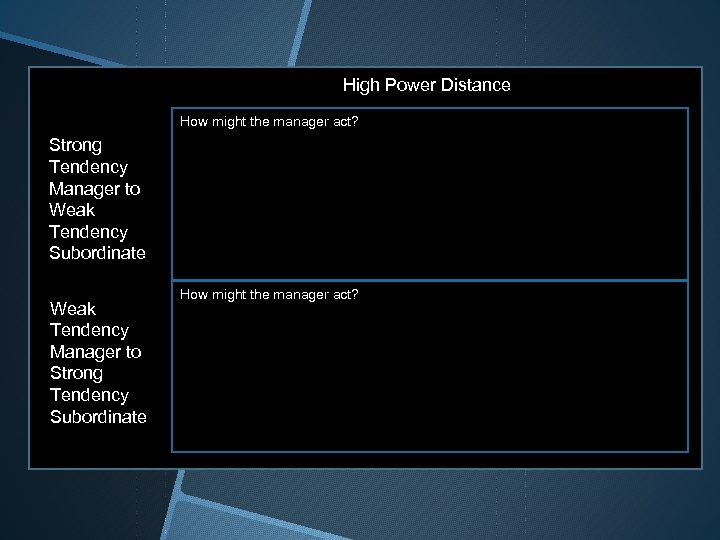
Hum an R es ou rce M ana g eme Moti v nt / ation …D iscus s ion High Power Distance How might the manager act? Strong Tendency Manager to Weak Tendency Subordinate Weak Tendency Manager to Strong Tendency Subordinate How might the manager act?
Hum an R es ou rce M ana g eme Moti v nt / ation …D iscus s ion Uncertainty Avoidance How might the manager act? Strong Tendency Manager to Weak Tendency Subordinate How might the manager act? Weak Tendency Manager to Strong Tendency Subordinate
Hum an R es ou rce M ana g eme Moti v nt / ation …D iscus s ion Collectivism How might the manager act? Strong Tendency Manager to Weak Tendency Subordinate How might the manager act? Weak Tendency Manager to Strong Tendency Subordinate
Human Resource Management / Motivation … Discussion Masculinity vs Femininty How might the manager act? Strong Tendency Manager to Weak Tendency Subordinate Weak Tendency Manager to Strong Tendency Subordinate How might the manager act?
Скачать презентацию Cultural Norms It seems to be obvious that
84b459d474db15b5d0c84dad29b6a223.ppt