



 Cultural Measurements
 A wise man once said… In an ideal world: -The police are English -The mechanics are German -The cooks are French -The innkeepers are Swiss -The lovers are Italian In a living hell: -The police are German -The mechanics are French -The cooks are English -The innkeepers are Italian -The lovers are Swiss
 Cultural Characteristics • • • Individualist vs Collectivist Monochronic vs Polychronic High context vs. Low context Perception and value of time Power Distance Perception of space
 Common misconceptions • Handshakes – US • firm, confident, 2 -3 seconds – Africa • limp, several minutes • Display of attraction – Britain: Men ought not look – France: Men ought to look • French think Brits are gay
 Perceptions of Americans • “Americans are stupid and unsubtle. They’re fat and bad dressers. ” • “Americans always want to say your name. ” • “Americans are always in a hurry. ” • “Americans are distant. They’re not close to anyone, even other Americans. ” • “In the middle of nowhere, with no oncoming traffic, an American still stopped. ”
 Perceptions of Americans • “In the US, life is only work. ” • “In the US, everything has to be discussed analyzed. Why? ” • “Americans are explicit. They want yes or no. Figurative speech confuses them. ” • “An American professor said, ‘I don’t know, I need to look it up. ’ Why is he teaching? ”
 Cultural Scales
 Individualist • • • Emphasis on the individual Self-determination (create own success) Decisive, independent and shows initiative Everyone should abide by universal values Personal success encouraged
 Collectivist • People should identify with and join groups • Groups protect their people – In return, people give loyalty and compliance • Understanding that groups have differing values • Pursuit of group harmony and success
 Monochronic • “One thing at a time” • Emphasis on perfect order, time and place – No interruptions (closed office doors) – Lateness is unacceptable – Business is business
 Polychronic • Multitasking – Hold business meeting – Answer phone calls – Send text messages • Things finish when they finish
 Low Context • Everything fully and concisely explained • Responsibility on recipients to stay updated • Vulnerable to communication breakdowns – Typically insular, not understanding and intolerant • Breakdowns occur due to poor assumptions
 Low Context • • • Dependence on what is said or written Often miss subtle signs Connections short-lived with purpose No double meanings or misunderstandings People say what they mean
 Low Context • • • Topics are addressed directly and precisely Verbal is primary Non-verbal is background Speakers show no hesitation offering opinions Interpersonal contact is superficial Task-oriented
 Low Context Cultures • • • English American German Dutch Scandinavian
 High Context • Close connections maintained over time • Not what, but who you know • Cultural behavior assumed to be common – You do it because your mom did – Your mom did it because her mom did
 High Context • • • Less verbal and written communication Relationship networks affect business Communication relies on long-term relationships Speakers do not present themselves strongly Decisions based on personal relationships Centered around person of authority
 High Context • • • Hidden assumptions Double meanings Heavy use of idioms and slang Cultural gap Silence is a tool
 High Context Cultures • • • Asian African South American Slavic Middle Eastern Romance
 High Context vs. Low Context • Japanese think: – Westerners offensively blunt • Westerners think: – Japanese devious, unforthcoming and closed
 High Context vs. Low Context • French workers think: – German workers insult French intelligence • German workers think: – French workers provide poor guidance
 High Context considerations When interacting with Low Context • Focus on what is actually said • Non-verbal messages may be unintentional • Speakers concentrate on matters of importance • Direct questions and observations are clarifying
 Low Context considerations When interacting with High Context • Non-verbal communication may be as important • Face-saving and tact vital • Honest discussions need appropriate locations • Relationships go a long way
 Perception of Time Past Orientation • Traditional values and lifestyles • Conservative management • Slow to change • “Go with the flow” Let things happen
 Perception of Time Present-oriented society • Past has passed • Futures are uncertain • Preference for short-term benefits
 Perception of Time Future-oriented society • Optimism about the future • The future can be controlled • Management plan, do, and control
 Quantity of Time Two options • Time is limited; use it or waste it – “Time is money” – Punctuality: a virtue and sign of respect • Time is plentiful, if not infinite – Tasks can be done tomorrow
 Doing Business • Time-limited – No time to develop trust – Mechanisms (i. e. rule-of-law) replace trust • Time-plentiful – Business relies on trust
 Power Distance • High power distance – Bypassing structure is unacceptable • Low power distance – Chain of command may be bypassed – Superiors and subordinates interact as equals – Professors and graduate students indistinguishable
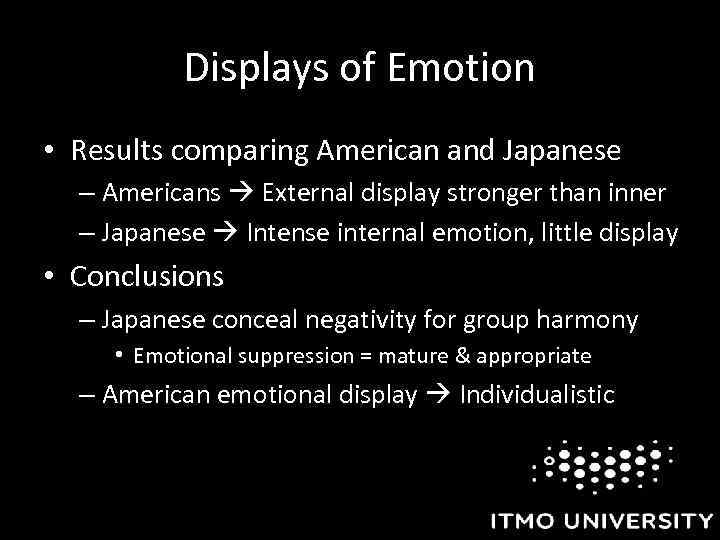 Displays of Emotion • Results comparing American and Japanese – Americans External display stronger than inner – Japanese Intense internal emotion, little display • Conclusions – Japanese conceal negativity for group harmony • Emotional suppression = mature & appropriate – American emotional display Individualistic
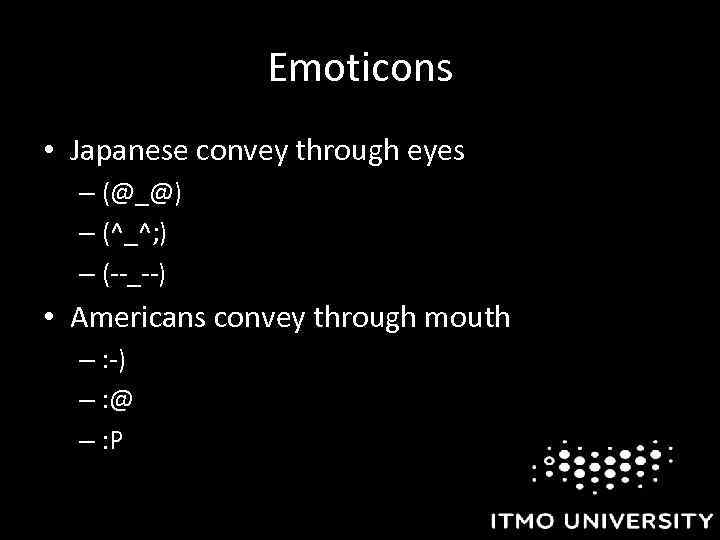 Emoticons • Japanese convey through eyes – (@_@) – (^_^; ) – (--_--) • Americans convey through mouth – : -) – : @ – : P
 Proxemics (Perception of Space) • Personal bubble • Personal living space
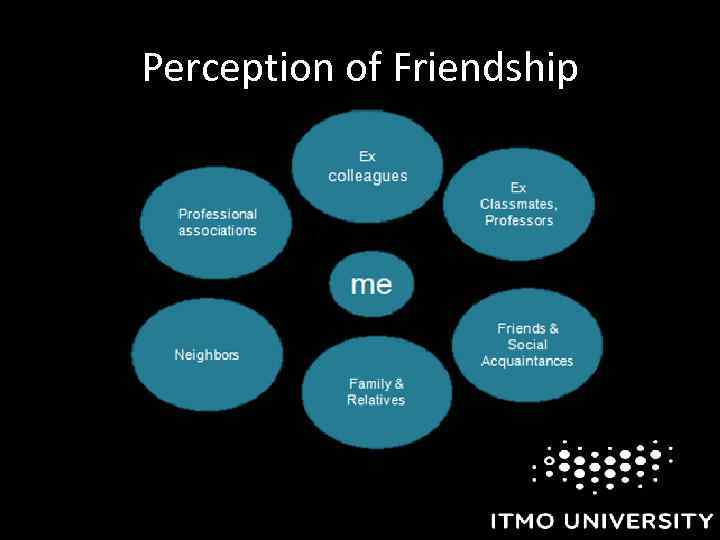 Perception of Friendship
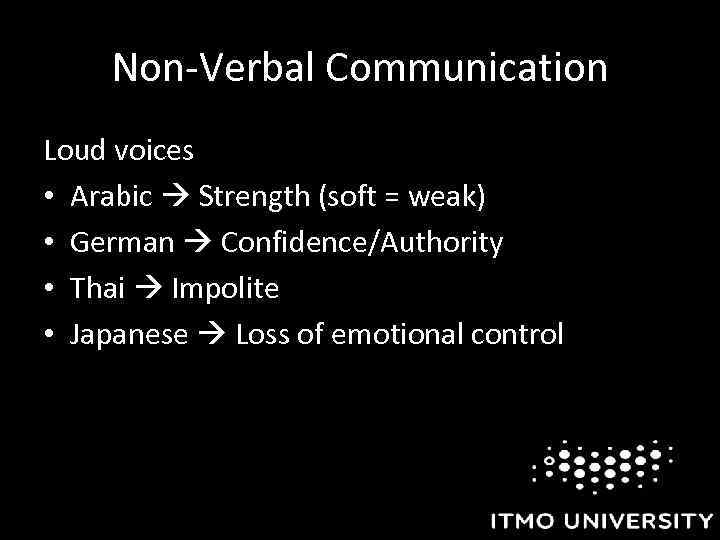 Non-Verbal Communication Loud voices • Arabic Strength (soft = weak) • German Confidence/Authority • Thai Impolite • Japanese Loss of emotional control
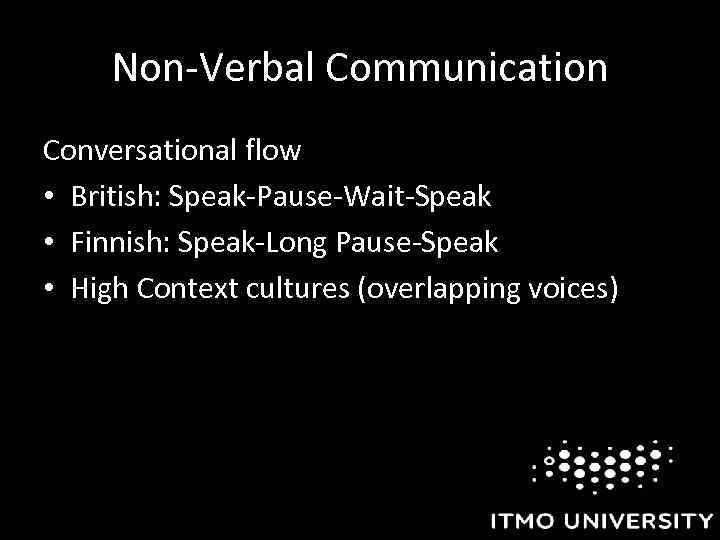 Non-Verbal Communication Conversational flow • British: Speak-Pause-Wait-Speak • Finnish: Speak-Long Pause-Speak • High Context cultures (overlapping voices)
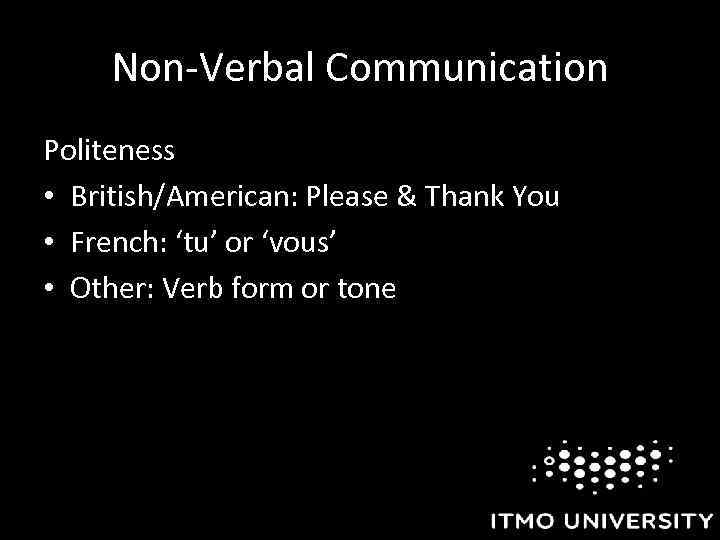 Non-Verbal Communication Politeness • British/American: Please & Thank You • French: ‘tu’ or ‘vous’ • Other: Verb form or tone
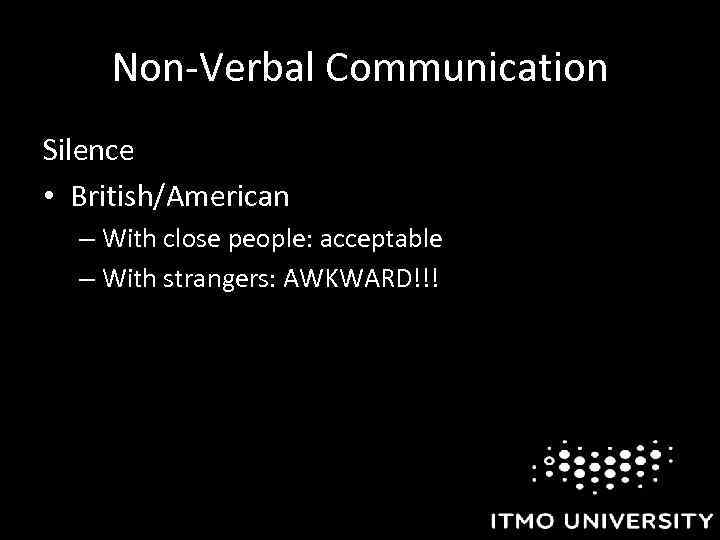 Non-Verbal Communication Silence • British/American – With close people: acceptable – With strangers: AWKWARD!!!
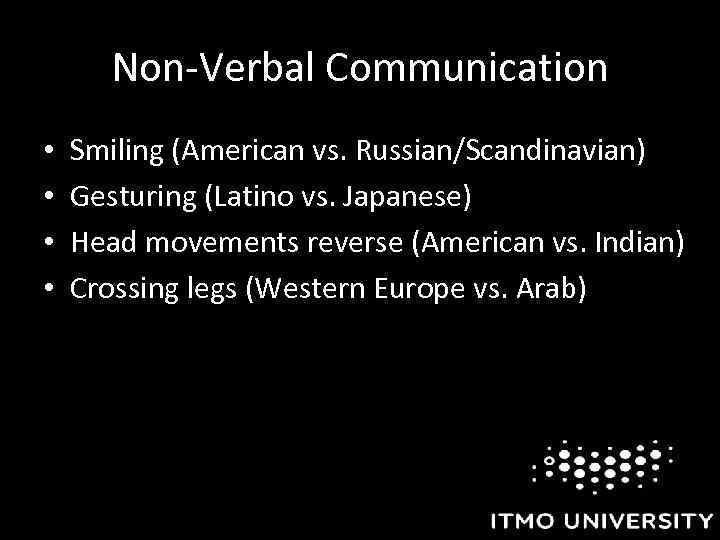 Non-Verbal Communication • • Smiling (American vs. Russian/Scandinavian) Gesturing (Latino vs. Japanese) Head movements reverse (American vs. Indian) Crossing legs (Western Europe vs. Arab)
 Case Study • Client: French Company • Options – American Company – Mexican Company • Who did the French choose? Why?
 Case Study • You American • Client Austrian • Main facts – 6 business meetings in 4 months – The client calls you “Herr Smith” As an American, what is your reaction?
 Case Study • Businessman: Japanese • Client: Norwegian • Main facts – Japanese: “That will be very difficult” – Norwegian: “How can I help? ” – The businessman is confused What did the businessman mean?
 Case Study • American Businessmen and Japanese Clients • Main facts – Americans make an offer – Japanese say nothing – Americans make a second offer – Japanese quickly accept What happened?
 Case Study Rebecca works for a Chicago-based company. Abhinav works for an India-based company. Rebecca: We need to get all our customer service employers trained in the next 2 weeks. Can you do it? Abhinav: That timeline is aggressive. Do you think it’s possible? Rebecca: It will require creativity and hard work but I think so. Abhinav: Ok. Rebecca: Now that business is finished, how is everything else? Abhinav: All’s well, although the heavy monsoons are causing delays getting around the city.
 Two Weeks Later… Abhinav: We’ve pulled all our resources together and I’m happy to say that 60% of customer service reps are trained. The remaining 40% will be done in 2 weeks. Rebecca: Only 60%? We agreed they all would be trained by now! Abhinav: Yes. The monsoon is over now so the rest of training should be fast. Rebecca: The training is critical. Please get it done as soon as possible. Abhinav: I am certain it will be done.
 Case Study • An American executive in London complained that he had taken his wife to a traditional English pub and an English couple decided to sit at their table. “First, they sat without asking, then they ignored us, ” he complained. What happened?
 Case Study • An Englishman travels to Russia and stands patiently in the queue to buy a metro token. However, people keep breaking the order of the queue and it takes him 10 minutes to buy a token. What happened?
 Case Study • A high-ranking US government official accidentally delayed negotiations with the Soviets on nuclear weapons. In response to a “No” from the Soviets regarding a proposal, the official stopped talking about it. Several months later, the Russians told a visiting American they had been surprised. What happened?
 Case Study American: We want to take a plane from A to B. Japanese: Are you sure? American: Yes. Japanese: Maybe you would prefer a train? American: No, a plane. Japanese: How about a bus? American: No, a plane. Don’t you understand? What happened?
 Intercultural Sensitivity • • • Denial Defense/Reversal Minimization Acceptance Adaptation Integration
 Denial • Uninterested in cultural differences • Lack of caring about cultures
 Denial/Refusal • Threatened by cultural difference • Highly critical of other cultures • Heavily criticize own culture (Reversal)
 Minimization • Find commonalities between self and others – Often superficial
 Acceptance • Recognize and appreciate cultural difference – Behaviors – Values • Not necessary to agree
 Adaptation • Can perceive world through another culture • Changes behavior to communicate effectively
 Integration • Cultural mediators • Help others understand different cultures • Promote unity between cultures
 Stupid Cultural Jokes
 International Corporations Traditional Capitalism • You have two cows • You sell one and buy a bull • Your herd multiplies & the economy grows • You sell them & retire
 International Corporations American Corporation • You have 2 cows; sell 3 to your company using your brother’s credit; do a credit default swap to get 4 cows with a tax exemption for 5 cows; transfer the rights to 6 cows through a shadow company who sells the rights to 7 cows back to your company; the annual report says the company owns 8 cows with an option for 1 more. • The public buys your bull.
 International Corporations French Corporation • You have two cows • You go on strike because you want three
 International Corporations Japanese Corporation • You have two cows • Redesign them so they are 1/10 th the size & produce 20 times more milk • Create “cowkimon”
 International Corporations German Corporation • You have two cows • You reengineer tem so they live for 100 years, eat once a month and milk themselves
 International Corporations Italian corporation • You have two cows • You don’t know where they are • You break for lunch
 International Corporations Swiss Corporation • You have 5000 cows, none which belong to you • You charge others for storing them
 International Corporations Indian Corporation • You have two cows • You worship them
 v The European Commission just announced that English will replace German as the EU official language. Her Majesty’s Government acknowledged that a five-year phase-in plan will take place known as “Euro-English. ”
 Ze Langadzh of ze Urop In the first year, “s” will replace the soft “c”. Sertainly, this will make sivil servant happy. The hard “c” will be dropped for “k”. This should klear up konfusion and keyboards kan have 1 less letter.
 Ze Langadzh of ze Urop There will be publik enthusiasm in the sekond year, when “ph” will be “f”. Words like “fotograf” are 20% shorter.
 Ze Langadzh of ze Urop In the third year, publik akseptanse of the new spelling kan be ekspekted to reach the stage where more komplikated changes are possible. Governments will enkorage the removal of double letters, which have always ben a deterent to akurate speling. Also, al wil agre that the horible mes of the silent “e”s wil go away.
 Ze Langadzh of ze Urop In the fourth year, peopl wil be reseptiv to replasing “th” with “z” and “w” with “v”. During ze fifz year, ze unesesary “o” kan be dropd from vords kontaining “ou” and similar changes vud of kors be aplid to ozer kombinations of leters.
 Ze Langadzh of ze Urop After zis fifz year, ve vil hav a reli sensibl riten styl. Zer vil be no more trubl or difikultis and evrivun vil find it ezi to undertstand ech ozer. Ze drem vil finali kum tru!