


 Скачать презентацию Cultural control of pests HORT 378 Integrated Insect
Cultural control of pests (chapter 10).pptx
- Количество слайдов: 18
 Cultural control of pests HORT 378 Integrated Insect and Disease Management
 Introduction • As we learned earlier agroecosytems are an artificial ecosystem set up by men to produce food and fiber for human use. • Crop production alters the space that was previously taken up by a natural ecosystem. • By doing so it modifies the soil, water and even the topography of the land.
 Introduction • The crop species that replaces the natural species usually requires high-energy inputs such as: • Tillage • Fertilizers • Cultivation • Irrigation
 Introduction • These introduced agricultural practices are designed to create a favorable environment for the desired crop species. • While setting up these favorable environmental conditions for a crop man is also setting up conditions for pests to invade the crop.
 Introduction • One of the overarching agronomic techniques that is used in crop protection is the concept that is called cultural control. • Cultural control is defined as: “purposeful manipulation of the environment to reduce rates of pest increase and damage. ”
 Cultural Control • Reducing favorable conditions for pests by using, for the most part, involves manipulating the crop residues ( materials left in the field after harvest) and crop plantings. • The two main methods that are used in this regard is: field sanitation and crop rotation.
 Field sanitation • Field sanitation is one the most basic methods in reducing pest species while at the same time, in most cases, preparing the field for next the planting season.
 Crop residue destruction and utilization • This method either destroys or removes the crop residues and therefore reduces or eliminates overwintering sites for pests to survive in.
 Crop residue destruction and utilization • Plowing/tillage – Preparing the seedbed for planting and weed control – Method of choice (most commonly used) for the elimination of crop residues for harboring pests. • Burning – Used to destroy plant material around the borders of fields in the fall. – Reduce crop residues
 Crop residue destruction and utilization • Shredding/chopping – Reduces crop residues to smaller pieces so insect pests cannot get established in them – Destroys pest that may already be in the crop residues • Weed removal or destruction – Around greenhouses and grain storage bins
 Crop rotation • It is a technique that controls pests in one crop while it is not a pest in another. • The practice of crop rotation came about as a method to improve soil workability and fertility. • It is the practice of planting two or more crops in some sort of sequence in the same field that changes from year to year.
 Crop rotation • One of the most common crop rotation methods that is used here in the Mid-West is the corn/soybean rotation. • This helps control the pest corn rootworm. • This pest, while in the larvae stage, exclusively eats the roots of developing and growing corn plants.
 Crop rotation • With a 2 –year crop rotation schedule of corn followed by soybean it has virtually eliminated the corn root worm problem. • When soybeans are planted the corn rootworm cannot survive, because its food source has been removed.
 Cover crops • A cover crop is a plant that is seeded to cover the ground from one season to the next. • It protects the soil from erosion. • Source of organic material for the next cropping season when worked into soil. • Controls the growth of winter weeds on the soil.
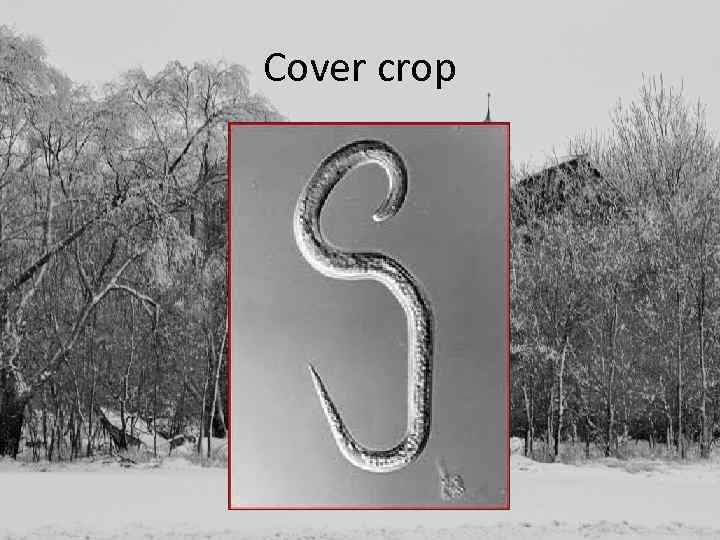
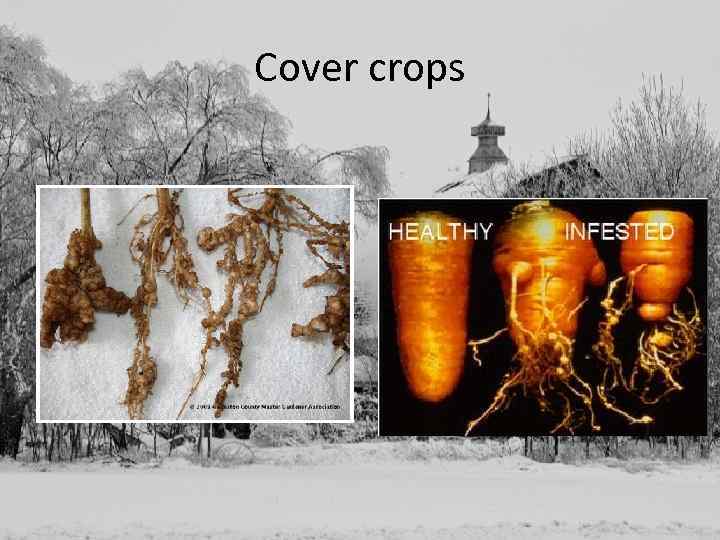
 Cover crop • Some cover crops acts as bio-fumigants. • When the cover crop is incorporated into the soil and it breaks down it may gives off substances that controls the germination of weed seeds • In some cases controls a pest called root knot nematodes.
 Cover crops • The root knot nematode is a very small unsegment worm that feeds upon the cells of the roots and causes a large amount of scar tissue. • It greatly reduces the productivity of the plant.
 Cover crop
 Cover crops