 Скачать презентацию CUBIC Program Summer 2001 Professors Ken Kozar and
bcc8a5aae8da18eb0cdd711fd441d5cc.ppt
- Количество слайдов: 78



CUBIC Program Summer 2001 Professors Ken Kozar and Ramiro Montealegre
BACKGROUND - Background - IT and Internet knowledge / experience - Expectations about this course
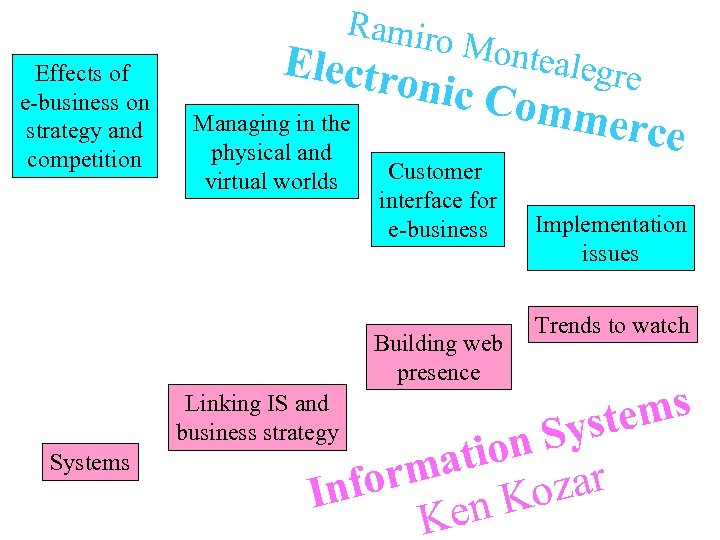
Ramiro Effects of e-business on strategy and competition Montea Electro legre nic Co mmerc Managing in the e physical and virtual worlds Customer interface for e-business Building web presence Trends to watch ems yst on S ati form Kozar In Ken Linking IS and business strategy Systems Implementation issues
CUBIC Program Summer 2001 Professor Ramiro Montealegre Effects of e-business on strategy and competition
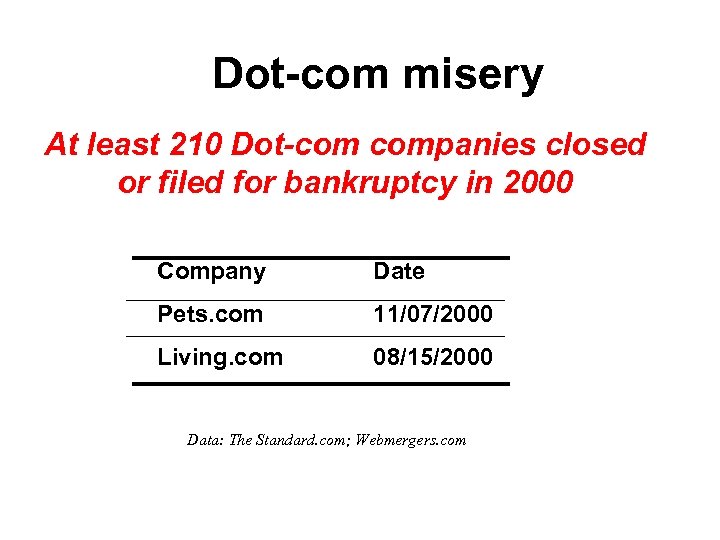
Dot-com misery At least 210 Dot-com companies closed or filed for bankruptcy in 2000 Company Date Pets. com 11/07/2000 Living. com 08/15/2000 Data: The Standard. com; Webmergers. com
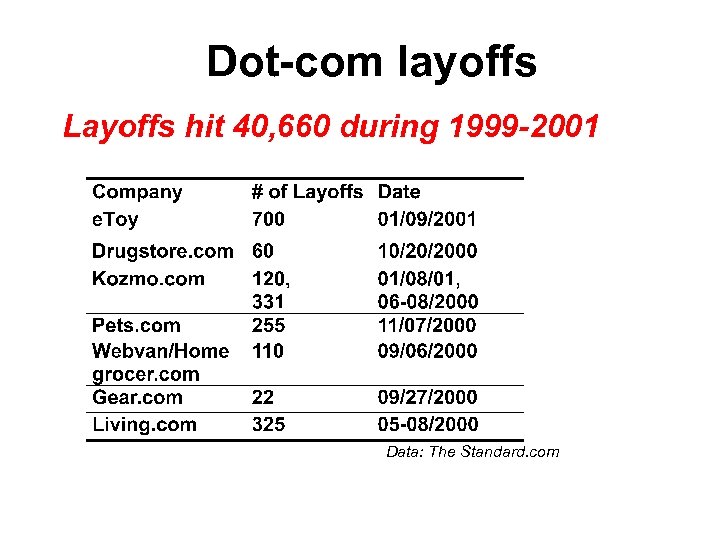
Dot-com layoffs Layoffs hit 40, 660 during 1999 -2001 Data: The Standard. com
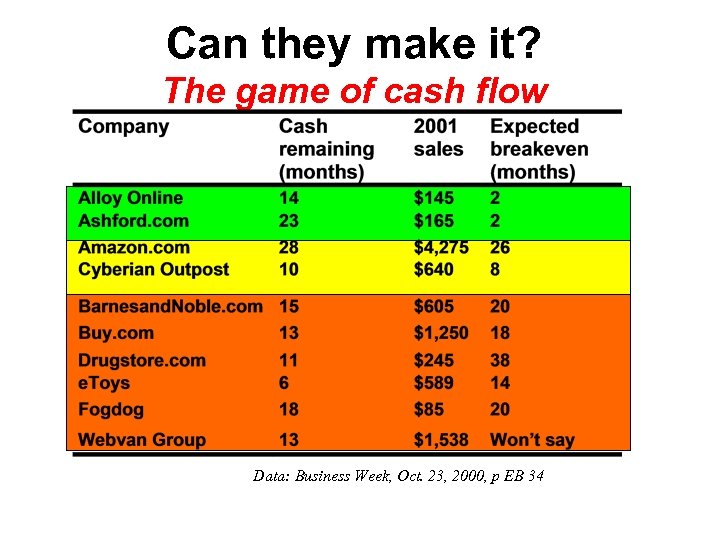
Can they make it? The game of cash flow Data: Business Week, Oct. 23, 2000, p EB 34
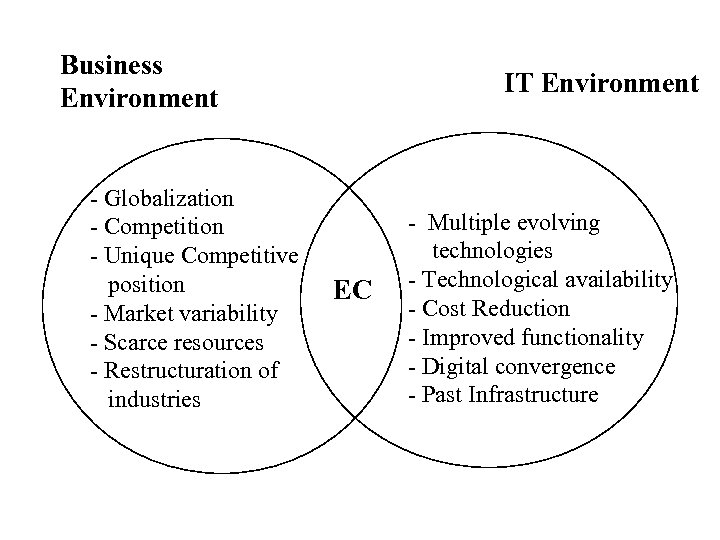
Business Environment - Globalization - Competition - Unique Competitive position - Market variability - Scarce resources - Restructuration of industries IT Environment EC - Multiple evolving technologies - Technological availability - Cost Reduction - Improved functionality - Digital convergence - Past Infrastructure
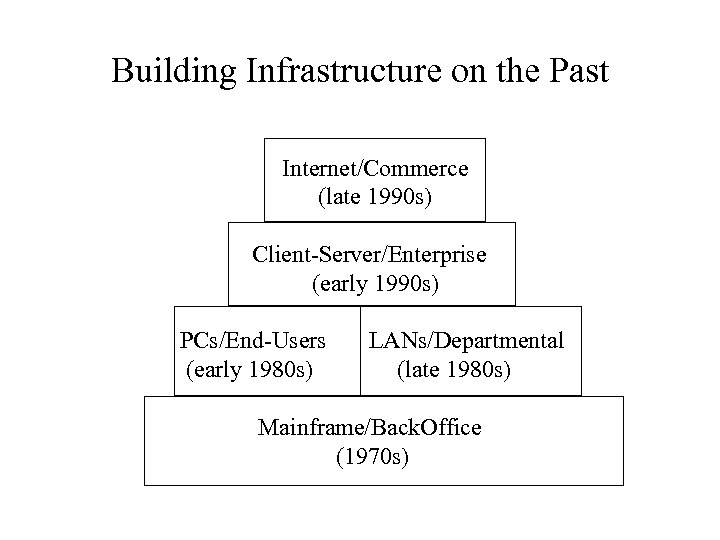
Building Infrastructure on the Past Internet/Commerce (late 1990 s) Client-Server/Enterprise (early 1990 s) PCs/End-Users (early 1980 s) LANs/Departmental (late 1980 s) Mainframe/Back. Office (1970 s)

If you’re not confused, you’re not paying attention!
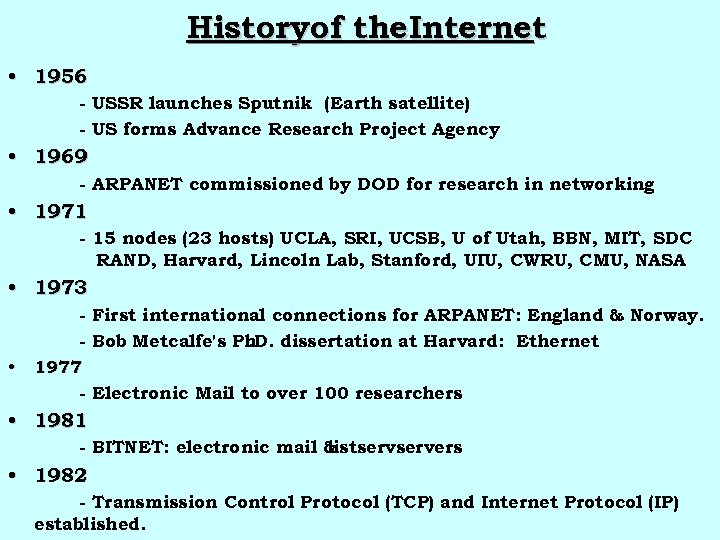
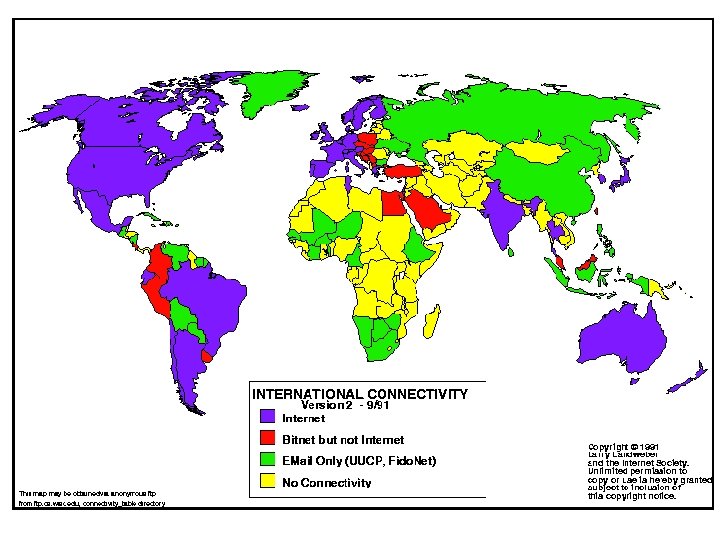
Historyof the Internet • 1956 - USSR launches Sputnik (Earth satellite) - US forms Advance Research Project Agency • 1969 - ARPANET commissioned by DOD for research in networking • 1971 - 15 nodes (23 hosts) UCLA, SRI, UCSB, U of Utah, BBN, MIT, SDC RAND, Harvard, Lincoln Lab, Stanford, UIU, CWRU, CMU, NASA • 1973 - First international connections for ARPANET: England & Norway. - Bob Metcalfe's Ph dissertation at Harvard: Ethernet. D. • 1977 - Electronic Mail to over 100 researchers • 1981 - BITNET: electronic mail & listservers • 1982 - Transmission Control Protocol (TCP) and Internet Protocol (IP) established.
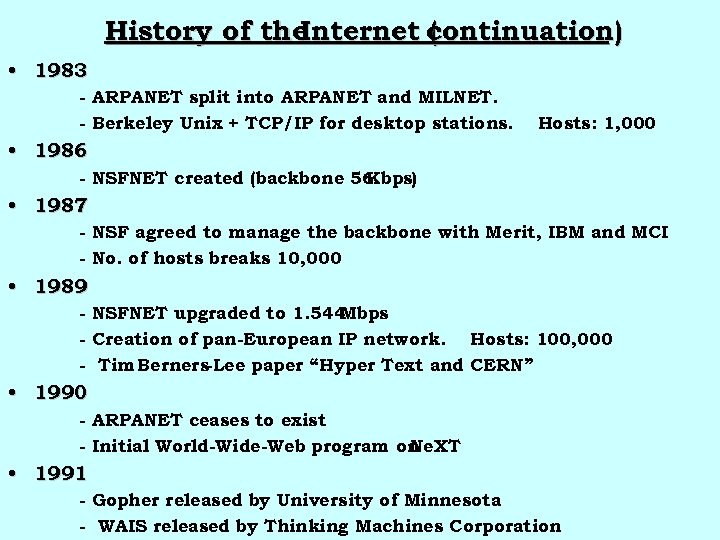
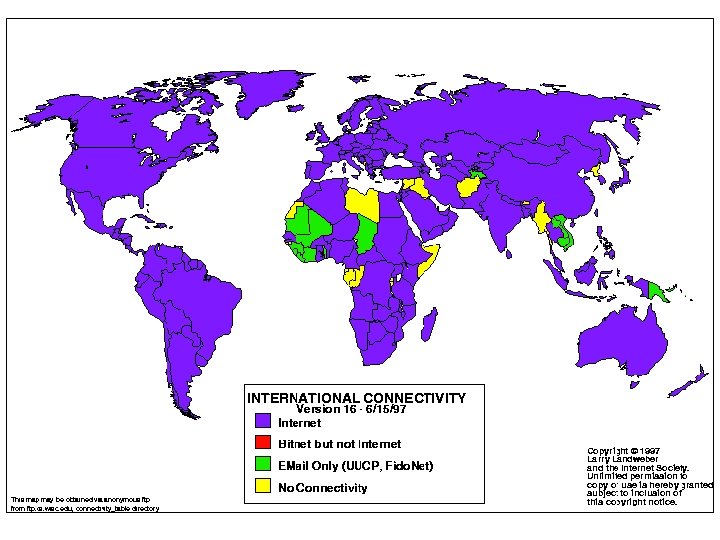
History of the Internet continuation) ( continuation) • 1983 - ARPANET split into ARPANET and MILNET. - Berkeley Unix + TCP/IP for desktop stations. Hosts: 1, 000 • 1986 - NSFNET created (backbone 56 Kbps) • 1987 - NSF agreed to manage the backbone with Merit, IBM and MCI - No. of hosts breaks 10, 000 • 1989 - NSFNET upgraded to 1. 544 Mbps - Creation of pan-European IP network. Hosts: 100, 000 - Tim Berners-Lee paper “Hyper Text and CERN” • 1990 - ARPANET ceases to exist - Initial World-Wide-Web program on Ne. XT • 1991 - Gopher released by University of Minnesota - WAIS released by Thinking Machines Corporation
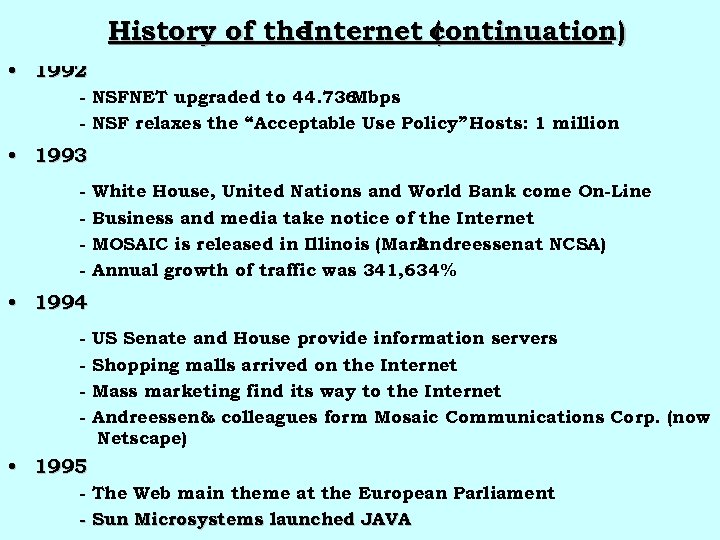
History of the Internet continuation) ( continuation) • 1992 - NSFNET upgraded to 44. 736 Mbps - NSF relaxes the “Acceptable Use Policy”. Hosts: 1 million • 1993 - White House, United Nations and World Bank come On-Line - Business and media take notice of the Internet - MOSAIC is released in Illinois (Mark Andreessenat NCSA) - Annual growth of traffic was 341, 634% • 1994 - US Senate and House provide information servers - Shopping malls arrived on the Internet - Mass marketing find its way to the Internet - Andreessen & colleagues form Mosaic Communications Corp. (now Netscape) • 1995 - The Web main theme at the European Parliament - Sun Microsystems launched JAVA
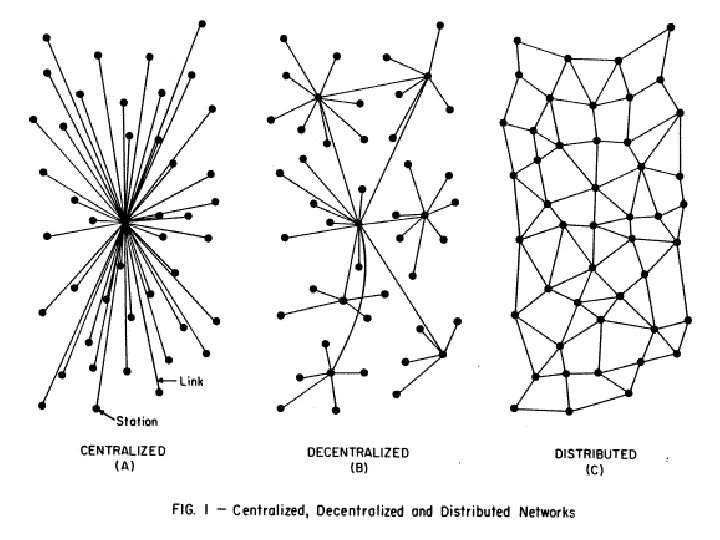
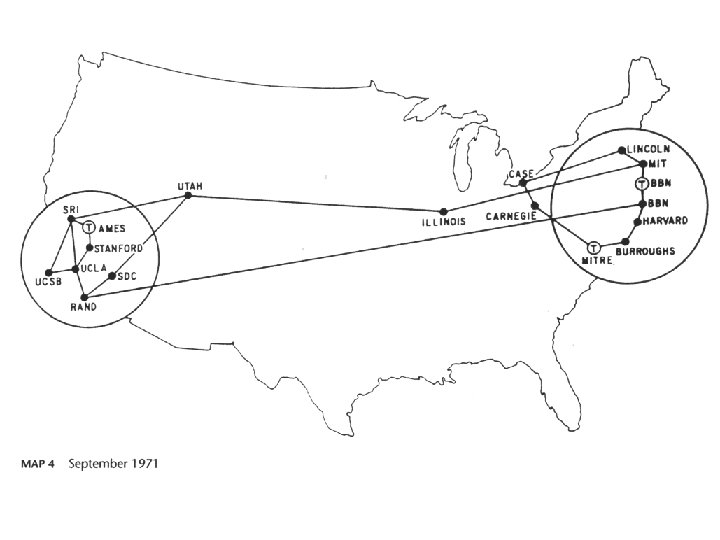
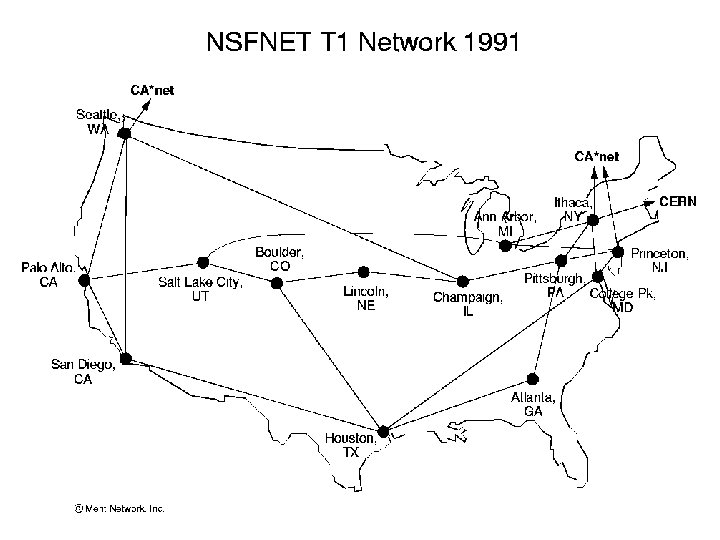
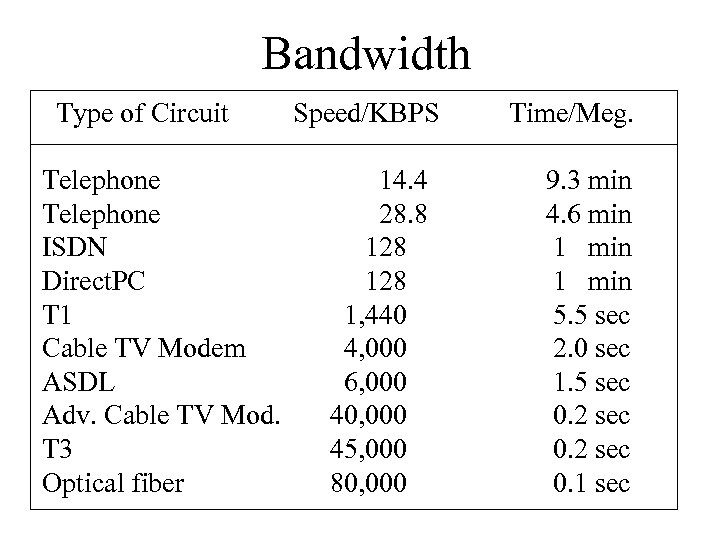
Bandwidth Type of Circuit Telephone ISDN Direct. PC T 1 Cable TV Modem ASDL Adv. Cable TV Mod. T 3 Optical fiber Speed/KBPS 14. 4 28. 8 128 1, 440 4, 000 6, 000 40, 000 45, 000 80, 000 Time/Meg. 9. 3 min 4. 6 min 1 min 5. 5 sec 2. 0 sec 1. 5 sec 0. 2 sec 0. 1 sec
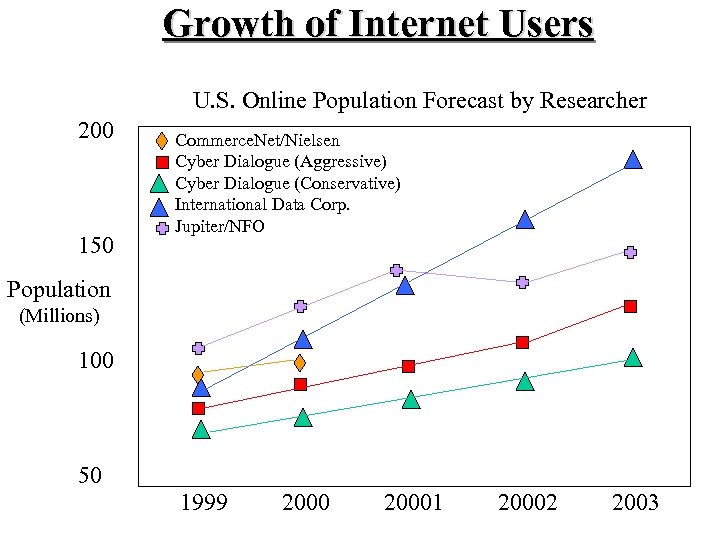
Growth of Internet Users U. S. Online Population Forecast by Researcher 200 150 Commerce. Net/Nielsen Cyber Dialogue (Aggressive) Cyber Dialogue (Conservative) International Data Corp. Jupiter/NFO Population (Millions) 100 50 1999 20001 20002 2003
Why the Optimism? - Continuing rapid growth of the Web - Business are rapidly deploying intranets/extranets and moving toward browsers as universal frontends
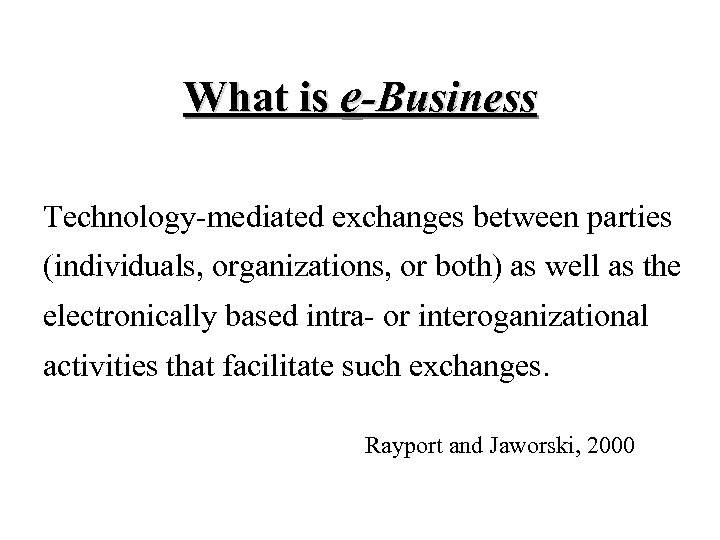
What is e-Business Technology-mediated exchanges between parties (individuals, organizations, or both) as well as the electronically based intra- or interoganizational activities that facilitate such exchanges. Rayport and Jaworski, 2000
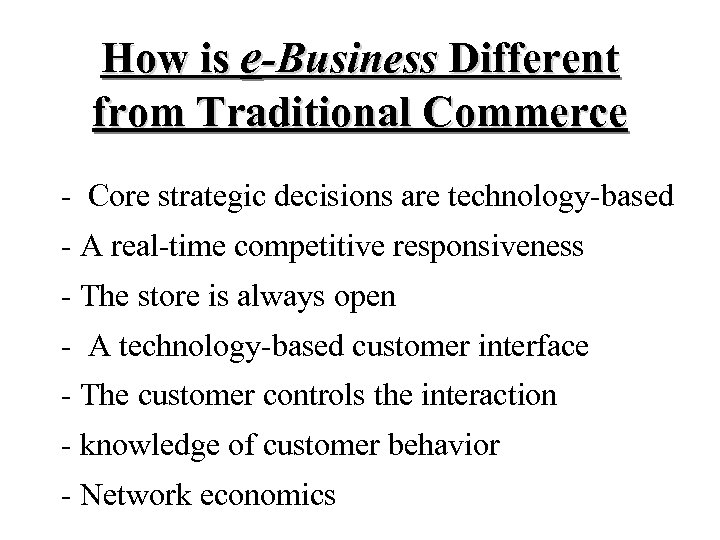
How is e-Business Different from Traditional Commerce - Core strategic decisions are technology-based - A real-time competitive responsiveness - The store is always open - A technology-based customer interface - The customer controls the interaction - knowledge of customer behavior - Network economics
Other Interesting References Internet Online Atlas: http: //www. cybergeography. org/atlas. html History of the Internet: http: //www. isoc. org/guest/zakon/Internet/
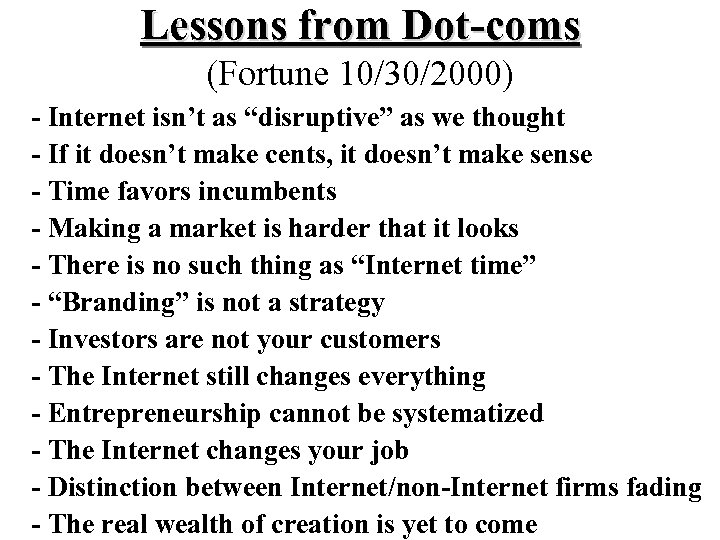
Lessons from Dot-coms (Fortune 10/30/2000) - Internet isn’t as “disruptive” as we thought - If it doesn’t make cents, it doesn’t make sense - Time favors incumbents - Making a market is harder that it looks - There is no such thing as “Internet time” - “Branding” is not a strategy - Investors are not your customers - The Internet still changes everything - Entrepreneurship cannot be systematized - The Internet changes your job - Distinction between Internet/non-Internet firms fading - The real wealth of creation is yet to come
e-Business - It is a strategy, not an application, technology, or suite of products - It is not a grassroots initiative - It includes B 2 B and B 2 C - No one vendor provides all needed applications
Key elements for success - Lasting relationship with customers - Owning the customer-base - Cross-selling opportunities / multiple sources of revenue - Strong branding - Large number of offerings to reach/capture consumers - Superior virtual customer service - A value proposition that is better and more enticing than the off-line world (not just an additional distribution arm).
A great e-Business strategy includes: - Realign / reinvent business processes - Use the full range of technology - Sell the company as well your wares - Use technology to maximize customer contacts - Put current application to strategic use
What if YOU are in charge of a new e-Business initiative - Which customer groups should I serve? - How do I provide a compelling “value proposition” - How do I communicate with customers? - What is the content, “look-and-feel, ” community, and degree of personalization? - How should I structure my organization? - What are my potential partners? - How will this business provide value to shareholders - What metrics should I use to judge progress?

CUBIC Program Summer 2001 Professor Ramiro Montealegre Managing in the physical and virtual worlds
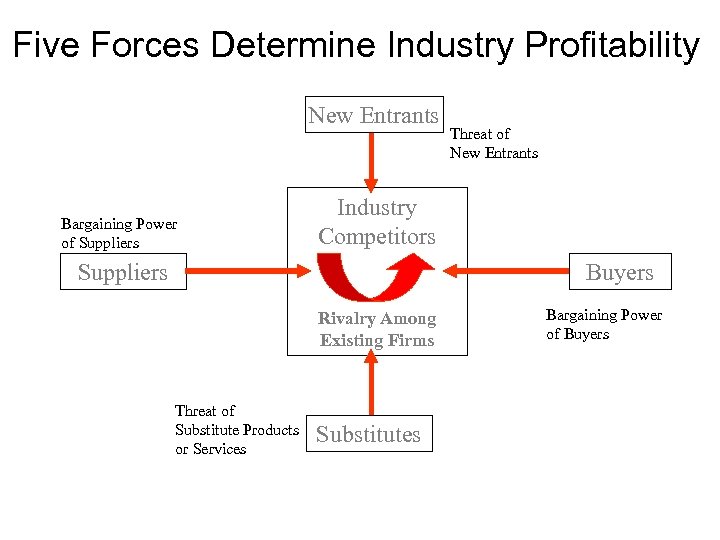
Five Forces Determine Industry Profitability New Entrants Bargaining Power of Suppliers Threat of New Entrants Industry Competitors Suppliers Buyers Rivalry Among Existing Firms Threat of Substitute Products or Services Substitutes Bargaining Power of Buyers
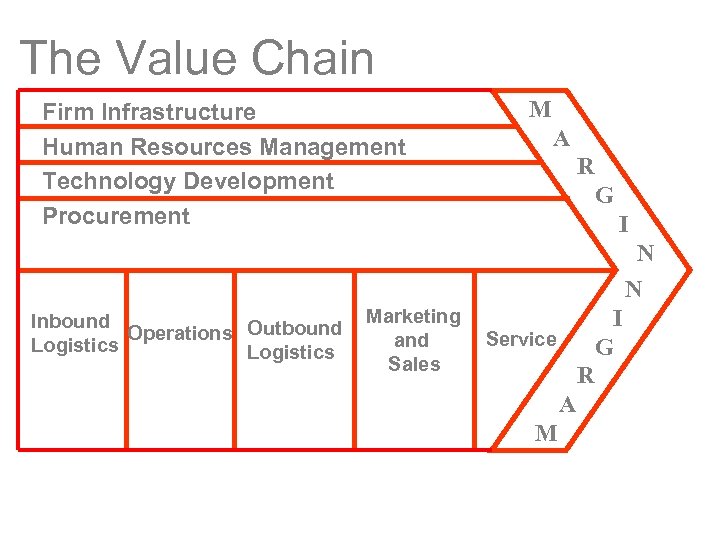
The Value Chain Firm Infrastructure Human Resources Management Technology Development Procurement M A R G I N N Inbound Operations Outbound Logistics Marketing and Sales I G Service R A M
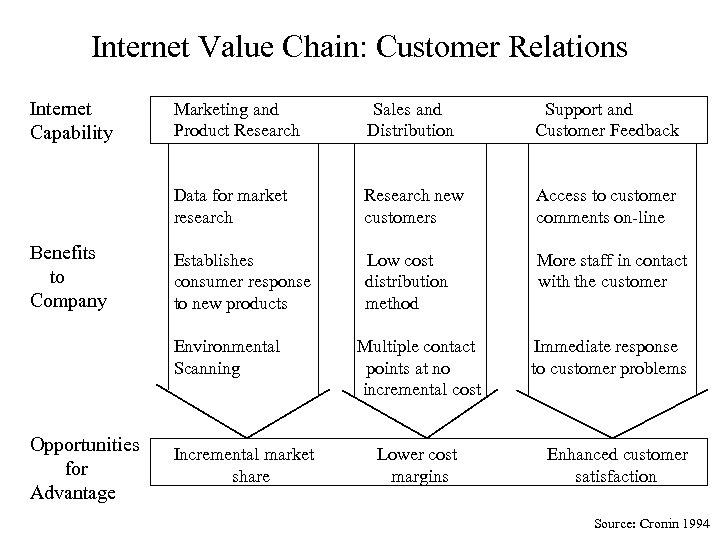
Internet Value Chain: Customer Relations Internet Capability Sales and Distribution Support and Customer Feedback Data for market research Benefits to Company Marketing and Product Research new customers Access to customer comments on-line Establishes consumer response to new products Low cost distribution method More staff in contact with the customer Environmental Scanning Opportunities for Advantage Incremental market share Multiple contact points at no incremental cost Lower cost margins Immediate response to customer problems Enhanced customer satisfaction Source: Cronin 1994
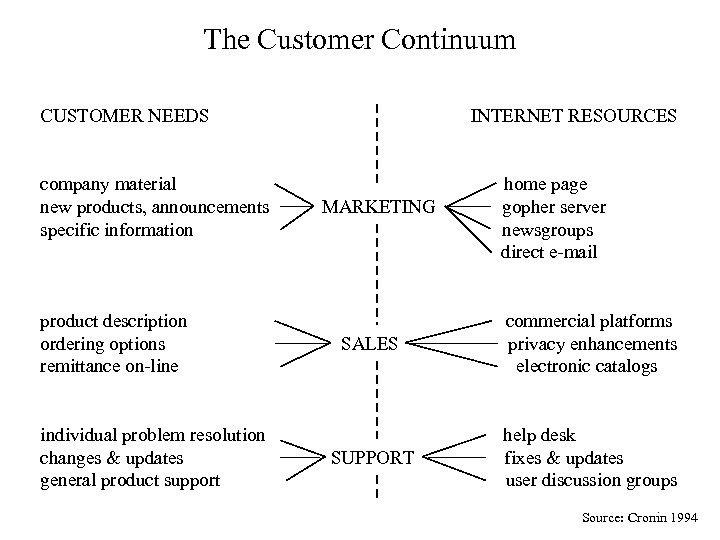
The Customer Continuum CUSTOMER NEEDS company material new products, announcements specific information product description ordering options remittance on-line individual problem resolution changes & updates general product support INTERNET RESOURCES MARKETING home page gopher server newsgroups direct e-mail SALES commercial platforms privacy enhancements electronic catalogs SUPPORT help desk fixes & updates user discussion groups Source: Cronin 1994
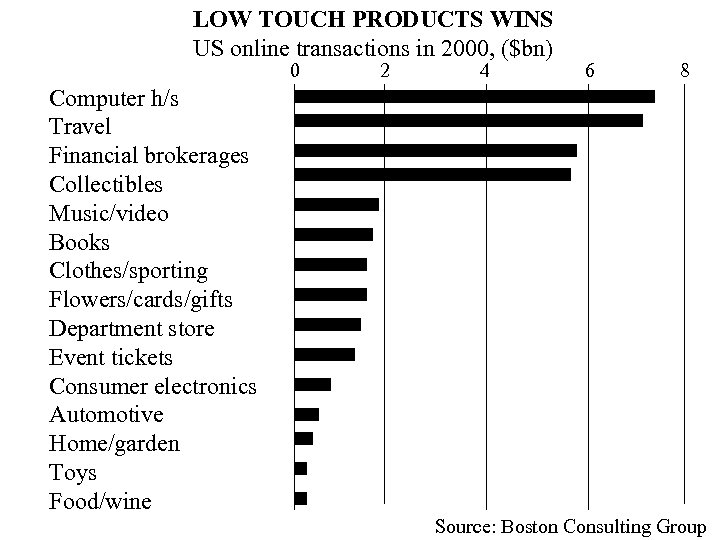
LOW TOUCH PRODUCTS WINS US online transactions in 2000, ($bn) 0 2 4 6 8 Computer h/s Travel Financial brokerages Collectibles Music/video Books Clothes/sporting Flowers/cards/gifts Department store Event tickets Consumer electronics Automotive Home/garden Toys Food/wine Source: Boston Consulting Group
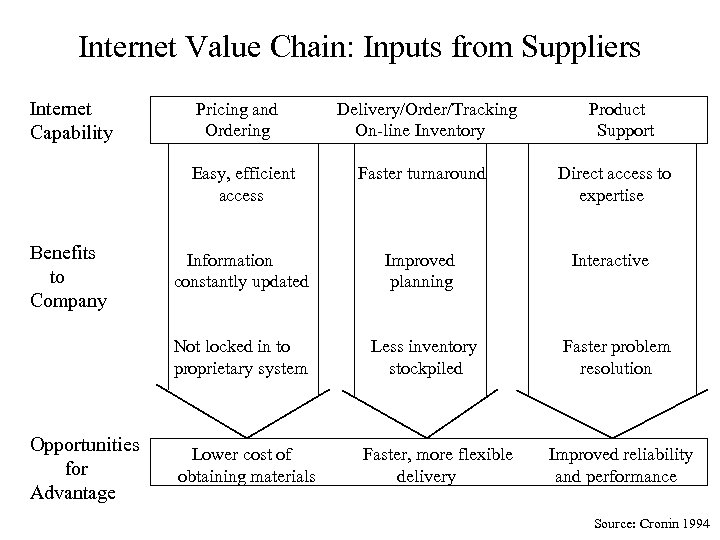
Internet Value Chain: Inputs from Suppliers Internet Capability Pricing and Ordering Delivery/Order/Tracking On-line Inventory Product Support Easy, efficient access Opportunities for Advantage Direct access to expertise Information constantly updated Improved planning Interactive Not locked in to proprietary system Benefits to Company Faster turnaround Less inventory stockpiled Lower cost of obtaining materials Faster, more flexible delivery Faster problem resolution Improved reliability and performance Source: Cronin 1994
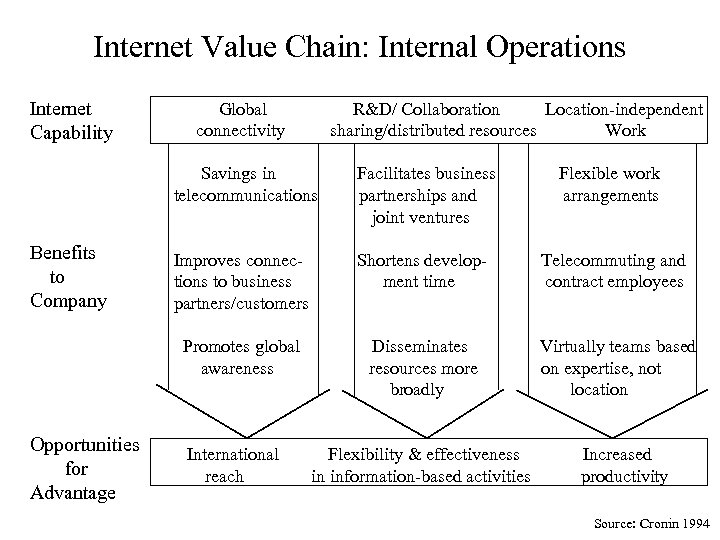
Internet Value Chain: Internal Operations Internet Capability Global connectivity R&D/ Collaboration Location-independent sharing/distributed resources Work Savings in telecommunications Opportunities for Advantage Flexible work arrangements Improves connections to business partners/customers Shortens development time Telecommuting and contract employees Promotes global awareness Benefits to Company Facilitates business partnerships and joint ventures Disseminates resources more broadly Virtually teams based on expertise, not location International reach Flexibility & effectiveness in information-based activities Increased productivity Source: Cronin 1994
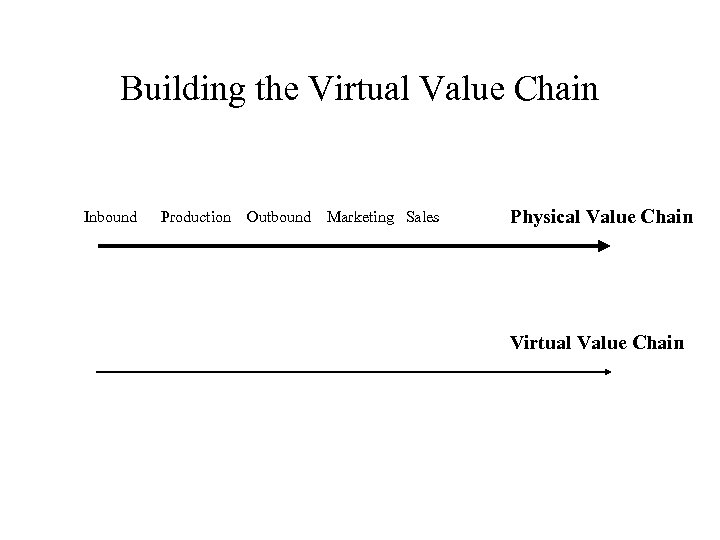
Building the Virtual Value Chain Inbound Production Outbound Marketing Sales Physical Value Chain Virtual Value Chain
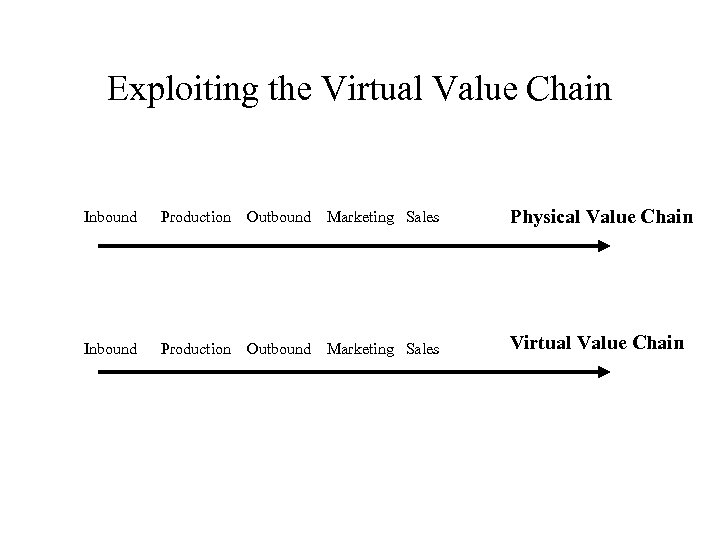
Exploiting the Virtual Value Chain Inbound Production Outbound Marketing Sales Physical Value Chain Inbound Production Outbound Marketing Sales Virtual Value Chain
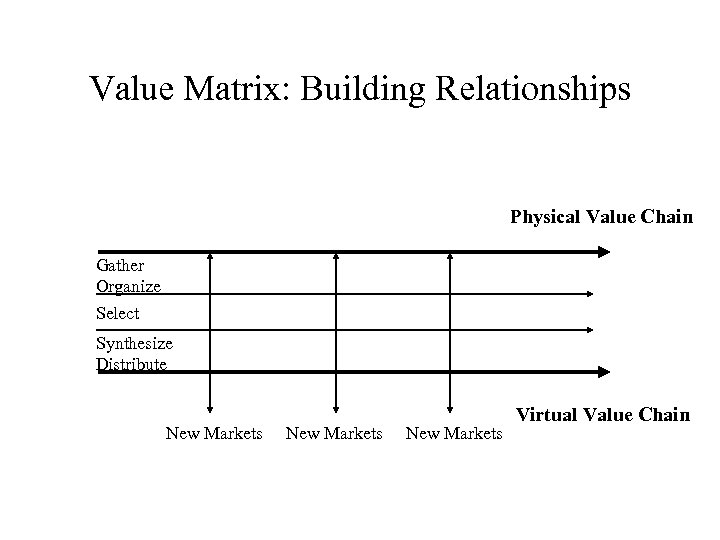
Value Matrix: Building Relationships Physical Value Chain Gather Organize Select Synthesize Distribute New Markets Virtual Value Chain
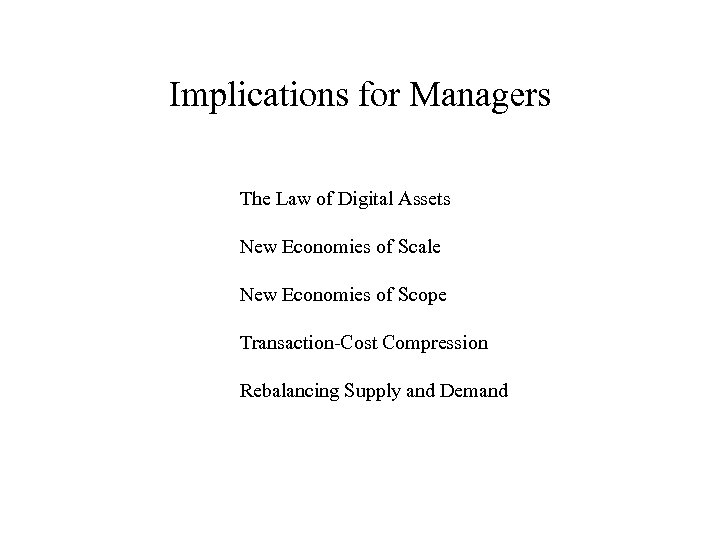
Implications for Managers The Law of Digital Assets New Economies of Scale New Economies of Scope Transaction-Cost Compression Rebalancing Supply and Demand
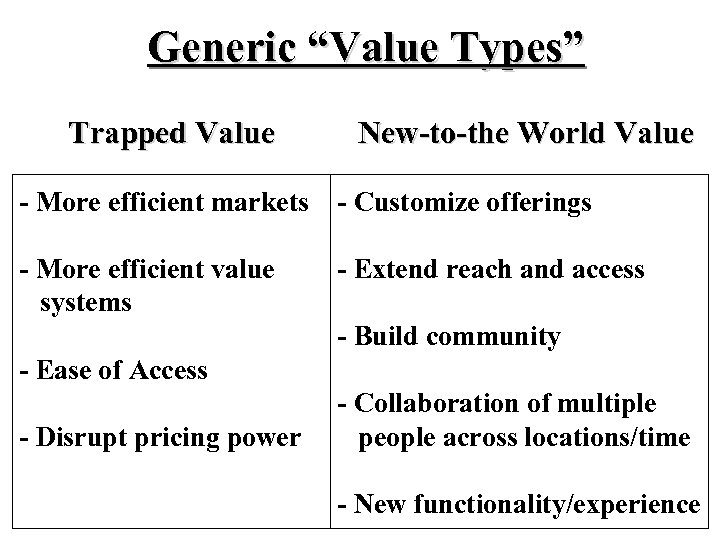
Generic “Value Types” Trapped Value New-to-the World Value - More efficient markets - Customize offerings - More efficient value systems - Extend reach and access - Build community - Ease of Access - Disrupt pricing power - Collaboration of multiple people across locations/time - New functionality/experience
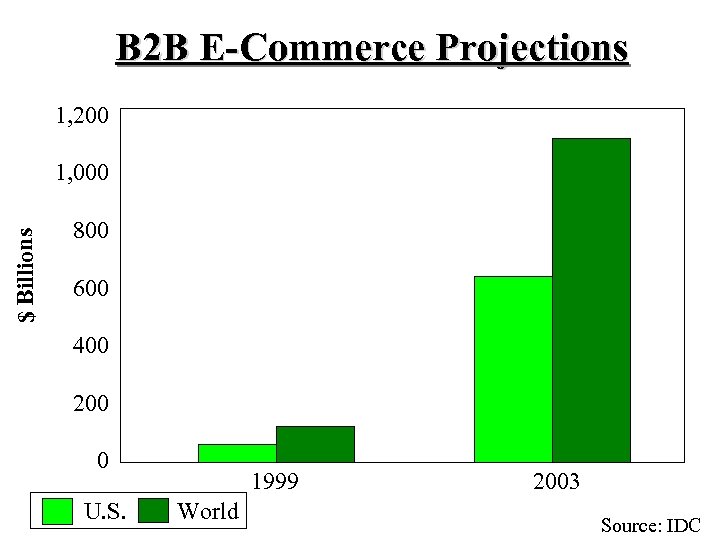
B 2 B E-Commerce Projections 1, 200 $ Billions 1, 000 800 600 400 200 0 U. S. 1999 World 2003 Source: IDC
CUBIC Program Summer 2001 Professor Ramiro Montealegre The customer interface for e-business
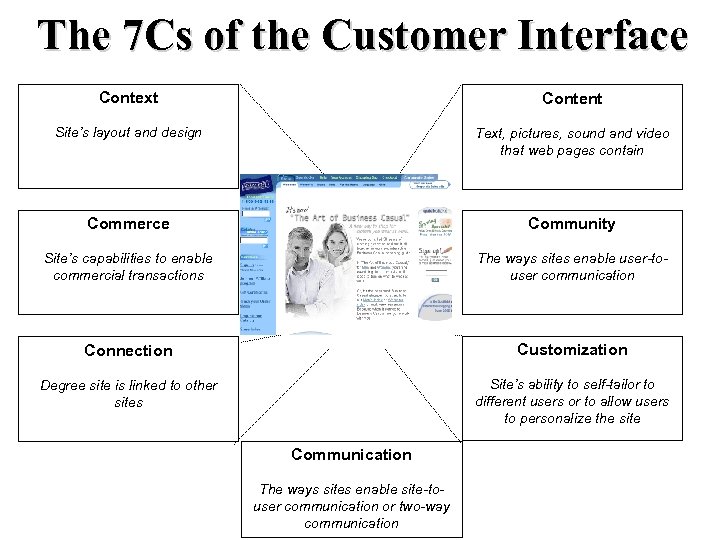
The 7 Cs of the Customer Interface Context Content Site’s layout and design Text, pictures, sound and video that web pages contain Commerce Community Site’s capabilities to enable commercial transactions The ways sites enable user-touser communication Connection Customization Degree site is linked to other sites Site’s ability to self-tailor to different users or to allow users to personalize the site Communication The ways sites enable site-touser communication or two-way communication
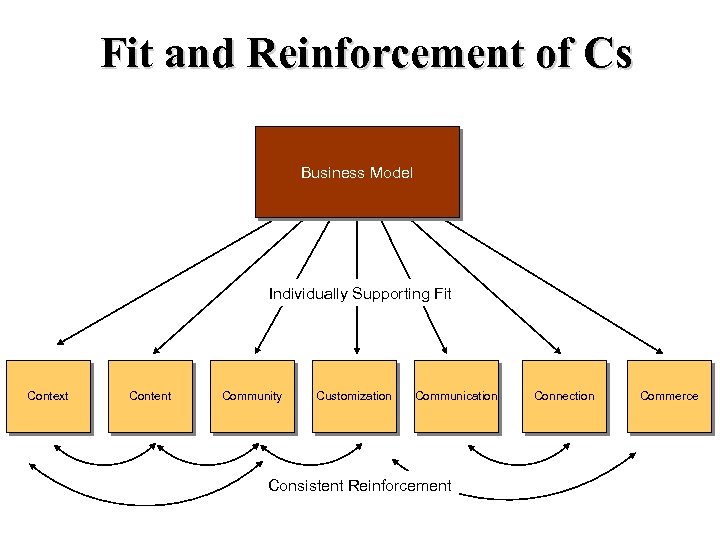
Fit and Reinforcement of Cs Business Model Individually Supporting Fit Context Content Community Customization Communication Consistent Reinforcement Connection Commerce
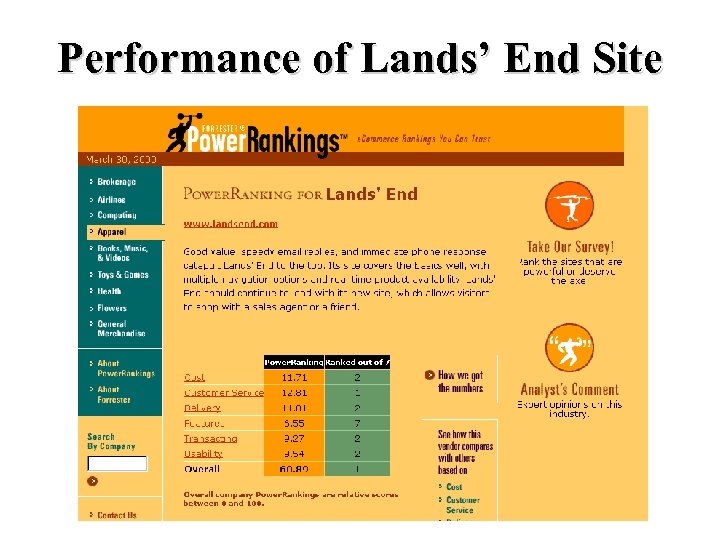
Performance of Lands’ End Site
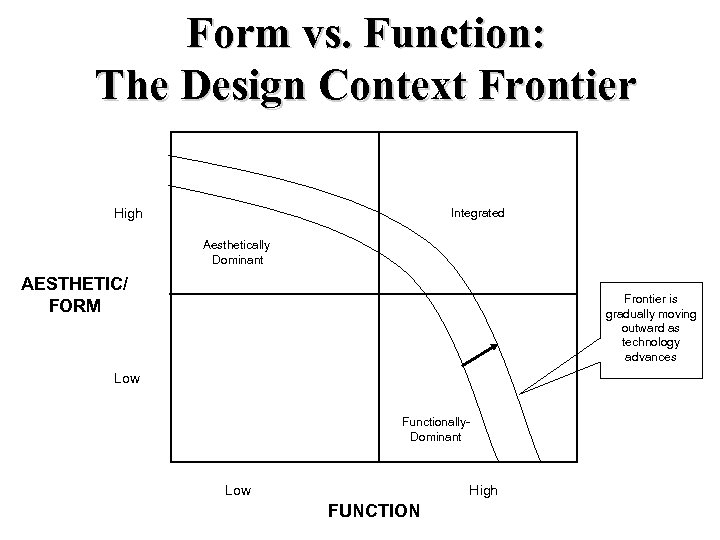
Form vs. Function: The Design Context Frontier High Integrated Aesthetically Dominant AESTHETIC/ FORM Frontier is gradually moving outward as technology advances Low Functionally. Dominant Low High FUNCTION
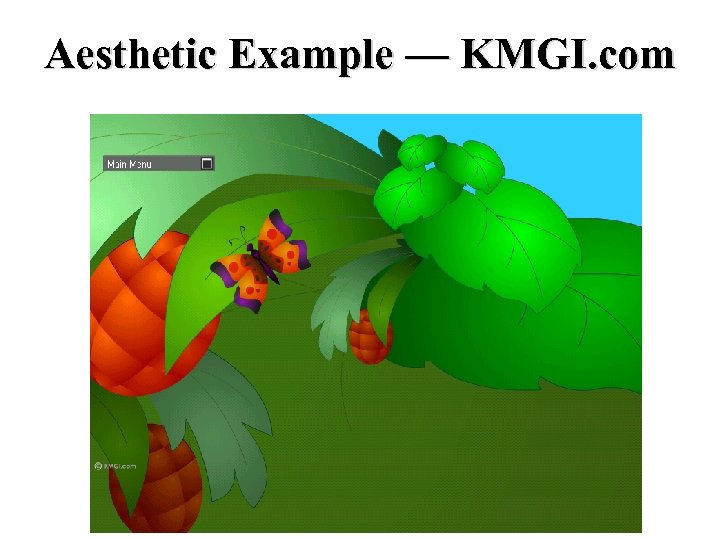
Aesthetic Example — KMGI. com
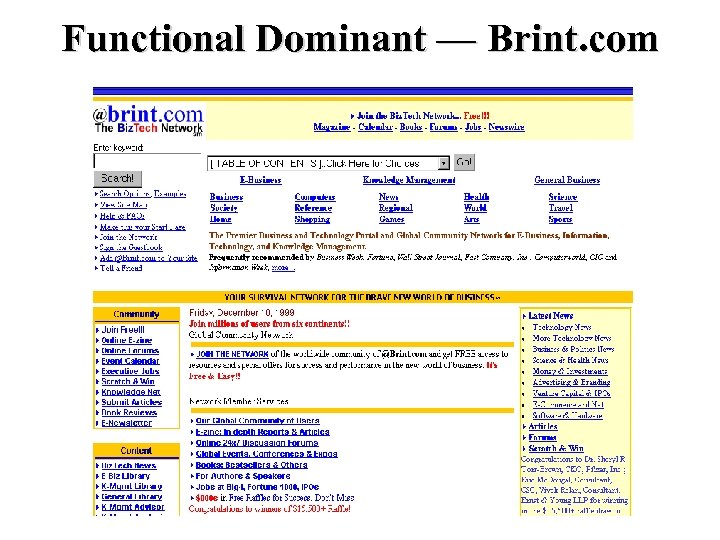
Functional Dominant — Brint. com
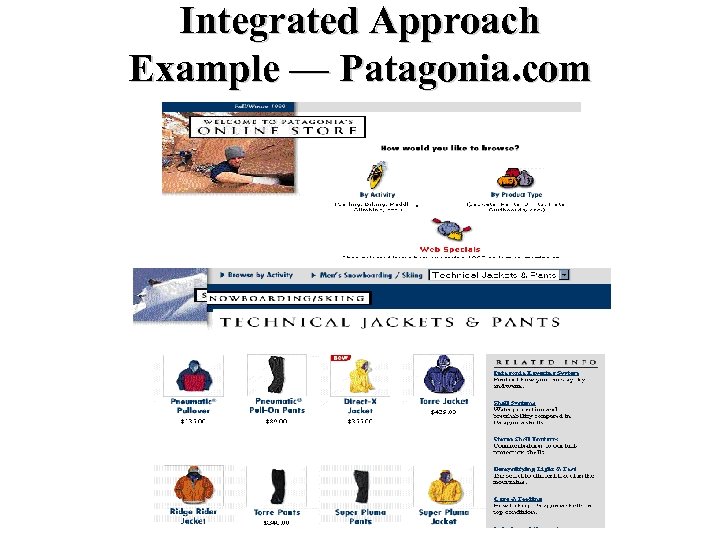
Integrated Approach Example — Patagonia. com
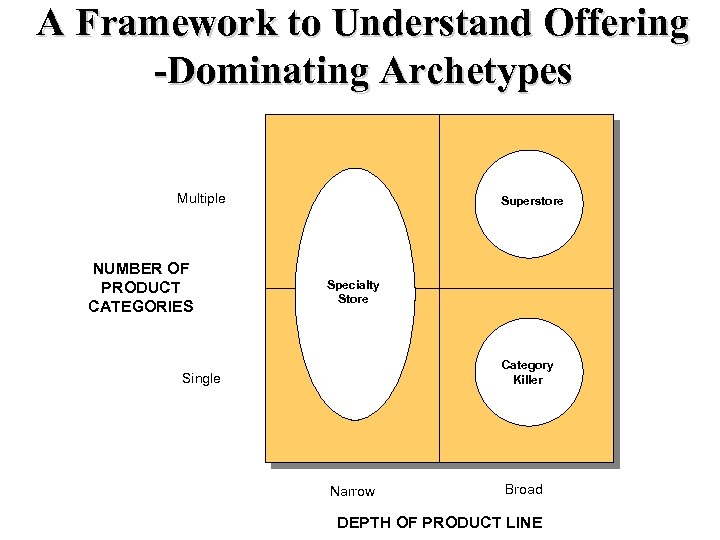
A Framework to Understand Offering -Dominating Archetypes Multiple NUMBER OF PRODUCT CATEGORIES Superstore Specialty Store Category Killer Single Narrow Broad DEPTH OF PRODUCT LINE
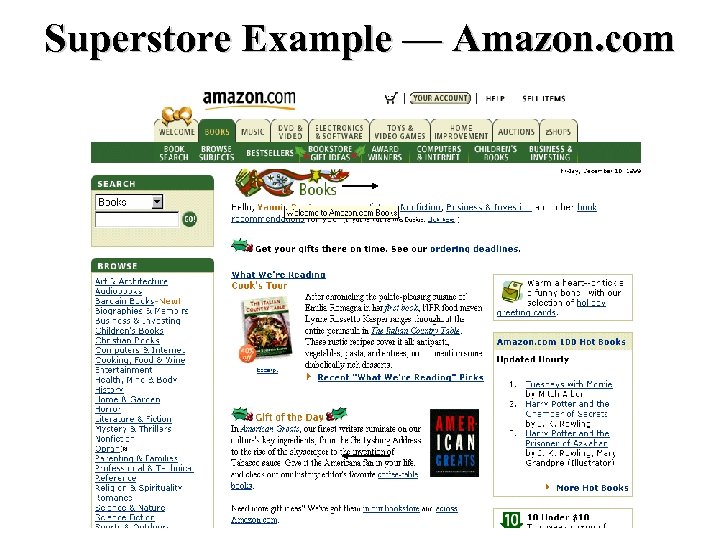
Superstore Example — Amazon. com
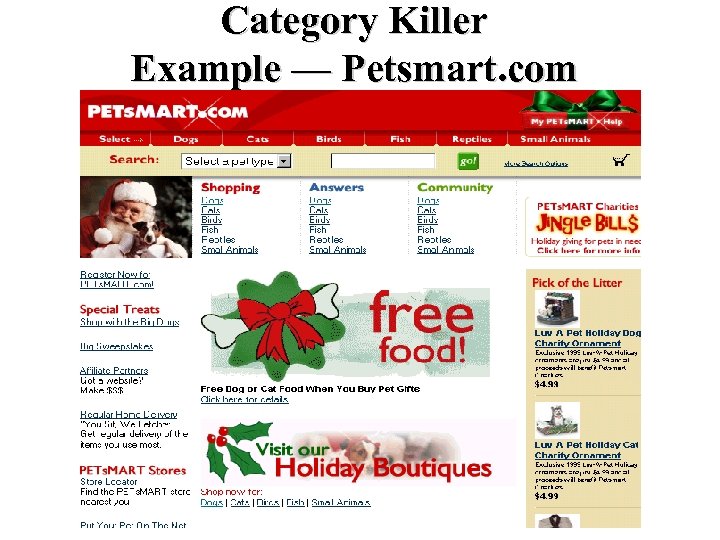
Category Killer Example — Petsmart. com
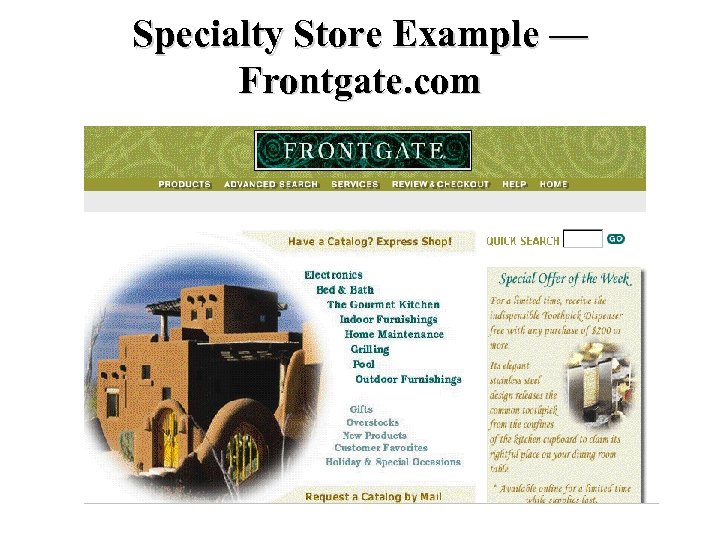
Specialty Store Example — Frontgate. com
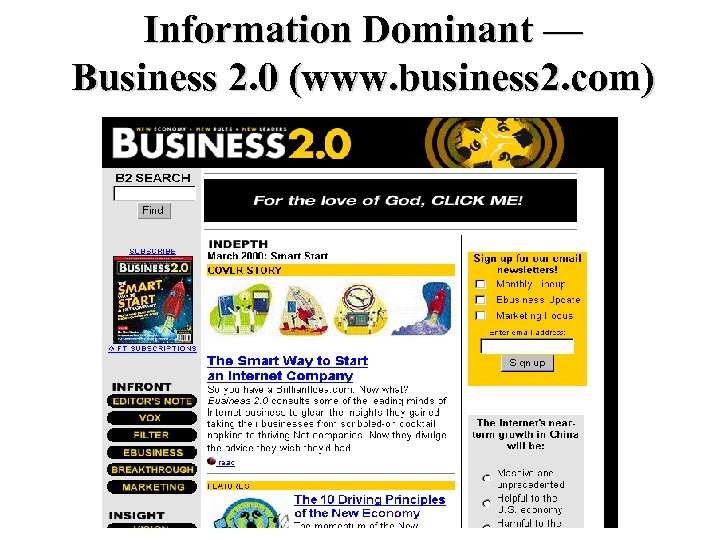
Information Dominant — Business 2. 0 (www. business 2. com)
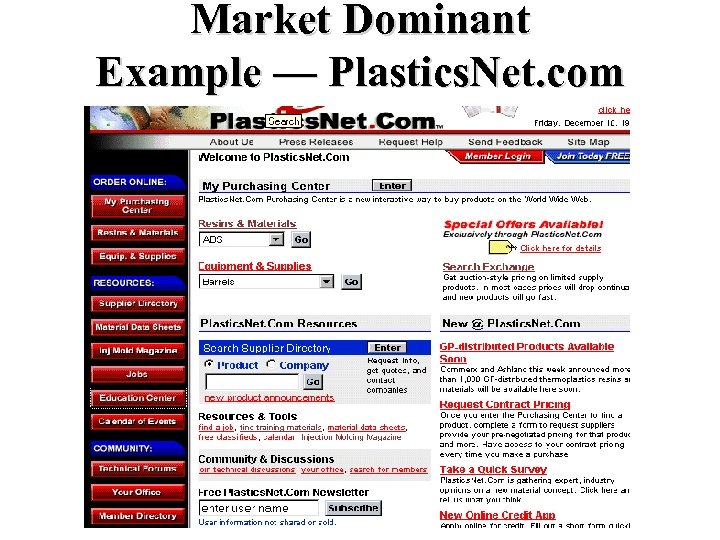
Market Dominant Example — Plastics. Net. com
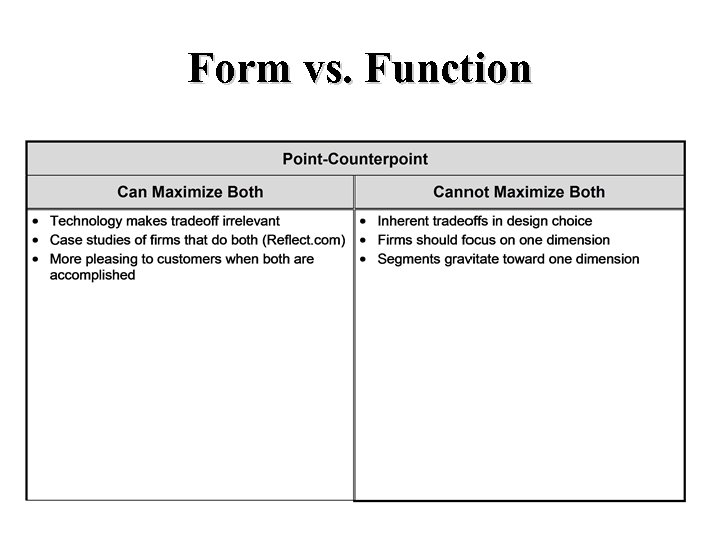
Form vs. Function
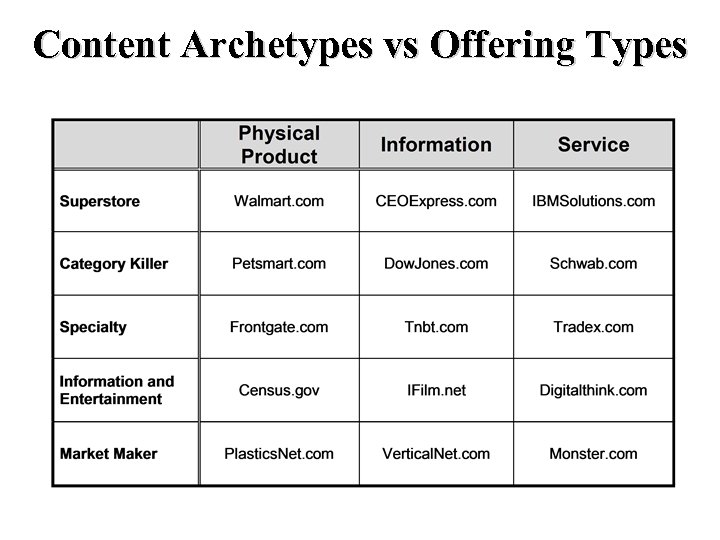
Content Archetypes vs Offering Types
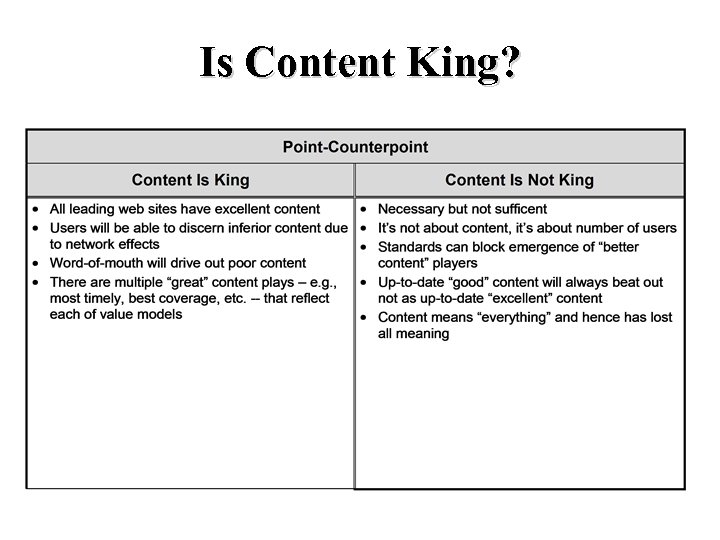
Is Content King?
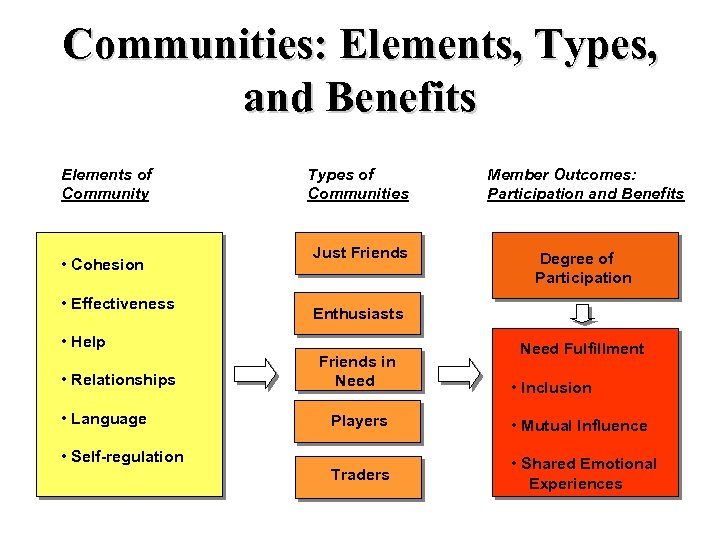
Communities: Elements, Types, and Benefits Elements of Community • Cohesion • Effectiveness Types of Communities Member Outcomes: Participation and Benefits Just Friends Degree of Participation Enthusiasts • Help • Relationships • Language • Self-regulation Friends in Need Fulfillment • Inclusion Players • Mutual Influence Traders • Shared Emotional Experiences
CUBIC Program Summer 2001 Professor Ramiro Montealegre Implementation Issues
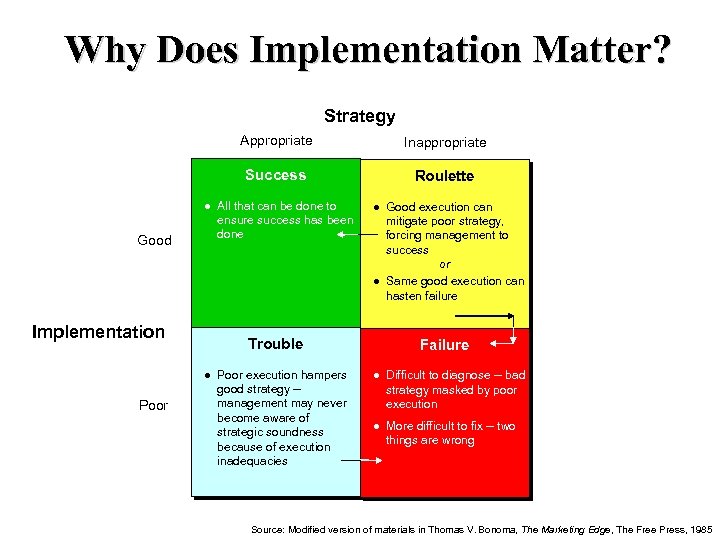
Why Does Implementation Matter? Strategy Appropriate Success Good Inappropriate Roulette All that can be done to ensure success has been done Implementation Trouble Poor execution hampers good strategy -management may never become aware of strategic soundness because of execution inadequacies Good execution can mitigate poor strategy, forcing management to success or Same good execution can hasten failure Failure Difficult to diagnose -- bad strategy masked by poor execution More difficult to fix -- two things are wrong Source: Modified version of materials in Thomas V. Bonoma, The Marketing Edge, The Free Press, 1985
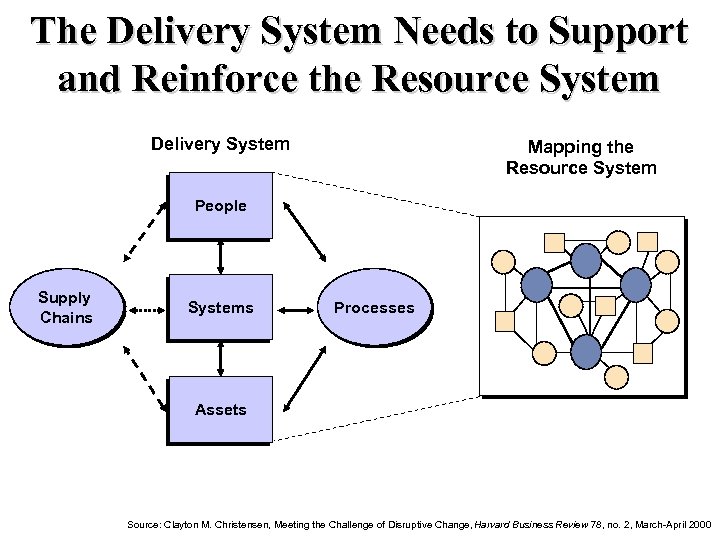
The Delivery System Needs to Support and Reinforce the Resource System Delivery System Mapping the Resource System People Supply Chains Systems Processes Assets Source: Clayton M. Christensen, Meeting the Challenge of Disruptive Change, Harvard Business Review 78, no. 2, March-April 2000
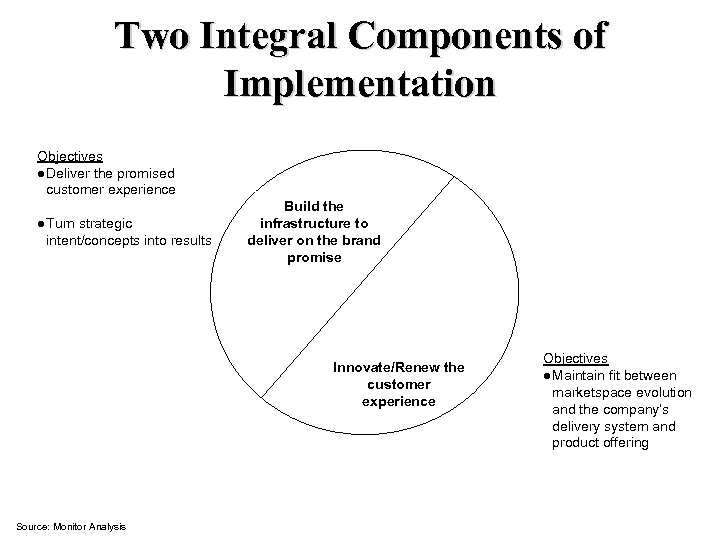
Two Integral Components of Implementation Objectives Deliver the promised customer experience Turn strategic intent/concepts into results Build the infrastructure to deliver on the brand promise Innovate/Renew the customer experience Source: Monitor Analysis Objectives Maintain fit between marketspace evolution and the company’s delivery system and product offering
Ideas are critical… Innovation is the mainspring of the new economy. But as more and more companies compete in ideas, the game changes to competing in the implementation of the ideas. In this next stage of competition: Getting an idea gives way to getting it done!
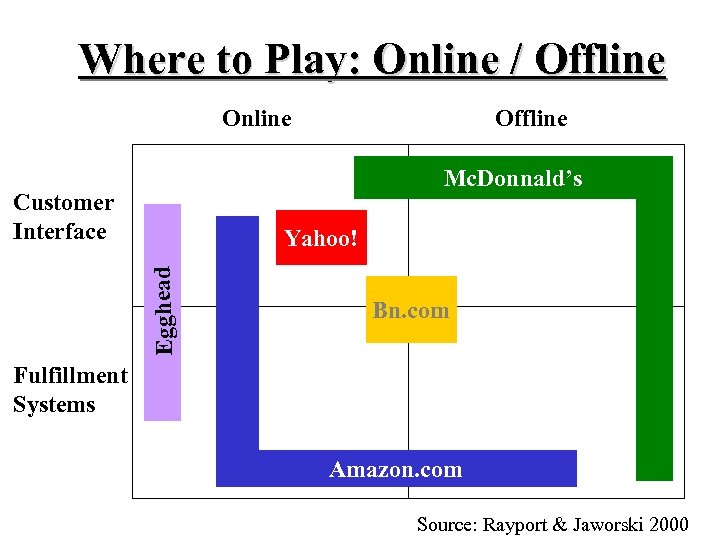
Where to Play: Online / Offline Online Offline Mc. Donnald’s Customer Interface Egghead Yahoo! Bn. com Fulfillment Systems Amazon. com Source: Rayport & Jaworski 2000
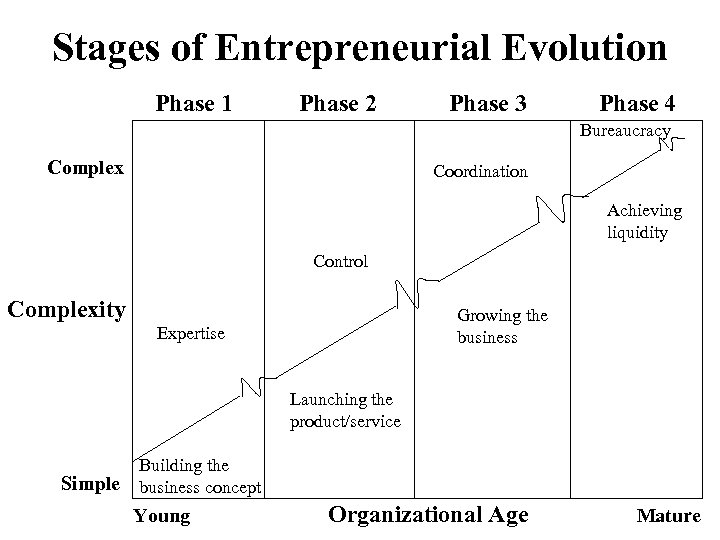
Stages of Entrepreneurial Evolution Phase 1 Phase 2 Phase 3 Phase 4 Bureaucracy Complex Coordination Achieving liquidity Control Complexity Growing the business Expertise Launching the product/service Simple Building the business concept Young Organizational Age Mature
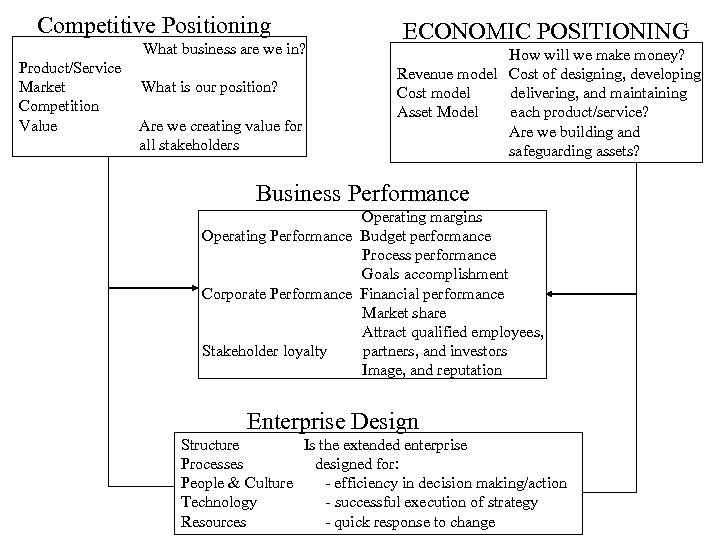
Competitive Positioning What business are we in? Product/Service Market Competition Value What is our position? Are we creating value for all stakeholders ECONOMIC POSITIONING How will we make money? Revenue model Cost of designing, developing Cost model delivering, and maintaining Asset Model each product/service? Are we building and safeguarding assets? Business Performance Operating margins Operating Performance Budget performance Process performance Goals accomplishment Corporate Performance Financial performance Market share Attract qualified employees, Stakeholder loyalty partners, and investors Image, and reputation Enterprise Design Structure Is the extended enterprise Processes designed for: People & Culture - efficiency in decision making/action Technology - successful execution of strategy Resources - quick response to change
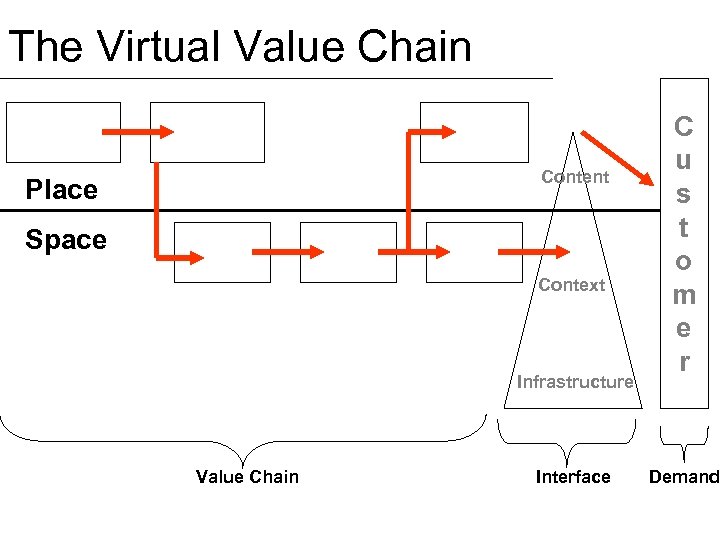
The Virtual Value Chain Content Place Space Context Infrastructure Value Chain Interface C u s t o m e r Demand
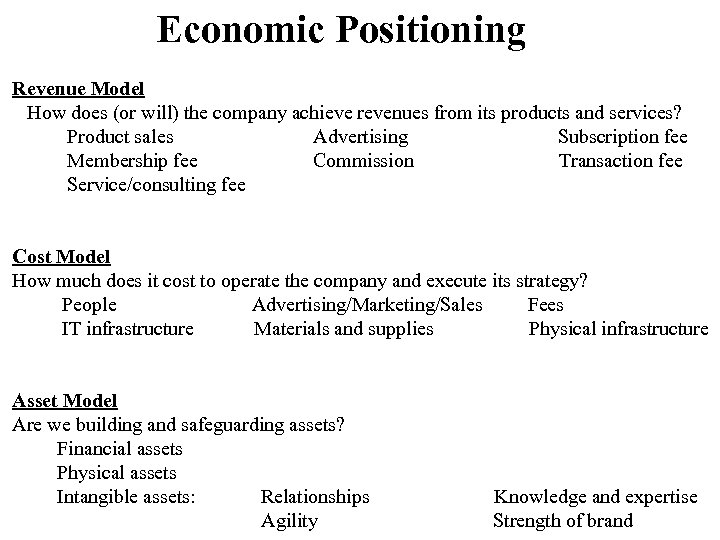
Economic Positioning Revenue Model How does (or will) the company achieve revenues from its products and services? Product sales Advertising Subscription fee Membership fee Commission Transaction fee Service/consulting fee Cost Model How much does it cost to operate the company and execute its strategy? People Advertising/Marketing/Sales Fees IT infrastructure Materials and supplies Physical infrastructure Asset Model Are we building and safeguarding assets? Financial assets Physical assets Intangible assets: Relationships Agility Knowledge and expertise Strength of brand
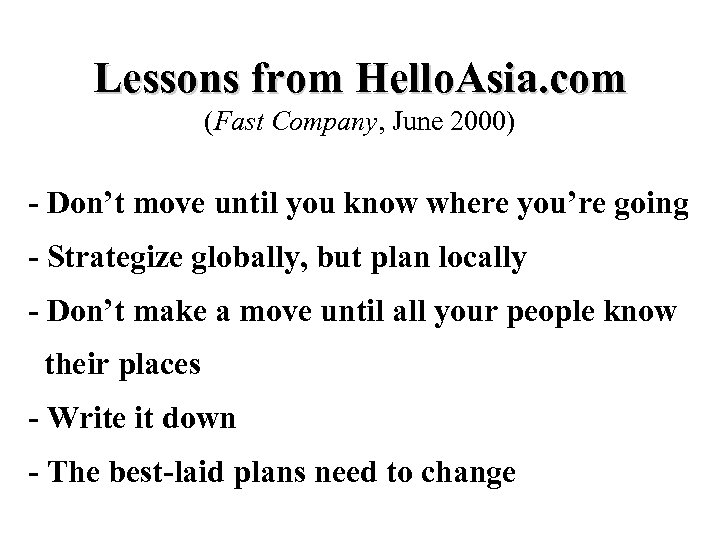
Lessons from Hello. Asia. com (Fast Company, June 2000) - Don’t move until you know where you’re going - Strategize globally, but plan locally - Don’t make a move until all your people know their places - Write it down - The best-laid plans need to change

CUBIC Program Summer 2001 Professor Ramiro Montealegre
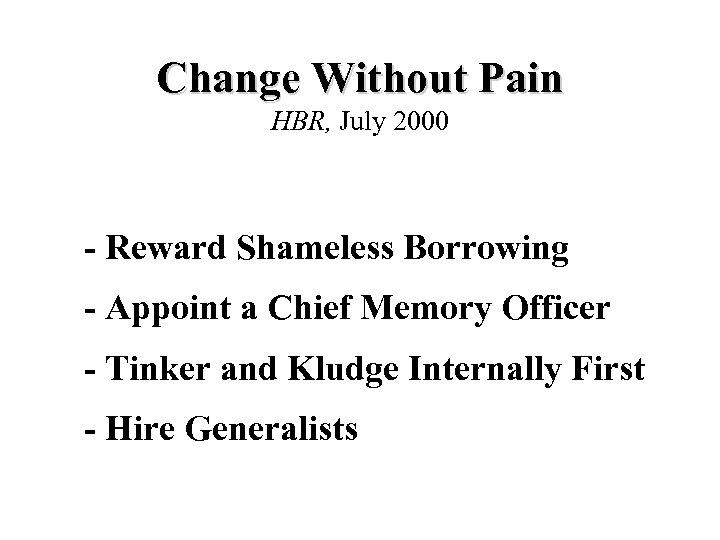
Change Without Pain HBR, July 2000 - Reward Shameless Borrowing - Appoint a Chief Memory Officer - Tinker and Kludge Internally First - Hire Generalists
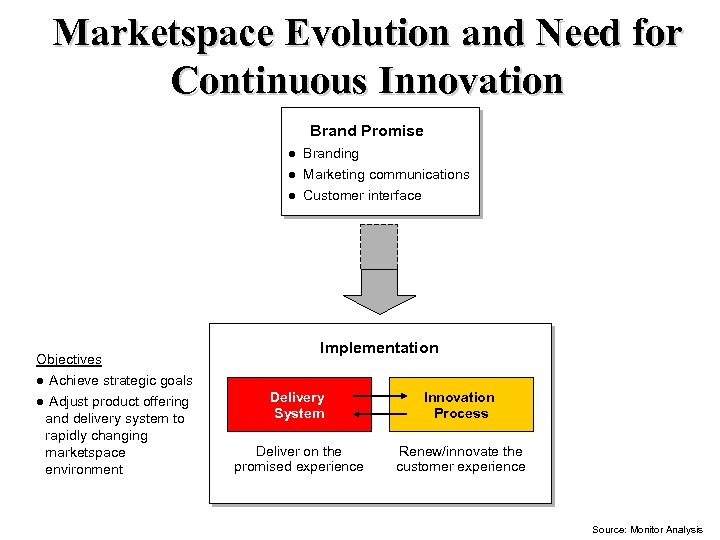
Marketspace Evolution and Need for Continuous Innovation Brand Promise Branding Marketing communications Customer interface Objectives Achieve strategic goals Adjust product offering and delivery system to rapidly changing marketspace environment Implementation Delivery System Innovation Process Deliver on the promised experience Renew/innovate the customer experience Source: Monitor Analysis
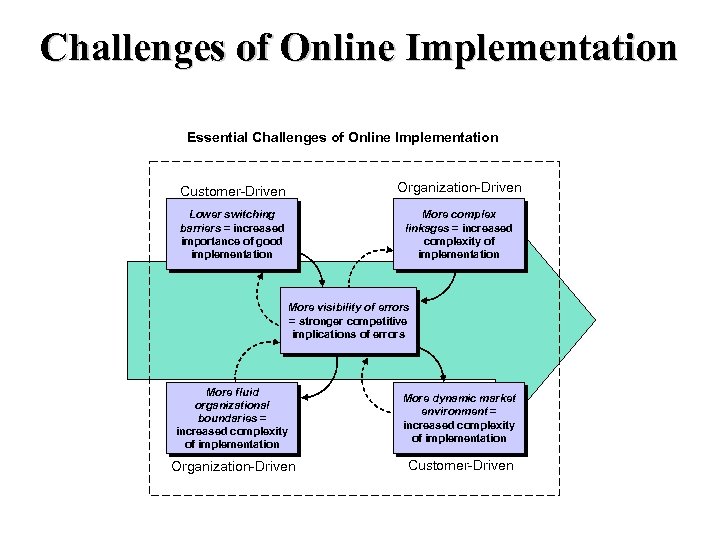
Challenges of Online Implementation Essential Challenges of Online Implementation Customer-Driven Organization-Driven Lower switching barriers = increased importance of good implementation More complex linkages = increased complexity of implementation More visibility of errors = stronger competitive implications of errors More fluid organizational boundaries = increased complexity of implementation More dynamic market environment = increased complexity of implementation Organization-Driven Customer-Driven
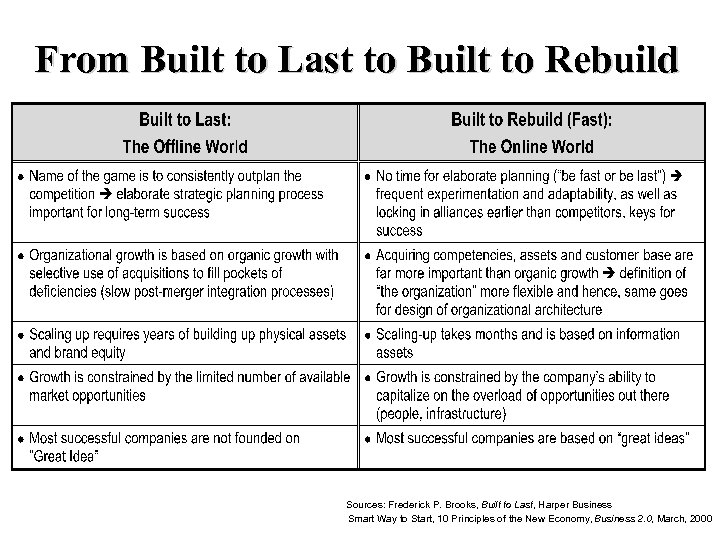
From Built to Last to Built to Rebuild Sources: Frederick P. Brooks, Built to Last, Harper Business Smart Way to Start, 10 Principles of the New Economy, Business 2. 0, March, 2000
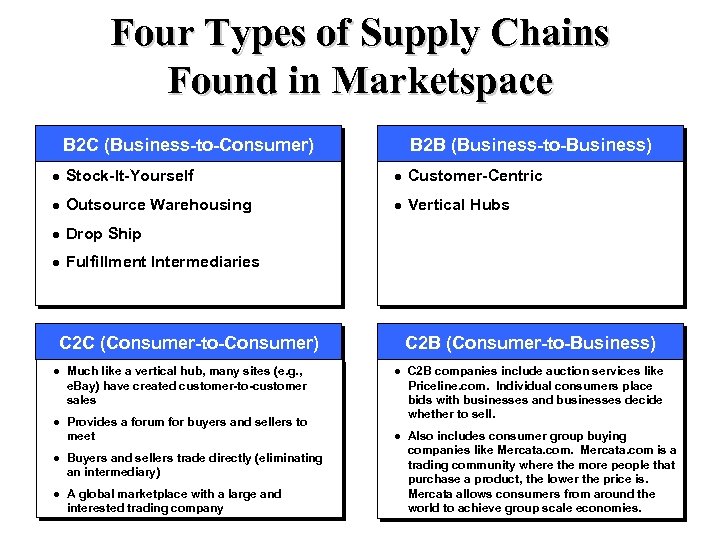
Four Types of Supply Chains Found in Marketspace B 2 C (Business-to-Consumer) B 2 B (Business-to-Business) Stock-It-Yourself Customer-Centric Outsource Warehousing Vertical Hubs Drop Ship Fulfillment Intermediaries C 2 C (Consumer-to-Consumer) Much like a vertical hub, many sites (e. g. , e. Bay) have created customer-to-customer sales Provides a forum for buyers and sellers to meet Buyers and sellers trade directly (eliminating an intermediary) A global marketplace with a large and interested trading company C 2 B (Consumer-to-Business) C 2 B companies include auction services like Priceline. com. Individual consumers place bids with businesses and businesses decide whether to sell. Also includes consumer group buying companies like Mercata. com is a trading community where the more people that purchase a product, the lower the price is. Mercata allows consumers from around the world to achieve group scale economies.
Скачать презентацию CUBIC Program Summer 2001 Professors Ken Kozar and
bcc8a5aae8da18eb0cdd711fd441d5cc.ppt