 Скачать презентацию Cube Calculus Overview Of This Presentation
c2ca3ec56486b2e3bafc9f4674b61795.ppt
- Количество слайдов: 89



Cube Calculus
Overview Of This Presentation • A Brief Review of Cube Calculus. • Summary of Cube Calculus operations. • Positional notation concept for Cube Calculus operations. • Summary of Positional Notation concept for Cube Calculus operations. • Why we need hardware realization of Cube Calculus?

Brief Review Of Cube Calculus
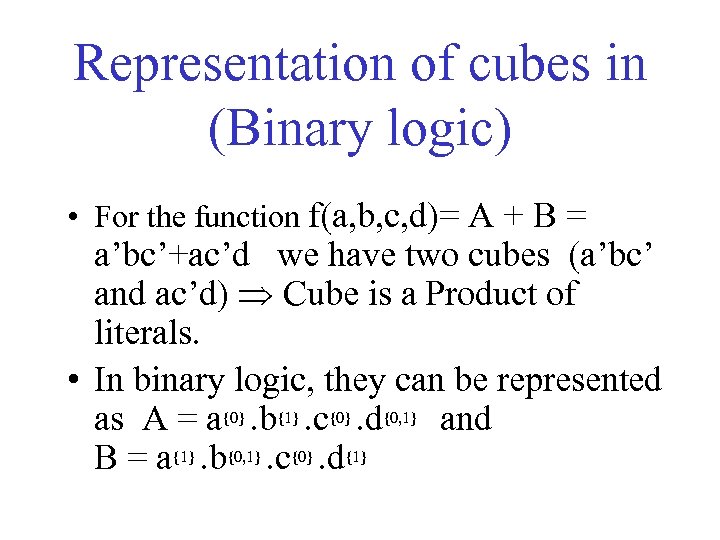
Representation of cubes in (Binary logic) • For the function f(a, b, c, d)= A + B = a’bc’+ac’d we have two cubes (a’bc’ and ac’d) Cube is a Product of literals. • In binary logic, they can be represented as A = a{0}. b{1}. c{0}. d{0, 1} and B = a{1}. b{0, 1}. c{0}. d{1}
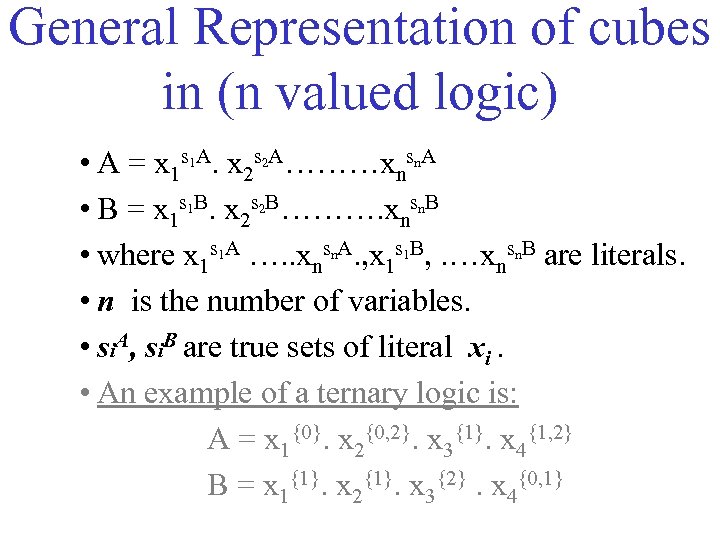
General Representation of cubes in (n valued logic) • A = x 1 s 1 A. x 2 s 2 A………xnsn. A • B = x 1 s 1 B. x 2 s 2 B………. xnsn. B • where x 1 s 1 A …. . xnsn. A. , x 1 s 1 B, . …xnsn. B are literals. • n is the number of variables. • si. A, si. B are true sets of literal xi. • An example of a ternary logic is: A = x 1{0}. x 2{0, 2}. x 3{1}. x 4{1, 2} B = x 1{1}. x 2{1}. x 3{2}. x 4{0, 1}
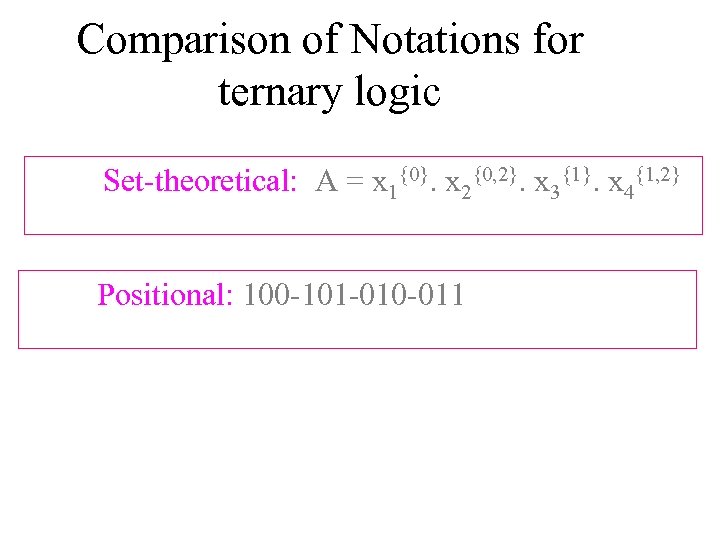
Comparison of Notations for ternary logic Set-theoretical: A = x 1{0}. x 2{0, 2}. x 3{1}. x 4{1, 2} Positional: 100 -101 -010 -011
Cube Calculus Operations
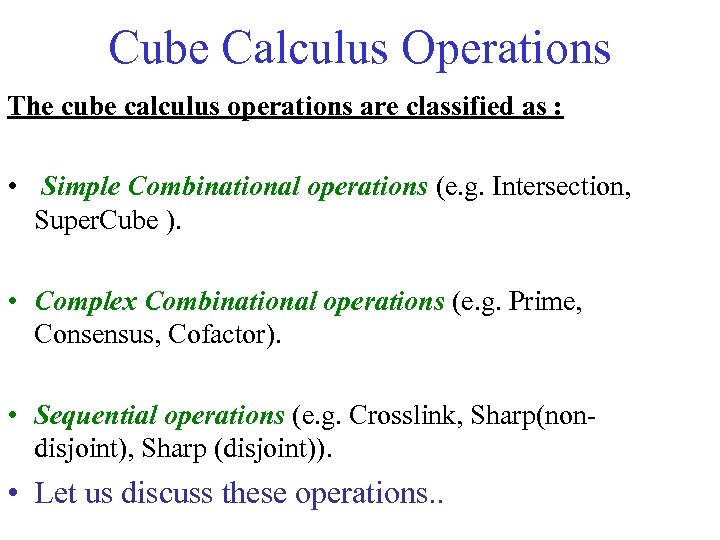
Cube Calculus Operations The cube calculus operations are classified as : • Simple Combinational operations (e. g. Intersection, Super. Cube ). • Complex Combinational operations (e. g. Prime, Consensus, Cofactor). • Sequential operations (e. g. Crosslink, Sharp(nondisjoint), Sharp (disjoint)). • Let us discuss these operations. .
Simple Combinational Cube Operations
Simple Combinational Operations • Defined as a SINGLE set operation on all pairs of true sets and produces one resultant cube. • Intersection and Supercube are simple combinational cube operations. • These operations are fast in software and very fast when realized in hardware. • Have various applications in two-level synthesis, set covering, graph coloring and all kinds of basic algorithms
Example Of Binary Function
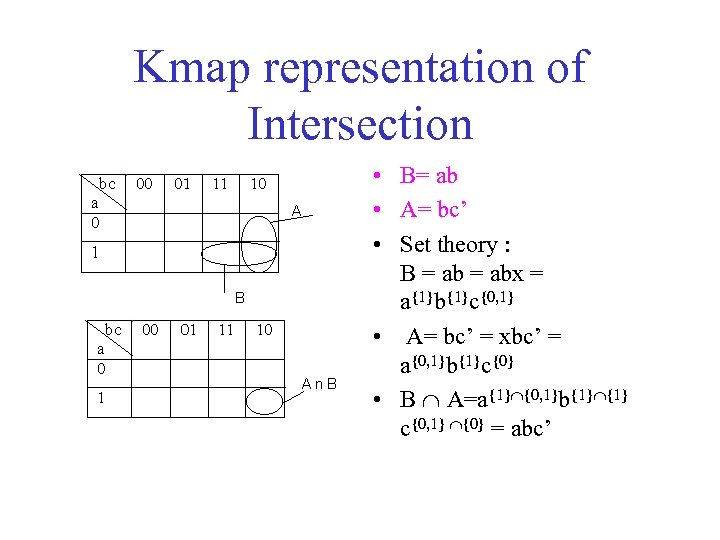
Kmap representation of Intersection • B= ab • A= bc’ • Set theory : B = abx = a{1}b{1}c{0, 1} • A= bc’ = xbc’ = a{0, 1}b{1}c{0} • B A=a{1} {0, 1}b{1} c{0, 1} {0} = abc’
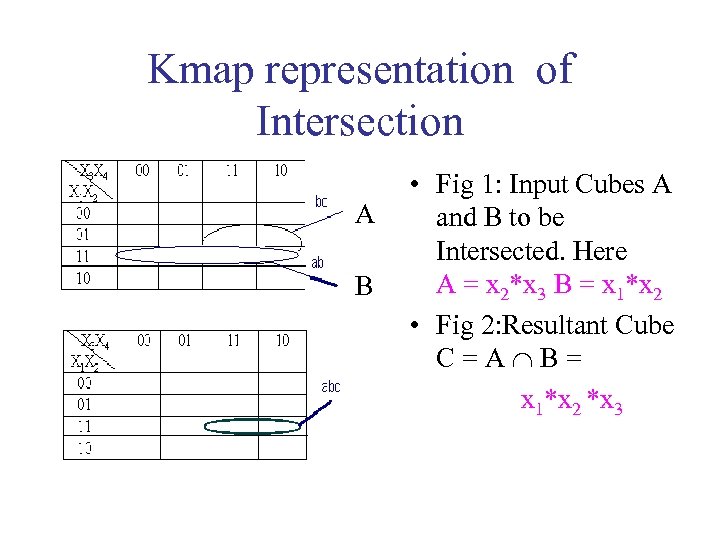
Kmap representation of Intersection A B • Fig 1: Input Cubes A and B to be Intersected. Here A = x 2*x 3 B = x 1*x 2 • Fig 2: Resultant Cube C=A B= x 1*x 2 *x 3
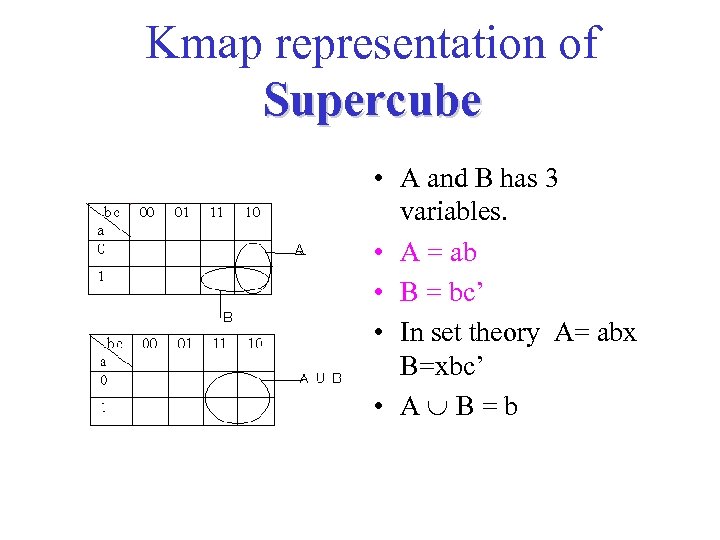
Kmap representation of Supercube • A and B has 3 variables. • A = ab • B = bc’ • In set theory A= abx B=xbc’ • A B=b
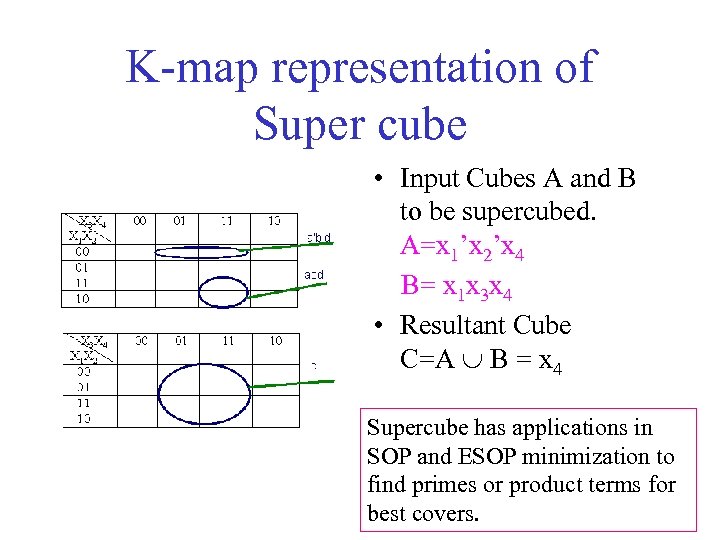
K-map representation of Super cube • Input Cubes A and B to be supercubed. A=x 1’x 2’x 4 B= x 1 x 3 x 4 • Resultant Cube C=A B = x 4 Supercube has applications in SOP and ESOP minimization to find primes or product terms for best covers.
Examples Of Cube Operations for Multi-Valued Functions
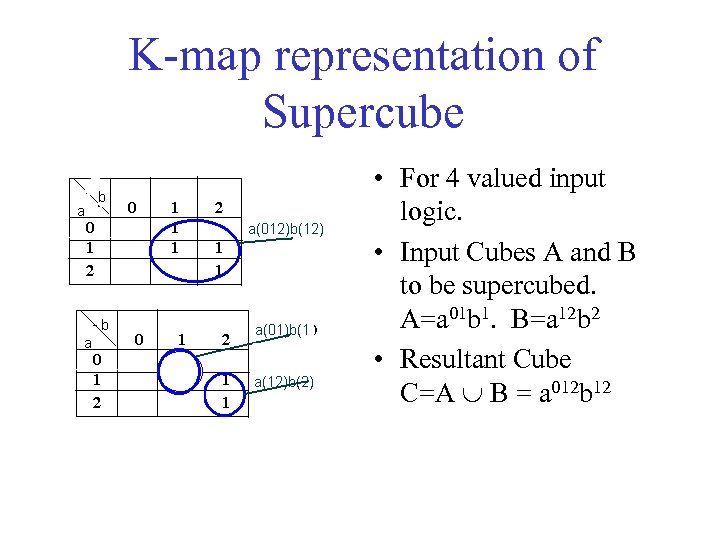
K-map representation of Supercube ) • For 4 valued input logic. • Input Cubes A and B to be supercubed. A=a 01 b 1. B=a 12 b 2 • Resultant Cube C=A B = a 012 b 12
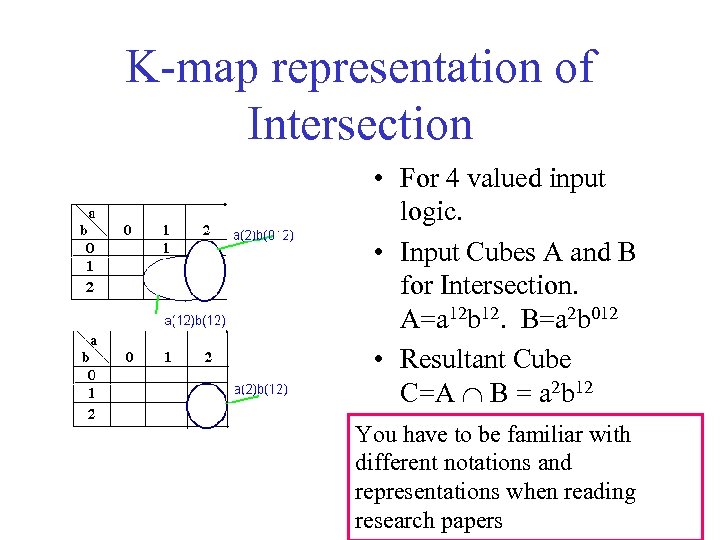
K-map representation of Intersection • For 4 valued input logic. • Input Cubes A and B for Intersection. A=a 12 b 12. B=a 2 b 012 • Resultant Cube C=A B = a 2 b 12 You have to be familiar with different notations and representations when reading research papers
Definitions of Simple Combinational Cube Operations
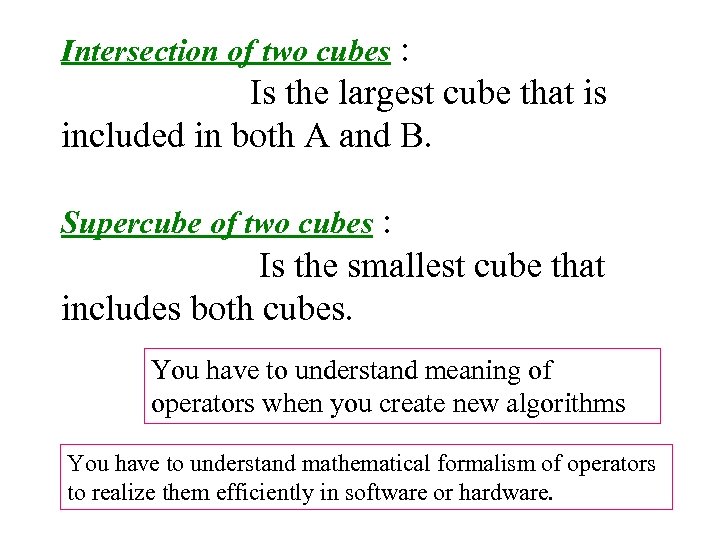
Intersection of two cubes : Is the largest cube that is included in both A and B. Supercube of two cubes : Is the smallest cube that includes both cubes. You have to understand meaning of operators when you create new algorithms You have to understand mathematical formalism of operators to realize them efficiently in software or hardware.
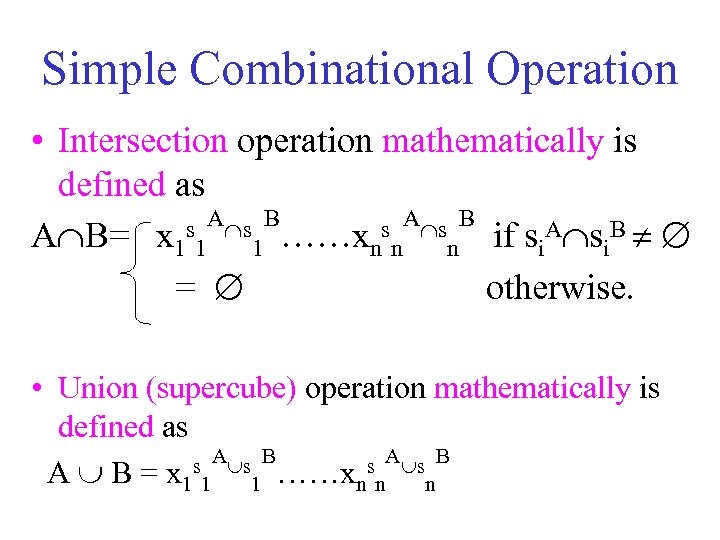
Simple Combinational Operation • Intersection operation mathematically is defined as s A s B……x s A s B if s A s B A B= x 1 1 1 nn n i i = otherwise. • Union (supercube) operation mathematically is defined as s A s B……x s A s B A B = x 1 1 1 nn n
Complex Combinational Cube Operations
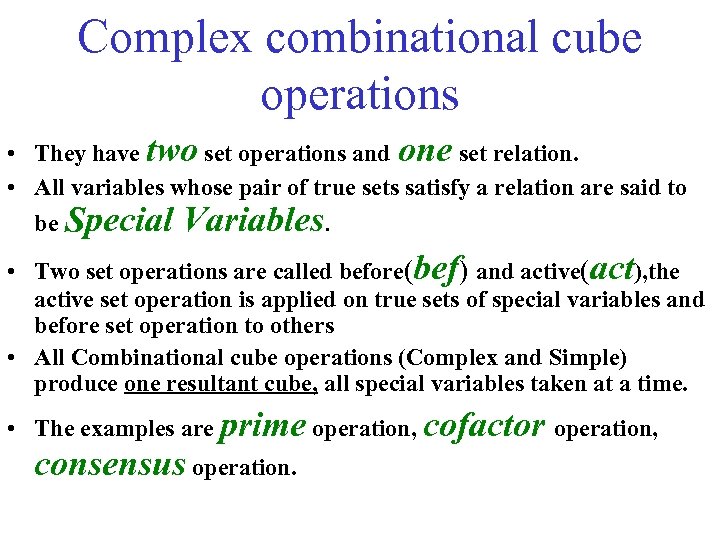
Complex combinational cube operations • They have two set operations and one set relation. • All variables whose pair of true sets satisfy a relation are said to be Special Variables. • Two set operations are called before(bef) and active(act), the active set operation is applied on true sets of special variables and before set operation to others • All Combinational cube operations (Complex and Simple) produce one resultant cube, all special variables taken at a time. • The examples are prime operation, cofactor operation, consensus operation.
Examples of Complex Combinational Cube Operations
Example Of Binary Function
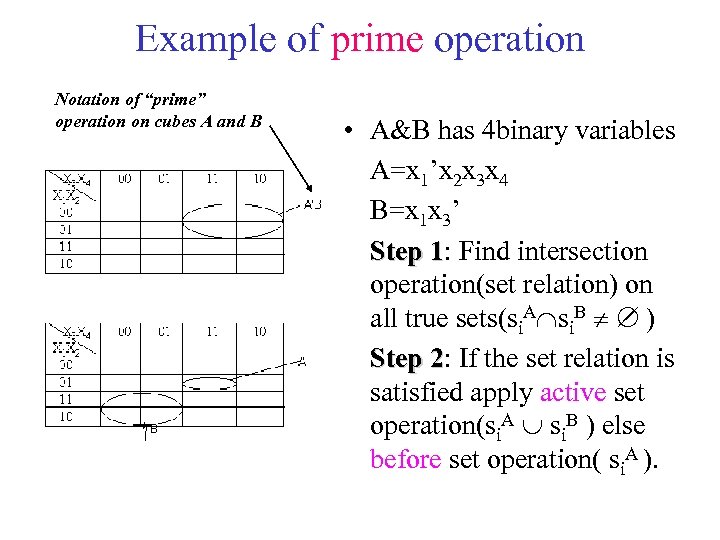
Example of prime operation Notation of “prime” operation on cubes A and B • • A&B has 4 binary variables A=x 1’x 2 x 3 x 4 B=x 1 x 3’ Step 1: Find intersection 1 operation(set relation) on all true sets(si. A si. B ) • Step 2: If the set relation is 2 satisfied apply active set operation(si. A si. B ) else before set operation( si. A ).
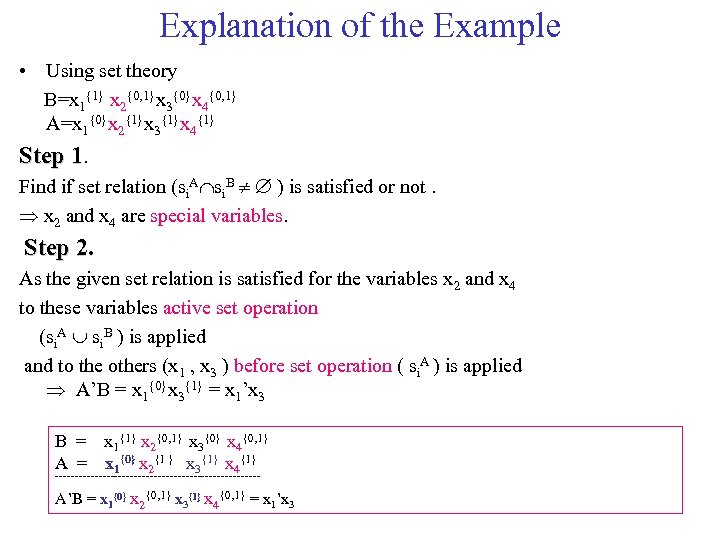
Explanation of the Example • Using set theory B=x 1{1} x 2{0, 1}x 3{0}x 4{0, 1} A=x 1{0}x 2{1}x 3{1}x 4{1} Step 1. Find if set relation (si. A si. B ) is satisfied or not. x 2 and x 4 are special variables. Step 2. As the given set relation is satisfied for the variables x 2 and x 4 to these variables active set operation (si. A si. B ) is applied and to the others (x 1 , x 3 ) before set operation ( si. A ) is applied A’B = x 1{0}x 3{1} = x 1’x 3 B = x 1{1} x 2{0, 1} x 3{0} x 4{0, 1} A = x 1{0} x 2{1 } x 3{1} x 4{1} -------------------------- A’B = x 1{0} x 2{0, 1} x 3{1} x 4{0, 1} = x 1’x 3
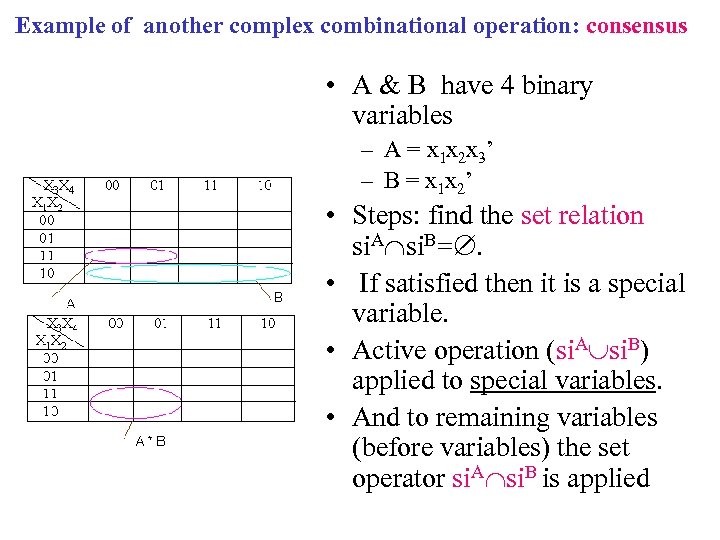
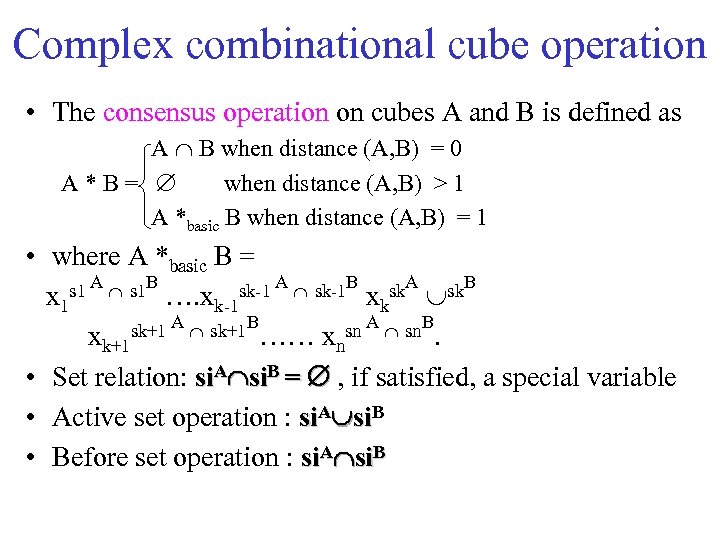
Example of another complex combinational operation: consensus • A & B have 4 binary variables – A = x 1 x 2 x 3’ – B = x 1 x 2’ • Steps: find the set relation si. A si. B=. • If satisfied then it is a special variable. • Active operation (si. A si. B) applied to special variables. • And to remaining variables (before variables) the set operator si. A si. B is applied
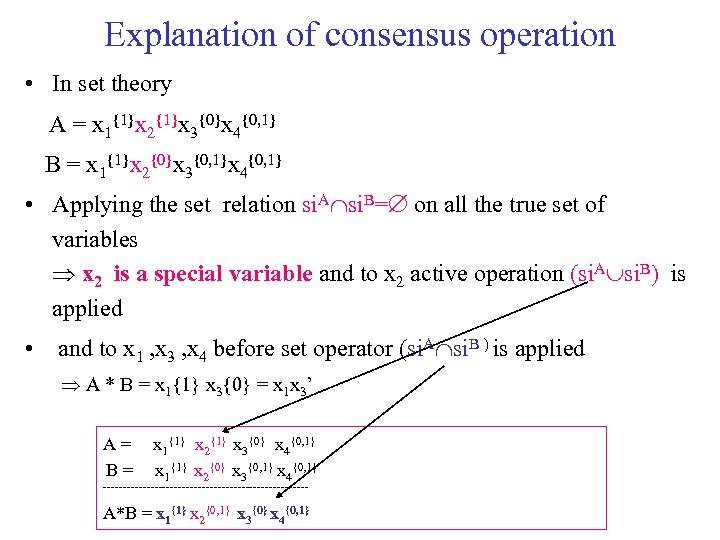
Explanation of consensus operation • In set theory A = x 1{1}x 2{1}x 3{0}x 4{0, 1} B = x 1{1}x 2{0}x 3{0, 1}x 4{0, 1} • Applying the set relation si. A si. B= on all the true set of variables x 2 is a special variable and to x 2 active operation (si. A si. B) is applied • and to x 1 , x 3 , x 4 before set operator (si. A si. B ) is applied A * B = x 1{1} x 3{0} = x 1 x 3’ A= B= x 1{1} x 2{1} x 3{0} x 4{0, 1} x 1{1} x 2{0} x 3{0, 1} x 4{0, 1} -------------------------- A*B = x 1{1} x 2{0, 1} x 3{0} x 4{0, 1}
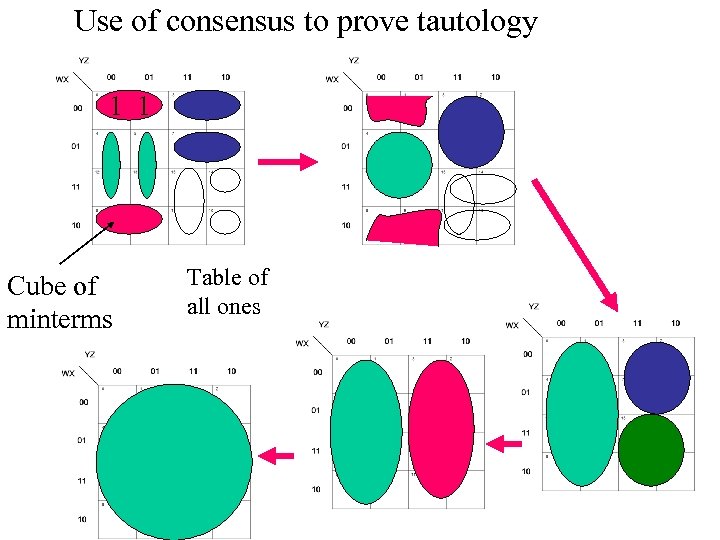
Use of consensus to prove tautology 1 1 Cube of minterms Table of all ones
Proving tautology • By using consensus I combine step-by-step larger and larger cubes of ones. • Ultimately, the cube of ones that covers the whole map is created. • Thus the function is a tautology. • The process of combining cubes can be represented as a tree The same Cube Calculus has dual meaning when applied to cubes of zeros (maxterms) It is called resolution and used in automatic theorem proving to derive empty clause = cube of all zeros
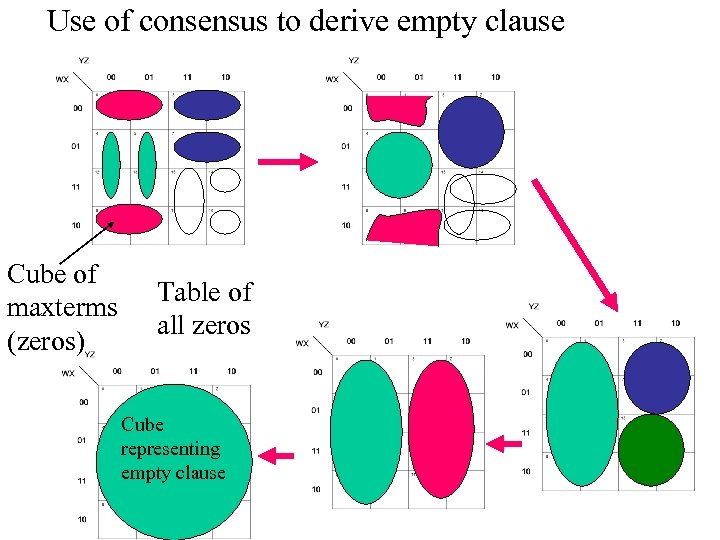
Use of consensus to derive empty clause Cube of maxterms (zeros) Table of all zeros Cube representing empty clause
Proving non-satisfiability is deriving empty clause • By using resolution operator (dual to consensus) I combine step-by-step larger and larger cubes of zeros. • Ultimately, the cube of zeros that covers the whole map is created. This is empty clause. • Thus the function is always zero. • The process of combining cubes can be represented as a tree. • This is used in automatic theorem proving to prove that a set of clauses is inconsistent • Please do a complete example with all formulas applied in formal way , step by step. • What would be a program?
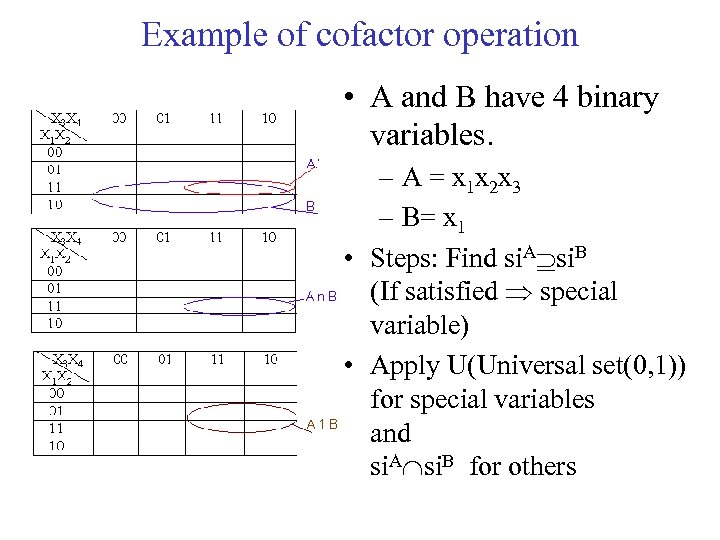
Example of cofactor operation • A and B have 4 binary variables. – A = x 1 x 2 x 3 – B= x 1 • Steps: Find si. A si. B (If satisfied special variable) • Apply U(Universal set(0, 1)) for special variables and si. A si. B for others
Explanation • Set theory: A = x 1{1}x 2{1}x 3{1}x 4{0, 1} B = x 1{1}x 2{0, 1}x 3{0, 1}x 4{0, 1} • Testing the relation si. A si. B for the variables. x 1 and x 4 are special variables. Universal set operator applied to these variables. • To the rest of the variables the intersection operation is applied. The result is x 2 x 3. • In K-map apply the intersection operator and remove the special variables.
Example Of Complex Combinational Operations for Multi. Valued Functions
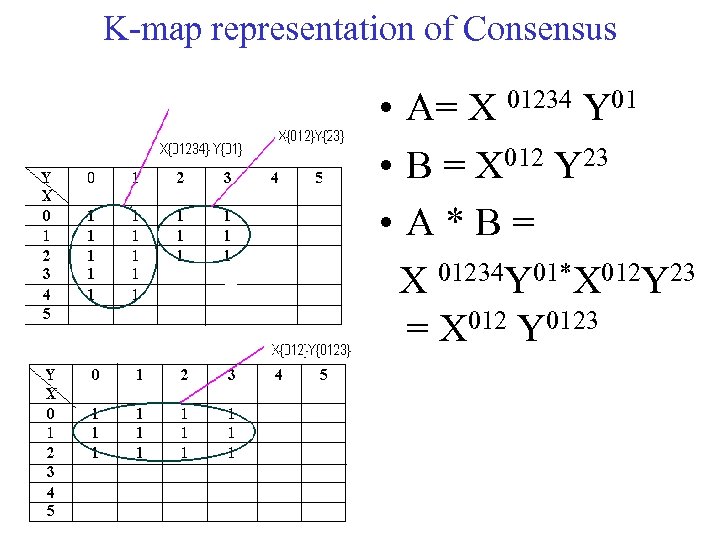
K-map representation of Consensus • A= X 01234 Y 01 • B = X 012 Y 23 • A*B= X 01234 Y 01*X 012 Y 23 = X 012 Y 0123
Definitions of Complex Combinational Cube Operations
General Description of Consensus Cube Operation
Complex combinational cube operation • The consensus operation on cubes A and B is defined as A B when distance (A, B) = 0 A*B= when distance (A, B) > 1 A *basic B when distance (A, B) = 1 • where A *basic B = s 1 A s 1 B …. x sk-1 A sk-1 B x sk. A sk. B x 1 k-1 k sk+1 A sk+1 B…… x sn A sn. B. xk+1 n • Set relation: si. A si. B = , if satisfied, a special variable • Active set operation : si. A si. B • Before set operation : si. A si. B
Complex combinational cube operation • Application of consensus theorem: – For finding prime implicants (Used for two-level logic minimization), – three level, – multilevel minimization, – and machine learning. Most applications are in few-level circuit design, basic operations and automatic theorem proving in AND/OR logic
General Description of Cofactor Cube Operation
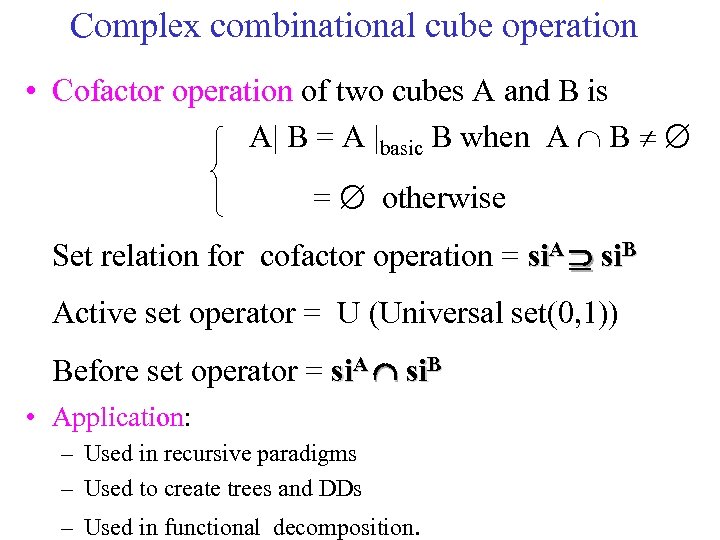
Complex combinational cube operation • Cofactor operation of two cubes A and B is A| B = A |basic B when A B = otherwise Set relation for cofactor operation = si. A si. B Active set operator = U (Universal set(0, 1)) Before set operator = si. A si. B • Application: – Used in recursive paradigms – Used to create trees and DDs – Used in functional decomposition.
General Description of Prime Operation
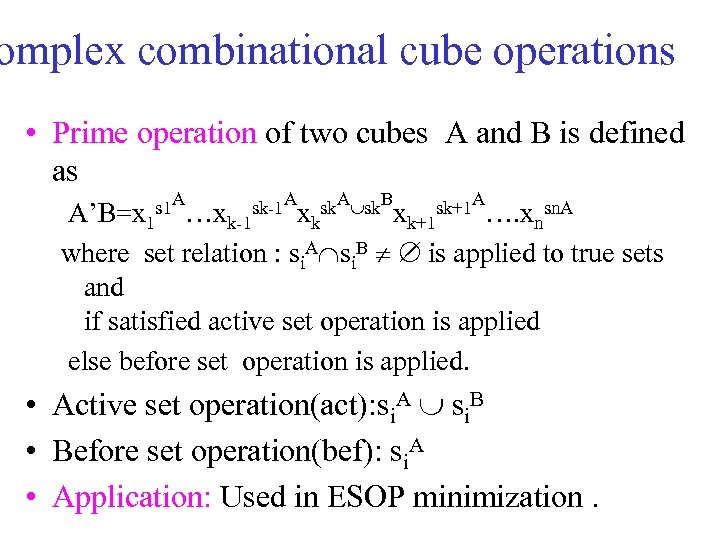
omplex combinational cube operations • Prime operation of two cubes A and B is defined as s 1 A…x sk-1 Ax sk. A sk. Bx sk+1 A…. x sn. A A’B=x 1 k-1 k k+1 n where set relation : si. A si. B is applied to true and if satisfied active set operation is applied else before set operation is applied. • Active set operation(act): si. A si. B • Before set operation(bef): si. A • Application: Used in ESOP minimization. sets
Sequential Cube Operations
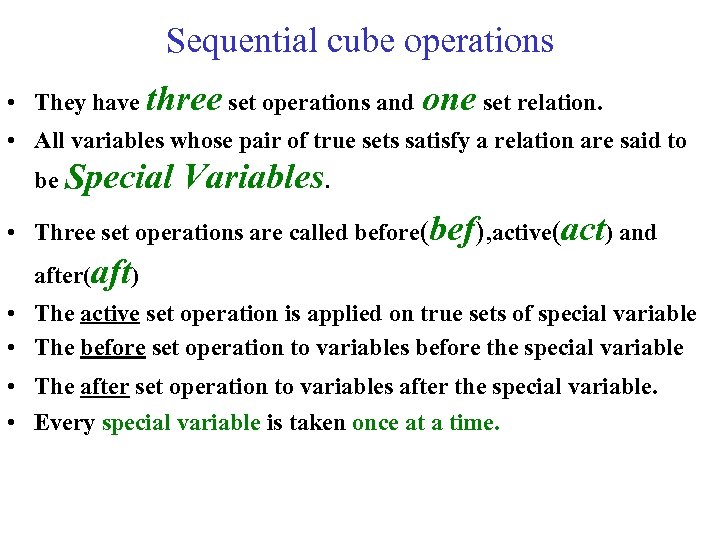
Sequential cube operations • They have three set operations and one set relation. • All variables whose pair of true sets satisfy a relation are said to be Special Variables. • Three set operations are called before(bef), active(act) and after(aft) • The active set operation is applied on true sets of special variable • The before set operation to variables before the special variable • The after set operation to variables after the special variable. • Every special variable is taken once at a time.
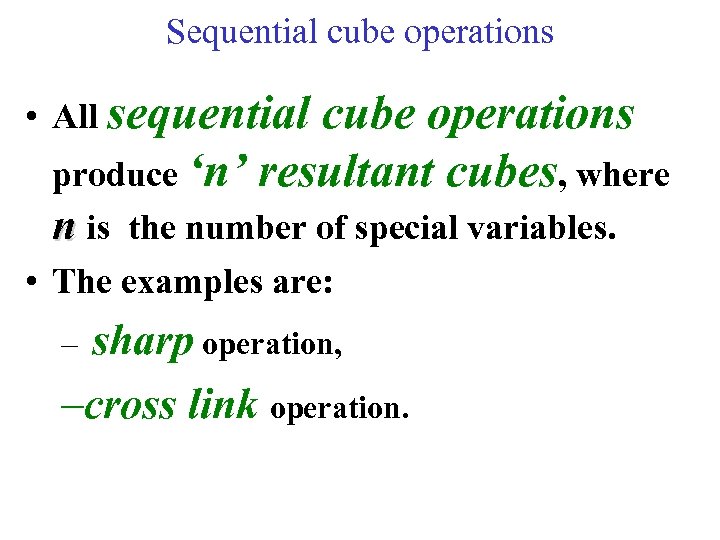
Sequential cube operations • All sequential cube operations produce ‘n’ resultant cubes, where n is the number of special variables. • The examples are: sharp operation, –cross link operation. –
Examples of Sequential Cube Operations
Example Of Binary Function
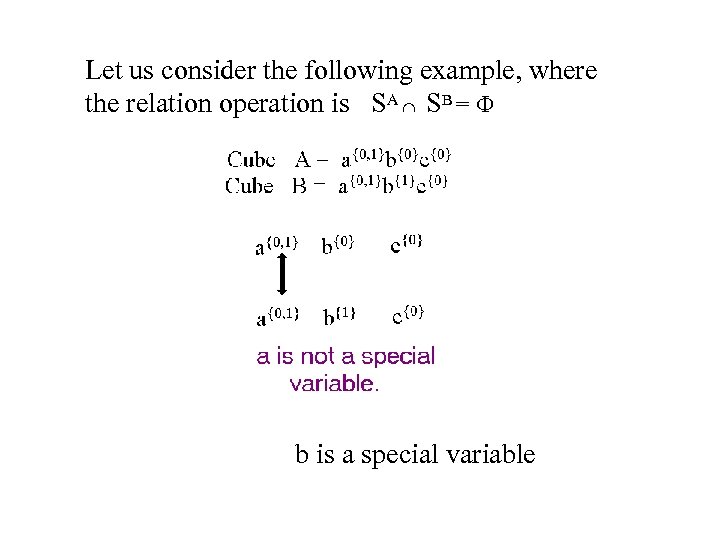
Let us consider the following example, where the relation operation is SA SB = b is a special variable
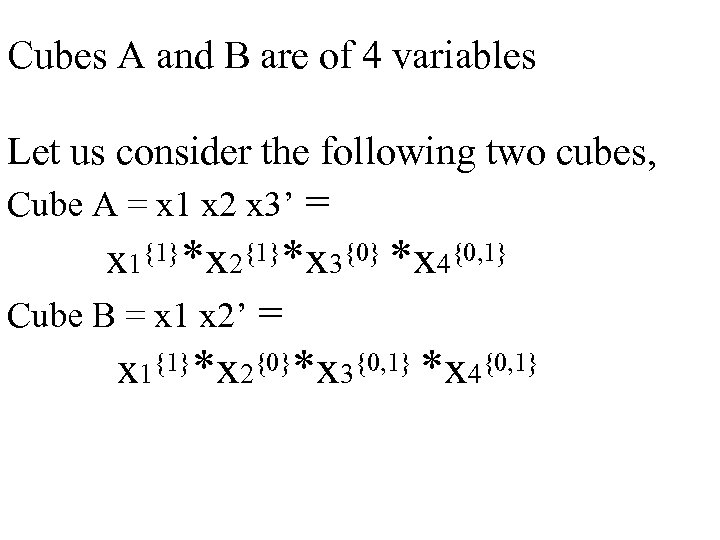
Cubes A and B are of 4 variables Let us consider the following two cubes, Cube A = x 1 x 2 x 3’ = x 1{1}*x 2{1}*x 3{0} *x 4{0, 1} Cube B = x 1 x 2’ = x 1{1}*x 2{0}*x 3{0, 1} *x 4{0, 1}
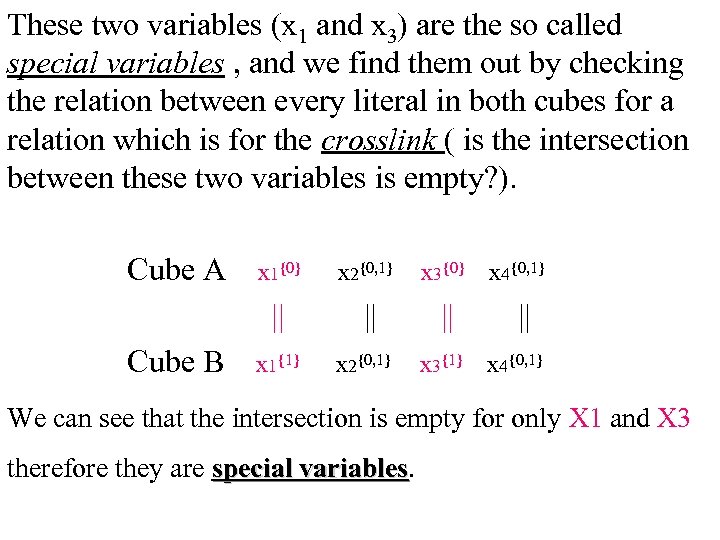
These two variables (x 1 and x 3) are the so called special variables , and we find them out by checking the relation between every literal in both cubes for a relation which is for the crosslink ( is the intersection between these two variables is empty? ). Cube A x 2{0, 1} || Cube B x 1{0} || x 1{1} x 2{0, 1} x 3{0} x 4{0, 1} || || x 3{1} x 4{0, 1} We can see that the intersection is empty for only X 1 and X 3 therefore they are special variables
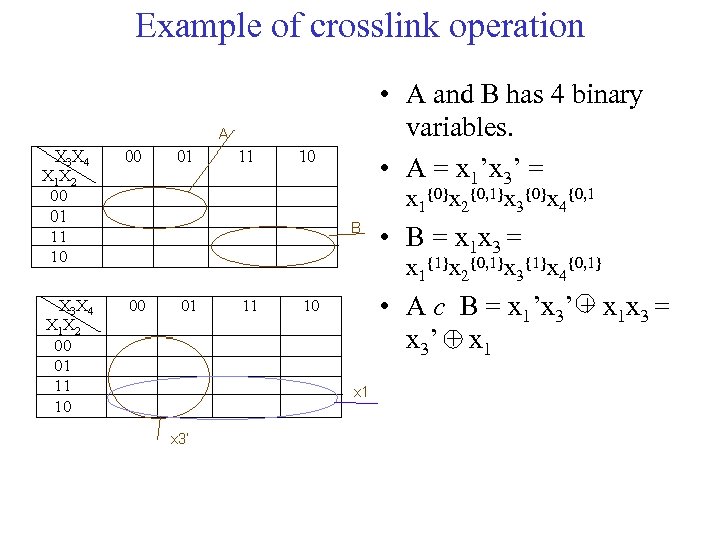
Example of crosslink operation • A and B has 4 binary variables. • A = x 1’x 3’ = x 1{0}x 2{0, 1}x 3{0}x 4{0, 1 • B = x 1 x 3 = x 1{1}x 2{0, 1}x 3{1}x 4{0, 1} • A c B = x 1’x 3’ + x 1 x 3 = x 3’ + x 1
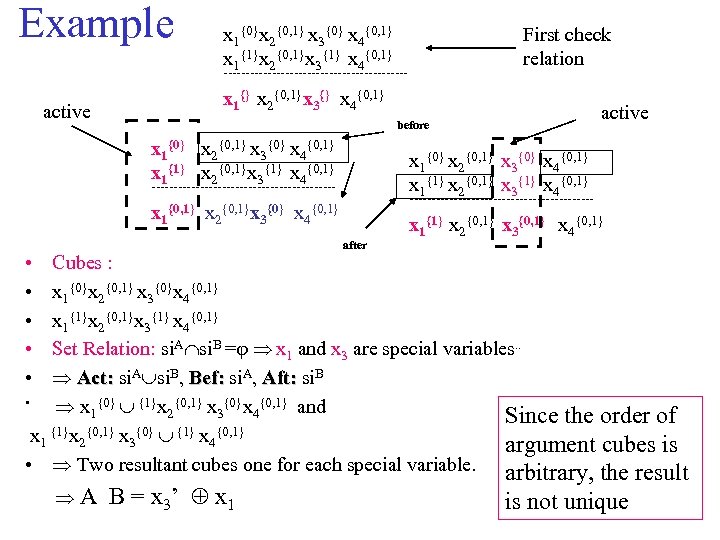
Example x 1{0}x 2{0, 1} x 3{0} x 4{0, 1} x 1{1}x 2{0, 1}x 3{1} x 4{0, 1} First check relation --------------------- x 1{} x 2{0, 1}x 3{} x 4{0, 1} active before x 1{0} x 2{0, 1} x 3{0} x 4{0, 1} x 1{1} x 2{0, 1}x 3{1} x 4{0, 1} x 1{0} x 2{0, 1} x 3{0} x 4{0, 1} x 1{1} x 2{0, 1} x 3{1} x 4{0, 1} --------------------- x 1 {0, 1} x 2{0, 1}x 3{0} x 4 --------------------- {0, 1} after • • • x 1{1} x 2{0, 1} x 3{0, 1} x 4{0, 1} Cubes : x 1{0}x 2{0, 1} x 3{0}x 4{0, 1} x 1{1}x 2{0, 1}x 3{1} x 4{0, 1} Set Relation: si. A si. B = x 1 and x 3 are special variables. . Act: si. A si. B, Bef: si. A, Aft: si. B • x 1{0} {1}x 2{0, 1} x 3{0}x 4{0, 1} and Since the order of {1}x {0, 1} x {0} {1} x {0, 1} x 1 2 3 4 argument cubes is • Two resultant cubes one for each special variable. arbitrary, the result A B = x 3’ x 1 is not unique
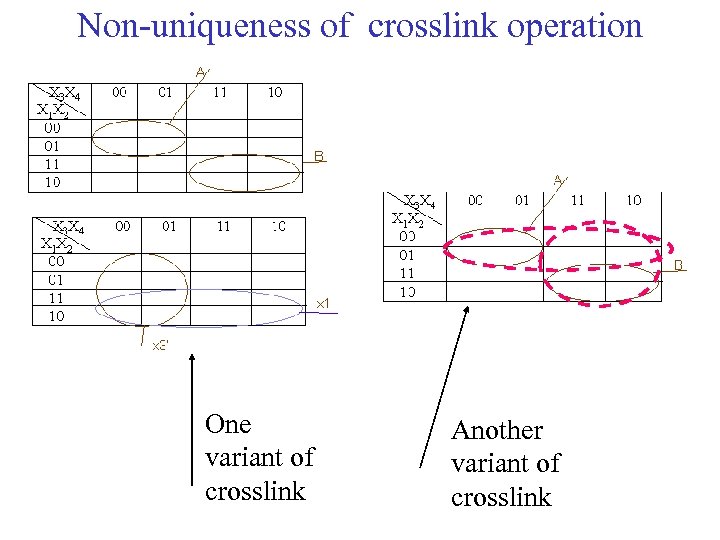
Non-uniqueness of crosslink operation One variant of crosslink Another variant of crosslink
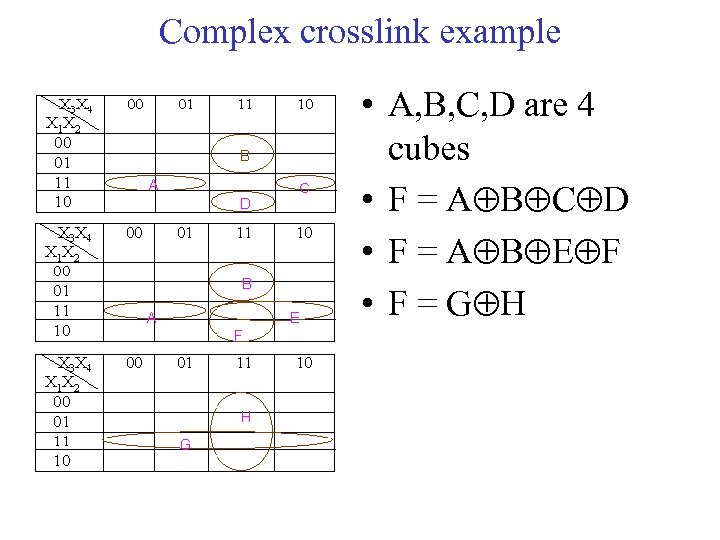
Complex crosslink example • A, B, C, D are 4 cubes • F = A B C D • F = A B E F • F = G H
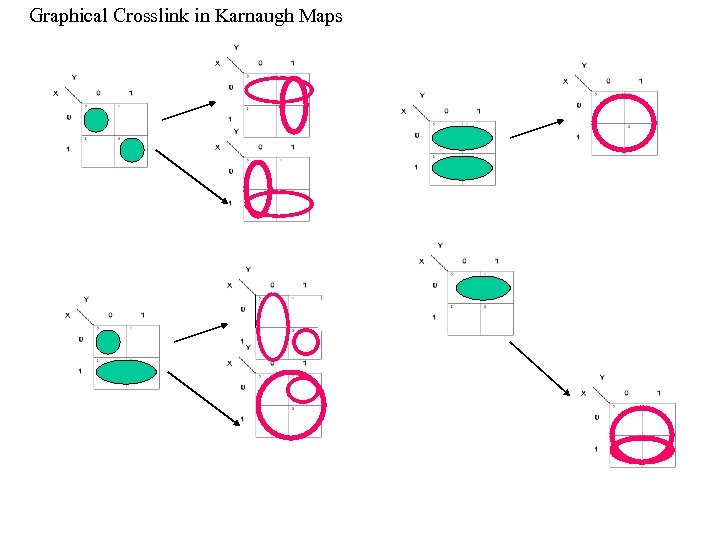
Graphical Crosslink in Karnaugh Maps
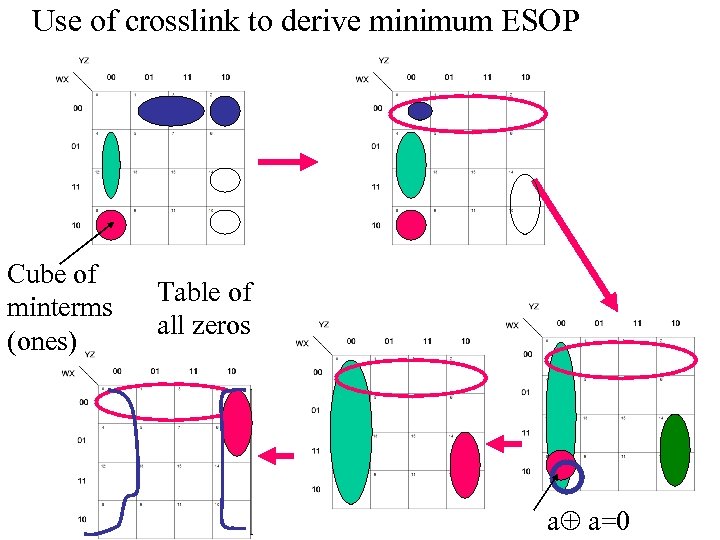
Use of crosslink to derive minimum ESOP Cube of minterms (ones) Table of all zeros a a=0
Use of Crosslink for ESOP minimization • Please write formulas for the previous example • The solution is not unique • You have to use backtracking, heuristics, or probabilistic methods to obtain good solution • Look-ahead methods. • Start from several starting points.
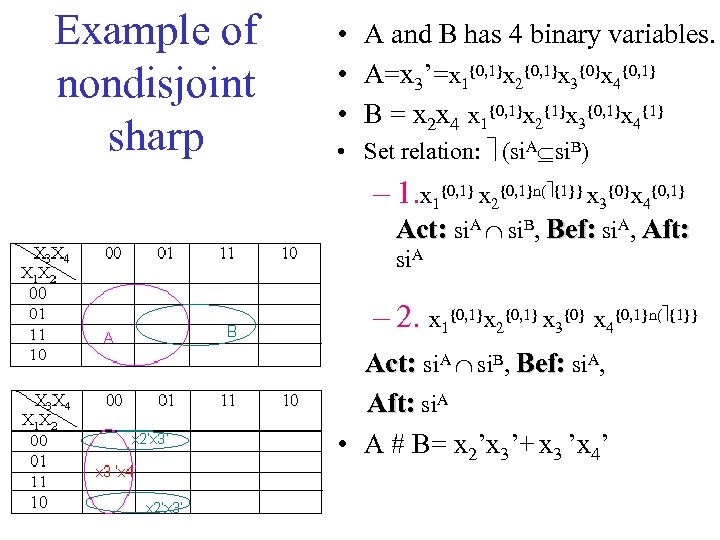
Example of nondisjoint sharp • A and B has 4 binary variables. • A=x 3’=x 1{0, 1}x 2{0, 1}x 3{0}x 4{0, 1} • B = x 2 x 4 x 1{0, 1}x 2{1}x 3{0, 1}x 4{1} • Set relation: (si. A si. B) – 1. x 1{0, 1} x 2{0, 1}n( {1}} x 3{0}x 4{0, 1} Act: si. A si. B, Bef: si. A, Aft: si. A – 2. x 1{0, 1}x 2{0, 1} x 3{0} x 4{0, 1}n( {1}} Act: si. A si. B, Bef: si. A, Aft: si. A • A # B= x 2’x 3’+ x 3 ’x 4’
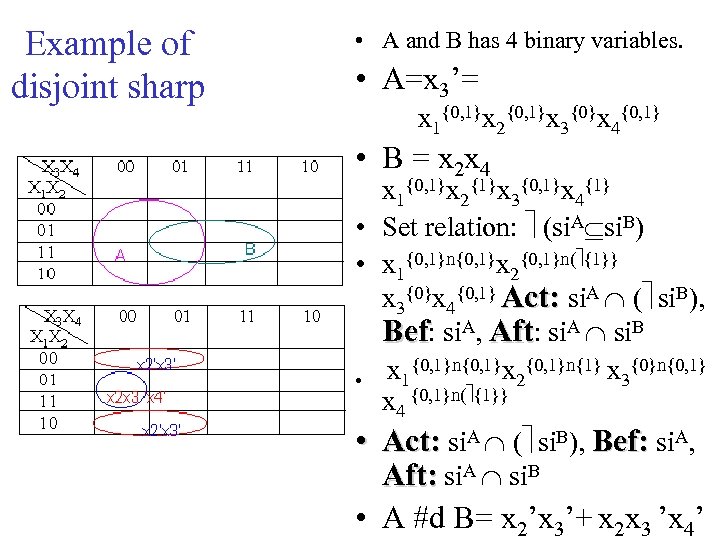
Example of disjoint sharp • A and B has 4 binary variables. • A=x 3’= x 1{0, 1}x 2{0, 1}x 3{0}x 4{0, 1} • B = x 2 x 4 • • x 1{0, 1}x 2{1}x 3{0, 1}x 4{1} Set relation: (si. A si. B) x 1{0, 1}n{0, 1}x 2{0, 1}n( {1}} x 3{0}x 4{0, 1} Act: si. A ( si. B), Bef: si. A, Aft: si. A si. B x 1{0, 1}n{0, 1}x 2{0, 1}n{1} x 3{0}n{0, 1} x 4 {0, 1}n( {1}} Act: si. A ( si. B), Bef: si. A, Aft: si. A si. B • A #d B= x 2’x 3’+ x 2 x 3 ’x 4’
Example Of Multi-Valued Function
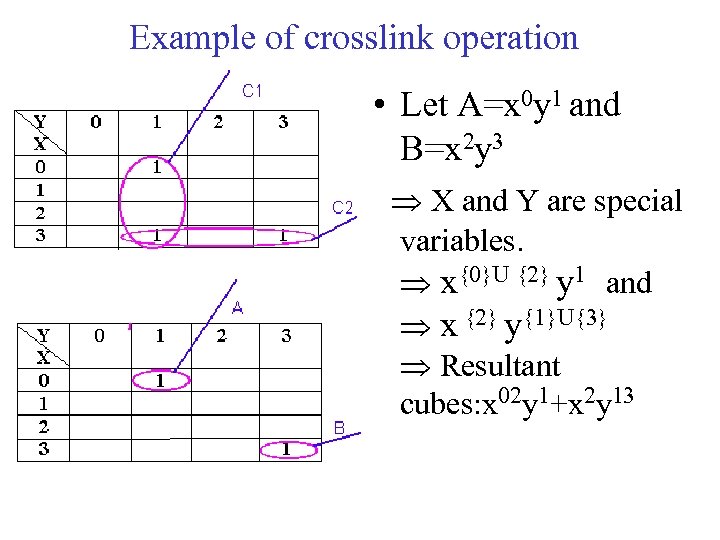
Example of crosslink operation • Let A=x 0 y 1 and B=x 2 y 3 X and Y are special variables. x{0}U {2} y 1 and x {2} y{1}U{3} Resultant cubes: x 02 y 1+x 2 y 13
Definitions of Sequential Cube Operations
General Description of Nondisjoint sharp Operation
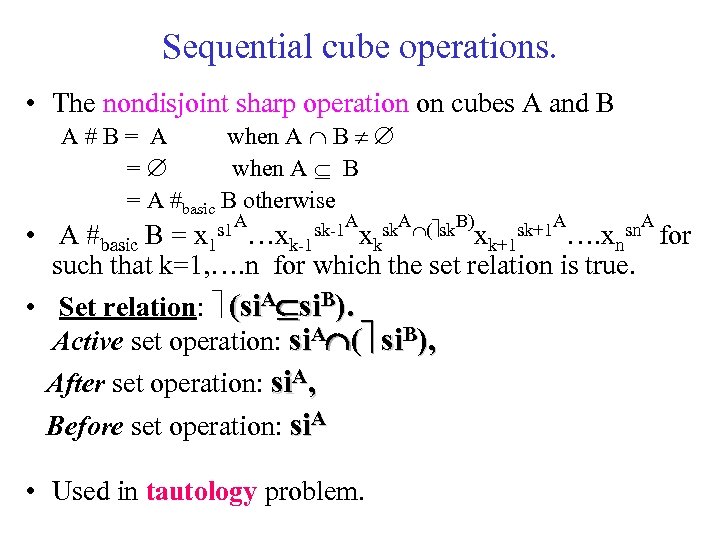
Sequential cube operations. • The nondisjoint sharp operation on cubes A and B A#B= A when A B = A #basic B otherwise s 1 A…x sk-1 Ax sk. A ( sk. B)x sk+1 A…. x sn. A for x 1 k-1 k k+1 n • A #basic B = such that k=1, …. n for which the set relation is true. • Set relation: (si. A si. B). Active set operation: si. A ( si. B), After set operation: si. A, Before set operation: si. A • Used in tautology problem.
General Description of disjoint sharp operation
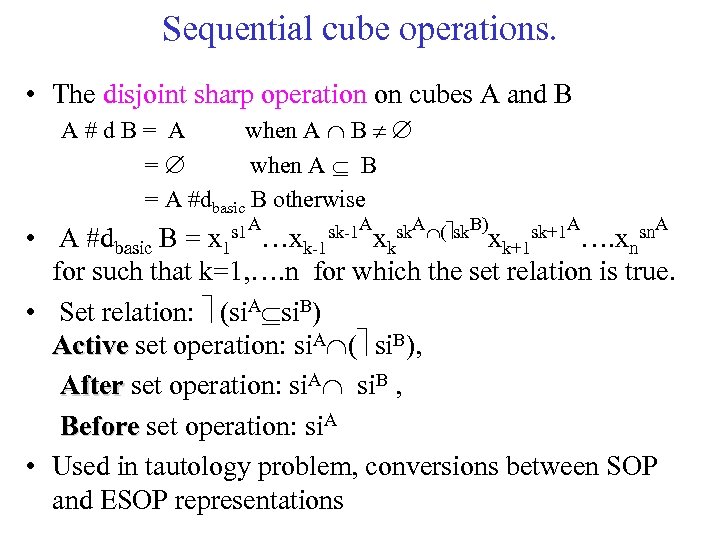
Sequential cube operations. • The disjoint sharp operation on cubes A and B A#d. B= A when A B = A #dbasic B otherwise s 1 A…x sk-1 Ax sk. A ( sk. B)x sk+1 A…. x sn. A x 1 k-1 k k+1 n • A #dbasic B = for such that k=1, …. n for which the set relation is true. • Set relation: (si. A si. B) Active set operation: si. A ( si. B), After set operation: si. A si. B , Before set operation: si. A • Used in tautology problem, conversions between SOP and ESOP representations
General Description of Crosslink Operation
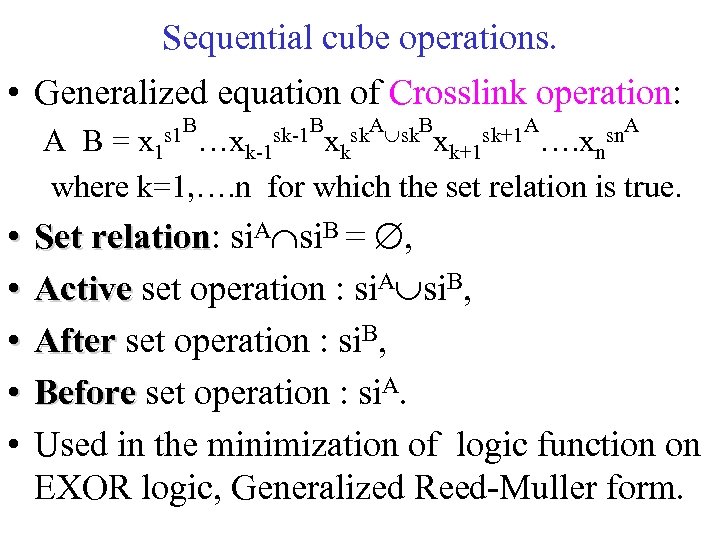
Sequential cube operations. • Generalized equation of Crosslink operation: s 1 B…x sk-1 Bx sk. A sk. Bx sk+1 A…. x sn. A x 1 k-1 k k+1 n A B= where k=1, …. n for which the set relation is true. • • • Set relation: si. A si. B = , relation Active set operation : si. A si. B, After set operation : si. B, Before set operation : si. A. Used in the minimization of logic function on EXOR logic, Generalized Reed-Muller form.

Applications of Crosslink
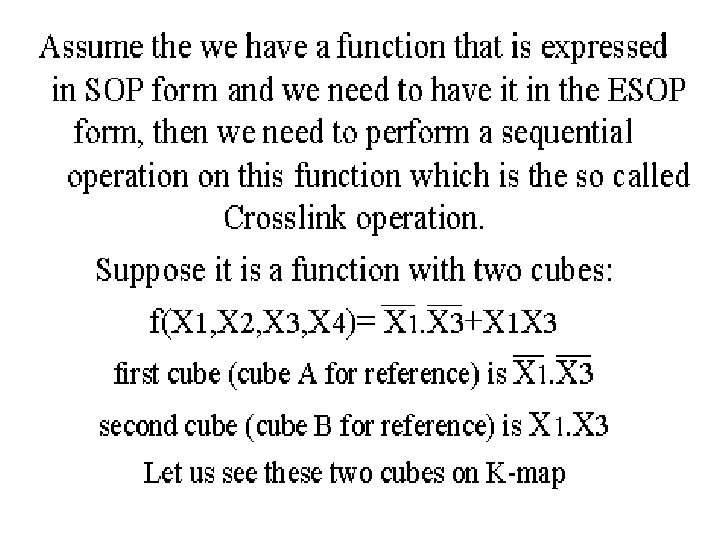
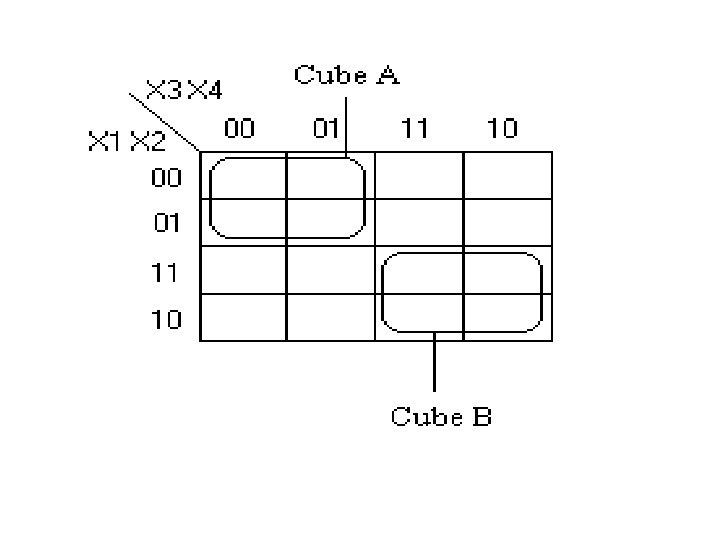
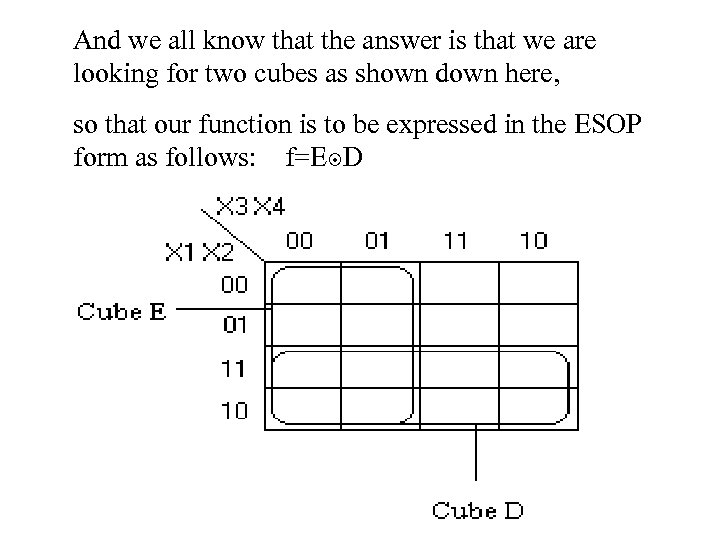
And we all know that the answer is that we are looking for two cubes as shown down here, so that our function is to be expressed in the ESOP form as follows: f=E D
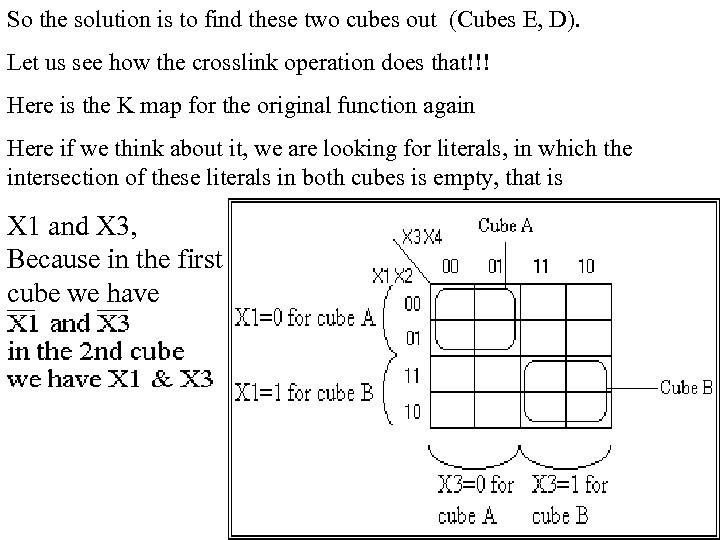
So the solution is to find these two cubes out (Cubes E, D). Let us see how the crosslink operation does that!!! Here is the K map for the original function again Here if we think about it, we are looking for literals, in which the intersection of these literals in both cubes is empty, that is X 1 and X 3, Because in the first cube we have
Summary of the Cube Calculus Operation
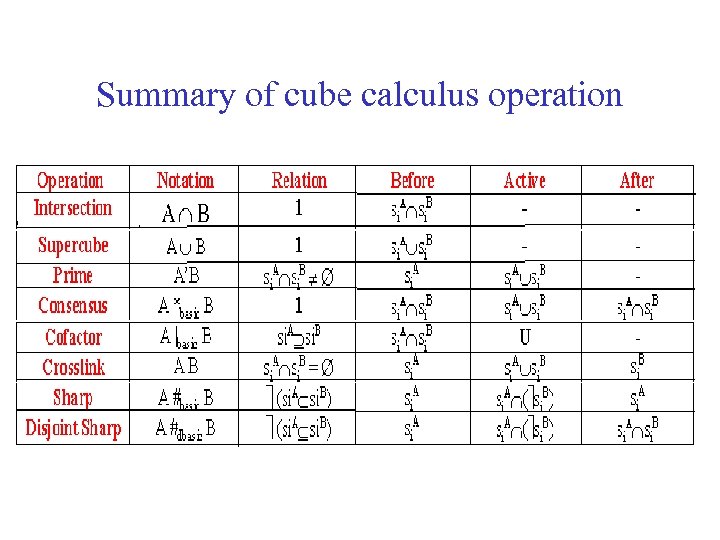
Summary of cube calculus operation

Positional Notation
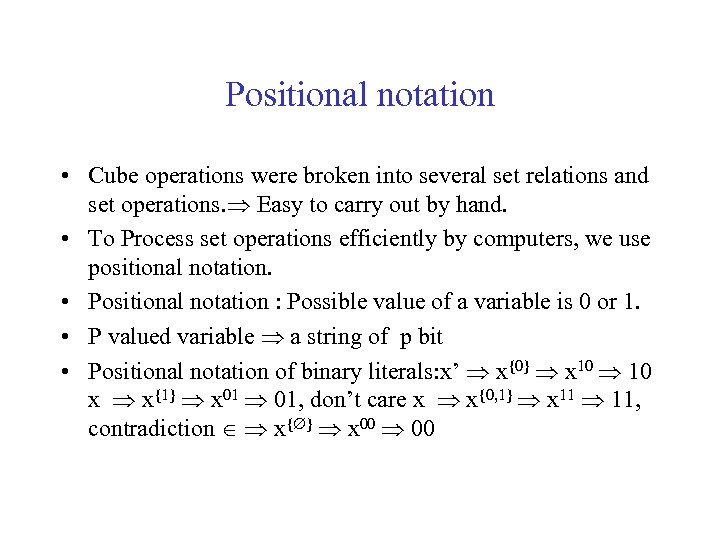
Positional notation • Cube operations were broken into several set relations and set operations. Easy to carry out by hand. • To Process set operations efficiently by computers, we use positional notation. • Positional notation : Possible value of a variable is 0 or 1. • P valued variable a string of p bit • Positional notation of binary literals: x’ x{0} x 10 x x{1} x 01 01, don’t care x x{0, 1} x 11 11, contradiction x{ } x 00
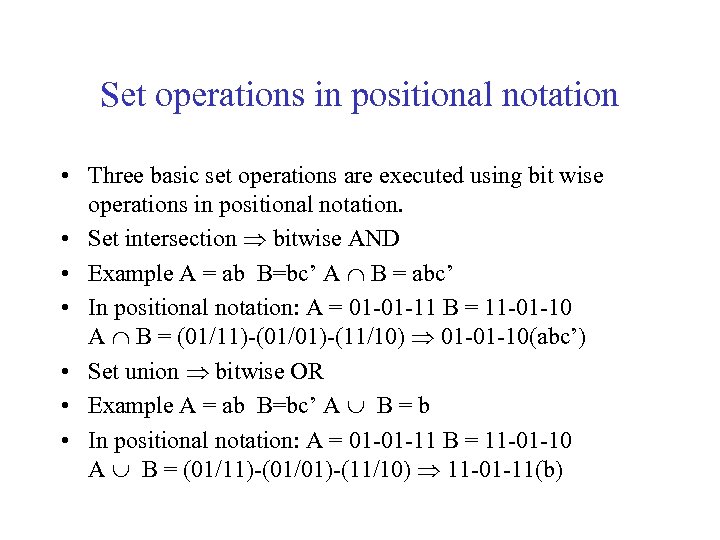
Set operations in positional notation • Three basic set operations are executed using bit wise operations in positional notation. • Set intersection bitwise AND • Example A = ab B=bc’ A B = abc’ • In positional notation: A = 01 -01 -11 B = 11 -01 -10 A B = (01/11)-(01/01)-(11/10) 01 -01 -10(abc’) • Set union bitwise OR • Example A = ab B=bc’ A B = b • In positional notation: A = 01 -01 -11 B = 11 -01 -10 A B = (01/11)-(01/01)-(11/10) 11 -01 -11(b)
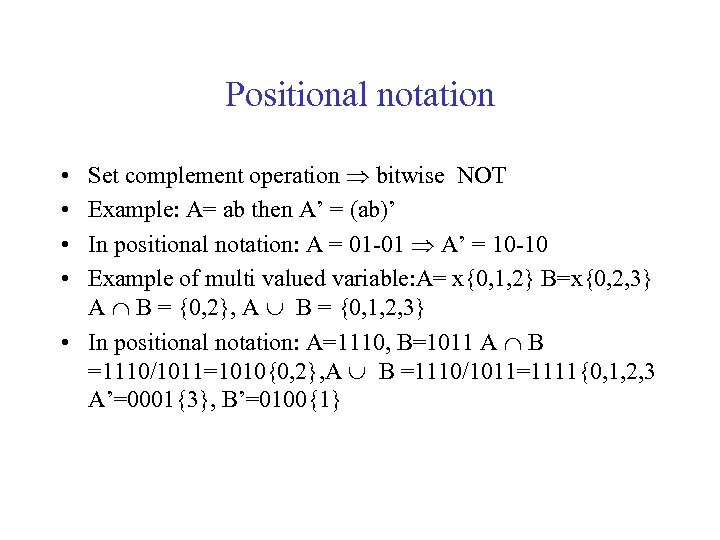
Positional notation Set complement operation bitwise NOT Example: A= ab then A’ = (ab)’ In positional notation: A = 01 -01 A’ = 10 -10 Example of multi valued variable: A= x{0, 1, 2} B=x{0, 2, 3} A B = {0, 2}, A B = {0, 1, 2, 3} • In positional notation: A=1110, B=1011 A B =1110/1011=1010{0, 2}, A B =1110/1011=1111{0, 1, 2, 3 A’=0001{3}, B’=0100{1} • •
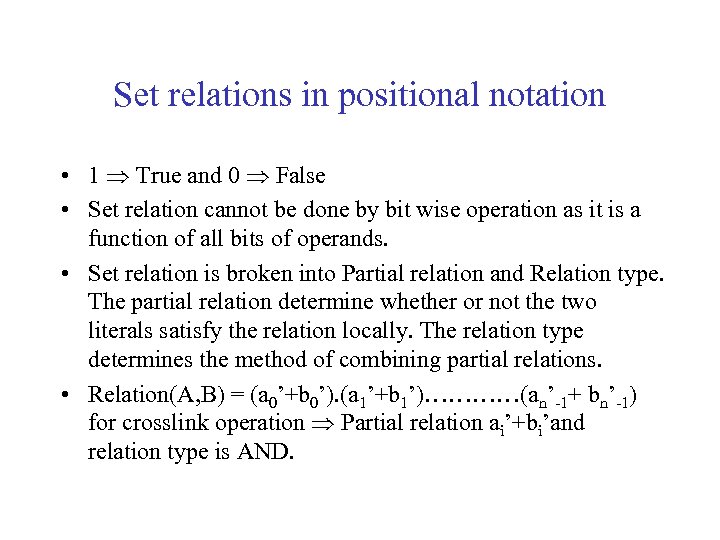
Set relations in positional notation • 1 True and 0 False • Set relation cannot be done by bit wise operation as it is a function of all bits of operands. • Set relation is broken into Partial relation and Relation type. The partial relation determine whether or not the two literals satisfy the relation locally. The relation type determines the method of combining partial relations. • Relation(A, B) = (a 0’+b 0’). (a 1’+b 1’)…………(an’-1+ bn’-1) for crosslink operation Partial relation ai’+bi’and relation type is AND.
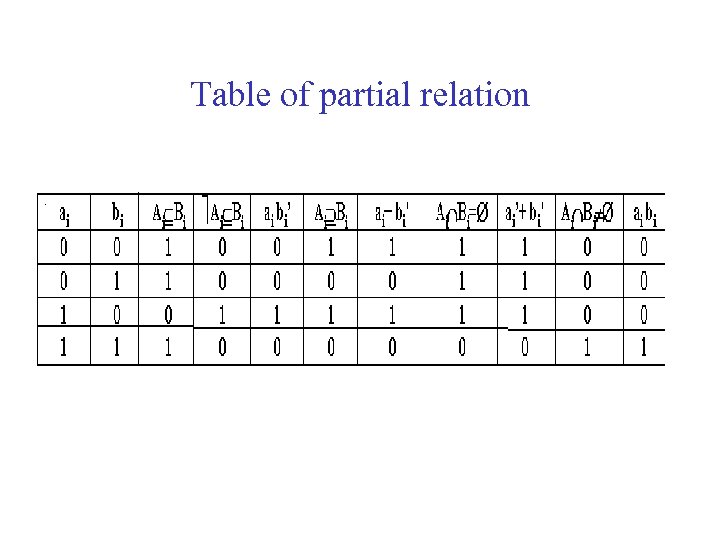
Table of partial relation
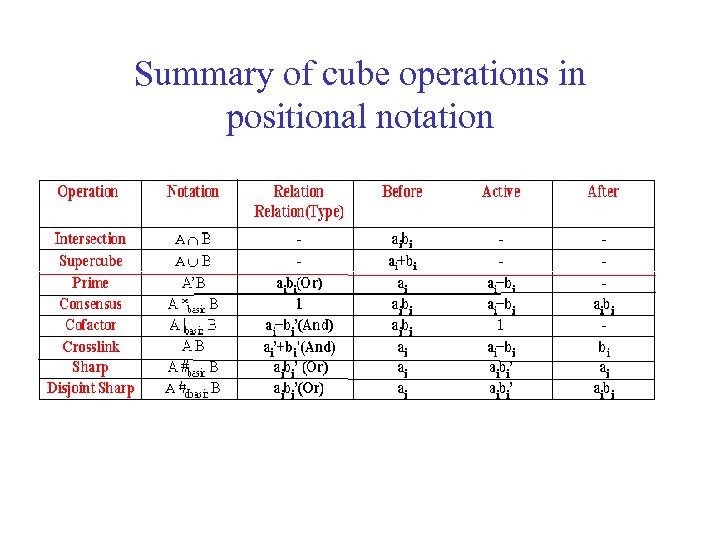
Summary of cube operations in positional notation

Why We Need Cube Calculus Hardware?
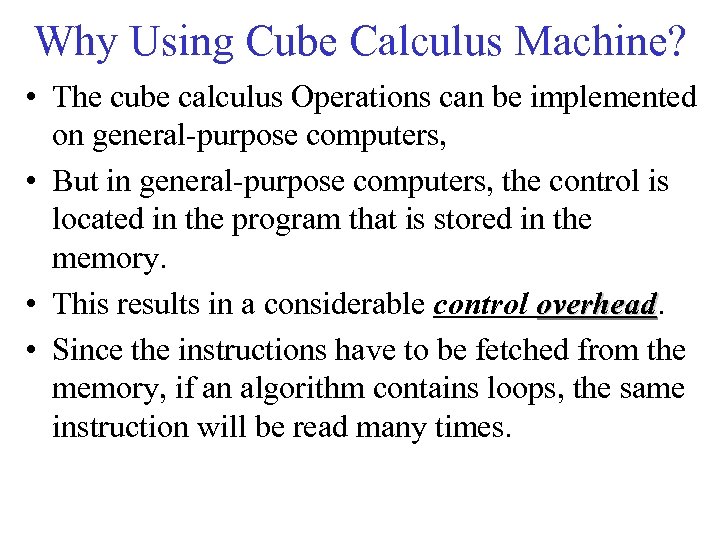
Why Using Cube Calculus Machine? • The cube calculus Operations can be implemented on general-purpose computers, • But in general-purpose computers, the control is located in the program that is stored in the memory. • This results in a considerable control overhead • Since the instructions have to be fetched from the memory, if an algorithm contains loops, the same instruction will be read many times.
That makes the memory interface the bottleneck of these architectures. The cube calculus operations involve nested loops, it leads to poor performance on these general-purpose computers.

Slides by Nouraddin Alhagi & Syeda Mohsina Lecture on Oct 8, 2001
Скачать презентацию Cube Calculus Overview Of This Presentation
c2ca3ec56486b2e3bafc9f4674b61795.ppt