


 Скачать презентацию CTC 475 Review n n n Methods for
f043005079198818b23b7726792feaa6.ppt
- Количество слайдов: 38
 CTC 475 Review n n n Methods for determining whether an alternative is feasible or not Establishing MARR Net cash flows
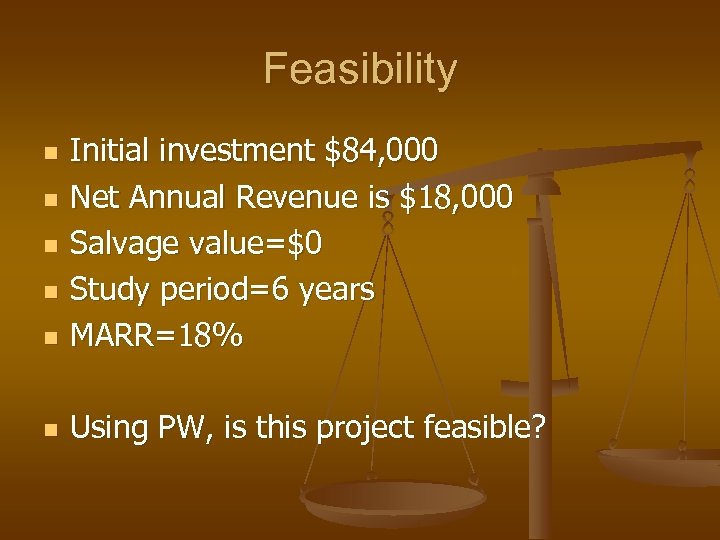 Feasibility n Initial investment $84, 000 Net Annual Revenue is $18, 000 Salvage value=$0 Study period=6 years MARR=18% n Using PW, is this project feasible? n n
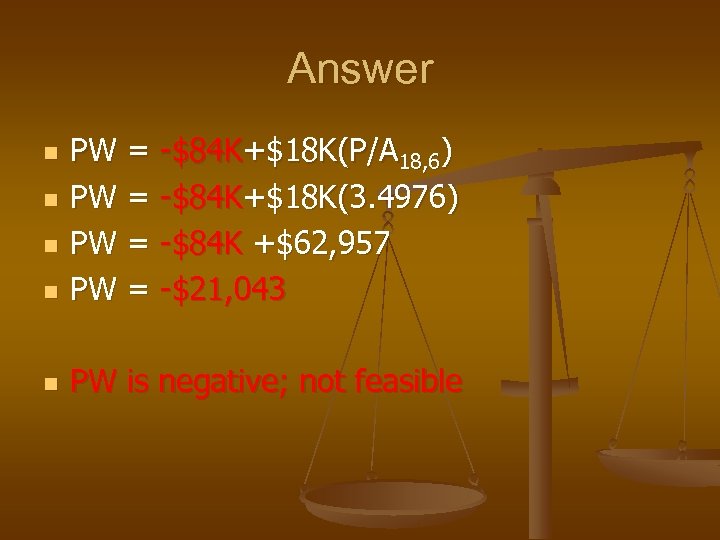 Answer n PW = -$84 K+$18 K(P/A 18, 6) PW = -$84 K+$18 K(3. 4976) PW = -$84 K +$62, 957 PW = -$21, 043 n PW is negative; not feasible n n n
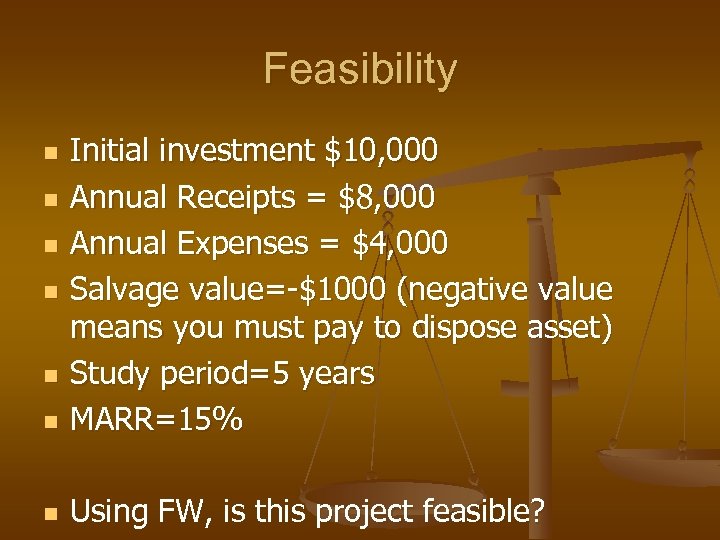 Feasibility n Initial investment $10, 000 Annual Receipts = $8, 000 Annual Expenses = $4, 000 Salvage value=-$1000 (negative value means you must pay to dispose asset) Study period=5 years MARR=15% n Using FW, is this project feasible? n n n
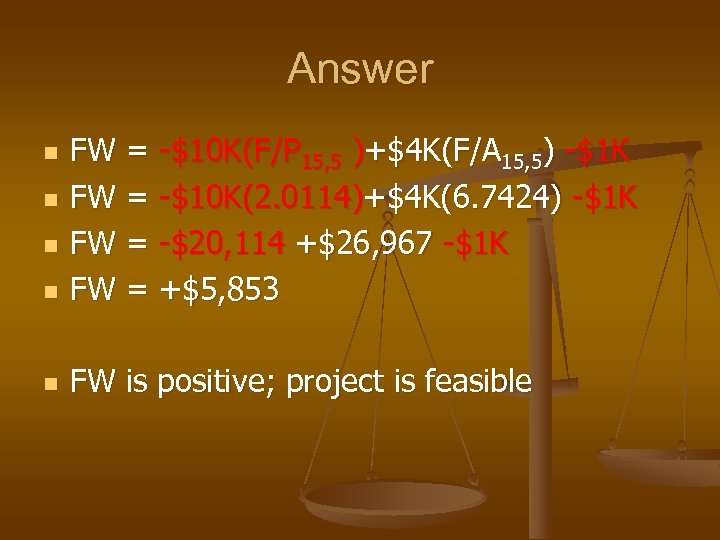 Answer n FW = -$10 K(F/P 15, 5 )+$4 K(F/A 15, 5) -$1 K FW = -$10 K(2. 0114)+$4 K(6. 7424) -$1 K FW = -$20, 114 +$26, 967 -$1 K FW = +$5, 853 n FW is positive; project is feasible n n n
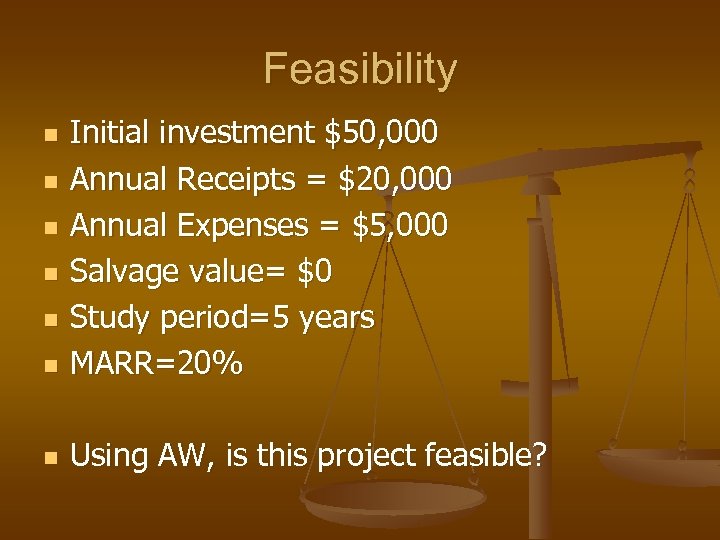 Feasibility n Initial investment $50, 000 Annual Receipts = $20, 000 Annual Expenses = $5, 000 Salvage value= $0 Study period=5 years MARR=20% n Using AW, is this project feasible? n n n
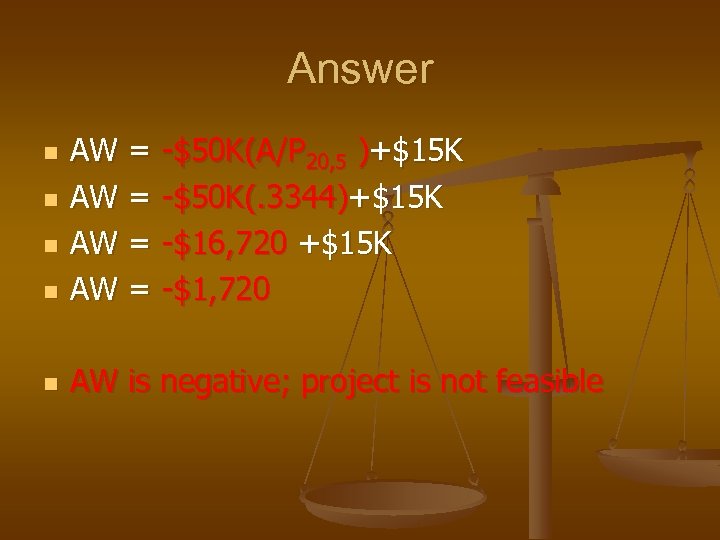 Answer n AW = -$50 K(A/P 20, 5 )+$15 K AW = -$50 K(. 3344)+$15 K AW = -$16, 720 +$15 K AW = -$1, 720 n AW is negative; project is not feasible n n n
 CTC 475 Bonds
 Objectives n n n Know why bonds are issued Know how bonds work Solve bond problems
 Bonds – Why are they issued? n n n Government agencies/private firms issue bonds as a way to raise capital ($) Roads, bridges, water & ww plants are very expensive Govt. Agencies often use bonds to pay for infrastructure
 Bonds – How they Work n n XYZ company issues $5 million worth of bonds Brokerage firms split into smaller units ($1000, $5000) and sell to individual investors
 Bond-Face Value n n The stated value on the individual bond is the face, or par value (Ex $1000) The face value is paid back after a specified length of time (5, 10 years)
 Bonds n Issuing unit is obligated to redeem the bond at par value at maturity. Issuing unit must specify a bond rate on the par value between the date of issuance and date of maturity
 Bond Rate n Examples of Bond Rates: 10%/yr payable quarterly n 9 -½%/yr payable semiannually n 6%/yr payable annually n n The bond rate applies to the par value
 Example n n n 7 -year treasury note Face value =$1000 Interest rate 9 3/8% payable semiannually Earned interest of $46. 90 every 6 months After 7 years, received $1000
 Bond Complications n n n Bonds are not complicated if the bond is bought at the date of issuance and held to the date of maturity Bonds do get complicated when they are sold between the date of issuance and the date of maturity Because interest rates fluctuate bonds are not usually sold at par value
 Bonds n n If you bought a $1000 bond paying 9% and a new $1000 bond is paying 4% you wouldn’t sell the bond unless you got more than $1000. Likewise, if you sell a $1000 bond paying 2% and a new $1000 bond is paying 4% no one will buy your bond unless you sell it for less than $1000
 Bond Complications n n Interest rates fluctuate Selling bonds between the date of issuance and date of maturity for something other than the par value changes the actual yield rate
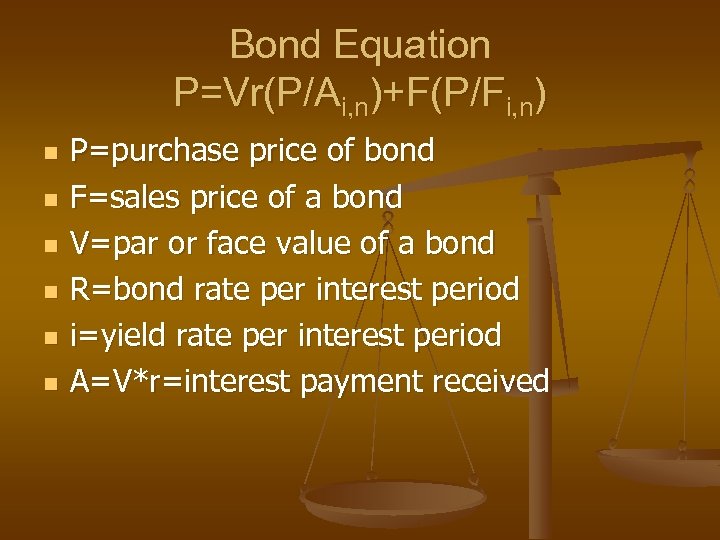 Bond Equation P=Vr(P/Ai, n)+F(P/Fi, n) n n n P=purchase price of bond F=sales price of a bond V=par or face value of a bond R=bond rate per interest period i=yield rate per interest period A=V*r=interest payment received
 Hints n n P (purchase price) may or may not equal the par value. If the bond was bought at the date of issuance then the purchase price = par value F (sales price) may or may not equal the par value. If the bond is held to maturity then the sales price = par value
 Bond Problem Types n n n Find sales price (F) Find purchase price (P) Find yield rate (i)
 Find sales price (F) n Find the selling price of a bond (F) if you want to sell it before it matures and you want a desired yield i
 Find purchase price (P) n Determine the purchase price of a bond (P) so that you can make a desired yield i for the future
 Find effective yield (i) n Determine the effective yield (i) for a bond if it wasn’t bought and/or redeemed at par value
 Find F example An individual purchased a $1000, 8% semi -annual bond for $1050 3 years ago and is considering selling it. How much should be asked for the bond in order to earn a yield rate of 6% compounded semiannually (3% per semi comp. semi)?
 Find F example n n n n P=$1050 (bond wasn’t bought at date of issuance) F=? V=$1000 r=4% per semi comp. semi i=3% per semi comp. semi n=6 semi’s (r, i & n periods must match) A=V*r=$40
 Find F example n n F = $995 If owner of bond can sell it for at least $995 then the owner effectively earns 6% per year compounded semiannually
 Find P example If a $1000, 12% semiannual bond is purchased, held for 3 years and redeemed at par value, what must the purchase price have been in order for the bond to be preferred over investing at 14% compounded semiannually?
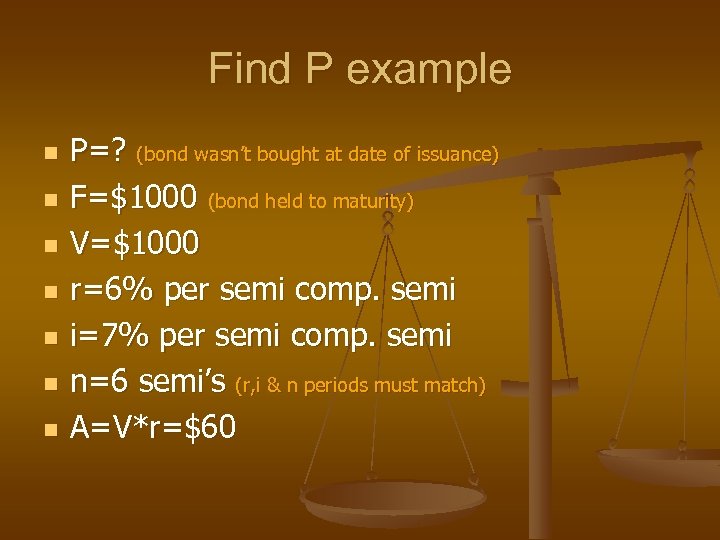 Find P example n n n n P=? (bond wasn’t bought at date of issuance) F=$1000 (bond held to maturity) V=$1000 r=6% per semi comp. semi i=7% per semi comp. semi n=6 semi’s (r, i & n periods must match) A=V*r=$60
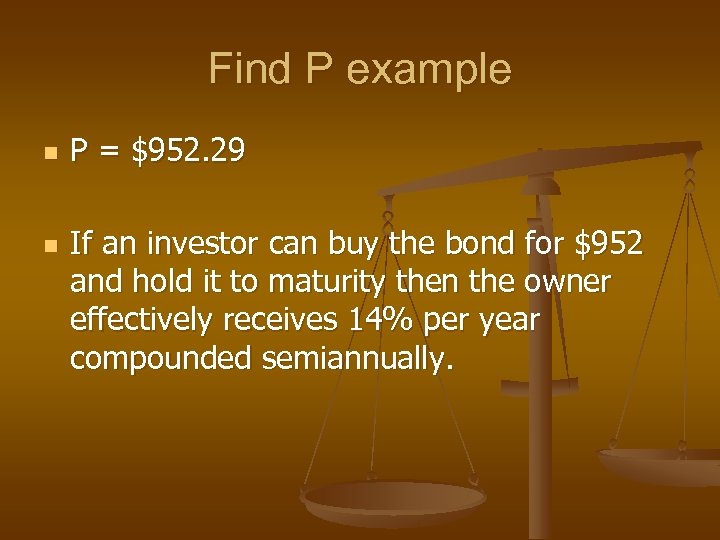 Find P example n n P = $952. 29 If an investor can buy the bond for $952 and hold it to maturity then the owner effectively receives 14% per year compounded semiannually.
 Find i example If a $1000, 12% quarterly bond is purchased for $1020 and sold 3 years later for $950: a) What was the quarterly yield? b) What was the effective annual return?
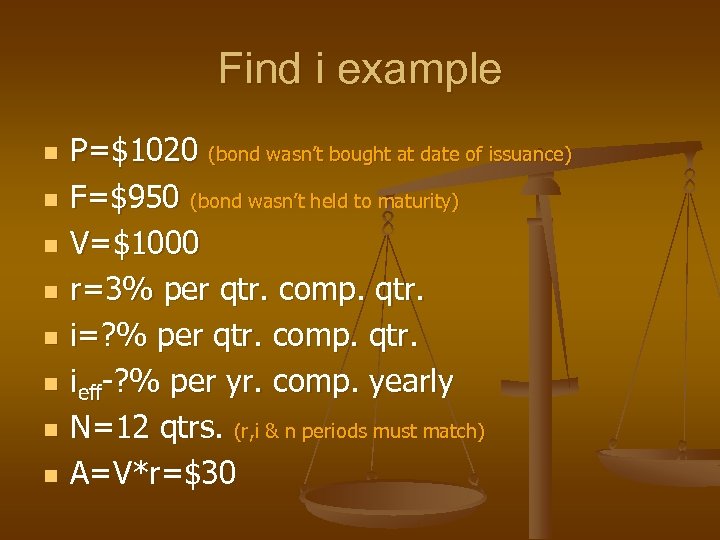 Find i example n n n n P=$1020 (bond wasn’t bought at date of issuance) F=$950 (bond wasn’t held to maturity) V=$1000 r=3% per qtr. comp. qtr. i=? % per qtr. comp. qtr. ieff-? % per yr. comp. yearly N=12 qtrs. (r, i & n periods must match) A=V*r=$30
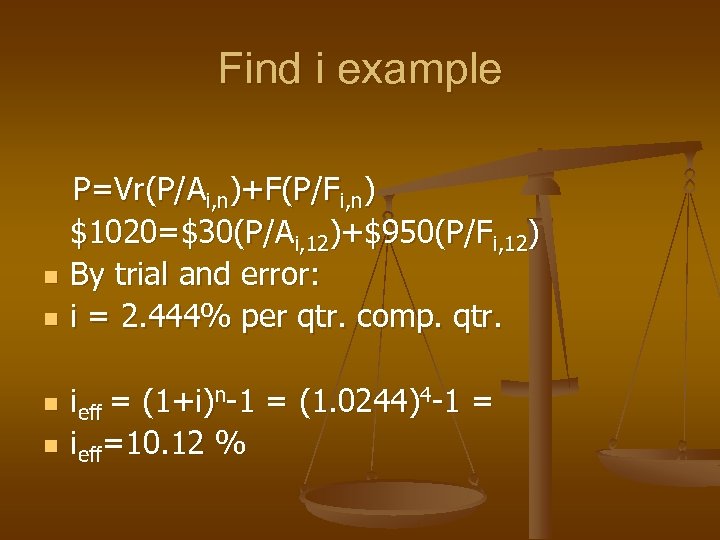 Find i example n n P=Vr(P/Ai, n)+F(P/Fi, n) $1020=$30(P/Ai, 12)+$950(P/Fi, 12) By trial and error: i = 2. 444% per qtr. comp. qtr. n ieff = n (1+i)n-1 = (1. 0244)4 -1 = ieff=10. 12 %
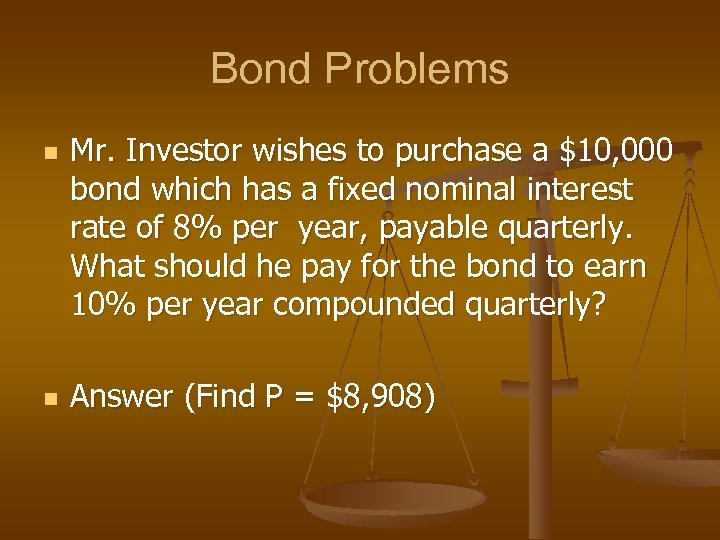 Bond Problems n n Mr. Investor wishes to purchase a $10, 000 bond which has a fixed nominal interest rate of 8% per year, payable quarterly. What should he pay for the bond to earn 10% per year compounded quarterly? Answer (Find P = $8, 908)
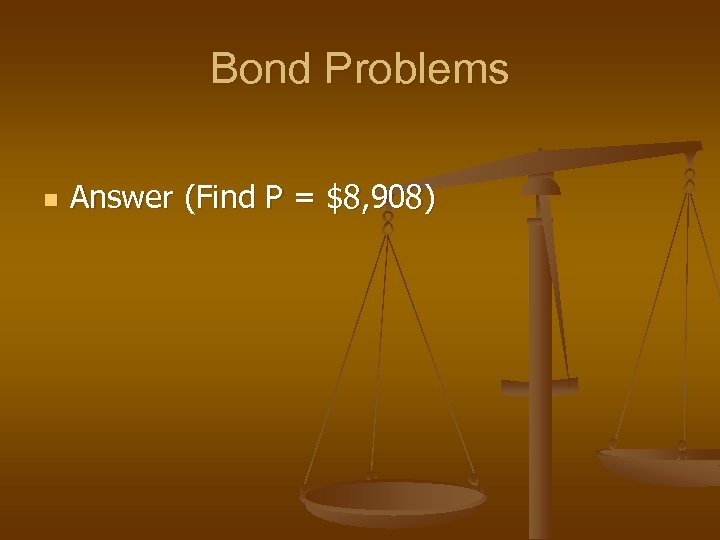 Bond Problems n Answer (Find P = $8, 908)
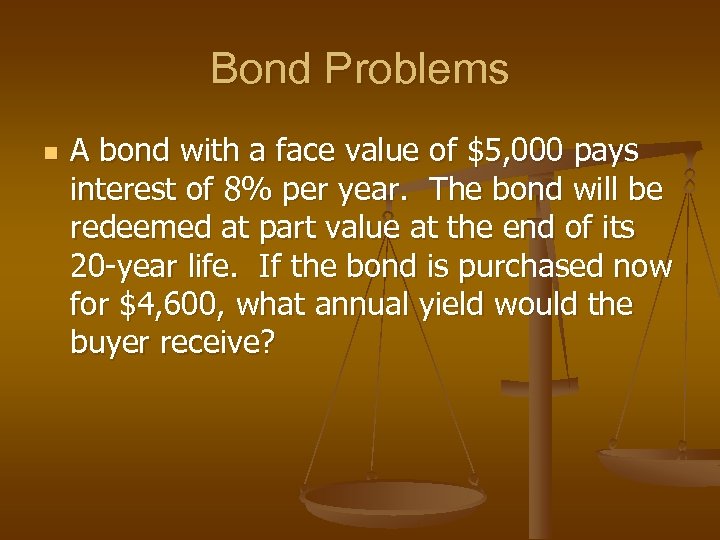 Bond Problems n A bond with a face value of $5, 000 pays interest of 8% per year. The bond will be redeemed at part value at the end of its 20 -year life. If the bond is purchased now for $4, 600, what annual yield would the buyer receive?
 Bond Problems n Answer (Find i = 8. 9%)
 Next lecture n Comparing Alternatives