


 Скачать презентацию CT Screening for Lung Cancer International Early Lung
1b8dbaf7924a43d976f5c9751103ee4d.ppt
- Количество слайдов: 60
 CT Screening for Lung Cancer: International Early Lung Cancer Action Program
 What we know Why is screening controversial?
 We know Only 15% of lung cancers are found in early stage Most of these because of CXR or CT done for other reasons Almost all with lung cancer die of it 164, 000/174, 000 = 95%
 Prior randomized controlled studies Three studies in US in the 1970’s Mayo Lung Project Memorial Sloan Kettering Lung Project Johns Hopkins Lung Project None showed a benefit of sputum cytology Mayo Lung Project did not show a benefit of CXR As a result the USPSTF recommended against screening for lung cancer However, the negative interpretation was highly controversial and physicians continued to provide CXR for their high-risk patients
 Prior case-control studies Japan has provided CXR screening for all men and women 40 years and older Five studies in Japan All showed a benefit of CXR screening Considered timing of dx relative to CXR The USPSTF revised their recommendation from against screening for lung cancer to: “not enough evidence for or against screening”
 Early Lung Cancer Action Project After reviewing prior trials, we decided to study CT screening and planned this in 1991 -2 We invited the statisticians and pathologists from the prior studies to discuss study design issues with us We asked them to use their prior data and model to predict the potential value of CT screening
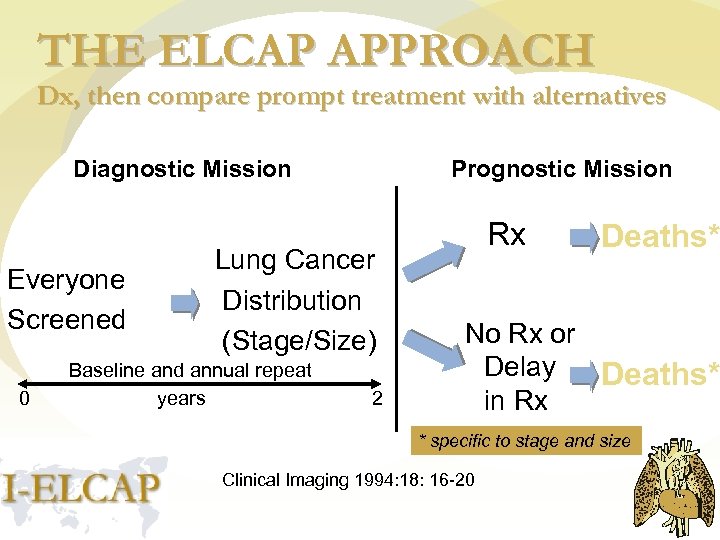 THE ELCAP APPROACH Dx, then compare prompt treatment with alternatives Diagnostic Mission Everyone Screened 0 Prognostic Mission Lung Cancer Distribution (Stage/Size) Baseline and annual repeat years 2 Rx Deaths* No Rx or Delay Deaths* in Rx * specific to stage and size Clinical Imaging 1994: 18: 16 -20
 Early Lung Cancer Action Project Enrollment of participants at high-risk of lung cancer started in 1993 New York University Medical Center and Cornell Medical Center Baseline and 1 annual repeat Reported results, separately for Baseline in Lancet in 1999 Annual repeat in Cancer 2001
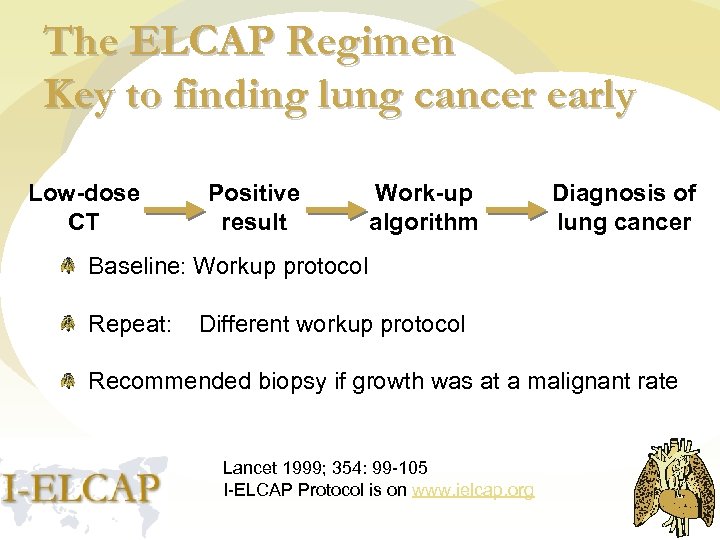 The ELCAP Regimen Key to finding lung cancer early Low-dose CT Positive result Work-up algorithm Diagnosis of lung cancer Baseline: Workup protocol Repeat: Different workup protocol Recommended biopsy if growth was at a malignant rate Lancet 1999; 354: 99 -105 I-ELCAP Protocol is on www. ielcap. org
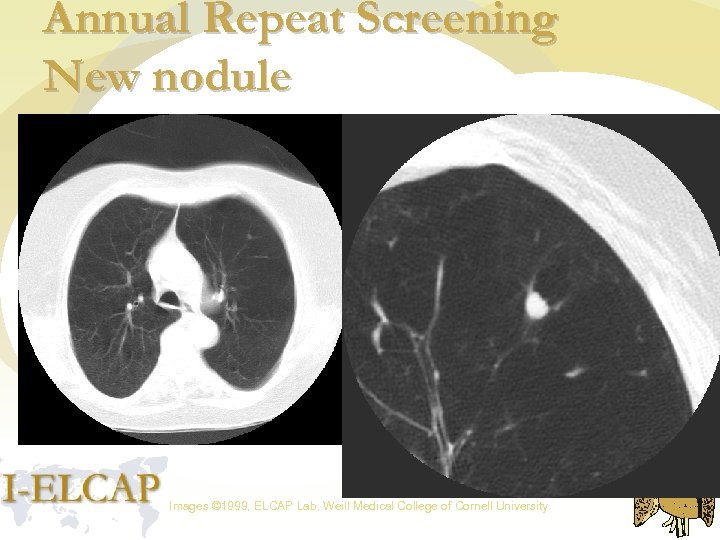 Annual Repeat Screening New nodule Images © 1999, ELCAP Lab, Weill Medical College of Cornell University
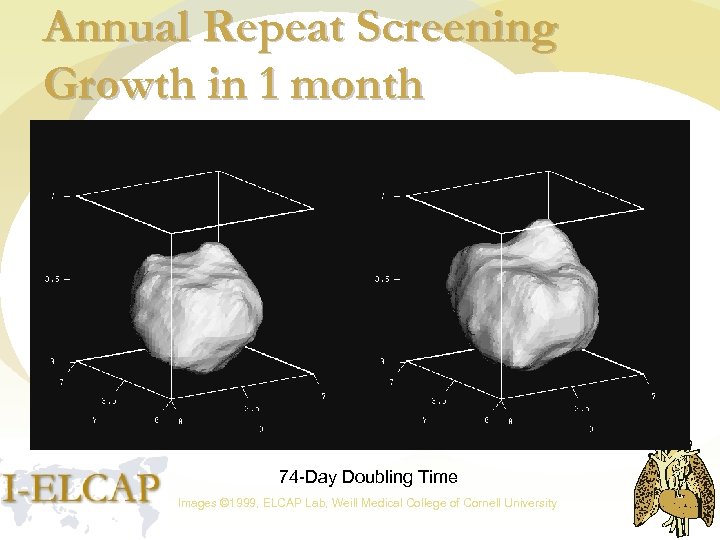 Annual Repeat Screening Growth in 1 month 74 -Day Doubling Time Images © 1999, ELCAP Lab, Weill Medical College of Cornell University
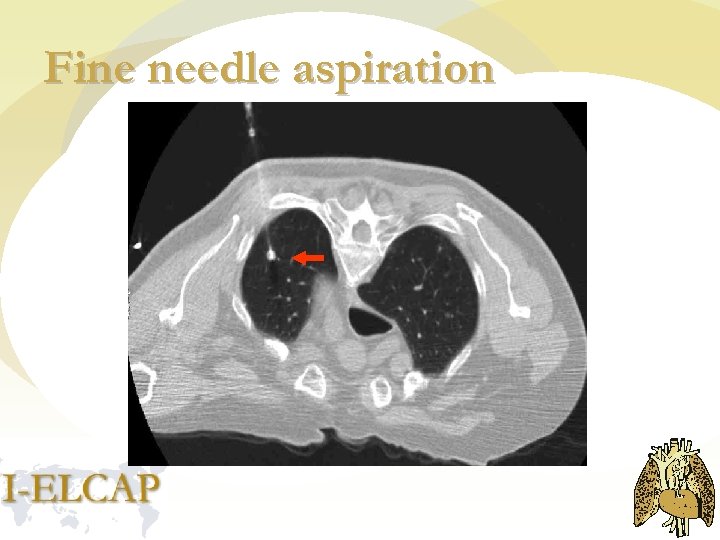 Fine needle aspiration
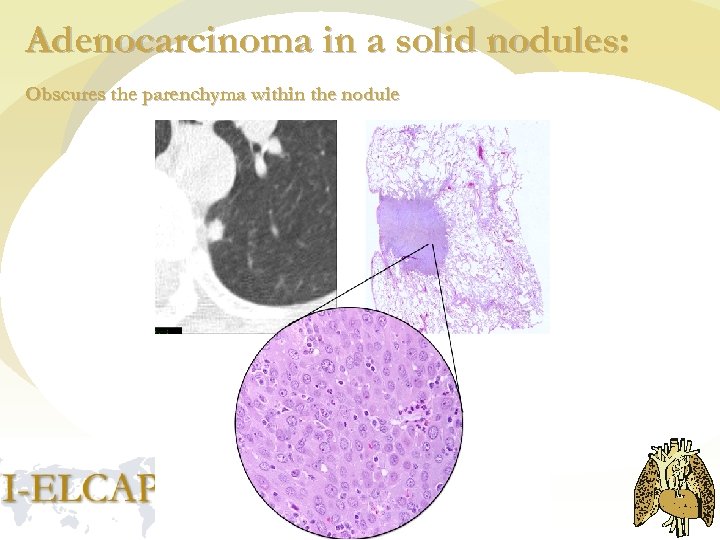 Adenocarcinoma in a solid nodules: Obscures the parenchyma within the nodule
 Early Lung Cancer Action Project Created great excitement around the world as it showed that lung cancer can be found early stage in 85% of the people diagnosed with lung cancer While in the absence of screening, early stage cancer is only found in 15% It was estimated that 60 -80% of the deaths from lung cancer would be prevented
 ELCAP provided New knowledge Usefulness of growth assessment Identification of part-solid and nonsolid nodules and the frequency with which they are malignant Need different assessment of growth A paradigm for rapid assessment of technology advances Single slice to multislice scanners PET scanners
 New York- ELCAP Expanded ELCAP to diverse medical settings in New York State using updated regimen Enrollment of same high-risk participants started in 2001 -2003 in 12 institutions Baseline and 1 annual repeat Confirmed the results of ELCAP and the importance of the regimen of screening Delay in diagnosis in 31% of cancers Cancer grew in size and progressed in stage Radiology 2007; 239 -249
 I-ELCAP Expanded to 8 countries, 44 institutions Expanded enrollment criteria to lower risk participants Common regimen of screening Reported results in N Eng J Med on October 26, 2006
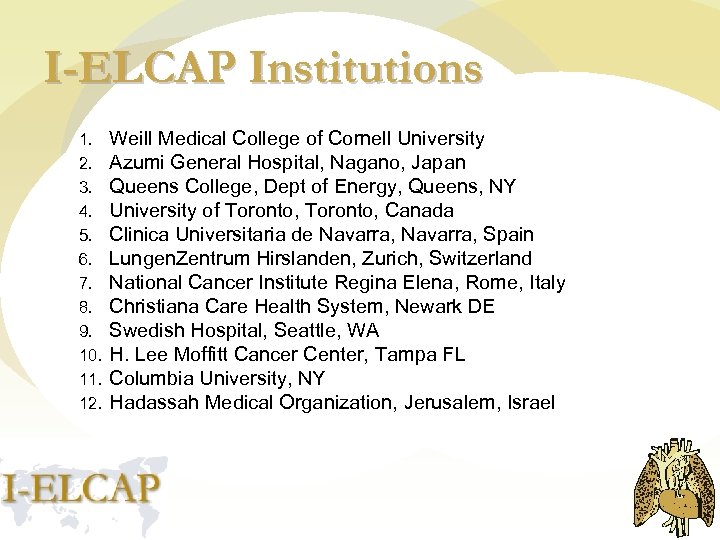 I-ELCAP Institutions 1. 2. 3. 4. 5. 6. 7. 8. 9. 10. 11. 12. Weill Medical College of Cornell University Azumi General Hospital, Nagano, Japan Queens College, Dept of Energy, Queens, NY University of Toronto, Canada Clinica Universitaria de Navarra, Spain Lungen. Zentrum Hirslanden, Zurich, Switzerland National Cancer Institute Regina Elena, Rome, Italy Christiana Care Health System, Newark DE Swedish Hospital, Seattle, WA H. Lee Moffitt Cancer Center, Tampa FL Columbia University, NY Hadassah Medical Organization, Jerusalem, Israel
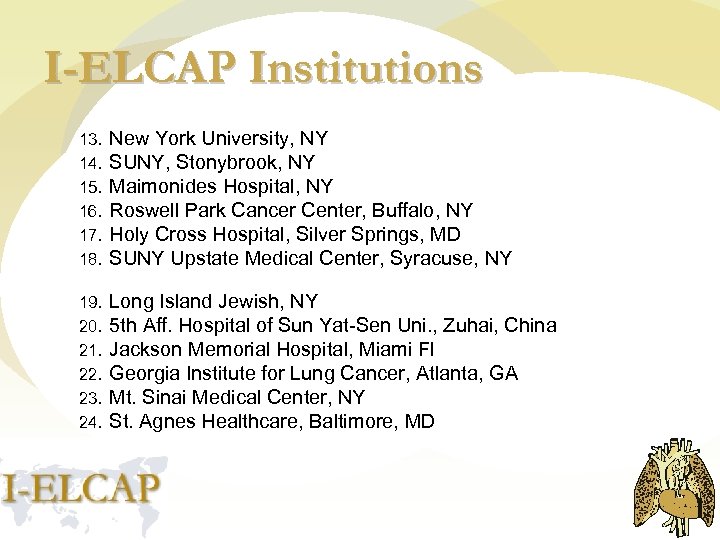 I-ELCAP Institutions 13. 14. 15. 16. 17. 18. New York University, NY SUNY, Stonybrook, NY Maimonides Hospital, NY Roswell Park Cancer Center, Buffalo, NY Holy Cross Hospital, Silver Springs, MD SUNY Upstate Medical Center, Syracuse, NY 19. 20. 21. 22. 23. 24. Long Island Jewish, NY 5 th Aff. Hospital of Sun Yat-Sen Uni. , Zuhai, China Jackson Memorial Hospital, Miami Fl Georgia Institute for Lung Cancer, Atlanta, GA Mt. Sinai Medical Center, NY St. Agnes Healthcare, Baltimore, MD
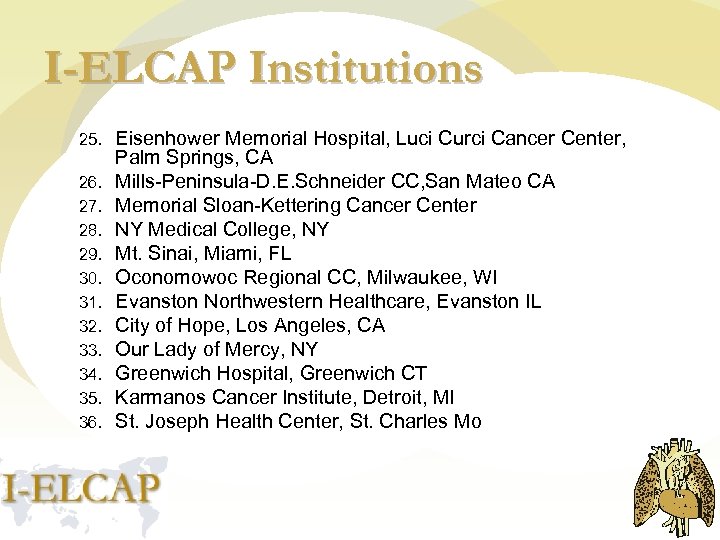 I-ELCAP Institutions 25. 26. 27. 28. 29. 30. 31. 32. 33. 34. 35. 36. Eisenhower Memorial Hospital, Luci Curci Cancer Center, Palm Springs, CA Mills-Peninsula-D. E. Schneider CC, San Mateo CA Memorial Sloan-Kettering Cancer Center NY Medical College, NY Mt. Sinai, Miami, FL Oconomowoc Regional CC, Milwaukee, WI Evanston Northwestern Healthcare, Evanston IL City of Hope, Los Angeles, CA Our Lady of Mercy, NY Greenwich Hospital, Greenwich CT Karmanos Cancer Institute, Detroit, MI St. Joseph Health Center, St. Charles Mo
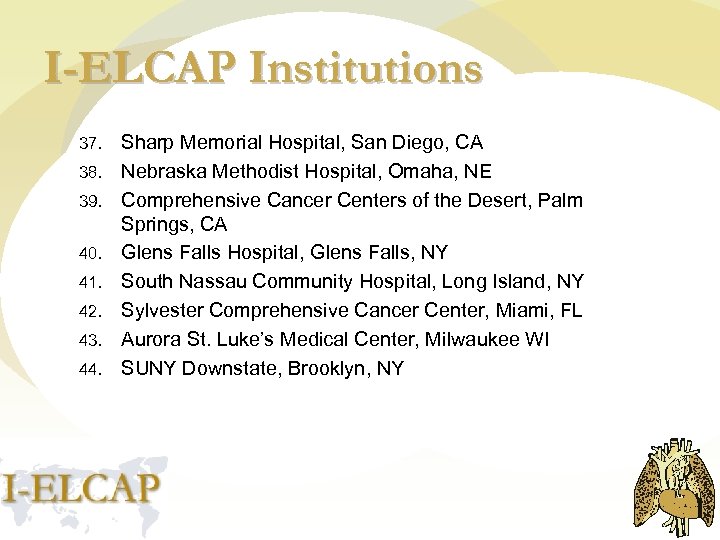 I-ELCAP Institutions 37. 38. 39. 40. 41. 42. 43. 44. Sharp Memorial Hospital, San Diego, CA Nebraska Methodist Hospital, Omaha, NE Comprehensive Cancer Centers of the Desert, Palm Springs, CA Glens Falls Hospital, Glens Falls, NY South Nassau Community Hospital, Long Island, NY Sylvester Comprehensive Cancer Center, Miami, FL Aurora St. Luke’s Medical Center, Milwaukee WI SUNY Downstate, Brooklyn, NY
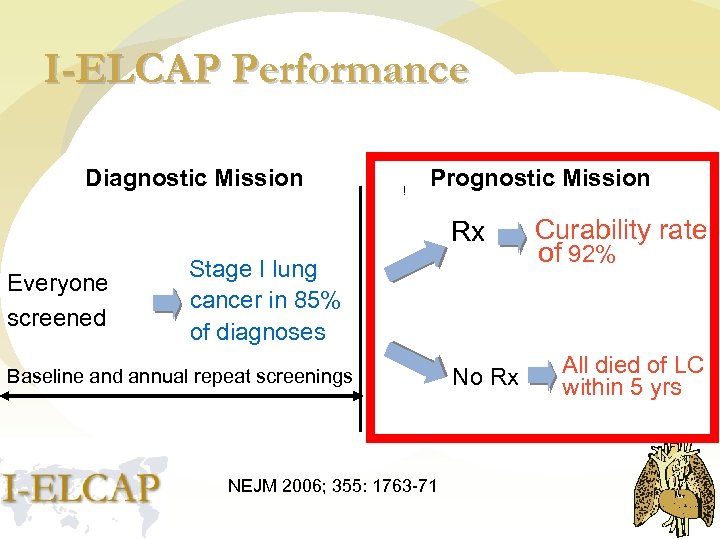 I-ELCAP Performance Diagnostic Mission ! Prognostic Mission Rx Everyone screened Stage I lung cancer in 85% of diagnoses Baseline and annual repeat screenings NEJM 2006; 355: 1763 -71 No Rx Curability rate of 92% All died of LC within 5 yrs
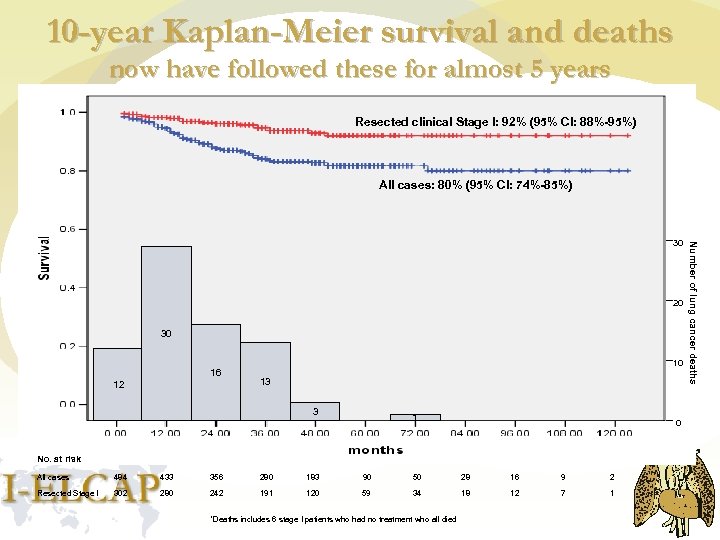 10 -year Kaplan-Meier survival and deaths now have followed these for almost 5 years Resected clinical Stage I: 92% (95% CI: 88%-95%) All cases: 80% (95% CI: 74%-85%) 20 30 16 12 10 13 3 1 0 No. at risk All cases 484 433 356 280 183 90 50 28 16 9 2 Resected Stage I 302 280 242 191 120 59 34 18 12 7 1 *Deaths includes 6 stage I patients who had no treatment who all died Number of lung cancer deaths 30
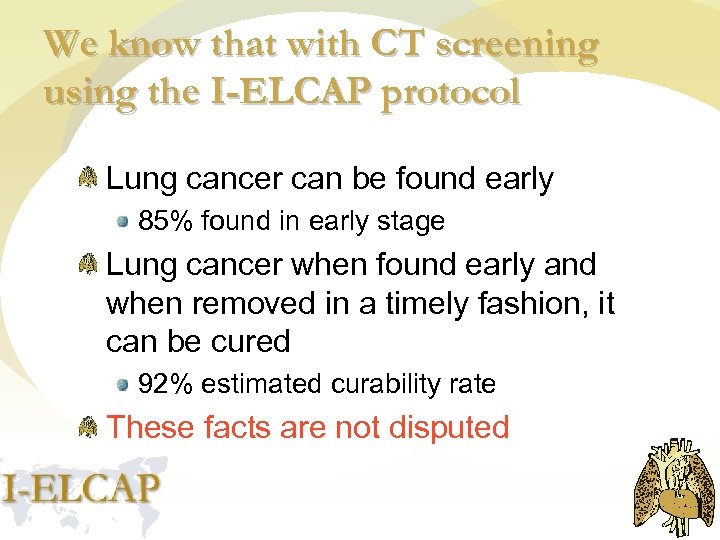 We know that with CT screening using the I-ELCAP protocol Lung cancer can be found early 85% found in early stage Lung cancer when found early and when removed in a timely fashion, it can be cured 92% estimated curability rate These facts are not disputed
 Emphysema and Coronary Artery Disease on low-dose CT Determine extent of emphysema Determine extent of coronary artery calcifications These findings are predictive of death from the coronary artery disease and chronic obstructive pulmonary disease
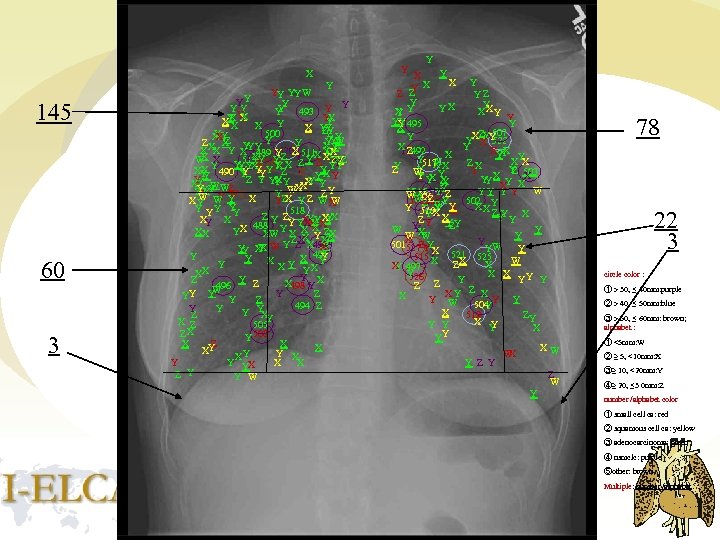 Y X Y 145 60 3 YY YY W YY Y 493 Y Y X XX X X Y Y X X YY ZY Y 500 ZY XY XZ YY Y ZX X Y Y Y XYW X Y X 489 Y X 511 YX 520 X X X YXY Y W X Y 513 Z 528 ZX Y Y Z X ZY XZ Z Y Y XY Z X Y XY Y 490 Y Y XYY Y Y Z Y YX Y Y XY WW XY YX Y WX ZZ Y Y ZY W YW X XY W Y X YZ Y Z W X W Y YY Y 518 Y Z X YX X X Y X XX X 488 Y Y YXX X X Y ZX XX YX XW X X Y X ZX XY X Y W Y Z X 499 X Z Y X Y Y Y X X 491 Y Y X Y YX XX Y X Z Y Z X 496 498 Y W Y Z YY Y Y Z 494 Z Y Y Z X Y X Z 505 X Z Y 508 X X Z Y X X Y YX X Y X Z Y Y W Y Y X X Y Z Z YZ Y YX X XX Y YY 495 Y Y X 507 XZ Y Y 522 XZ Y XX X Y 492 X X Y Y Y X XX ZX 517 XX Y Z Y Y Y X Y 503 Z W YY X X X Y Y X XX Y Y Y 514 Y 516 YY Y Y W WW X Y Z 512 523 Y ZZW 502 Y Z XX Y 510 Y Y ZY X YX Z Y Y ZY X Y Y Z Y W YX Y W W Y X Y 501527 Y ZY YW Y X 515 X 521 525 W ZX X X 497 Y Y X X 526 Y YY Y Z Z XY Z X X Y W Y Y 504 Y X ZY 519 X Y Y X YY XW X W Y Z W Y 78 22 3 circle color : ① 30, ≤ 40 mm: purple ② 40, ≤ 50 mm: blue ③ 50, ≤ 60 mm: brown; alphabet : ① <5 mm: W ② ≥ 5, <10 mm: X ③≥ 10, <20 mm: Y ④≥ 20, ≤ 3 0 mm: Z number /alphabet color ① small cell ca: red ② squamous cell ca: yellow ③ adenocarcinoma: green ④ nsmclc: purple ⑤other: brown Multiple: number /alphabet
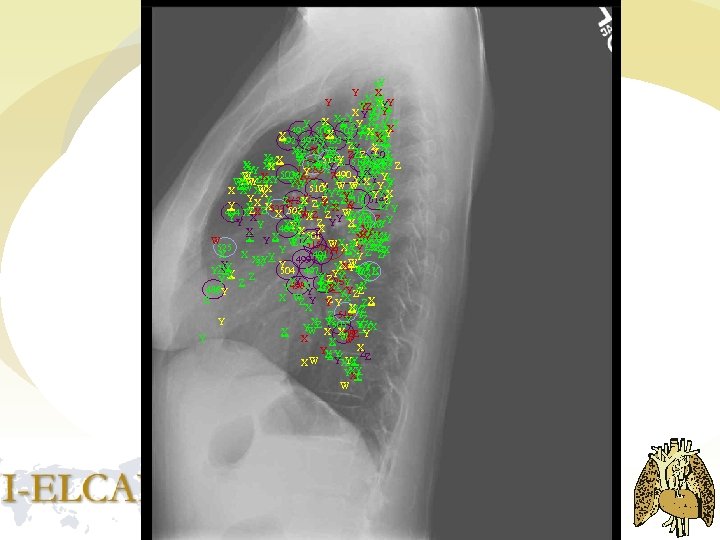 Y X Y YY X X Y Y Y ZZX Y Y YW Y Y Z X YYYY X Y XZ Y Y X Y Y Z Z X Y X YYYYY XY Y X YYZ X X 495 500 507 YYXXY X XY Y Y 492 497 Y 493 Z Y YX X XX Y Y X Y 511 Y XX W ZZZ 520 Y X X YZ Y 517 X X Y Y YZ X X X YX X XXX Y 522 Y Y Y 513 YYYY Z XX XY Y ZY Y Y 528 YX 490 Y Y XX Y Z Z XX Y X X W YY Y 503 X YXYY Y W YY XXY YY Z XXY YY YWYX Y Y XW WX WW 510 YYZW X Y X XX Y Y Y 512 X Z X 516 514 Z Y Z X Y Z Y Y X XZX Z Y Y Y Z YY Y XZX 523 502 W Z Y X WYY 494 X X W X Z YY W Z Y Y YY Y Z Y X 518 Y YY Y 488 X XW X XYXY W X X Y 501 X YZ YYX X Y YX W Z W WY Z 515 W X YXYXY Y YXZ X YY YX 525 ZX 527 X X ZXZX Y X X X YY Y 499 491 Y W X Y Y XW Y Y X Y 521 YXY 504 497 YX Y Y YX Z YY Y 526 Y Y Z YY X YX Z Z YY X 496 X Y 498 Y Y X YX 486 Y Y Z X W Y Y Y X Z Z Z X XYZ Y Z 519 Y Y YZ Y X Y 505 Y Y Z X W X Y X X ZY X 508 Y Y X W XW X YX Y Y YY Z W Z YXX Z X YXY X Y W
 Low-dose CT provides screening for the entire chest Lung cancer Coronary artery disease Chronic obstructive pulmonary disease Other regions in the future
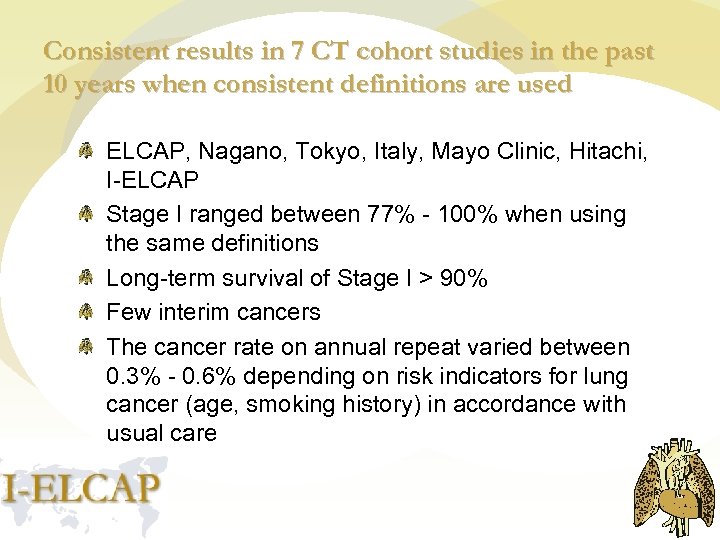 Consistent results in 7 CT cohort studies in the past 10 years when consistent definitions are used ELCAP, Nagano, Tokyo, Italy, Mayo Clinic, Hitachi, I-ELCAP Stage I ranged between 77% - 100% when using the same definitions Long-term survival of Stage I > 90% Few interim cancers The cancer rate on annual repeat varied between 0. 3% - 0. 6% depending on risk indicators for lung cancer (age, smoking history) in accordance with usual care
 What more do we need to do?
 Some advocate a RCT but “Those who cannot remember the past are condemned to repeat it” Reason in Common Sense by George Santayana
 Look at Breast Cancer Eight randomized screening trials of over 500, 000 women All but 2 considered severely flawed Still controversies about the results of those trials – 2001 and again 2006 Some European countries stopped supporting screening for breast cancer In the US, this led to congressional hearings in 2002
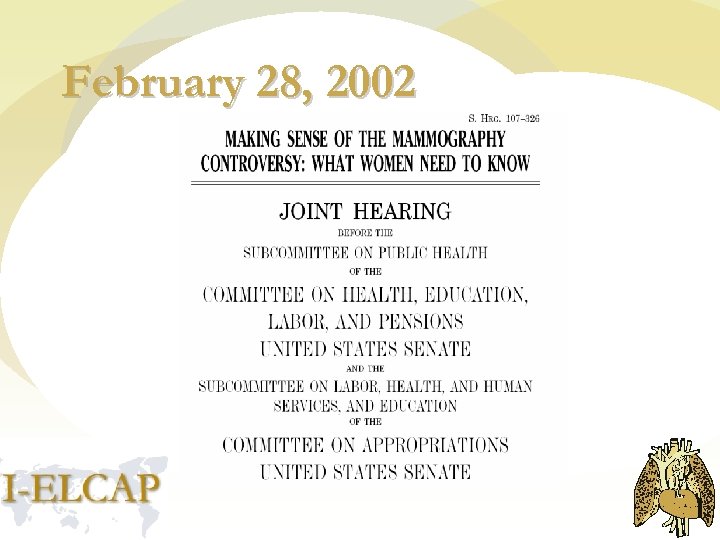 February 28, 2002
 Breast Cancer: Congressional hearings chaired by Senator Mulkulski A. von Eschenbach, Director of NCI said that more trials would be unethical we know we can find it early and earlier treatment is better than later treatment Echoed by Peter Greenwald, Head of Prevention at NCI
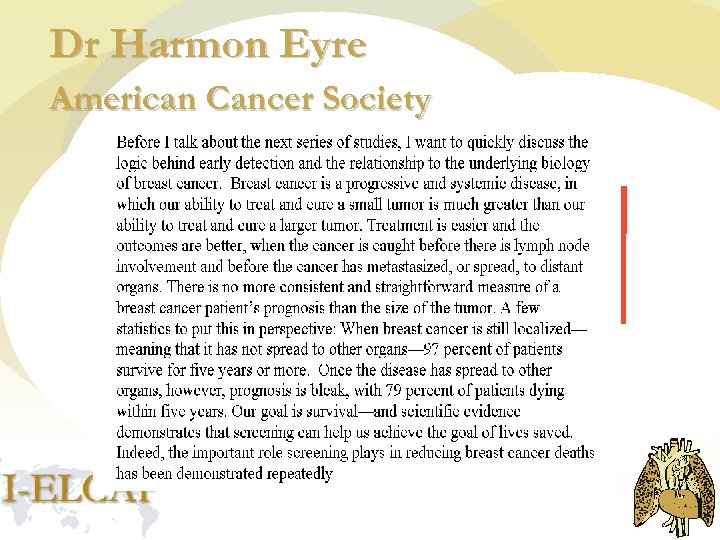 Dr Harmon Eyre American Cancer Society
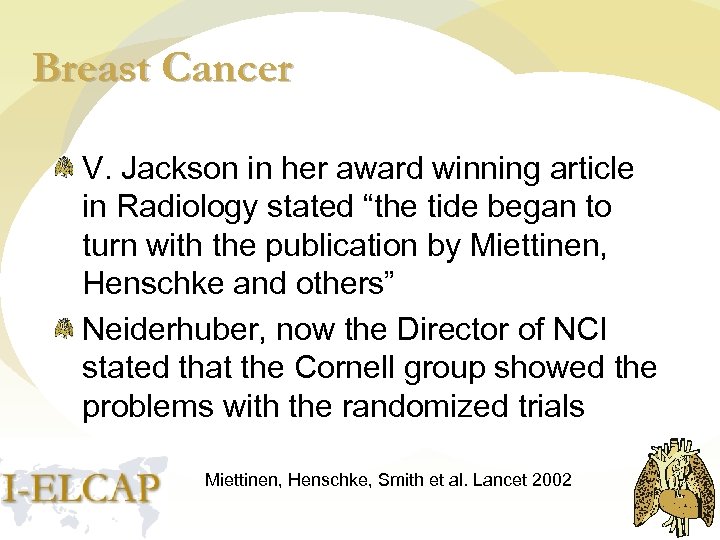 Breast Cancer V. Jackson in her award winning article in Radiology stated “the tide began to turn with the publication by Miettinen, Henschke and others” Neiderhuber, now the Director of NCI stated that the Cornell group showed the problems with the randomized trials Miettinen, Henschke, Smith et al. Lancet 2002
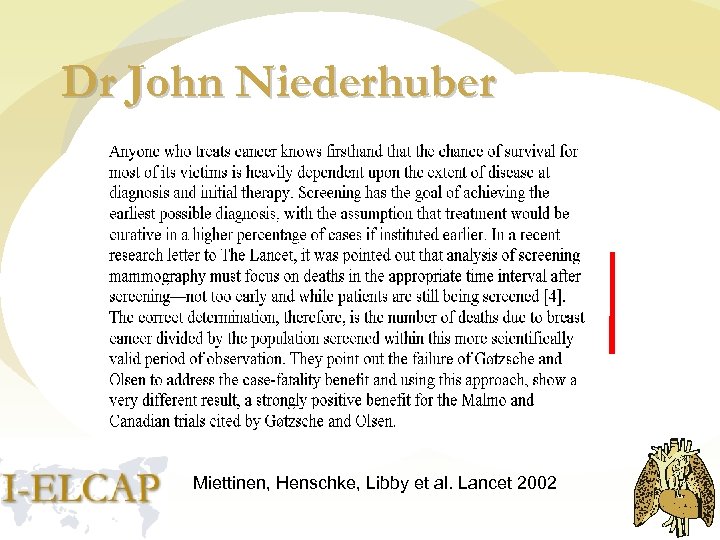 Dr John Niederhuber Miettinen, Henschke, Libby et al. Lancet 2002
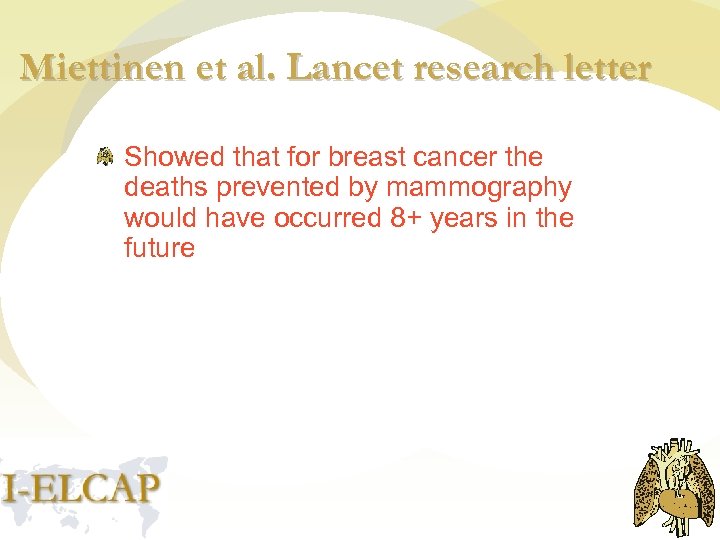 Miettinen et al. Lancet research letter Showed that for breast cancer the deaths prevented by mammography would have occurred 8+ years in the future
 Conclusion of the breast controversy The results of the 8 randomized trials were ignored Screening continued because Mammography found it early Earlier treatment is better than later treatment
 What do we know about lung cancer? Screening using low-dose CT Finds lung cancer early and Early treatment is better than later treatment and this has been known for 20+ years These facts are not disputed We knew this once ELCAP was published
 Quotes from RSNA News Letter by Bach, June 2007 “Until we figure out whether going through that chain of events is something that is helpful or harmful, it probably makes more sense not to be screened” “Stopping smoking, managing body weight, exercising and wearing a seat belt are among more important steps people can undertake to improve their health”
 Have this been proven by an RCT? “Stopping smoking, managing body weight, exercising and wearing a seat belt are among more important steps people can undertake to improve their health” Bach, RSNA Newsletter June 2007 Have these been proven by an RCT? Let’s consider proving that smoking cessation reduces deaths from lung cancer
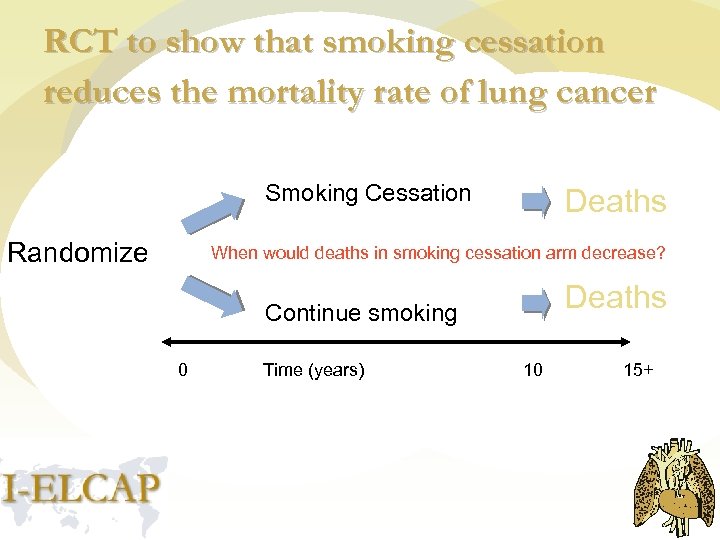 RCT to show that smoking cessation reduces the mortality rate of lung cancer Smoking Cessation Randomize Deaths When would deaths in smoking cessation arm decrease? Deaths Continue smoking 0 Time (years) 10 15+
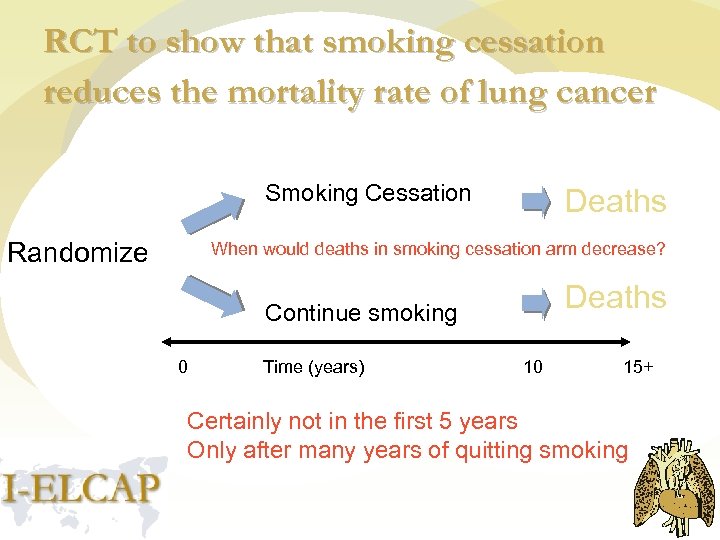 RCT to show that smoking cessation reduces the mortality rate of lung cancer Smoking Cessation Randomize Deaths When would deaths in smoking cessation arm decrease? Deaths Continue smoking 0 Time (years) 10 15+ Certainly not in the first 5 years Only after many years of quitting smoking
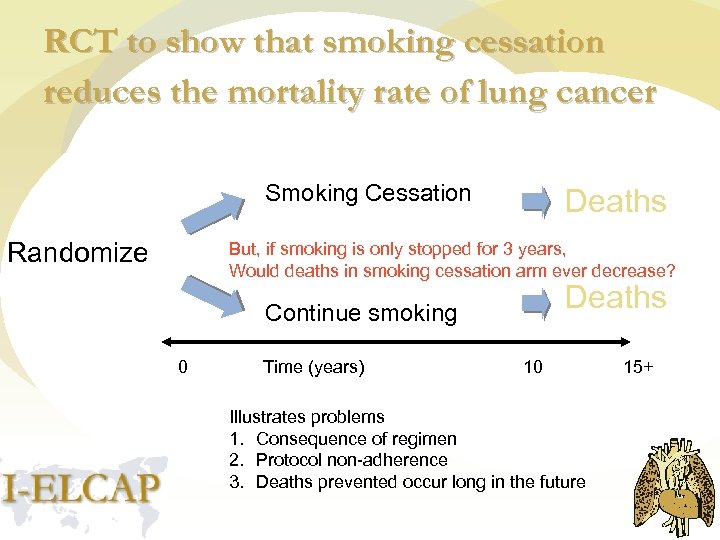 RCT to show that smoking cessation reduces the mortality rate of lung cancer Smoking Cessation Randomize Deaths But, if smoking is only stopped for 3 years, Would deaths in smoking cessation arm ever decrease? Deaths Continue smoking 0 Time (years) 10 Illustrates problems 1. Consequence of regimen 2. Protocol non-adherence 3. Deaths prevented occur long in the future 15+
 Ongoing randomized controlled trials for CT screening National Lung Screening Trial (NLST) Nelson Trial in the Netherlands and Belgium and Denmark
 It is important to identify limitations of any design and to address them
 Issues to be addressed by any screening trial- ELCAP or RCT Overdiagnosis bias Lead time bias No comparison group Length bias No reduction in late stage cancers
 Overdiagnosis bias Require growth prior to biopsy for small nodules All resected cases reviewed by an International Pathology Panel Those who delay diagnosis or treatment progress All with Stage I lung cancer without treatment died of lung cancer
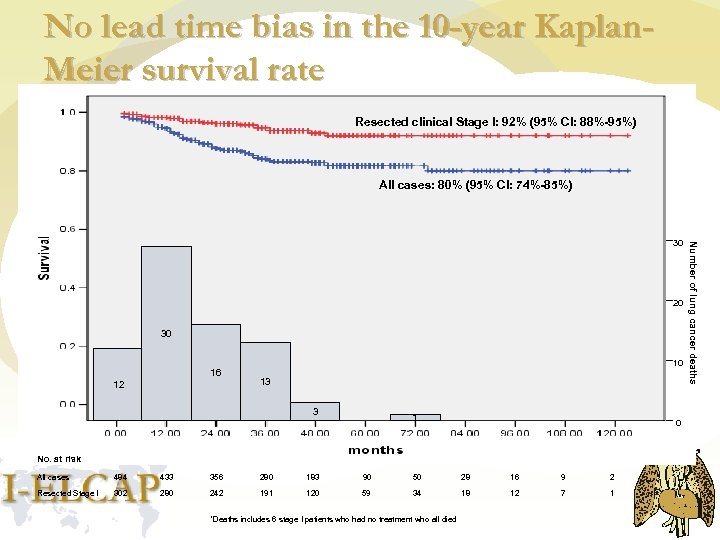 No lead time bias in the 10 -year Kaplan. Meier survival rate Resected clinical Stage I: 92% (95% CI: 88%-95%) All cases: 80% (95% CI: 74%-85%) 20 30 16 12 10 13 3 1 0 No. at risk All cases 484 433 356 280 183 90 50 28 16 9 2 Resected Stage I 302 280 242 191 120 59 34 18 12 7 1 *Deaths includes 6 stage I patients who had no treatment who all died Number of lung cancer deaths 30
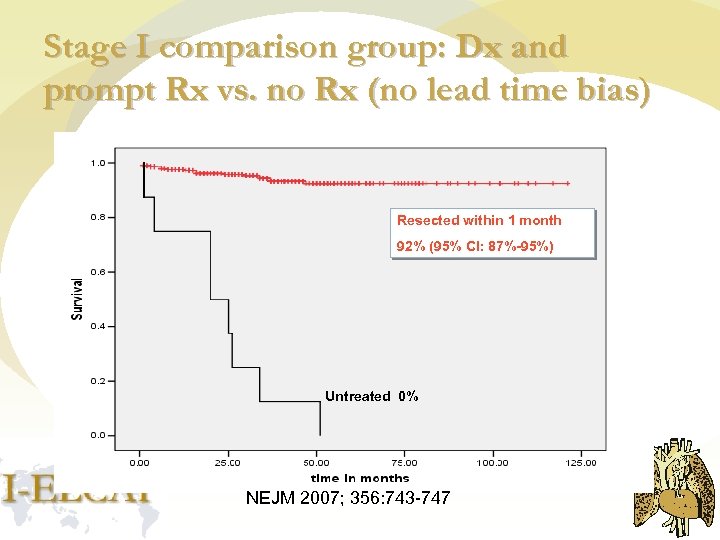 Stage I comparison group: Dx and prompt Rx vs. no Rx (no lead time bias) Resected within 1 month 92% (95% CI: 87%-95%) Untreated 0% NEJM 2007; 356: 743 -747
 Length bias Slower growing cancers are more frequently diagnosed in the baseline rounds, but The cancers in the baseline rounds are found later in their natural course than the cancers found in repeat rounds of screening Therefore baseline and repeat screenings should be reported separately
 Baseline vs. Annual Cancers Cell-type distribution illustrates length bias Baseline cancers Annual cancers Lung Cancer 2007; 56: 193 -199
 Issues to be addressed by any screening trial- ELCAP or RCT Overdiagnosis bias Lead time bias No comparison group Length bias No reduction in late stage cancers
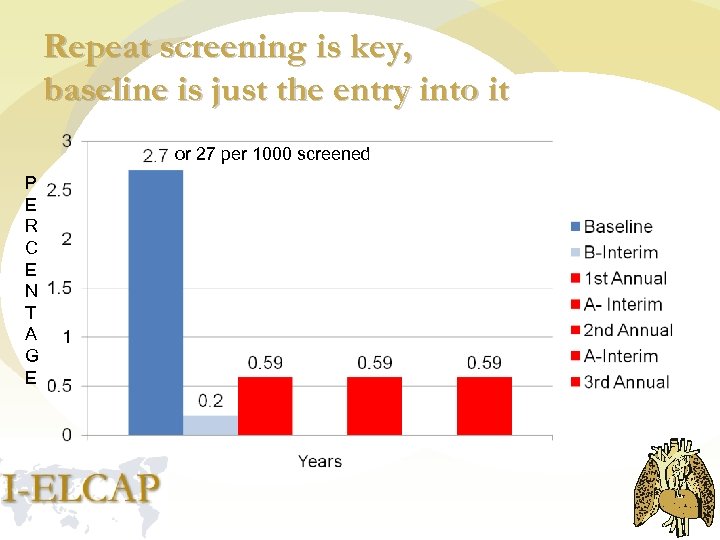 Repeat screening is key, baseline is just the entry into it or 27 per 1000 screened P E R C E N T A G E
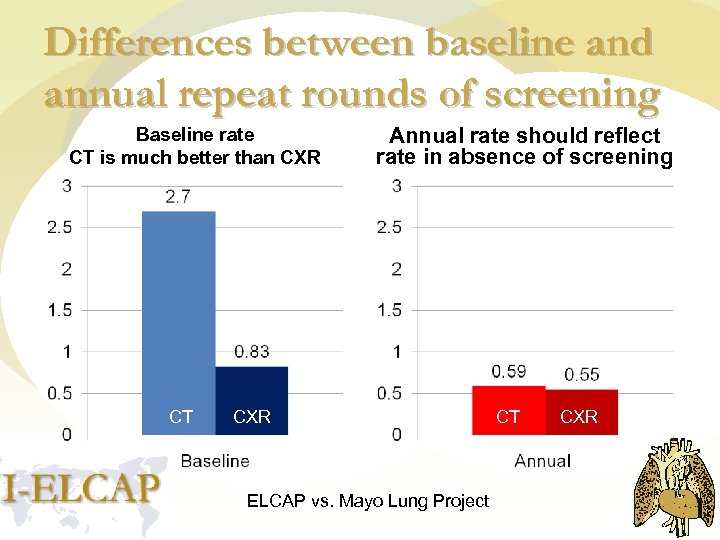 Differences between baseline and annual repeat rounds of screening Baseline rate CT is much better than CXR CT Annual rate should reflect rate in absence of screening CXR ELCAP vs. Mayo Lung Project CT CXR
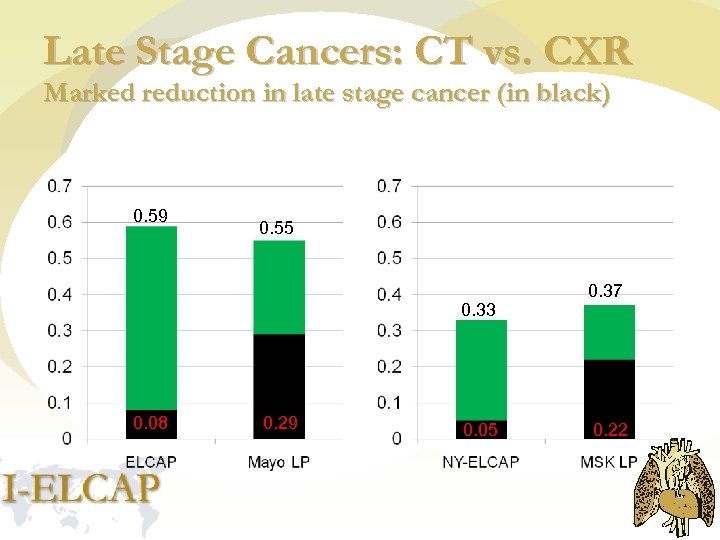 Late Stage Cancers: CT vs. CXR Marked reduction in late stage cancer (in black) 0. 59 0. 55 0. 33 0. 08 0. 29 0. 05 0. 37 0. 22
 What more do we need to do?
 We think that we should move to provide screening on a wider scale We should not wait for RCTs Focused discussions of RCT problems We should screen on a wider scale using the ELCAP approach Combine with smoking cessation programs This will provide ongoing evaluation and incorporation of new technologies
 The END