 Скачать презентацию CSU-CHILL Radar October 12 2009 Outline Brief
25b18b2deb290d8262bcc37d647410e3.ppt
- Количество слайдов: 36



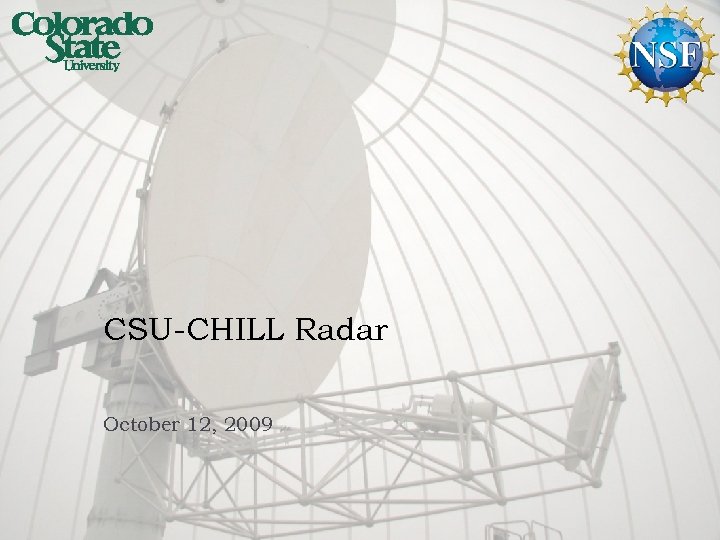
CSU-CHILL Radar October 12, 2009
Outline Brief history Overall Architecture Radar Hardware Radar Software Transmitter/timing generator Microwave hardware (Frequency chain, front-end) Antenna Digital receiver Signal Processor The “Virtual CHILL” - VCHILL Future Plans 10/12/2009
Brief History of the Radar Constructed in 1970 at the University of Chicago and the Illinois State Water Survey Directed by Dr. Eugene Mueller Originally a single-polarization S-band system, derived from FPS-18 Made a National Science Foundation facility in 1985 Moved to Colorado State University in 1990 Converted to a dual-polarization system with a single transmitter in 1981 Second transmitter added in 1995 Signal processor upgraded to “CDP” in 2005 -6 Dual-offset antenna system installed in 2008 10/12/2009
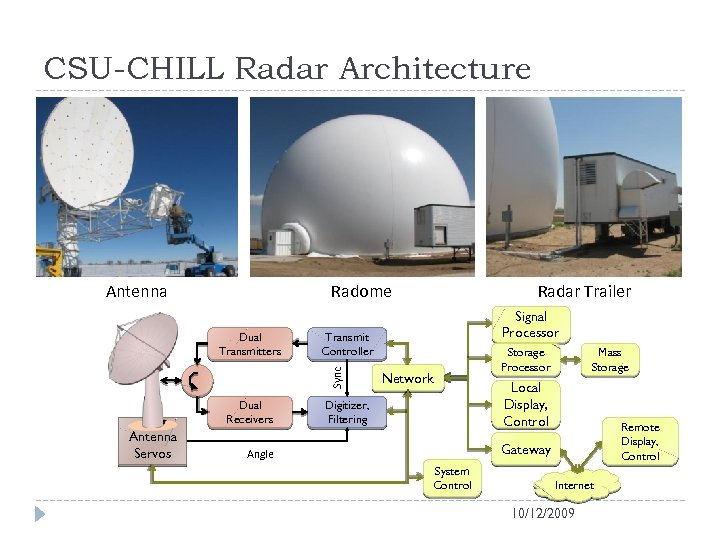
CSU-CHILL Radar Architecture Antenna Radome Dual Receivers Antenna Servos Signal Processor Transmit Controller Sync Dual Transmitters Radar Trailer Network Digitizer, Filtering Storage Processor Mass Storage Local Display, Control Remote Display, Control Gateway Angle System Control Internet 10/12/2009
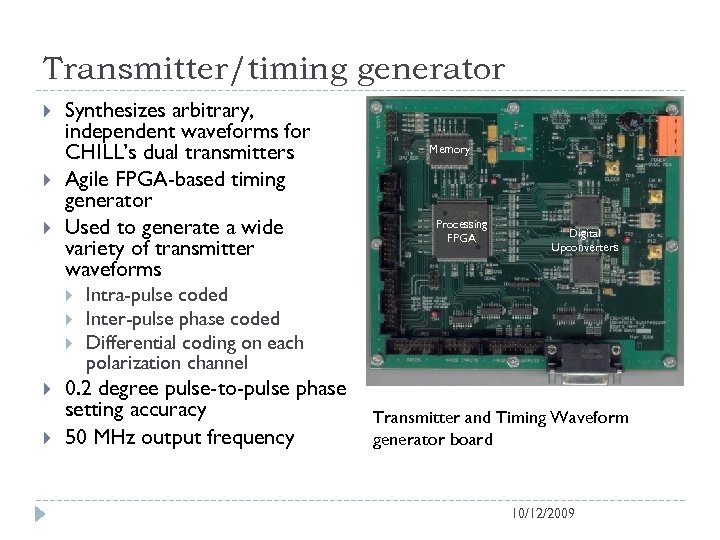
Transmitter/timing generator Synthesizes arbitrary, independent waveforms for CHILL’s dual transmitters Agile FPGA-based timing generator Used to generate a wide variety of transmitter waveforms Memory Processing FPGA Digital Upconverters Intra-pulse coded Inter-pulse phase coded Differential coding on each polarization channel 0. 2 degree pulse-to-pulse phase setting accuracy 50 MHz output frequency Transmitter and Timing Waveform generator board 10/12/2009
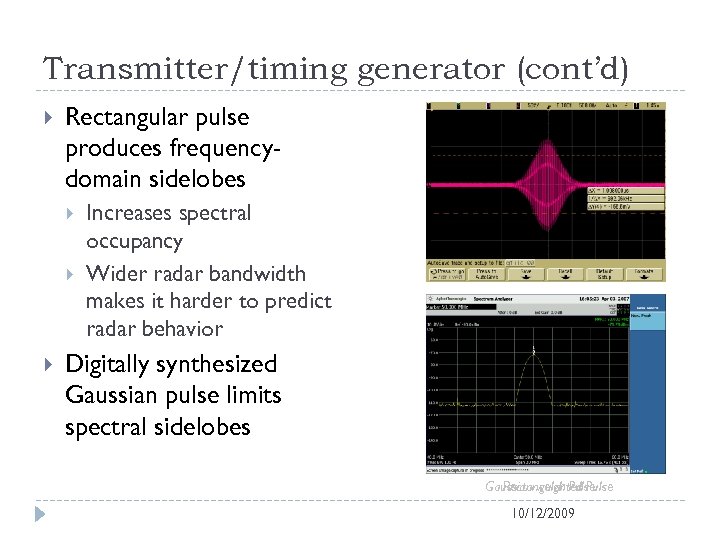
Transmitter/timing generator (cont’d) Rectangular pulse produces frequencydomain sidelobes Increases spectral occupancy Wider radar bandwidth makes it harder to predict radar behavior Digitally synthesized Gaussian pulse limits spectral sidelobes Gaussian-weighted Pulse Rectangular Pulse 10/12/2009
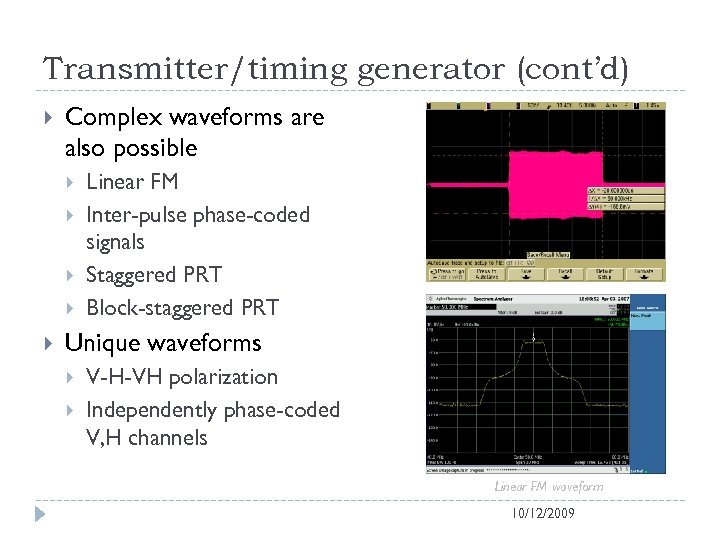
Transmitter/timing generator (cont’d) Complex waveforms are also possible Linear FM Inter-pulse phase-coded signals Staggered PRT Block-staggered PRT Unique waveforms V-H-VH polarization Independently phase-coded V, H channels Linear FM waveform 10/12/2009
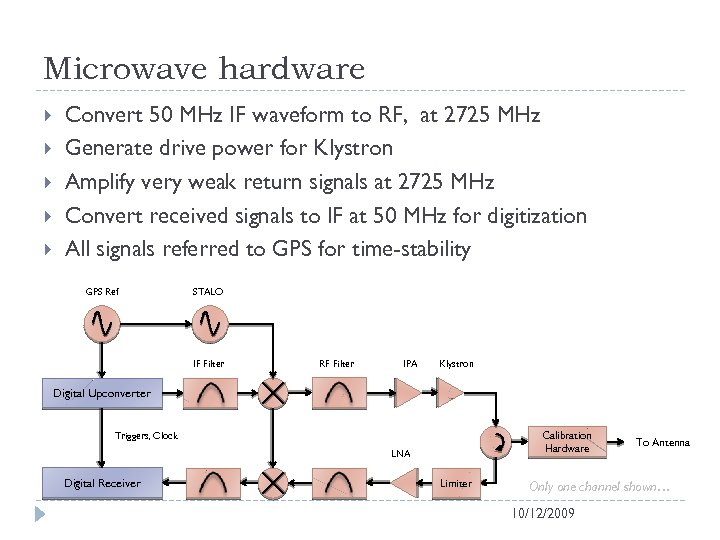
Microwave hardware Convert 50 MHz IF waveform to RF, at 2725 MHz Generate drive power for Klystron Amplify very weak return signals at 2725 MHz Convert received signals to IF at 50 MHz for digitization All signals referred to GPS for time-stability GPS Ref STALO IF Filter RF Filter IPA Klystron Digital Upconverter Calibration Hardware Triggers, Clock LNA Digital Receiver Limiter To Antenna Only one channel shown… 10/12/2009
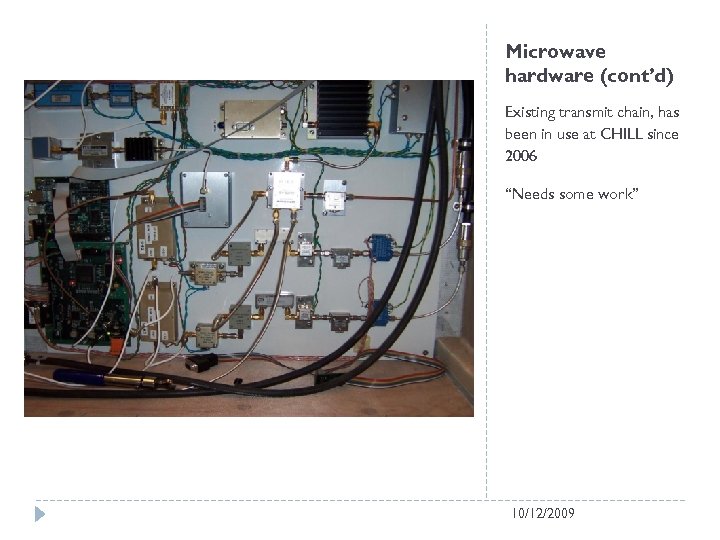
Microwave hardware (cont’d) Existing transmit chain, has been in use at CHILL since 2006 “Needs some work” 10/12/2009
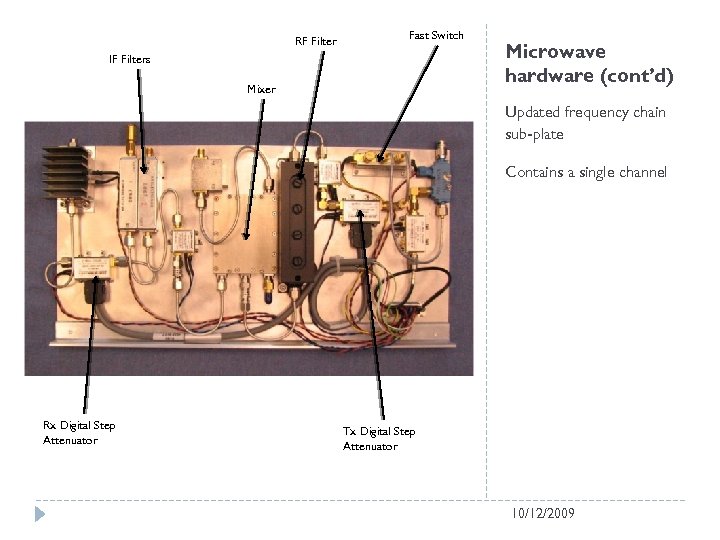
RF Filter Fast Switch IF Filters Mixer Microwave hardware (cont’d) Updated frequency chain sub-plate Contains a single channel Rx Digital Step Attenuator Tx Digital Step Attenuator 10/12/2009
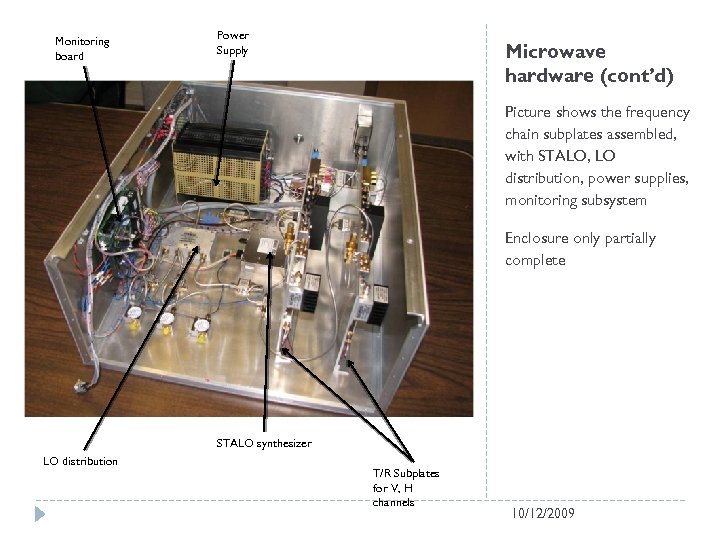
Monitoring board Power Supply Microwave hardware (cont’d) Picture shows the frequency chain subplates assembled, with STALO, LO distribution, power supplies, monitoring subsystem Enclosure only partially complete STALO synthesizer LO distribution T/R Subplates for V, H channels 10/12/2009
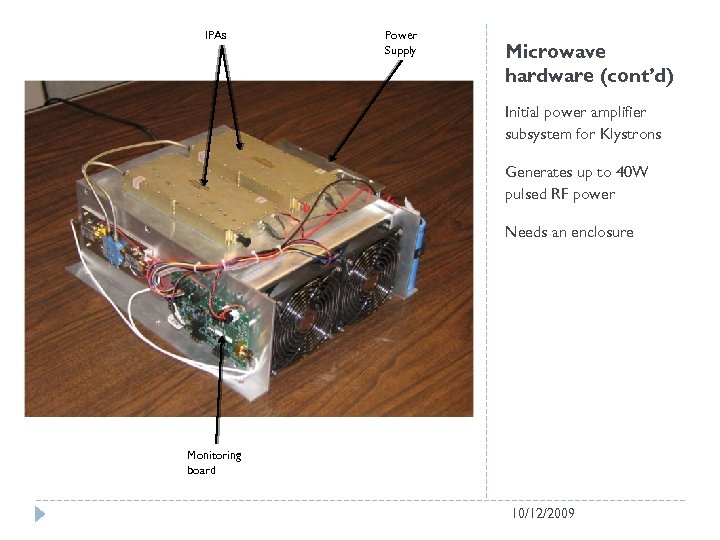
IPAs Power Supply Microwave hardware (cont’d) Initial power amplifier subsystem for Klystrons Generates up to 40 W pulsed RF power Needs an enclosure Monitoring board 10/12/2009
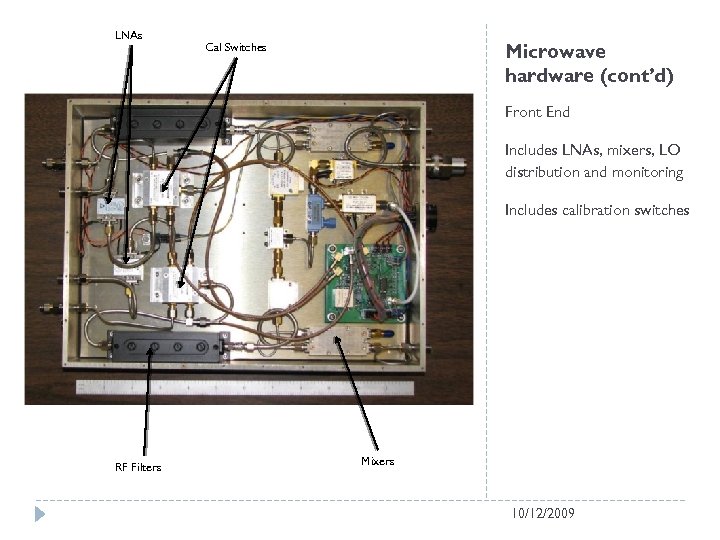
LNAs Microwave hardware (cont’d) Cal Switches Front End Includes LNAs, mixers, LO distribution and monitoring Includes calibration switches RF Filters Mixers 10/12/2009
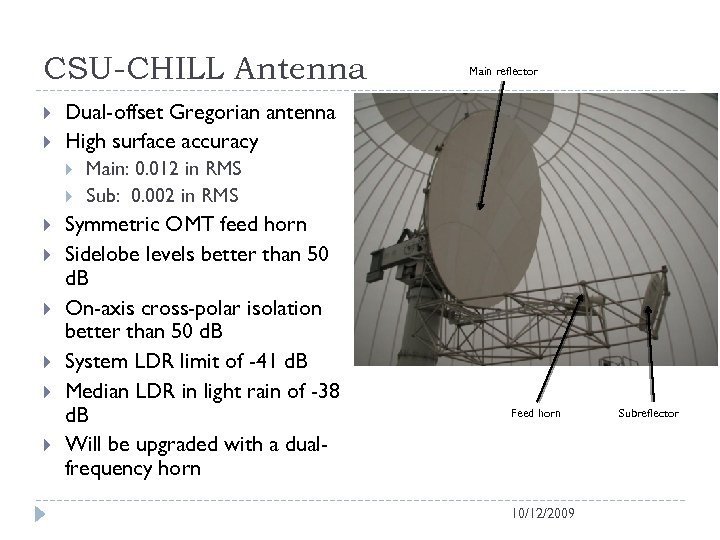
CSU-CHILL Antenna Dual-offset Gregorian antenna High surface accuracy Main reflector Main: 0. 012 in RMS Sub: 0. 002 in RMS Symmetric OMT feed horn Sidelobe levels better than 50 d. B On-axis cross-polar isolation better than 50 d. B System LDR limit of -41 d. B Median LDR in light rain of -38 d. B Will be upgraded with a dualfrequency horn Feed horn 10/12/2009 Subreflector
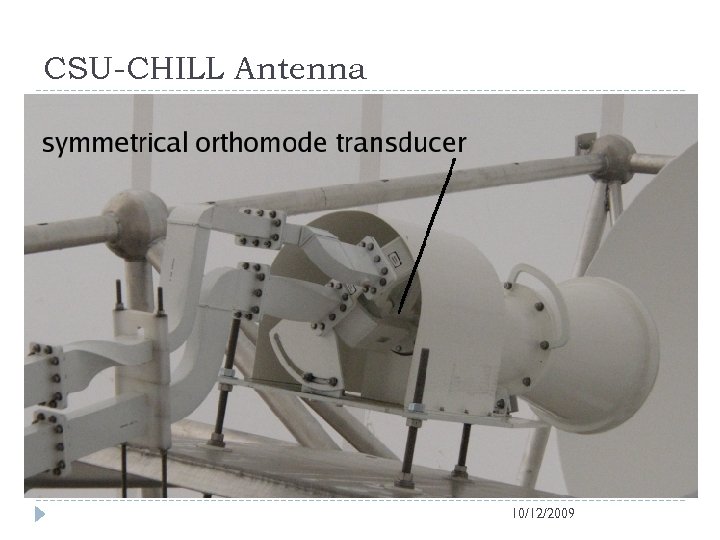
CSU-CHILL Antenna 10/12/2009
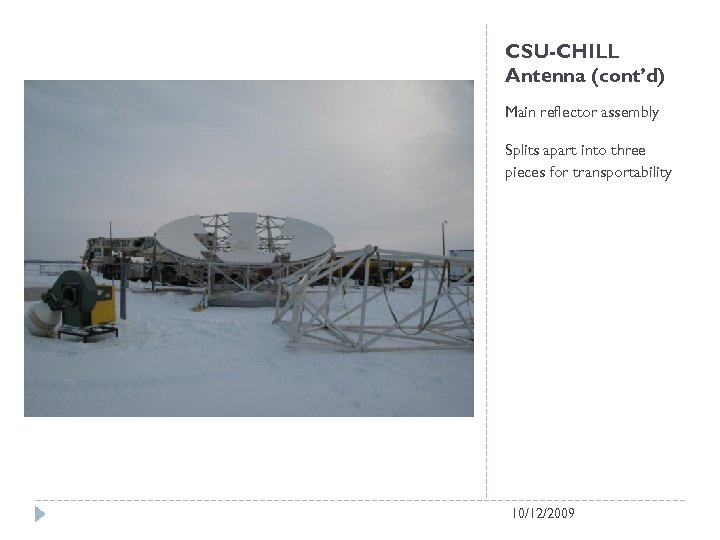
CSU-CHILL Antenna (cont’d) Main reflector assembly Splits apart into three pieces for transportability 10/12/2009
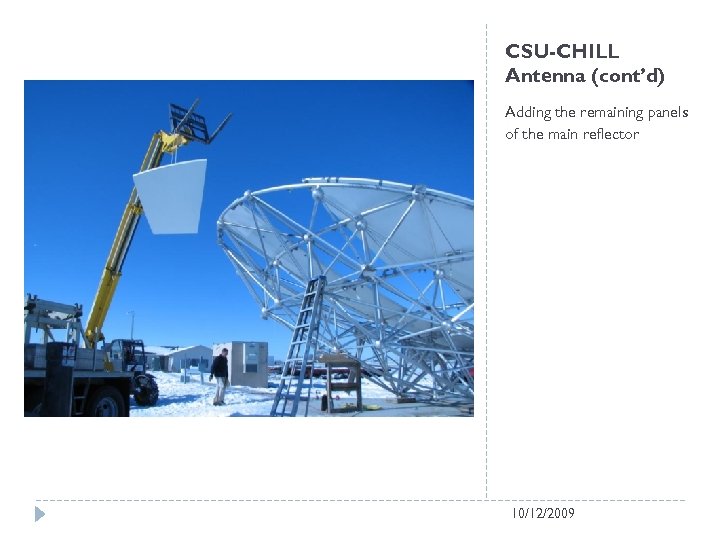
CSU-CHILL Antenna (cont’d) Adding the remaining panels of the main reflector 10/12/2009
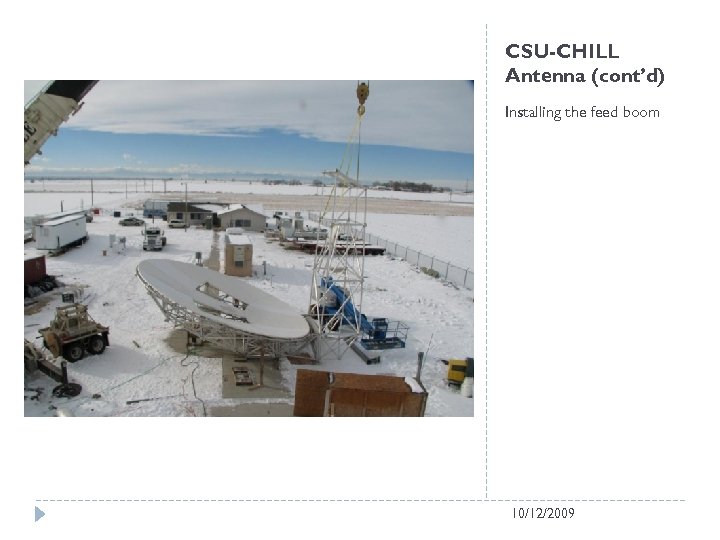
CSU-CHILL Antenna (cont’d) Installing the feed boom 10/12/2009
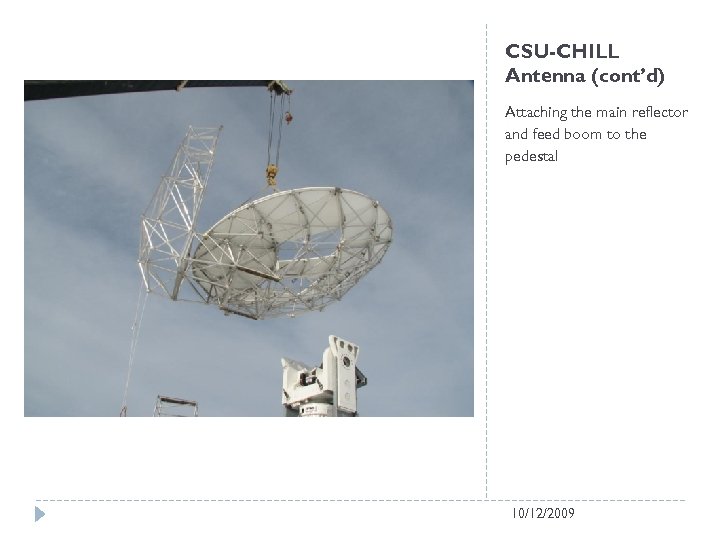
CSU-CHILL Antenna (cont’d) Attaching the main reflector and feed boom to the pedestal 10/12/2009
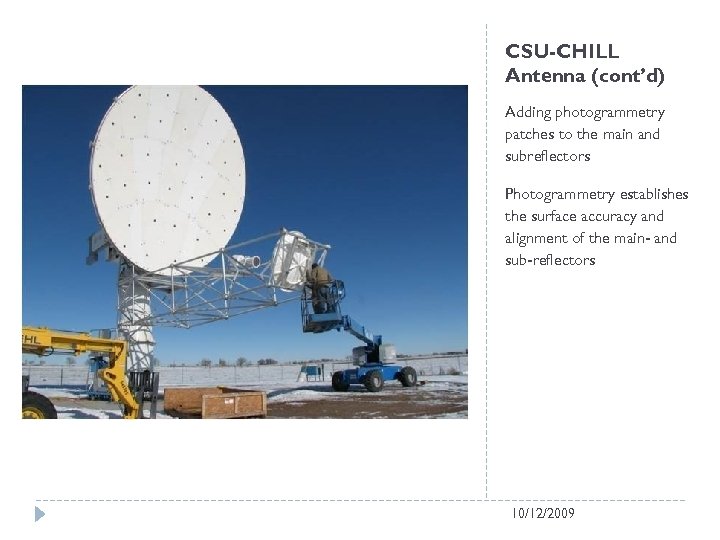
CSU-CHILL Antenna (cont’d) Adding photogrammetry patches to the main and subreflectors Photogrammetry establishes the surface accuracy and alignment of the main- and sub-reflectors 10/12/2009
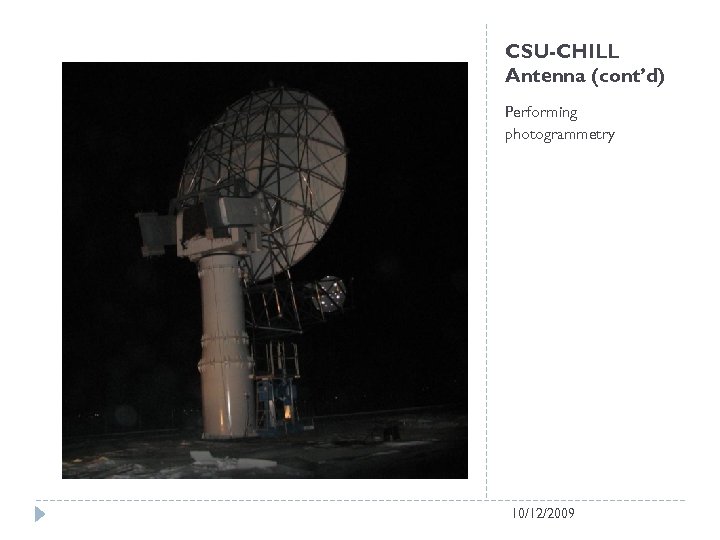
CSU-CHILL Antenna (cont’d) Performing photogrammetry 10/12/2009
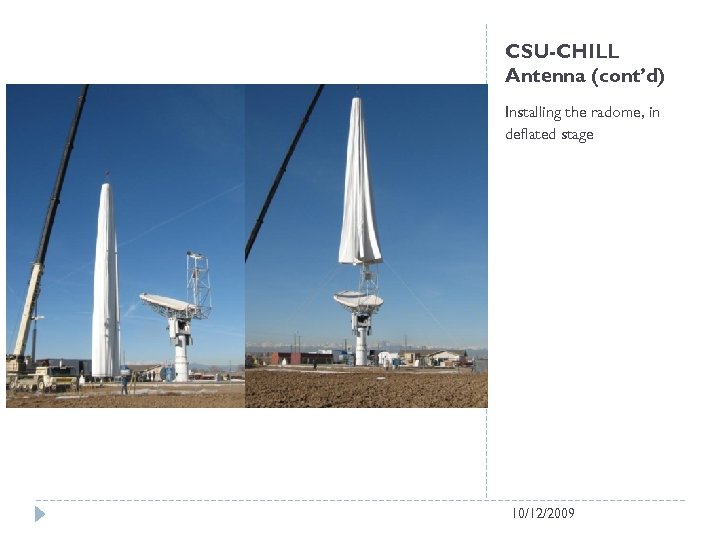
CSU-CHILL Antenna (cont’d) Installing the radome, in deflated stage 10/12/2009
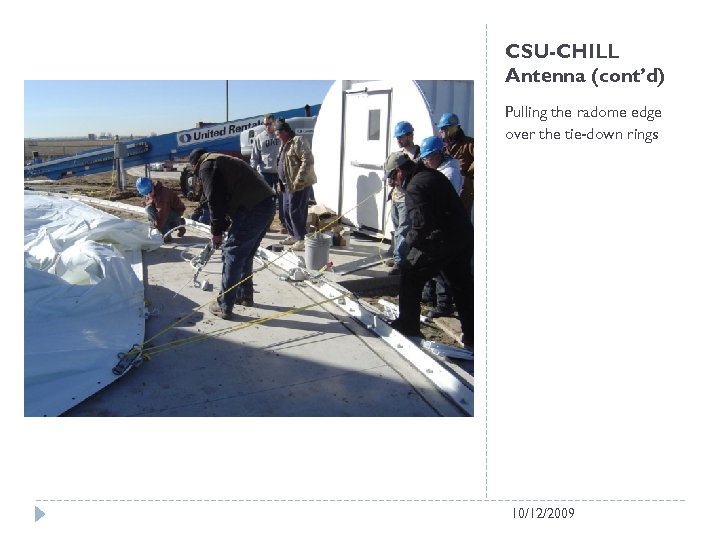
CSU-CHILL Antenna (cont’d) Pulling the radome edge over the tie-down rings 10/12/2009
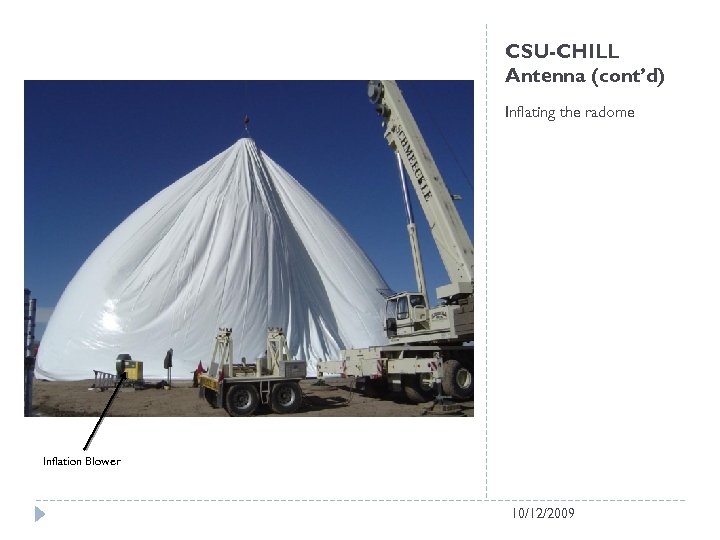
CSU-CHILL Antenna (cont’d) Inflating the radome Inflation Blower 10/12/2009
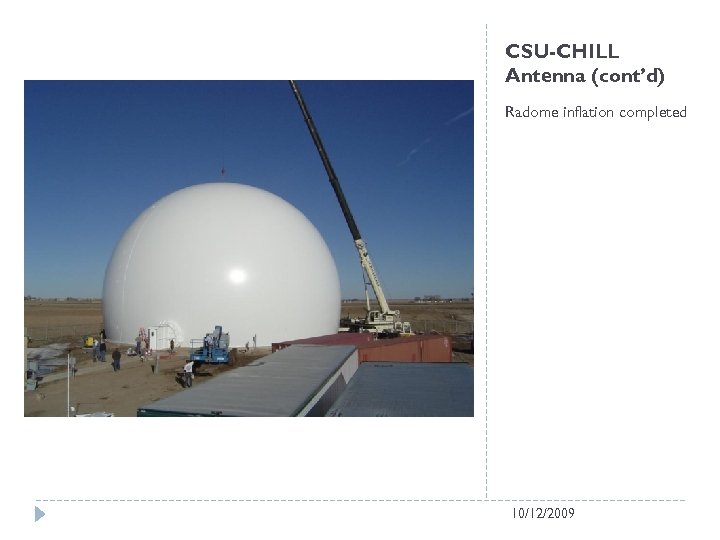
CSU-CHILL Antenna (cont’d) Radome inflation completed 10/12/2009
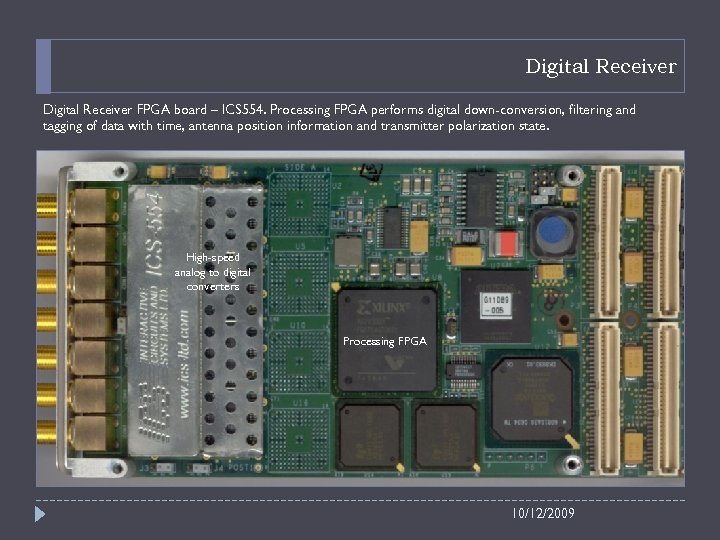
Digital Receiver FPGA board – ICS 554. Processing FPGA performs digital down-conversion, filtering and tagging of data with time, antenna position information and transmitter polarization state. High-speed analog to digital converters Processing FPGA 10/12/2009
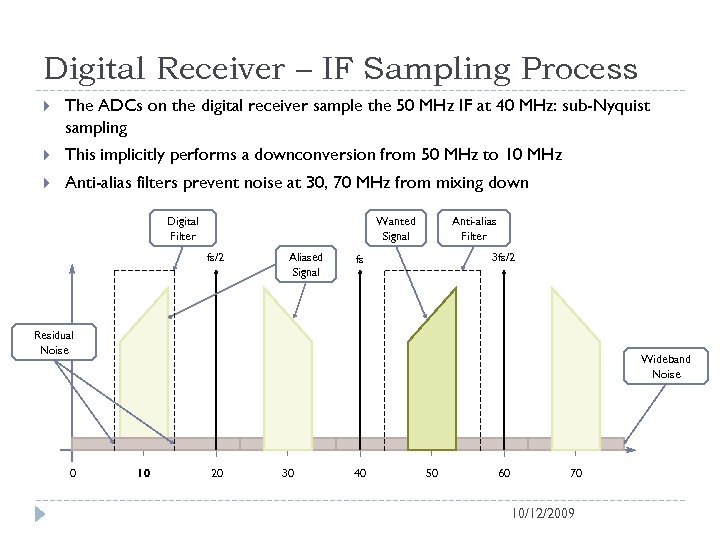
Digital Receiver – IF Sampling Process The ADCs on the digital receiver sample the 50 MHz IF at 40 MHz: sub-Nyquist sampling This implicitly performs a downconversion from 50 MHz to 10 MHz Anti-alias filters prevent noise at 30, 70 MHz from mixing down Digital Filter Wanted Signal fs/2 Aliased Signal Anti-alias Filter 3 fs/2 fs Residual Noise 0 Wideband Noise 10 20 30 40 50 60 70 10/12/2009
Digital Receiver (cont’d) Digital receiver filtering process is accelerated by the hardware implementation Performs 9 billion 16 -bit multiplications per second Received data is handed off to host PC through PCI bus Host PC serves out time-series (I/Q) data to multiple clients for further processing Signal processor Real-time debugging A-scope/spectrum display Time-series archiving 10/12/2009
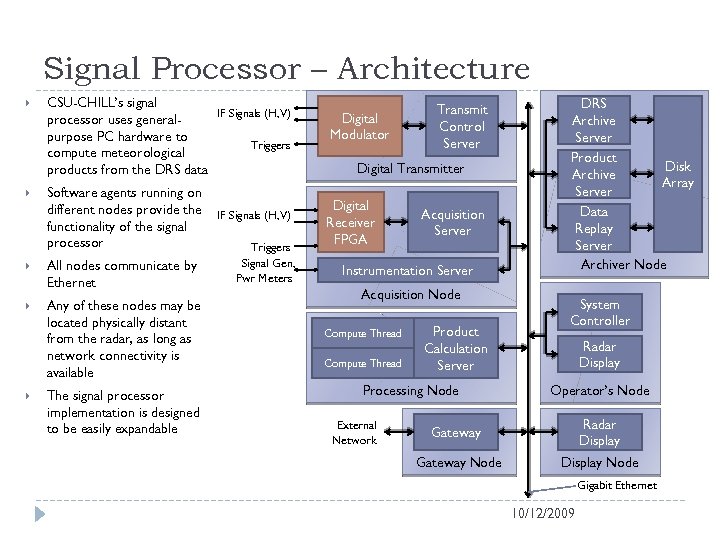
Signal Processor – Architecture CSU-CHILL’s signal IF Signals (H, V) processor uses generalpurpose PC hardware to Triggers compute meteorological products from the DRS data Software agents running on different nodes provide the functionality of the signal processor All nodes communicate by Ethernet Any of these nodes may be located physically distant from the radar, as long as network connectivity is available The signal processor implementation is designed to be easily expandable IF Signals (H, V) Triggers Signal Gen, Pwr Meters Digital Modulator Transmit Control Server Digital Transmitter Digital Receiver FPGA Acquisition Server Instrumentation Server Acquisition Node Compute Thread Product Calculation Server Processing Node External Network DRS Archive Server Product Disk Archive Array Server Data Replay Server Archiver Node System Controller Radar Display Operator’s Node Gateway Radar Display Gateway Node Display Node Gigabit Ethernet 10/12/2009
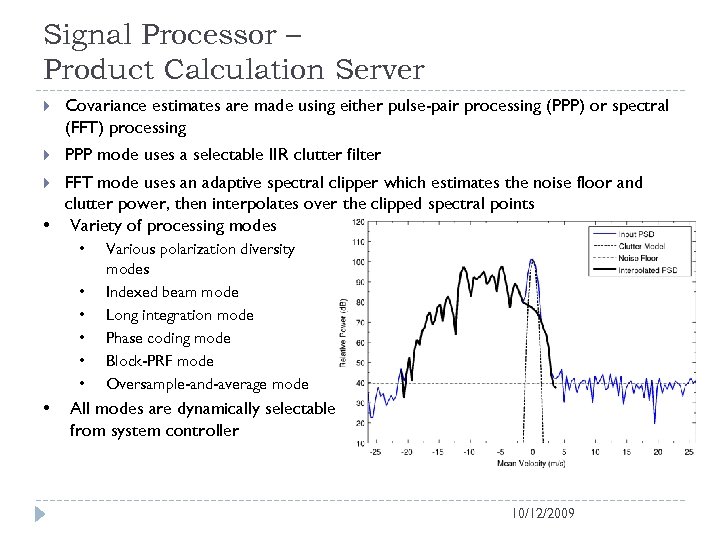
Signal Processor – Product Calculation Server Covariance estimates are made using either pulse-pair processing (PPP) or spectral (FFT) processing PPP mode uses a selectable IIR clutter filter FFT mode uses an adaptive spectral clipper which estimates the noise floor and clutter power, then interpolates over the clipped spectral points • Variety of processing modes • • Various polarization diversity modes Indexed beam mode Long integration mode Phase coding mode Block-PRF mode Oversample-and-average mode All modes are dynamically selectable from system controller 10/12/2009
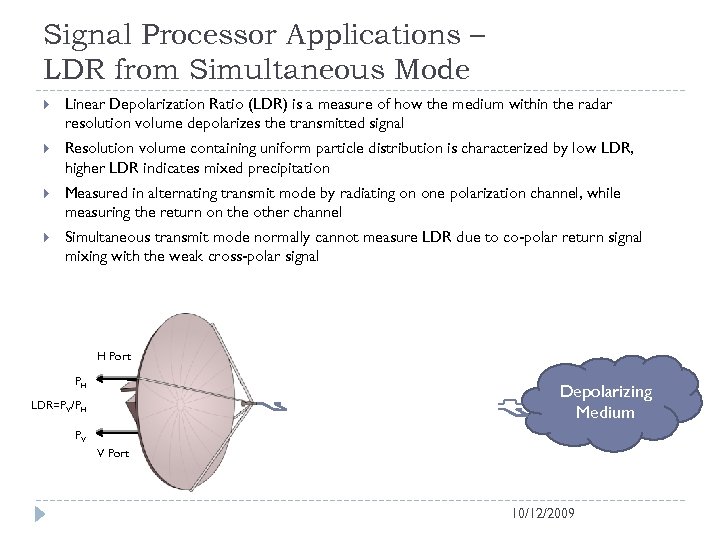
Signal Processor Applications – LDR from Simultaneous Mode Linear Depolarization Ratio (LDR) is a measure of how the medium within the radar resolution volume depolarizes the transmitted signal Resolution volume containing uniform particle distribution is characterized by low LDR, higher LDR indicates mixed precipitation Measured in alternating transmit mode by radiating on one polarization channel, while measuring the return on the other channel Simultaneous transmit mode normally cannot measure LDR due to co-polar return signal mixing with the weak cross-polar signal H Port PH Depolarizing Medium LDR=PV/PH PV V Port 10/12/2009
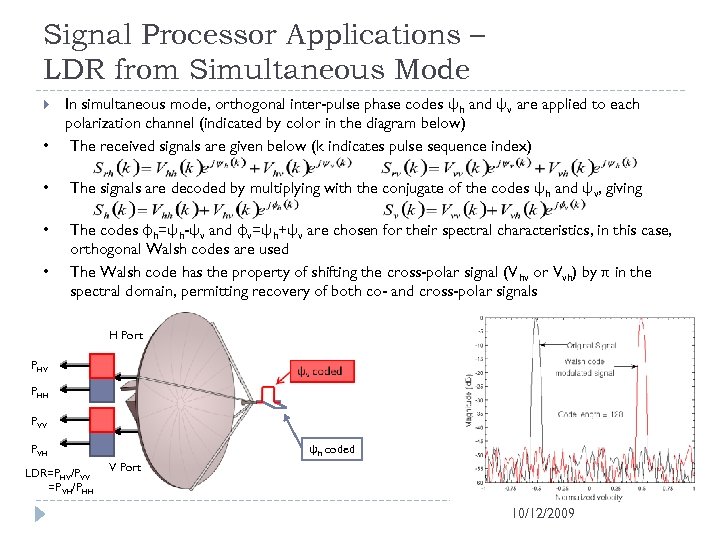
Signal Processor Applications – LDR from Simultaneous Mode In simultaneous mode, orthogonal inter-pulse phase codes ψh and ψv are applied to each polarization channel (indicated by color in the diagram below) • The received signals are given below (k indicates pulse sequence index) • The signals are decoded by multiplying with the conjugate of the codes ψh and ψv, giving • The codes φh=ψh-ψv and φv=ψh+ψv are chosen for their spectral characteristics, in this case, orthogonal Walsh codes are used The Walsh code has the property of shifting the cross-polar signal (V hv or Vvh) by π in the spectral domain, permitting recovery of both co- and cross-polar signals • H Port PHV Depolarizing Medium PHH PVV ψh coded PVH LDR=PHV/PVV =P VH/PHH V Port 10/12/2009
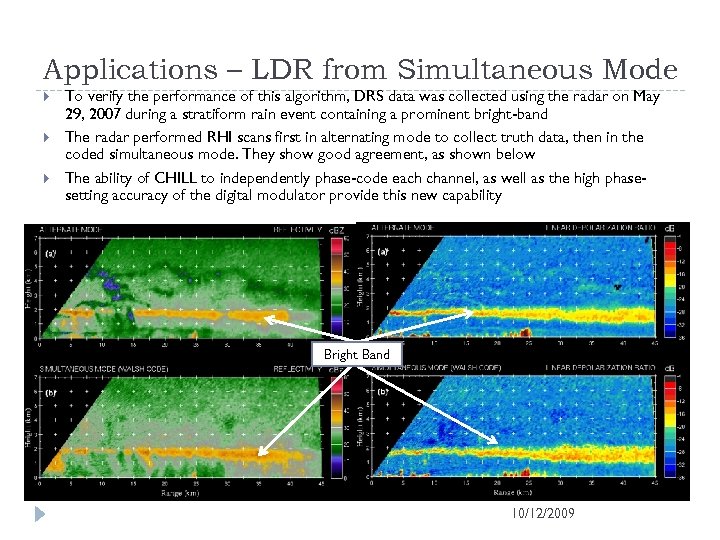
Applications – LDR from Simultaneous Mode To verify the performance of this algorithm, DRS data was collected using the radar on May 29, 2007 during a stratiform rain event containing a prominent bright-band The radar performed RHI scans first in alternating mode to collect truth data, then in the coded simultaneous mode. They show good agreement, as shown below The ability of CHILL to independently phase-code each channel, as well as the high phasesetting accuracy of the digital modulator provide this new capability Bright Band 10/12/2009
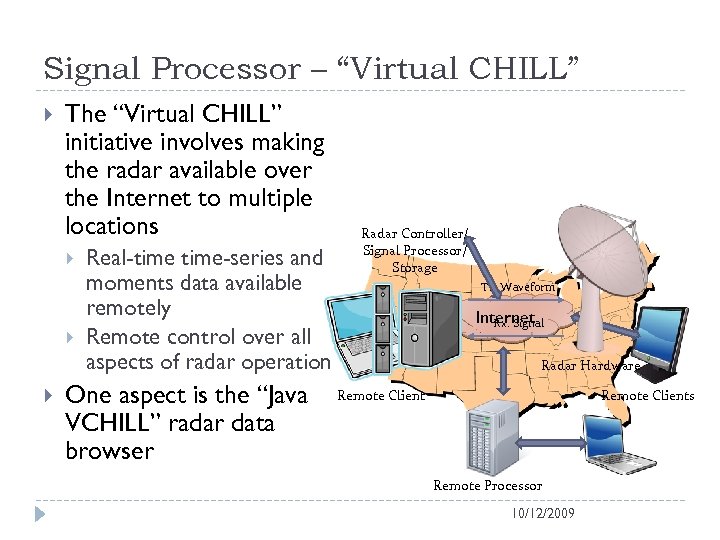
Signal Processor – “Virtual CHILL” The “Virtual CHILL” initiative involves making the radar available over the Internet to multiple locations Real-time-series and moments data available remotely Remote control over all aspects of radar operation One aspect is the “Java VCHILL” radar data browser Radar Controller/ Signal Processor/ Storage Tx. Waveform Internet Rx. Signal Radar Hardware Remote Clients Remote Processor 10/12/2009
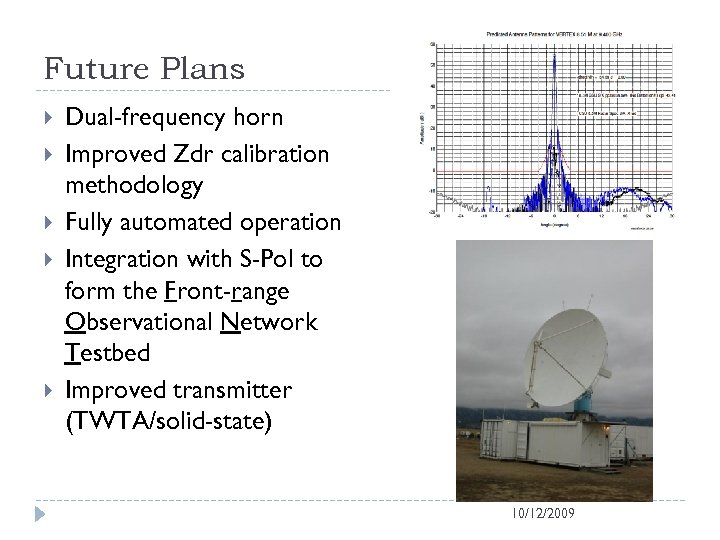
Future Plans Dual-frequency horn Improved Zdr calibration methodology Fully automated operation Integration with S-Pol to form the Front-range Observational Network Testbed Improved transmitter (TWTA/solid-state) 10/12/2009
Thank You 10/12/2009
Скачать презентацию CSU-CHILL Radar October 12 2009 Outline Brief
25b18b2deb290d8262bcc37d647410e3.ppt