 Скачать презентацию CSR at the workplace Being socially responsible means
CSR-6.ppt
- Количество слайдов: 24



CSR at the workplace Being socially responsible means not only fulfilling legal expectations, but also going beyond compliance and investing “more” into human capital, the environment and the relations with stakeholders. Going beyond basic legal obligations in the social area, e. g. training, working conditions, management-employee relations, can also have a direct impact on productivity. It opens a way of managing change and of reconciling social development with improved competitiveness.
Within the company, socially responsible practices primarily involve employees and relate to issues such as investing in human capital, health and safety, and managing change, while environmentally responsible practices relate mainly to the management of natural resources used in the production. They open a way of managing change and reconciling social development with improved competitiveness.
1. Human resources management A major challenge for enterprises today is to attract and retain skilled workers. Relevant measures could include life long learning, empowerment of employees, better information throughout the company, better balance between work, family, and leisure, greater work force diversity, equal pay and career prospects for women, profit sharing and share ownership schemes, and concern for employability as well as job security.
Active follow up and management of employees who are off work due to disabilities or injuries have also been shown to result in cost saving. Responsible recruitment practices, involving in particular non-discriminatory practices, could facilitate the recruitment of people from ethnic minorities, older workers, women and the longterm unemployed and people at disadvantage. Such practices are essential in relation to achieving the European Employment Strategy objectives of reducing unemployment, raising the employment rate, and fighting against social exclusion.

2. Health and safety at work has traditionally been approached mainly by means of legislation and enforcement measures. However, the trend of outsourcing work to contractors and suppliers makes companies more dependent on the safety and health performance of their contractors, especially those who are working within their own premises.
Companies, governments and sector organisations are increasingly looking at additional ways of promoting health and safety, by using them as a criteria in procuring products and services from other companies and as a marketing element for promoting their products or services. These voluntary schemes can be seen as complementary to legislation and control activities by public authorities as they likewise aim at promoting a preventive culture, i. e. higher levels of occupational safety and health.
3. Adaptation to change The widespread restructuring taking place in Europe raises concerns for all of the employees and other stakeholders as the closure of a factory or a heavy cut in its workforce may involve a serious economic, social or political crisis in a community. Few companies escape the need to restructure, often through downsizing, with the year 2000 seeing more mergers and acquisitions than any other year in history. According to one study, fewer than one in four restructuring operations achieve their objectives of reducing costs, increasing productivity and improving quality and customer service as they often cause the motivation, loyalty, creativity and productivity of the employees to suffer.
Restructuring in a socially responsible manner means to balance and take into consideration the interests and concerns of all those who are affected by the changes and decisions. In practice the process is often as important as the substance to the success of restructuring. In particular this involves seeking the participation and involvement of those affected through open information and consultation. Furthermore, restructuring needs to be well prepared by identifying major risks, calculating all the costs, both direct and indirect, associated with alternative strategies and policies, and evaluating all of the alternatives which would reduce the need for redundancies.
Experience of the major restructuring operations carried out in Europe in the steel, coal and shipbuilding industries has shown that successful restructuring can be better achieved through joint efforts involving the public authorities, companies and employees' representatives. This process should seek to safeguard employees' rights and enable them to undergo vocational retraining where necessary, to modernise production tools and processes in order to develop on-site activities, to mobilise public and private financing and to establish procedures for information, dialogue, cooperation and partnership. Companies should take up their share of responsibility to ensure the employability of their staff.
By engaging in local development and active labour market strategies through involvement in local employment and/or social inclusion partnerships, companies can lessen the social and local impact of large scale restructuring.
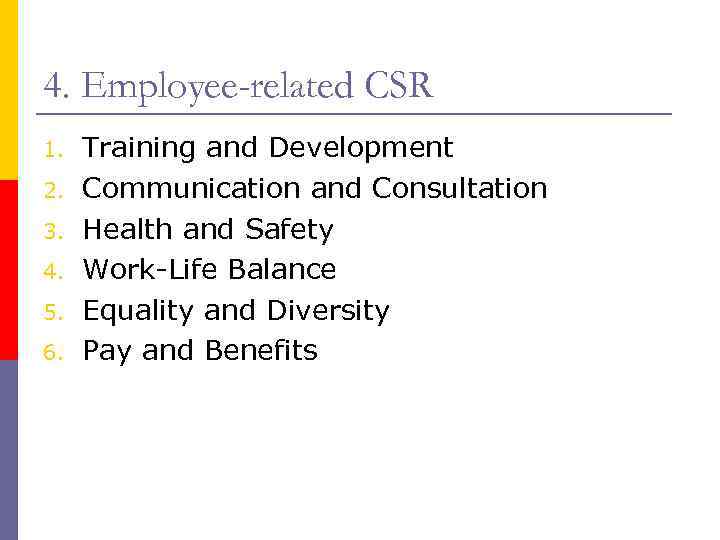
4. Employee-related CSR 1. 2. 3. 4. 5. 6. Training and Development Communication and Consultation Health and Safety Work-Life Balance Equality and Diversity Pay and Benefits
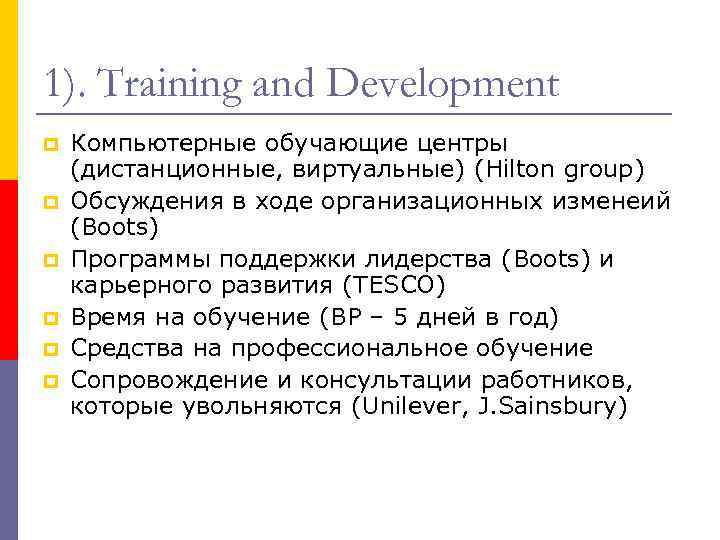
1). Training and Development Компьютерные обучающие центры (дистанционные, виртуальные) (Hilton group) Обсуждения в ходе организационных изменеий (Boots) Программы поддержки лидерства (Boots) и карьерного развития (TESCO) Время на обучение (BP – 5 дней в год) Средства на профессиональное обучение Сопровождение и консультации работников, которые увольняются (Unilever, J. Sainsbury)
2). Communication and Consultation Телефонные и интернет линия поддержки (Safeway, Marks & Spencer) Встречи и совещания, возможность непосредственного общения с высшим руководством Политика по недопущению дискриминации и преследования Возможность обратной связи
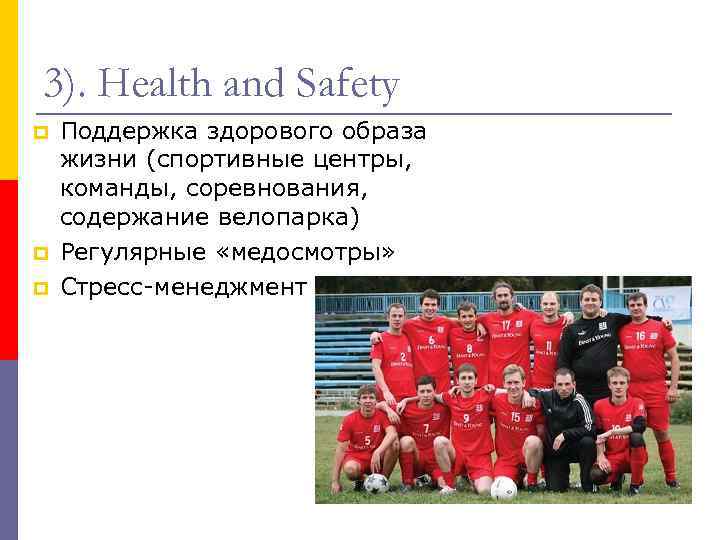
3). Health and Safety Поддержка здорового образа жизни (спортивные центры, команды, соревнования, содержание велопарка) Регулярные «медосмотры» Стресс-менеджмент
4). Work-Life Balance «Гибкий» рабочий график Схема поддержки матерей «Карьерные» перерывы (даже до 6 мес. )
5). Equality and Diversity Обучение персонала работе с потребителями с ограниченными возможностями «Женщина – руководитель» (Woman manager) Недопущение дискриминации (пол, возраст, этническая группа) Одинаковые возможности для работников по различным условиям найма
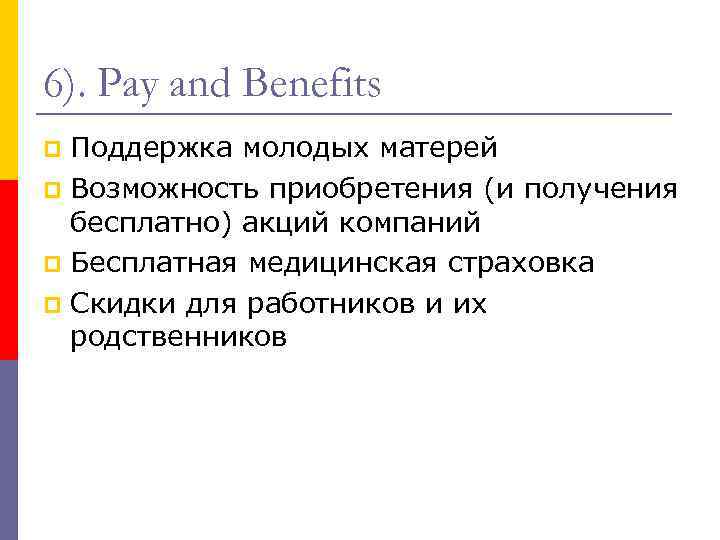
6). Pay and Benefits Поддержка молодых матерей Возможность приобретения (и получения бесплатно) акций компаний Бесплатная медицинская страховка Скидки для работников и их родственников
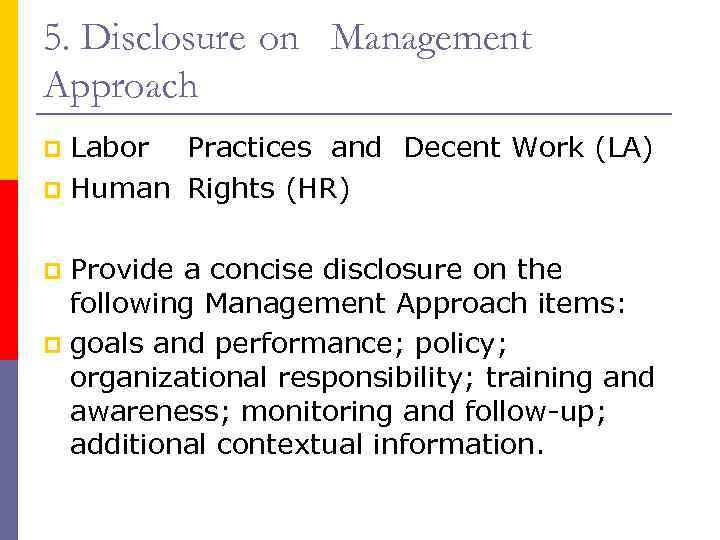
5. Disclosure on Management Approach Labor Practices and Decent Work (LA) Human Rights (HR) Provide a concise disclosure on the following Management Approach items: goals and performance; policy; organizational responsibility; training and awareness; monitoring and follow-up; additional contextual information.
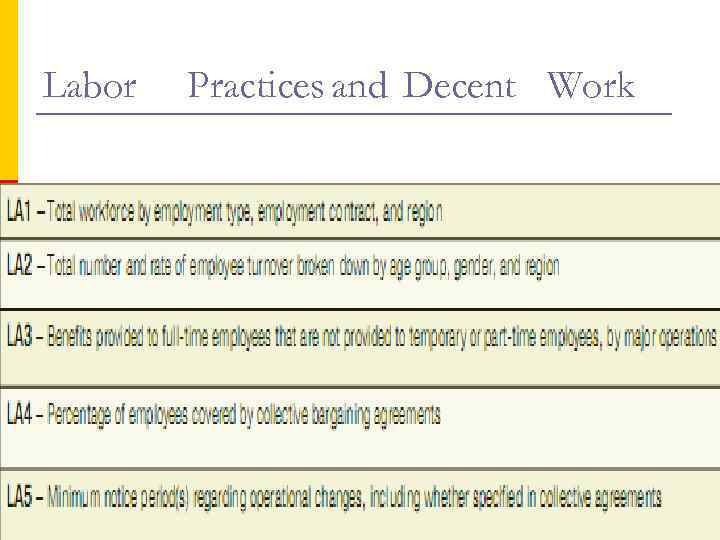
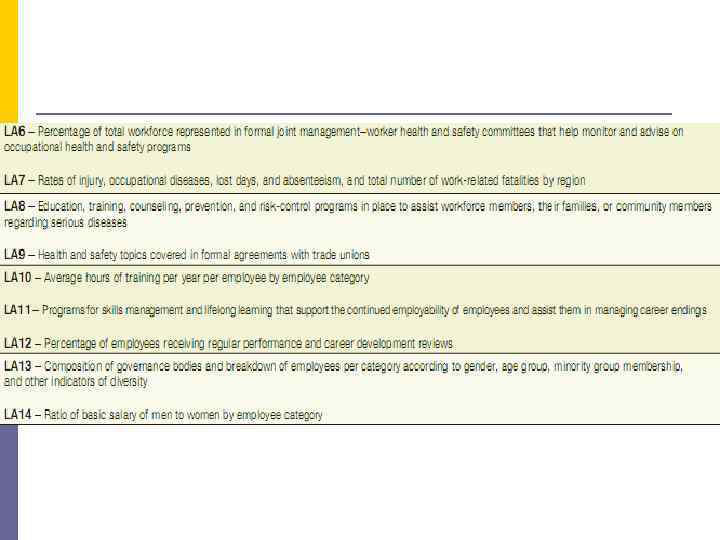
Labor Practices and Decent Work
Human Rights HR 1 – Percentage and total number of significant investment agreements that include human rights clauses or that underwent human rights screening HR 2 – Percentage of significant suppliers and contractors that underwent screening on human rights and actions taken HR 3 – Total hours of employee training on policies and procedures concerning aspects of human rights that are relevant to operations, including the percentage of employees trained HR 4 – Total number of incidents of discrimination and actions taken HR 5 – Operations identified where the right to exercise freedom of association and collective bargaining may be at significant risk, and actions to support these rights
HR 6 – Operations identified as having significant risk for incidents of child labor and measures to contribute to eliminate child labor HR 7 – Operations identified as having significant risk for incidents of forced or compulsory labor and measures to contribute to the elimination of forced or compulsory labor HR 8 – Percentage of security personnel trained in the company’s policies or procedures concerning aspects of human rights relevant to operations HR 9 – Total number of incidents of violations involving rights of indigenous people and actions taken
Increased Ability to Attract, Motivate, and Retain Employees a company's participation in social initiatives can have a positive impact on prospective and current employees, as well as citizens and executives Employees working in companies reported to have causerelated programs were 38% more likely to say they are proud of their company's values than were employees in companies not reported to have these programs Even before 9/11, 48 percent of respondents indicated that a company's commitment to causes is important when deciding where to work. After 9/11, that percentage rose to 76 … more than half of the 2, 100 MBA students surveyed indicated they would accept a lower salary in order to work for a socially responsible company … graduates look for the right corporate culture, as well as the right salary, job description, and opportunities for promotion
Скачать презентацию CSR at the workplace Being socially responsible means
CSR-6.ppt