


 Скачать презентацию CSI CRIM E SC ENE INTOLERANCE TAP E
9d6f293ee5fc01cab9bb2821158f840e.ppt
- Количество слайдов: 26
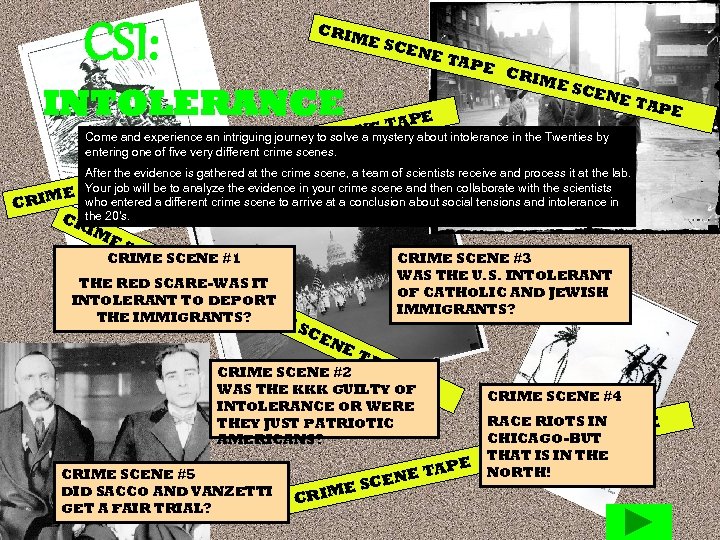 CSI: CRIM E SC ENE INTOLERANCE TAP E C RIM E SC ENE TAP E PE E TA about intolerance in the Twenties by Come and experience an intriguing journey to solve. N mystery CE a ME S entering one of five very different crime scenes. CRI After the evidence is gathered at the crime scene, a team of scientists receive and process it at the lab. APE E Tbe to analyze the evidence in your crime scene and then collaborate with the scientists Your job SCEN will E CRIM who entered a different crime scene to arrive at a conclusion about social tensions and intolerance in CRthe 20’s. IM ES CE CRIME SCENE #1 CRIME SCENE #3 NE TA WAS THE U. S. INTOLERANT PE THE RED SCARE-WAS IT OF CATHOLIC AND JEWISH CR INTOLERANT TO DEPORT IMMIGRANTS? I THE IMMIGRANTS? ME SC EN ET AP E CRIME SCENE #2 WAS THE KKK GUILTY OF INTOLERANCE OR WERE THEY JUST PATRIOTIC AMERICANS? CRIME SCENE #5 DID SACCO AND VANZETTI GET A FAIR TRIAL? CRIME SCENE #4 RACE RIOTS IN APE NE CHICAGO-BUT T SCE IM IS THAT E IN THE CR APE NORTH! ET SCEN E CRIM
 CSI: CR IME INTOLERANCE SCE NE TAPE CR IME SCE NE E SC about what was going around the crime scene to It is always important to gather RIM some background PE C understand the context of the crime. What was its setting? A NE T CEWorld War I brought great upheaval to American society. When the war ended, The S MEend of TAP E CRI government agencies removed their controls from the American economy. This released pent-up demand in the economy. People raced to buy goods that had been rationed, while businesses rapidly raised prices they had been forced to keep low during the war. The result was rapid inflation. The inflation rate was more than 15% per year. Inflation increased the cost of living. Many companies had been forced to raise wages during the war, but inflation threatened to wipe out any gains the workers had made. Workers wanted higher wages to keep up with inflation, while companies wanted to not increase wages in an effort to keep their operation expenses down. Many companies were determined to break the back of the unions as well. These circumstances led to an enormous wave of strikes in 1919. By year’s end over 4 million workers had been involved in over 3. 600 strikes. The first major strike was the Seattle General Strike. This worried Americans because the general strike was a tactic used by the Communists in Europe. The most famous strike was the Boston Police Strike in 1919 where over 75% of the police force walked off the job. Riots and looting occurred and the National Guard had to be called in. When they tried to return to work, the police commissioner refused to let them and said that they all should be fired. The governor of Massachusetts, Calvin Coolidge, agreed with him, saying that “ There is no right to strike against the public safety by anybody, anywhere, anytime. ” Shortly after the police strike ended, one of the largest strikes in America began when an estimated 350, 000 steel workers went on strike. Many of the workers. CENE were ME S immigrants. The head of U. S. Steel, decided to break the union by dividing it by. CRI anti-immigrant using PE feelings. They blamed the strike on the radical immigrants and brought in loyal Americans to work the E TA steel mills. Clashes were often violent and several deaths occurred. CEN ES CRIM TAPE
 CR IME SCE NE CSI: INTOLERANCE TAP E CR IM The wave of strikes in 1919 helped to fuel fears that the Communists were conspiring to. E S a start CEN revolution in the United States. Americans had been stunned when Lenin and the Bolsheviks seized E power and withdrew Russia from World War I. Americans had become very anti-German during the war and when the Bolsheviks withdrew Russia from E war, it had seemed that they were aiding the TAP enemy, Germany. Americans began associating Communism with being unpatriotic and disloyal. NE TAP E CRI E E SC MU. S. , the fear that Communists or “reds” as they were commonly called, As strikes erupted across I CR the PE led to a nationwide panic called the “Red Scare. ” In April, the postal service might seize A E T power CEN intercepted some parcels addressed to important businessmen and politicians that were triggered to ME S explode when opened. In June, eight bombs exploded in eight different cities within minutes of each other, suggesting a nationwide conspiracy. One of them damaged the home of A. Mitchell Palmer, the Attorney-General of the United States. Most people believed that the Communists were behind the bombs and were trying to destroy the American way of life. Palmer established a special division, the General Intelligence Division, to investigate who was behind all the strikes and bombs. From late 1919 to early 1920, Palmer organized a series of raids on the headquarters of various radical organizations. He focused on foreign residents and immigrants, detaining thousands and deporting over 600. Americans often linked radicalism with immigrants, and that attitude led to a call for Congress to limit immigration. Adding to the tension were the hundreds of thousands of American soldiers from Europe who needed to find employment. Many African-Americans who had moved north during the war were competing for jobs and housing. Frustration and racism combined to produce violence. In the summer of 1919 race riots broke out in over 20 northern cities. The worst violence occurred in Chicago. As the 1920 s opened, a short economic recession, an influx of unskilled immigrants, and racial and cultural tensions, combined to create an atmosphere of disillusionment and intolerance. The experiences of Sacco and Vanzetti, exemplify the prejudices and fears of the period. At the forefront ENE E SC of the movement to restrict immigration was the Ku Klux Klan. The “new” Klan had new target, IM E CR Catholics, Jews, and immigrants. Any group they felt did not represent American values was suspect. AP ET CEN publisher, pages 472 -475, 482 -483. -Adapted from The American Republic since 1877, Glencoe ES CRIM TAPE
 CSI: CRIM E SC ENE TAP INTOLERANCE E C RIM E SC ENE TAP E ENE E SC about intolerance in the Twenties by Come and experience an intriguing journey to solve a mystery CRIM entering one of five very different crime scenes. E CRIM After the evidence is gathered at the crime scene, a team of scientists receive and process it at the lab. APE E Tbe to analyze the evidence in your crime scene and then collaborate with the scientists Your job SCEN will who entered a different crime scene to arrive at a conclusion about social tensions and intolerance in the 20’s. CRIME SCENE #1 CR IM E THE RED SCARE-WAS IT INTOLERANT TO DEPORT NE TA THE IMMIGRANTS? SC E PE CR IM CRIME SCENE #1 ES CE THE RED SCARE NE Shortly after the end of World. TA I and War P the Bolshevik Revolution in Russia, E Red Scare took hold of Americans. Why did this fear cause Americans to ignore civil liberties and detain innocent people? Why were immigrants singled out? Were PE TA ENE innocents deported? SC E CRIM CRI APE NE T CE ME S
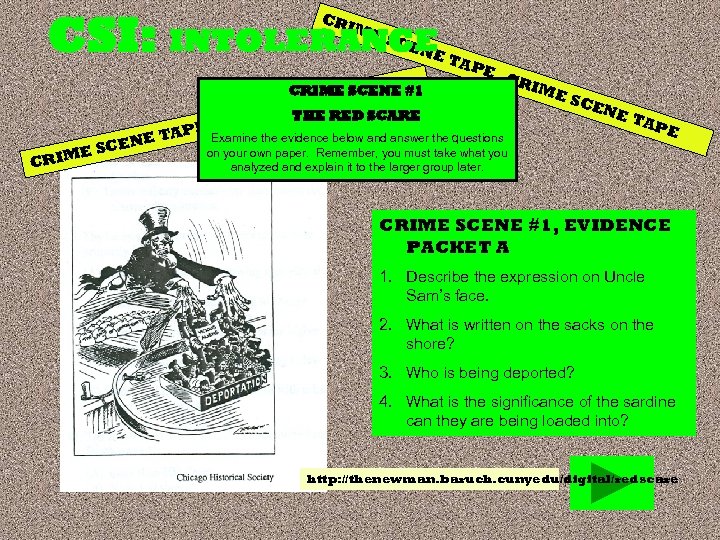 CSI: INTOLERANCE CR IME SCE NE CRIME TAPE #1 SCENE E CEN E STHE RED SCARE M TAP E CR I E CR TAP Examine the evidence below and answer the questions ENE on your own paper. Remember, you must take what you E SC RIM C analyzed and explain it to the larger group later. IME SCE NE TAP E CRIME SCENE #1, EVIDENCE PACKET A 1. Describe the expression on Uncle Sam’s face. 2. What is written on the sacks on the shore? 3. Who is being deported? 4. What is the significance of the sardine can they are being loaded into? http: //thenewman. baruch. cunyedu/digital/redscare
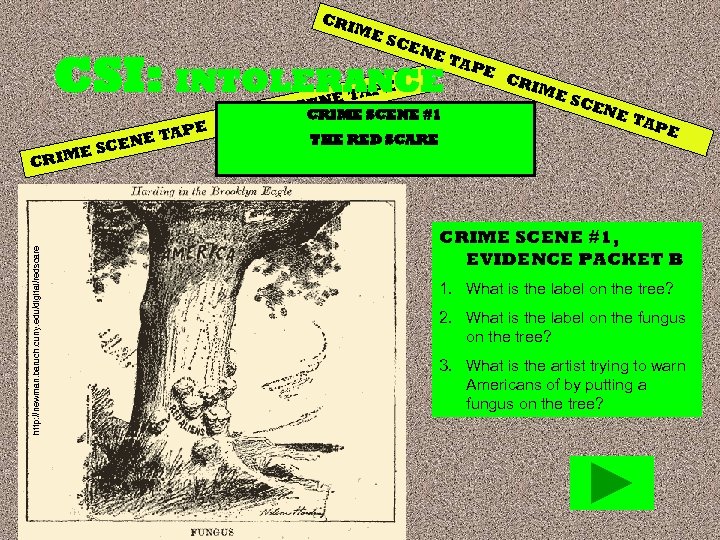 CR IME SCE NE CSI: INTOLERANCE TAPE http: //newman. baruch. cuny. edu/digital/redscare I E CR TAP ENE E SC RIM C ENE E SCCRIME SCENE #1 M THE RED SCARE TAP E CR IME SCE NE TAP E CRIME SCENE #1, EVIDENCE PACKET B 1. What is the label on the tree? 2. What is the label on the fungus on the tree? 3. What is the artist trying to warn Americans of by putting a fungus on the tree?
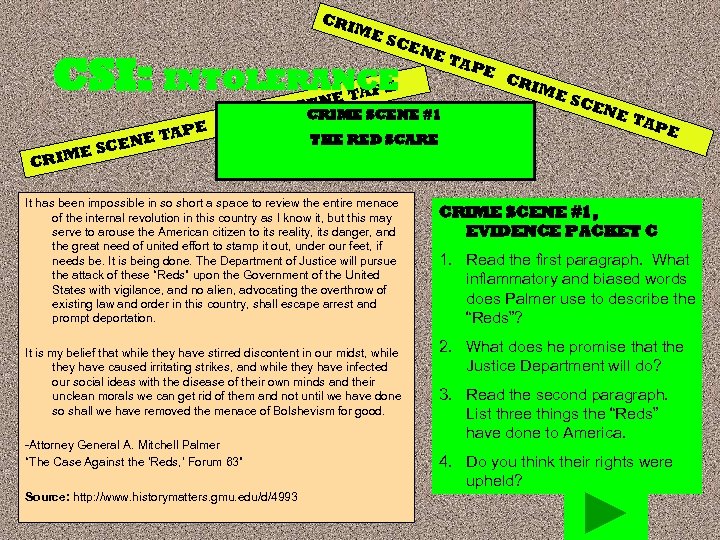 CR IME SCE NE CSI: INTOLERANCE TAPE I E CR TAP ENE E SC RIM C ENE E SCCRIME SCENE #1 M THE RED SCARE It has been impossible in so short a space to review the entire menace of the internal revolution in this country as I know it, but this may serve to arouse the American citizen to its reality, its danger, and the great need of united effort to stamp it out, under our feet, if needs be. It is being done. The Department of Justice will pursue the attack of these “Reds” upon the Government of the United States with vigilance, and no alien, advocating the overthrow of existing law and order in this country, shall escape arrest and prompt deportation. It is my belief that while they have stirred discontent in our midst, while they have caused irritating strikes, and while they have infected our social ideas with the disease of their own minds and their unclean morals we can get rid of them and not until we have done so shall we have removed the menace of Bolshevism for good. -Attorney General A. Mitchell Palmer “The Case Against the ‘Reds, ’ Forum 63” Source: http: //www. historymatters. gmu. edu/d/4993 TAP E CR IME SCE NE TAP E CRIME SCENE #1, EVIDENCE PACKET C 1. Read the first paragraph. What inflammatory and biased words does Palmer use to describe the “Reds”? 2. What does he promise that the Justice Department will do? 3. Read the second paragraph. List three things the “Reds” have done to America. 4. Do you think their rights were upheld?
 CSI: CRIM E SC ENE INTOLERANCE TAP E C RIM E SC ENE TAP E ENE E SC about intolerance in the Twenties by Come and experience an intriguing journey to solve a mystery CRIM entering one of five very different crime scenes. E CRIM After the evidence is gathered at the crime scene, a team of scientists receive and process it at the lab. APE E Tbe to analyze the evidence in your crime scene and then collaborate with the scientists Your job SCEN will who entered a different crime scene to arrive at a conclusion about social tensions and intolerance in the 20’s. CR IM E CRIME SCENE #2 THE KKK MARCHES ON WASHINGTON, DC SC E NE T AP E CRIME SCENE #2 CR IM WAS THE KKK GUILTY OF E INTOLERANCE OR WERE THEY JUST PATRIOTIC AMERICANS? The KKK, a white supremacist organization, is not an “open membership organization. No person is allowed in the Movement who cannot pledge themselves to the SC EN protection, preservation, and ET advancement of the White race. Are A private rights. PEthe KKK, Catholics, for Jews, foreign born, and African. Americans alike ? Is the KKK guilty of intolerance or are they just patriotic. ME I E CR Americans? AP ENE E SC CRIM T APE NE T SCE
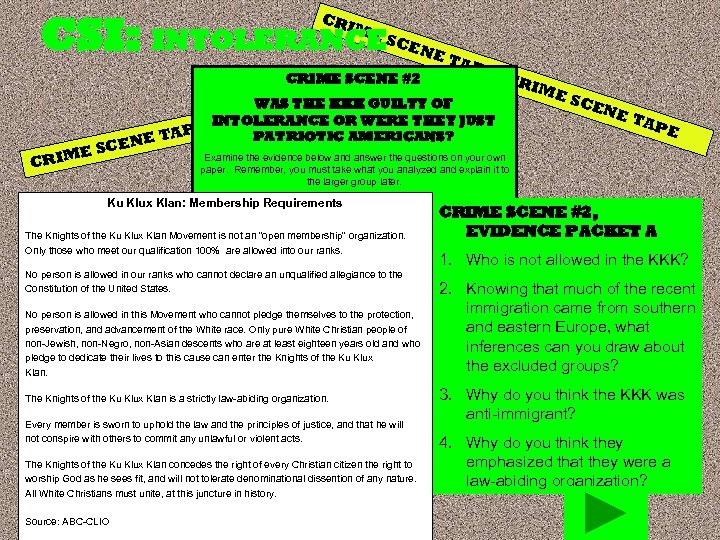 CR IME CSI: INTOLERANCE SCE NE CRIME SCENE #2 TAPE TAP E CR WAS THE KKK GUILTY OF ENE E SC IM INTOLERANCE OR WERE THEY JUST E CR TAP PATRIOTIC AMERICANS? ENE SC E Examine the evidence below and answer the questions on your own CRIM paper. Remember, you must take what you analyzed and explain it to IME SCE NE TAP E the larger group later. Ku Klux Klan: Membership Requirements The Knights of the Ku Klux Klan Movement is not an "open membership" organization. Only those who meet our qualification 100% are allowed into our ranks. No person is allowed in our ranks who cannot declare an unqualified allegiance to the Constitution of the United States. No person is allowed in this Movement who cannot pledge themselves to the protection, preservation, and advancement of the White race. Only pure White Christian people of non-Jewish, non-Negro, non-Asian descents who are at least eighteen years old and who pledge to dedicate their lives to this cause can enter the Knights of the Ku Klux Klan. The Knights of the Ku Klux Klan is a strictly law-abiding organization. Every member is sworn to uphold the law and the principles of justice, and that he will not conspire with others to commit any unlawful or violent acts. The Knights of the Ku Klux Klan concedes the right of every Christian citizen the right to worship God as he sees fit, and will not tolerate denominational dissention of any nature. All White Christians must unite, at this juncture in history. Source: ABC-CLIO CRIME SCENE #2, EVIDENCE PACKET A 1. Who is not allowed in the KKK? 2. Knowing that much of the recent immigration came from southern and eastern Europe, what inferences can you draw about the excluded groups? 3. Why do you think the KKK was anti-immigrant? 4. Why do you think they emphasized that they were a law-abiding organization?
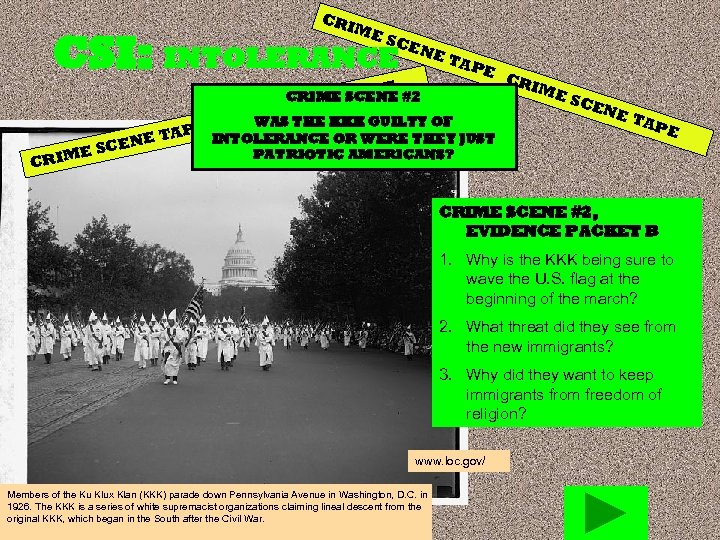 CR IME CSI: INTOLERANCE ENE E SC M CRI TAPE SCE NE TAP E APE CRIME SCENE #2 NE T SCE IME THE KKK GUILTY OF CR WAS INTOLERANCE OR WERE THEY JUST PATRIOTIC AMERICANS? CR IME SCE NE TAP E CRIME SCENE #2, EVIDENCE PACKET B 1. Why is the KKK being sure to wave the U. S. flag at the beginning of the march? 2. What threat did they see from the new immigrants? 3. Why did they want to keep immigrants from freedom of religion? www. loc. gov/ Members of the Ku Klux Klan (KKK) parade down Pennsylvania Avenue in Washington, D. C. in 1926. The KKK is a series of white supremacist organizations claiming lineal descent from the original KKK, which began in the South after the Civil War.
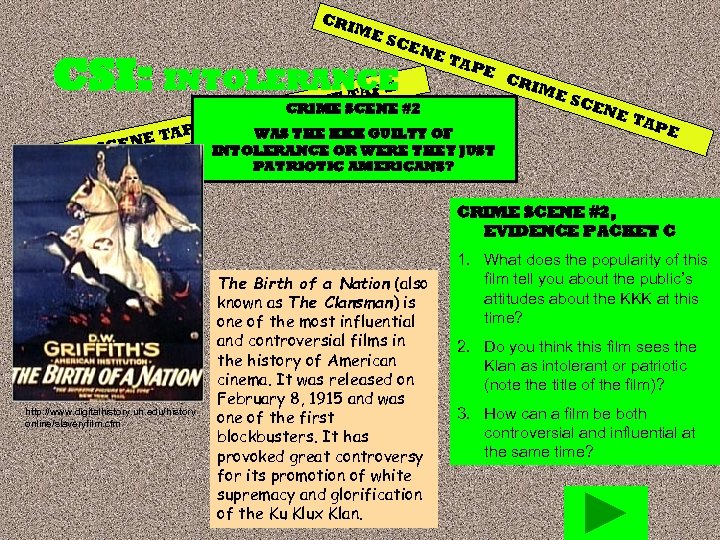 CR IME SCE NE CSI: INTOLERANCE TAPE ENE CRIME SCENE #2 E SC M TAP E I E CR WAS THE KKK GUILTY OF TAP ENE INTOLERANCE OR WERE THEY JUST E SC RIM C PATRIOTIC AMERICANS? CR IME SCE NE TAP E CRIME SCENE #2, EVIDENCE PACKET C http: //www. digitalhistory. uh. edu/history online/slaveryfilm. cfm The Birth of a Nation (also known as The Clansman) is one of the most influential and controversial films in the history of American cinema. It was released on February 8, 1915 and was one of the first blockbusters. It has provoked great controversy for its promotion of white supremacy and glorification of the Ku Klux Klan. 1. What does the popularity of this film tell you about the public’s attitudes about the KKK at this time? 2. Do you think this film sees the Klan as intolerant or patriotic (note the title of the film)? 3. How can a film be both controversial and influential at the same time?
 CSI: CRIM E SC ENE TAP INTOLERANCE E C RIM E SC ENE TAP E ENE E SC about intolerance in the Twenties by Come and experience an intriguing journey to solve a mystery CRIM entering one of five very different crime scenes. E CRIM After the evidence is gathered at the crime scene, a team of scientists receive and process it at the lab. APE E Tbe to analyze the evidence in your crime scene and then collaborate with the scientists Your job SCEN will who entered a different crime scene to arrive at a conclusion about social tensions and intolerance in the 20’s. CRIME SCENE #3 IS THERE AN OPEN DOOR? CR IM E SC E NE T A#3 CRIME SCENE P E WAS THE U. S. INTOLERANT CR IM OF CATHOLIC AND JEWISH ES IMMIGRANTS? CE NE E CRIM Is it the Statue of Liberty or the Quota Act? Is it nativism or Natural Origins Act? Is the American Dream still a reality or is the door slammed shut? Examine these documents and TA determine if the U. S. ideals of PE welcoming immigrants continues of if the doors are shutting due to religious or cultural differences. ENE SC What caused this RIME ideal to change? APE NE T SCE C TAPE
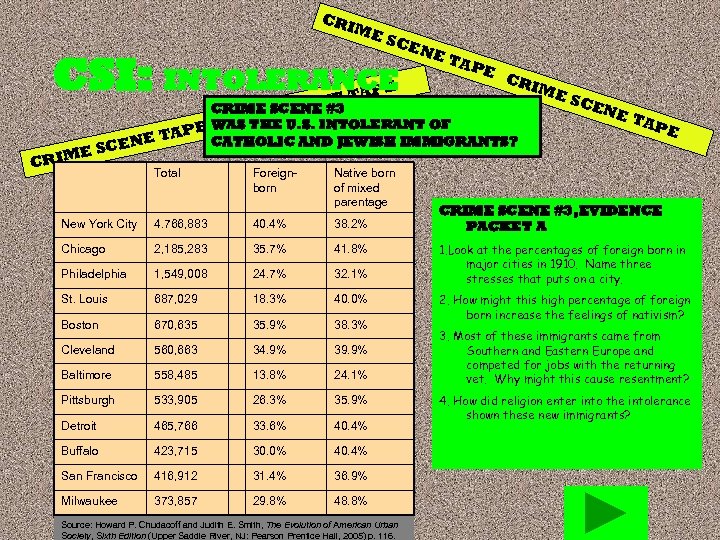 CR IME SCE NE CSI: INTOLERANCE E TAP E CR CRIME E SCENE #3 RIM U. S. INTOLERANT OF C WAS THE TAPE CATHOLIC AND JEWISH IMMIGRANTS? E CEN IME SCE NE TAP E ES CRIM Total Foreignborn Native born of mixed parentage New York City 4. 766, 883 40. 4% 38. 2% Chicago 2, 185, 283 35. 7% 41. 8% Philadelphia 1, 549, 008 24. 7% 32. 1% St. Louis 687, 029 18. 3% 40. 0% Boston 670, 635 35. 9% 38. 3% Cleveland 560, 663 34. 9% 39. 9% Baltimore 558, 485 13. 8% 24. 1% Pittsburgh 533, 905 26. 3% 35. 9% Detroit 465, 766 33. 6% 40. 4% Buffalo 423, 715 30. 0% 40. 4% San Francisco 416, 912 31. 4% 36. 9% Milwaukee 373, 857 29. 8% 48. 8% Source: Howard P. Chudacoff and Judith E. Smith, The Evolution of American Urban Society, Sixth Edition (Upper Saddle River, NJ: Pearson Prentice Hall, 2005) p. 116. CRIME SCENE #3, EVIDENCE PACKET A 1. Look at the percentages of foreign born in major cities in 1910. Name three stresses that puts on a city. 2. How might this high percentage of foreign born increase the feelings of nativism? 3. Most of these immigrants came from Southern and Eastern Europe and competed for jobs with the returning vet. Why might this cause resentment? 4. How did religion enter into the intolerance shown these new immigrants?
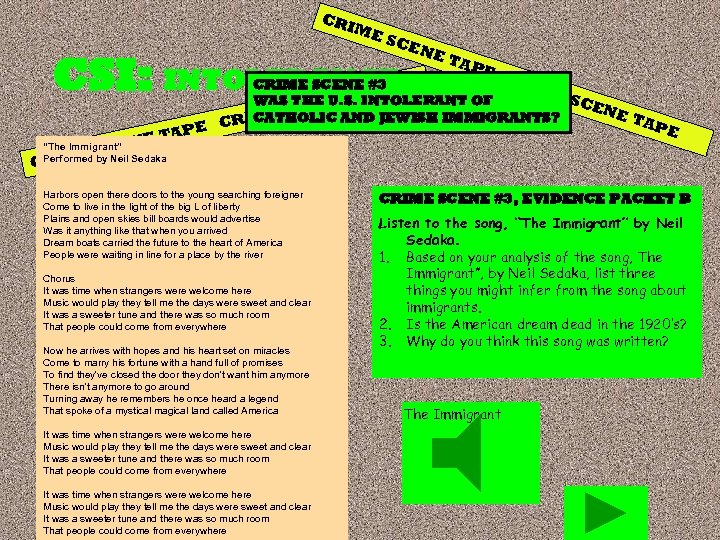 CR IME SCE NE CSI: INTOLERANCE APE NE T TAP E CR CRIME SCENE #3 E IME P TA SCE E WAS THE U. S. INTOLERANT OF SCEN NE E CATHOLIC AND JEWISH IMMIGRANTS? TA RIM C PE SCE “The Immigrant” Performed by Neil Sedaka E CRIM Harbors open there doors to the young searching foreigner Come to live in the light of the big L of liberty Plains and open skies bill boards would advertise Was it anything like that when you arrived Dream boats carried the future to the heart of America People were waiting in line for a place by the river Chorus It was time when strangers were welcome here Music would play they tell me the days were sweet and clear It was a sweeter tune and there was so much room That people could come from everywhere Now he arrives with hopes and his heart set on miracles Come to marry his fortune with a hand full of promises To find they've closed the door they don't want him anymore There isn't anymore to go around Turning away he remembers he once heard a legend That spoke of a mystical magical land called America It was time when strangers were welcome here Music would play they tell me the days were sweet and clear It was a sweeter tune and there was so much room That people could come from everywhere CRIME SCENE #3, EVIDENCE PACKET B Listen to the song, “The Immigrant” by Neil Sedaka. 1. Based on your analysis of the song, The Immigrant”, by Neil Sedaka, list three things you might infer from the song about immigrants. 2. Is the American dream dead in the 1920’s? 3. Why do you think this song was written? The Immigrant
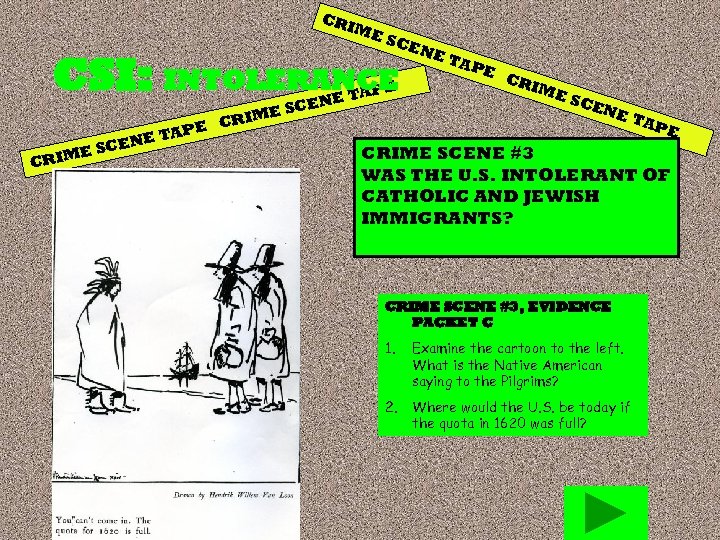 CR IME SCE NE CSI: INTOLERANCE I E CR TAP ENE E SC RIM C ENE E SC M TAPE TAP E CR IME SCE NE TAP E CRIME SCENE #3 WAS THE U. S. INTOLERANT OF CATHOLIC AND JEWISH IMMIGRANTS? CRIME SCENE #3, EVIDENCE PACKET C 1. Examine the cartoon to the left. What is the Native American saying to the Pilgrims? 2. Where would the U. S. be today if the quota in 1620 was full?
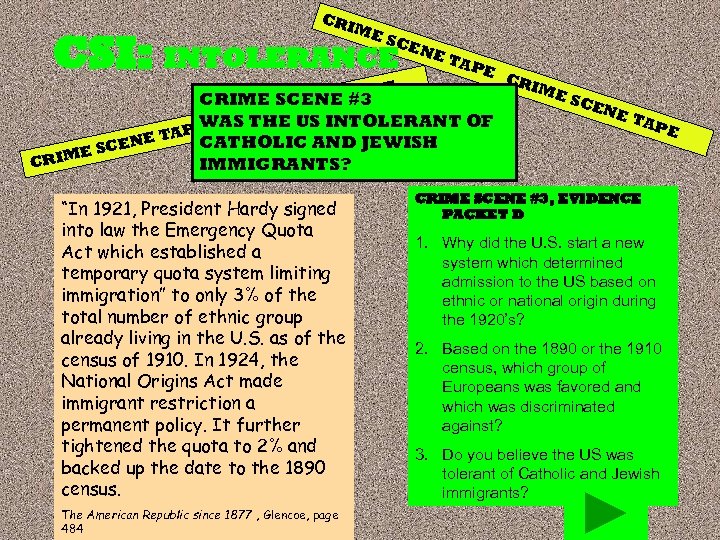 CR IME CSI: INTOLERANCE SCE NE TAP E CRIME SCENE #3 ENE E SC WAS IM E CR THE US INTOLERANT OF TAP CATHOLIC AND JEWISH ENE E SC RIM C IMMIGRANTS? “In 1921, President Hardy signed into law the Emergency Quota Act which established a temporary quota system limiting immigration” to only 3% of the total number of ethnic group already living in the U. S. as of the census of 1910. In 1924, the National Origins Act made immigrant restriction a permanent policy. It further tightened the quota to 2% and backed up the date to the 1890 census. The American Republic since 1877 , Glencoe, page 484 CR IME SCE NE TAP CRIME SCENE #3, EVIDENCE PACKET D 1. Why did the U. S. start a new system which determined admission to the US based on ethnic or national origin during the 1920’s? 2. Based on the 1890 or the 1910 census, which group of Europeans was favored and which was discriminated against? 3. Do you believe the US was tolerant of Catholic and Jewish immigrants? E
 CSI: CRIM E SC ENE TAP INTOLERANCE E C RIM E SC ENE TAP E ENE E SC about intolerance in the Twenties by Come and experience an intriguing journey to solve a mystery CRIM entering one of five very different crime scenes. E CRIM After the evidence is gathered at the crime scene, a team of scientists receive and process it at the lab. APE E Tbe to analyze the evidence in your crime scene and then collaborate with the scientists Your job SCEN will who entered a different crime scene to arrive at a conclusion about social tensions and intolerance in the 20’s. CR IM E SC E CRIME SCENE #4 RACE RIOTS IN CHICAGOAP E BUT ISN’T THAT THE CR NORTH? IM NE T CRIME SCENE #4 RACE RIOTS IN CHICAGO-BUT ISN’T THAT IN THE NORTH? E SC Competition for jobs and housing E returning soldier and the between the NE TA African-Americans who had moved PE North during the war escalated into violence in over 20 northern cities. Chicago was the site of the most violent. Is this racism intolerance? E CRIM I E CR TAP ENE SC APE NE T CE ME S
 CR IME CSI: INTOLERANCE SC IME CR SCE NE TAP E CR IME CRIME SCENE #4 PE TA SCE E NE RACEME SCEN CHICAGO-BUT RIOTS IN TAP RI E C E P ISN’T THAT IN THE NORTH? E TA EN CHICAGO, SUMMER, 1919 CRIME SCENE #4, EVIDENCE PACKET A 1. Why were the African-American bathers from 25 th Street attacked by the whites at 29 th Street? The scene was an all-white beach at 29 th Street, Chicago. Black bathers from the “black patronized” beach on 25 th Street had strolled over and 2. gone in the water to bathe. This “whites’ only” beach became the battleground of racial violence as the 3. groups began throwing rocks and exchanging gunfire. The rioting fueled by false rumors of atrocities extended to other parts of Chicago during the next five days and resulted in the death of 23 blacks, 15 whites and injuries to over 500 A World of Difference, page 259 Why do you think the African. American bathers came over to 29 th Street? Why do you think the rioting expanded to other areas of Chicago over the next few days?
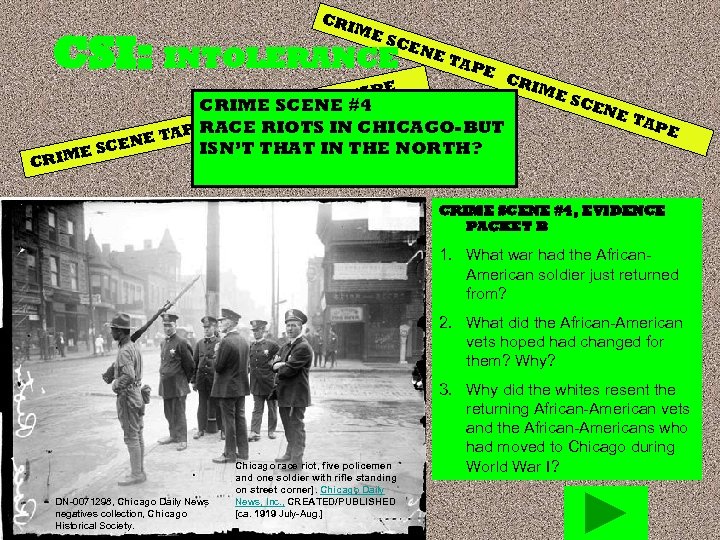 CR IME CSI: INTOLERANCE SCE NE TAP E CRIMEE SCENE #4 SCENE IM CR RACE RIOTS IN CHICAGO-BUT APE ET ISN’T THAT IN THE NORTH? SCEN IME CR IME SCE NE TAP E CR CRIME SCENE #4, EVIDENCE PACKET B 1. What war had the African. American soldier just returned from? 2. What did the African-American vets hoped had changed for them? Why? DN-0071298, Chicago Daily News negatives collection, Chicago Historical Society. Chicago race riot, five policemen and one soldier with rifle standing on street corner]. Chicago Daily News, Inc. , CREATED/PUBLISHED [ca. 1919 July-Aug. ] 3. Why did the whites resent the returning African-American vets and the African-Americans who had moved to Chicago during World War I?
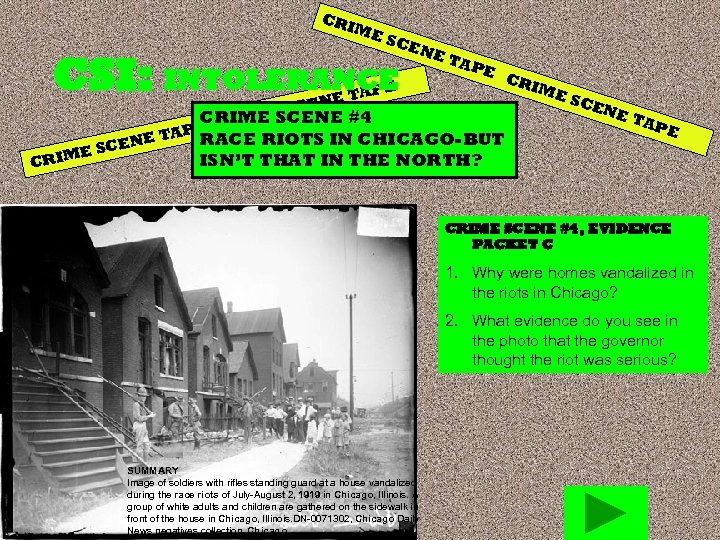 CR IME SCE NE CSI: INTOLERANCE ENE E SC M TAPE TAP E I CRIME SCENE #4 E CR TAP RACE RIOTS IN CHICAGO-BUT ENE E SC RIM ISN’T THAT IN THE NORTH? C CR IME SCE NE TAP E CRIME SCENE #4, EVIDENCE PACKET C 1. Why were homes vandalized in the riots in Chicago? 2. What evidence do you see in the photo that the governor thought the riot was serious? SUMMARY Image of soldiers with rifles standing guard at a house vandalized during the race riots of July-August 2, 1919 in Chicago, Illinois. A group of white adults and children are gathered on the sidewalk in front of the house in Chicago, Illinois. DN-0071302, Chicago Daily News negatives collection, Chicago
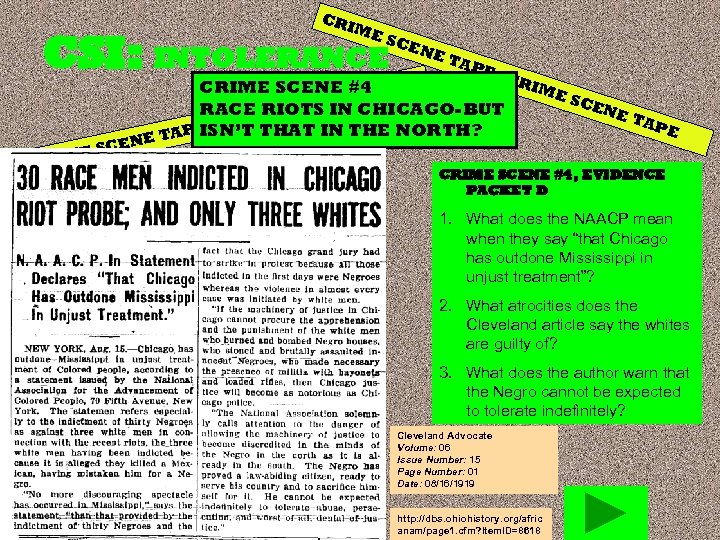 CR IME CSI: INTOLERANCE CR SC IME SCE NE TAP E CR IME CRIME SCENE #4 PE TA SCE E NE RACEME SCEN CHICAGO-BUT RIOTS IN TAP RI E C E P ISN’T THAT IN THE NORTH? E TA EN CRIME SCENE #4, EVIDENCE PACKET D 1. What does the NAACP mean when they say “that Chicago has outdone Mississippi in unjust treatment”? 2. What atrocities does the Cleveland article say the whites are guilty of? 3. What does the author warn that the Negro cannot be expected to tolerate indefinitely? Cleveland Advocate Volume: 06 Issue Number: 15 Page Number: 01 Date: 08/16/1919 http: //dbs. ohiohistory. org/afric anam/page 1. cfm? Item. ID=8618
 CSI: CRIM E SC ENE INTOLERANCE TAP E C RIM E SC ENE TAP E ENE E SC about intolerance in the Twenties by Come and experience an intriguing journey to solve a mystery CRIM entering one of five very different crime scenes. E CRIM After the evidence is gathered at the crime scene, a team of scientists receive and process it at the lab. APE E Tbe to analyze the evidence in your crime scene and then collaborate with the scientists Your job SCEN will who entered a different crime scene to arrive at a conclusion about social tensions and intolerance in the 20’s. CR IM E SC E NE T AP E CR IM E CRIME SCENE #5 DID SACCO AND VANZETTI GET A FAIR TRIAL? FEAR of communists, socialists, anarchists, and other dissidents suddenly SC grabbed the American psyche in 1919 EN ET following a series of anarchist bombings. AP Many feel Sacco and Vanzetti were jailed E for expressing their views, Were civil liberties ignored? Were individual rights ENE upheld? E SC E CRIM IM E CR TAP ENE SC TAPE
 CR IME CSI: SCE NE TAP CRIME SCENE #5 E C RIM INTOLERANCE DID SACCO ANDAPE VANZETTI ES CEN NE T ETRIAL or were GET A FAIR E SC ET M APE CRIvictims of the troubled they APE ET SCEN atmosphere in the US at the E RIM C time? “On April 15, 1920, in South Braintree, Massachusetts, armed robbers murdered two factory employees during a payroll holdup. Police arrested two Italian and immigrants – Nicola Sacco and Bartolomeo Vanzetti – as suspects. Newspapers around the country revealed that the two men were anarchists and that Sacco owned a gun similar to the one used in the crime. After a court found the two men guilty – defense attorneys fought for six years for a new trial. The attorneys believed the trial had shown signs of prejudice, intimidation, and dishonesty. ” The defendants were questioned about their political views not about the evidence against them. They were executed in 1927. - The American Republic since 1877, Glencoe, page 483, 490 -491. CRIME SCENE #5, EVIDENCE PACKET A 1. Why was there prejudice against Italians at this time? 2. Sacco and Vanzetti were known anarchists. Why was there prejudice against anarchists? 3. Many of the people who testified in their behalf were Italian immigrants and did not speak good English. Do you think this affected their credibility?
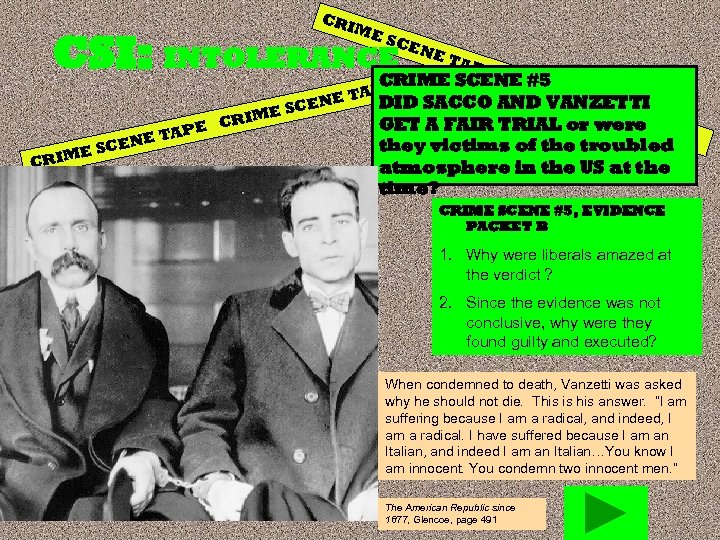 CR IME CSI: INTOLERANCE SCENE #5 CRIME CR SC IME ENE I E CR TAP ENE E SC M SCE NE TAP E CR IME SCE DID SACCO AND VANZETTI NE TA GET A FAIR TRIAL or were PE they victims of the troubled atmosphere in the US at the time? CRIME SCENE #5, EVIDENCE PACKET B 1. Why were liberals amazed at the verdict ? 2. Since the evidence was not conclusive, why were they found guilty and executed? When condemned to death, Vanzetti was asked why he should not die. This is his answer. “I am suffering because I am a radical, and indeed, I am a radical. I have suffered because I am an Italian, and indeed I am an Italian…You know I am innocent. You condemn two innocent men. ” The American Republic since 1877, Glencoe, page 491
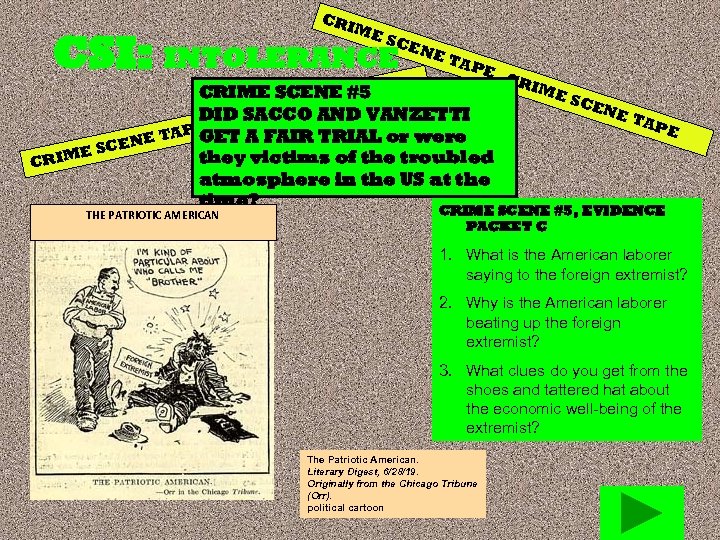 CR IME CSI: INTOLERANCE CRI ENE E SC M SCE NE TAP E CRIME SCENE #5 PE TA ENE E SC DID SACCO AND VANZETTI RIM C TAPE CR IME SCE NE TAP E GET A FAIR TRIAL or were they victims of the troubled atmosphere in the US at the time? CRIME SCENE #5, EVIDENCE THE PATRIOTIC AMERICAN PACKET C 1. What is the American laborer saying to the foreign extremist? 2. Why is the American laborer beating up the foreign extremist? 3. What clues do you get from the shoes and tattered hat about the economic well-being of the extremist? The Patriotic American. Literary Digest, 6/28/19. Originally from the Chicago Tribune (Orr). political cartoon
 Works Cited Appleby, Joyce et al. The American Republic since 1877. Vol. 2, Texas ed. New York City: Glencoe/Mc. Graw Hill, 2003. The Birth of a Nation. Digital image. Digital History. 11 Nov. 2008