


 Скачать презентацию CSI 5388 Topics in Machine Learning Instructor Nathalie
7b5757c524ffb5d237761f2d41ee4571.ppt
- Количество слайдов: 14
 CSI 5388: Topics in Machine Learning Instructor: Nathalie Japkowicz e-mail: nat@site. uottawa. ca Objectives of the Course and Preliminaries Course Webpage (including Syllabus): http: //www. site. uottawa. ca/~nat/Courses/csi 5388_2005. html 1
 Some Information § § § Instructor: Dr. Nathalie Japkowicz Office: STE 5 -029 Phone Number: 562 -5800 x 6693 (don’t rely on it!) E-mail: nat@site. uottawa. caa (best way to contact me!) Office Hours: Monday 11: 45 pm-12: 45 pm and 2: 30 pm-3: 30 pm or by appointment § Extra Seminars: TAMALE Seminars, Thursdays, 1: 30 pm-3: 00 pm (invited talks on Machine Learning and Natural Language Processing) 2
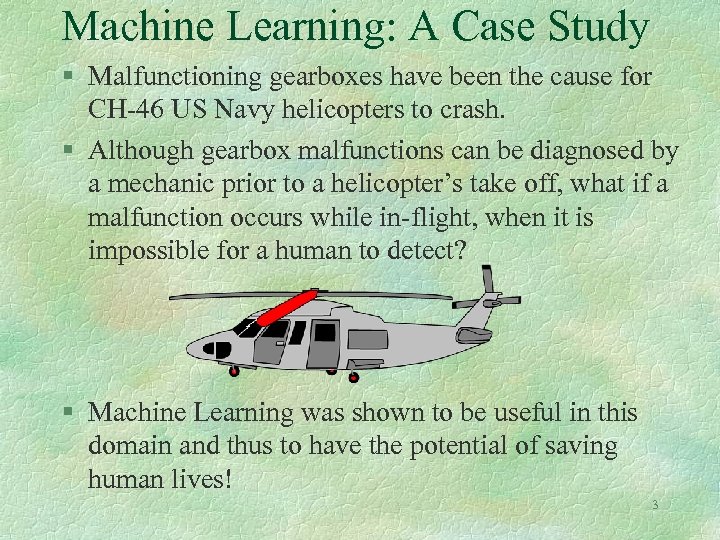 Machine Learning: A Case Study § Malfunctioning gearboxes have been the cause for CH-46 US Navy helicopters to crash. § Although gearbox malfunctions can be diagnosed by a mechanic prior to a helicopter’s take off, what if a malfunction occurs while in-flight, when it is impossible for a human to detect? § Machine Learning was shown to be useful in this domain and thus to have the potential of saving human lives! 3
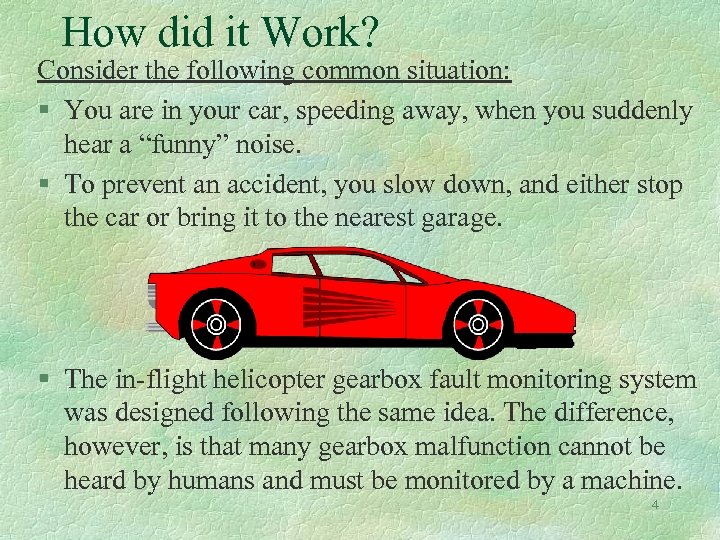 How did it Work? Consider the following common situation: § You are in your car, speeding away, when you suddenly hear a “funny” noise. § To prevent an accident, you slow down, and either stop the car or bring it to the nearest garage. § The in-flight helicopter gearbox fault monitoring system was designed following the same idea. The difference, however, is that many gearbox malfunction cannot be heard by humans and must be monitored by a machine. 4
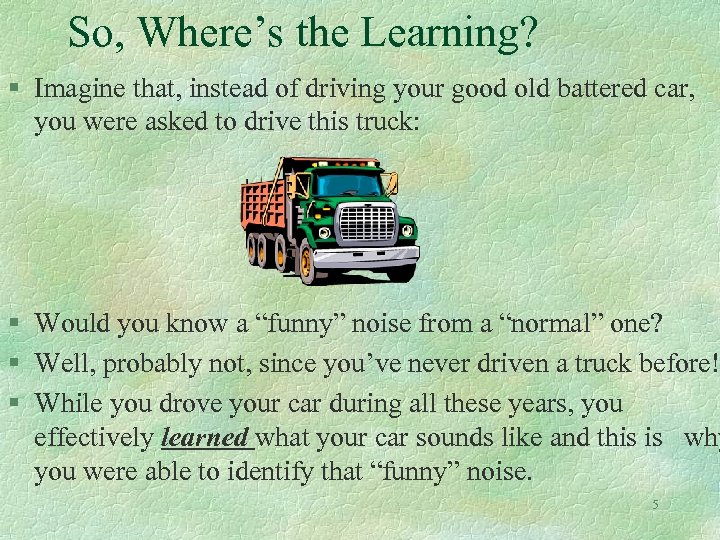 So, Where’s the Learning? § Imagine that, instead of driving your good old battered car, you were asked to drive this truck: § Would you know a “funny” noise from a “normal” one? § Well, probably not, since you’ve never driven a truck before! § While you drove your car during all these years, you effectively learned what your car sounds like and this is why you were able to identify that “funny” noise. 5
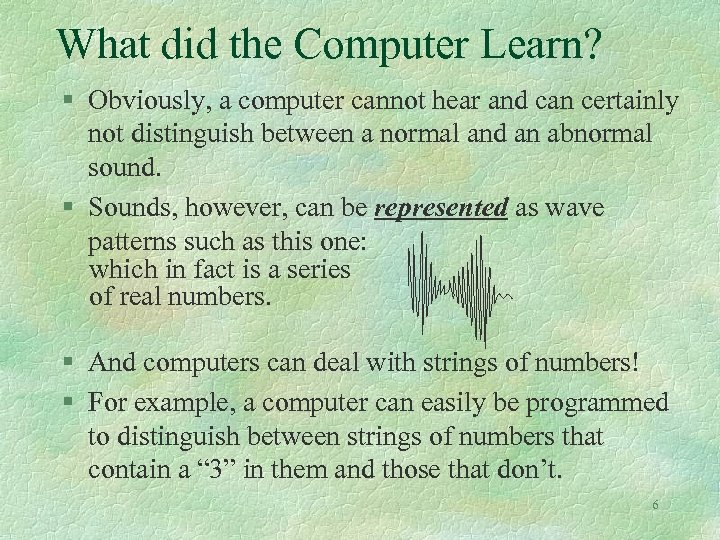 What did the Computer Learn? § Obviously, a computer cannot hear and can certainly not distinguish between a normal and an abnormal sound. § Sounds, however, can be represented as wave patterns such as this one: which in fact is a series of real numbers. § And computers can deal with strings of numbers! § For example, a computer can easily be programmed to distinguish between strings of numbers that contain a “ 3” in them and those that don’t. 6
 What did the Computer Learn? (Cont’d) § In the helicopter gearbox monitoring problem, the assumption is that functioning and malfunctioning gearboxes emit different noises. Thus, the strings of numbers that represent these noises have different characteristics. § The exact characteristics of these different categories, however, are unknown and/or are too difficult to describe. § Therefore, they cannot be programmed, but rather, they need to be learned by the computer. § There are many ways in which a computer can learn how to distinguish between two patterns (e. g. , decision trees, neural networks, bayesian networks, etc. ) and that is the 7 topic of this course!
 What else can Machine Learning do? § § Medical Diagnostic (e. g. , breast cancer detection) Credit Card Fraud Detection Sonar Detection (e. g. , submarines versus shrimps (!) ) Speech Recognition (e. g. , Telephone automated systems) § Autonomous Vehicles (e. g. , a vehicle drove unassisted at 70 mph for 90 miles on a public highway. Useful for hazardous missions) § Personalized Web Assistants (e. g. , an automated assistant can assemble personally customized newspapers) 8 § etc…. . .
 Useful Reading Material Good References § Machine Learning, Tom Mitchell, Mc. Graw Hill, 1997. § Introduction to Machine Learning, Nils J. Nilsson (available (free) from the Web) § Research papers (available from the Library, the Web or will be distributed in class). Research Papers § See the papers listed on the Web site 9
 Objectives of the Courses: § To introduce advanced topics in Machine Learning, including classifier evaluation, genetic algorithms, unsupervised learning, feature selection, single-class learning and learning from class imbalances. § To introduce the students to the careful reading, presenting and critiquing of individual research papers. § To introduce the students to background research in a subfield of Machine Learning: finding appropriate sources (some giving broad overviews, others describing the most important approaches in the subfield), organizing the knowledge logically, presenting the knowledge to the class. § To initiate the students to formulate a research problem and carrying this research through. 10
 Format of the Course: § Each week will be devoted to a different topic in the field. § The first part of the lecture will be a presentation (by the lecturer or invited guests) of the basics concepts pertaining to the weekly topic. § The second part of the lecture will be a set of presentations by 1 or 2 students on: l recent research papers written on that topic. l a specialized sub-area of that topic § The last week of the term will be devoted to project presentations. 11
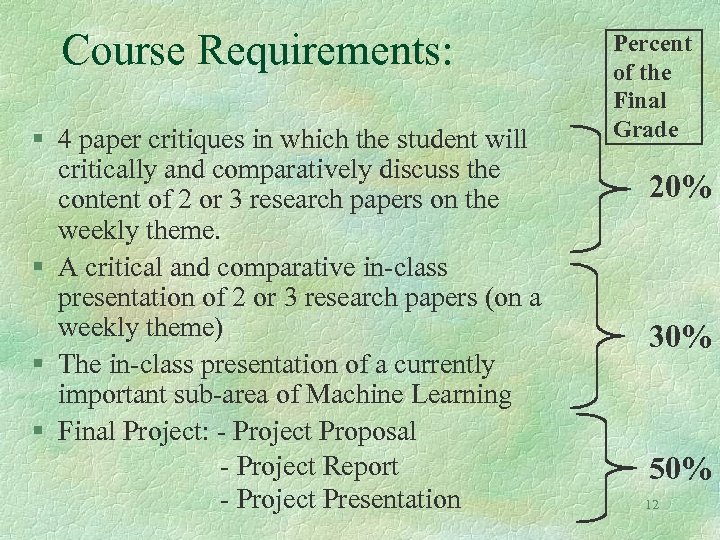 Course Requirements: § 4 paper critiques in which the student will critically and comparatively discuss the content of 2 or 3 research papers on the weekly theme. § A critical and comparative in-class presentation of 2 or 3 research papers (on a weekly theme) § The in-class presentation of a currently important sub-area of Machine Learning § Final Project: - Project Proposal - Project Report - Project Presentation Percent of the Final Grade 20% 30% 50% 12
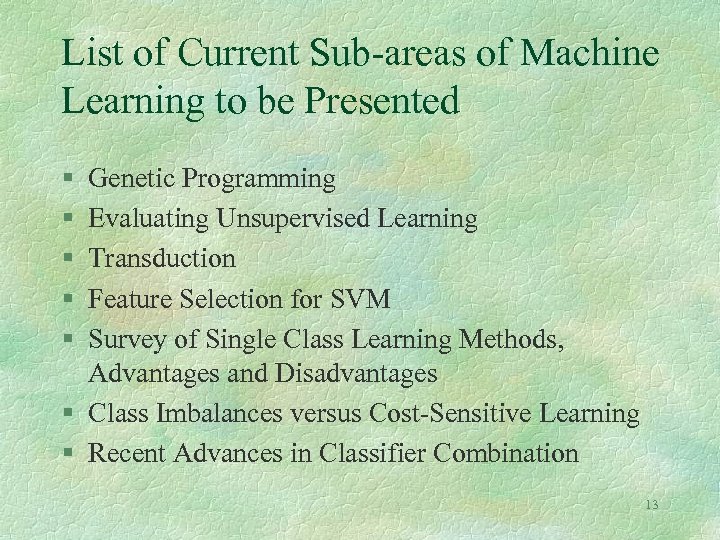 List of Current Sub-areas of Machine Learning to be Presented § § § Genetic Programming Evaluating Unsupervised Learning Transduction Feature Selection for SVM Survey of Single Class Learning Methods, Advantages and Disadvantages § Class Imbalances versus Cost-Sensitive Learning § Recent Advances in Classifier Combination 13
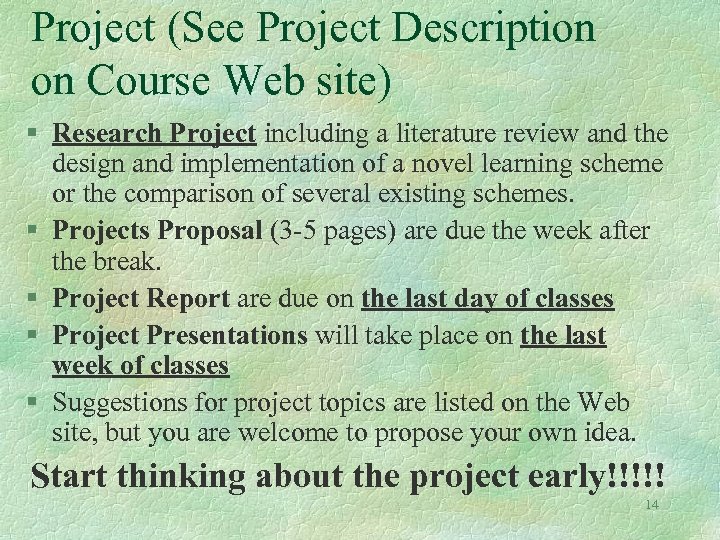 Project (See Project Description on Course Web site) § Research Project including a literature review and the design and implementation of a novel learning scheme or the comparison of several existing schemes. § Projects Proposal (3 -5 pages) are due the week after the break. § Project Report are due on the last day of classes § Project Presentations will take place on the last week of classes § Suggestions for project topics are listed on the Web site, but you are welcome to propose your own idea. Start thinking about the project early!!!!! 14