


 Скачать презентацию CSE P 503 Principles of Software Engineering David
91b482cf5f0f38e6d9eb7460cccb35f7.ppt
- Количество слайдов: 119
 CSE P 503: Principles of Software Engineering David Notkin Autumn 2007 3/19/2018 Evolution There is in the worst of fortune the best of chances for a happy change. --Euripides He who cannot dance will say, “The drum is bad --Ashanti proverb The ruling power within, when it is in its natural state, is so related to outer circumstances that it easily changes to accord with what can be done and what is given it to do --Marcus Aurelius 1
 Software evolution • Software changes – Software maintenance – Software evolution – Incremental development • The objective is to use an existing code base as an asset – Cheaper and better to get there from here, rather than starting from scratch – Anyway, where would you aim for with a new system? 3/19/2018 2
 A legacy • Merriam-Webster on-line dictionary – “a gift by will especially of money or other personal property” – “something transmitted by or received from an ancestor or predecessor or from the past” • The usual joke is that in anything but software, you’d love to receive a legacy – Maybe we feel the same way about inheritance, too, especially multiple inheritance 3/19/2018 3
 Why does it change? • Software changes does not change primarily because it doesn’t work right – Maintenance in software is different than maintenance for automobiles • But rather because the technological, economic, and societal environment in which it is embedded changes • This provides a feedback loop to the software – The software is usually the most malleable link in the chain, hence it tends to change • Counterexample: Space shuttle astronauts have thousands of extra responsibilities because it’s safer than changing code 3/19/2018 4
 Kinds of change • Corrective maintenance – Fixing bugs in released code • Adaptive maintenance – Porting to new hardware or software platform • Perfective maintenance – Providing new functions • Oft-cited data from Lientz and Swanson (1980, focused on IT systems – about 17%, 18%, 65% (respectively) • Modern data? There is some … not too different 3/19/2018 5
 High cost, long time • Gold’s 1973 study showed the fraction of programming effort spent in maintenance • For example, 22% of the organizations spent 30% of their effort in maintenance 3/19/2018 6
 Total life cycle cost • Lientz and Swanson determined that at least 50% of the total life cycle cost is in maintenance • There are several other studies that are reasonably consistent • General belief is that maintenance accounts for somewhere between 50 -75% of total life cycle costs 3/19/2018 7
 Open question • How much maintenance cost is “reasonable? ” – Corrective maintenance costs are ostensibly not “reasonable” (OK, this is easy) – How much adaptive maintenance cost is “reasonable”? – How much perfective maintenance cost is “reasonable”? • Measuring “reasonable” costs in terms of percentage of life cycle costs doesn’t make sense 3/19/2018 8
 High-level answer • For perfective maintenance, the objective should be for the cost of the change in the implementation to be proportional to the cost of the change in the specification (design) – Ex: Allowing dates for the year 2000 is (at most) a small specification change – Ex: Adding call forwarding is a more complicated specification change – Ex: Converting a compiler into an ATM machine is … 3/19/2018 9
 (Common) Observations • Maintainers often get less respect than developers • Maintenance is generally assigned to the least experienced programmers • Software structure degrades over time • Documentation is often poor and is often inconsistent with the code • Is there any relationship between these? 3/19/2018 10
 Laws of Program Evolution Lehman & Belady • Law of continuing change • “A large program that is used undergoes continuing change or becomes progressively less useful. ” – Analogies to biological evolution have been made; the rate of change in software is far faster 3/19/2018 • P-type programs – Well-defined, precisely specified – The challenge is efficient implementation – Ex: sort • E-type programs – Ill-defined, fit into an everchanging environment – The challenge is managing change • Also, S-type programs – Ex: chess 11
 Law of increasing complexity • “As a large program is continuously changed, its complexity, which reflects deteriorating structure, increases unless work is done to maintain or reduce it. ” – Complexity, in part, is relative to a programmer’s knowledge of a system • Novices vs. experts doing maintenance – Cleaning up structure is done relatively infrequently • Even with the recent interest in refactoring, this seems true. Why? 3/19/2018 12
 Reprise • The claim is that if you measure any reasonable metric of the system – Modules modified, modules created, modules handled, subsystems modified, … • and then plot those against time (or releases) • Then you get highly similar curves regardless of the actual software system • A zillion graphs on http: //www. doc. ic. ac. uk/~mml/feast 1/ 3/19/2018 13
![Statistically regular growth • “Measures of [growth] are cyclically self-regulating with statistically determinable trends](https://present5.com/presentation/91b482cf5f0f38e6d9eb7460cccb35f7/image-14.jpg "Statistically regular growth • “Measures of [growth] are cyclically self-regulating with statistically determinable trends") Statistically regular growth • “Measures of [growth] are cyclically self-regulating with statistically determinable trends and invariances. ” – (You can run but you can’t hide) • There’s a feedback loop – Based on data from OS/360 and some other systems – Ex: Content in releases decreases, or time between releases increases • Is this related to Brooks’ observation that adding people to a late project makes it later? 3/19/2018 14
Statistically regular growth • “Measures of [growth] are cyclically self-regulating with statistically determinable trends and invariances. ” – (You can run but you can’t hide) • There’s a feedback loop – Based on data from OS/360 and some other systems – Ex: Content in releases decreases, or time between releases increases • Is this related to Brooks’ observation that adding people to a late project makes it later? 3/19/2018 14
 And two others • “The global activity rate in a large programming project is invariant. ” • “For reliable, planned evolution, a large program undergoing change must be made available for regular user execution at maximum intervals determined by its net growth. ” – This is related to “daily builds” 3/19/2018 15
 Open question • Are these “laws” of Belady and Lehman actually inviolable laws? • Could they be overcome with tools, education, discipline, etc. ? • Could their constants be fundamentally improved to give significant improvements in productivity? – Greenspan and others have claimed that IT has fundamentally changed the productivity of the economy: “The synergistic effect of new technology is an important factor underlying improvements in productivity. ” 3/19/2018 16
 Approaches to reducing cost • Design for change (proactive) – Information hiding, layering, open implementation, aspect-oriented programming, etc. • Tools to support change (reactive) – grep, etc. – Reverse engineering, program 3/19/2018 17
 Approaches to reducing cost • Improved documentation (proactive) – Discipline, stylized approaches – Parnas is pushing this very hard, using a tabular form of specifications – Literate programming • Reducing bugs (proactive) – Many techniques, some covered later in the quarter • Increasing correctness of specifications (proactive) • Others? 3/19/2018 18
 Program understanding & comprehension • Definition: The task of building mental models of the underlying software at various abstraction levels, ranging from models of the code itself to ones of the underlying application domain, for maintenance, evolution, and re-engineering purposes [H. Müller] 3/19/2018 19
 What do you do? 3/19/2018 20
 Various strategies • Top-down – Try to map from the application domain to the code • Bottom-up – Try to map from the code to the application domain • Opportunistic: mix of top-down and bottom-up • I’m not a fan of these distinctions, since it has to be opportunistic in practice – Perhaps with a really rare exception 3/19/2018 21
 Did you try to understand? • “The ultimate goal of research in program understanding is to improve the process of comprehending programs, whether by improving documentation, designing better programming languages, or building automated support tools. ” —Clayton, Rugaber, Wills • To me, this definition (and many, many similar ones) miss a key point: What is the programmer’s task? • Furthermore, most good programmers seem to be good at knowing what they need to know and what they don’t need to know 3/19/2018 22
 A scenario • I’m about to walk through a simple scenario or two • The goal isn’t to show you “how” to evolve software • Rather, the goal is to try to increase some of the ways in which you think during software evolution 3/19/2018 23
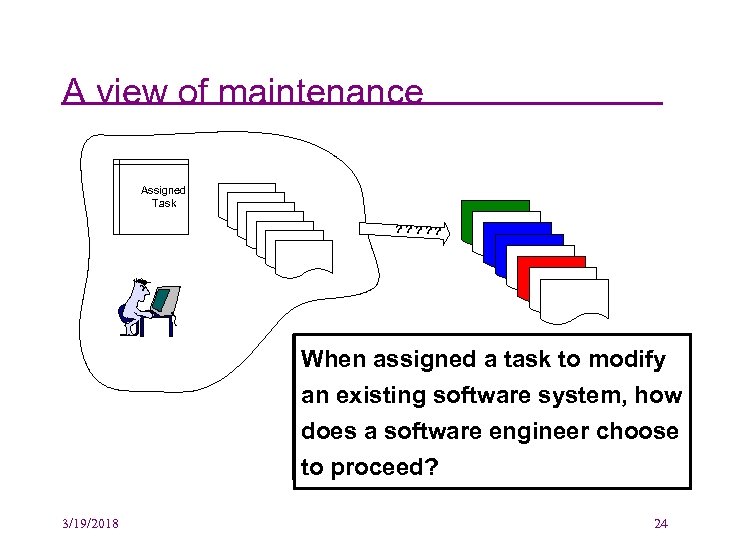 A view of maintenance Assigned Task Document Document ? ? ? Document Document When assigneda task to modify assigned a task to modify an existing software system, how does a software engineer choose to proceed? 3/19/2018 24
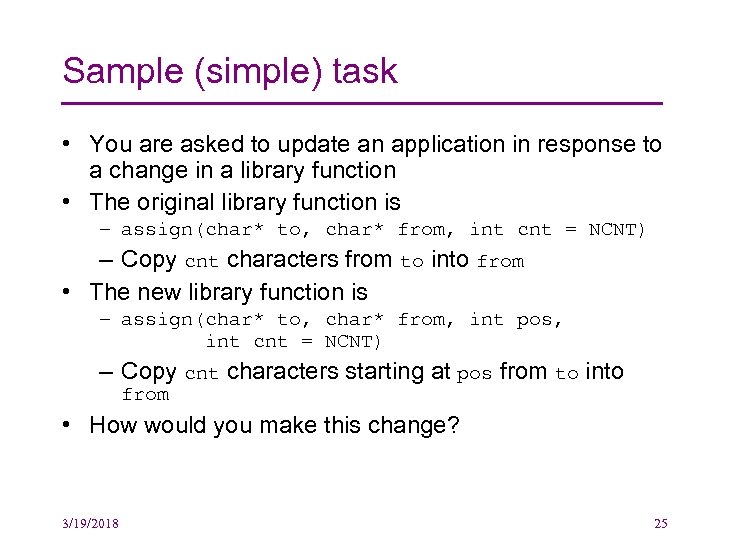 Sample (simple) task • You are asked to update an application in response to a change in a library function • The original library function is – assign(char* to, char* from, int cnt = NCNT) – Copy cnt characters from to into from • The new library function is – assign(char* to, char* from, int pos, int cnt = NCNT) – Copy cnt characters starting at pos from to into from • How would you make this change? 3/19/2018 25
 Recap: example • What information did you need? • What information was available? • What tools produced the information? – Did you think about other pertinent tools? • How accurate was the information? – Any false information? Any missing true information? • How did you view and use the information? • Can you imagine other useful tools? 3/19/2018 26
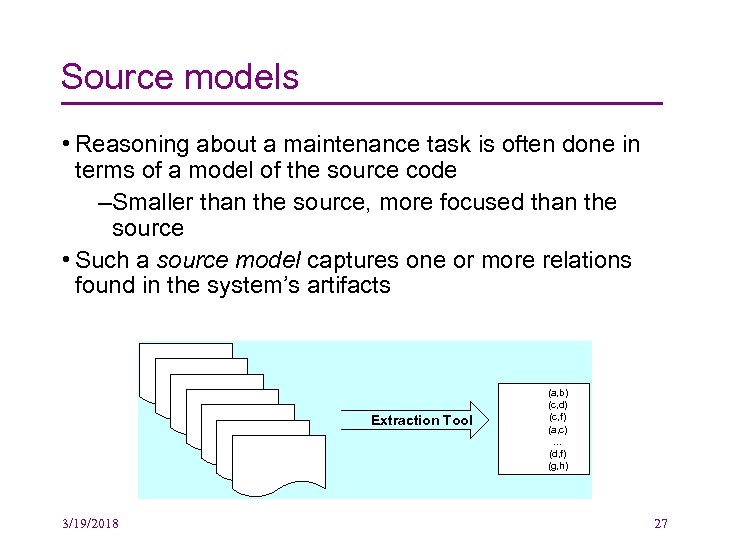 Source models • Reasoning about a maintenance task is often done in terms of a model of the source code –Smaller than the source, more focused than the source • Such a source model captures one or more relations found in the system’s artifacts Document Document 3/19/2018 Extraction Tool (a, b) (c, d) (c, f) (a, c). . . (d, f) (g, h) 27
 Example source models • A calls graph – Which functions call which other functions? • An inheritance hierarchy – Which classes inherit from which other classes? • A global variable cross-reference – Which functions reference which globals? • A lexical-match model – Which source lines contain a given string? • A def-use model – Which variable definitions are used at which use sites? 3/19/2018 28
 Combining source models • Source models may be produced by combining other source models using simple relational operations; for example, – Extract a source model indicating which functions reference which global variables – Extract a source model indicating which functions appear in which modules – Join these two source models to produce a source model of modules referencing globals 3/19/2018 29
 Extracting source models • Source models are extracted using tools • Any source model can be extracted in multiple ways – That is, more than one tool can produce a given kind of source model • The tools are sometimes off-the-shelf, sometimes hand-crafted, sometimes customized 3/19/2018 30
 Program databases • There are many projects in which a program database is built, representing source models of a program • They vary in many significant ways – The data model used (relational, object-oriented) – The granularity of information • Per procedure, per statement, etc. – Support for creating new source models • Operations on the database, entirely new ones – Programming languages supported 3/19/2018 31
 Three old examples • CIA/CIA++, ATT Research (Chen et al. ) – Relational, C/C++ – http: //www. research. att. com/sw/tools/reuse/ – CIAO, a web-based front-end for program database access • Desert, Brown University (Reiss) – Uses Fragment integration • Preserves original files, with references into them – http: //www. cs. brown. edu/software/desert/ – Uses Frame. Maker as the editing/viewing engine • Rigi (support for reverse engineering) – http: //www. rigi. csc. uvic. ca/rigiframe 1. shtml 3/19/2018 32
 What tools do you use now? • What do they provide? • What don’t they provide? 3/19/2018 33
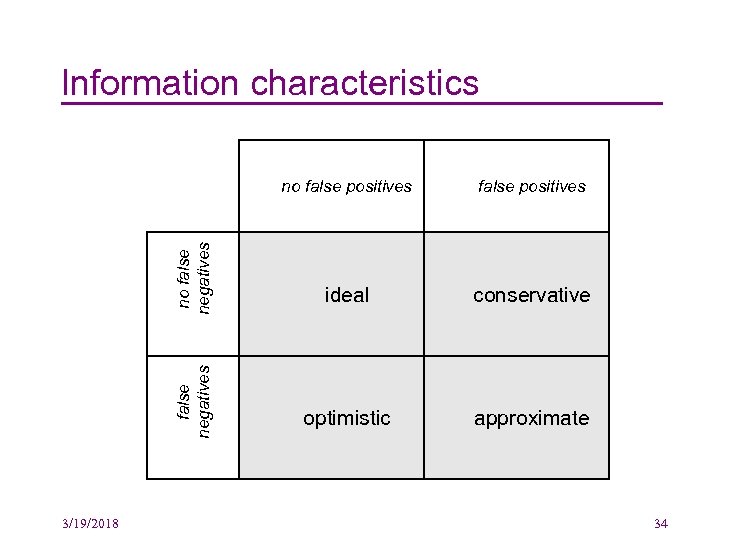 Information characteristics false negatives no false positives 3/19/2018 false positives ideal conservative optimistic approximate 34
 Ideal source models • It would be best if every source model extracted was perfect: all entries are true and no true entries are omitted • For some source models, this is possible – Inheritance, defined functions, #include structure, • For some source models, achieving the ideal may be difficult in practice – Ex: computational time is prohibitive in practice • For many other interesting source models, this is not possible – Ideal call graphs, for example, are uncomputable 3/19/2018 35
 Conservative source models • These include all true information and maybe some false information, too • Frequently used in compiler optimization, parallelization, in programming language type inference, etc. – Ex: never misidentify a call that can be made or else a compiler may translate improperly – Ex: never misidentify an expression in a statically typed programming language 3/19/2018 36
 Optimistic source models • These include only truth but may omit some true information • Often come from dynamic extraction • Ex: In white-box code coverage in testing – Indicating which statements have been executed by the selected test cases – Others statements may be executable with other test cases 3/19/2018 37
 Approximate source models • May include some false information and may omit some true information • These source models can be useful for maintenance tasks – Especially useful when a human engineer is using the source model, since humans deal well with approximation – It’s “just like the web!” • Turns out many tools produce approximate source models (more on this later) 3/19/2018 38
 Static vs. dynamic • Source model extractors can work – statically, directly on the system’s artifacts, or – dynamically, on the execution of the system, or – a combination of both • Ex: – A call graph can be extracted statically by analyzing the system’s source code or can be extracted dynamically by profiling the system’s execution 3/19/2018 39
 Must iterate • Usually, the engineer must iterate to get a source model that is “good enough” for the assigned task • Often done by inspecting extracted source models and refining extraction tools • May add and combine source models, too 3/19/2018 40
 Another maintenance task • Given a software system, rename a given variable throughout the system – Ex: angle should become diffraction – Probably in preparation for a larger task • Semantics must be preserved • This is a task that is done infrequently – Without it, the software structure degrades more and more 3/19/2018 41
 What source model? • Our preferred source model for the task would be a list of lines (probably organized by file) that reference the variable angle • A static extraction tool makes the most sense – Dynamic references aren’t especially pertinent for this task 3/19/2018 42
 Start by searching • Let’s start with grep, the most likely tool for extracting the desired source model • The most obvious thing to do is to search for the old identifier in all of the system’s files – grep angle * 3/19/2018 43
 What files to search? • It’s hard to determine which files to search – Multiple and recursive directory structures – Many types of files • Object code? Documentation? (ASCII vs. non. ASCII? ) Files generated by other programs (such as yacc)? Makefiles? – Conditional compilation? Other problems? • Care must be taken to avoid false negatives arising from files that are missing 3/19/2018 44
![False positives • grep angle [system’s files] • There are likely to be a](https://present5.com/presentation/91b482cf5f0f38e6d9eb7460cccb35f7/image-45.jpg "False positives • grep angle [system’s files] • There are likely to be a") False positives • grep angle [system’s files] • There are likely to be a number of spurious matches – …triangle…, …quadrangle… – /* I could strangle this programmer! */ – /* Supports the small planetary rovers presented by Angle & Brooks (IROS ‘ 90) */ – printf(“Now play the Star Spangled Banner”); • Be careful about using agrep! 3/19/2018 45
False positives • grep angle [system’s files] • There are likely to be a number of spurious matches – …triangle…, …quadrangle… – /* I could strangle this programmer! */ – /* Supports the small planetary rovers presented by Angle & Brooks (IROS ‘ 90) */ – printf(“Now play the Star Spangled Banner”); • Be careful about using agrep! 3/19/2018 45
 More false negatives • Some languages allow identifiers to be split across line boundaries – Cobol, Fortran, PL/I, etc. – This leads to potential false negatives • Preprocessing can hurt, too – #define deflection angle. . . deflection = sin(theta); 3/19/2018 46
 It’s not just syntax • It is also important to check, before applying the change, that the new variable name (degree) is not in conflict anywhere in the program – The problems in searching apply here, too – Nested scopes introduce additional complications 3/19/2018 47
 Tools vs. task • In this case, grep is a lexical tool but the renaming task is a semantic one – Mismatch with syntactic tools, too • Mismatches are common and not at all unreasonable – But it does introduce added obligations on the maintenance engineer – Must be especially careful in extracting and then using the approximate source model 3/19/2018 48
 Finding vs. updating • Even after you have extracted a source model that identifies all of (or most of) the lines that need to be changed, you have to change them • Global replacement of strings is at best dangerous • Manually walking through each site is time-consuming, tedious, and error-prone 3/19/2018 49
 Downstream consequences • After extracting a good source model by iterating, the engineer can apply the renaming to the identified lines of code • However, since the source model is approximate, regression testing (and/or other testing regimens) should be applied 3/19/2018 50
 An alternative approach • Griswold developed a meaning-preserving program restructuring tool that can help • For a limited set of transformations, the engineer applies a local change and the tool applies global compensating changes that maintain the program’s meaning – Or else the change is not applied – Reduces errors and tedium when successful 3/19/2018 51
 But • The tool requires significant infrastructure – Abstract syntax trees, control flow graphs, program dependence graphs, etc. • The technology OK for small programs – Downstream testing isn’t needed – No searching is needed • But it does not scale directly in terms of either computation size or space 3/19/2018 52
 Recap • “There is more than one way to skin a cat” – Even when it’s a tiger • The engineer must decide on a source model needed to support a selected approach • The engineer must be aware of the kind of source model extracted by the tools at hand • The engineer must iterate the source model as needed for the given task • Even if this is not conscious nor explicit 3/19/2018 53
 Build up idioms • Handling each task independently is hard • You can build up some more common idiomatic approaches – Some tasks, perhaps renaming, are often part of larger tasks and may apply frequently – Also internalize source models, tools, etc. and what they are (and are not) good at • But don’t constrain yourself to only what your usual tools are good for 3/19/2018 54
 Source model accuracy • This is important for programmers to understand • Little focus is given to the issue 3/19/2018 55
 Call graph extraction tools (C) • Two basic categories: lexical or syntactic – lexical • e. g. , awk, mkfunctmap, lexical source model extraction (LSME) • likely produce an approximate source model • extract calls across configurations • can extract even if we can’t compile • typically fast 3/19/2018 56
 A CGE experiment • To investigate several call graph extractors for C, we ran a simple experiment – For several applications, extract call graphs using several extractors – Applications: mapmaker, mosaic, gcc – Extractors: CIA, rigiparse, Field, cflow, mkfunctmap 3/19/2018 57
 Experimental results • Quantitative – pairwise comparisons between the extracted call graphs • Qualitative – sampling of discrepancies • Analysis – what can we learn about call graph extractors (especially, the design space)? 3/19/2018 58
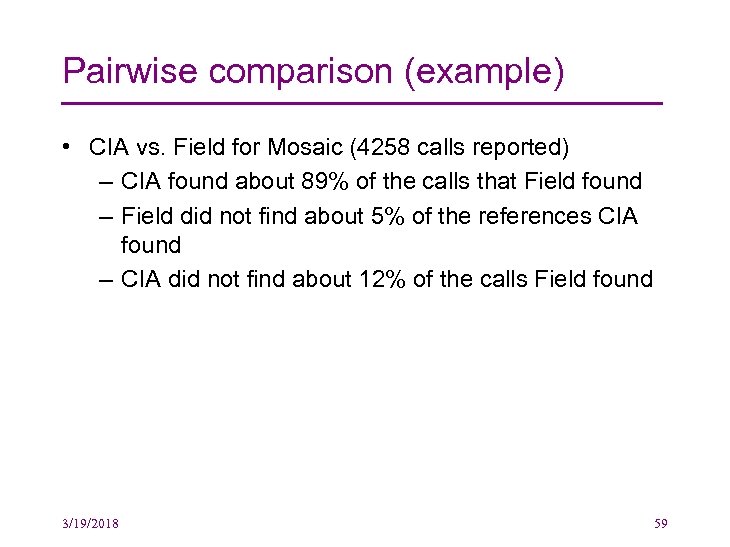 Pairwise comparison (example) • CIA vs. Field for Mosaic (4258 calls reported) – CIA found about 89% of the calls that Field found – Field did not find about 5% of the references CIA found – CIA did not find about 12% of the calls Field found 3/19/2018 59
 Quantitative Results • No two tools extracted the same calls for any of the three programs • In several cases, tools extracted large sets of nonoverlapping calls • For each program, the extractor that found the most calls varied (but remember, more isn’t necessarily better) • Can’t determine the relationship to the ideal 3/19/2018 60
 Qualitative results • Sampled elements to identify false positives and false negatives • Mapped the tuples back to the source code and performed manual analysis by inspection • Every extractor produced some false positives and some false negatives 3/19/2018 61
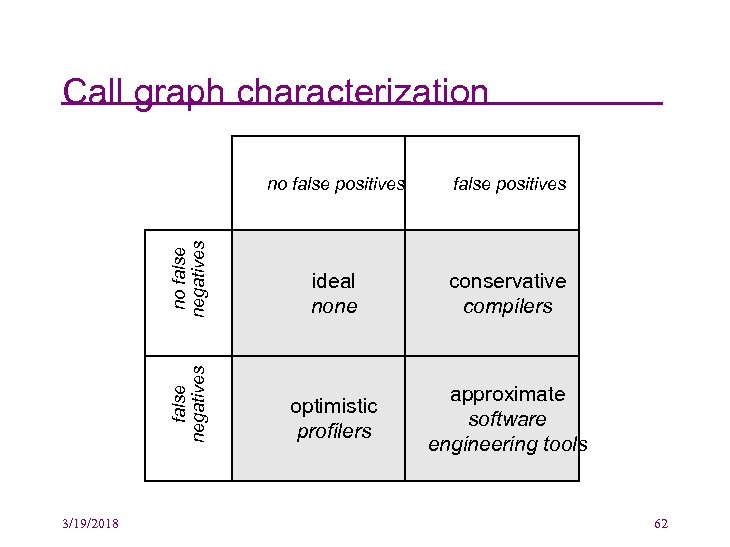 no false positives no false negatives 3/19/2018 false positives ideal none conservative compilers false negatives Call graph characterization optimistic profilers approximate software engineering tools 62
 In other words, caveat emptor 3/19/2018 63
 Taxonomy: reverse/reengineering Chikofsky and Cross • Design recovery is a subset of reverse engineering • The objective of design recovery is to discover designs latent in the software – These may not be the original designs, even if there were any explicit ones – They are generally recovered independent of the task faced by the developer • It’s a way harder problem than design itself 3/19/2018 64
 Restructuring • One taxonomy activity is restructuring • Why don’t people restructure as much as we’d like…? – Doesn’t make money now – Introduces new bugs – Decreases understanding – Political pressures – Who wants to do it? – Hard to predict lifetime costs & benefits 3/19/2018 65
 Griswold’s 1 st approach • Griswold developed an approach to meaningpreserving restructuring • Make a local change – The tool finds global, compensating changes that ensure that the meaning of the program is preserved • What does it mean for two programs to have the same meaning? – If it cannot find these, it aborts the local change 3/19/2018 66
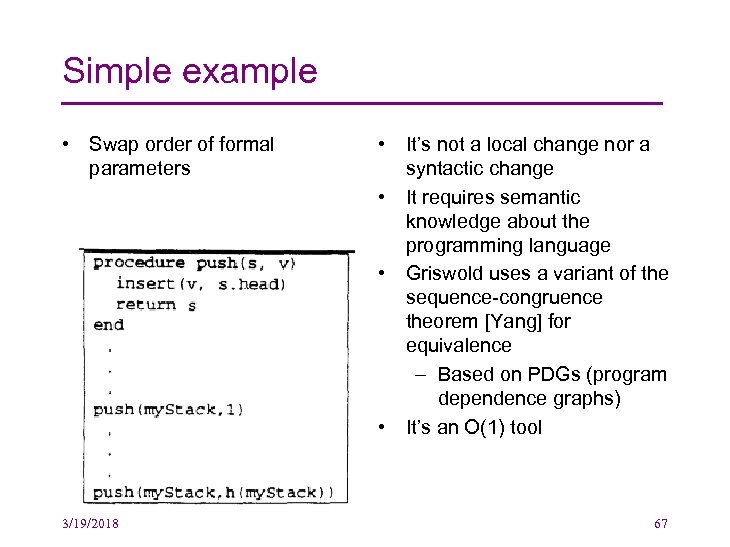 Simple example • Swap order of formal parameters 3/19/2018 • It’s not a local change nor a syntactic change • It requires semantic knowledge about the programming language • Griswold uses a variant of the sequence-congruence theorem [Yang] for equivalence – Based on PDGs (program dependence graphs) • It’s an O(1) tool 67
 Limited power • The actual tool and approach has limited power • Can help translate one of Parnas’ KWIC decompositions to the other • Too limited to be useful in practice – PDGs are limiting • Big and expensive to manipulate • Difficult to handle in the face of multiple files, etc. • May encourage systematic restructuring in some cases 3/19/2018 68
![Star diagrams [Griswold et al. ] • Meaning-preserving restructuring isn’t going to work on](https://present5.com/presentation/91b482cf5f0f38e6d9eb7460cccb35f7/image-69.jpg "Star diagrams [Griswold et al. ] • Meaning-preserving restructuring isn’t going to work on") Star diagrams [Griswold et al. ] • Meaning-preserving restructuring isn’t going to work on a large scale • But sometimes significant restructuring is still desirable • Instead provide a tool (star diagrams) to – record restructuring plans – hide unnecessary details • Some modest studies on programs of 20 -70 KLOC 3/19/2018 69
Star diagrams [Griswold et al. ] • Meaning-preserving restructuring isn’t going to work on a large scale • But sometimes significant restructuring is still desirable • Instead provide a tool (star diagrams) to – record restructuring plans – hide unnecessary details • Some modest studies on programs of 20 -70 KLOC 3/19/2018 69
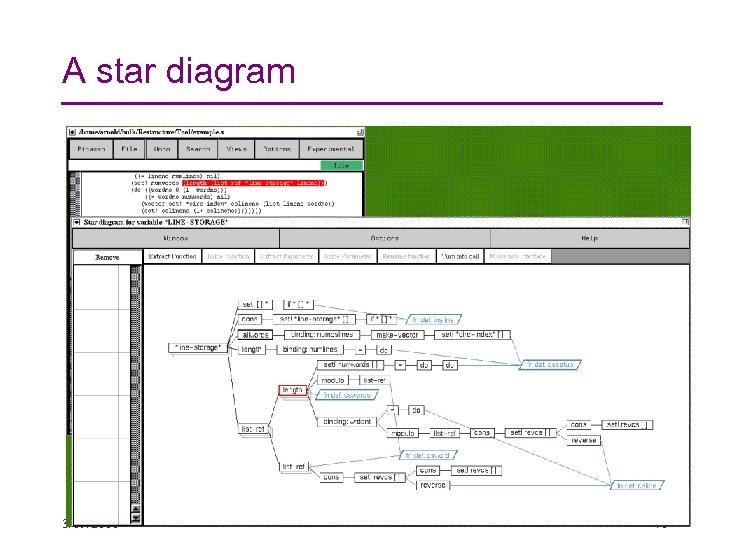 A star diagram 3/19/2018 70
 Interpreting a star diagram • The root (far left) represents all the instances of the variable to be encapsulated • The children of a node represent the operations and declarations directly referencing that variable • Stacked nodes indicate that two or more pieces of code correspond to (perhaps) the same computation • The children in the last level (parallelograms) represent the functions that contain these computations 3/19/2018 71
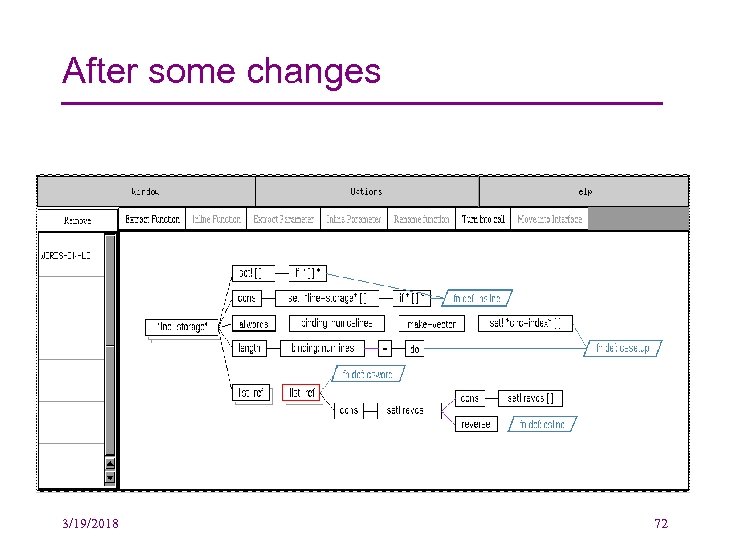 After some changes 3/19/2018 72
 Evaluation • Compared small teams of programmers on small programs – Used a variety of techniques, including videotape – Compared to vi/grep/etc. • Nothing conclusive, but some interesting observations including – The teams with standard tools adopted more complicated strategies for handling completeness and consistency 3/19/2018 73
 My view • Star diagrams may not be “the” answer • But I like the idea that they encourage people – To think clearly about a maintenance task, reducing the chances of an ad hoc approach – They help track mundane aspects of the task, freeing the programmer to work on more complex issues – To focus on the source code • Murphy/Kersten and Mylyn and tasktop. com are of the same flavor…. 3/19/2018 74
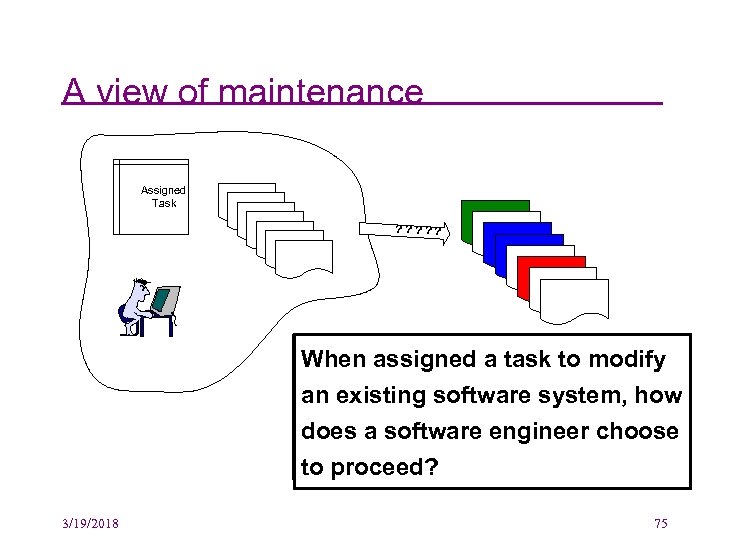 A view of maintenance Assigned Task Document Document ? ? ? Document Document When assigneda task to modify assigned a task to modify an existing software system, how does a software engineer choose to proceed? 3/19/2018 75
 A task: isolating a subsystem • Many maintenance tasks require identifying and isolating functionality within the source – sometimes to extract the subsystem – sometimes to replace the subsystem 3/19/2018 76
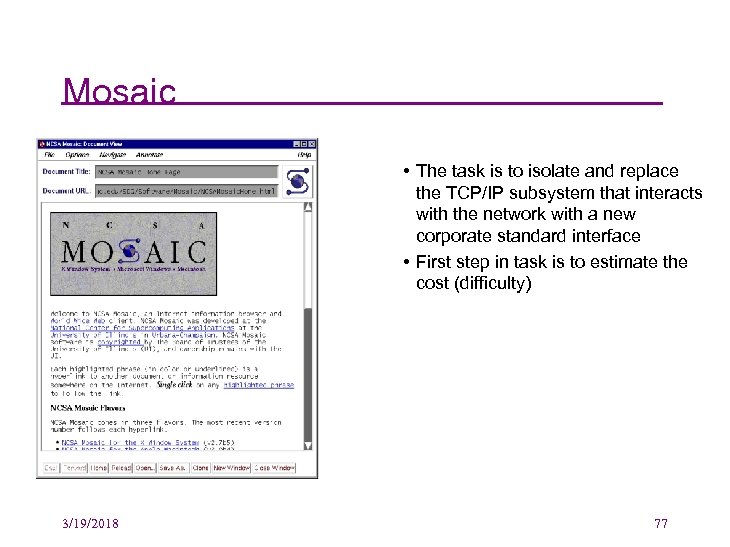 Mosaic • The task is to isolate and replace the TCP/IP subsystem that interacts with the network with a new corporate standard interface • First step in task is to estimate the cost (difficulty) 3/19/2018 77
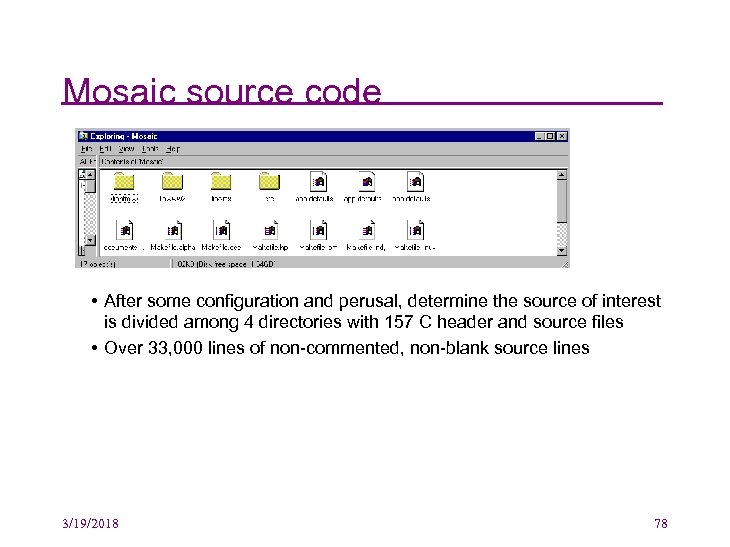 Mosaic source code • After some configuration and perusal, determine the source of interest is divided among 4 directories with 157 C header and source files • Over 33, 000 lines of non-commented, non-blank source lines 3/19/2018 78
 Some initial analysis • The names of the directories suggest the software is broken into: – code to interface with the X window system – code to interpret HTML – two other subsystems to deal with the world-wide-web and the application (although the meanings of these is not clear) 3/19/2018 79
 How to proceed? • What source model would be useful? – calls between functions (particularly calls to Unix TCP/IP library) • How do we get this source model? – statically with a tool that analyzes the source or dynamically using a profiling tool – these differ in information characterization produced • False positives, false negatives, etc. 3/19/2018 80
 More. . . • What we have – approximate call and global variable reference information • What we want – increase confidence in source model • Action: – collect dynamic call information to augment source model 3/19/2018 81
 Augment with dynamic calls • Compile Mosaic with profiling support • Run with a variety of test paths and collect profile information • Extract call graph source model from profiler output – 1872 calls – 25% overlap with CIA – 49% of calls reported by gprof not reported by CIA 3/19/2018 82
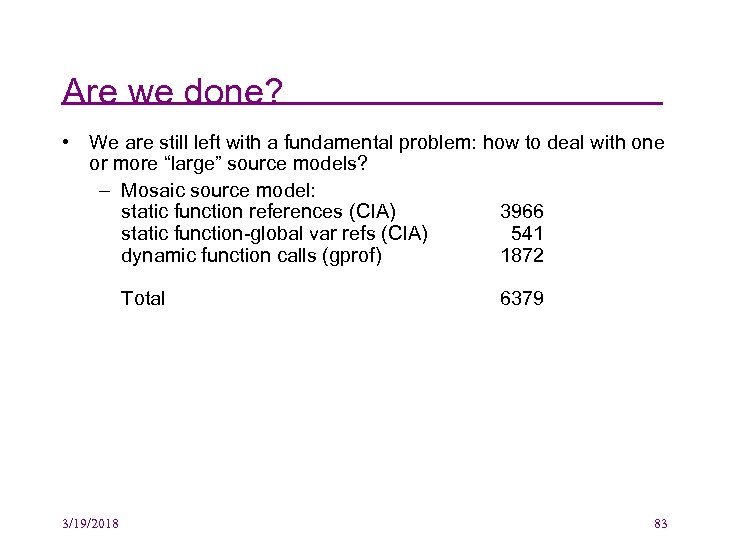 Are we done? • We are still left with a fundamental problem: how to deal with one or more “large” source models? – Mosaic source model: static function references (CIA) 3966 static function-global var refs (CIA) 541 dynamic function calls (gprof) 1872 Total 3/19/2018 6379 83
 One approach • Use a query tool against the source model(s) –maybe grep? –maybe source model specific tool? • As necessary, consult source code –“It’s the source, Luke. ” –Mark Weiser. Source Code. IEEE Computer 20, 11 (November 1987) 3/19/2018 84
 Other approaches • Visualization • Reverse engineering • Summarization 3/19/2018 85
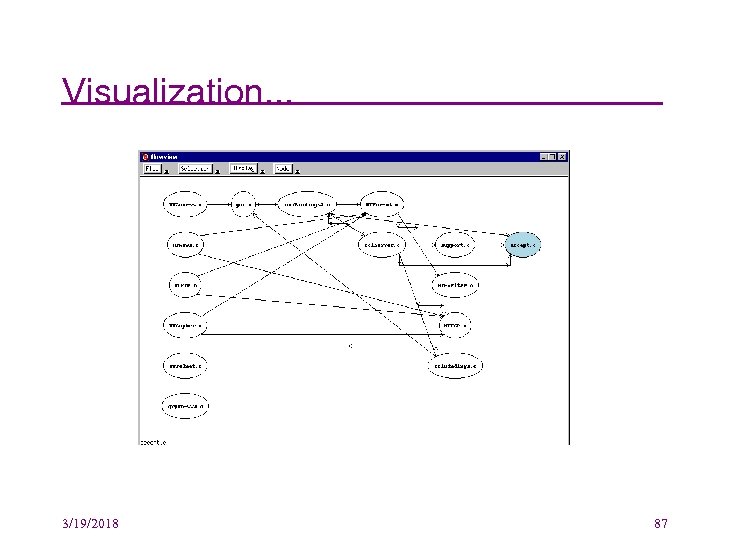
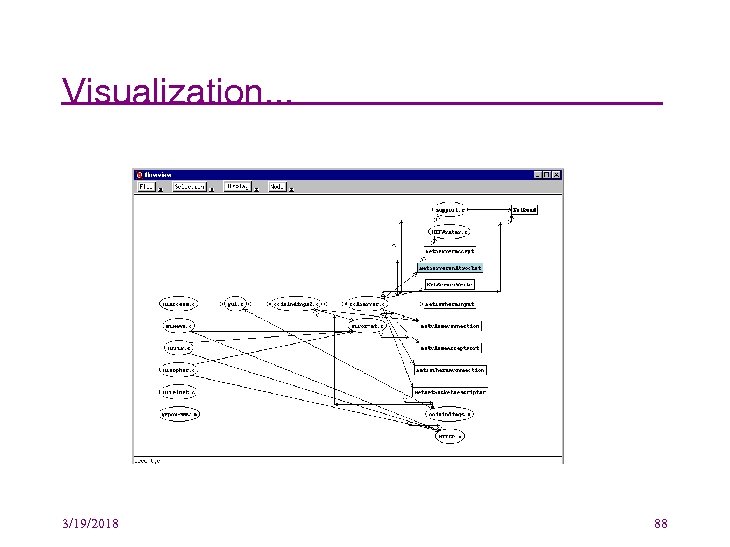
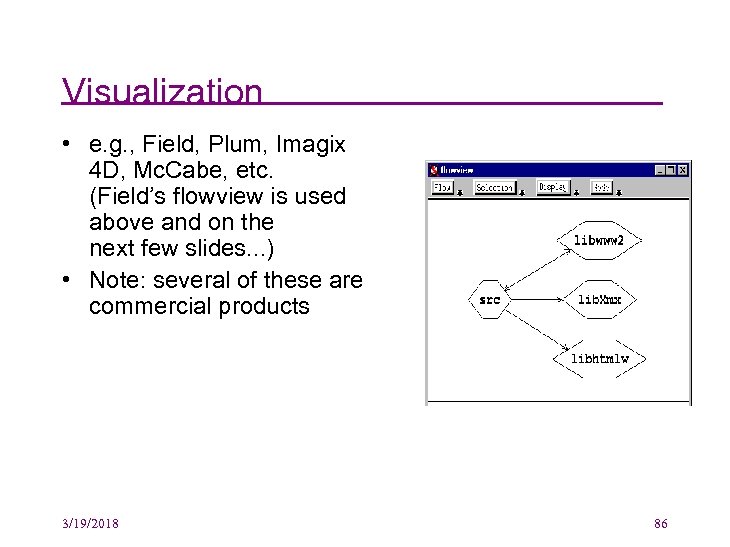 Visualization • e. g. , Field, Plum, Imagix 4 D, Mc. Cabe, etc. (Field’s flowview is used above and on the next few slides. . . ) • Note: several of these are commercial products 3/19/2018 86
 Visualization. . . 3/19/2018 87
 Visualization. . . 3/19/2018 88
 Visualization. . . • Provides a “direct” view of the source model • View often contains too much information – Use elision (…) – With elision you describe what you are not interested in, as opposed to what you are interested in 3/19/2018 89
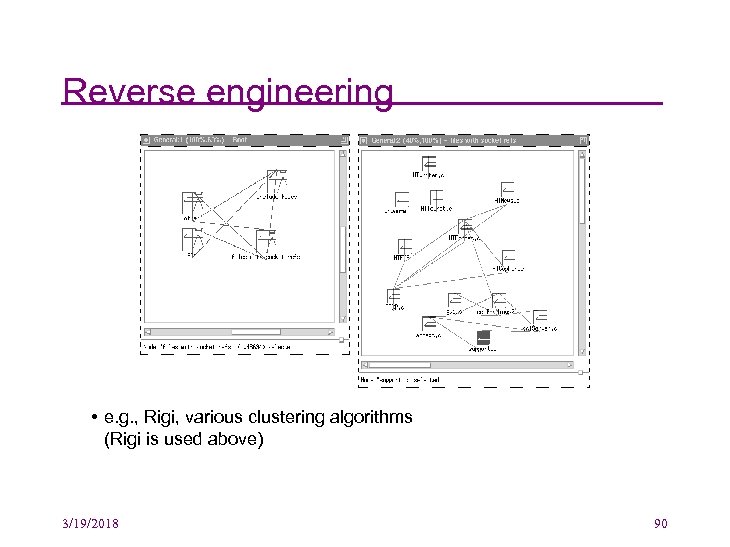 Reverse engineering • e. g. , Rigi, various clustering algorithms (Rigi is used above) 3/19/2018 90
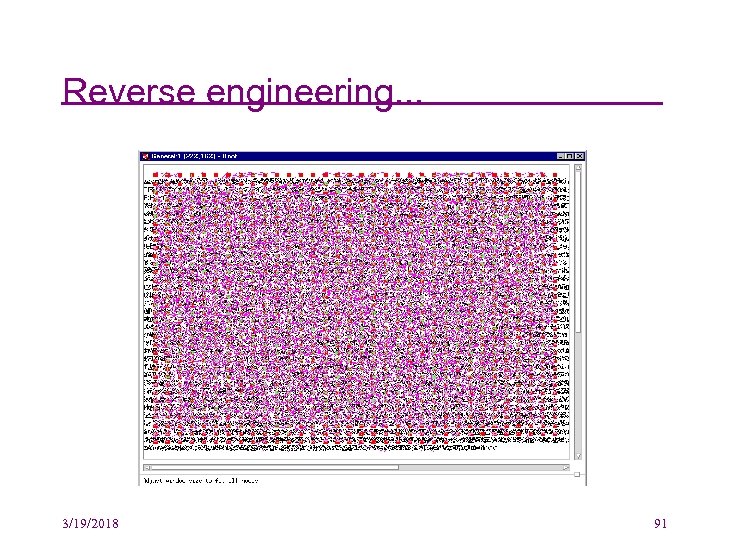 Reverse engineering. . . 3/19/2018 91
 Clustering • The basic idea is to take one or more source models of the code and find appropriate clusters that might indicate “good” modules • Coupling and cohesion, of various definitions, are at the heart of most clustering approaches • Many different algorithms 3/19/2018 92
 Rigi’s approach • Extract source models (they call them resource relations) • Build edge-weighted resource flow graphs – Discrete sets on the edges, representing the resources that flow from source to sink • Compose these to represent subsystems – Looking for strong cohesion, weak coupling • The papers define interconnection strength and similarity measures (with tunable thresholds) 3/19/2018 93
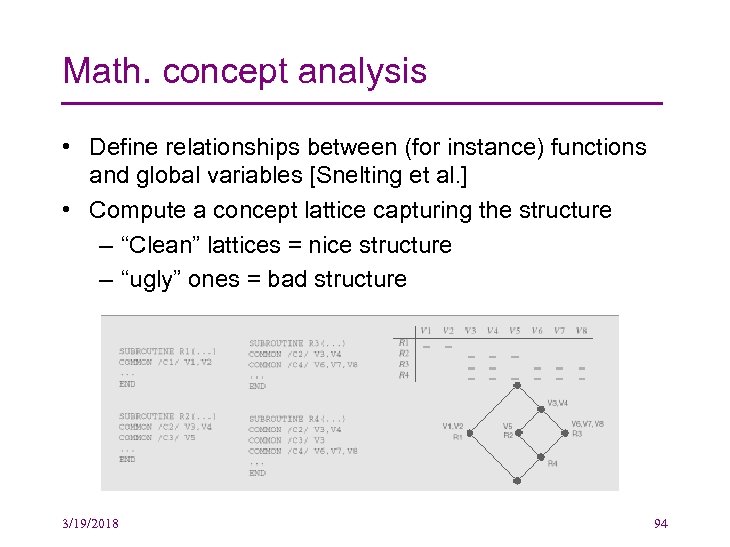 Math. concept analysis • Define relationships between (for instance) functions and global variables [Snelting et al. ] • Compute a concept lattice capturing the structure – “Clean” lattices = nice structure – “ugly” ones = bad structure 3/19/2018 94
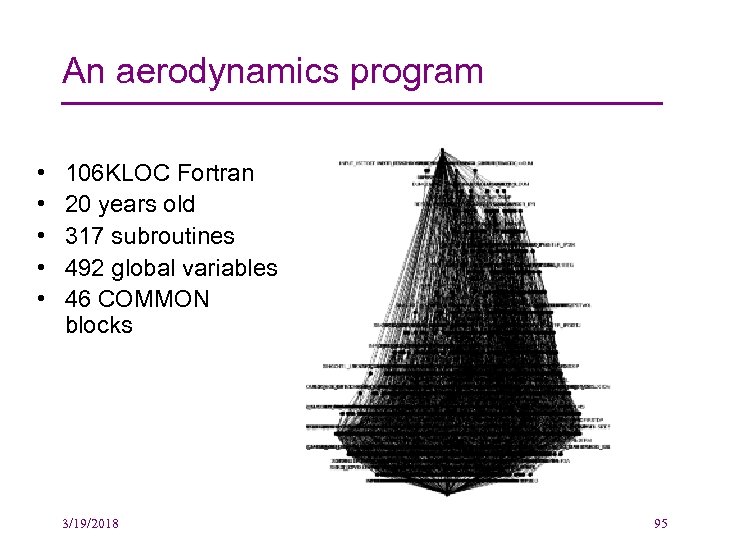 An aerodynamics program • • • 106 KLOC Fortran 20 years old 317 subroutines 492 global variables 46 COMMON blocks 3/19/2018 95
 Other concept lattice uses • File and version dependences across C programs (using the preprocessor) • Reorganizing class libraries 3/19/2018 96
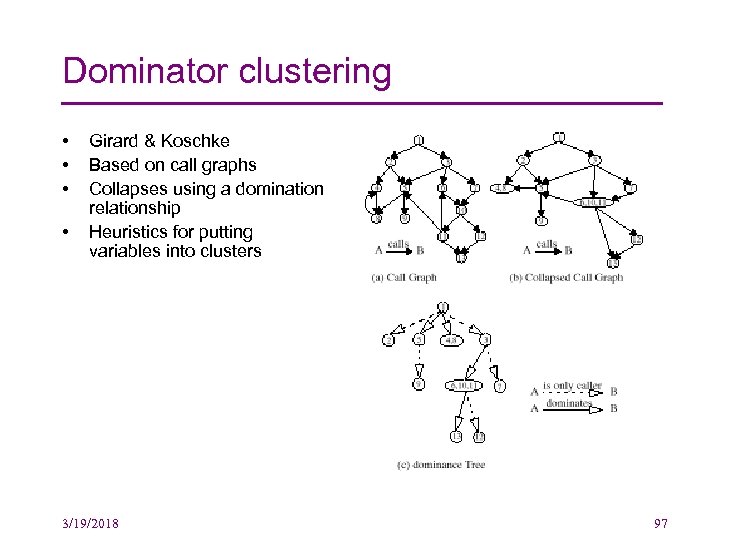 Dominator clustering • • Girard & Koschke Based on call graphs Collapses using a domination relationship Heuristics for putting variables into clusters 3/19/2018 97
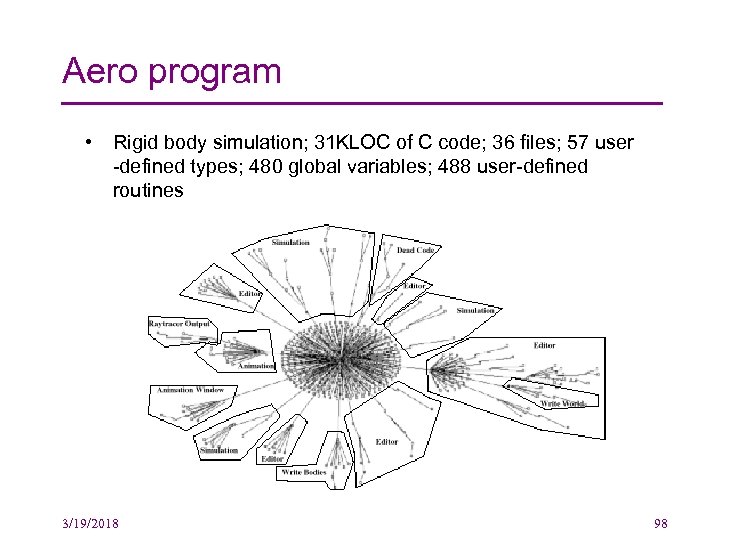 Aero program • Rigid body simulation; 31 KLOC of C code; 36 files; 57 user -defined types; 480 global variables; 488 user-defined routines 3/19/2018 98
 Other clustering • Schwanke – Clustering with automatic tuning of thresholds – Data and/or control oriented – Evaluated on reasonable sized programs • Basili and Hutchens – Data oriented 3/19/2018 99
 Reverse engineering recap • Generally produces a higher-level view that is consistent with source – Like visualization, can produce a “precise” view – Although this might be a precise view of an approximate source model • Sometimes view still contains too much information leading again to the use of techniques like elision – May end up with “optimistic” view 3/19/2018 100
 More recap • Automatic clustering approaches must try to produce “the” design – One design fits all • User-driven clustering may get a good result – May take significant work (which may be unavoidable) – Replaying this effort may be hard • Tunable clustering approaches may be hard to tune; unclear how well automatic tuning works 3/19/2018 101
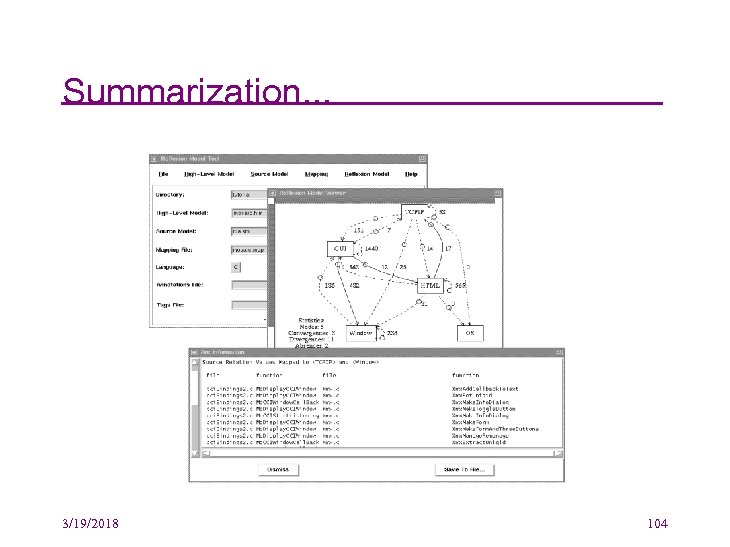
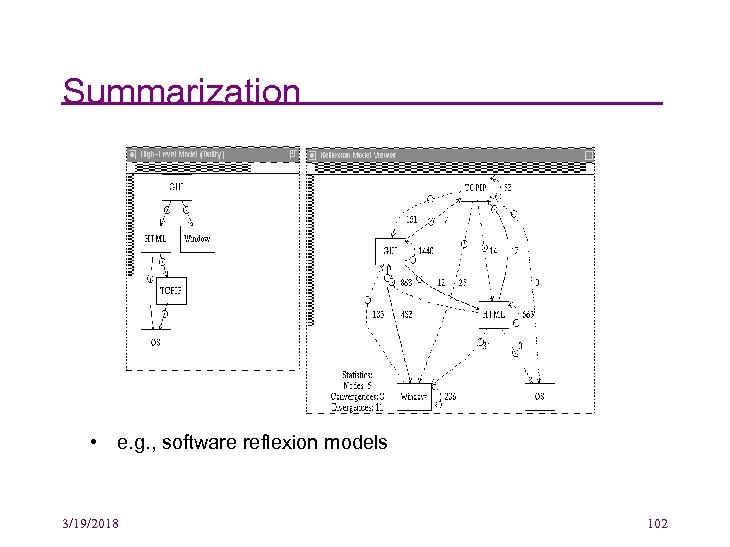 Summarization • e. g. , software reflexion models 3/19/2018 102
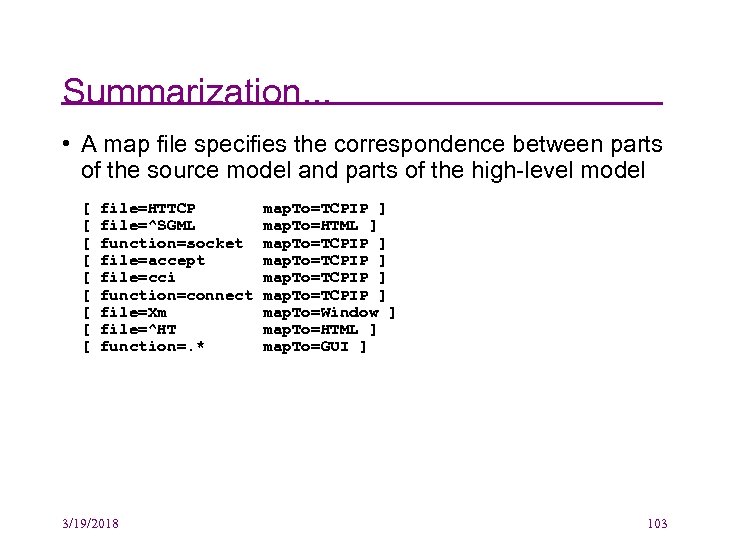 Summarization. . . • A map file specifies the correspondence between parts of the source model and parts of the high-level model [ [ [ [ [ file=HTTCP file=^SGML function=socket file=accept file=cci function=connect file=Xm file=^HT function=. * 3/19/2018 map. To=TCPIP ] map. To=HTML ] map. To=TCPIP ] map. To=Window ] map. To=HTML ] map. To=GUI ] 103
 Summarization. . . 3/19/2018 104
 Summarization. . . • Condense (some or all) information in terms of a highlevel view quickly – In contrast to visualization and reverse engineering, produce an “approximate” view – Iteration can be used to move towards a “precise” view • Some evidence that it scales effectively • May be difficult to assess the degree of approximation 3/19/2018 105
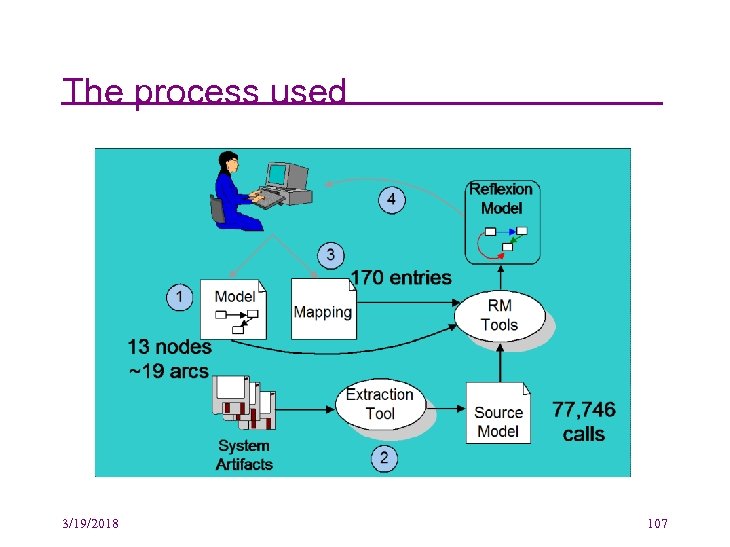
 Case study: A task on Excel • A series of approximate tools were used by a Microsoft engineer to perform an experimental reengineering task on Excel • The task involved the identification and extraction of components from Excel • Excel (then) comprised about 1. 2 million lines of C source – About 15, 000 functions spread over ~400 files 3/19/2018 106
 The process used 3/19/2018 107
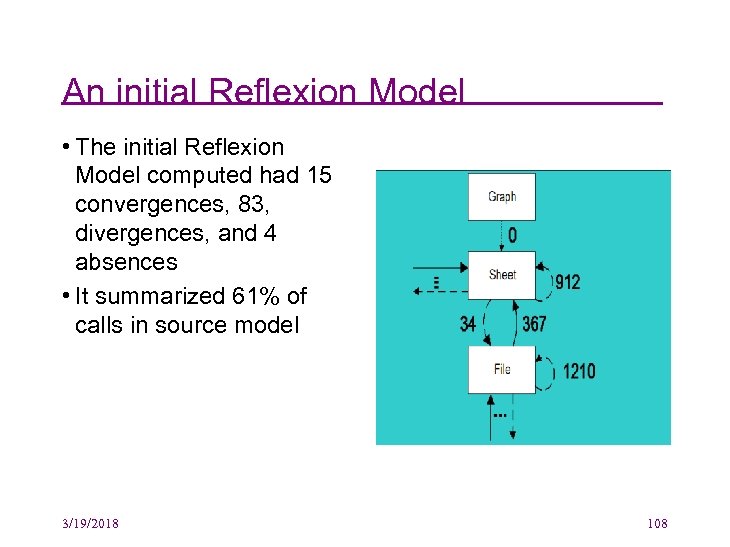 An initial Reflexion Model • The initial Reflexion Model computed had 15 convergences, 83, divergences, and 4 absences • It summarized 61% of calls in source model 3/19/2018 108
 An iterative process • Over a 4+ week period • Investigate an arc • Refine the map – Eventually over 1000 entries • Document exceptions • Augment the source model – Eventually, 119, 637 interactions 3/19/2018 109
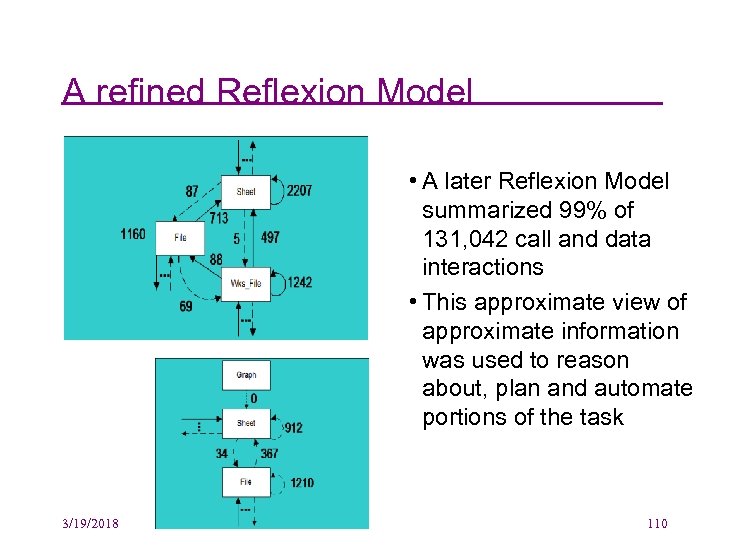 A refined Reflexion Model • A later Reflexion Model summarized 99% of 131, 042 call and data interactions • This approximate view of approximate information was used to reason about, plan and automate portions of the task 3/19/2018 110
 Results • Microsoft engineer judged the use of the Reflexion Model technique successful in helping to understand the system structure and source code “Definitely confirmed suspicions about the structure of Excel. Further, it allowed me to pinpoint the deviations. It is very easy to ignore stuff that is not interesting and thereby focus on the part of Excel that I want to know more about. ” — Microsoft A. B. C. (anonymous by choice) engineer 3/19/2018 111
 Open questions • How stable is the mapping as the source code changes? • Should reflexion models allow comparisons separated by the type of the source model entries? • . . . 3/19/2018 112
 Which ideas are important? (I think…) • Source code, source code • Task, task – The programmer decides where to increase the focus, not the tool • Iterative, pretty fast • Doesn’t require changing other tools nor standard process being used • Text representation of intermediate files • A computation that the programmer fundamentally understands – Indeed, could do manually, if there was only enough time • Graphical may be important, but also may be overrated in some situations 3/19/2018 113
 See. Soft: Eick et al. • Visualize text files by – mapping each line into a thin row – colored according to a statistic of interest • Focus on source code, with sample statistics including – age, programmer, or functionality of each line – Data extracted from version control systems, static analysis and profiling • User can manipulate this representation to find interesting patterns in software • Applications include data discovery, project management, code tuning and analysis of development methodologies 3/19/2018 114
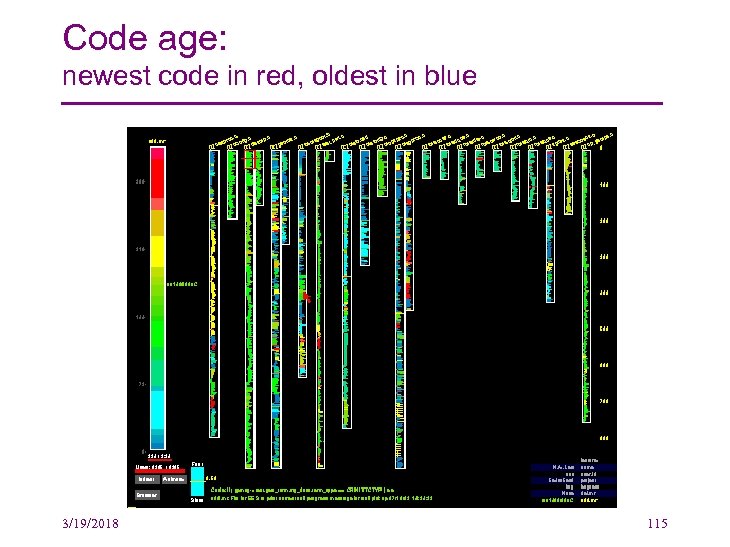 Code age: newest code in red, oldest in blue 3/19/2018 115
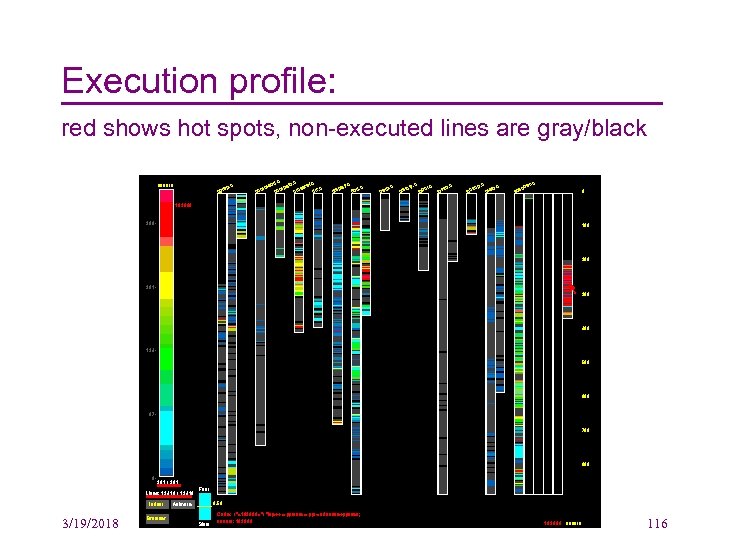 Execution profile: red shows hot spots, non-executed lines are gray/black 3/19/2018 116
 See. Soft • See. Soft seems excellent for building important, qualitative understanding of some aspects of source code • It also links in effectively with the underlying source code • It is flexible in terms of what statistics are viewed – It’s not entirely clear how much work is needed to add a new statistic 3/19/2018 117
 Summary • Evolution is done in a relatively ad hoc way – Much more ad hoc than design, I think • Putting some intellectual structure on the problem might help – Sometimes tools can help with this structure, but it is often the intellectual structure that is more critical 3/19/2018 118
 Why is there a lack of tools to support evolution? • Intellectual tools • Actual tools • Opportunities? 3/19/2018 119