


 Скачать презентацию CSE HCST DATA WAREHOUSING 19 March 2018 UNIT-IV 1
ec603b051dd755697ec6aeea04011915.ppt
- Количество слайдов: 69
 CSE@HCST DATA WAREHOUSING 19 March 2018 UNIT-IV 1
 Data Warehousing and On-line Analytical Processing 2 Data Warehouse: Basic Concepts Data Warehouse Modeling: Data Cube and OLAP Data Warehouse Design and Usage Data Warehouse Implementation Data Generalization by Attribute-Oriented Induction Summary CSE@HCST 19 March 2018
 What is a Data Warehouse? 3 Defined in many different ways, but not rigorously. A decision support database that is maintained separately from the organization’s operational database. Support information processing by providing a solid platform of consolidated, historical data for analysis. “A data warehouse is a subject-oriented, integrated, timevariant, and nonvolatile collection of data in support of management’s decision-making process. ”—W. H. Inmon Data warehousing: CSE@HCST 19 March 2018 The process of constructing and using data warehouses.
 Data Warehouse—Subject-Oriented 4 Organized around major subjects, such as customer, product, sales. Focusing on the modeling and analysis of data for decision makers, not on daily operations or transaction processing. Provide a simple and concise view around particular subject issues by excluding data that are not useful in the decision support process. CSE@HCST 19 March 2018
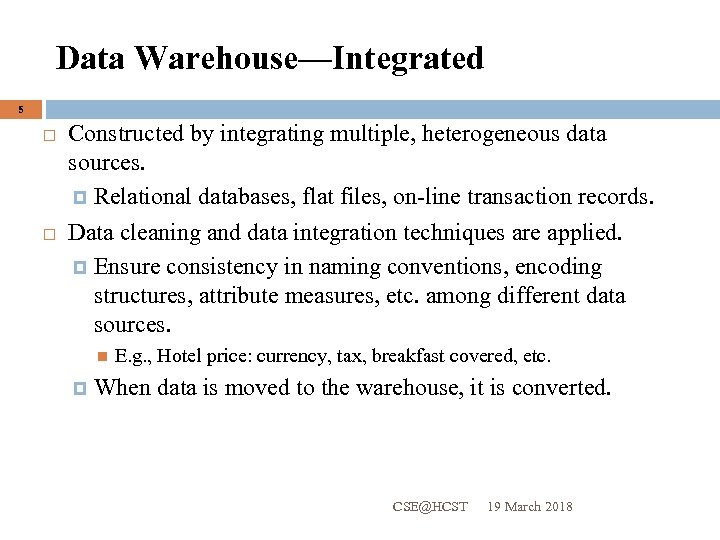 Data Warehouse—Integrated 5 Constructed by integrating multiple, heterogeneous data sources. Relational databases, flat files, on-line transaction records. Data cleaning and data integration techniques are applied. Ensure consistency in naming conventions, encoding structures, attribute measures, etc. among different data sources. E. g. , Hotel price: currency, tax, breakfast covered, etc. When data is moved to the warehouse, it is converted. CSE@HCST 19 March 2018
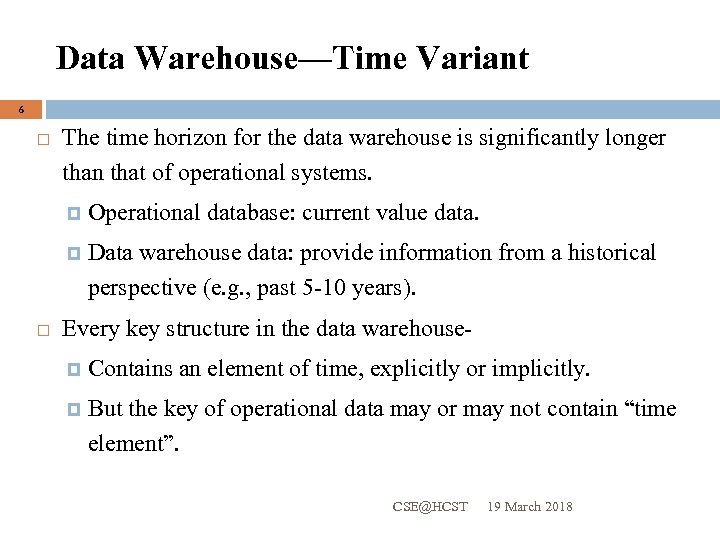 Data Warehouse—Time Variant 6 The time horizon for the data warehouse is significantly longer than that of operational systems. Operational database: current value data. Data warehouse data: provide information from a historical perspective (e. g. , past 5 -10 years). Every key structure in the data warehouse Contains an element of time, explicitly or implicitly. But the key of operational data may or may not contain “time element”. CSE@HCST 19 March 2018
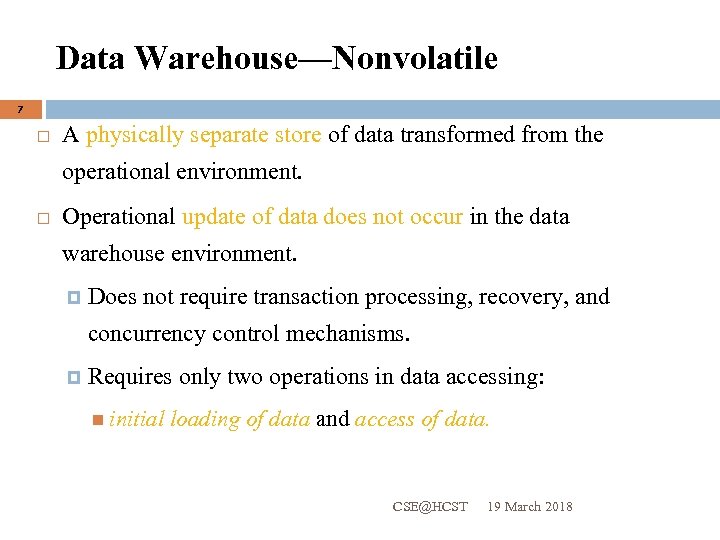 Data Warehouse—Nonvolatile 7 A physically separate store of data transformed from the operational environment. Operational update of data does not occur in the data warehouse environment. Does not require transaction processing, recovery, and concurrency control mechanisms. Requires only two operations in data accessing: initial loading of data and access of data. CSE@HCST 19 March 2018
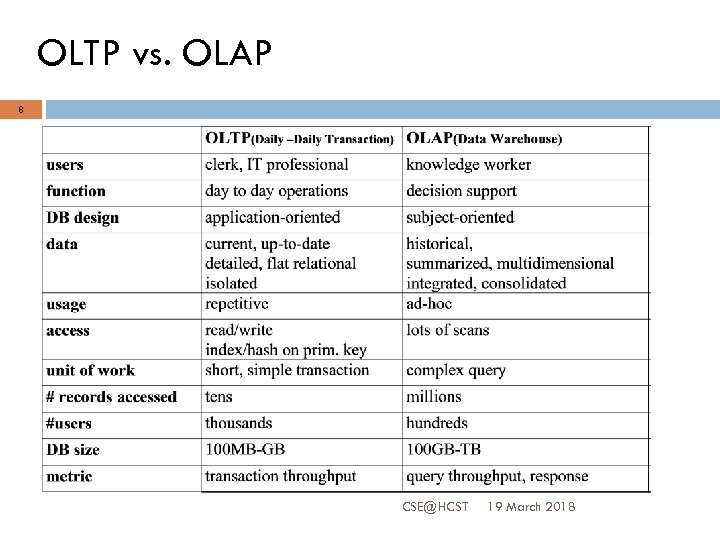 OLTP vs. OLAP 8 CSE@HCST 19 March 2018
 Why a Separate Data Warehouse? 9 High performance for both systems DBMS— tuned for OLTP: access methods, indexing, concurrency control, recovery. Warehouse—tuned for OLAP: complex OLAP queries, multidimensional view, consolidation. Different functions and different data: Missing data: Decision support requires historical data which operational DBs do not typically maintain. Data consolidation: DS requires consolidation (aggregation, summarization) of data from heterogeneous sources. Data quality: different sources typically use inconsistent data representations, codes and formats which have to be reconciled. Note: There are more and more systems which perform OLAP analysis directly on relational databases. CSE@HCST 19 March 2018
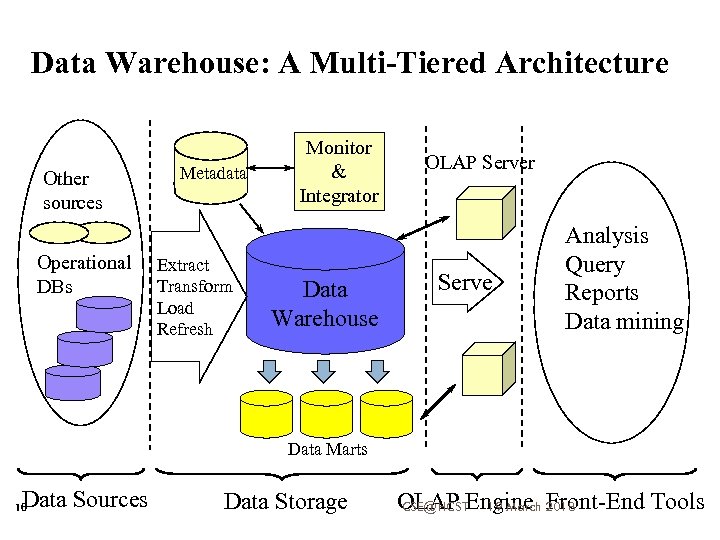 Data Warehouse: A Multi-Tiered Architecture Other sources Operational DBs Metadata Extract Transform Load Refresh Monitor & Integrator Data Warehouse OLAP Server Serve Analysis Query Reports Data mining Data Marts Data Sources 10 Data Storage OLAP Engine 2018 CSE@HCST 19 March Front-End Tools
 Three Data Warehouse Models 11 Enterprise warehouse Collects all of the information about subjects spanning the entire organization. Data Mart A subset of corporate-wide data that is of value to a specific groups of users. Its scope is confined to specific, selected groups, such as marketing data mart. Independent vs. dependent (directly from warehouse) data mart Virtual warehouse A set of views over operational databases. Only some of the possible summary views may be materialized. CSE@HCST 19 March 2018
 Extraction, Transformation, and Loading (ETL) 12 Data extraction get data from multiple, heterogeneous, and external sources. Data cleaning detect errors in the data and rectify them when possible. Data transformation convert data from legacy or host format to warehouse format. Load sort, summarize, consolidate, compute views, check integrity, and build index and partitions. Refresh propagate the updates from the data sources to the warehouse. CSE@HCST 19 March 2018
 Metadata Repository 13 Meta data is the data defining warehouse objects. It stores: Description of the structure of the data warehouse schema, view, dimensions, hierarchies, derived data defn, data mart locations and contents. Operational meta-data lineage (history of migrated data and transformation path), currency of data (active, archived, or purged), monitoring information (warehouse usage statistics, error reports, audit trails). The algorithms used for summarization. The mapping from operational environment to the data warehouse. Data related to system performance. warehouse schema, view and derived data definitions. Business data business terms and definitions, ownership of data, charging policies. CSE@HCST 19 March 2018
 Chapter 4: Data Warehousing and On-line Analytical Processing 14 Data Warehouse: Basic Concepts Data Warehouse Modeling: Data Cube and OLAP Data Warehouse Design and Usage Data Warehouse Implementation Data Generalization by Attribute-Oriented Induction Summary CSE@HCST 19 March 2018
 From Tables and Spreadsheets to Data Cubes 15 A data warehouse is based on a multidimensional data model which views data in the form of a data cube. A data cube, such as sales, allows data to be modeled and viewed in multiple dimensions. Dimension tables, such as item (item_name, brand, type), or time(day, week, month, quarter, year). Fact table contains measures (such as dollars_sold) and keys to each of the related dimension tables. In data warehousing literature, an n-D base cube is called a base cuboid. The top most 0 -D cuboid, which holds the highest-level of summarization, is called the apex cuboid. The lattice of cuboids forms a data cube. CSE@HCST 19 March 2018
 A Multidimensional Data Model 16/74 From Tables and Spreadsheets to Data Cubes A data cube is defined by dimensions and facts Dimension table Fact table CSE@HCST 19 March 2018
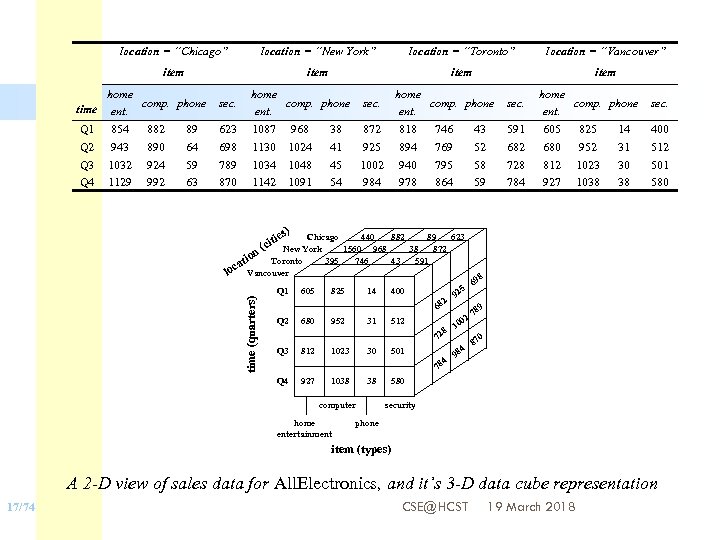 location = “Chicago” location = “New York” location = “Toronto” location = “Vancouver” item home time ent. comp. phone sec. home comp. phone ent. sec. Q 1 Q 2 Q 3 Q 4 623 698 789 870 1087 1130 1034 1142 872 925 1002 984 854 943 1032 1129 882 890 924 992 89 64 59 63 968 1024 1048 1091 38 41 45 54 home comp. phone ent. 818 894 940 978 746 769 795 864 43 52 58 59 sec. 591 682 728 784 home comp. phone ent. 605 680 812 927 825 952 1023 1038 14 31 30 38 sec. 400 512 501 580 es) ti (ci time (quarters) Chicago 440 882 89 623 New York 1560 968 38 872 n 395 746 43 591 tio Toronto ca Vancouver lo Q 1 605 825 14 400 2 68 Q 2 680 952 31 512 8 72 Q 3 812 1023 30 501 4 78 Q 4 927 1038 38 computer home entertainment 5 92 8 69 9 2 00 78 1 0 4 98 87 580 security phone item (types) A 2 -D view of sales data for All. Electronics, and it’s 3 -D data cube representation 17/74 CSE@HCST 19 March 2018
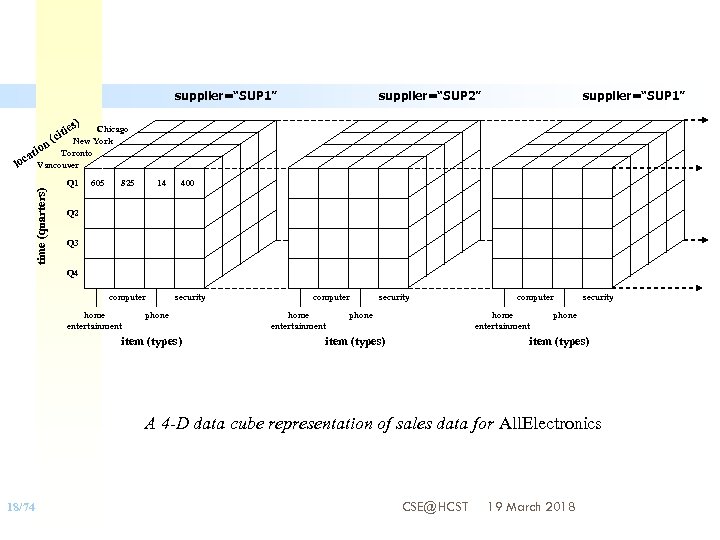 supplier=“SUP 1” tie (ci supplier=“SUP 2” supplier=“SUP 1” s) time (quarters) Chicago New York n tio Toronto ca Vancouver lo Q 1 605 825 14 400 Q 2 Q 3 Q 4 computer home entertainment security phone item (types) computer home entertainment security phone computer home entertainment item (types) security phone item (types) A 4 -D data cube representation of sales data for All. Electronics 18/74 CSE@HCST 19 March 2018
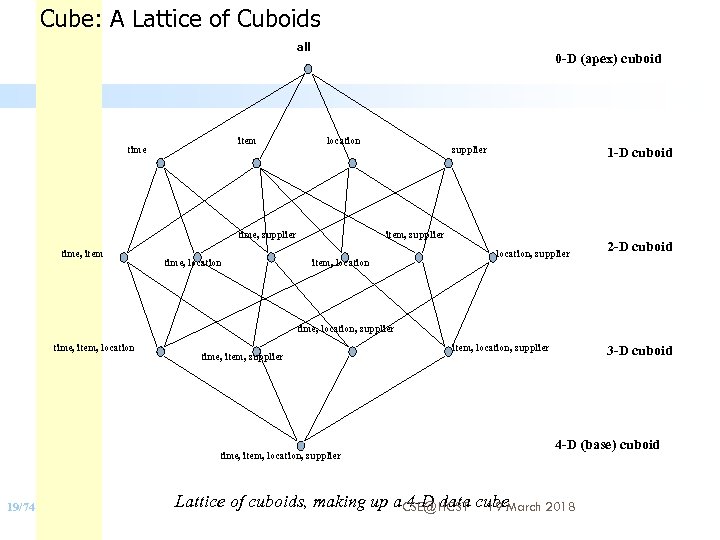 Cube: A Lattice of Cuboids all item time 0 -D (apex) cuboid location time, supplier time, item time, location supplier 1 -D cuboid item, supplier item, location, supplier 2 -D cuboid time, location, supplier time, item, location time, item, supplier time, item, location, supplier 19/74 item, location, supplier 3 -D cuboid 4 -D (base) cuboid Lattice of cuboids, making up a. CSE@HCST cube. March 2018 4 -D data 19
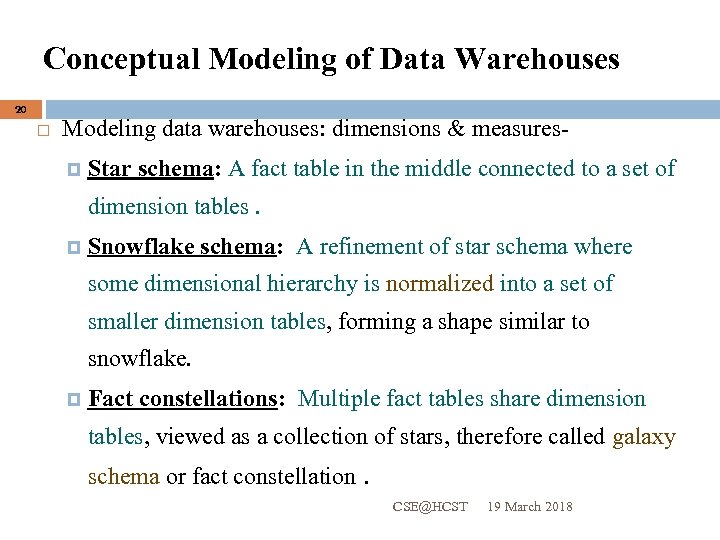 Conceptual Modeling of Data Warehouses 20 Modeling data warehouses: dimensions & measures Star schema: A fact table in the middle connected to a set of dimension tables. Snowflake schema: A refinement of star schema where some dimensional hierarchy is normalized into a set of smaller dimension tables, forming a shape similar to snowflake. Fact constellations: Multiple fact tables share dimension tables, viewed as a collection of stars, therefore called galaxy schema or fact constellation. CSE@HCST 19 March 2018
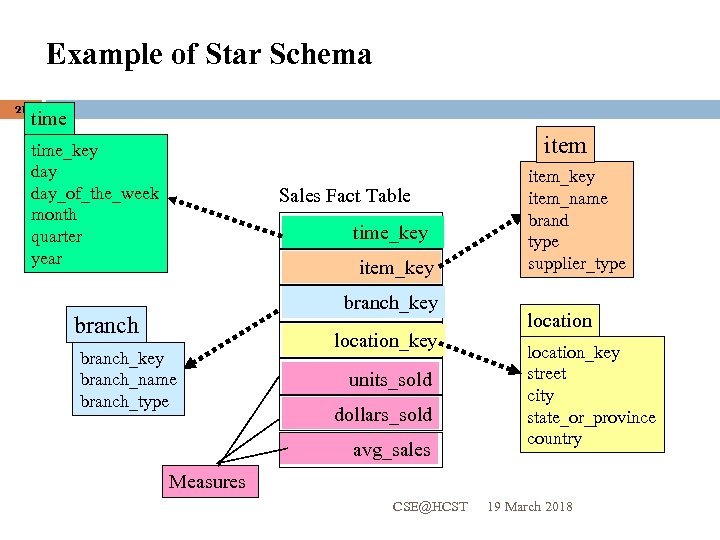 Example of Star Schema 21 time item time_key day_of_the_week month quarter year Sales Fact Table time_key item_key branch_key branch_name branch_type location_key units_sold dollars_sold avg_sales item_key item_name brand type supplier_type location_key street city state_or_province country Measures CSE@HCST 19 March 2018
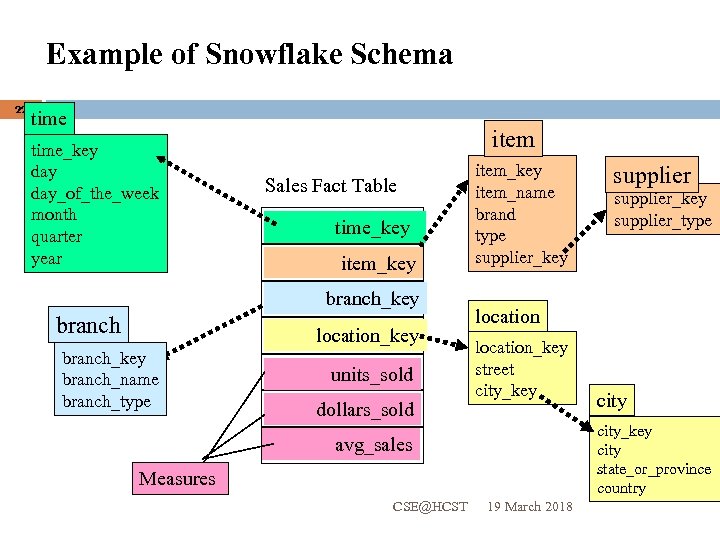 Example of Snowflake Schema 22 time_key day_of_the_week month quarter year item Sales Fact Table time_key item_key branch location_key branch_name branch_type units_sold dollars_sold item_key item_name brand type supplier_key supplier_type location_key street city_key city state_or_province country avg_sales Measures CSE@HCST supplier 19 March 2018
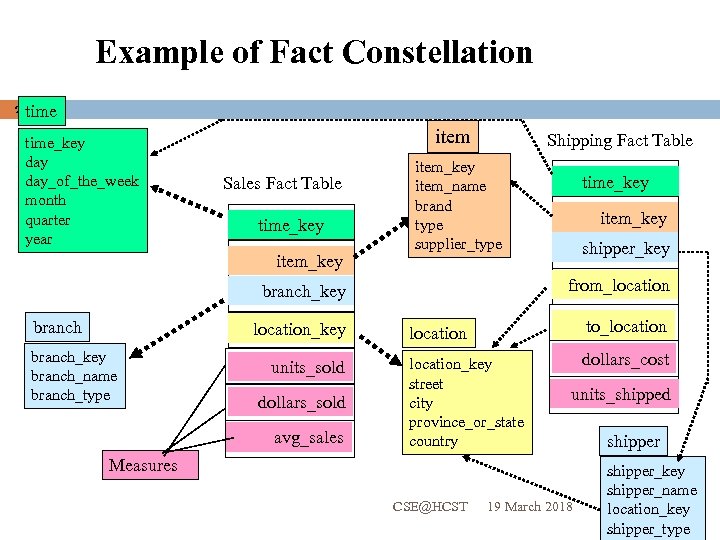 Example of Fact Constellation time 23 time_key day_of_the_week month quarter year item Sales Fact Table time_key item_key Shipping Fact Table item_key item_name brand type supplier_type location_key branch_name branch_type units_sold dollars_sold avg_sales item_key shipper_key from_location branch_key branch time_key location to_location_key street city province_or_state country dollars_cost units_shipped Measures CSE@HCST 19 March 2018 shipper_key shipper_name location_key shipper_type
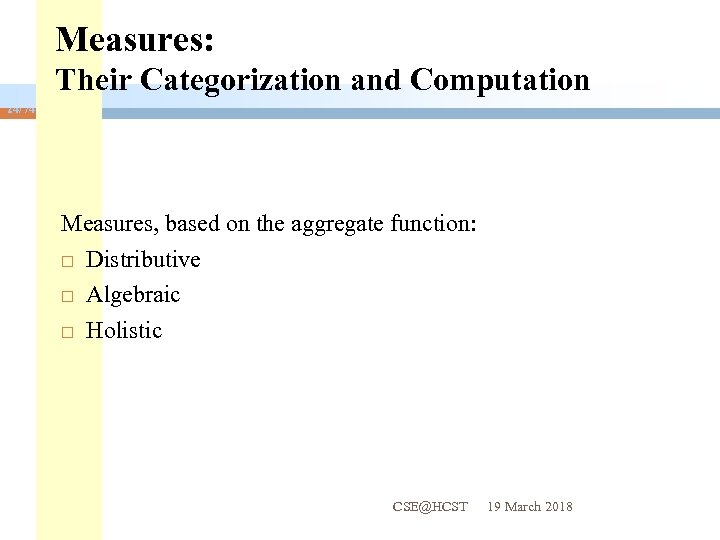 Measures: Their Categorization and Computation 24/74 Measures, based on the aggregate function: Distributive Algebraic Holistic CSE@HCST 19 March 2018
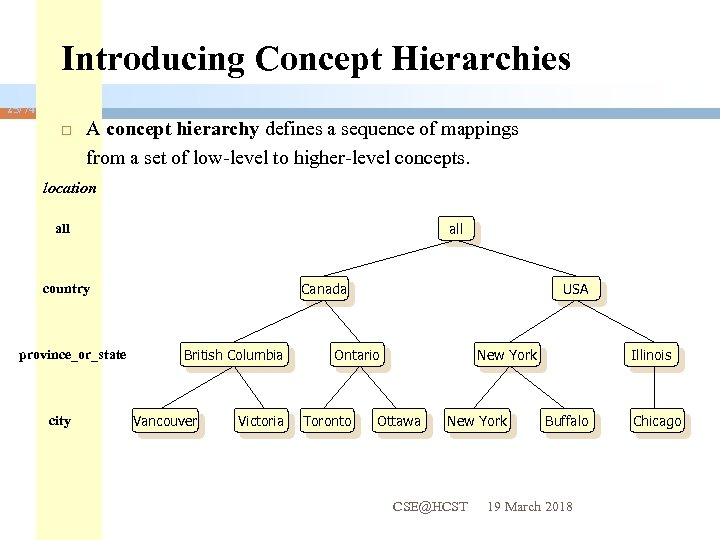 Introducing Concept Hierarchies 25/74 A concept hierarchy defines a sequence of mappings from a set of low-level to higher-level concepts. location all Canada country province_or_state city British Columbia Vancouver Victoria USA Ontario Toronto New York Ottawa New York CSE@HCST Illinois Buffalo 19 March 2018 Chicago
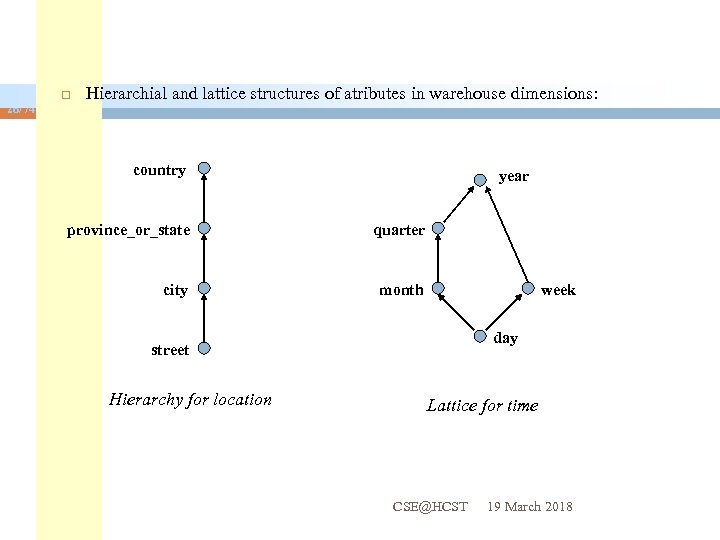 26/74 Hierarchial and lattice structures of atributes in warehouse dimensions: country year province_or_state quarter city month week day street Hierarchy for location Lattice for time CSE@HCST 19 March 2018
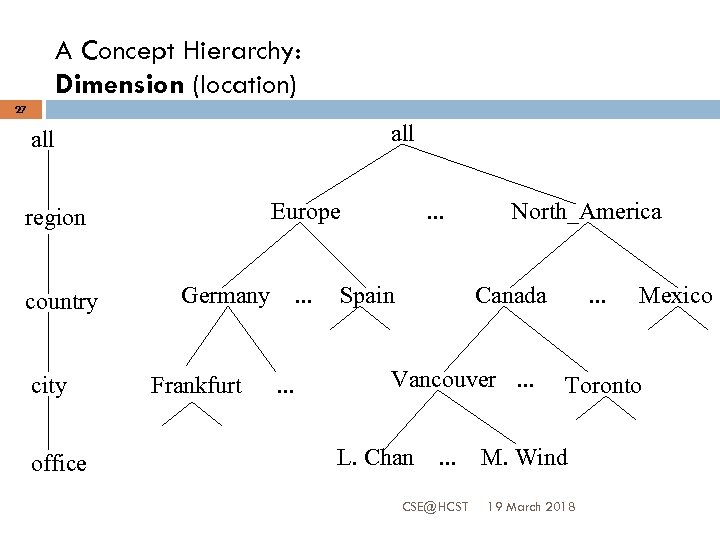 A Concept Hierarchy: Dimension (location) 27 all Europe region country city office Germany Frankfurt . . Spain North_America Canada Vancouver. . . L. Chan . . . CSE@HCST . . . Mexico Toronto M. Wind 19 March 2018
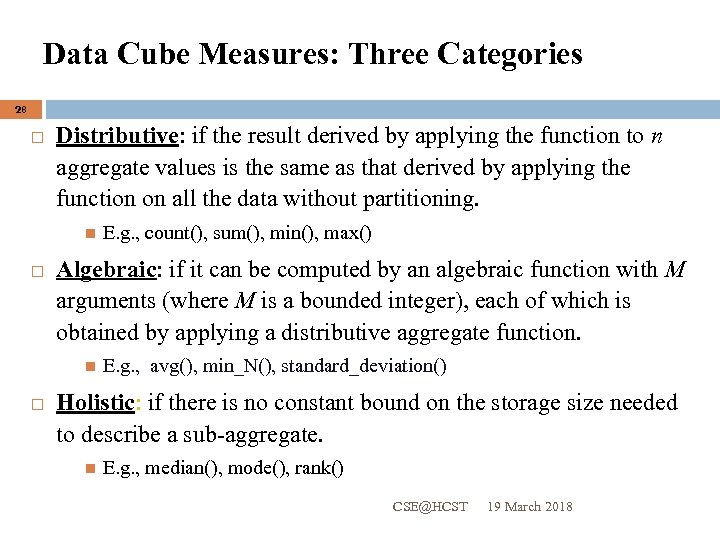 Data Cube Measures: Three Categories 28 Distributive: if the result derived by applying the function to n aggregate values is the same as that derived by applying the function on all the data without partitioning. Algebraic: if it can be computed by an algebraic function with M arguments (where M is a bounded integer), each of which is obtained by applying a distributive aggregate function. E. g. , count(), sum(), min(), max() E. g. , avg(), min_N(), standard_deviation() Holistic: if there is no constant bound on the storage size needed to describe a sub-aggregate. E. g. , median(), mode(), rank() CSE@HCST 19 March 2018
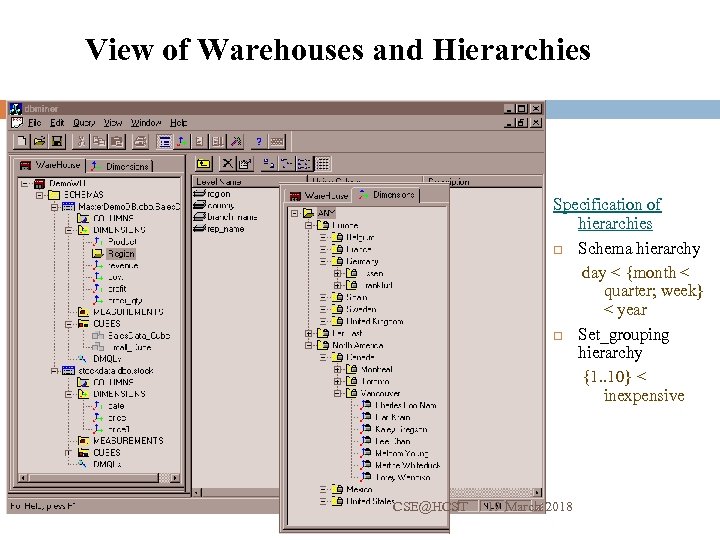 View of Warehouses and Hierarchies 29 Specification of hierarchies Schema hierarchy day < {month < quarter; week} < year Set_grouping hierarchy {1. . 10} < inexpensive CSE@HCST 19 March 2018
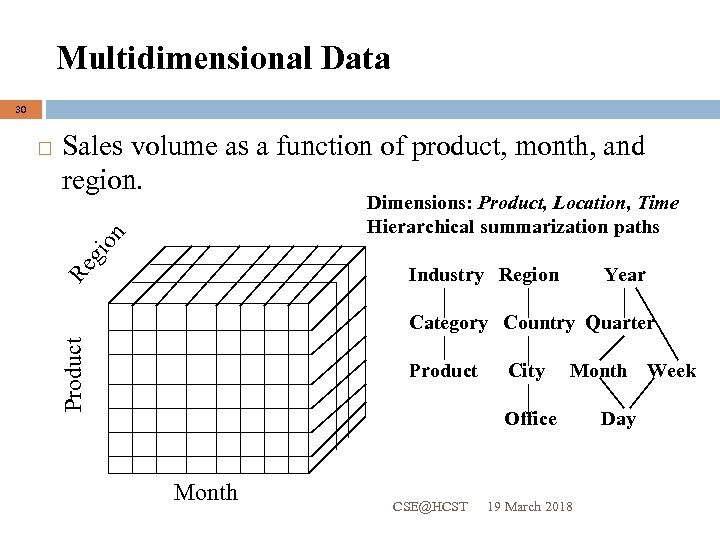 Multidimensional Data 30 Sales volume as a function of product, month, and region. gi on Dimensions: Product, Location, Time Hierarchical summarization paths Re Industry Region Year Category Country Quarter Product City Month Office Month CSE@HCST 19 March 2018 Day Week
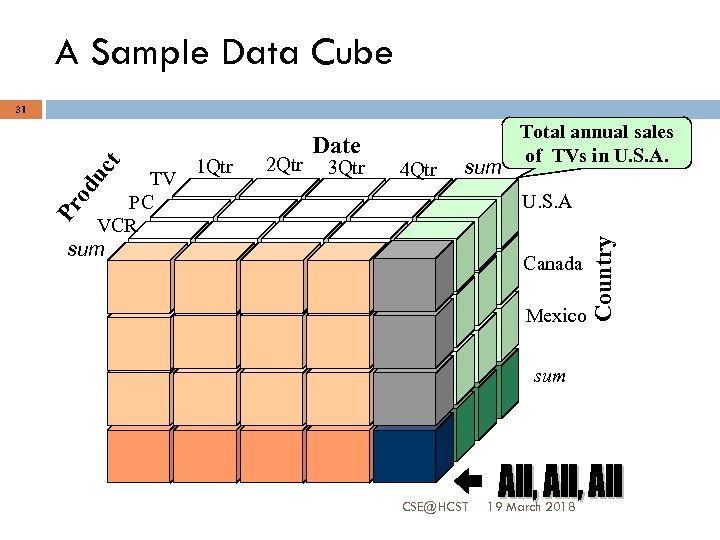 A Sample Data Cube 2 Qtr 3 Qtr 4 Qtr sum od TV PC VCR sum 1 Qtr Date Total annual sales of TVs in U. S. A. Pr U. S. A Canada Mexico sum CSE@HCST 19 March 2018 Country uc t 31
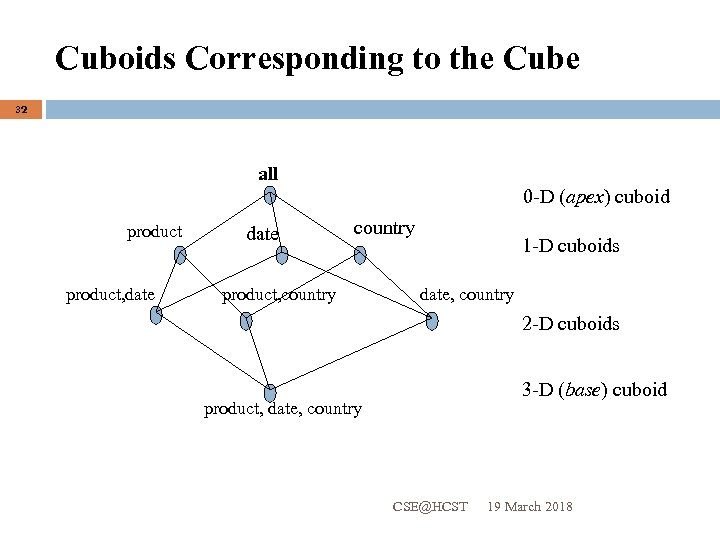 Cuboids Corresponding to the Cube 32 all 0 -D (apex) cuboid product, date country product, country 1 -D cuboids date, country 2 -D cuboids 3 -D (base) cuboid product, date, country CSE@HCST 19 March 2018
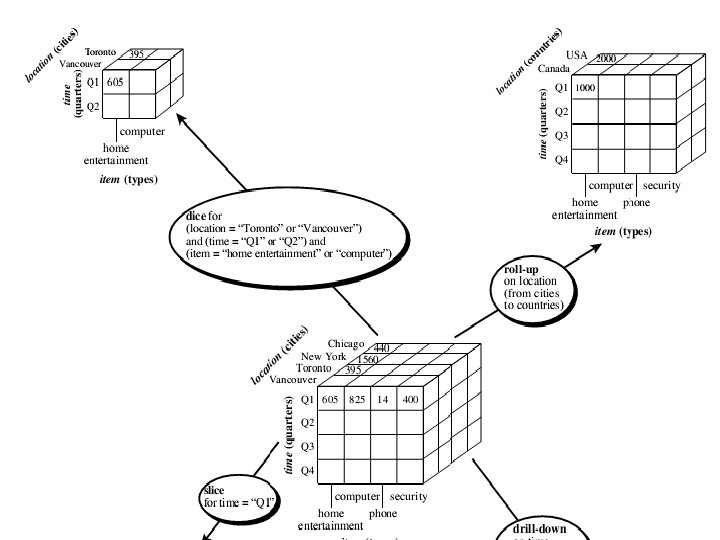
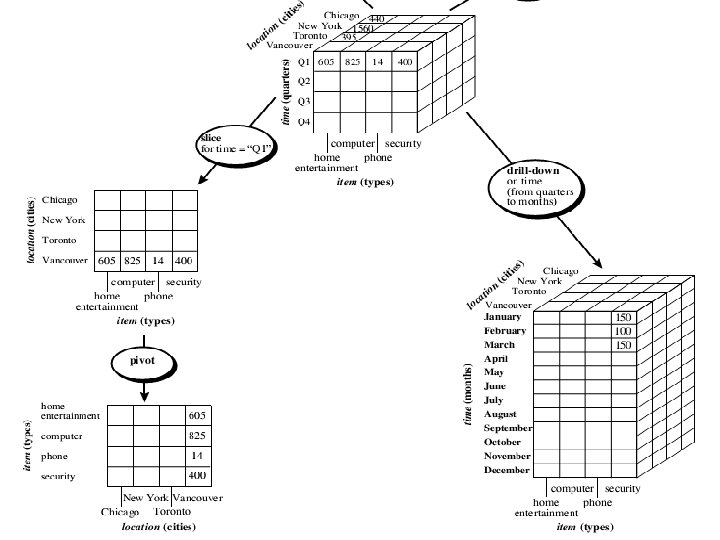
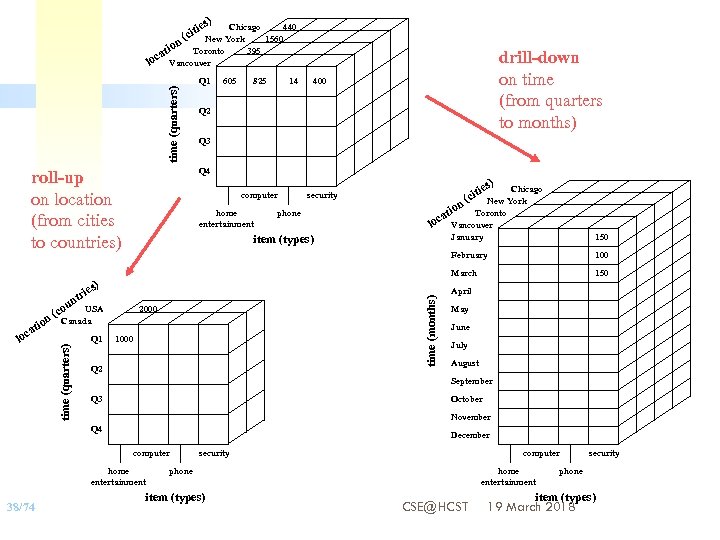
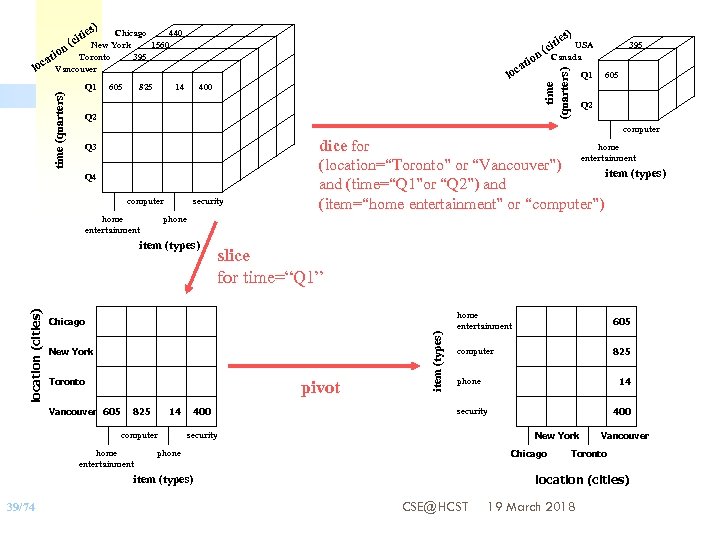
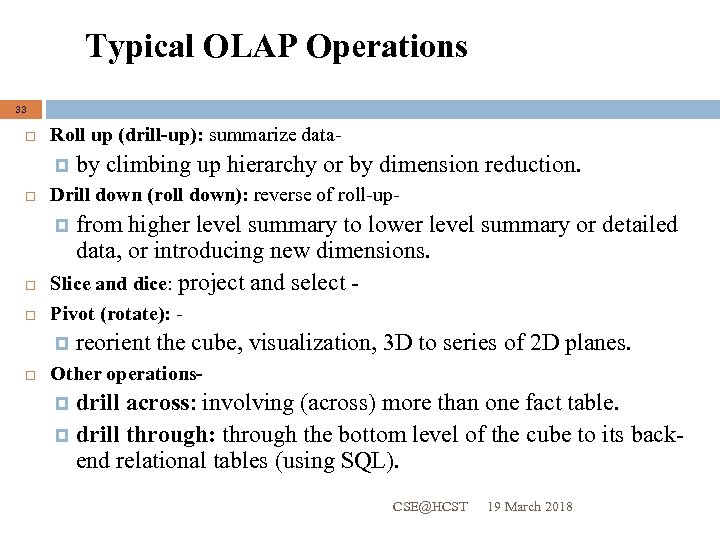 Typical OLAP Operations 33 Roll up (drill-up): summarize data by climbing up hierarchy or by dimension reduction. Drill down (roll down): reverse of roll-up- from higher level summary to lower level summary or detailed data, or introducing new dimensions. Slice and dice: project and select - Pivot (rotate): - reorient the cube, visualization, 3 D to series of 2 D planes. Other operations- drill across: involving (across) more than one fact table. drill through: through the bottom level of the cube to its backend relational tables (using SQL). CSE@HCST 19 March 2018
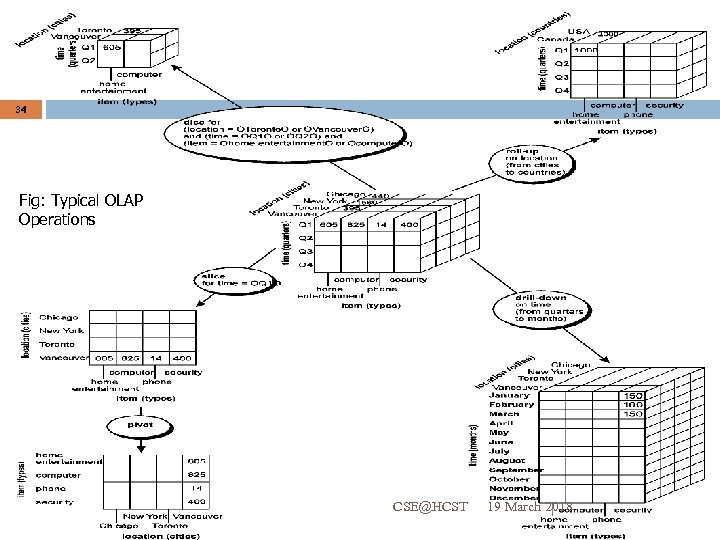 34 Fig: Typical OLAP Operations CSE@HCST 19 March 2018
 35 CSE@HCST 19 March 2018
 36 CSE@HCST 19 March 2018
 37/74 OLAP Operations in the Multidimensional Data Model Roll-up Drill-down Slice and dice Pivot (rotate) Other (drill-across, drill-through) CSE@HCST 19 March 2018
 ) ies Chicago 440 New York 1560 on Toronto 395 ati loc Vancouver time (quarters) t (ci Q 1 605 Q 3 computer home entertainment es) Chicago New York n tio Toronto ca Vancouver lo January 150 time (months) 2000 1000 Q 2 100 March 150 April May June July August September Q 3 October November Q 4 December computer home entertainment 38/74 phone ti (ci February ) ies Q 1 security item (types) USA Canada time (quarters) loc (co 400 Q 2 r on ati 14 Q 4 roll-up on location (from cities to countries) t un 825 drill-down on time (from quarters to months) security computer home entertainment phone item (types) CSE@HCST security phone item (types) 19 March 2018
 es) ti (ci Chicago 440 New York 1560 n 395 tio Toronto ca Vancouver lo 605 825 a loc 14 400 Q 2 Q 3 computer home entertainment security Q 1 395 605 Q 2 home dice for entertainment (location=“Toronto” or “Vancouver”) item (types) and (time=“Q 1”or “Q 2”) and (item=“home entertainment” or “computer”) phone item (types) slice for time=“Q 1” home entertainment Chicago New York Toronto Vancouver 605 pivot 825 14 computer home entertainment 400 item (types) location (cities) USA Canada computer Q 4 605 computer 825 14 phone 400 security New York security Chicago phone Vancouver Toronto location (cities) item (types) 39/74 n tio time (quarters) Q 1 ) ies t (ci CSE@HCST 19 March 2018
 A Starnet Query Model for Querying Multidimensional Databases 40/74 location customer continent group country province_or_state category city street day name brand category type item month quarter year time CSE@HCST 19 March 2018
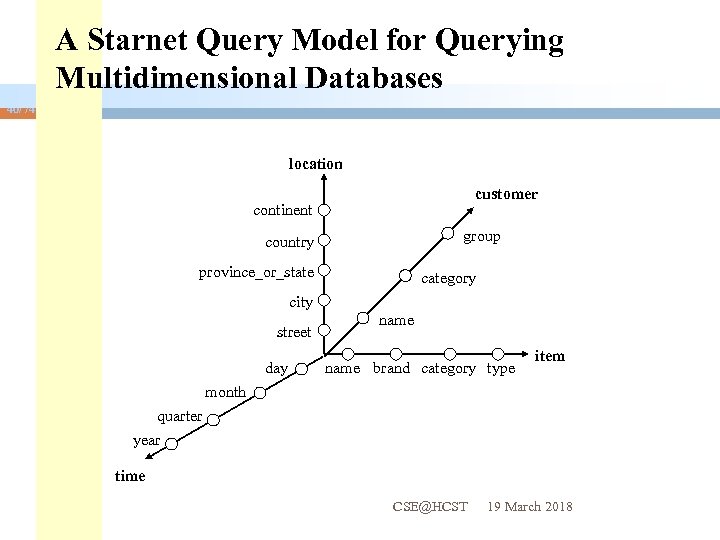
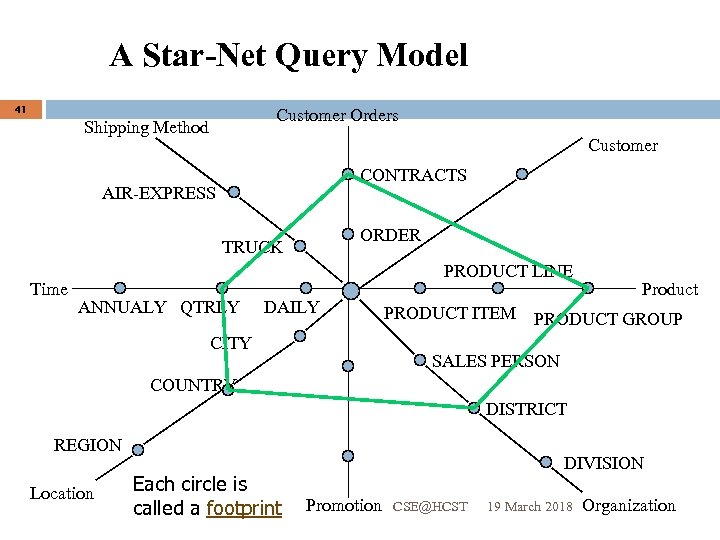 A Star-Net Query Model 41 Customer Orders Shipping Method Customer CONTRACTS AIR-EXPRESS ORDER TRUCK Time PRODUCT LINE ANNUALY QTRLY DAILY CITY Product PRODUCT ITEM PRODUCT GROUP SALES PERSON COUNTRY DISTRICT REGION Location Each circle is called a footprint DIVISION Promotion CSE@HCST 19 March 2018 Organization
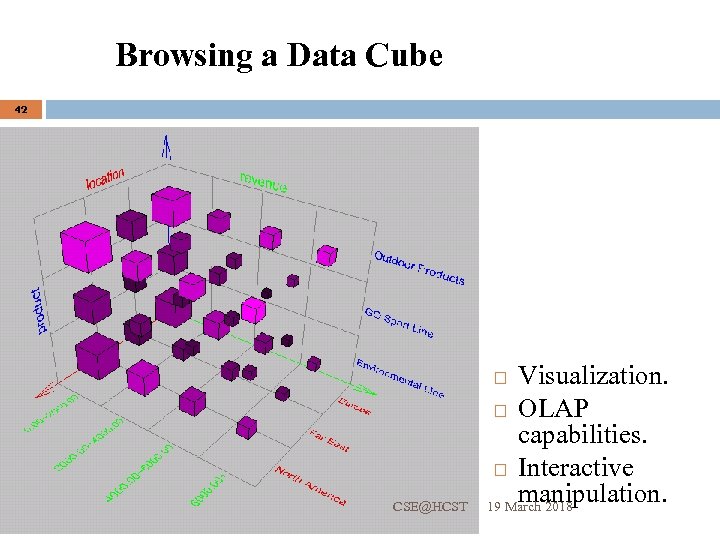 Browsing a Data Cube 42 Visualization. OLAP capabilities. Interactive manipulation. 19 March 2018 CSE@HCST
 Chapter 4: Data Warehousing and On-line Analytical Processing 43 Data Warehouse: Basic Concepts Data Warehouse Modeling: Data Cube and OLAP Data Warehouse Design and Usage Data Warehouse Implementation Data Generalization by Attribute-Oriented Induction Summary CSE@HCST 19 March 2018
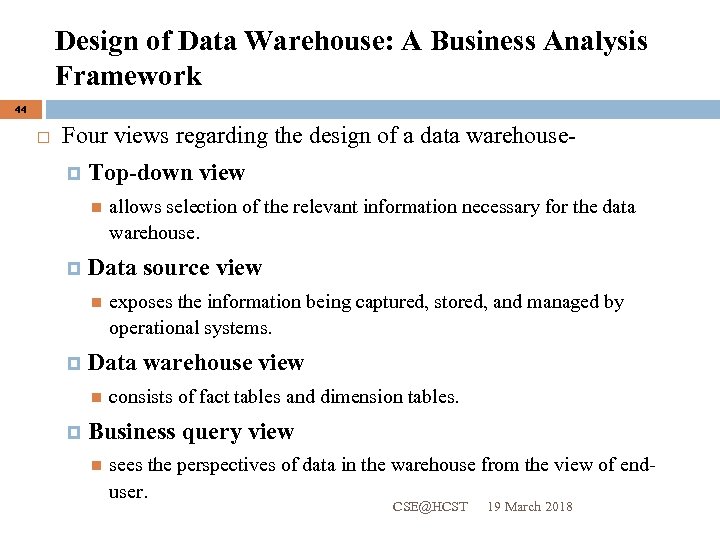 Design of Data Warehouse: A Business Analysis Framework 44 Four views regarding the design of a data warehouse Top-down view Data source view exposes the information being captured, stored, and managed by operational systems. Data warehouse view allows selection of the relevant information necessary for the data warehouse. consists of fact tables and dimension tables. Business query view sees the perspectives of data in the warehouse from the view of enduser. CSE@HCST 19 March 2018
 Data Warehouse Design Process 45 Top-down, bottom-up approaches or a combination of both Top-down: Starts with overall design and planning (mature). Bottom-up: Starts with experiments and prototypes (rapid). From software engineering point of view Waterfall: structured and systematic analysis at each step before proceeding to the next. Spiral: rapid generation of increasingly functional systems, short turn around time, quick turn around. Typical data warehouse design process Choose a business process to model, e. g. , orders, invoices, etc. Choose the grain (atomic level of data) of the business process. Choose the dimensions that will apply to each fact table record. Choose the measure that will populate each fact table record. CSE@HCST 19 March 2018
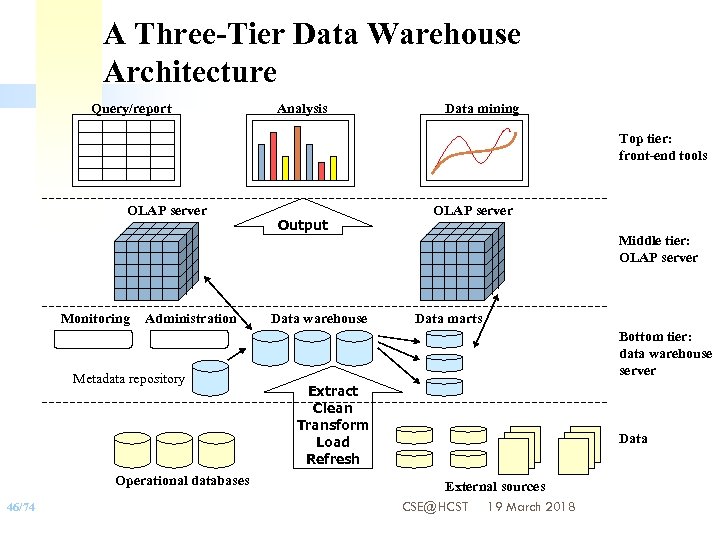 A Three-Tier Data Warehouse Architecture Query/report Analysis Data mining Top tier: front-end tools OLAP server Output OLAP server Middle tier: OLAP server Monitoring Administration Metadata repository Operational databases 46/74 Data warehouse Data marts Bottom tier: data warehouse server Extract Clean Transform Load Refresh Data External sources CSE@HCST 19 March 2018
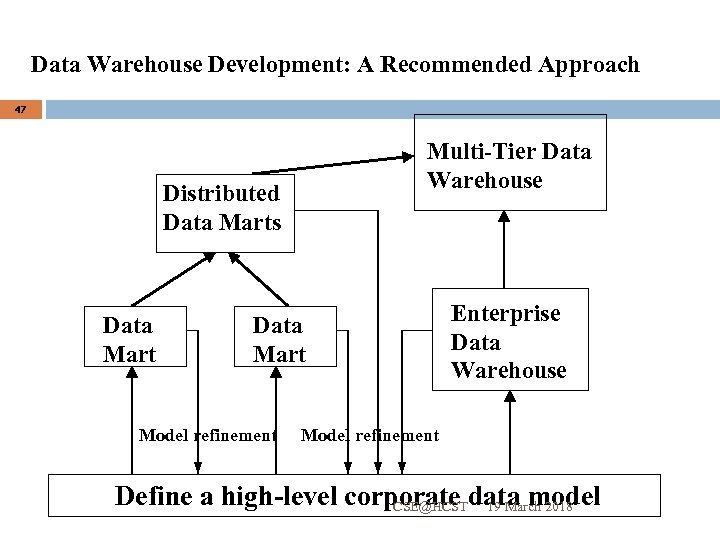 Data Warehouse Development: A Recommended Approach 47 Multi-Tier Data Warehouse Distributed Data Marts Data Mart Model refinement Enterprise Data Warehouse Model refinement Define a high-level corporate data model CSE@HCST 19 March 2018
 Data Warehouse Usage 48 Three kinds of data warehouse applications Information processing supports querying, basic statistical analysis, and reporting using crosstabs, tables, charts and graphs. Analytical processing multidimensional analysis of data warehouse data. supports basic OLAP operations, slice-dice, drilling, pivoting. Data mining knowledge discovery from hidden patterns. supports associations, constructing analytical models, performing classification and prediction, and presenting the mining results using CSE@HCST 19 March 2018 visualization tools.
 From On-Line Analytical Processing (OLAP) to On Line Analytical Mining (OLAM) 49 Why online analytical mining? High quality of data in data warehouses DW contains integrated, consistent, cleaned data. Available information processing structure surrounding data warehouses. ODBC, OLEDB, Web accessing, service facilities, reporting and OLAP tools. OLAP-based exploratory data analysis Mining with drilling, dicing, pivoting, etc. On-line selection of data mining functions Integration and swapping of multiple mining functions, algorithms, and tasks. CSE@HCST 19 March 2018
 Chapter 4: Data Warehousing and On-line Analytical Processing 50 Data Warehouse: Basic Concepts Data Warehouse Modeling: Data Cube and OLAP Data Warehouse Design and Usage Data Warehouse Implementation Data Generalization by Attribute-Oriented Induction Summary CSE@HCST 19 March 2018
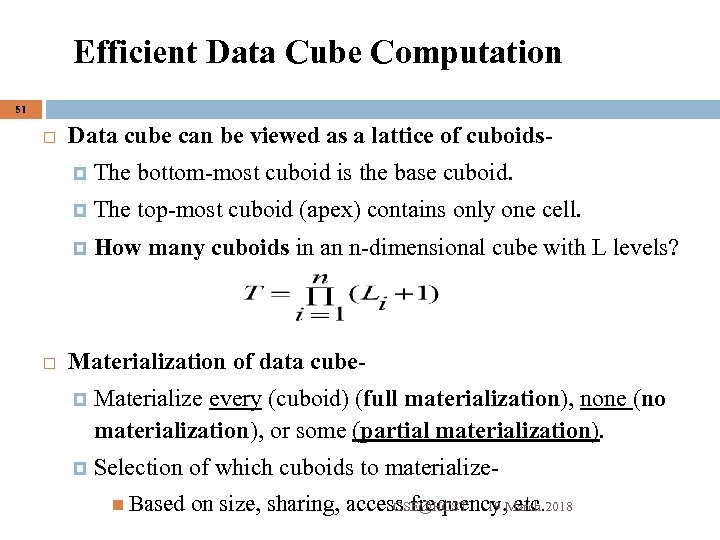 Efficient Data Cube Computation 51 Data cube can be viewed as a lattice of cuboids The top-most cuboid (apex) contains only one cell. The bottom-most cuboid is the base cuboid. How many cuboids in an n-dimensional cube with L levels? Materialization of data cube Materialize every (cuboid) (full materialization), none (no materialization), or some (partial materialization). Selection of which cuboids to materialize Based on size, sharing, access frequency, March 2018 CSE@HCST 19 etc.
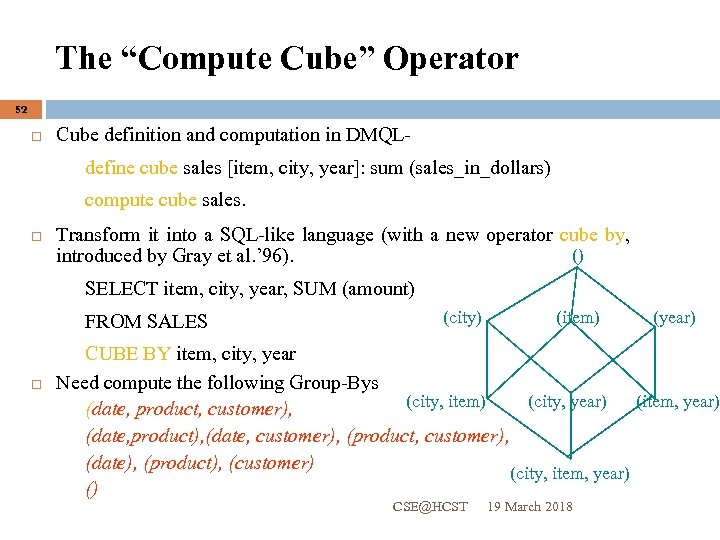 The “Compute Cube” Operator 52 Cube definition and computation in DMQLdefine cube sales [item, city, year]: sum (sales_in_dollars) compute cube sales. Transform it into a SQL-like language (with a new operator cube by, () introduced by Gray et al. ’ 96). SELECT item, city, year, SUM (amount) FROM SALES (city) (item) (year) CUBE BY item, city, year Need compute the following Group-Bys (city, item) (city, year) (item, year) (date, product, customer), (date, product), (date, customer), (product, customer), (date), (product), (customer) (city, item, year) () CSE@HCST 19 March 2018
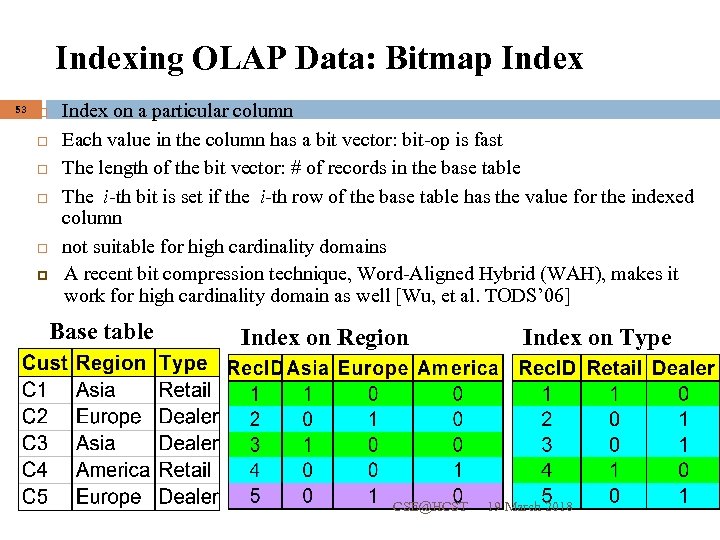 Indexing OLAP Data: Bitmap Index 53 Index on a particular column Each value in the column has a bit vector: bit-op is fast The length of the bit vector: # of records in the base table The i-th bit is set if the i-th row of the base table has the value for the indexed column not suitable for high cardinality domains A recent bit compression technique, Word-Aligned Hybrid (WAH), makes it work for high cardinality domain as well [Wu, et al. TODS’ 06] Base table Index on Region CSE@HCST Index on Type 19 March 2018
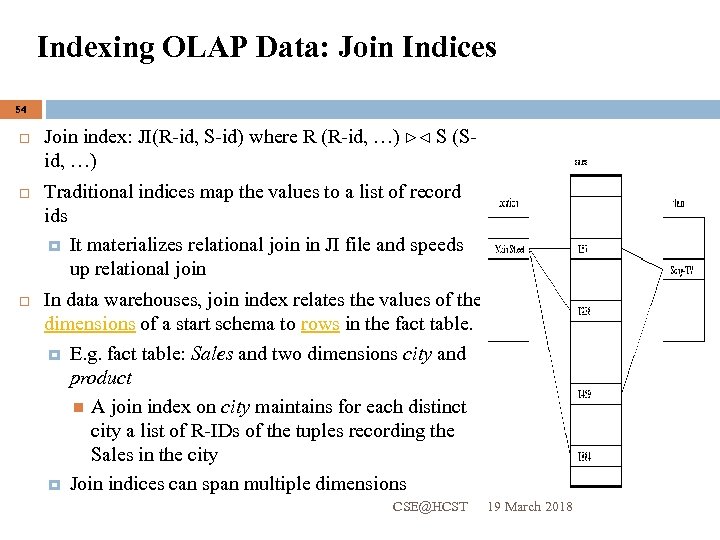 Indexing OLAP Data: Join Indices 54 Join index: JI(R-id, S-id) where R (R-id, …) S (Sid, …) Traditional indices map the values to a list of record ids It materializes relational join in JI file and speeds up relational join In data warehouses, join index relates the values of the dimensions of a start schema to rows in the fact table. E. g. fact table: Sales and two dimensions city and product A join index on city maintains for each distinct city a list of R-IDs of the tuples recording the Sales in the city Join indices can span multiple dimensions CSE@HCST 19 March 2018
 Efficient Processing OLAP Queries 55 Determine which operations should be performed on the available cuboids Transform drill, roll, etc. into corresponding SQL and/or OLAP operations, e. g. , dice = selection + projection Determine which materialized cuboid(s) should be selected for OLAP op. Let the query to be processed be on {brand, province_or_state} with the condition “year = 2004”, and there are 4 materialized cuboids available: 1) {year, item_name, city} 2) {year, brand, country} 3) {year, brand, province_or_state} 4) {item_name, province_or_state} where year = 2004 Which should be selected to process the query? CSE@HCST Explore indexing structures and compressed vs. dense 19 March 2018 in MOLAP array structs
 OLAP Server Architectures 56 Relational OLAP (ROLAP) Use relational or extended-relational DBMS to store and manage warehouse data and OLAP middle ware Include optimization of DBMS backend, implementation of aggregation navigation logic, and additional tools and services Greater scalability Multidimensional OLAP (MOLAP) Sparse array-based multidimensional storage engine Fast indexing to pre-computed summarized data Hybrid OLAP (HOLAP) (e. g. , Microsoft SQLServer) Flexibility, e. g. , low level: relational, high-level: array Specialized SQL servers (e. g. , Redbricks) Specialized support for SQL queries over star/snowflake schemas CSE@HCST 19 March 2018
 Chapter 4: Data Warehousing and On-line Analytical Processing 57 Data Warehouse: Basic Concepts Data Warehouse Modeling: Data Cube and OLAP Data Warehouse Design and Usage Data Warehouse Implementation Data Generalization by Attribute-Oriented Induction Summary CSE@HCST 19 March 2018
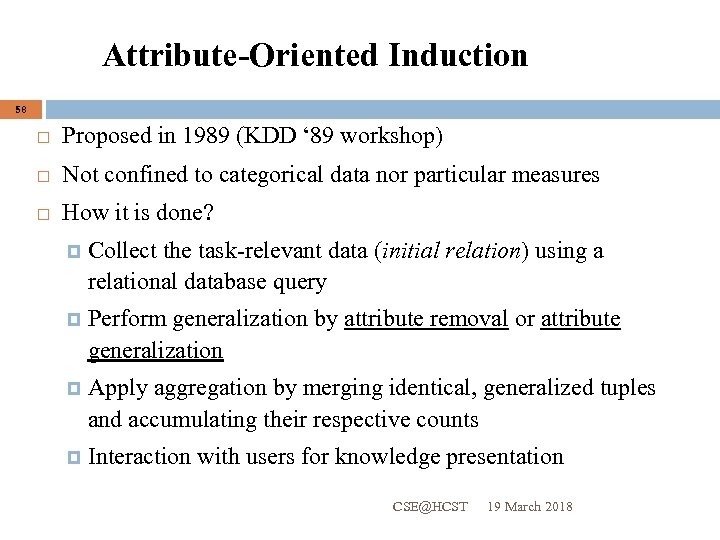 Attribute-Oriented Induction 58 Proposed in 1989 (KDD ‘ 89 workshop) Not confined to categorical data nor particular measures How it is done? Collect the task-relevant data (initial relation) using a relational database query Perform generalization by attribute removal or attribute generalization Apply aggregation by merging identical, generalized tuples and accumulating their respective counts Interaction with users for knowledge presentation CSE@HCST 19 March 2018
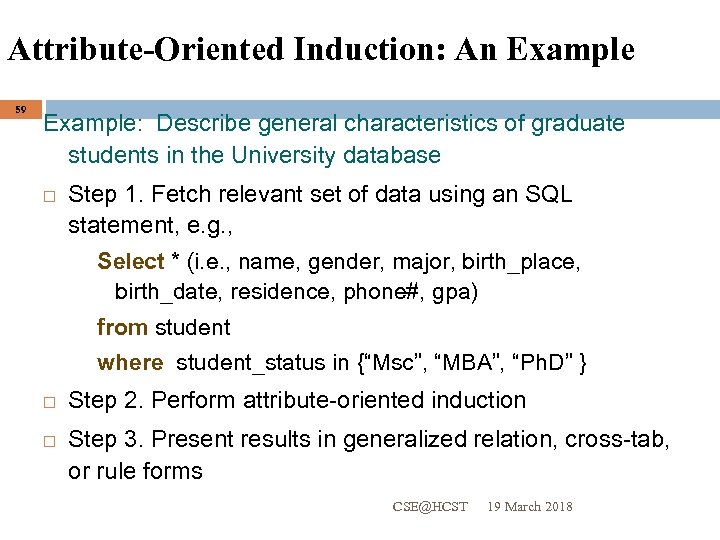 Attribute-Oriented Induction: An Example 59 Example: Describe general characteristics of graduate students in the University database Step 1. Fetch relevant set of data using an SQL statement, e. g. , Select * (i. e. , name, gender, major, birth_place, birth_date, residence, phone#, gpa) from student where student_status in {“Msc”, “MBA”, “Ph. D” } Step 2. Perform attribute-oriented induction Step 3. Present results in generalized relation, cross-tab, or rule forms CSE@HCST 19 March 2018
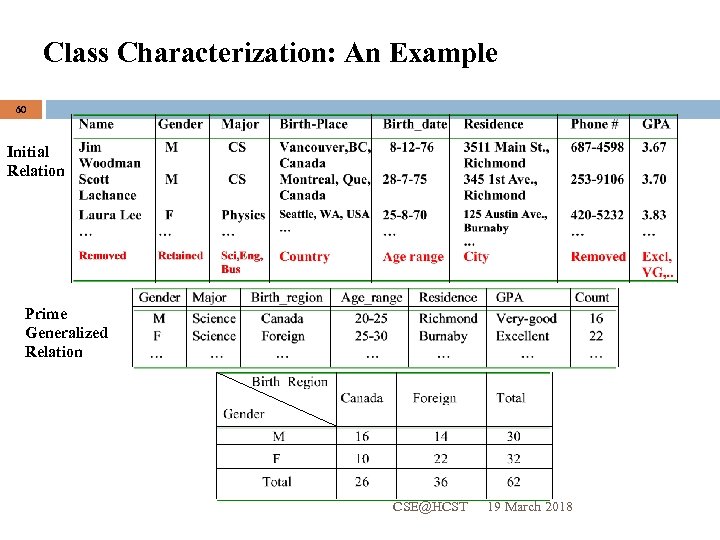 Class Characterization: An Example 60 Initial Relation Prime Generalized Relation CSE@HCST 19 March 2018
 Basic Principles of Attribute-Oriented Induction 61 Data focusing: task-relevant data, including dimensions, and the result is the initial relation. Attribute-removal: remove attribute A if there is a large set of distinct values for A but (1) there is no generalization operator on A, or (2) A’s higher level concepts are expressed in terms of other attributes. Attribute-generalization: If there is a large set of distinct values for A, and there exists a set of generalization operators on A, then select an operator and generalize A. Attribute-threshold control: typical 2 -8, specified/default. Generalized relation threshold control: control the final relation/rule size. CSE@HCST 19 March 2018
 Attribute-Oriented Induction: Basic Algorithm 62 Initial. Rel: Query processing of task-relevant data, deriving the initial relation. Pre. Gen: Based on the analysis of the number of distinct values in each attribute, determine generalization plan for each attribute: removal? or how high to generalize? Prime. Gen: Based on the Pre. Gen plan, perform generalization to the right level to derive a “prime generalized relation”, accumulating the counts. Presentation: User interaction: (1) adjust levels by drilling, (2) pivoting, (3) mapping into rules, cross tabs, visualization presentations. CSE@HCST 19 March 2018
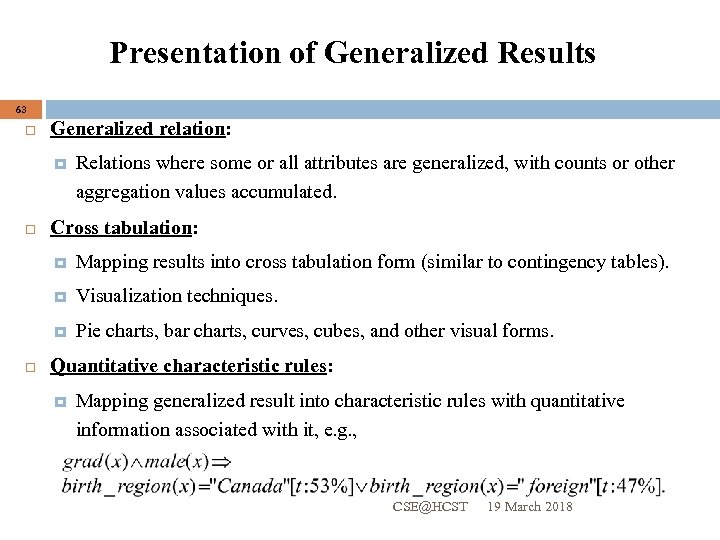 Presentation of Generalized Results 63 Generalized relation: Relations where some or all attributes are generalized, with counts or other aggregation values accumulated. Cross tabulation: Visualization techniques. Mapping results into cross tabulation form (similar to contingency tables). Pie charts, bar charts, curves, cubes, and other visual forms. Quantitative characteristic rules: Mapping generalized result into characteristic rules with quantitative information associated with it, e. g. , CSE@HCST 19 March 2018
 Mining Class Comparisons 64 Comparison: Comparing two or more classes Method: Partition the set of relevant data into the target class and the contrasting class(es) Generalize both classes to the same high level concepts Compare tuples with the same high level descriptions Present for every tuple its description and two measures support - distribution within single class comparison - distribution between classes Highlight the tuples with strong discriminant features Relevance Analysis: Find attributes (features) which best distinguish different classes CSE@HCST 19 March 2018
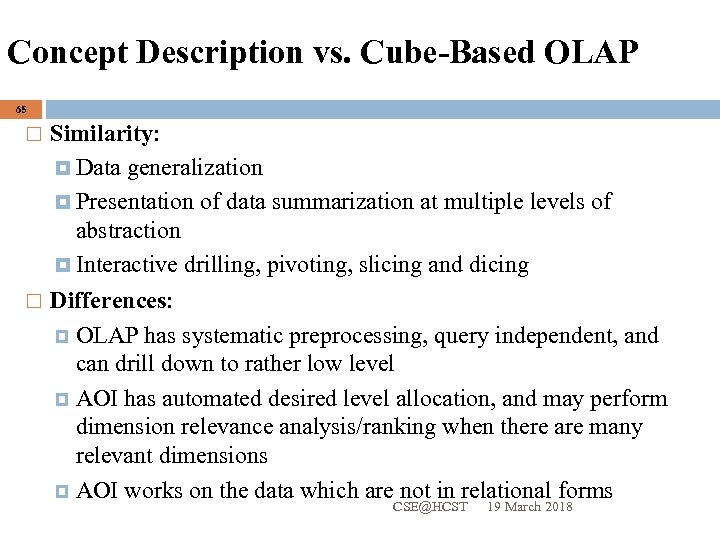 Concept Description vs. Cube-Based OLAP 65 Similarity: Data generalization Presentation of data summarization at multiple levels of abstraction Interactive drilling, pivoting, slicing and dicing Differences: OLAP has systematic preprocessing, query independent, and can drill down to rather low level AOI has automated desired level allocation, and may perform dimension relevance analysis/ranking when there are many relevant dimensions AOI works on the data which are not in relational forms CSE@HCST 19 March 2018
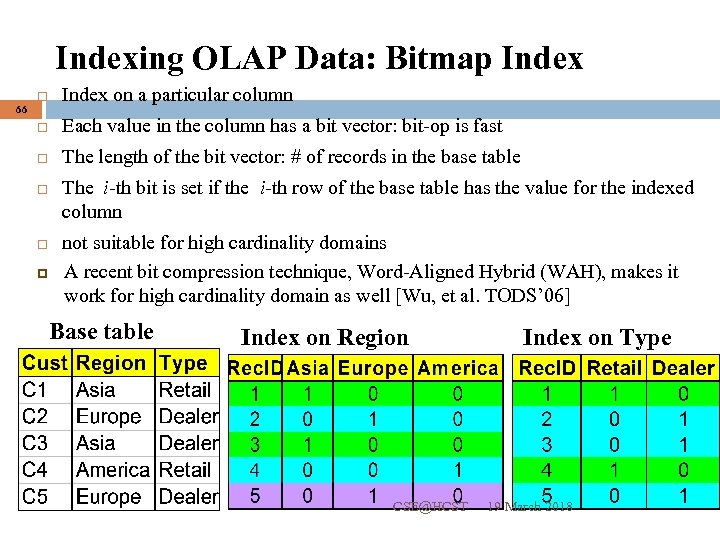 Indexing OLAP Data: Bitmap Index on a particular column Each value in the column has a bit vector: bit-op is fast The length of the bit vector: # of records in the base table 66 The i-th bit is set if the i-th row of the base table has the value for the indexed column not suitable for high cardinality domains A recent bit compression technique, Word-Aligned Hybrid (WAH), makes it work for high cardinality domain as well [Wu, et al. TODS’ 06] Base table Index on Region CSE@HCST Index on Type 19 March 2018
 Data Warehousing and On-line Analytical Processing 67 Data Warehouse: Basic Concepts Data Warehouse Modeling: Data Cube and OLAP Data Warehouse Design and Usage Data Warehouse Implementation Data Generalization by Attribute-Oriented Induction Summary CSE@HCST 19 March 2018
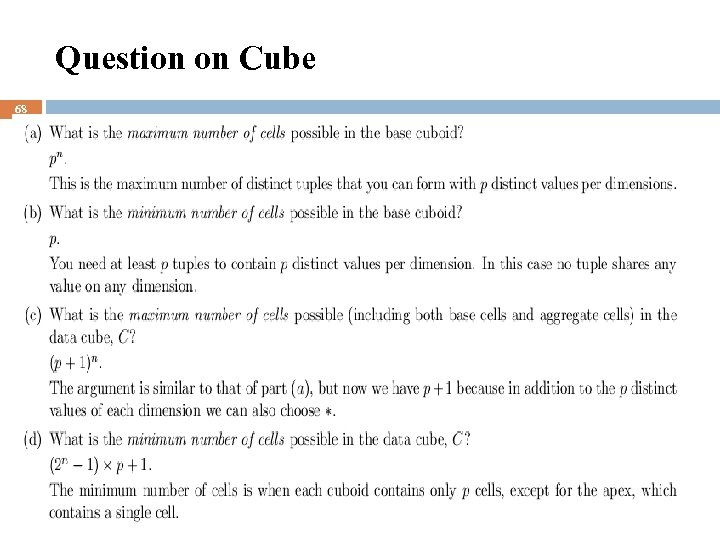 Question on Cube 68 CSE@HCST 19 March 2018
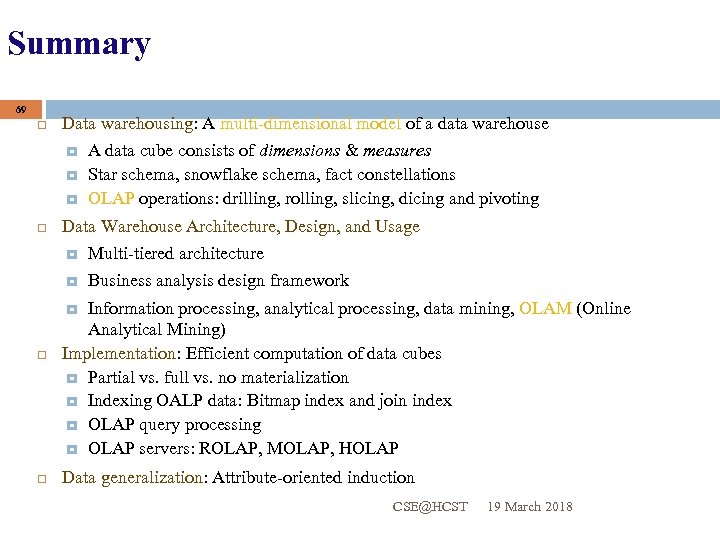 Summary 69 Data warehousing: A multi-dimensional model of a data warehouse A data cube consists of dimensions & measures Star schema, snowflake schema, fact constellations OLAP operations: drilling, rolling, slicing, dicing and pivoting Data Warehouse Architecture, Design, and Usage Multi-tiered architecture Business analysis design framework Information processing, analytical processing, data mining, OLAM (Online Analytical Mining) Implementation: Efficient computation of data cubes Partial vs. full vs. no materialization Indexing OALP data: Bitmap index and join index OLAP query processing OLAP servers: ROLAP, MOLAP, HOLAP Data generalization: Attribute-oriented induction CSE@HCST 19 March 2018