


 Скачать презентацию CSE 709 Millimeter-Wave Networking Sensing and Applications Dimitrios
59cc424dbd47315580be43e5823bb463.ppt
- Количество слайдов: 42
 CSE 709 Millimeter-Wave Networking, Sensing, and Applications Dimitrios Koutsonikolas August 30, 2017 http: //www. cse. buffalo. edu/faculty/dimitrio/courses/cse 709_f 17/index. html
 Instructor http: //www. cse. buffalo. edu/faculty/dimitrio/ • Associate Professor, CSE • Research interests: experimental wireless/mobile networks and systems • Office: 311 Davis Hall • Office hours: Tuesday 11: 00 -12: 00, or by appointment (use email) • Email: dimitrio@buffalo. edu 2
 Time and Location • Lectures – Wednesday, 6: 30 -9: 00 PM, Davis 338 A • Presentation preparation meetings – Tuesday, 11: 00 -12: 00, Davis 311 – More on this later 3
 Important URLs • Course website (notes, slides, etc. ) http: //www. cse. buffalo. edu/faculty/dimitrio/courses/cse 709_f 17/index. html • Piazza (questions, discussions, announcements) https: //piazza. com/buffalo/fall 2017/cse 709/home 4
 Course Overview • A selection of topics in mm. Wave networking and sensing • Systems/practical perspective 5
 Millimeter-Wave (mm. Wave) Networking 6
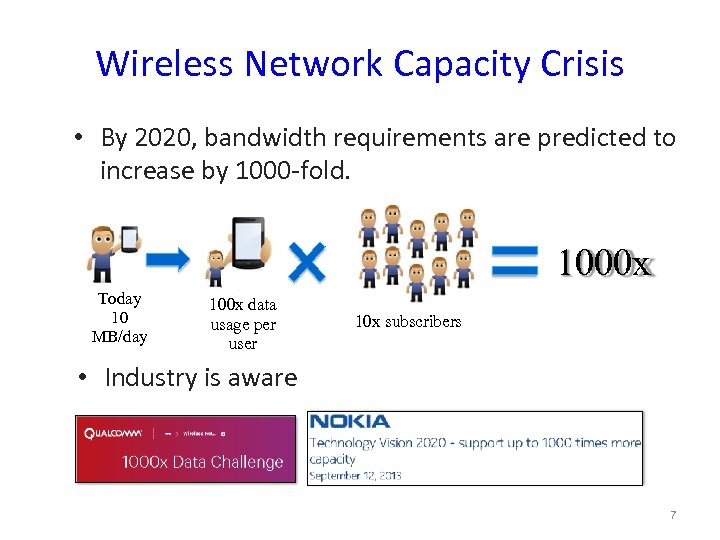 Wireless Network Capacity Crisis • By 2020, bandwidth requirements are predicted to increase by 1000 -fold. 1000 x Today 10 MB/day 100 x data usage per user 10 x subscribers • Industry is aware 7
 Current solutions are Limited • To meet the 1000 x requirement, we could. . – Buy more spectrum: (LTE) 100 MHz ->-> 100 GHz – Massively large MIMO arrays: 1000 -element array • In reality, hopefully 2 x licensed spectrum and 20 x gain from MIMO by 2020 – Still far from 1000 x • Need dramatically different approaches to speed up! 8
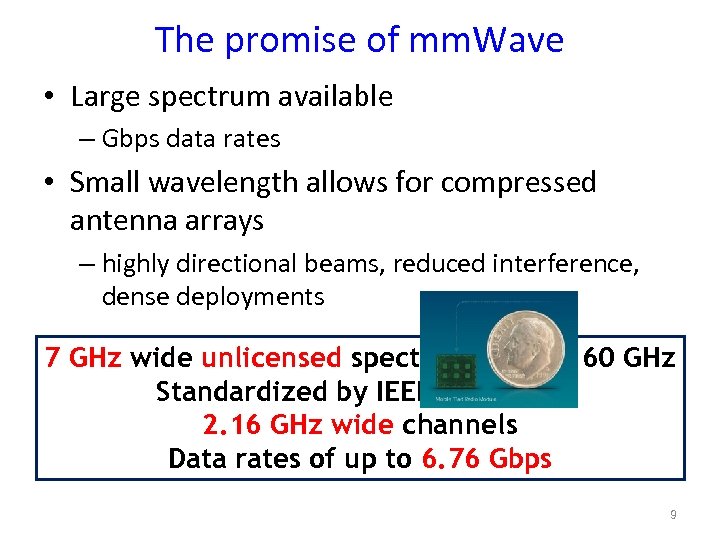 The promise of mm. Wave • Large spectrum available – Gbps data rates • Small wavelength allows for compressed antenna arrays – highly directional beams, reduced interference, dense deployments 7 GHz wide unlicensed spectrum around 60 GHz Standardized by IEEE 802. 11 ad 2. 16 GHz wide channels Data rates of up to 6. 76 Gbps 9
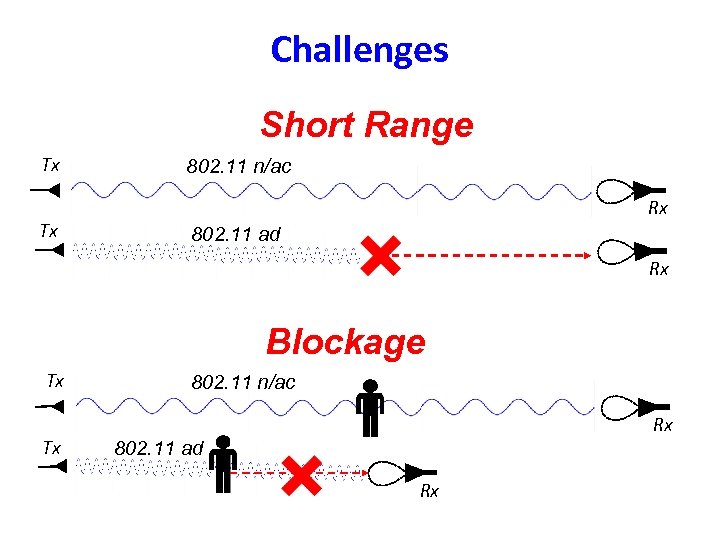 Challenges Short Range Tx Tx 802. 11 n/ac Rx 802. 11 ad Rx Blockage Tx Tx 802. 11 n/ac Rx 802. 11 ad Rx
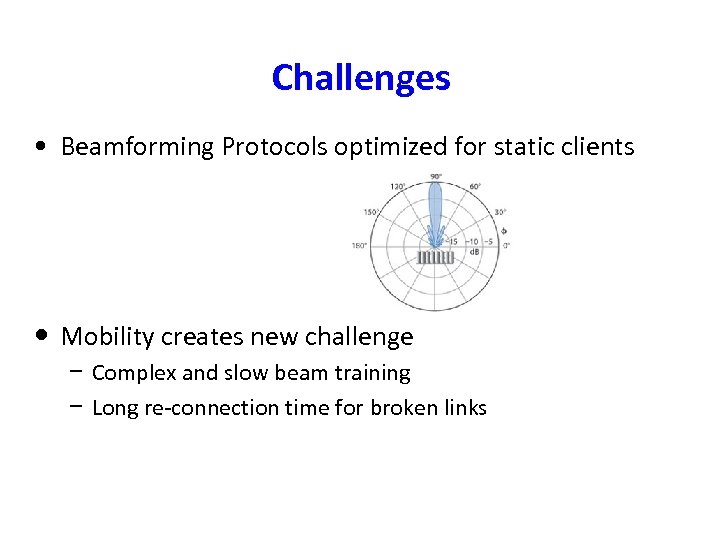 Challenges • Beamforming Protocols optimized for static clients • Mobility creates new challenge − Complex and slow beam training − Long re-connection time for broken links
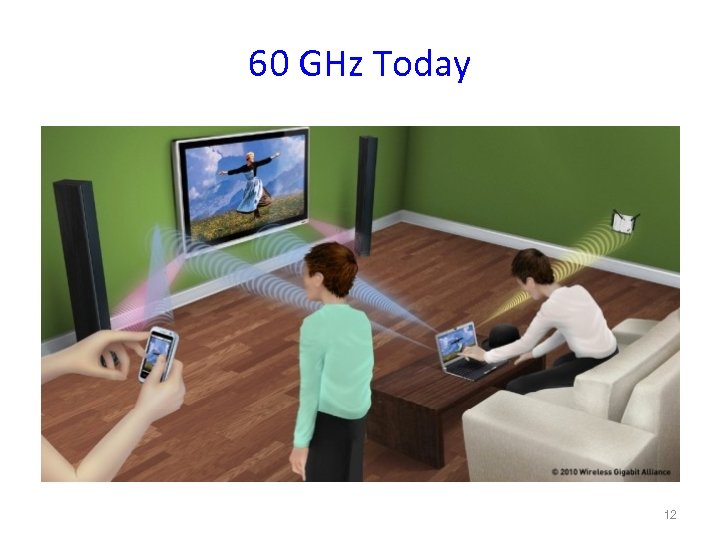 60 GHz Today 12
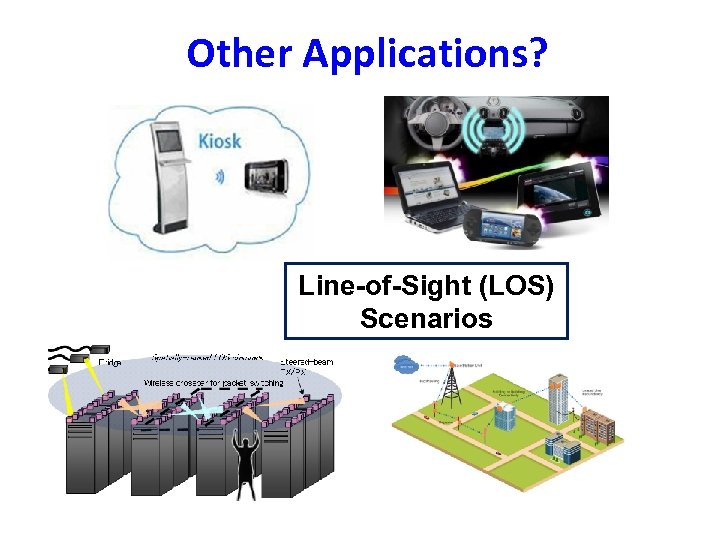 Other Applications? Line-of-Sight (LOS) Scenarios
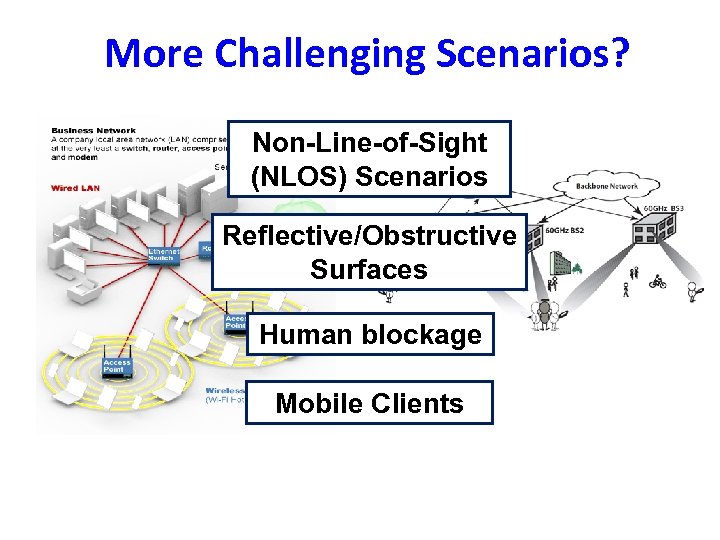 More Challenging Scenarios? Non-Line-of-Sight (NLOS) Scenarios Reflective/Obstructive Surfaces Human blockage Mobile Clients
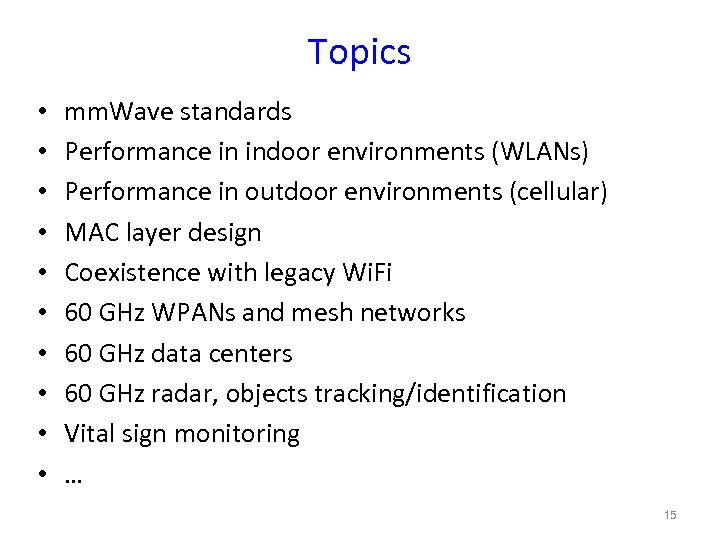 Topics • • • mm. Wave standards Performance in indoor environments (WLANs) Performance in outdoor environments (cellular) MAC layer design Coexistence with legacy Wi. Fi 60 GHz WPANs and mesh networks 60 GHz data centers 60 GHz radar, objects tracking/identification Vital sign monitoring … 15
 Course Objectives • Learn state-of-the-art in mm. Wave networking • Discuss challenges and opportunities in mm. Wave networking research • Identify open research problems for further study (for interested students) • Learn/practice 2 essential skills of doing research – How to read/review a research paper – How to present a research paper 16
 Prerequisites • Background in computer/wireless networking – CSE 589 or CSE 630 or equivalent • If you haven’t taken any of the prerequisites, arrange for a meeting with me this week! • Send me email including – Brief description of your relevant background – Why you want to take this seminar 17
 Course Workload • • • Read papers Write paper reviews Present 1 paper Present 1 related work summary (2/3 credits) Participate in class discussions 18
 Class Format • Discuss one topic each week – Mandatory paper (everyone reads before class!) – Optional papers • One student presents mandatory paper for 11. 5 hours • Another student summarizes optional papers and leads topic discussion for remaining 1 hour 19
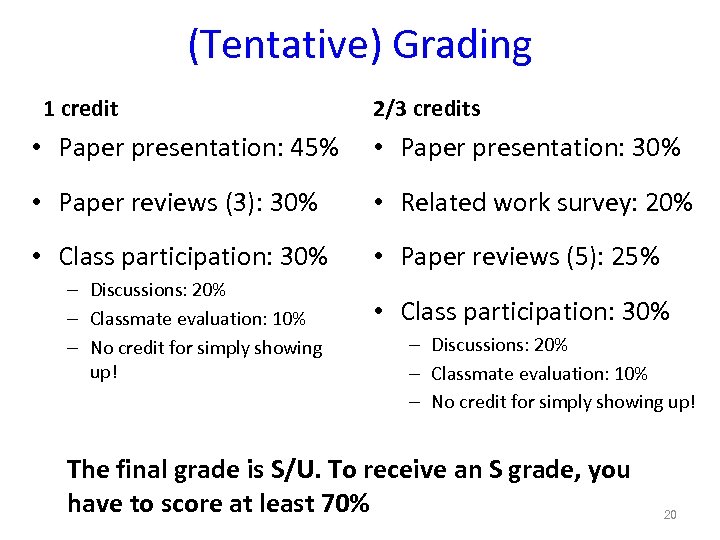 (Tentative) Grading 1 credit 2/3 credits • Paper presentation: 45% • Paper presentation: 30% • Paper reviews (3): 30% • Related work survey: 20% • Class participation: 30% • Paper reviews (5): 25% – Discussions: 20% – Classmate evaluation: 10% – No credit for simply showing up! • Class participation: 30% – Discussions: 20% – Classmate evaluation: 10% – No credit for simply showing up! The final grade is S/U. To receive an S grade, you have to score at least 70% 20
 Reading Papers • 10 mandatory papers – Everyone has to read • Recommended reading: “How to Read a paper”, S. Keshav • 3 -pass approach 21
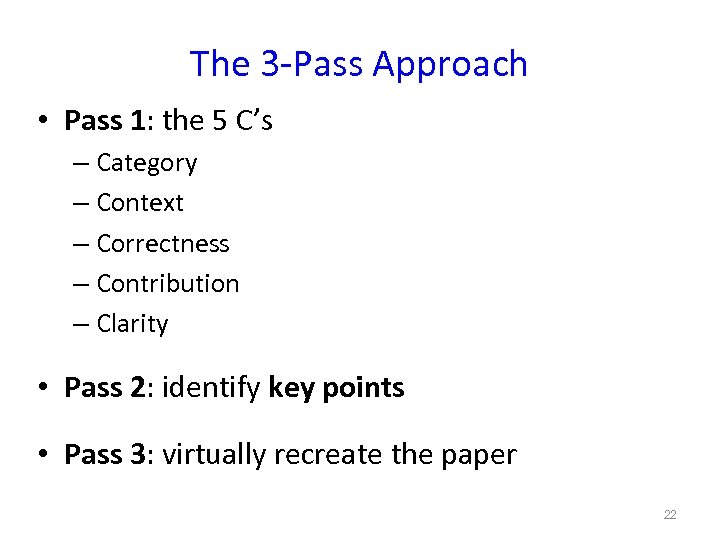 The 3 -Pass Approach • Pass 1: the 5 C’s – Category – Context – Correctness – Contribution – Clarity • Pass 2: identify key points • Pass 3: virtually recreate the paper 22
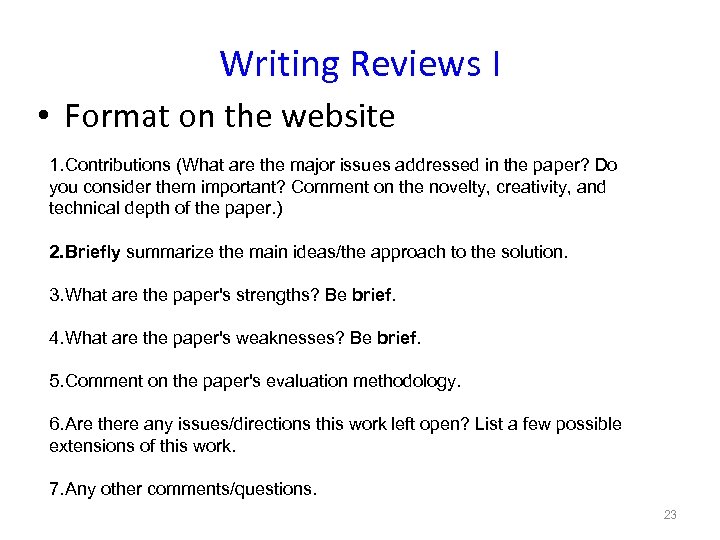 Writing Reviews I • Format on the website 1. Contributions (What are the major issues addressed in the paper? Do you consider them important? Comment on the novelty, creativity, and technical depth of the paper. ) 2. Briefly summarize the main ideas/the approach to the solution. 3. What are the paper's strengths? Be brief. 4. What are the paper's weaknesses? Be brief. 5. Comment on the paper's evaluation methodology. 6. Are there any issues/directions this work left open? List a few possible extensions of this work. 7. Any other comments/questions. 23
 Writing Reviews II • Email the reviews to me by 08: 59 am on Wednesdays! – txt only – Late reviews will not be accepted! • You have to submit 3/5 reviews (your choice) – You cannot choose the papers you are presenting • Will post best 2 -3 reviews every time online • NO CHEATING!!!!! 24
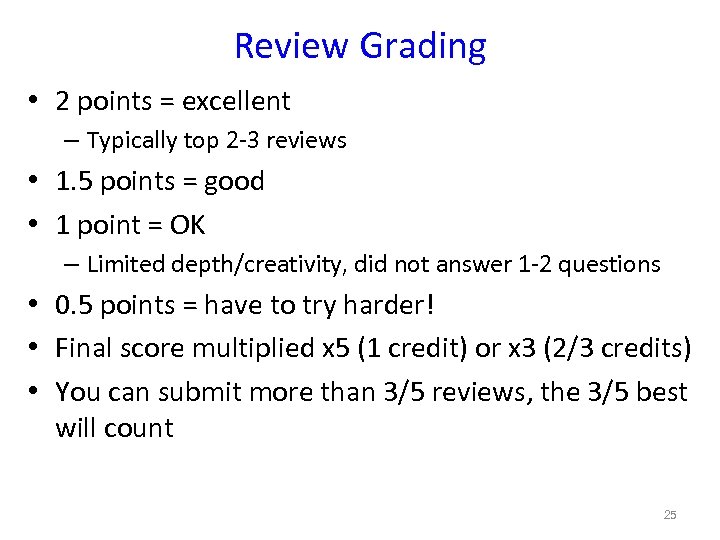 Review Grading • 2 points = excellent – Typically top 2 -3 reviews • 1. 5 points = good • 1 point = OK – Limited depth/creativity, did not answer 1 -2 questions • 0. 5 points = have to try harder! • Final score multiplied x 5 (1 credit) or x 3 (2/3 credits) • You can submit more than 3/5 reviews, the 3/5 best will count 25
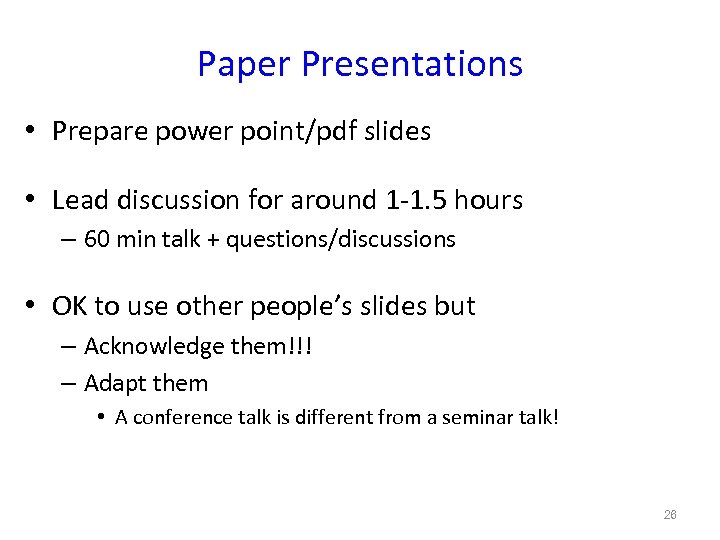 Paper Presentations • Prepare power point/pdf slides • Lead discussion for around 1 -1. 5 hours – 60 min talk + questions/discussions • OK to use other people’s slides but – Acknowledge them!!! – Adapt them • A conference talk is different from a seminar talk! 26
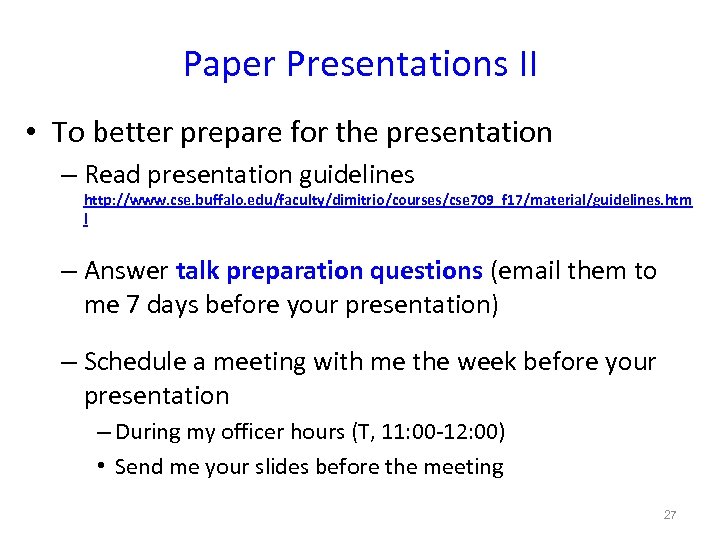 Paper Presentations II • To better prepare for the presentation – Read presentation guidelines http: //www. cse. buffalo. edu/faculty/dimitrio/courses/cse 709_f 17/material/guidelines. htm l – Answer talk preparation questions (email them to me 7 days before your presentation) – Schedule a meeting with me the week before your presentation – During my officer hours (T, 11: 00 -12: 00) • Send me your slides before the meeting 27
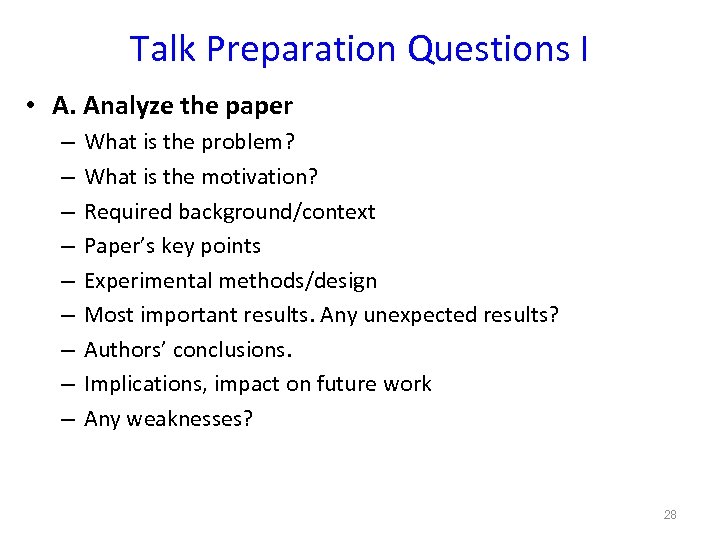 Talk Preparation Questions I • A. Analyze the paper – – – – – What is the problem? What is the motivation? Required background/context Paper’s key points Experimental methods/design Most important results. Any unexpected results? Authors’ conclusions. Implications, impact on future work Any weaknesses? 28
 Talk Preparation Questions II • B. Adapt paper for your audience – Why should the audience be interested in this topic? – What do they already know? – What terms/definitions will be new? – Which key points/definitions will be most difficult to grasp? 29
 Presentation Guidelines • Rule 0: Understand the paper, identify key points, think how to adapt for audience • Rule 1: Have a slide very early on that states the key points of the paper • Rule 2: Structure rest of talk around key points • Rule 3: Explain purpose of experiments, experimental setup, results, conclusions drawn • Rule 4: Two parts in your talk – 1 st part: present paper as author – 2 nd part: your critique 30
 Presentation Guidelines (Slides) • Rule 5: Use a big letter size! • Rule 6: Do not clutter your slides! • Rule 7: Pictures are almost always better than text • Rule 8: A slide should never try to convey more than a single concept 31
 Presentation Guidelines (Preparation) • Rule 9: Do at least a couple of dry-runs • Rule 10: Think of possible questions, prepare back-up slides • Rule 11: To memorize or not? – Memorizing the first few slides often helps… 32
 Presentation Guidelines (On the Stage) • Rule 12: Make it look like you are having a good time • Rule 13: Make sure the audience can always see the screen • Rule 14: Do not try too hard to be funny • Rule 15: Maintain eye contact with the audience • Presentation evaluation – Done by classmates! – Counts towards class participation! 33
 Peer evaluations • After each paper presentation – Fill in the form at the end of each class – I will send a summary to presenter(s) along with my evaluation – Presenter does not see who wrote what – No offensive comments! • Your evaluations do not affect the grade of the presenters! – Be honest! • Your evaluations affect your grade! – Take them seriously! 34
 How Do I Describe a Graph? • It is the presenter’s task to explain the graph and the conclusions drawn to the audience! • Describe x, y axis • Describe points, lines, bars, error bars, etc. • Describe conclusions 35
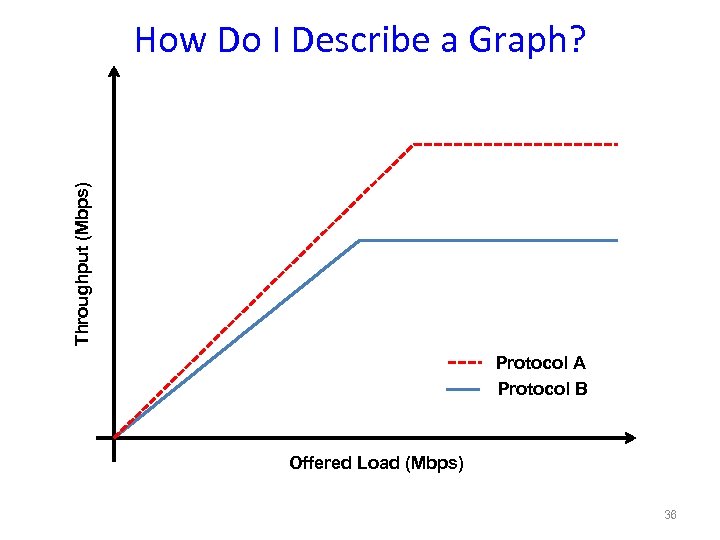 Throughput (Mbps) How Do I Describe a Graph? Protocol A Protocol B Offered Load (Mbps) 36
 Related Work Presentation • Summarize 2 -4 papers – Optional papers in reading list – Any other relevant paper you find (but ask me first!) • Use slides (highly recommended) – Only main ideas, no details – How does it differ from the main paper? How does it expand the main paper? • Lead discussion on topic of the week • Discuss with presenter of mandatory paper 37
 Class Participation • Very important!!! • Attend classes, participate in discussions (in class and online), express your opinion, ask questions • Be critical – No paper is perfect! • Be creative – Think of alternative solutions/possible extensions • Feel free to share ideas, questions, articles on mm. Wave networking etc. on piazza 38
 Academic Integrity • No tolerance on cheating/plagiarism!!! – All academic integrity violation cases will be reported to the department, school and university, and recorded – 0 in the particular assignment for first offence in any course – Fail the course for 2 nd offence – Consult the University Statements on Academic Integrity: https: //engineering. buffalo. edu/computer-science-engineering/graduate/resources-forcurrent-students/academic-integrity. html • Students who share the work with others are as responsible for academic dishonesty as those receiving the material 39
 Academic Integrity II • Paper presentations – You can use any material found online (except past CSE 630/701/708 slides) as long as you acknowledge them – E. g. , in your last slide: “Many slides were borrowed from …”, or use footnotes in each slide • Paper reviews – You cannot use any online material! – Reading/discussing papers in groups is encouraged – The reviews have to be written individually!!! – A zero grade due to cheating will be included in the list of graded reviews! – A second zero = fail the course 40
 Assignment 0 • Read “How to Read a Paper” • Decide whether you are staying or not • Pick up your preferred topics – 1 st and 2 nd choice for presentation – 1 st and 2 nd choice for related work (have to be different from presentation topics) – Post your choices on piazza by Friday – FCFS – check piazza before you choose – We need volunteers for the first topic 41
 Questions? 42