


 Скачать презентацию CSE 588 Network Systems Terry Gray Director Networks
d754e3b6211788cd84a51b606dde5ae9.ppt
- Количество слайдов: 45
 CSE 588: Network Systems Terry Gray* Director, Networks & Distributed Computing Affiliate Professor, Computer Science & Engineering University of Washington * and friends
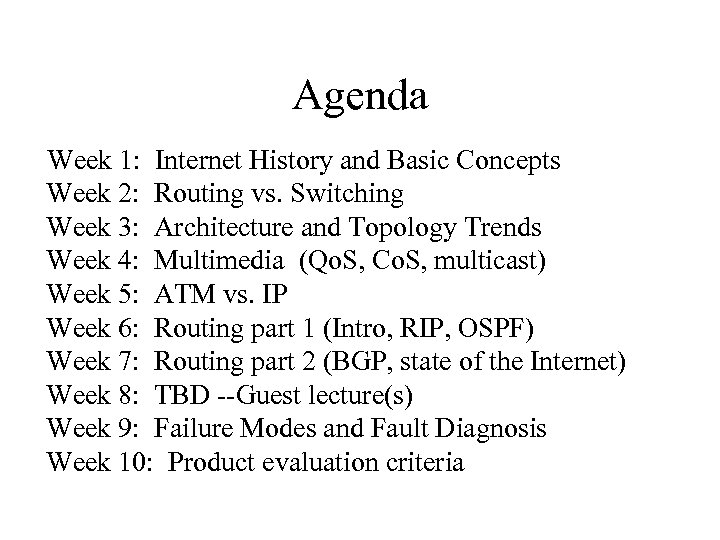 Agenda Week 1: Internet History and Basic Concepts Week 2: Routing vs. Switching Week 3: Architecture and Topology Trends Week 4: Multimedia (Qo. S, Co. S, multicast) Week 5: ATM vs. IP Week 6: Routing part 1 (Intro, RIP, OSPF) Week 7: Routing part 2 (BGP, state of the Internet) Week 8: TBD --Guest lecture(s) Week 9: Failure Modes and Fault Diagnosis Week 10: Product evaluation criteria
 Non-Agenda • • • Tutorial on Networking Fundamentals Protocol Design Device Design Network Programming Network Modeling/Analysis
 The Plan • Focus on Internet technology from network practitioner’s perspective. • Focus on enterprise and wide-area issues. • Use commodity Internet and UW campus network as case studies. • Discuss and debate alternatives!
 Week 1: Background • Networking Fundamentals • The Internet: Past, Present, Future • UW’s Intranet: Past, Present, Future
 Networking Fundamentals • • • Terminology The Reference Model(s) The Great Debates Conventional Wisdom Gray’s Networking Nuggets Some Research Questions
 Terminology • • • Open LAN, CAN, MAN, WAN. . . VLAN, ELAN TCP/IP Internet, Intranet Packet, Message, Circuit Switching Frame, Cell Repeater, Bridge/Switch, Router MAC Address IP Address ATM
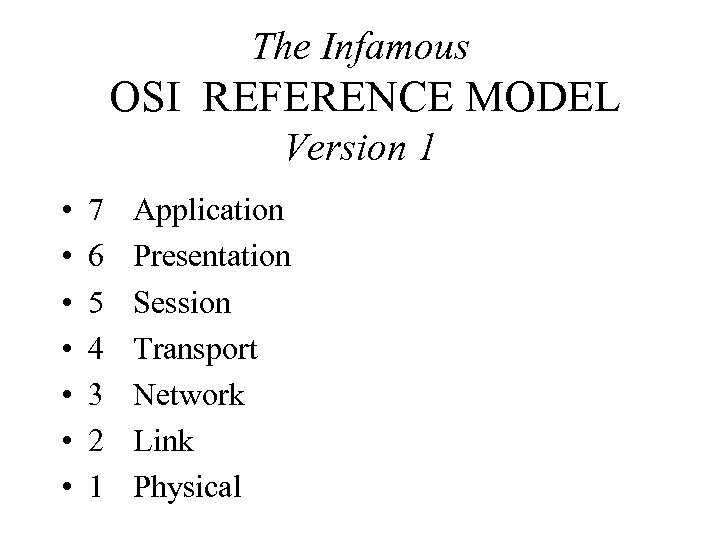 The Infamous OSI REFERENCE MODEL Version 1 • • 7 6 5 4 3 2 1 Application Presentation Session Transport Network Link Physical
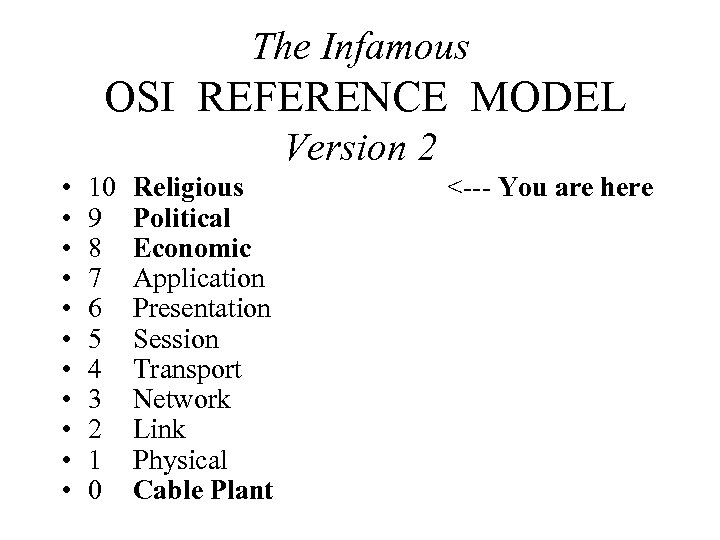 The Infamous OSI REFERENCE MODEL Version 2 • • • 10 9 8 7 6 5 4 3 2 1 0 Religious Political Economic Application Presentation Session Transport Network Link Physical Cable Plant <--- You are here
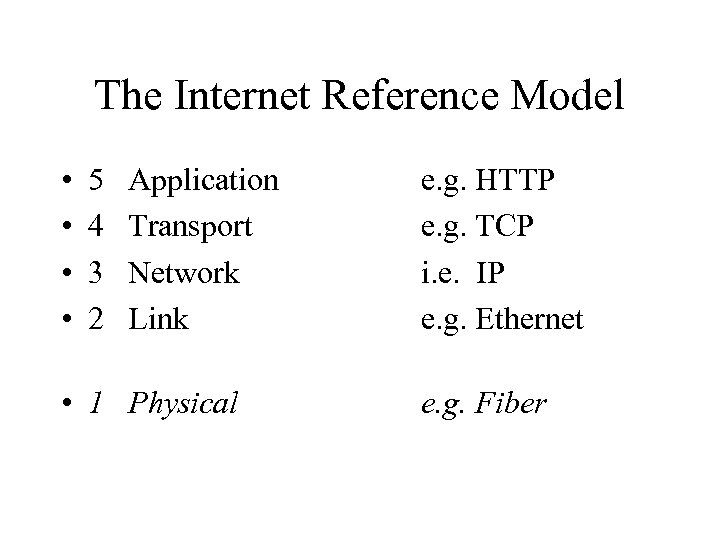 The Internet Reference Model • • 5 4 3 2 Application Transport Network Link • 1 Physical e. g. HTTP e. g. TCP i. e. IP e. g. Ethernet e. g. Fiber
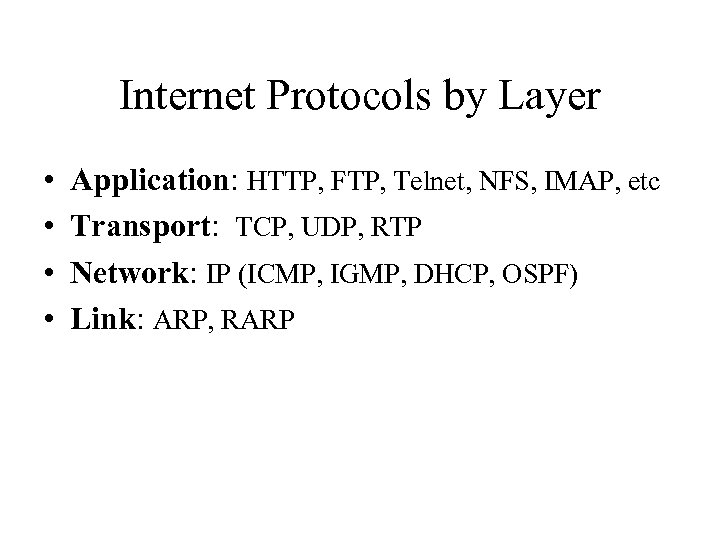 Internet Protocols by Layer • • Application: HTTP, FTP, Telnet, NFS, IMAP, etc Transport: TCP, UDP, RTP Network: IP (ICMP, IGMP, DHCP, OSPF) Link: ARP, RARP
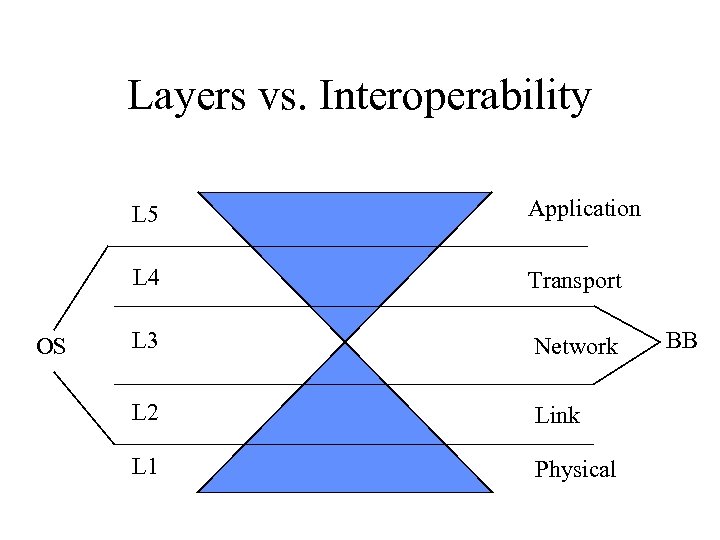 Layers vs. Interoperability L 5 L 4 OS Application Transport L 3 Network L 2 Link L 1 Physical BB
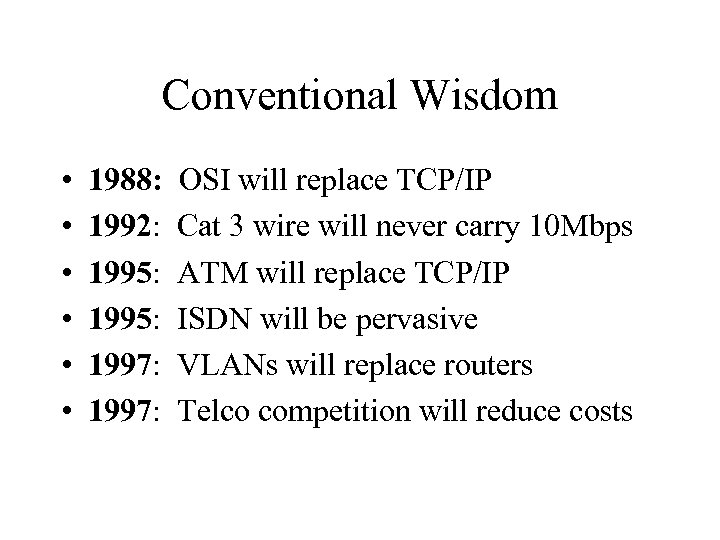 Conventional Wisdom • • • 1988: 1992: 1995: 1997: OSI will replace TCP/IP Cat 3 wire will never carry 10 Mbps ATM will replace TCP/IP ISDN will be pervasive VLANs will replace routers Telco competition will reduce costs
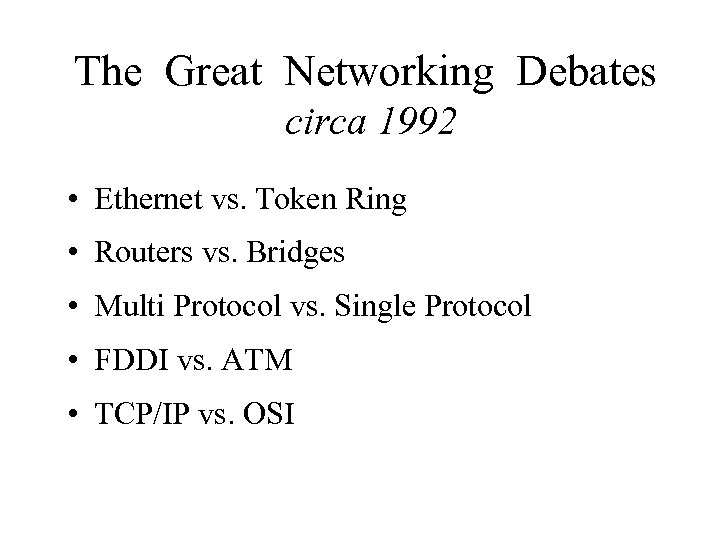 The Great Networking Debates circa 1992 • Ethernet vs. Token Ring • Routers vs. Bridges • Multi Protocol vs. Single Protocol • FDDI vs. ATM • TCP/IP vs. OSI
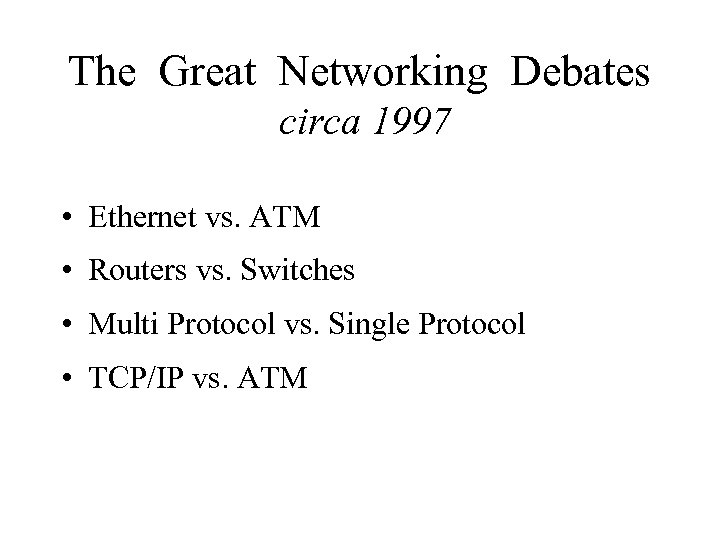 The Great Networking Debates circa 1997 • Ethernet vs. ATM • Routers vs. Switches • Multi Protocol vs. Single Protocol • TCP/IP vs. ATM
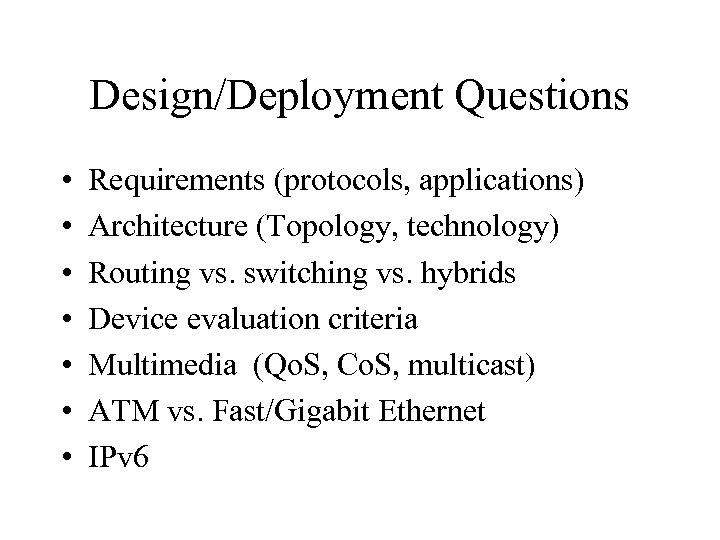 Design/Deployment Questions • • Requirements (protocols, applications) Architecture (Topology, technology) Routing vs. switching vs. hybrids Device evaluation criteria Multimedia (Qo. S, Co. S, multicast) ATM vs. Fast/Gigabit Ethernet IPv 6
 Gray's Networking Nuggets • KISS-1: Keep It Simple, Stupid “Heterogeneity always costs more than you think it will” • KISS-2: Keep It Separate, Stupid “Good fences make good neighbors” • The last art is the art of glumping • Design for high-availability. . . but beware the dark side of Redundancy • Technology rots: don't buy it before you need it
 Gray's Networking Nuggets continued • “Trust but Verify”… "Acid indigestion? Check your source. ” • Beware standardization by government edict (Ada, OSI, X. 400) • Standardization always happens too soon technically, but too late practically • "Conventional Wisdom" is completely orthogonal to "Wisdom"
 Research Questions • Performance: – Transient delay analysis tools – Multi-layer congestion control effects – QOS and COS – TCP, RTP, etc, design improvements • Topology: Hierarchy, mesh, lattice, ring • Security: Infrastructure, session/packet
 End of Fundamentals • If the terminology is unfamiliar, hit the books! • Discussion? • Next up: 30 years of the Internet in 30 minutes
 The Internet: Past, Present, Future • • Introduction History Issues Summary
 Introduction: How many of you. . . • • Use Email almost every day? Use the Web almost every day? Consider yourself an "Internet Junkie"? Plan to become one Real Soon Now! ? Have seen a TV documentary on the Internet? Know what the ARPANET was? See the 'Net as a Really Big Deal?
 My view of the Internet: • A powerful tool, with both good and bad uses. • An unparalleled sociological phenomenon. • Both a trigger and a medium for defining 21 st century values. • Some pretty interesting technology.
 POP QUIZ #1 ( True or False): • The ARPANET was designed to be a military command/control network that could survive nuclear war. • Packet switching technology was chosen for ARPANET primarily because of its ability to go around faulty portions of a net. • Packet switching technology was one of the most important achievements of Bell Labs, and AT&T was an enthusiastic partner in the ARPANET project. • Computer Scientists at major universities were universally supportive of the ARPANET, unlike those at smaller schools.
 POP QUIZ #1 ( Cont’d): • The World Wide Web was invented at CREN (the Corporation for Research and Educational Networking) • Email was one of the prime motivators for the net. • Unlike the telecommunication industry, the computer industry quickly adopted Internet standards in their quest to provide open systems. • Restricting use of encryption on the Internet will ensure that communication remains open.
 POP QUIZ #2 (True or False): • ARPA projects led not only to today's Internet, but also to cellular telephone and Ethernet technology. • The Web is not the Internet. • The Internet will eliminate many jobs. • The Internet will create many jobs. • The Internet is a powerful tool for world peace. • The Internet is a powerful tool for Western Imperialism. • In the Internet, the U. S. Constitution is a local ordinance.
 The History of the Internet overview… • 1960 s: The Vision > Remote Resource Sharing • 1970 s: Making it Work > Packet switching, LANs, Internets • 1980 s: Widespread Deployment > NSFnet, Bitnet, CSnet, Usenet, Fidonet • 1990 s: Success Problems > Scaling, Navigation, Filtering, Politics, Economics
 The History of the Internet highlights… • • 1962: Dr. Licklider goes to Washington 1966: Bob Taylor has too many terminals on his desk 1969: ARPANET begins (also Woodstock, Apollo 11) 1972: ARPANET and ALOHANET interconnect 1973: Metcalf/Boggs develop Ethernet from Alohanet 1974: Cerf/Kahn publish TCP/IP specification 1977: TCP/IP demo: ARPANET, SATNET, PRNET, Ethernet
 The History of the Internet highlights cont’d… • • • 1979: USENET (distributed BBS) begins 1981: BITNET, CSNET, Minitel begin 1983: ARPANET cutover to TCP/IP completed 1986: NSFNET begins 1988: The Internet Worm attack 1990: ARPANET ends 1991: World Wide Web invented 1993: NCSA Mosaic released 1995: NSFNET ends, Netscape goes public
 Why the Internet will Fail circa 1992 • "TCP/IP is a sunset technology" • "You can't use TCP/IP for mission critical applications" • "TCP/IP can't go very fast" • "FTP will corrupt complex data files" • "You can't do multimedia over SMTP" • "TCP/IP is a proprietary protocol developed by DOD" • "The Internet standards process is not open”
 Why the Internet might Fail circa 1997 • Scaling: – Addresses, – Routing, – Bandwidth, – DNS • Function: – QOS, – Security
 Why the Internet might Fail non-technical issues • Threats from policy problems: – Usage: Censorship, Copyright, Spam/junk – Micro-economic: distance/time/usage pricing – Macro-economic: Haves/Have. Nots, Investment • Threats to individuals: – Privacy: Exposure of info, usage patterns – Addiction: impact on social contact/activities – Productivity: signal-to-noise ratio
 More Internet concerns. . . • Threats from crime: – Real crime: technology helps the bad guys, too. – Pseudo-crime: misguided legislation • Threats to organizations: – Open communication – No hierarchy • Threats to business: – Some middlemen will be toast – Legal liabilities will stifle some businesses
 More Internet concerns. . . • Threats to scholarly quality: – Content: lots of junk, lots of old versions – Searching/catalogs: best stuff may never be found • Shared files/authorship: coordination problems
 The NSFnet is Gone • • NSFnet ceased to exist 30 April 1995 Initially a non-event, but trouble followed. There is no longer *a* national backbone MCInet is now carrying >> max NSFnet traffic MCInet traffic doubling every 4 -6 months MCInet backbone: DS-3 to OC-12 Extrapolation to 2000: Need OC 192
 The Internet Goes P. C. • PC = Personal Computer: – Nov 1994: Bill Gates announces 2 initiatives: • Investment in UUNET • Reorientation of Microsoft Network • PC = Politically Correct: – Oct 1996: Bill Clinton announces 3 initiatives: • Internet II • Next Generation Internet • Internet 2000
 INTERNET II ? • Is this a government or Higher-Ed initiative? • What are the goals? • Will commercial net providers meet Higher-Ed needs? • How do Higher-Ed needs differ from, say, Chrysler's? • Will "Virtual University" needs force dedicated net? • Would it even help to have a Higher-Ed net?
 Summary: The Internet. . . • Is an amazing tool and an amazing phenomenon. • Tends to eliminate time, distance, and rank. • Breeds misinformation on and about it. • Faces challenges that are growing exponentially. • Brings opportunities that are growing exponentially. • The hardest problems ahead are not technical (but there are some dandy technical problems, too!)
 End of Internet: Past, Present, Future • At least, from a non-technical perspective! • Discussion? • Next up: UW Network Overview
 UW’s Intranet: Past, Present, Future • • Environment Growth Key Decisions Topology
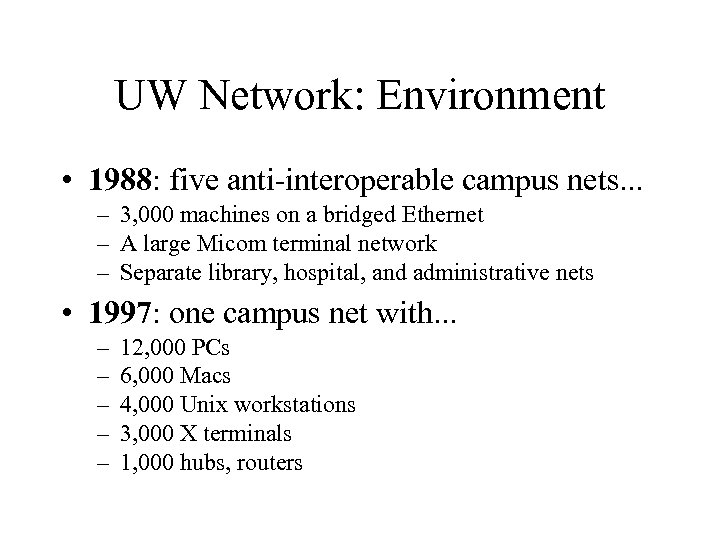 UW Network: Environment • 1988: five anti-interoperable campus nets. . . – 3, 000 machines on a bridged Ethernet – A large Micom terminal network – Separate library, hospital, and administrative nets • 1997: one campus net with. . . – – – 12, 000 PCs 6, 000 Macs 4, 000 Unix workstations 3, 000 X terminals 1, 000 hubs, routers
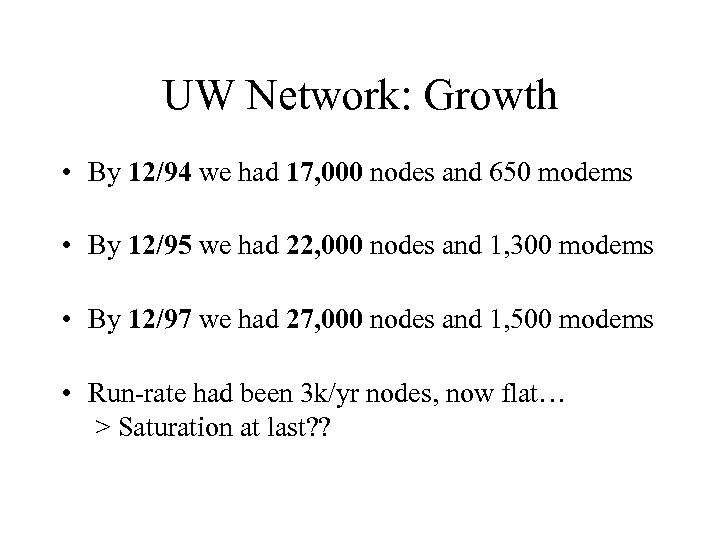 UW Network: Growth • By 12/94 we had 17, 000 nodes and 650 modems • By 12/95 we had 22, 000 nodes and 1, 300 modems • By 12/97 we had 27, 000 nodes and 1, 500 modems • Run-rate had been 3 k/yr nodes, now flat… > Saturation at last? ?
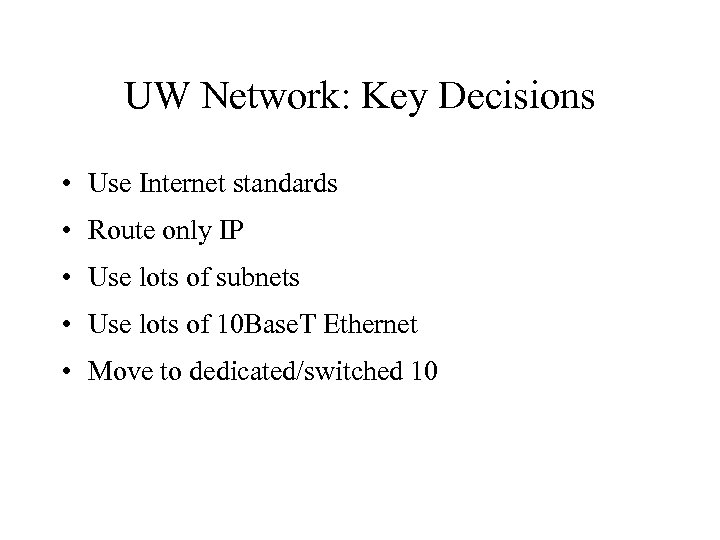 UW Network: Key Decisions • Use Internet standards • Route only IP • Use lots of subnets • Use lots of 10 Base. T Ethernet • Move to dedicated/switched 10
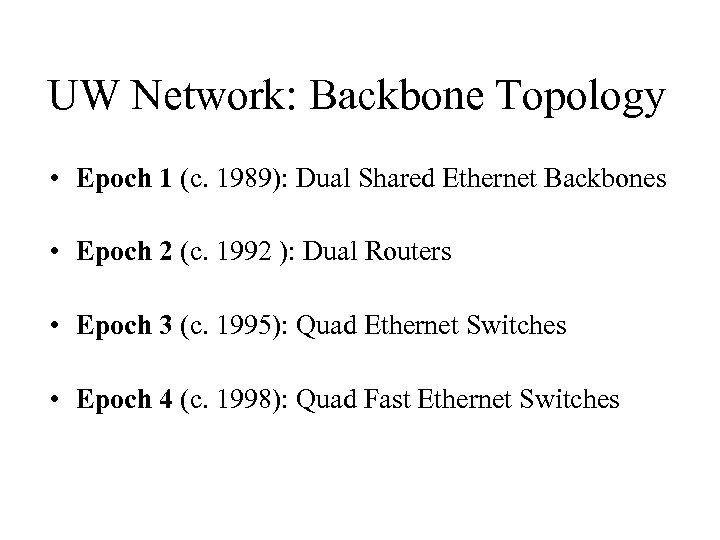 UW Network: Backbone Topology • Epoch 1 (c. 1989): Dual Shared Ethernet Backbones • Epoch 2 (c. 1992 ): Dual Routers • Epoch 3 (c. 1995): Quad Ethernet Switches • Epoch 4 (c. 1998): Quad Fast Ethernet Switches
 End of UW Network Overview • Stay tuned for more on UW network issues! • Discussion? • Next up: – Week 2: Switching and Routing