


 Скачать презентацию CSE 473 Artificial Intelligence Autumn 2010 Machine Learning
1774df250bd3972276d10f93f10f0f7f.ppt
- Количество слайдов: 56
 CSE 473: Artificial Intelligence Autumn 2010 Machine Learning: Naive Bayes and Perceptron Luke Zettlemoyer Many slides over the course adapted from Dan Klein. 1
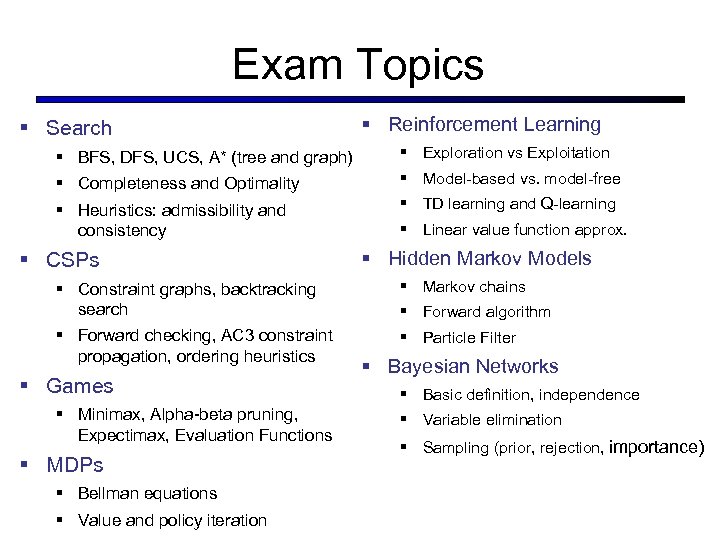 Exam Topics § Search § Reinforcement Learning § BFS, DFS, UCS, A* (tree and graph) § Exploration vs Exploitation § Completeness and Optimality § Model-based vs. model-free § Heuristics: admissibility and consistency § TD learning and Q-learning § CSPs § Linear value function approx. § Hidden Markov Models § Constraint graphs, backtracking search § Markov chains § Forward checking, AC 3 constraint propagation, ordering heuristics § Particle Filter § Games § Minimax, Alpha-beta pruning, Expectimax, Evaluation Functions § MDPs § Bellman equations § Value and policy iteration § Forward algorithm § Bayesian Networks § Basic definition, independence § Variable elimination § Sampling (prior, rejection, importance)
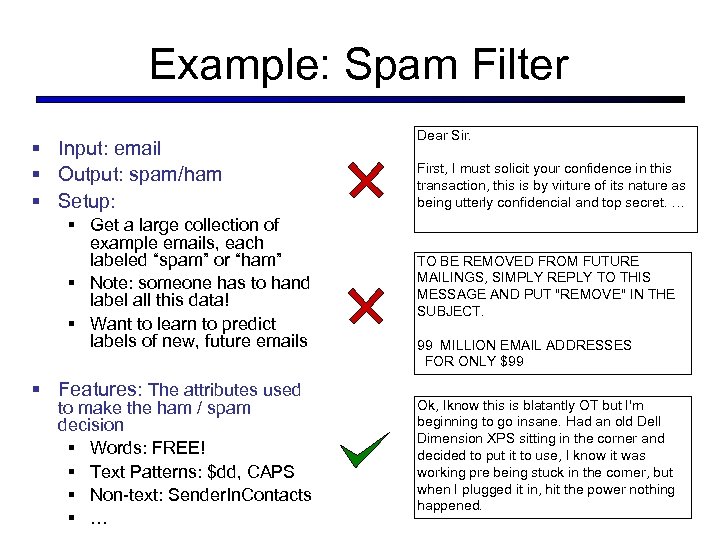 Example: Spam Filter § Input: email § Output: spam/ham § Setup: § Get a large collection of example emails, each labeled “spam” or “ham” § Note: someone has to hand label all this data! § Want to learn to predict labels of new, future emails § Features: The attributes used to make the ham / spam decision § Words: FREE! § Text Patterns: $dd, CAPS § Non-text: Sender. In. Contacts § … Dear Sir. First, I must solicit your confidence in this transaction, this is by virture of its nature as being utterly confidencial and top secret. … TO BE REMOVED FROM FUTURE MAILINGS, SIMPLY REPLY TO THIS MESSAGE AND PUT "REMOVE" IN THE SUBJECT. 99 MILLION EMAIL ADDRESSES FOR ONLY $99 Ok, Iknow this is blatantly OT but I'm beginning to go insane. Had an old Dell Dimension XPS sitting in the corner and decided to put it to use, I know it was working pre being stuck in the corner, but when I plugged it in, hit the power nothing happened.
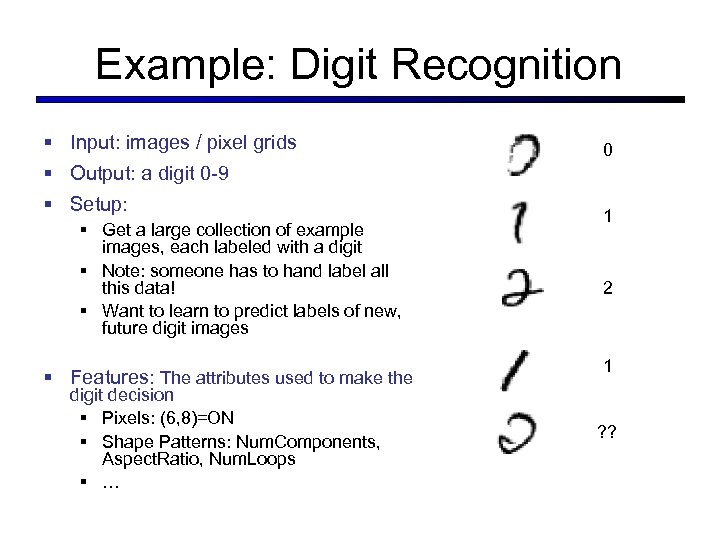 Example: Digit Recognition § Input: images / pixel grids 0 § Output: a digit 0 -9 § Setup: § Get a large collection of example images, each labeled with a digit § Note: someone has to hand label all this data! § Want to learn to predict labels of new, future digit images § Features: The attributes used to make the digit decision § Pixels: (6, 8)=ON § Shape Patterns: Num. Components, Aspect. Ratio, Num. Loops § … 1 2 1 ? ?
 Other Classification Tasks § In classification, we predict labels y (classes) for inputs x § Examples: § § § § Spam detection (input: document, classes: spam / ham) OCR (input: images, classes: characters) Medical diagnosis (input: symptoms, classes: diseases) Automatic essay grader (input: document, classes: grades) Fraud detection (input: account activity, classes: fraud / no fraud) Customer service email routing … many more § Classification is an important commercial technology!
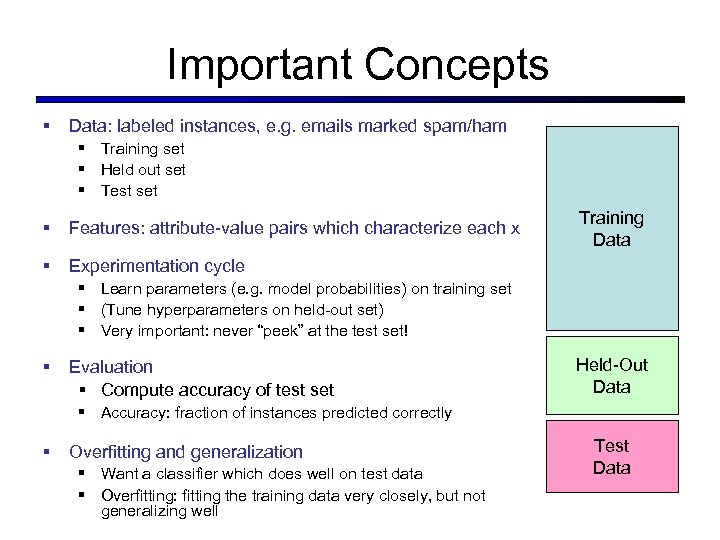 Important Concepts § Data: labeled instances, e. g. emails marked spam/ham § Training set § Held out set § Test set § Features: attribute-value pairs which characterize each x § Training Data Experimentation cycle § Learn parameters (e. g. model probabilities) on training set § (Tune hyperparameters on held-out set) § Very important: never “peek” at the test set! § Evaluation § Compute accuracy of test set Held-Out Data § Accuracy: fraction of instances predicted correctly § Overfitting and generalization § Want a classifier which does well on test data § Overfitting: fitting the training data very closely, but not generalizing well Test Data
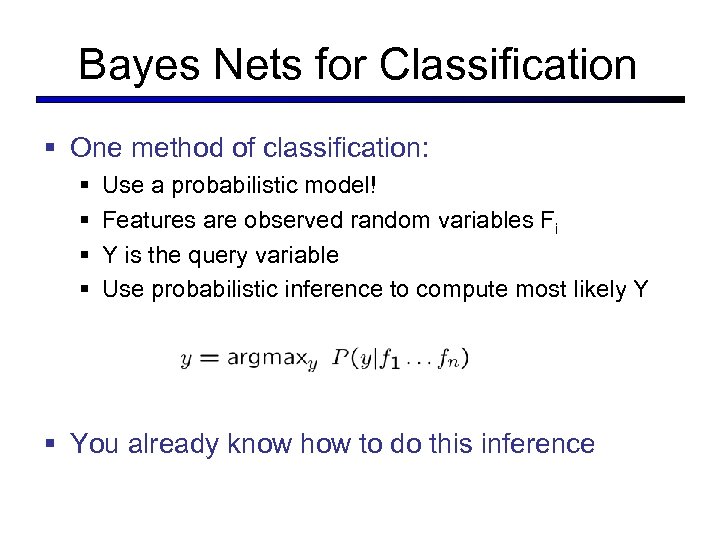 Bayes Nets for Classification § One method of classification: § § Use a probabilistic model! Features are observed random variables Fi Y is the query variable Use probabilistic inference to compute most likely Y § You already know how to do this inference
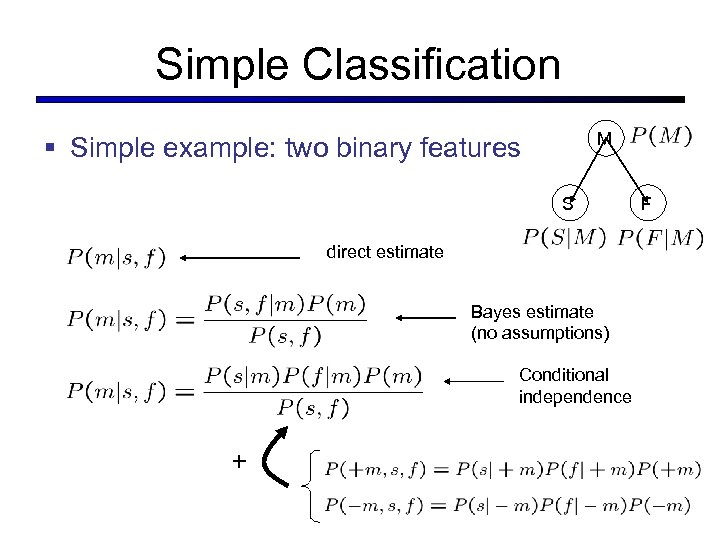 Simple Classification M § Simple example: two binary features S direct estimate Bayes estimate (no assumptions) Conditional independence + F
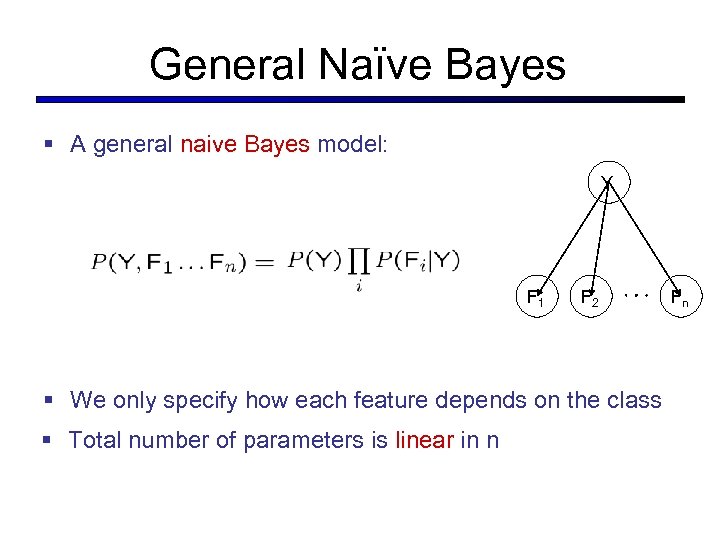 General Naïve Bayes § A general naive Bayes model: Y F 1 F 2 § We only specify how each feature depends on the class § Total number of parameters is linear in n Fn
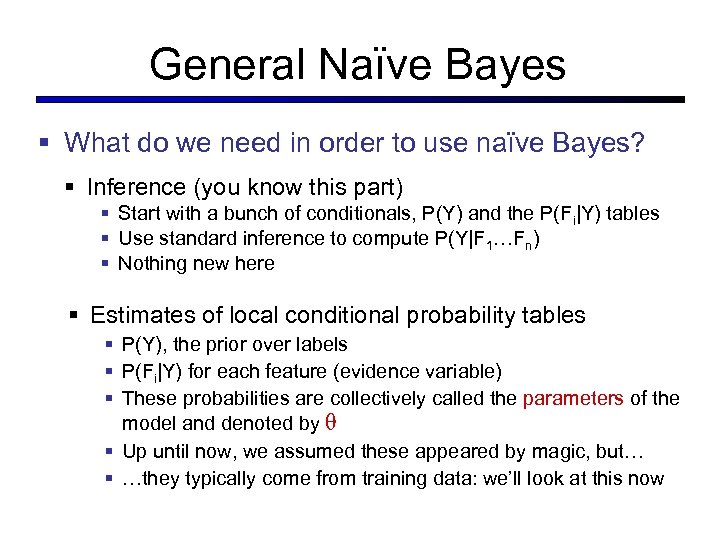 General Naïve Bayes § What do we need in order to use naïve Bayes? § Inference (you know this part) § Start with a bunch of conditionals, P(Y) and the P(Fi|Y) tables § Use standard inference to compute P(Y|F 1…Fn) § Nothing new here § Estimates of local conditional probability tables § P(Y), the prior over labels § P(Fi|Y) for each feature (evidence variable) § These probabilities are collectively called the parameters of the model and denoted by θ § Up until now, we assumed these appeared by magic, but… § …they typically come from training data: we’ll look at this now
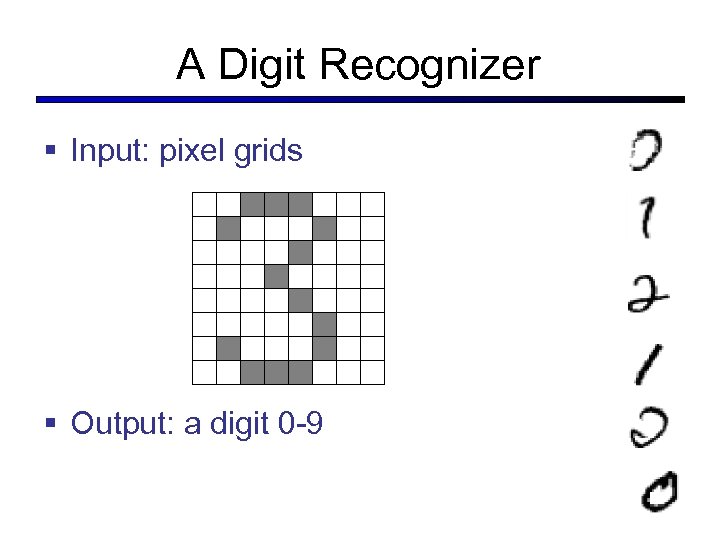 A Digit Recognizer § Input: pixel grids § Output: a digit 0 -9
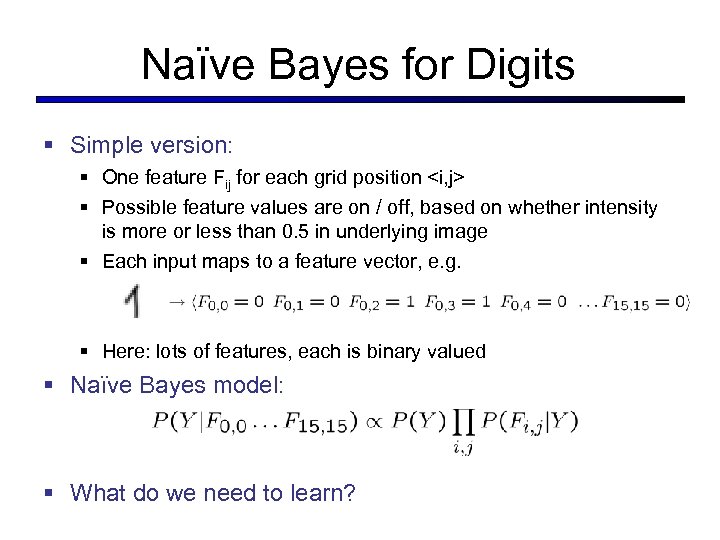 Naïve Bayes for Digits § Simple version: § One feature Fij for each grid position
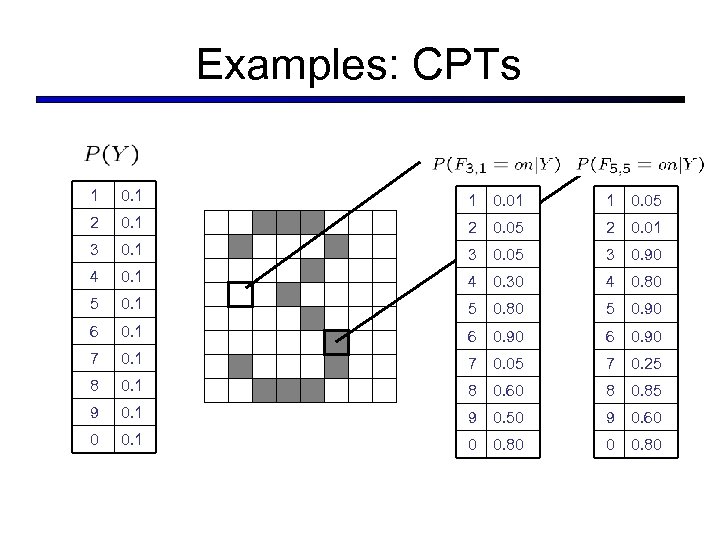 Examples: CPTs 1 0. 1 1 0. 05 2 0. 1 2 0. 05 2 0. 01 3 0. 05 3 0. 90 4 0. 1 4 0. 30 4 0. 80 5 0. 1 5 0. 80 5 0. 90 6 0. 1 6 0. 90 7 0. 1 7 0. 05 7 0. 25 8 0. 1 8 0. 60 8 0. 85 9 0. 1 9 0. 50 9 0. 60 0 0. 1 0 0. 80
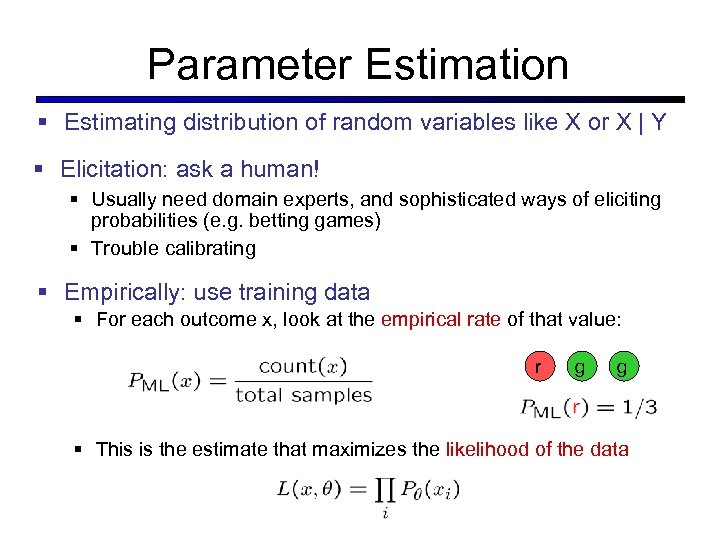 Parameter Estimation § Estimating distribution of random variables like X or X | Y § Elicitation: ask a human! § Usually need domain experts, and sophisticated ways of eliciting probabilities (e. g. betting games) § Trouble calibrating § Empirically: use training data § For each outcome x, look at the empirical rate of that value: r g g § This is the estimate that maximizes the likelihood of the data
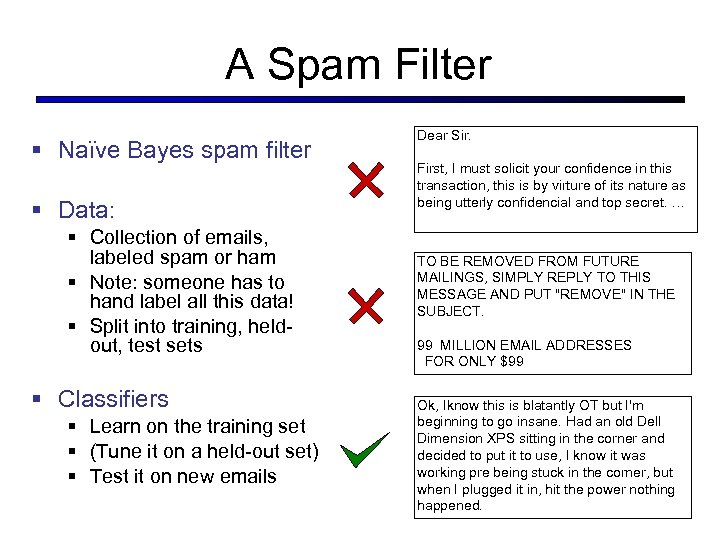 A Spam Filter § Naïve Bayes spam filter § Data: § Collection of emails, labeled spam or ham § Note: someone has to hand label all this data! § Split into training, heldout, test sets § Classifiers § Learn on the training set § (Tune it on a held-out set) § Test it on new emails Dear Sir. First, I must solicit your confidence in this transaction, this is by virture of its nature as being utterly confidencial and top secret. … TO BE REMOVED FROM FUTURE MAILINGS, SIMPLY REPLY TO THIS MESSAGE AND PUT "REMOVE" IN THE SUBJECT. 99 MILLION EMAIL ADDRESSES FOR ONLY $99 Ok, Iknow this is blatantly OT but I'm beginning to go insane. Had an old Dell Dimension XPS sitting in the corner and decided to put it to use, I know it was working pre being stuck in the corner, but when I plugged it in, hit the power nothing happened.
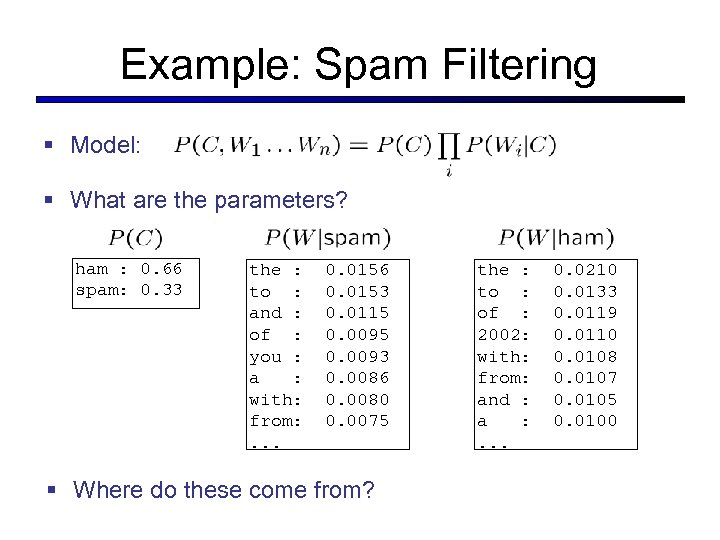
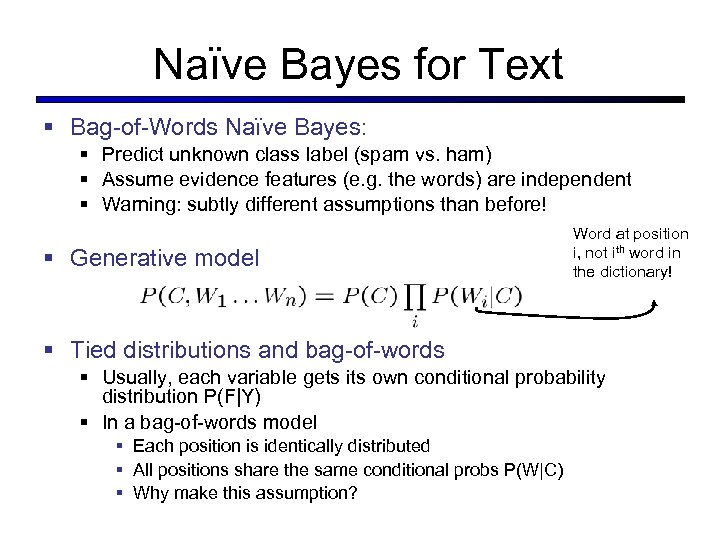 Naïve Bayes for Text § Bag-of-Words Naïve Bayes: § Predict unknown class label (spam vs. ham) § Assume evidence features (e. g. the words) are independent § Warning: subtly different assumptions than before! § Generative model Word at position i, not ith word in the dictionary! § Tied distributions and bag-of-words § Usually, each variable gets its own conditional probability distribution P(F|Y) § In a bag-of-words model § Each position is identically distributed § All positions share the same conditional probs P(W|C) § Why make this assumption?
 Example: Spam Filtering § Model: § What are the parameters? ham : 0. 66 spam: 0. 33 the : to : and : of : you : a : with: from: . . . 0. 0156 0. 0153 0. 0115 0. 0093 0. 0086 0. 0080 0. 0075 § Where do these come from? the : to : of : 2002: with: from: and : a : . . . 0. 0210 0. 0133 0. 0119 0. 0110 0. 0108 0. 0107 0. 0105 0. 0100
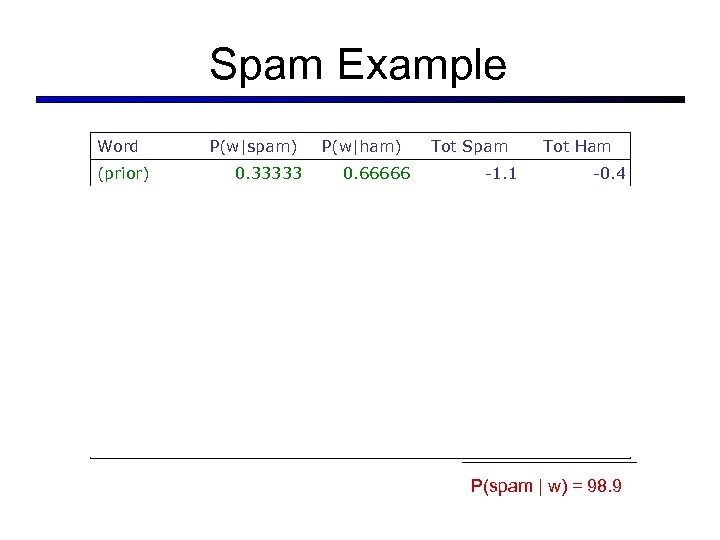 Spam Example Word P(w|spam) P(w|ham) Tot Spam Tot Ham (prior) 0. 33333 0. 66666 -1. 1 -0. 4 Gary 0. 00002 0. 00021 -11. 8 -8. 9 would 0. 00069 0. 00084 -19. 1 -16. 0 you 0. 00881 0. 00304 -23. 8 -21. 8 like 0. 00086 0. 00083 -30. 9 -28. 9 to 0. 01517 0. 01339 -35. 1 -33. 2 lose 0. 00008 0. 00002 -44. 5 -44. 0 weight 0. 00016 0. 00002 -53. 3 -55. 0 while 0. 00027 -61. 5 -63. 2 you 0. 00881 0. 00304 -66. 2 -69. 0 sleep 0. 00006 0. 00001 -76. 0 -80. 5 P(spam | w) = 98. 9
 Example: Overfitting 2 wins!!
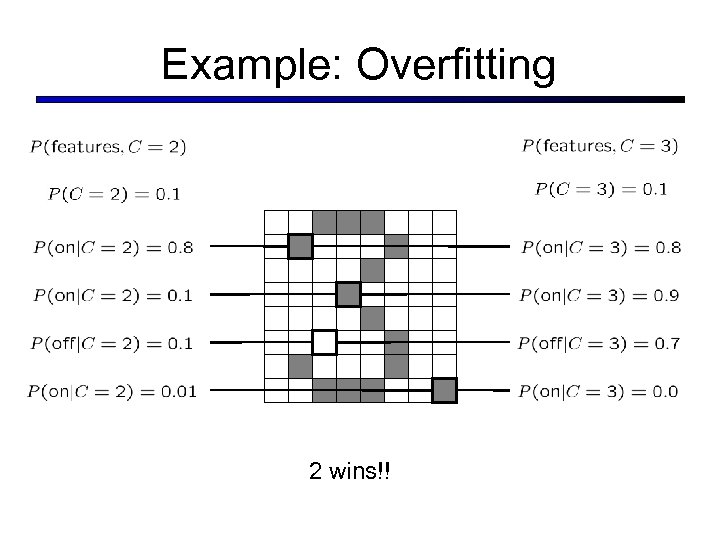
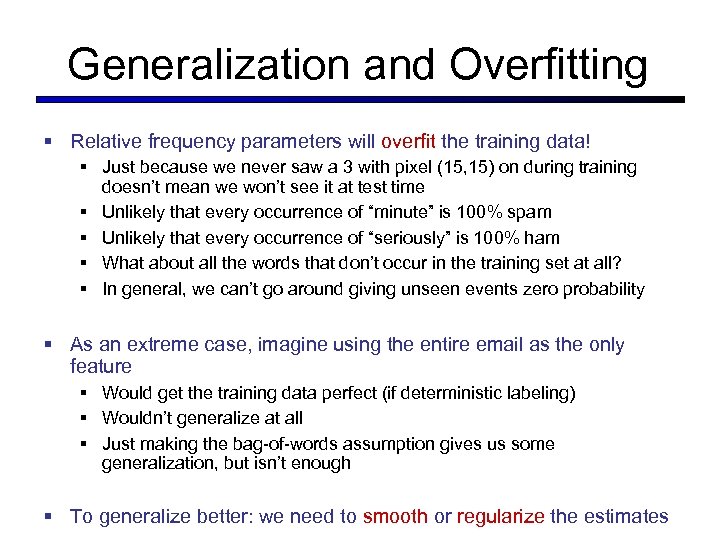 Generalization and Overfitting § Relative frequency parameters will overfit the training data! § Just because we never saw a 3 with pixel (15, 15) on during training doesn’t mean we won’t see it at test time § Unlikely that every occurrence of “minute” is 100% spam § Unlikely that every occurrence of “seriously” is 100% ham § What about all the words that don’t occur in the training set at all? § In general, we can’t go around giving unseen events zero probability § As an extreme case, imagine using the entire email as the only feature § Would get the training data perfect (if deterministic labeling) § Wouldn’t generalize at all § Just making the bag-of-words assumption gives us some generalization, but isn’t enough § To generalize better: we need to smooth or regularize the estimates
 Estimation: Smoothing § Problems with maximum likelihood estimates: § If I flip a coin once, and it’s heads, what’s the estimate for P(heads)? § What if I flip 10 times with 8 heads? § What if I flip 10 M times with 8 M heads? § Basic idea: § We have some prior expectation about parameters (here, the probability of heads) § Given little evidence, we should skew towards our prior § Given a lot of evidence, we should listen to the data
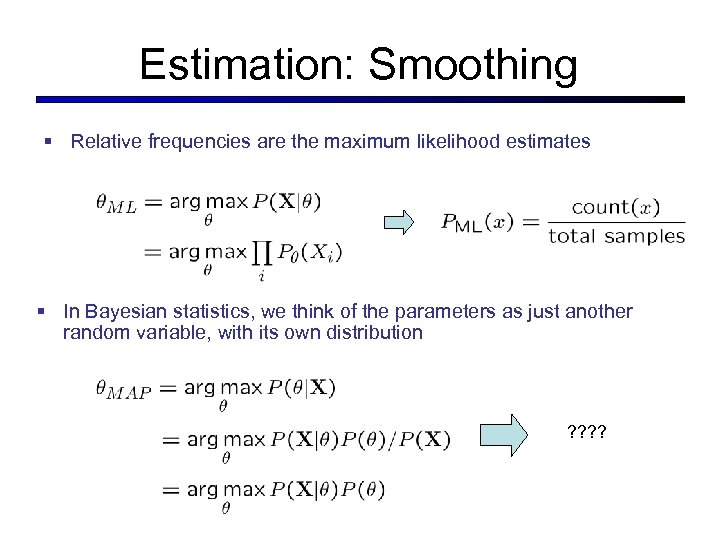 Estimation: Smoothing § Relative frequencies are the maximum likelihood estimates § In Bayesian statistics, we think of the parameters as just another random variable, with its own distribution ? ?
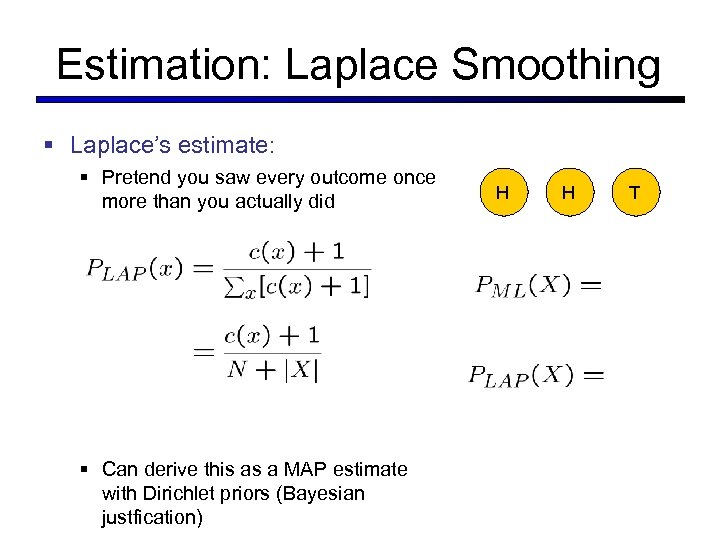 Estimation: Laplace Smoothing § Laplace’s estimate: § Pretend you saw every outcome once more than you actually did § Can derive this as a MAP estimate with Dirichlet priors (Bayesian justfication) H H T
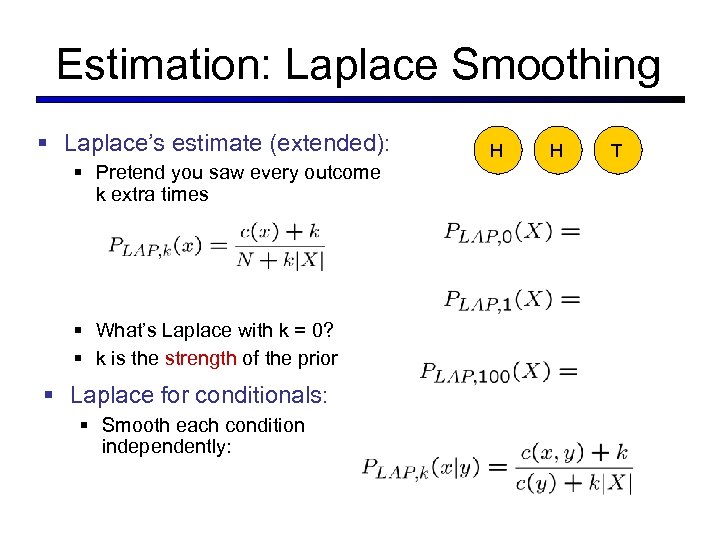 Estimation: Laplace Smoothing § Laplace’s estimate (extended): § Pretend you saw every outcome k extra times § What’s Laplace with k = 0? § k is the strength of the prior § Laplace for conditionals: § Smooth each condition independently: H H T
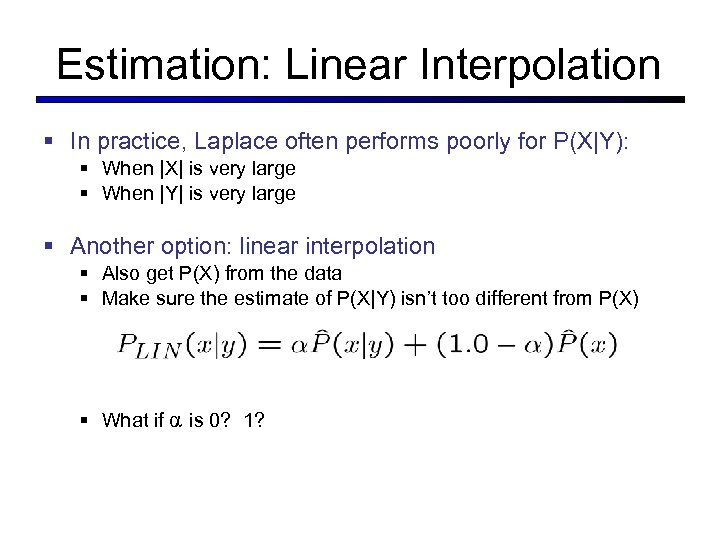 Estimation: Linear Interpolation § In practice, Laplace often performs poorly for P(X|Y): § When |X| is very large § When |Y| is very large § Another option: linear interpolation § Also get P(X) from the data § Make sure the estimate of P(X|Y) isn’t too different from P(X) § What if α is 0? 1?
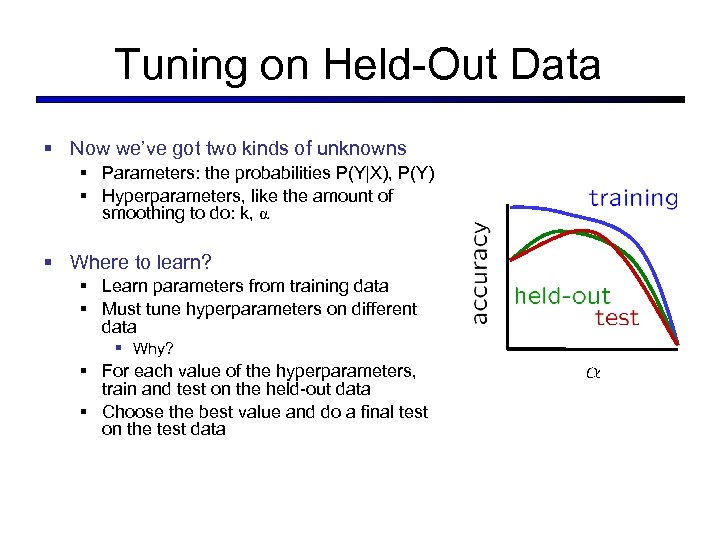 Tuning on Held-Out Data § Now we’ve got two kinds of unknowns § Parameters: the probabilities P(Y|X), P(Y) § Hyperparameters, like the amount of smoothing to do: k, α § Where to learn? § Learn parameters from training data § Must tune hyperparameters on different data § Why? § For each value of the hyperparameters, train and test on the held-out data § Choose the best value and do a final test on the test data
 Baselines § First step: get a baseline § Baselines are very simple “straw man” procedures § Help determine how hard the task is § Help know what a “good” accuracy is § Weak baseline: most frequent label classifier § Gives all test instances whatever label was most common in the training set § E. g. for spam filtering, might label everything as ham § Accuracy might be very high if the problem is skewed § E. g. calling everything “ham” gets 66%, so a classifier that gets 70% isn’t very good… § For real research, usually use previous work as a (strong) baseline
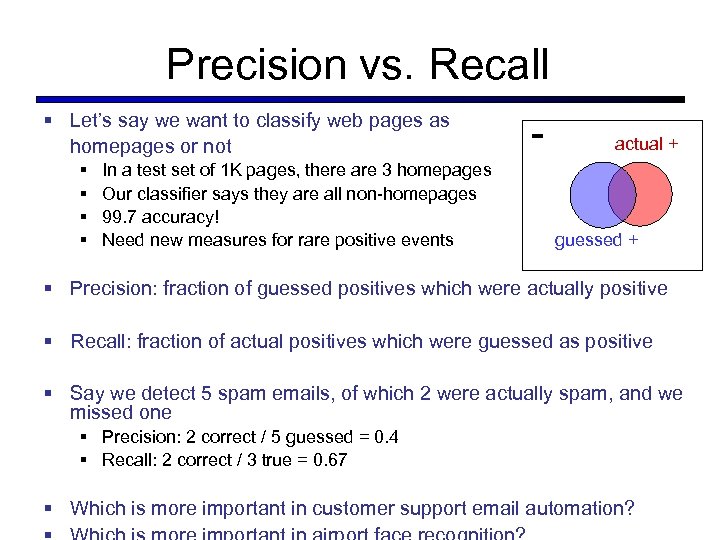 Precision vs. Recall § Let’s say we want to classify web pages as homepages or not § § In a test set of 1 K pages, there are 3 homepages Our classifier says they are all non-homepages 99. 7 accuracy! Need new measures for rare positive events - actual + guessed + § Precision: fraction of guessed positives which were actually positive § Recall: fraction of actual positives which were guessed as positive § Say we detect 5 spam emails, of which 2 were actually spam, and we missed one § Precision: 2 correct / 5 guessed = 0. 4 § Recall: 2 correct / 3 true = 0. 67 § Which is more important in customer support email automation?
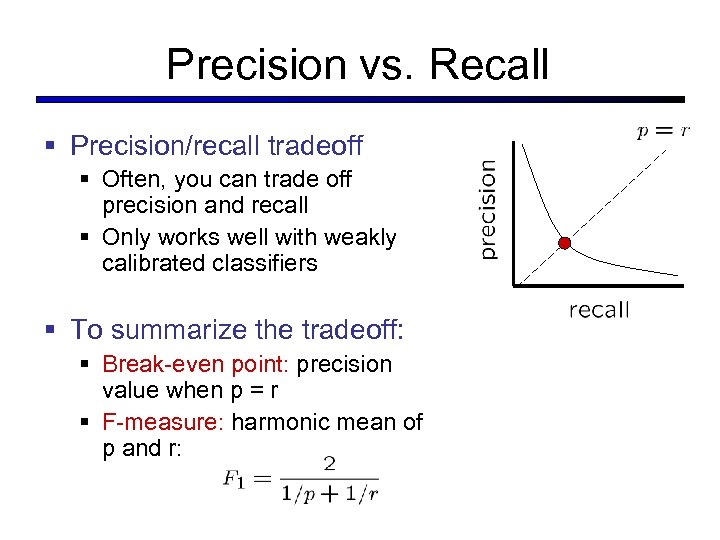 Precision vs. Recall § Precision/recall tradeoff § Often, you can trade off precision and recall § Only works well with weakly calibrated classifiers § To summarize the tradeoff: § Break-even point: precision value when p = r § F-measure: harmonic mean of p and r:
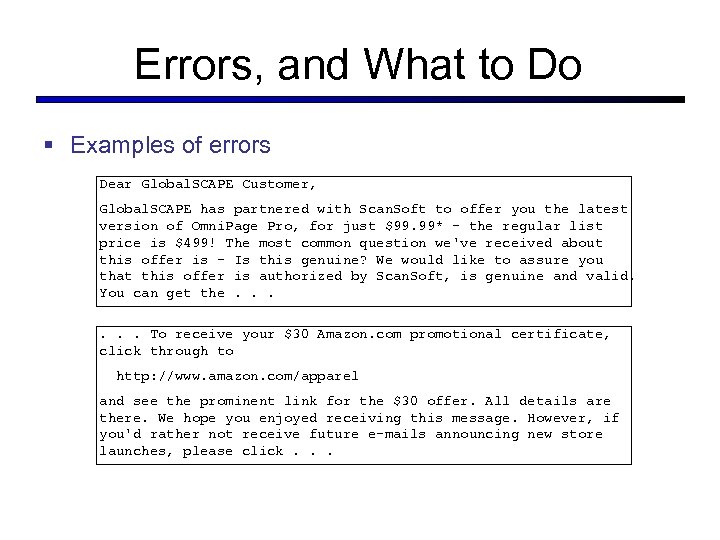 Errors, and What to Do § Examples of errors Dear Global. SCAPE Customer, Global. SCAPE has partnered with Scan. Soft to offer you the latest version of Omni. Page Pro, for just $99. 99* - the regular list price is $499! The most common question we've received about this offer is - Is this genuine? We would like to assure you that this offer is authorized by Scan. Soft, is genuine and valid. You can get the. . . To receive your $30 Amazon. com promotional certificate, click through to http: //www. amazon. com/apparel and see the prominent link for the $30 offer. All details are there. We hope you enjoyed receiving this message. However, if you'd rather not receive future e-mails announcing new store launches, please click. . .
 What to Do About Errors? § Need more features– words aren’t enough! § § § Have you emailed the sender before? Have 1 K other people just gotten the same email? Is the sending information consistent? Is the email in ALL CAPS? Do inline URLs point where they say they point? Does the email address you by (your) name? § Can add these information sources as new variables in the NB model § Next class we’ll talk about classifiers which let you easily add arbitrary features more easily
 Summary § Bayes rule lets us do diagnostic queries with causal probabilities § The naïve Bayes assumption takes all features to be independent given the class label § We can build classifiers out of a naïve Bayes model using training data § Smoothing estimates is important in real systems § Classifier confidences are useful, when you can get them
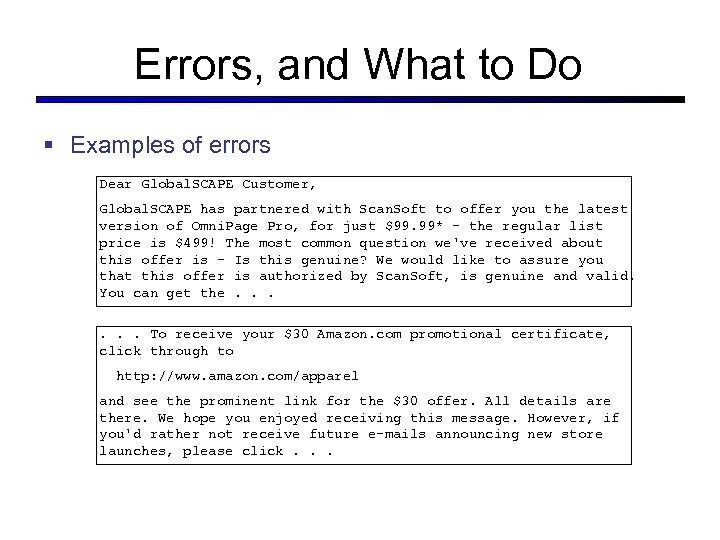 Errors, and What to Do § Examples of errors Dear Global. SCAPE Customer, Global. SCAPE has partnered with Scan. Soft to offer you the latest version of Omni. Page Pro, for just $99. 99* - the regular list price is $499! The most common question we've received about this offer is - Is this genuine? We would like to assure you that this offer is authorized by Scan. Soft, is genuine and valid. You can get the. . . To receive your $30 Amazon. com promotional certificate, click through to http: //www. amazon. com/apparel and see the prominent link for the $30 offer. All details are there. We hope you enjoyed receiving this message. However, if you'd rather not receive future e-mails announcing new store launches, please click. . .
 What to Do About Errors? § Need more features– words aren’t enough! § § § Have you emailed the sender before? Have 1 K other people just gotten the same email? Is the sending information consistent? Is the email in ALL CAPS? Do inline URLs point where they say they point? Does the email address you by (your) name? § Can add these information sources as new variables in the NB model § Next class we’ll talk about classifiers which let you easily add arbitrary features more easily
 Summary § Bayes rule lets us do diagnostic queries with causal probabilities § The naïve Bayes assumption takes all features to be independent given the class label § We can build classifiers out of a naïve Bayes model using training data § Smoothing estimates is important in real systems § Classifier confidences are useful, when you can get them
 Generative vs. Discriminative § Generative classifiers: § E. g. naïve Bayes § A joint probability model with evidence variables § Query model for causes given evidence § Discriminative classifiers: § No generative model, no Bayes rule, often no probabilities at all! § Try to predict the label Y directly from X § Robust, accurate with varied features § Loosely: mistake driven rather than model driven
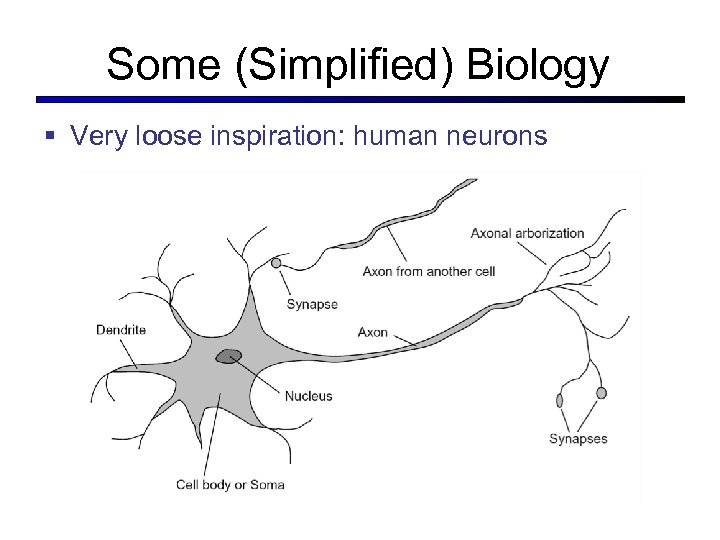 Some (Simplified) Biology § Very loose inspiration: human neurons
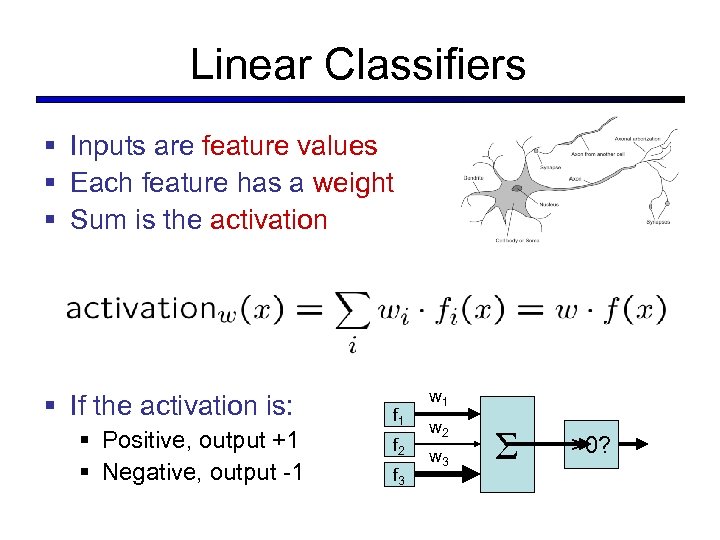 Linear Classifiers § Inputs are feature values § Each feature has a weight § Sum is the activation § If the activation is: § Positive, output +1 § Negative, output -1 f 2 f 3 w 1 w 2 w 3 Σ >0?
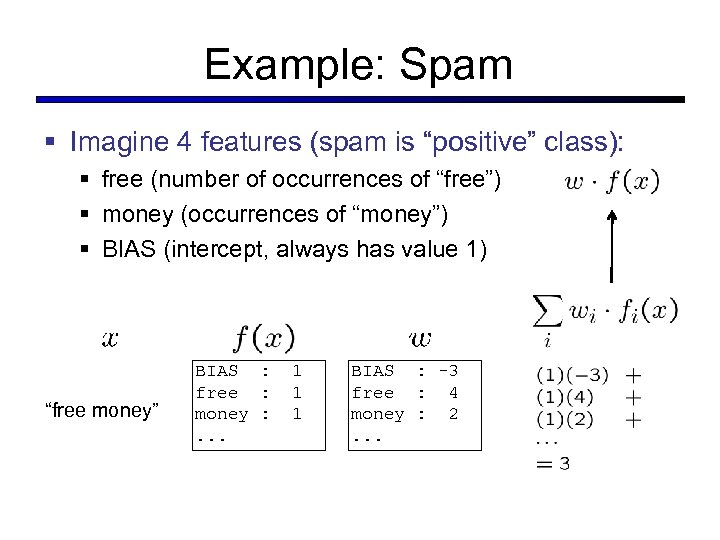 Example: Spam § Imagine 4 features (spam is “positive” class): § free (number of occurrences of “free”) § money (occurrences of “money”) § BIAS (intercept, always has value 1) “free money” BIAS : free : money : . . . 1 1 1 BIAS : -3 free : 4 money : 2. . .
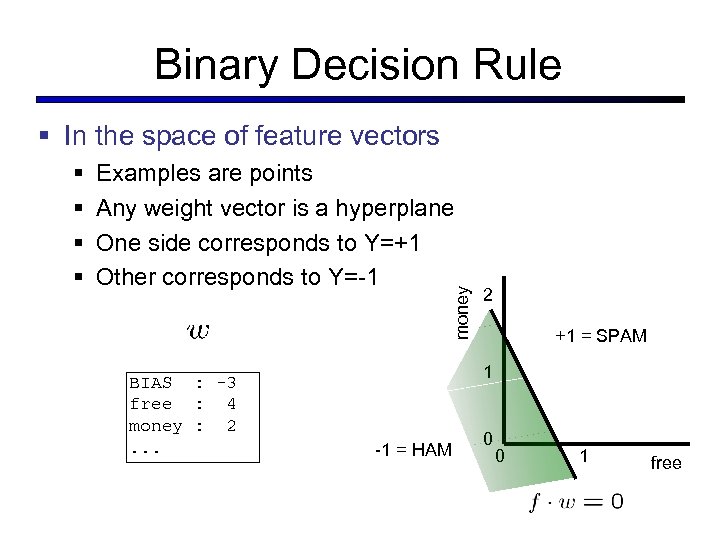 Binary Decision Rule § In the space of feature vectors Examples are points Any weight vector is a hyperplane One side corresponds to Y=+1 Other corresponds to Y=-1 money § § BIAS : -3 free : 4 money : 2. . . 2 +1 = SPAM 1 -1 = HAM 0 0 1 free
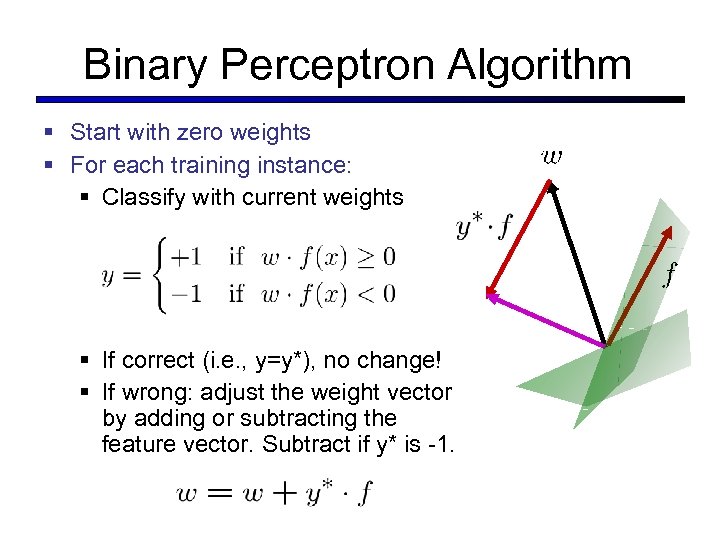 Binary Perceptron Algorithm § Start with zero weights § For each training instance: § Classify with current weights § If correct (i. e. , y=y*), no change! § If wrong: adjust the weight vector by adding or subtracting the feature vector. Subtract if y* is -1.
 Examples: Perceptron § Separable Case http: //isl. ira. uka. de/neural. Net. Course/2004/VL_11_5/Perceptron. html
 Examples: Perceptron § Inseparable Case http: //isl. ira. uka. de/neural. Net. Course/2004/VL_11_5/Perceptron. html
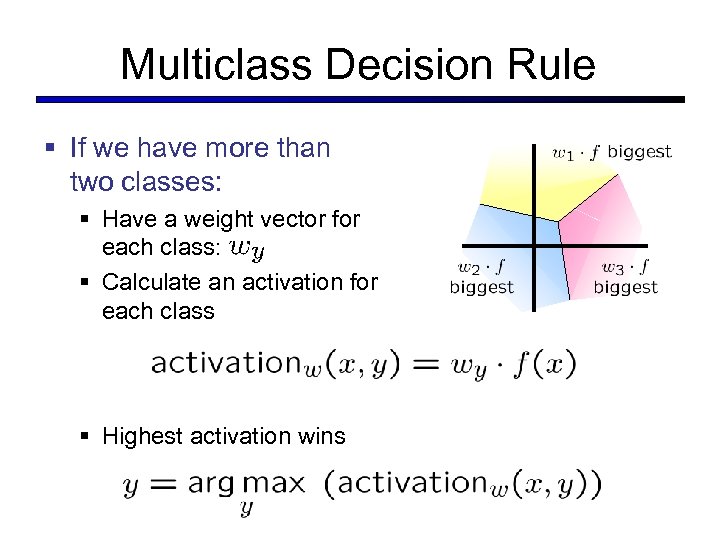 Multiclass Decision Rule § If we have more than two classes: § Have a weight vector for each class: § Calculate an activation for each class § Highest activation wins
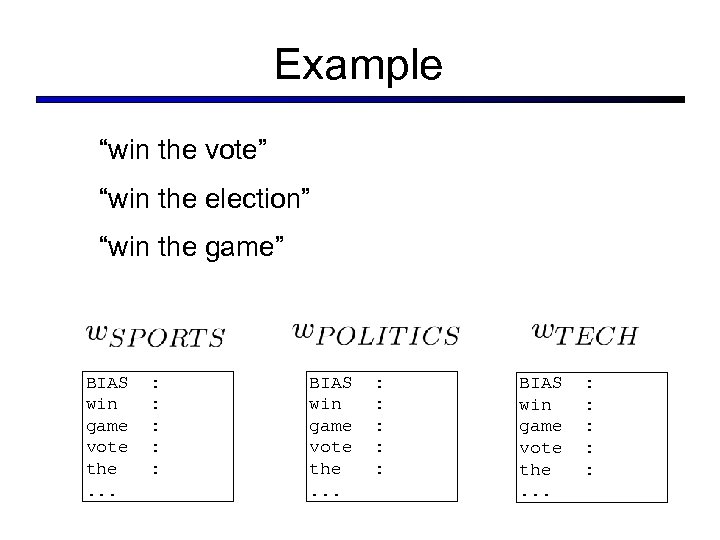 Example “win the vote” “win the election” “win the game” BIAS win game vote the. . . : : : : : BIAS win game vote the. . . : : :
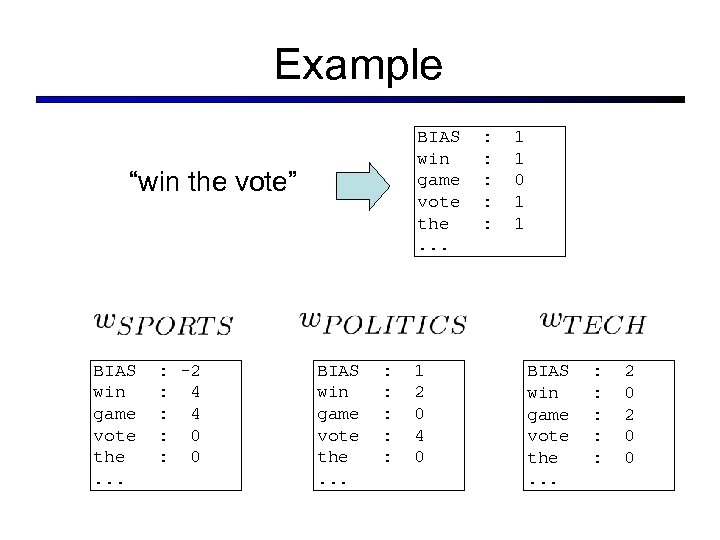 Example BIAS win game vote the. . . “win the vote” BIAS win game vote the. . . : -2 : 4 : 0 BIAS win game vote the. . . : : : 1 2 0 4 0 : : : 1 1 0 1 1 BIAS win game vote the. . . : : : 2 0 0
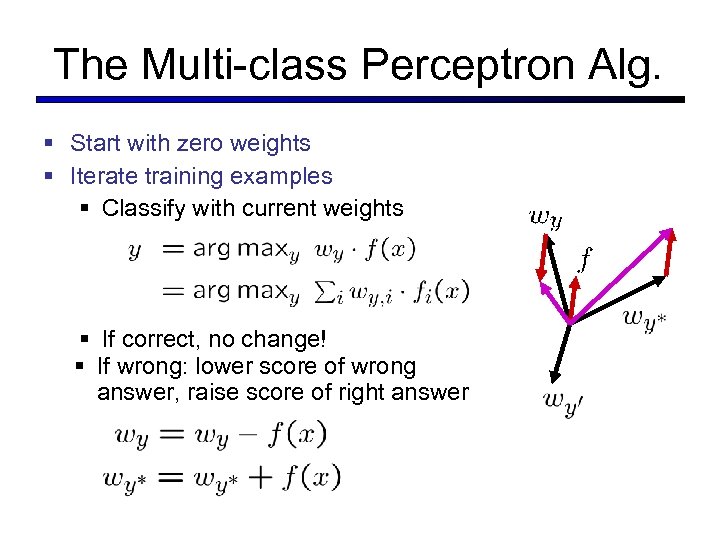 The Multi-class Perceptron Alg. § Start with zero weights § Iterate training examples § Classify with current weights § If correct, no change! § If wrong: lower score of wrong answer, raise score of right answer
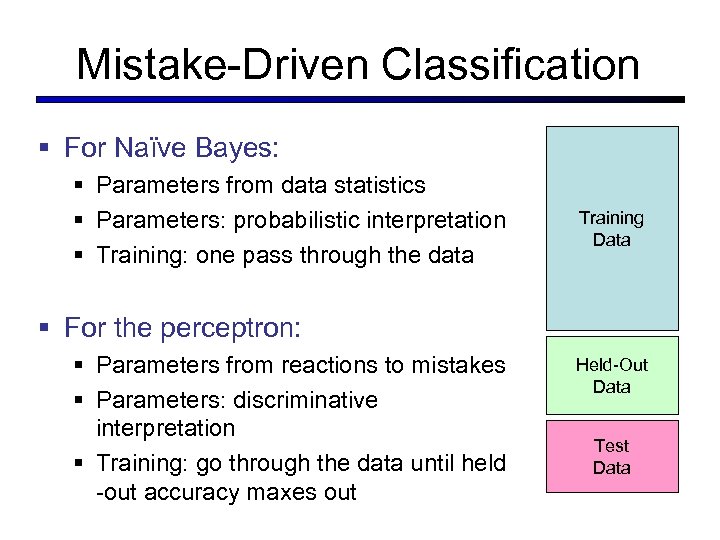 Mistake-Driven Classification § For Naïve Bayes: § Parameters from data statistics § Parameters: probabilistic interpretation § Training: one pass through the data Training Data § For the perceptron: § Parameters from reactions to mistakes § Parameters: discriminative interpretation § Training: go through the data until held -out accuracy maxes out Held-Out Data Test Data
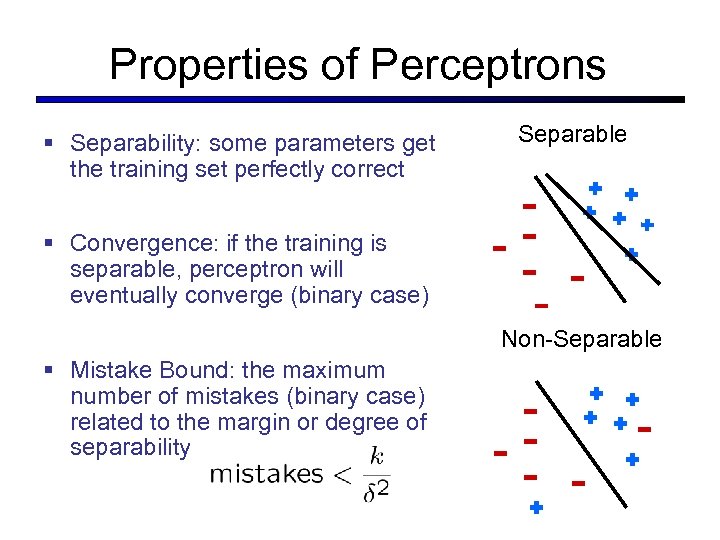 Properties of Perceptrons § Separability: some parameters get the training set perfectly correct Separable § Convergence: if the training is separable, perceptron will eventually converge (binary case) Non-Separable § Mistake Bound: the maximum number of mistakes (binary case) related to the margin or degree of separability
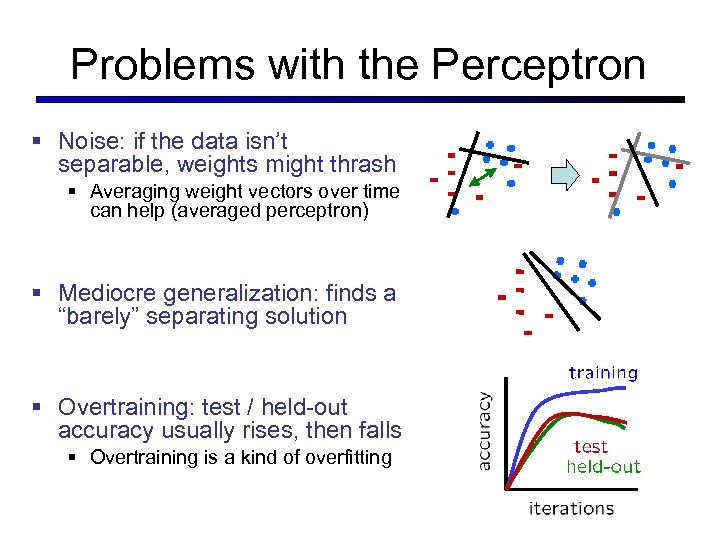 Problems with the Perceptron § Noise: if the data isn’t separable, weights might thrash § Averaging weight vectors over time can help (averaged perceptron) § Mediocre generalization: finds a “barely” separating solution § Overtraining: test / held-out accuracy usually rises, then falls § Overtraining is a kind of overfitting
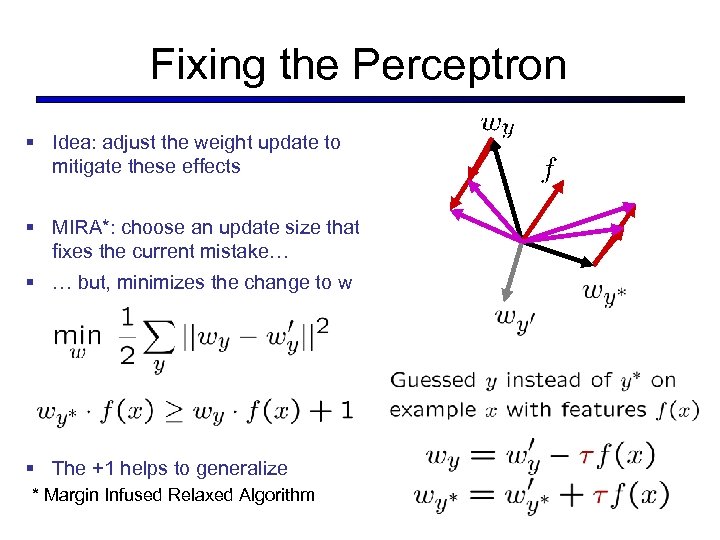 Fixing the Perceptron § Idea: adjust the weight update to mitigate these effects § MIRA*: choose an update size that fixes the current mistake… § … but, minimizes the change to w § The +1 helps to generalize * Margin Infused Relaxed Algorithm
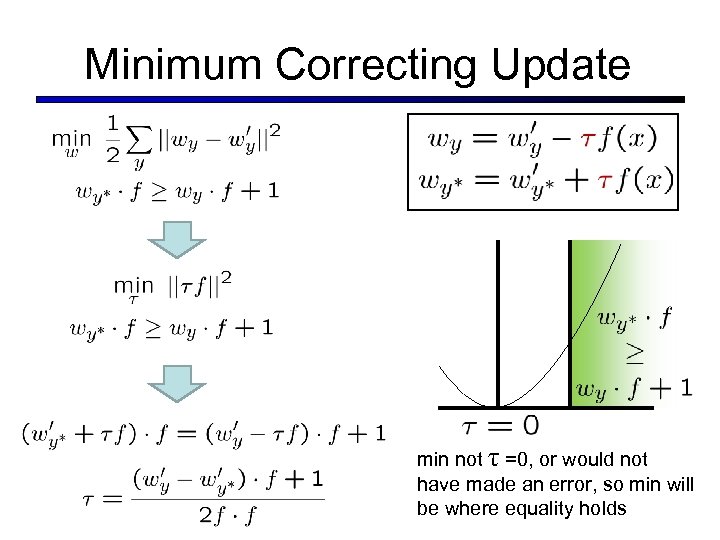 Minimum Correcting Update min not τ =0, or would not have made an error, so min will be where equality holds
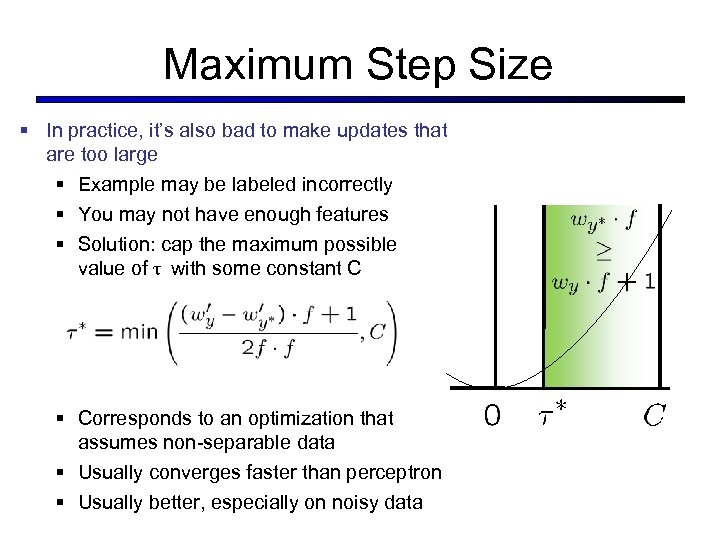 Maximum Step Size § In practice, it’s also bad to make updates that are too large § Example may be labeled incorrectly § You may not have enough features § Solution: cap the maximum possible value of τ with some constant C § Corresponds to an optimization that assumes non-separable data § Usually converges faster than perceptron § Usually better, especially on noisy data
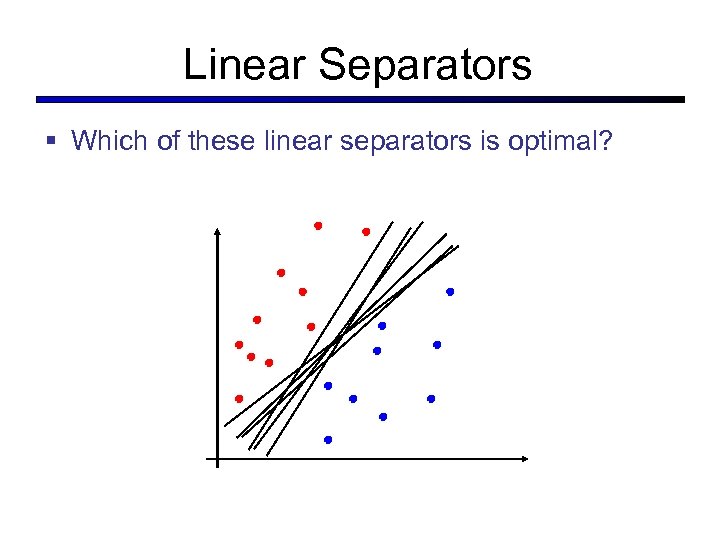 Linear Separators § Which of these linear separators is optimal?
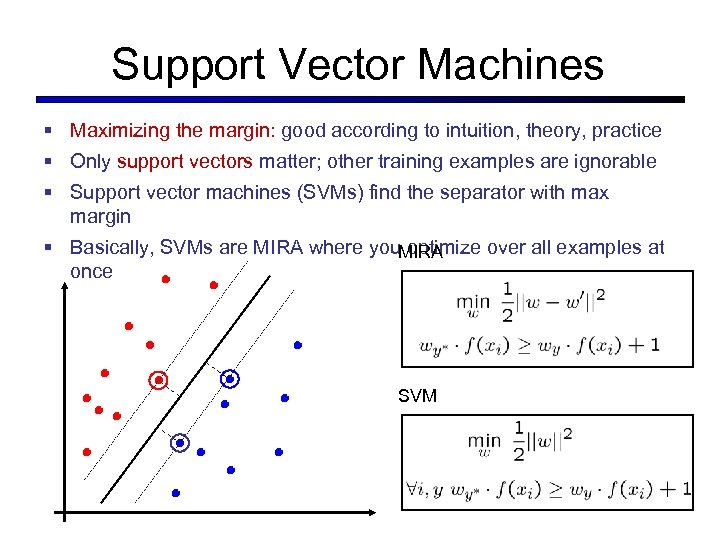 Support Vector Machines § Maximizing the margin: good according to intuition, theory, practice § Only support vectors matter; other training examples are ignorable § Support vector machines (SVMs) find the separator with max margin § Basically, SVMs are MIRA where you. MIRA optimize over all examples at once SVM
 Classification: Comparison § Naïve Bayes § § Builds a model training data Gives prediction probabilities Strong assumptions about feature independence One pass through data (counting) § Perceptrons / MIRA: § § Makes less assumptions about data Mistake-driven learning Multiple passes through data (prediction) Often more accurate