


 Скачать презентацию CSE 380 Computer Operating Systems Instructor Insup Lee
bea55160b4ee7f50bbfe7e09ca3b391c.ppt
- Количество слайдов: 55
 CSE 380 Computer Operating Systems Instructor: Insup Lee and Dianna. Xu University of Pennsylvania Fall 2003 Lecture Note: Security 1
 Preface Early (unix systems) security § Security by obscurity § Those that know enough to break the system also know enough not to q RTM § The Great Internet Worm of 1988 § Devastating watershed event in hacker history § First awareness of internet security q Legendary literatures: § Hackers – Steven Levy § Cyberpunk – Hafner and Markoff § The Cuckoo’s Egg – Clifford Stoll § The Jargon File q 2
 Hackers vs Crackers q The word hack doesn’t have 69 different meanings § an appropriate application of ingenuity § a creative/brilliant practical joke q Legendary hacks are revered as urban folklores § The element of cleverness § A flare for classic hacker’s humor and style, which includes references to Adams, Tolkien as well as jargons § Mostly harmless § Caltech/MIT football pranks § Robin Hood/Friar Tuck against Xerox q There is no cure against bored students 3
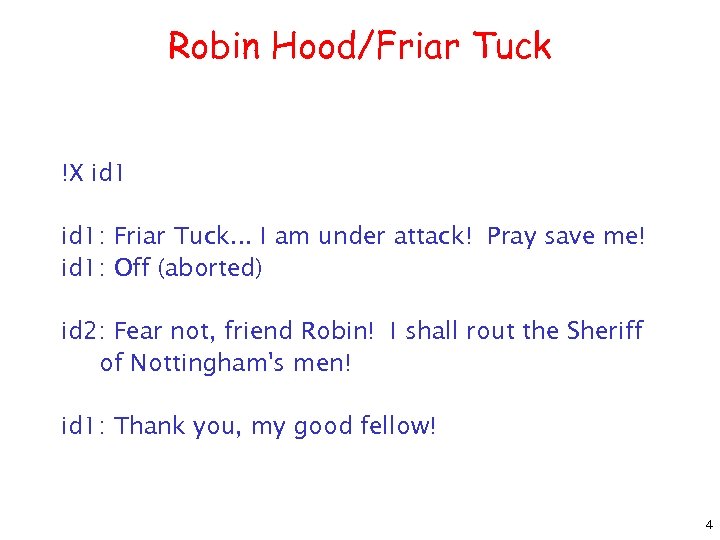 Robin Hood/Friar Tuck !X id 1: Friar Tuck. . . I am under attack! Pray save me! id 1: Off (aborted) id 2: Fear not, friend Robin! I shall rout the Sheriff of Nottingham's men! id 1: Thank you, my good fellow! 4
 Terminology Vulnerability (weakness/defects that can be exploited) § Ill-chosen passwords § Software bugs § Communication without encryption § Incorrect set-ups q Attack (ways of exploiting vulnerability) § Password crackers § Viruses and worms § Denial of service q Intruders (adversaries that try to attack) § Terrorists § Espionage § Hackers q 5
 Security Goals Data Confidentiality § Keep data and communication secret § Privacy of personal financial/health records etc § Military and commercial relevance q Data Integrity § Protect reliability of data against tampering § Can we be sure of the source and content of information? q System Availability § Data/resources should be accessible when needed § Protection against denial of service attacks q 6
 Sample Tools Cryptography § Can ensure confidentiality and integrity § Typically used for authentication q Firewalls, passwords, access control § Authorization mechanisms q Operating systems § Resource allocation § Monitoring and logging for audits q Java bytecode verifier § Memory safety against malicious/defective code q We do not have adequate technology today! 7
 Basics Terminology § Authentication: Verifying identity of sender and/or message integrity § Integrity: Message tampering detection § Plaintext: Original message § Ciphertext: Encrypted message § Key: Input for en- and decryption algorithm § Encryption: Plaintext + Key Ciphertext § Decryption: Ciphertext + Key Plaintext 8
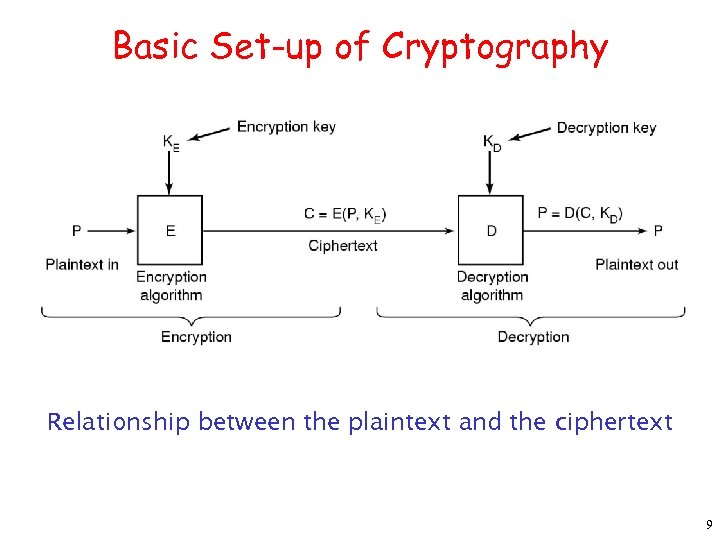 Basic Set-up of Cryptography Relationship between the plaintext and the ciphertext 9
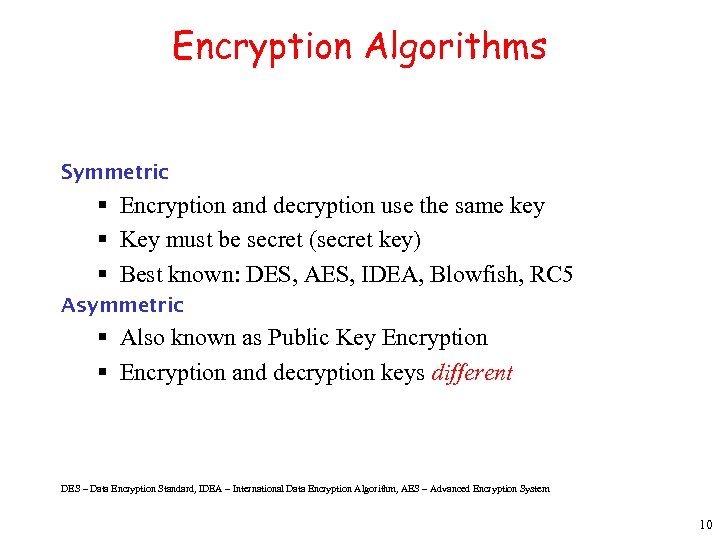 Encryption Algorithms Symmetric § Encryption and decryption use the same key § Key must be secret (secret key) § Best known: DES, AES, IDEA, Blowfish, RC 5 Asymmetric § Also known as Public Key Encryption § Encryption and decryption keys different DES – Data Encryption Standard, IDEA – International Data Encryption Algorithm, AES – Advanced Encryption System 10
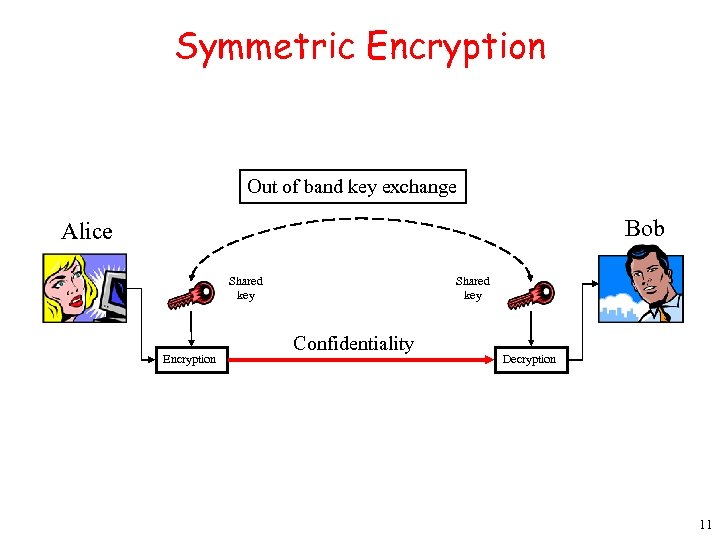 Symmetric Encryption Out of band key exchange Bob Alice Shared key Encryption Shared key Confidentiality Decryption 11
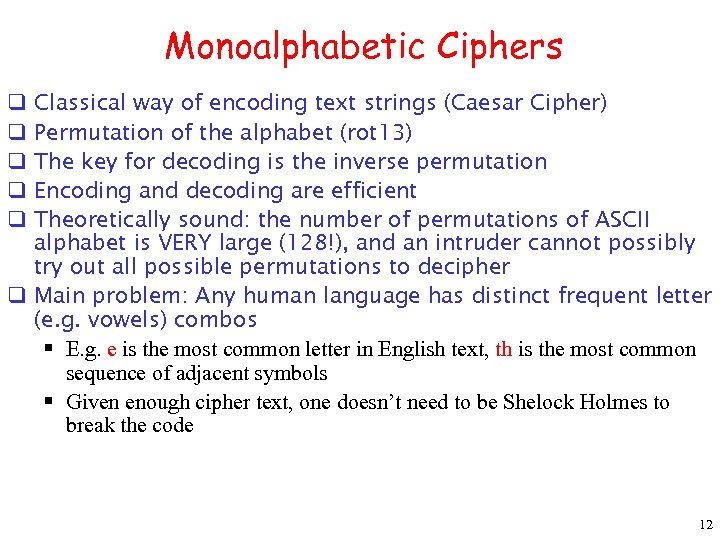 Monoalphabetic Ciphers Classical way of encoding text strings (Caesar Cipher) Permutation of the alphabet (rot 13) The key for decoding is the inverse permutation Encoding and decoding are efficient Theoretically sound: the number of permutations of ASCII alphabet is VERY large (128!), and an intruder cannot possibly try out all possible permutations to decipher q Main problem: Any human language has distinct frequent letter (e. g. vowels) combos § E. g. e is the most common letter in English text, th is the most common sequence of adjacent symbols § Given enough cipher text, one doesn’t need to be Shelock Holmes to break the code q q q 12
 Secret-Key Cryptography q Sender and receiver share the secret key q This is also called symmetric key cryptography q A popular scheme for many years: DES (Data Encryption Standard) promoted by NSA § Key is 56 bits (extended to 64 bits using 8 parity bits) § Input data is processed in chunks of 64 -bit blocks, by subjecting to a series of transformations using the key q Distribution of keys is a problem 13
 Asymmetric Encryption q Two complementary keys § Private key (kept secret) § Public key (published) q Private key VERY difficult to compute from public key q Encryption with one key can only be reversed with the other key q Used in PGP (Pretty Good Privacy) & PKI (Public Key Infrastructure) q Best known RSA & ECC, DSA for signatures RSA Rivest Shami Adleman, ECC – Eliptic Curve Cryptography, DSA – Digital Signature Algorithm 14
 One-Way Functions q Function such that given formula for f(x) § easy to evaluate y = f(x) given x q But given y § computationally infeasible to find x q There is a rich theory of one-way functions § Many candidates proposed § None of them “proved” to be one way § Existence of one-way functions linked to encryption, random number generators, (and other crypto concepts) in a precise sense 15
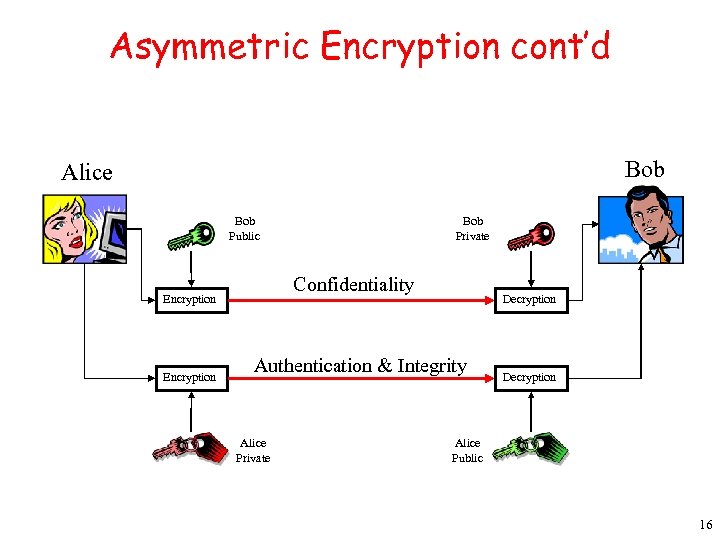 Asymmetric Encryption cont’d Bob Alice Bob Public Confidentiality Encryption Bob Private Decryption Authentication & Integrity Alice Private Decryption Alice Public 16
 Public-Key Cryptography q All users pick a public key/private key pair § publish the public key § private key not published q Public key is the encryption key § To send a message to user Alice, encrypt the message with Alice’s public key q Private key is the decryption key § Alice decrypts the ciphertext with its private key q Popular schemes (1970 s): Diffie-Hellman, RSA 17
 More on RSA q Introduced by Rivest, Shamir, and Adleman in 1979 q Foundations in number theory and computational difficulty of factoring q Not mathematically proven to be unbreakable, but has withstood attacks and analysis § Ideally, we would like to prove a theorem saying “if intruder does not know the key, then it cannot construct plaintext from the ciphertext by executing a polynomial-time algorithm” q Public and private keys are derived from secretly chosen large prime numbers (512 bits) q Plaintext is viewed as a large binary number and encryption is exponentiation in modulo arithmetic q Intruder will have to factor large numbers (and there are no known polynomial-time algorithms for this) § 2002’s major result: polynomial-time test to check if a number is prime 18
 Hash Functions q Produce hash values for data access or security q Hash value: Number generated from a string of text q Hash is substantially smaller than the text itself q Unlikely that other text produces the same hash value (collision resistance) q Unidirectional (cannot calculate text from hash) q Provides: Integrity & Authentication q Best known: SHA-1 & MD 5 SHA – Secure Hash Algorithm, MD 5 – Message Digest 19
 Digital Signatures q How can Alice sign a digital document ? q Let S(A, M) be the message M tagged with Alice’s signature q No forgery possible: If Alice signs M then nobody else can generate S(A, M) q Authenticity check: If you get the message S(A, M) you should be able to verify that this is really created by Alice q No alteration: Once Alice sends S(A, M), nobody (including Alice) can tamper this message q No reuse: Alice cannot duplicate S(A, M) at a later time 20
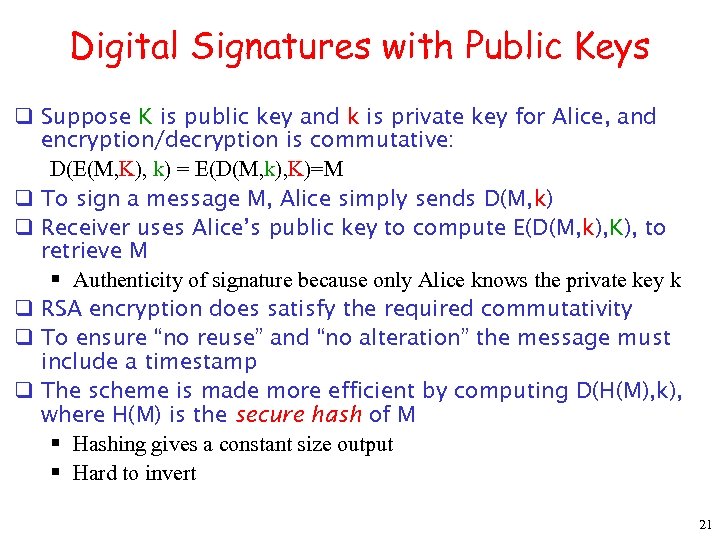 Digital Signatures with Public Keys q Suppose K is public key and k is private key for Alice, and encryption/decryption is commutative: D(E(M, K), k) = E(D(M, k), K)=M q To sign a message M, Alice simply sends D(M, k) q Receiver uses Alice’s public key to compute E(D(M, k), K), to retrieve M § Authenticity of signature because only Alice knows the private key k q RSA encryption does satisfy the required commutativity q To ensure “no reuse” and “no alteration” the message must include a timestamp q The scheme is made more efficient by computing D(H(M), k), where H(M) is the secure hash of M § Hashing gives a constant size output § Hard to invert 21
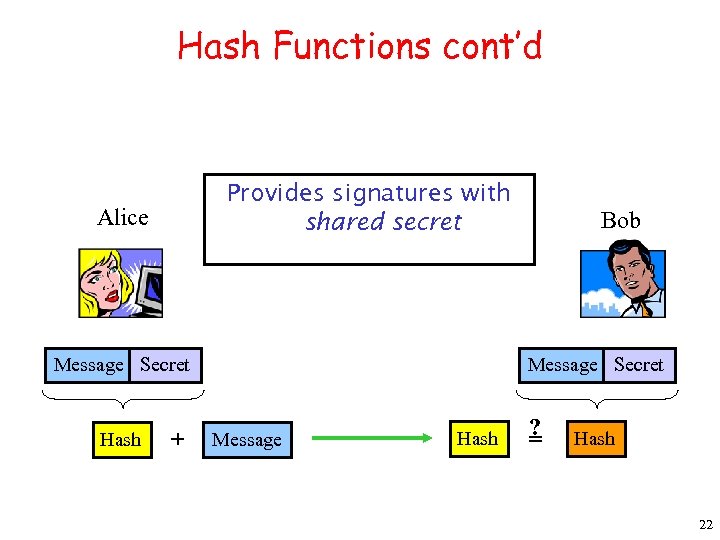 Hash Functions cont’d Provides signatures with shared secret Alice Message Secret Hash + Bob Message Secret Message Hash ? = Hash 22
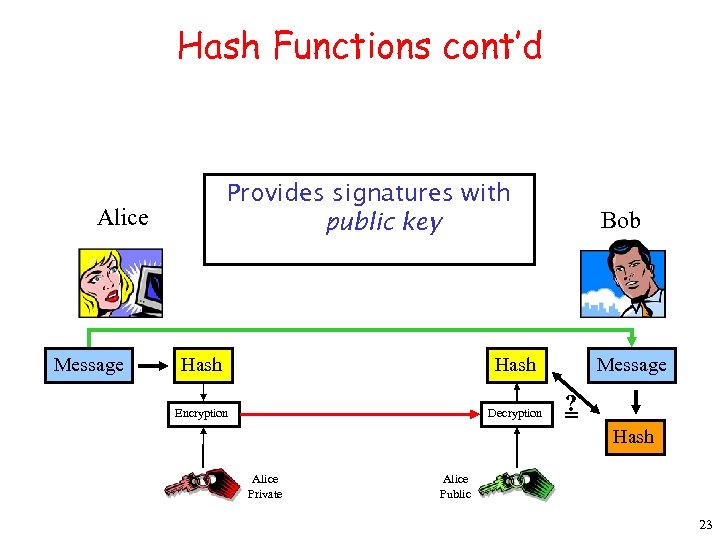 Hash Functions cont’d Provides signatures with public key Alice Message Hash Encryption Decryption Bob Alice Private Message ? = Hash Alice Public 23
 PKI in a Nutshell PKI (Public Key Infrastructure) based on § Certificates (X. 509) § Chain of trust (usually hierarchy) Certificates § Public keys signed by a trusted 3 rd party CA = Certificate Authority § Certificate is public as well § Different types for people, web server, … 24
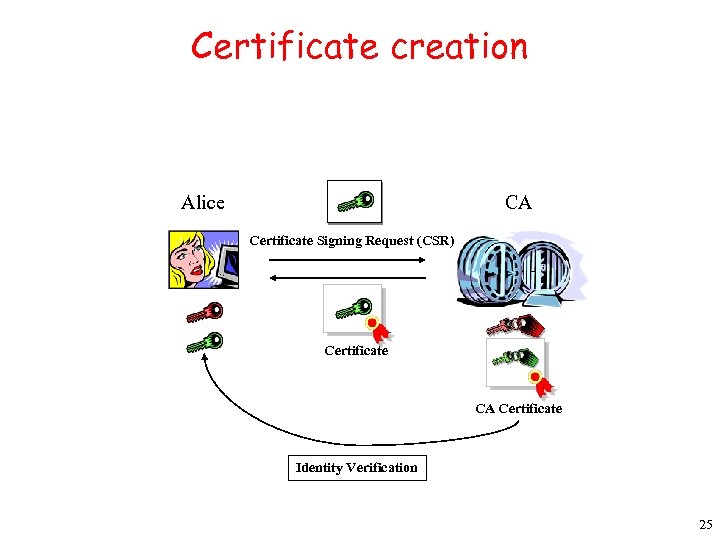 Certificate creation Alice CA Certificate Signing Request (CSR) Certificate CA Certificate Identity Verification 25
 User Authentication is the process of determining which user is making a request Basic Principles. Authentication must identify: 1. Something the user knows (e. g. password) 2. Something the user has (e. g. ID card) 3. Something user is (e. g. retina scan) Humans are the weakest link 26
 Passwords q The most commonly used way of authentication q Vulnerabilities § Stealing passwords § Poorly chosen passwords that are easy to guess § Attacks that search through password directories q If you were to guess passwords, how would you go about doing that? q Survey of passwords by Morris&Thomson: could guess 86% of all passwords § 15 single ASCII letters § 72 two ASCII letters § 464 three ASCII letters § Words from dictionary, names of people/streets …. 27
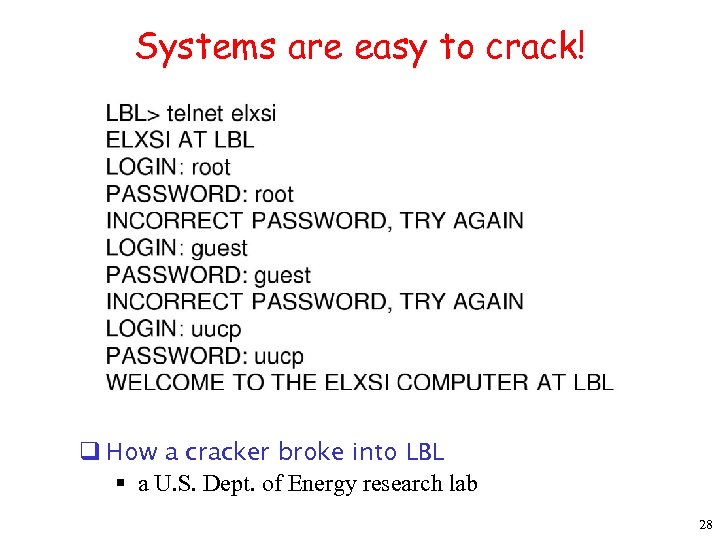 Systems are easy to crack! q How a cracker broke into LBL § a U. S. Dept. of Energy research lab 28
 Password Attacks q Deadly combo: § War dialers / password guessing q Once entrance to a system is gained: § password file § packet sniffer § rsh/rlogin into other machines with known usr/passwd combo q Social Engineering 29
 Unix: /etc/passwd q Passwords stored in a file system are vulnerable to automated attacks § At first Unix was implemented with a password file holding the actual passwords of users, but with only root permissions. q This had many vulnerabilities § Copies were made by privileged users § Copies were made by bugs: classic example posted password file on daily message file 30
 Improvements to First Approach q Enforce password rules § Makes the passwords harder to guess or crack with dictionaries § Problems? q Hashing and encryption: use password to create a key, then hash based on the DES algorithm for encryption § Speed OK for legitimate users § Takes longer to do automatic search q Password files contains these encrypted entries q Intruder cannot figure out the passwords just by gaining access to password file, but can keep guessing passwords, apply hash/encryption and compare the results to entries in password file 31
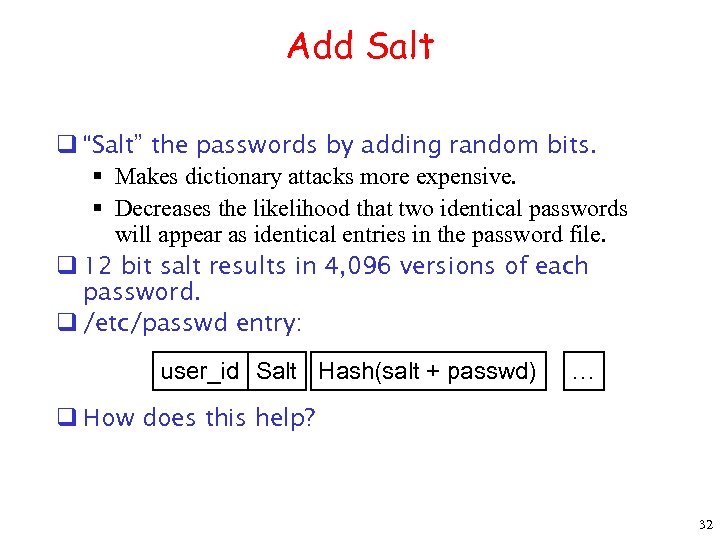 Add Salt q “Salt” the passwords by adding random bits. § Makes dictionary attacks more expensive. § Decreases the likelihood that two identical passwords will appear as identical entries in the password file. q 12 bit salt results in 4, 096 versions of each password. q /etc/passwd entry: user_id Salt Hash(salt + passwd) … q How does this help? 32
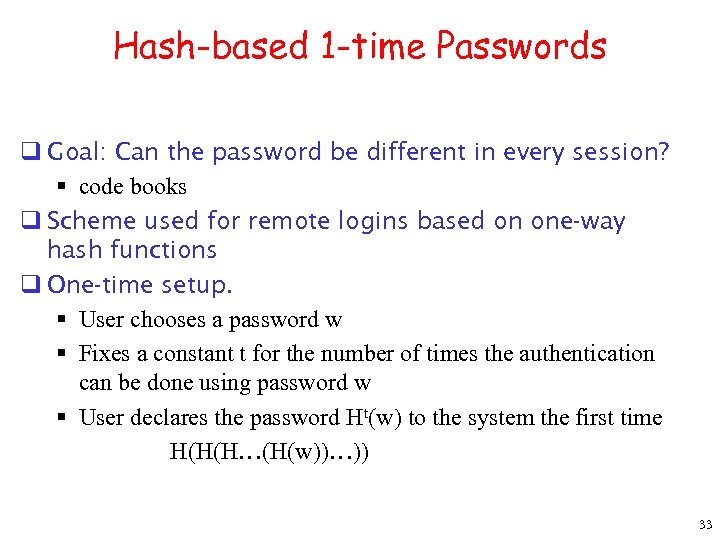 Hash-based 1 -time Passwords q Goal: Can the password be different in every session? § code books q Scheme used for remote logins based on one-way hash functions q One-time setup. § User chooses a password w § Fixes a constant t for the number of times the authentication can be done using password w § User declares the password Ht(w) to the system the first time H(H(H…(H(w))…)) 33
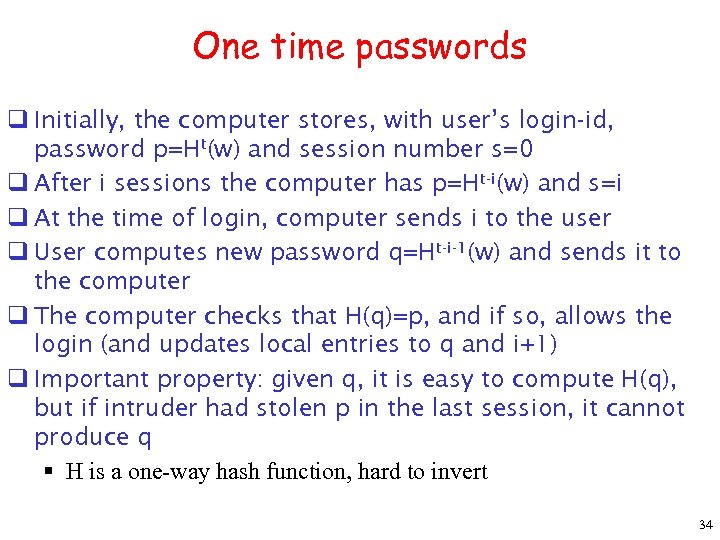 One time passwords q Initially, the computer stores, with user’s login-id, password p=Ht(w) and session number s=0 q After i sessions the computer has p=Ht-i(w) and s=i q At the time of login, computer sends i to the user q User computes new password q=Ht-i-1(w) and sends it to the computer q The computer checks that H(q)=p, and if so, allows the login (and updates local entries to q and i+1) q Important property: given q, it is easy to compute H(q), but if intruder had stolen p in the last session, it cannot produce q § H is a one-way hash function, hard to invert 34
 Operating System Security q Trojan horses § Free programs available to be downloaded and executed § Common trick: place altered versions of utility programs in user directories q Login Spoofing § Simulate the login session to acquire passwords q Logic Bomb q Trap Doors § System programmer writes code to bypass normal checks § Insider knowledge to exploit these intentional vulnerabilities 35
 Buffer Overflow Attacks q > 50% of security incidents reported at CERT (see cert. org) are due to buffer overflow attacks q C and C++ programming languages don’t do array bounds checks § In particular, widely used library functions such as strcpy, gets q Exploited in many famous attacks (read your Windows Service Pack notes) 36
 C’s Control Stack g(char *args) { int x; // more local // variables. . . } Larger Addresses f() { g(parameter); } SP Input parameter f’s stack frame Before calling g 37
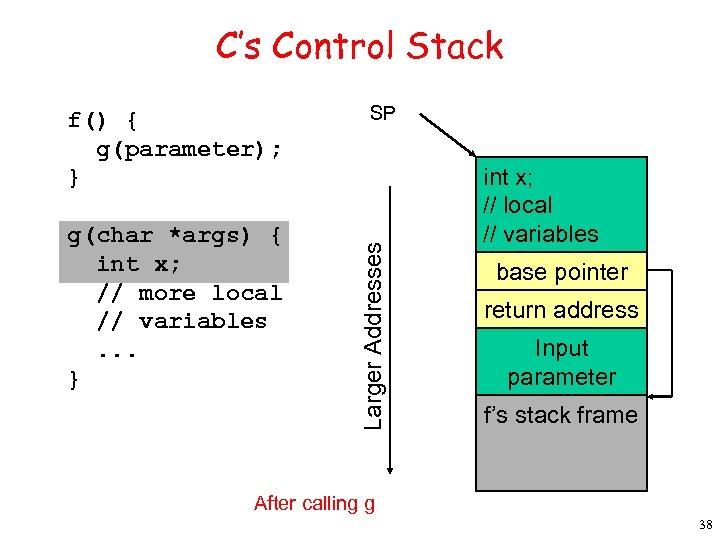 C’s Control Stack g(char *args) { int x; // more local // variables. . . } SP Larger Addresses f() { g(parameter); } int x; // local // variables base pointer return address Input parameter f’s stack frame After calling g 38
![Buffer Overflow Example buffer[] g(char *text) { char buffer[128]; strcpy(buffer, text); } text base](https://present5.com/presentation/bea55160b4ee7f50bbfe7e09ca3b391c/image-39.jpg "Buffer Overflow Example buffer[] g(char *text) { char buffer[128]; strcpy(buffer, text); } text base") Buffer Overflow Example buffer[] g(char *text) { char buffer[128]; strcpy(buffer, text); } text base pointer return address Attack code 128 bytes … ADDR f’s stack frame 39
Buffer Overflow Example buffer[] g(char *text) { char buffer[128]; strcpy(buffer, text); } text base pointer return address Attack code 128 bytes … ADDR f’s stack frame 39
![Buffer Overflow Example ADDR buffer[] Attack code 128 bytes g(char *text) { char buffer[128];](https://present5.com/presentation/bea55160b4ee7f50bbfe7e09ca3b391c/image-40.jpg "Buffer Overflow Example ADDR buffer[] Attack code 128 bytes g(char *text) { char buffer[128];") Buffer Overflow Example ADDR buffer[] Attack code 128 bytes g(char *text) { char buffer[128]; strcpy(buffer, text); } text base … pointer return address ADDR Attack code 128 bytes … ADDR Upon return from g, attack code gets executed ! f’s stack frame 40
Buffer Overflow Example ADDR buffer[] Attack code 128 bytes g(char *text) { char buffer[128]; strcpy(buffer, text); } text base … pointer return address ADDR Attack code 128 bytes … ADDR Upon return from g, attack code gets executed ! f’s stack frame 40
 Solutions q Don’t write code in C § Use a safe language instead (Java, C#, …) § Not always possible (low level programming) § Doesn’t solve legacy code problem q Link C code against safe version of libc § May degrade performance unacceptably q Software fault isolation § Instrument executable code to insert checks q Program analysis techniques § Examine program to see whether “tainted” data is used as argument to strcpy 41
 Avoiding Titanics q Unix § lpr § link core to /etc/passwd q Microsoft § code red (buffer overflow in IIS Indexing Service) q Weathering actual attacks is the best way to make an OS safe § tiger teams q System design should be public q Keep the design simple 42
 Network Security q External threat § code transmitted to target machine § code executed there, doing damage q Goals of virus writer § quickly spreading virus § difficult to detect § hard to get rid of q Virus = program can reproduce itself § by attaching its code to another program § additionally, do harm q Worm § self-replicating 43
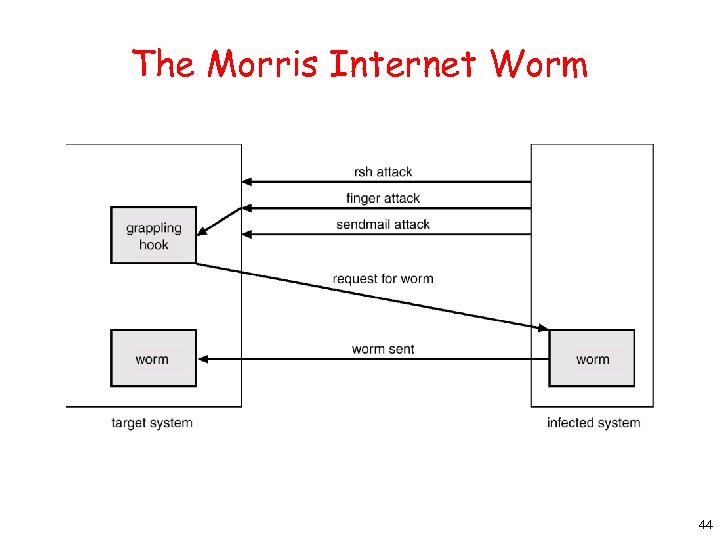 The Morris Internet Worm 44
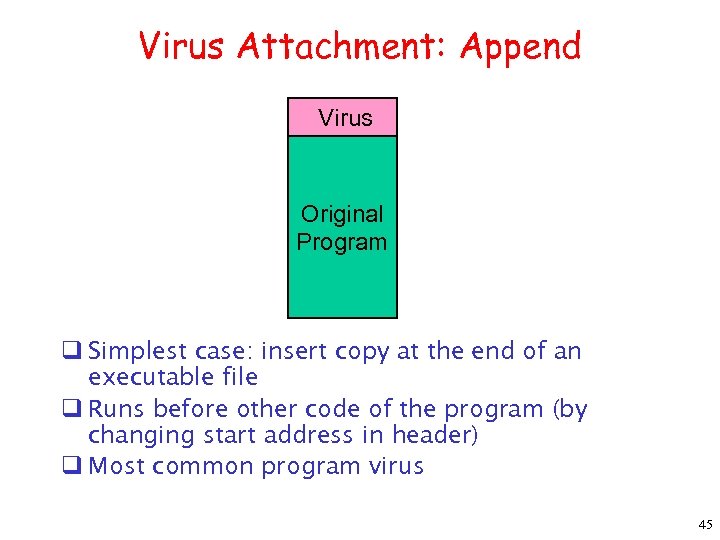 Virus Attachment: Append Virus Original Program q Simplest case: insert copy at the end of an executable file q Runs before other code of the program (by changing start address in header) q Most common program virus 45
 Kinds of Viruses q Overwriting Viruses § Companion Viruses § Executable Viruses q Parasitic Viruses § Cavity Viruses q Memory-resident Viruses § System-call-trap Viruses § Software Viruses (Windows manager, explorer, etc) q Boot Sector Viruses q Device Driver Viruses q Macro Viruses 46
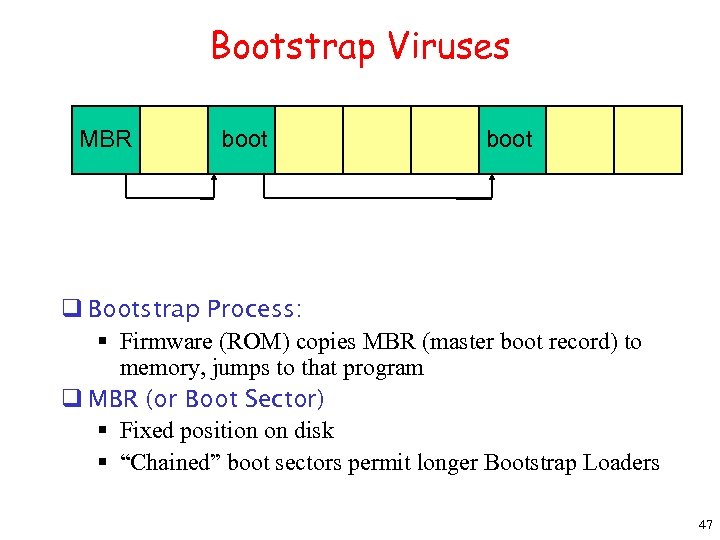 Bootstrap Viruses MBR boot q Bootstrap Process: § Firmware (ROM) copies MBR (master boot record) to memory, jumps to that program q MBR (or Boot Sector) § Fixed position on disk § “Chained” boot sectors permit longer Bootstrap Loaders 47
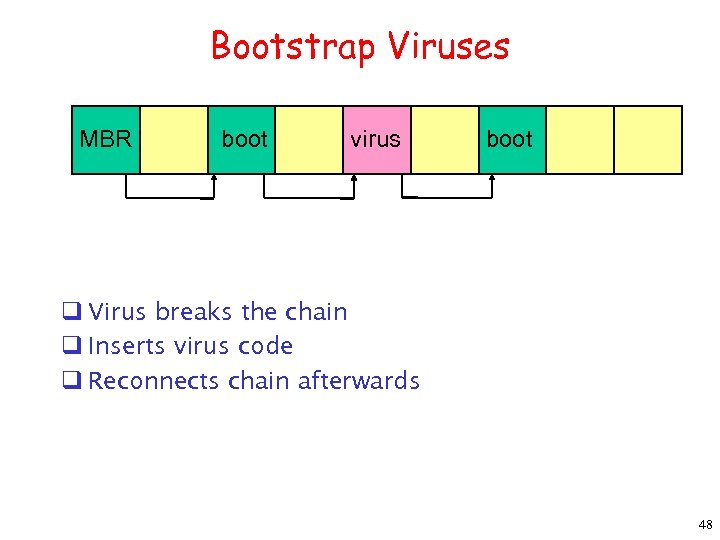 Bootstrap Viruses MBR boot virus boot q Virus breaks the chain q Inserts virus code q Reconnects chain afterwards 48
 Why the Boot Sector? q Automatically executed before OS is running § Also before detection tools are running q OS hides boot sector information from users § Hard to discover that the virus is there § Harder to fix q Any good virus scanning software scans the boot sectors 49
 Macro Viruses q Macros are just programs q Word processors & Spreadsheets § Startup macro § Macros turned on by default q Visual Basic Script (VBScript) 50
 Melissa Virus q Transmission Rate § The first confirmed reports of Melissa were received on Friday, March 26, 1999. § By Monday, March 29, it had reached more than 100, 000 computers. § One site got 32, 000 infected messages in 45 minutes. q Damage § Denial of service: mail systems off-line. § Could have been much worse 51
 Melissa Macro Virus q Implementation § VBA (Visual Basic for Applications) code associated with the "document. open" method of Word q Strategy § Email message containing an infected Word document as an attachment § Opening Word document triggers virus if macros are enabled q Propagation § Sends email message to first 50 entries in every Outlook address book readable by the user executing the macro 52
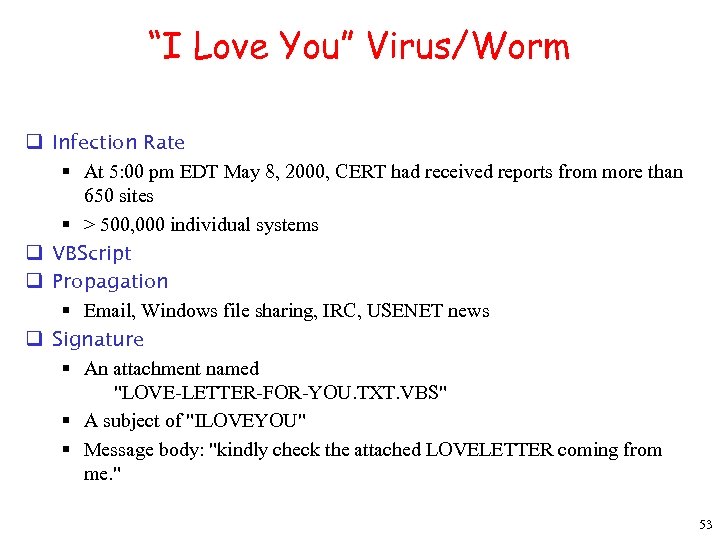 “I Love You” Virus/Worm q Infection Rate § At 5: 00 pm EDT May 8, 2000, CERT had received reports from more than 650 sites § > 500, 000 individual systems q VBScript q Propagation § Email, Windows file sharing, IRC, USENET news q Signature § An attachment named "LOVE-LETTER-FOR-YOU. TXT. VBS" § A subject of "ILOVEYOU" § Message body: "kindly check the attached LOVELETTER coming from me. " 53
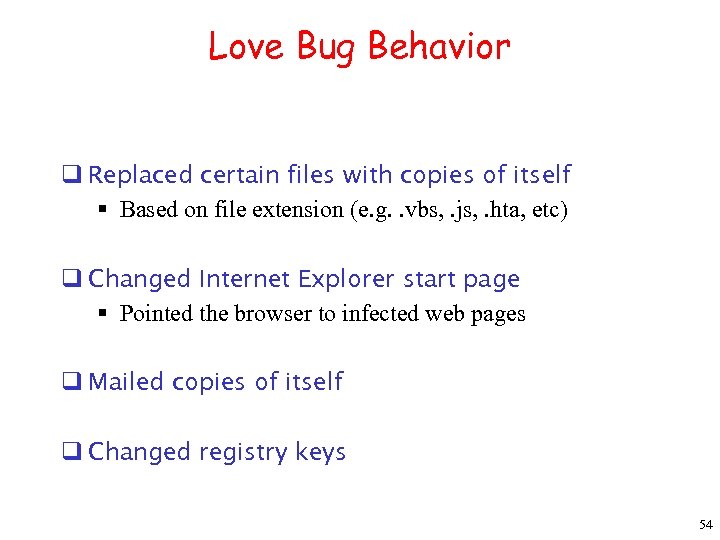 Love Bug Behavior q Replaced certain files with copies of itself § Based on file extension (e. g. . vbs, . js, . hta, etc) q Changed Internet Explorer start page § Pointed the browser to infected web pages q Mailed copies of itself q Changed registry keys 54
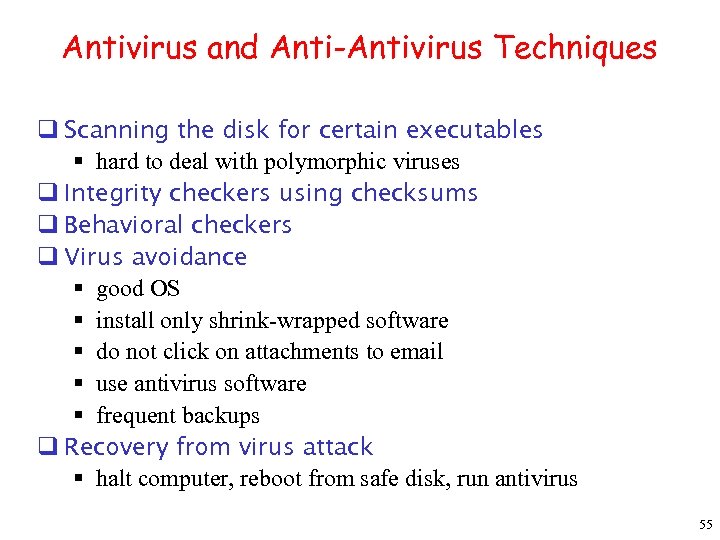 Antivirus and Anti-Antivirus Techniques q Scanning the disk for certain executables § hard to deal with polymorphic viruses q Integrity checkers using checksums q Behavioral checkers q Virus avoidance § good OS § install only shrink-wrapped software § do not click on attachments to email § use antivirus software § frequent backups q Recovery from virus attack § halt computer, reboot from safe disk, run antivirus 55