


 Скачать презентацию CSE 311 Foundations of Computing I Autumn 2011
61879d404bcf4efcd9166f37a51ae725.ppt
- Количество слайдов: 28
 CSE 311 Foundations of Computing I Autumn 2011 Lecture 2 More Propositional Logic Application: Circuits Propositional Equivalence
 Administrative • Course web: http: //www. cs. washington. edu/311 – Homework, Lecture slides, Office Hours. . . • Office Hours: starting today • Homework: – Paper turn-in (stapled) handed in at the start of class on due date (Wednesday). • No on-line turn-in. – Individual. • OK to discuss with a couple of others but nothing recorded from discussion and write-up done much later
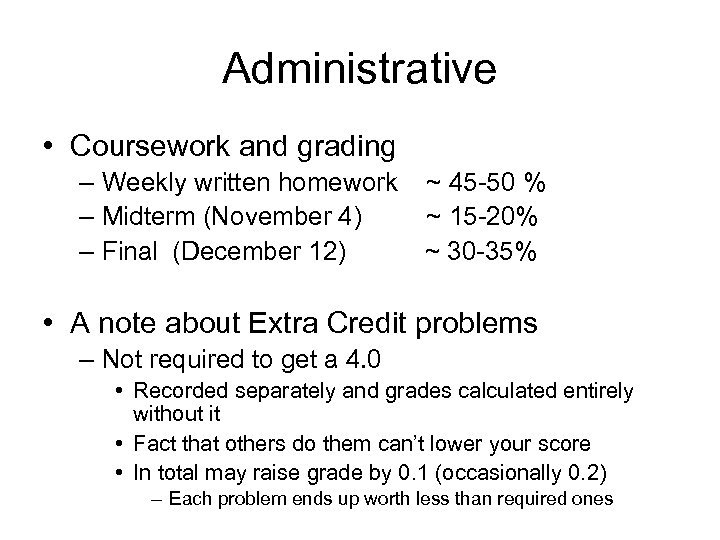 Administrative • Coursework and grading – Weekly written homework – Midterm (November 4) – Final (December 12) ~ 45 -50 % ~ 15 -20% ~ 30 -35% • A note about Extra Credit problems – Not required to get a 4. 0 • Recorded separately and grades calculated entirely without it • Fact that others do them can’t lower your score • In total may raise grade by 0. 1 (occasionally 0. 2) – Each problem ends up worth less than required ones
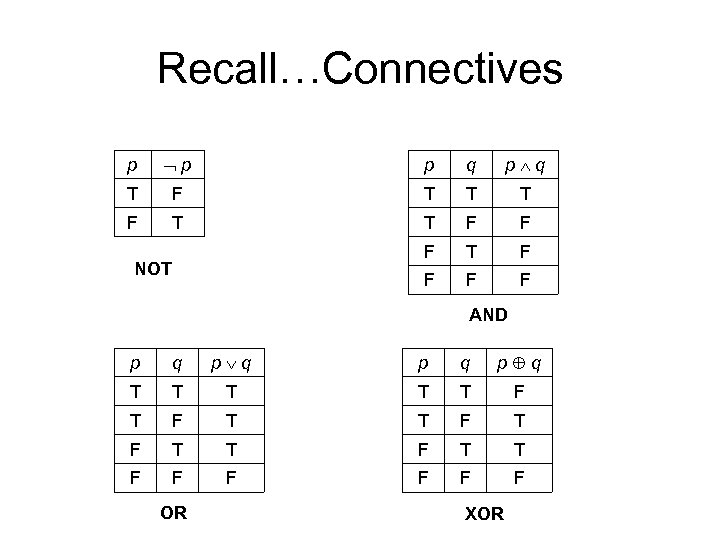 Recall…Connectives p p p q T F T T F F F T F F NOT AND p q p q T T T F T F T T F F F OR XOR
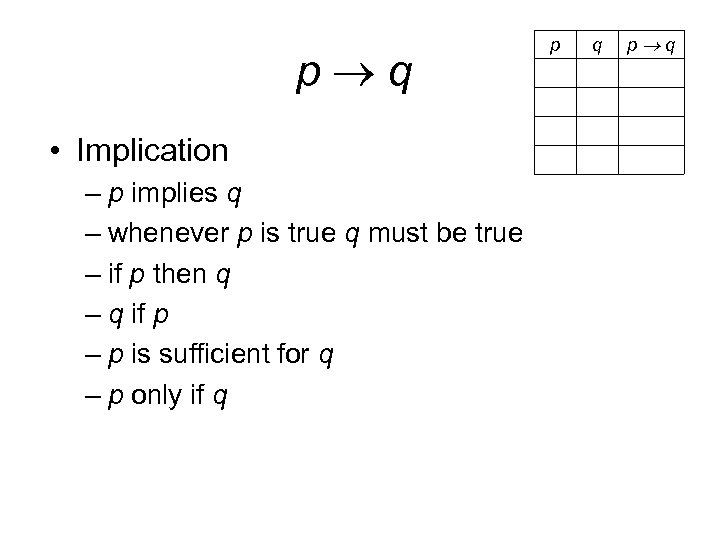 p q • Implication – p implies q – whenever p is true q must be true – if p then q – q if p – p is sufficient for q – p only if q p q
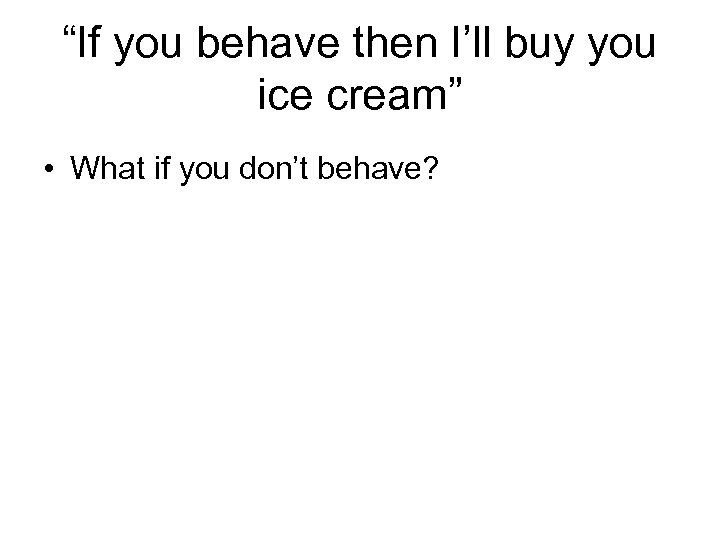 “If you behave then I’ll buy you ice cream” • What if you don’t behave?
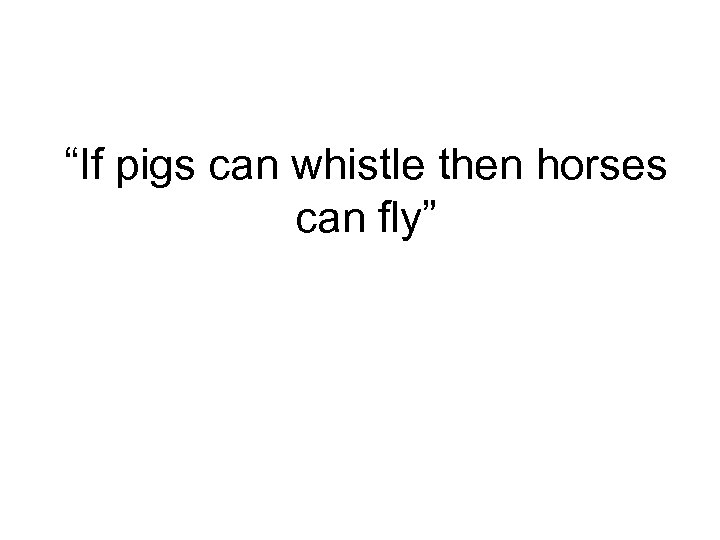 “If pigs can whistle then horses can fly”
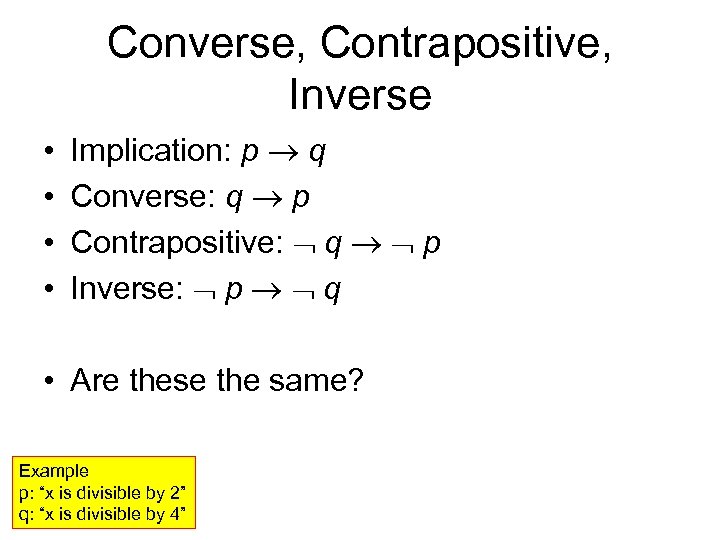 Converse, Contrapositive, Inverse • • Implication: p q Converse: q p Contrapositive: q p Inverse: p q • Are these the same? Example p: “x is divisible by 2” q: “x is divisible by 4”
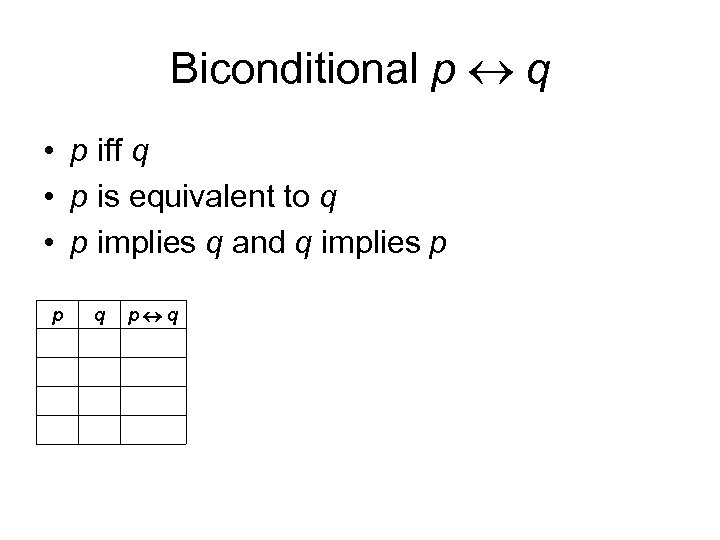 Biconditional p q • p iff q • p is equivalent to q • p implies q and q implies p p q
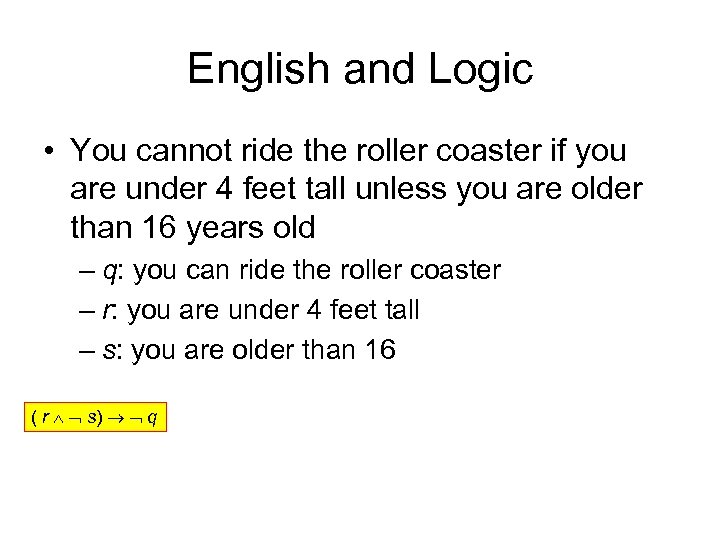 English and Logic • You cannot ride the roller coaster if you are under 4 feet tall unless you are older than 16 years old – q: you can ride the roller coaster – r: you are under 4 feet tall – s: you are older than 16 ( r s) q
 Digital Circuits • Computing with logic – T corresponds to 1 or “high” voltage – F corresponds to 0 or “low” voltage • Gates – Take inputs and produce outputs • Functions – Several kinds of gates – Correspond to propositional connectives • Only symmetric ones (order of inputs irrelevant)
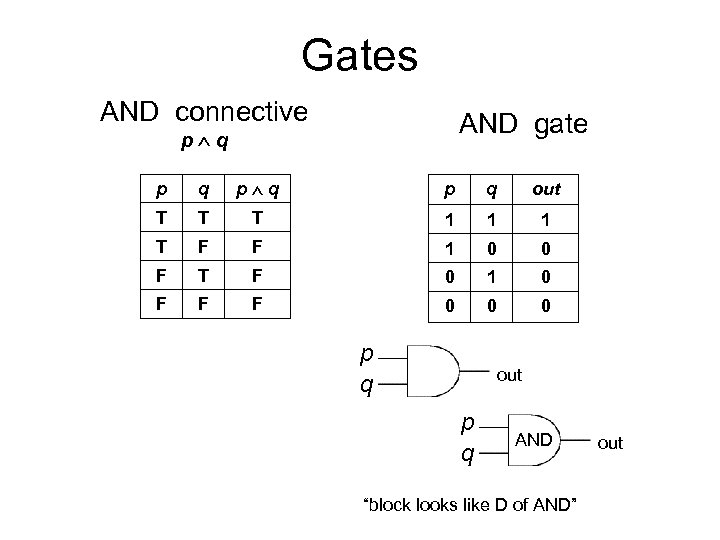 Gates AND connective AND gate p q p q out T T T 1 1 1 T F F 1 0 0 F T F 0 1 0 F F F 0 0 0 p q out p q AND “block looks like D of AND” out
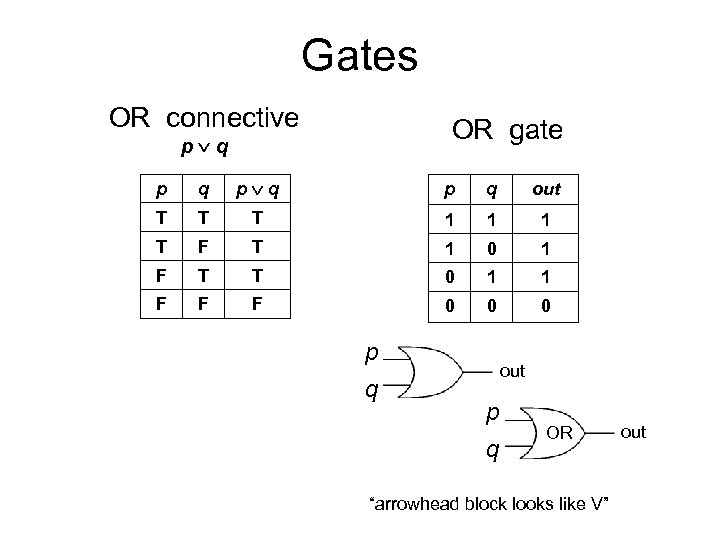 Gates OR connective OR gate p q p q out T T T 1 1 1 T F T 1 0 1 F T T 0 1 1 F F F 0 0 0 p q out p q OR “arrowhead block looks like V” out
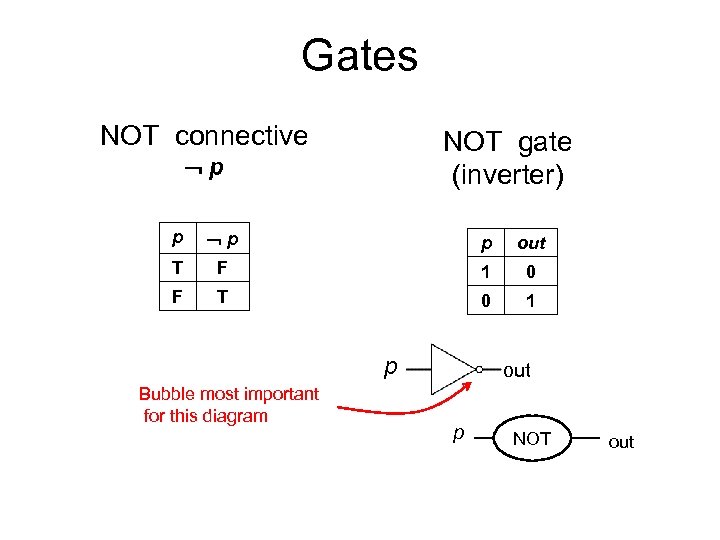 Gates NOT connective NOT gate (inverter) p p out T F 1 0 F T 0 1 p Bubble most important for this diagram out p NOT out
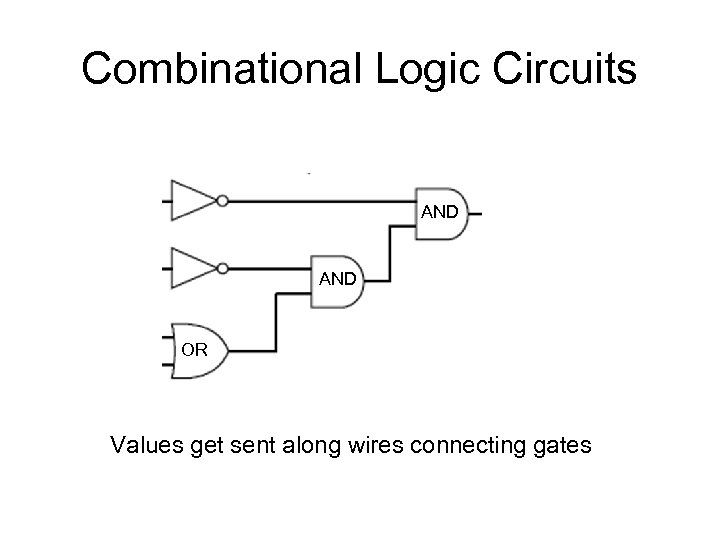 Combinational Logic Circuits AND OR Values get sent along wires connecting gates
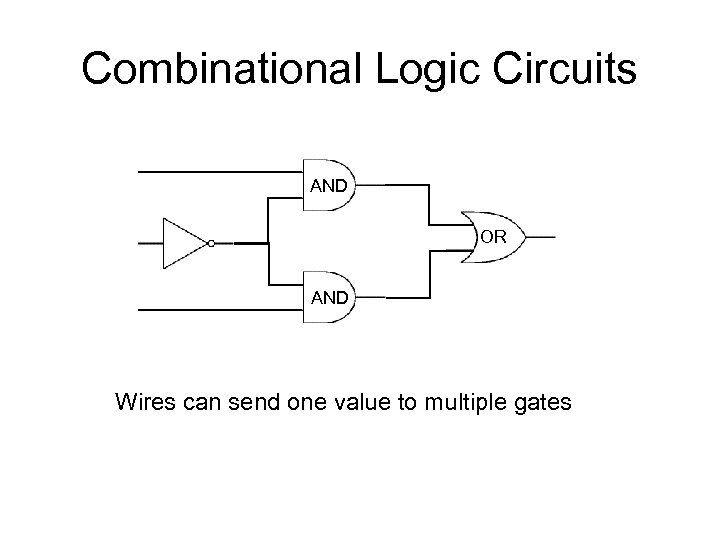 Combinational Logic Circuits AND OR AND Wires can send one value to multiple gates
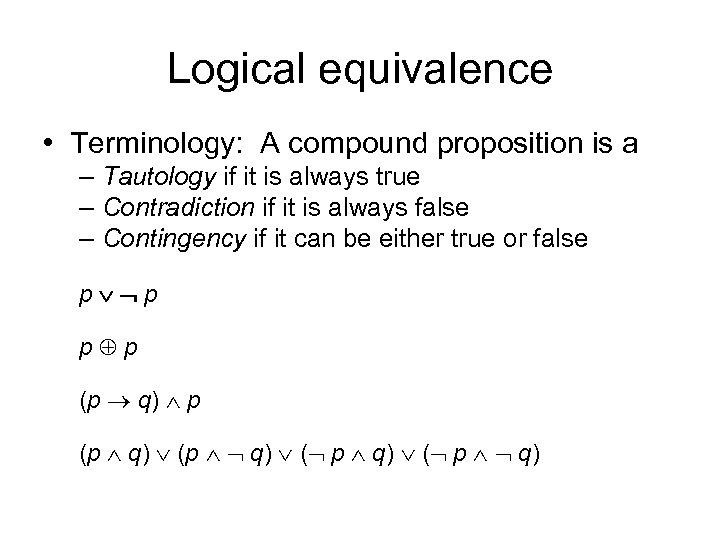 Logical equivalence • Terminology: A compound proposition is a – Tautology if it is always true – Contradiction if it is always false – Contingency if it can be either true or false p p (p q) (p q) ( p q)
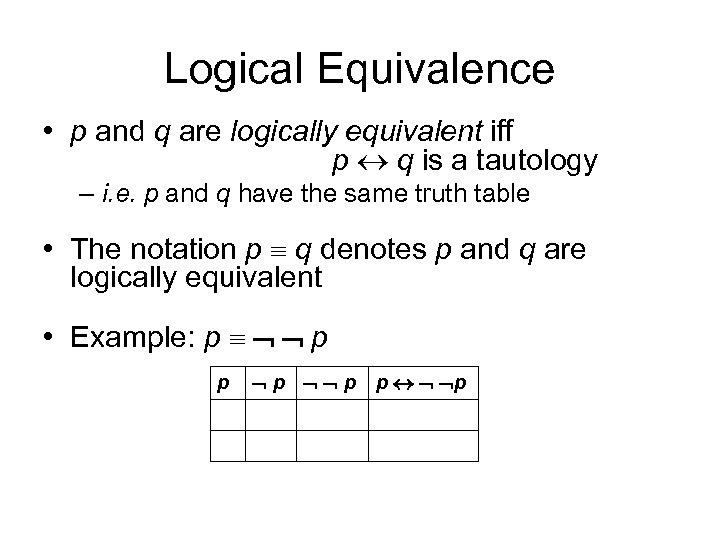 Logical Equivalence • p and q are logically equivalent iff p q is a tautology – i. e. p and q have the same truth table • The notation p q denotes p and q are logically equivalent • Example: p p p p p
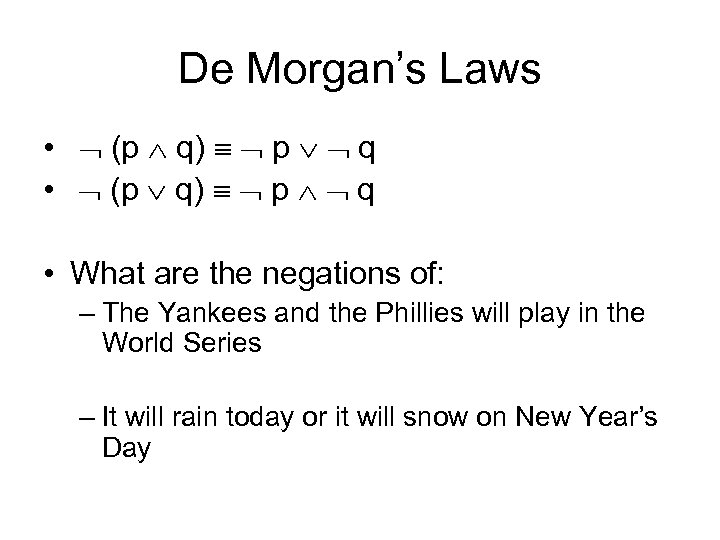 De Morgan’s Laws • (p q) p q • What are the negations of: – The Yankees and the Phillies will play in the World Series – It will rain today or it will snow on New Year’s Day
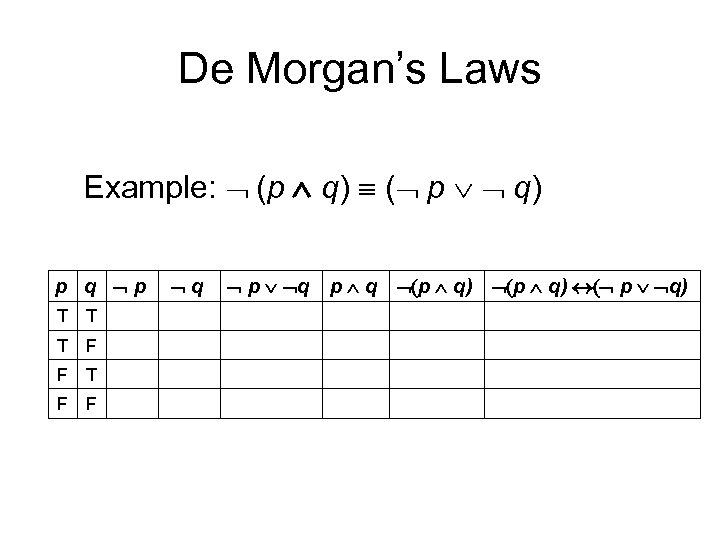 De Morgan’s Laws Example: (p q) ( p q) p q p T T T F F q p q (p q) ( p q)
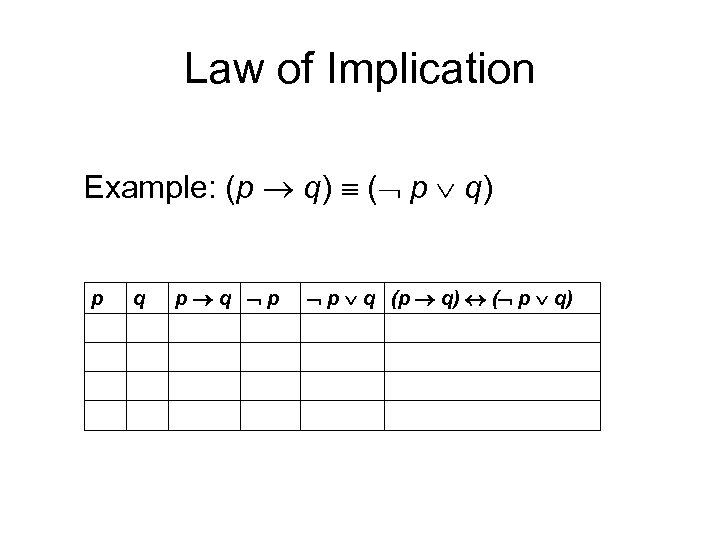 Law of Implication Example: (p q) ( p q) p q p p q (p q) ( p q)
 Computing equivalence • Describe an algorithm for computing if two logical expressions/circuits are equivalent • What is the run time of the algorithm?
 Understanding connectives • Reflect basic rules of reasoning and logic • Allow manipulation of logical formulas – Simplification – Testing for equivalence • Applications – Query optimization – Search optimization and caching – Artificial Intelligence – Program verification
 Properties of logical connectives • • Identity Domination Idempotent Commutative Associative Distributive Absorption Negation
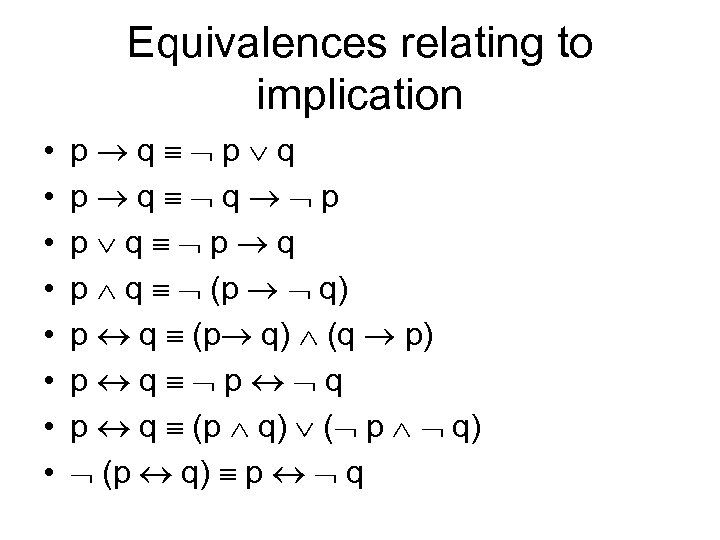 Equivalences relating to implication • • p q p q q p p q p q (p q) p q (p q) (q p) p q p q (p q) ( p q) (p q) p q
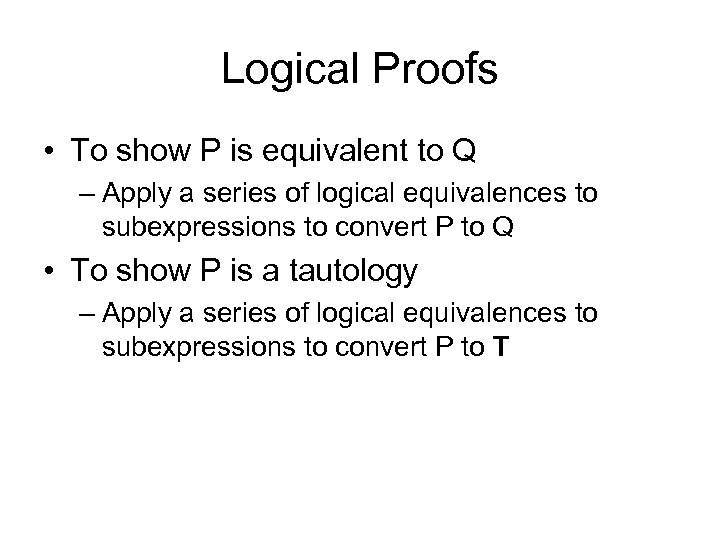 Logical Proofs • To show P is equivalent to Q – Apply a series of logical equivalences to subexpressions to convert P to Q • To show P is a tautology – Apply a series of logical equivalences to subexpressions to convert P to T
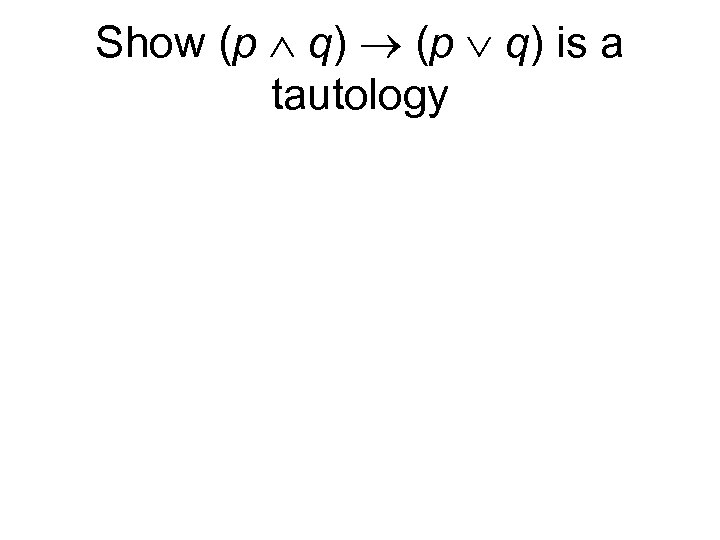 Show (p q) is a tautology
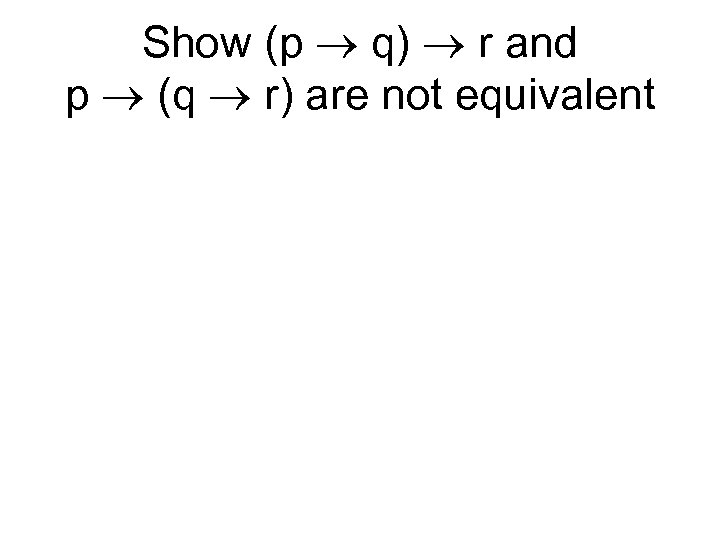 Show (p q) r and p (q r) are not equivalent