


 Скачать презентацию CSE 301 History of Computing Large Scale Computer
faacd70c82be133f3f981d3f3ab40d51.ppt
- Количество слайдов: 32
 CSE 301 History of Computing Large Scale Computer Projects
 Four Major Initiatives l l Whirlwind Semi-Automatic Ground Environment (SAGE) Semi-Automatic Business Research Environment (SABRE) The Apollo Moon Mission
 Whirlwind l l l Developed at MIT for the US Navy Flight Simulator system to train bomber crews Jay Forrester was in charge of the project, design completed in 1947 with Robert Everett Perry Crawford of MIT in 1945 sees a demo of the ENIAC and sees digital computer as solution 1 st computer to operate in real time and to use video displays for output Development led directly to the US Air Force’s SAGE system, and indirectly to minicomputers of the 1960’s
 Whirlwind l l l Most computers of the era operated in bit-serial mode, not fast enough for real-time Whirlwind had 16 math units operating on 16 - bit words in bit-parallel mode (16 X faster) CPU’s of today do arithmetic in bit-parallel mode, sometimes on 32 - or 64 -bit words Whirlwind took 3 years to build and went online April 20, 1951 175 people on the project, incl. 70 engineers & technicians. $1 million annual budget.
 Whirlwind l l l USAF takes over the project from Navy, and uses the Whirlwind computer in the Cape Cod System, a prototype of SAGE Addition 8 microseconds, multiplication 25. 5 microseconds, division 57 microseconds 5000 vacuum tubes Effort to transistorize led to the TX-0, led by Ken Olsen leaves MIT to start Digital Equipment Corp. (DEC)
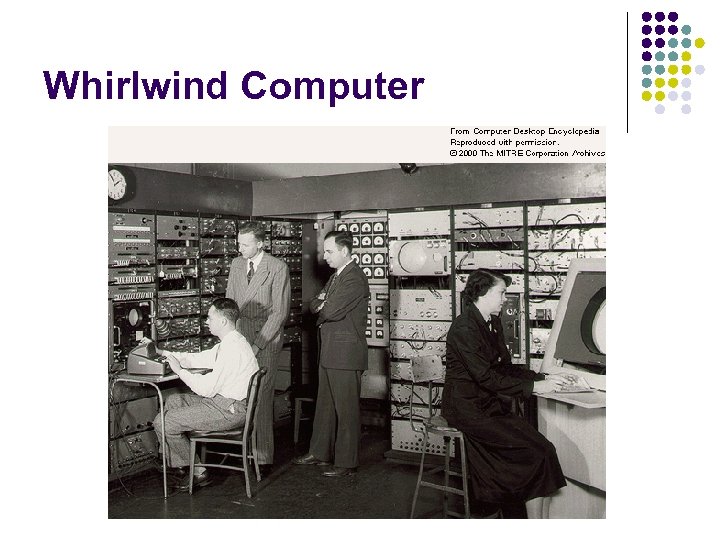 Whirlwind Computer
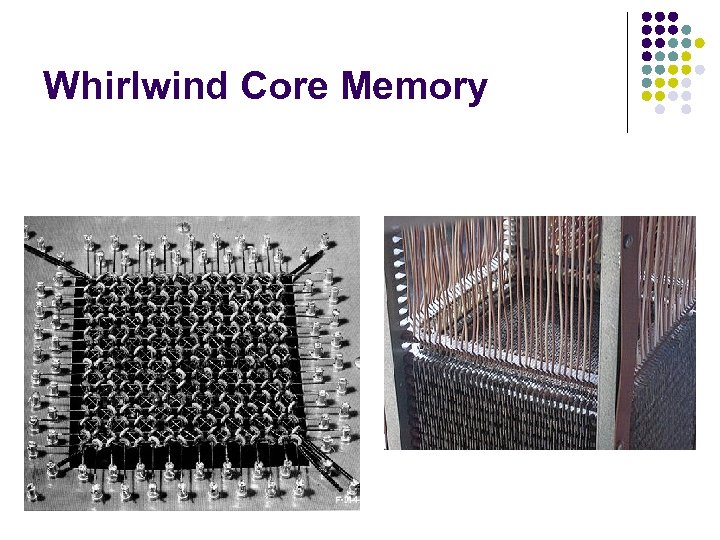 Whirlwind Core Memory
 SAGE l l l Automated control system for tracking and intercepting enemy jet bomber aircraft from the 1950’s into the 80’s. Real time computing, data communication using modems. IBM wins contract to develop SAGE’s AN/FSQ-7 computer Largest computer ever built Bomber threat became missile threat before SAGE was operational
 SAGE l l l l 55, 000 vacuum tubes ½ acre of floor space, 275 tons and consumes up to 3 megawatts of power. Two systems for redundancy for each SAGE center Hot-swappable components (vacuum tube trays) CRT-based real-time user interface Between $8 & $12 B in 1964 dollars ($55 B in 2000 dollars) Influenced design of FAA’s air traffic control system and led to SABRE project with American Airlines
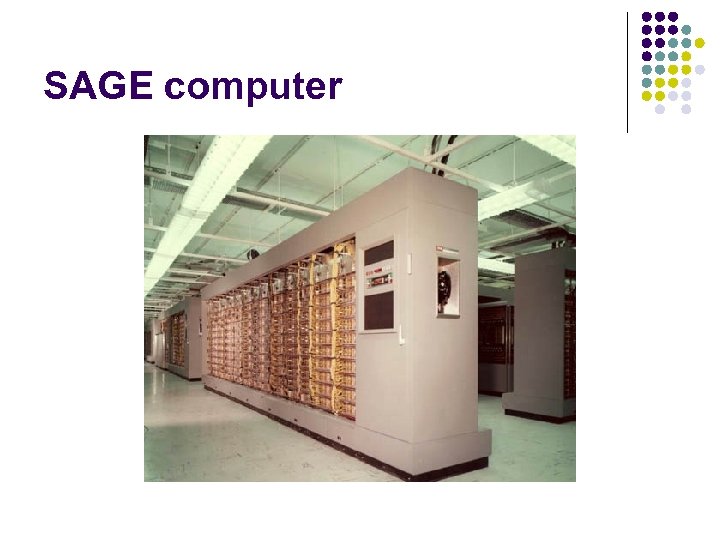 SAGE computer
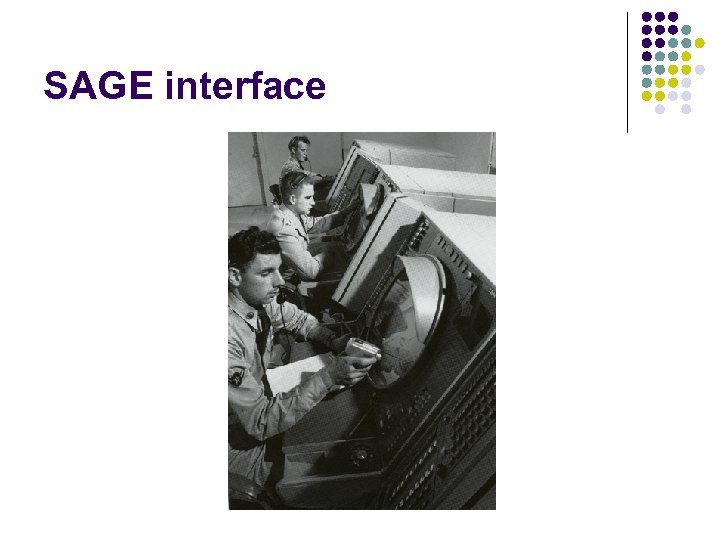 SAGE interface
 SABRE l l Computer reservation system used by airlines, railways, hotels, travel agents. Developed to help American Airlines improve booking operations. Replaced manual system in place since 1920’s Serendipity: top IBM salesman, Blair Smith, seated next to AA president C R Smith, on a flight from LA to NY in 1953. Common family name begins conversation that ends up with an IBM proposal to build SABRE 30 days later.
 SABRE l l l 3 years in development (1957 -1960) at a cost of $40 M ($350 M 2000 dollars) Takes over all booking operations in 1964. Opened to travel agents in 1976. Spun off by AA in 2000, taken private in 2007. Travelocity web site introduced in 1996. System today connects 3 million consumers to 30, 000 travel agents, 400 airlines, 50 carrental companies, and 35, 000 hotels.
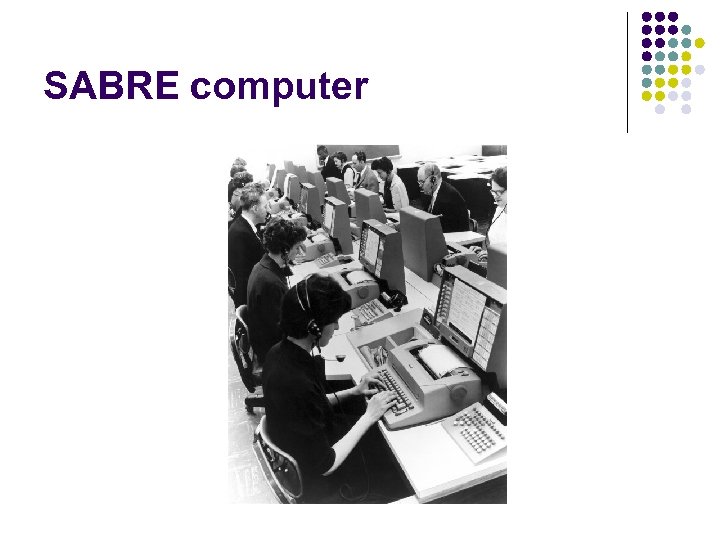 SABRE computer
 Apollo Space Program l l l Origin of Computer Simulation and Modeling (changing role of mathematical analysis) Era of Dual Computer Environments (scientific and business) Software Engineering (evolving recognition of need for software engineering processes)
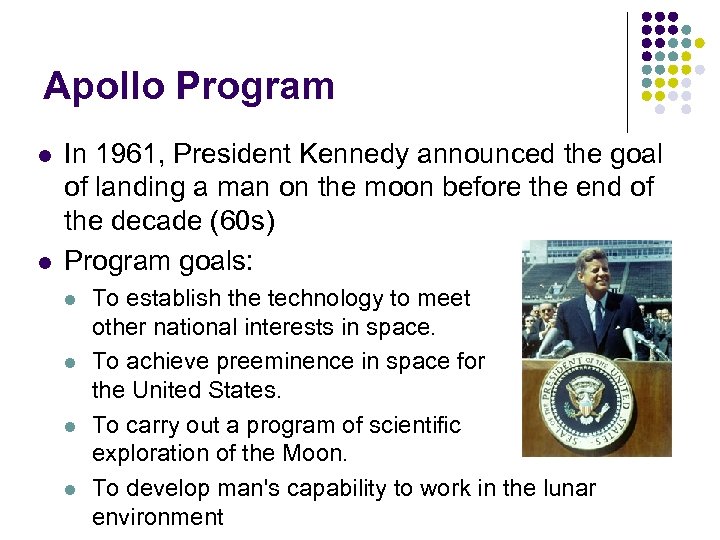 Apollo Program l l In 1961, President Kennedy announced the goal of landing a man on the moon before the end of the decade (60 s) Program goals: l l To establish the technology to meet other national interests in space. To achieve preeminence in space for the United States. To carry out a program of scientific exploration of the Moon. To develop man's capability to work in the lunar environment
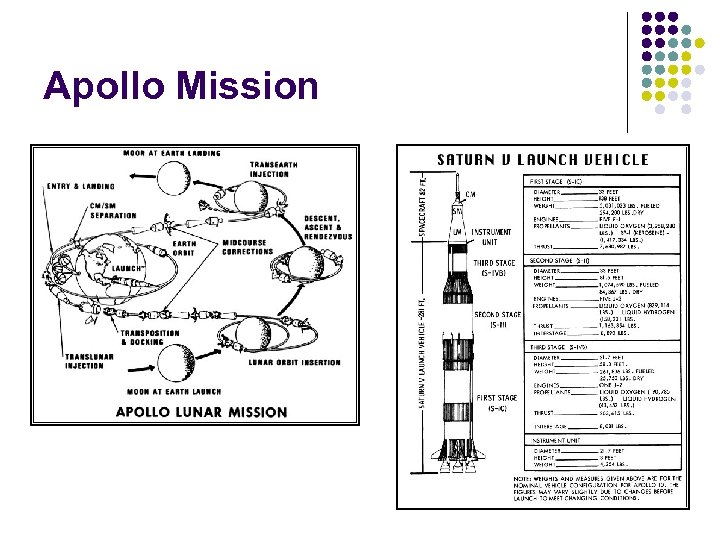 Apollo Mission
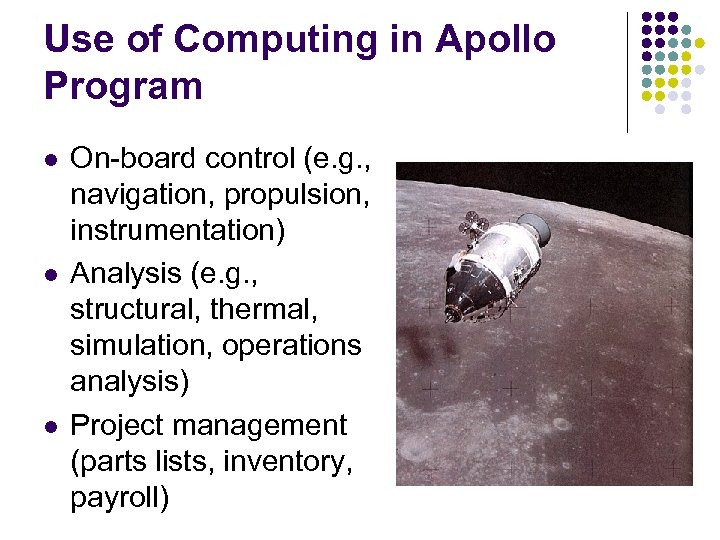 Use of Computing in Apollo Program l l l On-board control (e. g. , navigation, propulsion, instrumentation) Analysis (e. g. , structural, thermal, simulation, operations analysis) Project management (parts lists, inventory, payroll)
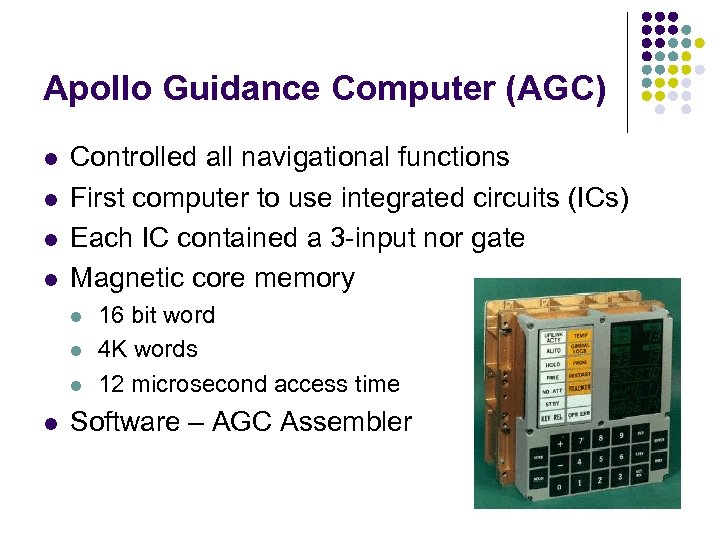 Apollo Guidance Computer (AGC) l l Controlled all navigational functions First computer to use integrated circuits (ICs) Each IC contained a 3 -input nor gate Magnetic core memory l l 16 bit word 4 K words 12 microsecond access time Software – AGC Assembler
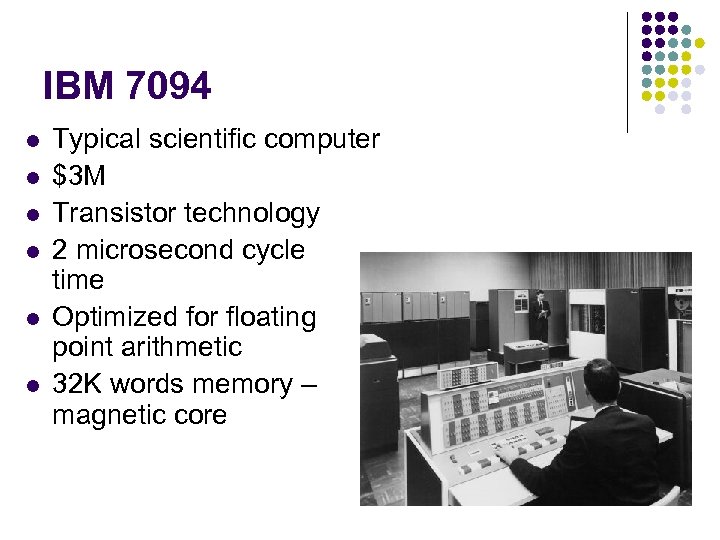 IBM 7094 l l l Typical scientific computer $3 M Transistor technology 2 microsecond cycle time Optimized for floating point arithmetic 32 K words memory – magnetic core
 Apollo Software Development l l Software engineering, as we know it, did not exist – but software development was done within the systems engineering structure No design documents, code reviews, test plans, best practices, etc. Software was considered an extension of mathematical analysis Typical programs were one huge module (1 - 4 thousand lines of code)
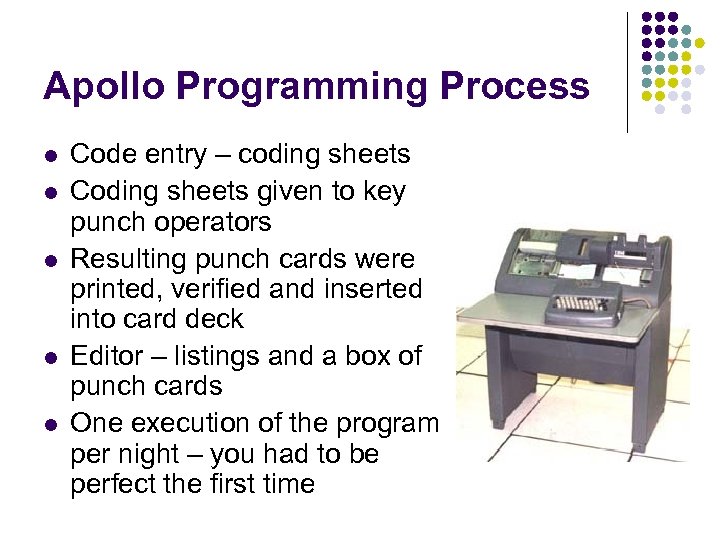 Apollo Programming Process l l l Code entry – coding sheets Coding sheets given to key punch operators Resulting punch cards were printed, verified and inserted into card deck Editor – listings and a box of punch cards One execution of the program per night – you had to be perfect the first time
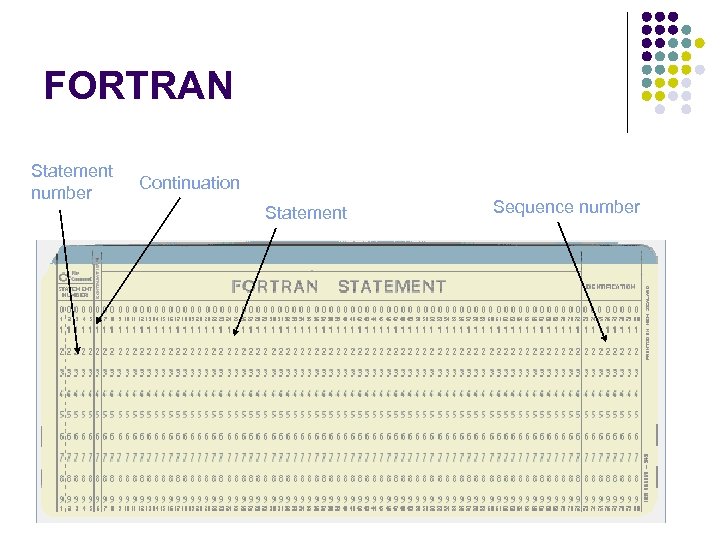 FORTRAN Statement number Continuation Statement Sequence number
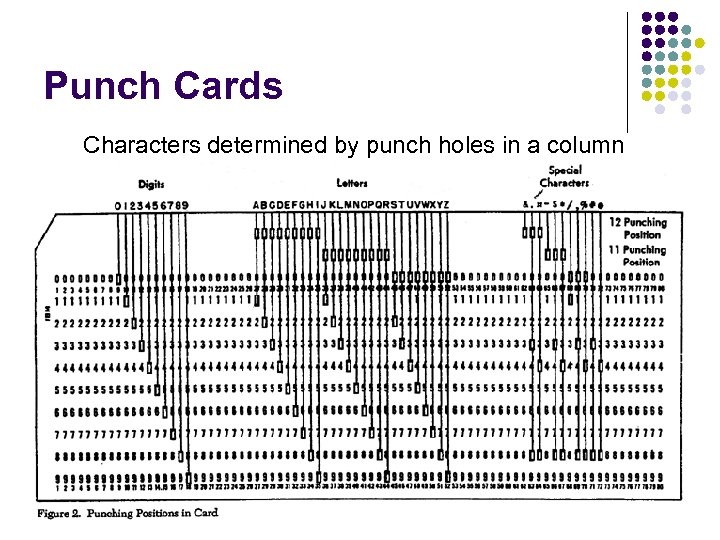 Punch Cards Characters determined by punch holes in a column
 FORTRAN l BY the late 1960 s, the software battle had been won – in favor of high level languages l l l Assembler Language – high performance FORTRAN – more portable Language features l l l Limited structuring Common blocks Dynamic loader Fixed field instruction layout (key punch ) Very efficient – close to assembler language in performance
 Memory and Processor Management l l l Memory was very limited, so approaches were developed to deal with that limitation l Loader map – programmed the loading of modules into memory so you only had what you needed l Aliasing – using multiple identifiers to refer to the same memory location Secondary storage – tape storage for partial results Processor was very slow, so approaches were developed to deal with that limitation l Assembler subroutines – subroutines that were frequently invoked were coded in assembler l Deep understanding of compiler optimization l Deep understanding of relationship between source code and object code
 Software Engineering Consequences l l In the 1960 s, people were cheap and computers were expensive Software reliability was not well understood Software maintenance implications were not well understood Advantages of code portability were not well understood
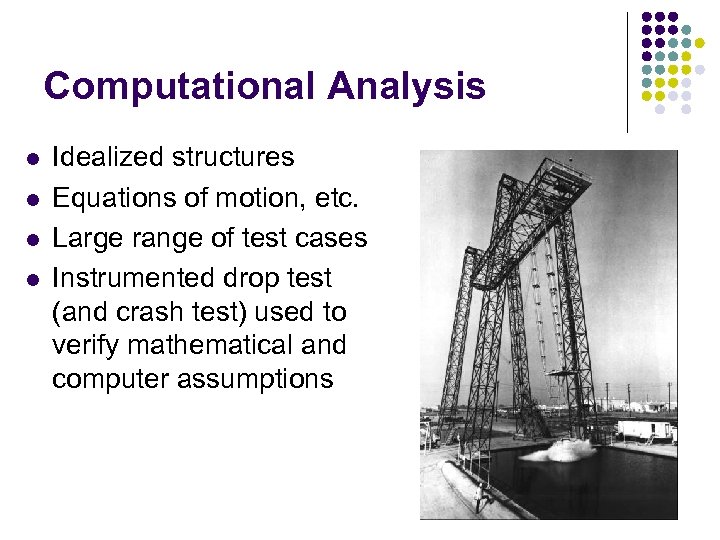 Computational Analysis l l Idealized structures Equations of motion, etc. Large range of test cases Instrumented drop test (and crash test) used to verify mathematical and computer assumptions
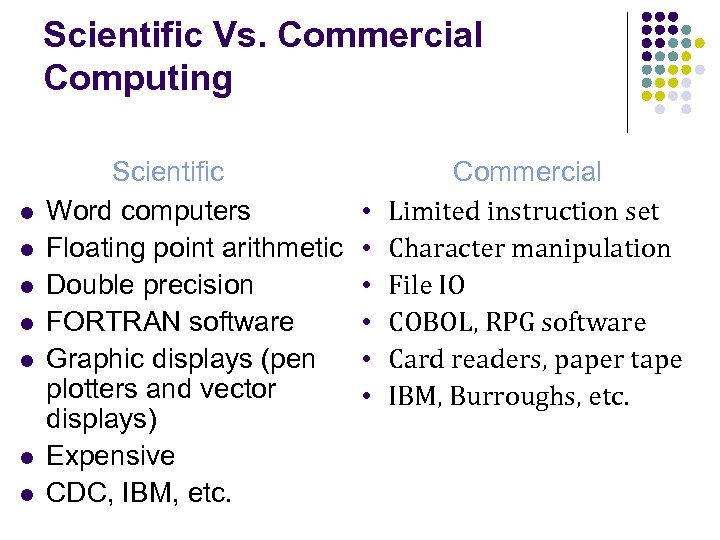 Scientific Vs. Commercial Computing l l l l Scientific Word computers Floating point arithmetic Double precision FORTRAN software Graphic displays (pen plotters and vector displays) Expensive CDC, IBM, etc. • • • Commercial Limited instruction set Character manipulation File IO COBOL, RPG software Card readers, paper tape IBM, Burroughs, etc.
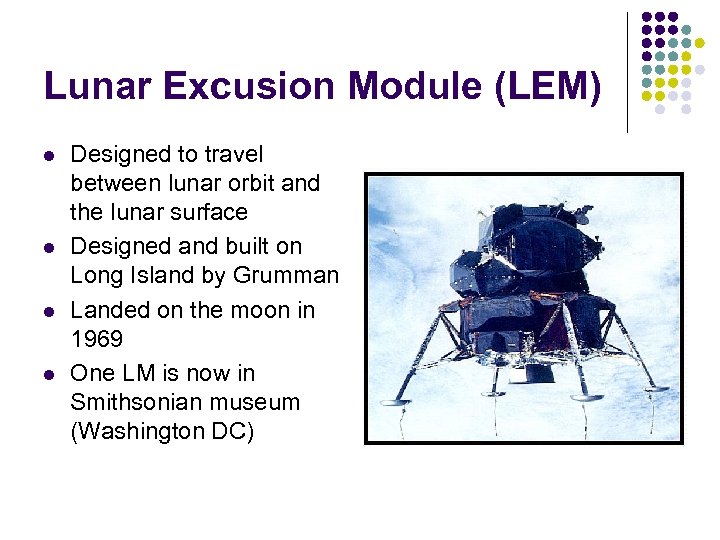 Lunar Excusion Module (LEM) l l Designed to travel between lunar orbit and the lunar surface Designed and built on Long Island by Grumman Landed on the moon in 1969 One LM is now in Smithsonian museum (Washington DC)
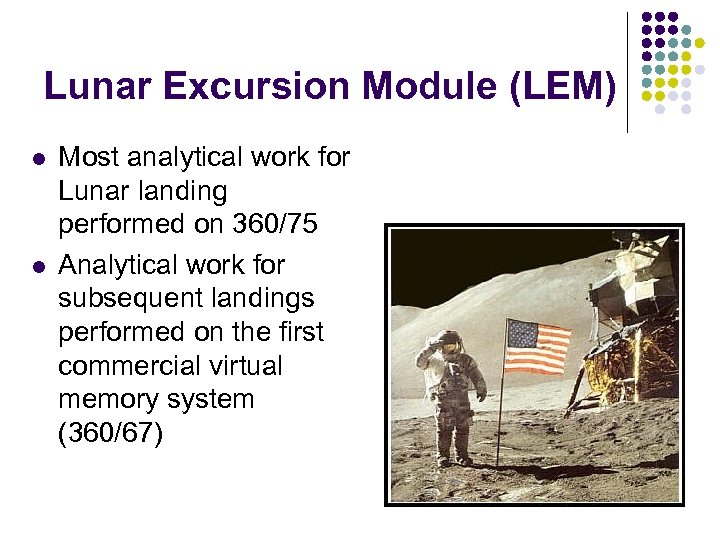 Lunar Excursion Module (LEM) l l Most analytical work for Lunar landing performed on 360/75 Analytical work for subsequent landings performed on the first commercial virtual memory system (360/67)
 Space Era Summary l l l Importance of computer modeling and simulation Convergence to single architecture for commercial and scientific processing Growth of software engineering issues