


 Скачать презентацию CSE 141 Exponential Growth 1 16 02 CSE 141 —
7574dcc391f7ce24eff264f412a539b2.ppt
- Количество слайдов: 21
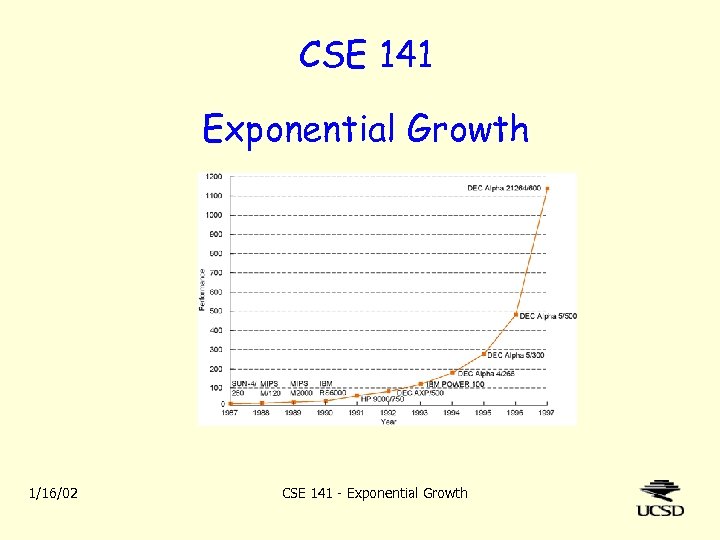 CSE 141 Exponential Growth 1/16/02 CSE 141 - Exponential Growth
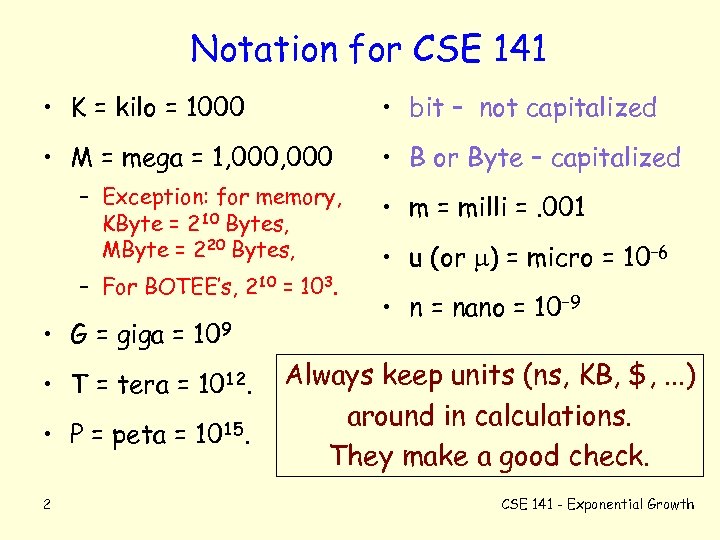 Notation for CSE 141 • K = kilo = 1000 • bit – not capitalized • M = mega = 1, 000 • B or Byte – capitalized – Exception: for memory, KByte = 210 Bytes, MByte = 220 Bytes, – For BOTEE’s, 210 = 103. • G = giga = 109 • T = tera = 1012. • P = peta = 1015. 2 • m = milli =. 001 • u (or ) = micro = 10– 6 • n = nano = 10– 9 Always keep units (ns, KB, $, . . . ) around in calculations. They make a good check. CSE 141 - Exponential Growth
 News from the NYTimes (June ’ 96) “When a computer runs out of [RAM memory], modern operating systems automatically use the memory on the hard drive. But today’s hard drives retrieve data at speeds of about 10 milliseconds (millionths of a second). That seems fast until you consider that modern RAM can do this at 60 nanoseconds (billionths of a second), more than 150 times as fast. ” What’s wrong with the above statement? ? • 1 Extra Credit point to first person to show me obvious innumeracy in current reputable newspaper. • Limit: 2 points person. 3 CSE 141 - Exponential Growth
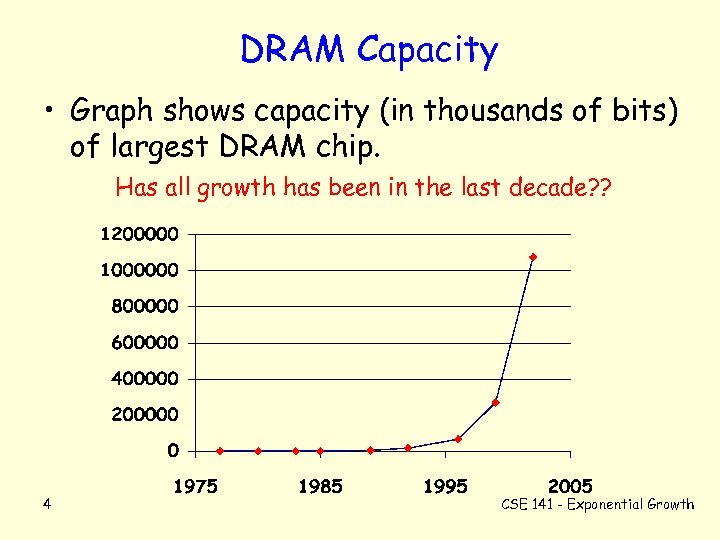 DRAM Capacity • Graph shows capacity (in thousands of bits) of largest DRAM chip. Has all growth has been in the last decade? ? 4 CSE 141 - Exponential Growth
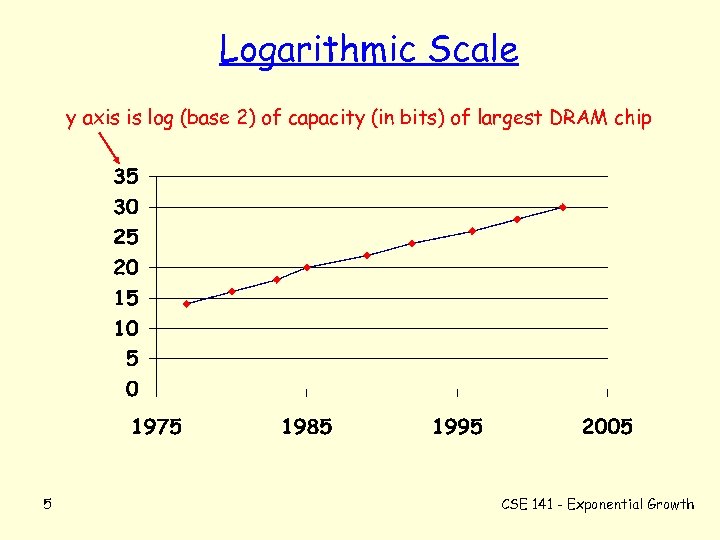 Logarithmic Scale y axis is log (base 2) of capacity (in bits) of largest DRAM chip 5 CSE 141 - Exponential Growth
 DRAM growth rule gets 4 times larger “DRAM capacity quadruples every three years” – Remarkably consistent over last 25 years. • Introduction of 1 Mbit chip came a year early. • 64 Mbit chip (and larger ones? ) coming a year late. – To some extent, a self-fulfilling prophecy. – Improvement due to smaller lithography and to increased chip size. • Chips aren’t profitable until they are small. 6 CSE 141 - Exponential Growth
 The news from www. news. com • “ 16 Mbit DRAM can store information from 128 newspaper pages. ” You should be able to – 224 bits / 27 pages = 217 bit/page do power-of-2 computations like this very easily. • “ 4 Gbit DRAM can store 16, 000 newspaper pages of information. ” – 232 bits / 214 pages = 218 bit/page Are newspaper pages getting larger? Perhaps bits hold less information than in “good old days”? ? 7 CSE 141 - Exponential Growth
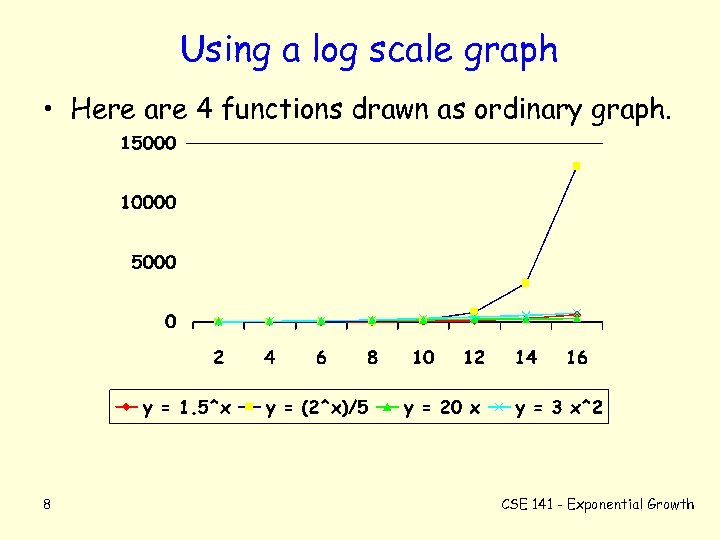 Using a log scale graph • Here are 4 functions drawn as ordinary graph. 8 CSE 141 - Exponential Growth
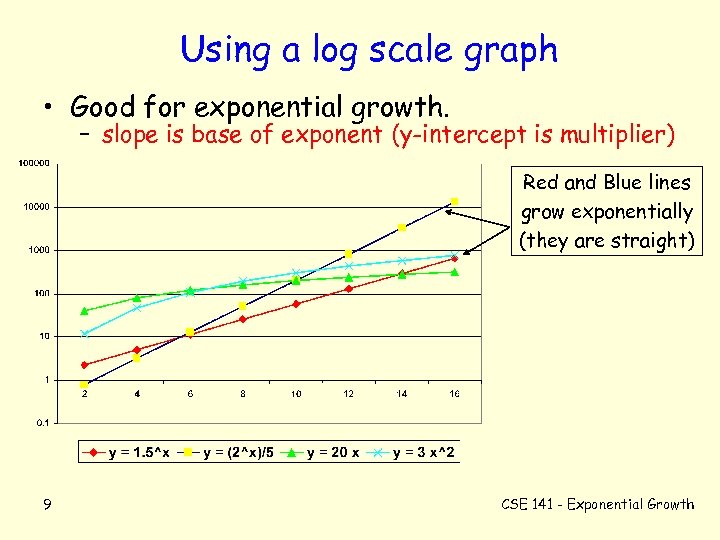 Using a log scale graph • Good for exponential growth. – slope is base of exponent (y-intercept is multiplier) Red and Blue lines grow exponentially (they are straight) 9 CSE 141 - Exponential Growth
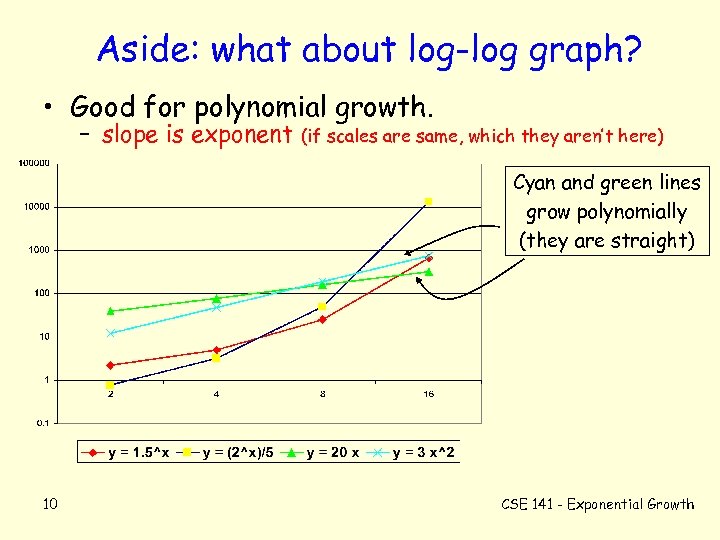 Aside: what about log-log graph? • Good for polynomial growth. – slope is exponent (if scales are same, which they aren’t here) Cyan and green lines grow polynomially (they are straight) 10 CSE 141 - Exponential Growth
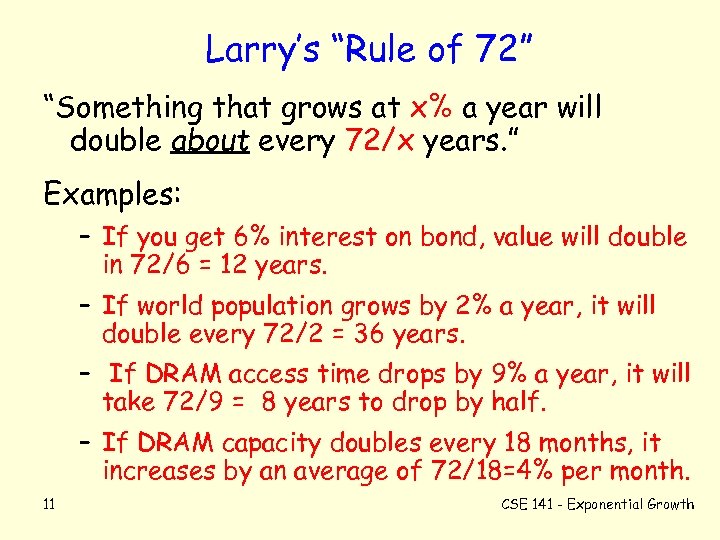 Larry’s “Rule of 72” “Something that grows at x% a year will double about every 72/x years. ” Examples: – If you get 6% interest on bond, value will double in 72/6 = 12 years. – If world population grows by 2% a year, it will double every 72/2 = 36 years. – If DRAM access time drops by 9% a year, it will take 72/9 = 8 years to drop by half. – If DRAM capacity doubles every 18 months, it increases by an average of 72/18=4% per month. 11 CSE 141 - Exponential Growth
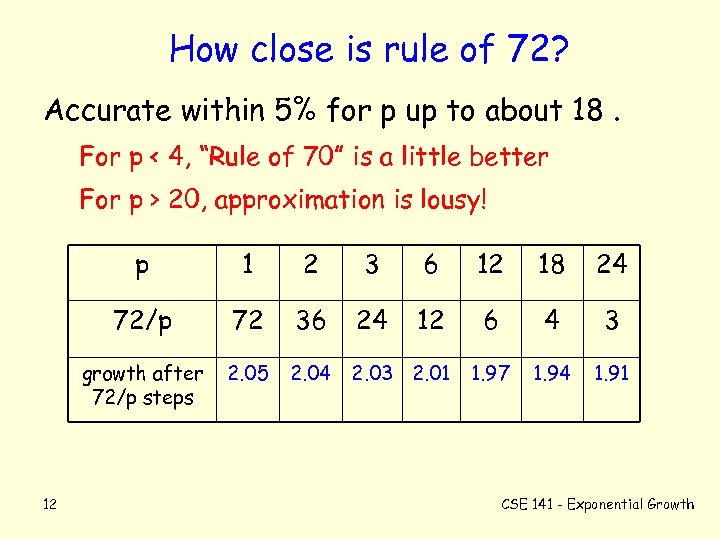 How close is rule of 72? Accurate within 5% for p up to about 18. For p < 4, “Rule of 70” is a little better For p > 20, approximation is lousy! p 2 3 6 12 18 24 72/p 72 36 24 12 6 4 3 growth after 72/p steps 12 1 2. 05 2. 04 2. 03 2. 01 1. 97 1. 94 1. 91 CSE 141 - Exponential Growth
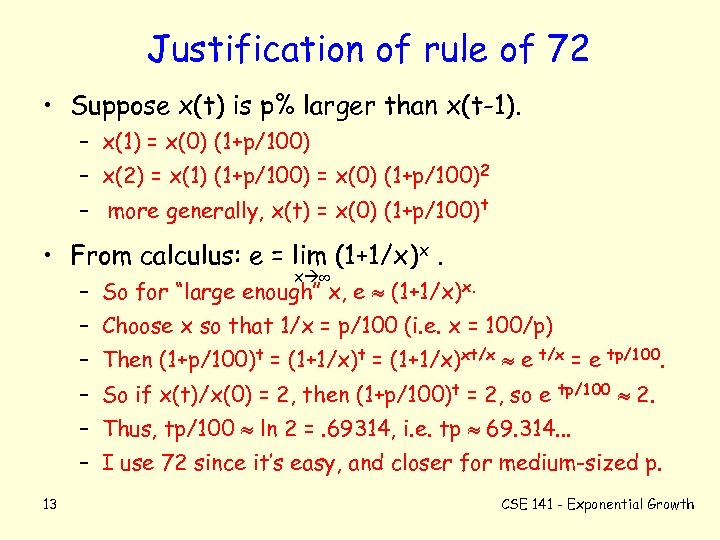 Justification of rule of 72 • Suppose x(t) is p% larger than x(t-1). – x(1) = x(0) (1+p/100) – x(2) = x(1) (1+p/100) = x(0) (1+p/100)2 – more generally, x(t) = x(0) (1+p/100)t • From calculus: e = lim (1+1/x)x. x – So for “large enough” x, e (1+1/x)x. – Choose x so that 1/x = p/100 (i. e. x = 100/p) – Then (1+p/100)t = (1+1/x)xt/x e t/x = e tp/100. – So if x(t)/x(0) = 2, then (1+p/100)t = 2, so e tp/100 2. – Thus, tp/100 ln 2 =. 69314, i. e. tp 69. 314. . . – I use 72 since it’s easy, and closer for medium-sized p. 13 CSE 141 - Exponential Growth
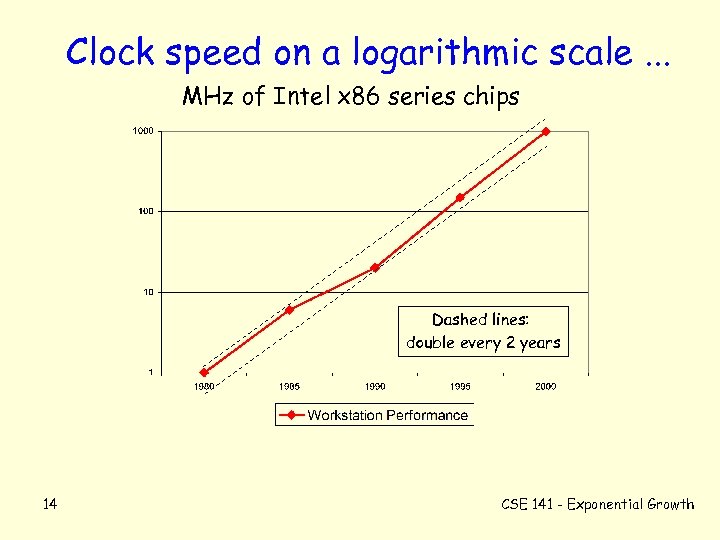 Clock speed on a logarithmic scale. . . MHz of Intel x 86 series chips Dashed lines: double every 2 years 14 CSE 141 - Exponential Growth
 Aside: a 30 x change is BIG • Changing something by a factor of 30 usually makes a qualitative change. – – – – – 10 people/square mile – farmland 300 p/mi^2 – suburbia 10, 000 p/mi^2 – big city 2 mph – walking 60 mph – driving 900 mph – fast jet 100 square feet – dorm room 3000 ft^2 – good sized house 100, 000 ft^2 – hotel • Computers are making such changes every decade (or faster). 15 CSE 141 - Exponential Growth
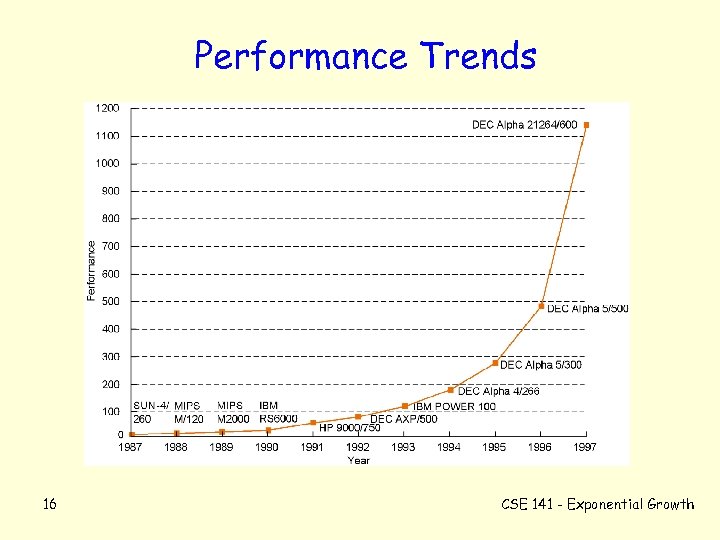 Performance Trends 16 CSE 141 - Exponential Growth
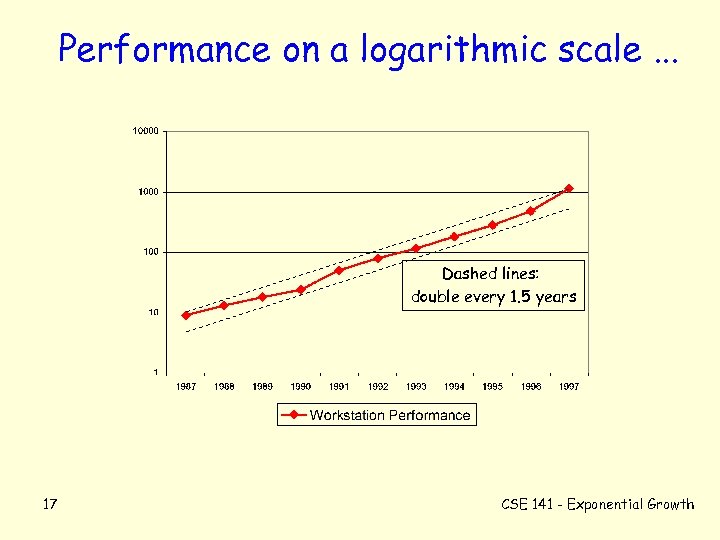 Performance on a logarithmic scale. . . Dashed lines: double every 1. 5 years 17 CSE 141 - Exponential Growth
 Memory Evolution • Transistors get smaller, chips get larger, results is. . . • DRAM chip capacity doubles every 1. 5 years Processor Evolution • Transistor count doubles every 2 years • Clock speed doubles every 2 years • Memory speeds increase a tiny bit and then a miracle occurs. . . • Performance doubles every 1. 5 years 18 CSE 141 - Exponential Growth
 Why is this surprising? • You’d expect processor speed to increase with the slowest technology – P&H estimate DRAM access time decreases 9% per year. – So memory speed doubles about every ? ? ? years. • Yet performance doubles faster than clock speed! – And much faster than DRAM access time. • Somehow, added transistors are being used effectively. – Sure, maybe you can wash your car faster with 4 people. – But does having 16 or 64 people help? ? ? • Later part of course is about how this happens! 19 CSE 141 - Exponential Growth
 When will computer exceed brain? • Human brain has about 10 billion neurons. • Each is connected to about 100, 000 other neurons. • A neuron can “fire” about 1000 times/sec. • Estimate when microprocessors will exceed a human’s brainpower. – Assume each “fire” decision corresponds to computation of 100, 000 transistors (one per connection) for one clock cycle. 20 CSE 141 - Exponential Growth
 Machine of the day – Babbage’s engines • Difference engine – Started 1847; completed 1991 (London Science Museum) – Very big calculator – 11 feet long, 7 feet high, 4000 parts • Analytical engine – Had “Mill” (processor) and “Store” (memory) – Had conditional branches; could execute loops – Op code and address written on separate punch cards • Neither machine completed by Babbage – Small analytical engine built by his son; calculated multiples of pi (incorrectly) • First programmer: Ada Lovelace 21 CSE 141 - Exponential Growth