


 Скачать презентацию CSC 480 Artificial Intelligence Dr Franz J Kurfess
695e0f7f2094fe8b5355d881916229a5.ppt
- Количество слайдов: 26
 CSC 480: Artificial Intelligence Dr. Franz J. Kurfess Computer Science Department Cal Poly © 2000 -2012 Franz Kurfess Knowledge-Based Systems
 Course Overview u Introduction u Knowledge u Intelligent u Agents u Search u u problem solving through search informed search u Games u games as search problems © 2000 -2012 Franz Kurfess u u u and Reasoning reasoning agents propositional logic predicate logic knowledge-based systems u Learning u u learning from observation neural networks u Conclusions Knowledge-Based Systems
 Chapter Overview Knowledge-Based Systems u Motivation u Example u Objectives u u Evaluation Criteria u Terminology u u u Data Knowledge Information u Knowledge u Domains Electronic Circuits u Important Concepts and Terms u Chapter Summary Engineering Methodology u Ontologies © 2000 -2012 Franz Kurfess Knowledge-Based Systems
 Motivation u without a good knowledge representation scheme, reasoning becomes very difficult u a balance must be found between expressiveness of the representation language, understandability, and efficiency of the inference mechanism u it is good to have a general-purpose methodology that can be refined for specific domains or problems u for performance reasons, sometimes specific schemes, methods, or inference mechanisms are used © 2000 -2012 Franz Kurfess Knowledge-Based Systems
 Objectives u distinguish between different phases in the knowledge representation process u learn to apply the concepts of predicate logic for the representation of knowledge u understand the difficulties of finding a good knowledge representation scheme u general-purpose u domain- or task-specific u distinguish the tasks and activities of a knowledge engineer from those of a system designer of programmer © 2000 -2012 Franz Kurfess Knowledge-Based Systems
 Terminology u Data u fixed relations between individual items u often arranged as vectors or arrays u interpretation is usually provided for the collection of data as a whole u Knowledge u separate, possibly dynamic relations between individual items u interpretation must be done for individual items u Information u generic term, used in a very general sense u precisely defined for information theory © 2000 -2012 Franz Kurfess Knowledge-Based Systems
 Knowledge Engineering u often performed by a knowledge engineer u intermediary between users, domain experts and programmers u must know enough about the domain v v objects relationships u must v be comfortable in the representation language encoding of objects and relationships u must understand the implementation of the inference mechanism v v performance issues explanation of results © 2000 -2012 Franz Kurfess Knowledge-Based Systems
 Knowledge Engineering Methodology u domain u objects, facts u vocabulary u u predicates, functions, constants in the language of logic ideally results in an ontology u background u u general knowledge about the domain specify the axioms about the terms in the ontology u specific u knowledge problem description of the instances of concepts and objects that determine the problem to be investigated u queries u requests answers from the knowledge base/inference mechanism © 2000 -2012 Franz Kurfess Knowledge-Based Systems
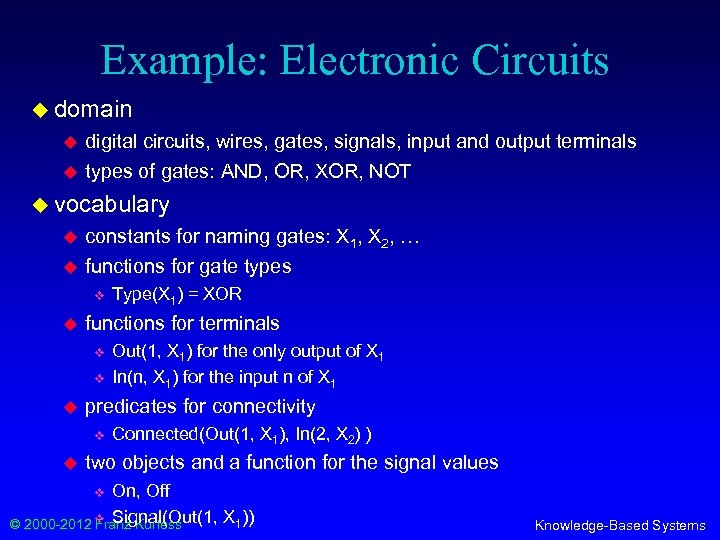 Example: Electronic Circuits u domain u u digital circuits, wires, gates, signals, input and output terminals types of gates: AND, OR, XOR, NOT u vocabulary u u constants for naming gates: X 1, X 2, … functions for gate types v u functions for terminals v v u Out(1, X 1) for the only output of X 1 In(n, X 1) for the input n of X 1 predicates for connectivity v u Type(X 1) = XOR Connected(Out(1, X 1), In(2, X 2) ) two objects and a function for the signal values On, Off © 2000 -2012 v Signal(Out(1, X 1)) Franz Kurfess v Knowledge-Based Systems
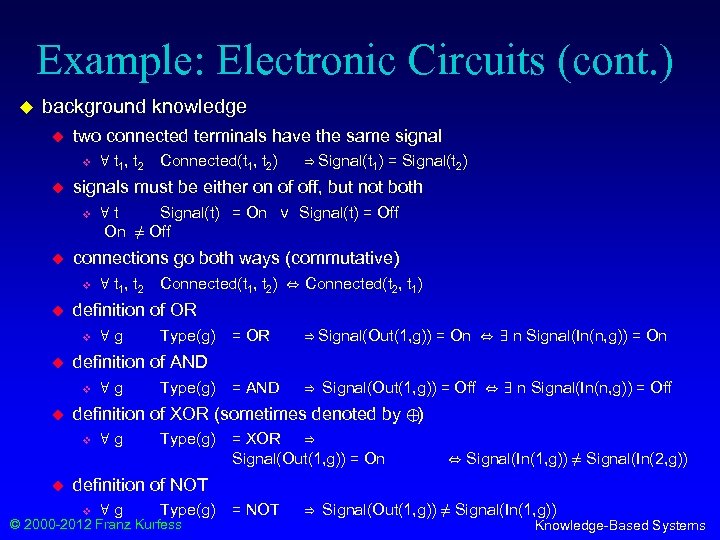 Example: Electronic Circuits (cont. ) u background knowledge u two connected terminals have the same signal v u Connected(t 1, t 2) ⇔ Connected(t 2, t 1) ∀g Type(g) = OR ⇒ Signal(Out(1, g)) = On ⇔ ∃ n Signal(In(n, g)) = On ∀g Type(g) = AND ⇒ Signal(Out(1, g)) = Off ⇔ ∃ n Signal(In(n, g)) = Off definition of XOR (sometimes denoted by ⊕) v u ∀ t 1, t 2 definition of AND v u ∀t Signal(t) = On ∨ Signal(t) = Off On ≠ Off definition of OR v u ⇒ Signal(t 1) = Signal(t 2) connections go both ways (commutative) v u Connected(t 1, t 2) signals must be either on of off, but not both v u ∀ t 1, t 2 ∀g Type(g) = XOR ⇒ Signal(Out(1, g)) = On ⇔ Signal(In(1, g)) ≠ Signal(In(2, g)) definition of NOT v ∀g Type(g) © 2000 -2012 Franz Kurfess = NOT ⇒ Signal(Out(1, g)) ≠ Signal(In(1, g)) Knowledge-Based Systems
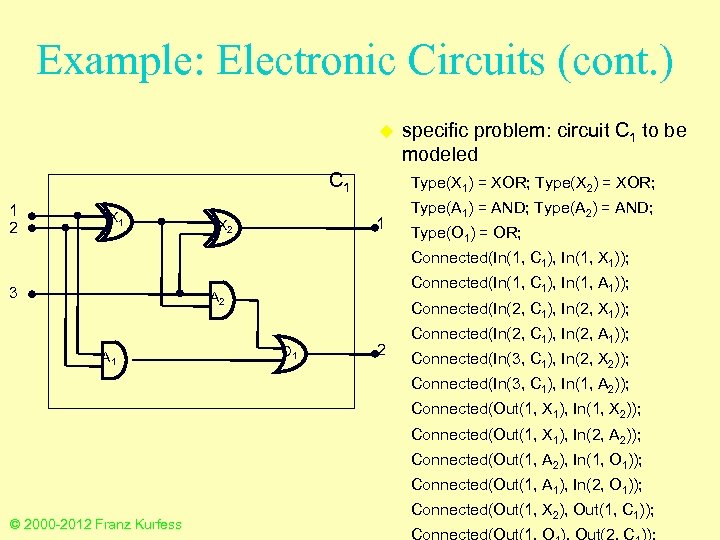 Example: Electronic Circuits (cont. ) u C 1 1 2 X 1 Type(X 1) = XOR; Type(X 2) = XOR; 1 X 2 specific problem: circuit C 1 to be modeled Type(A 1) = AND; Type(A 2) = AND; Type(O 1) = OR; Connected(In(1, C 1), In(1, X 1)); 3 Connected(In(1, C 1), In(1, A 1)); A 2 A 1 Connected(In(2, C 1), In(2, X 1)); O 1 2 Connected(In(2, C 1), In(2, A 1)); Connected(In(3, C 1), In(2, X 2)); Connected(In(3, C 1), In(1, A 2)); Connected(Out(1, X 1), In(1, X 2)); Connected(Out(1, X 1), In(2, A 2)); Connected(Out(1, A 2), In(1, O 1)); Connected(Out(1, A 1), In(2, O 1)); © 2000 -2012 Franz Kurfess Connected(Out(1, X 2), Out(1, C 1)); Knowledge-Based Systems
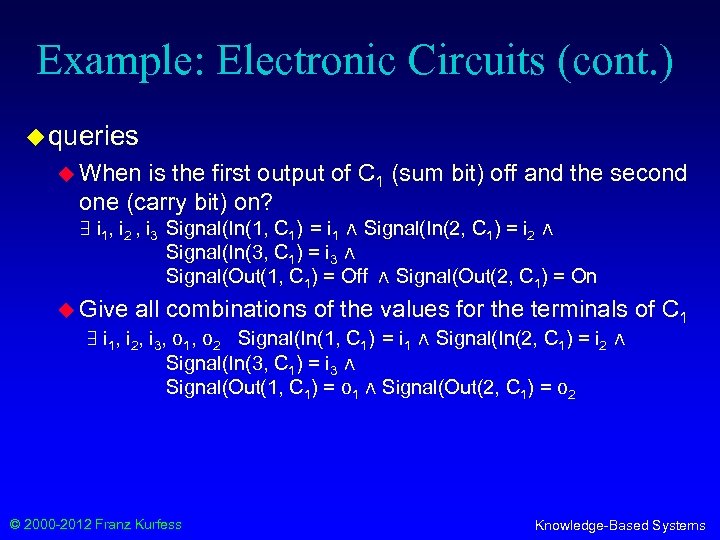 Example: Electronic Circuits (cont. ) u queries u When is the first output of C 1 (sum bit) off and the second one (carry bit) on? ∃ i 1, i 2 , i 3 Signal(In(1, C 1) = i 1 ∧ Signal(In(2, C 1) = i 2 ∧ Signal(In(3, C 1) = i 3 ∧ Signal(Out(1, C 1) = Off ∧ Signal(Out(2, C 1) = On u Give all combinations of the values for the terminals of C 1 ∃ i 1, i 2, i 3, o 1, o 2 Signal(In(1, C 1) = i 1 ∧ Signal(In(2, C 1) = i 2 ∧ Signal(In(3, C 1) = i 3 ∧ Signal(Out(1, C 1) = o 1 ∧ Signal(Out(2, C 1) = o 2 © 2000 -2012 Franz Kurfess Knowledge-Based Systems
 Ontologies u define the terminology about the objects and their relationships in a systematic way u closely v v related to taxonomies, classifications ontologies don’t have to be hierarchical emphasis on the terms to describe objects, relationships, not on the properties of objects or specific relationships between objects u general ontology u convergence of a multitude of special-purpose ontologies u should be applicable to any special-purpose domain © 2000 -2012 Franz Kurfess Knowledge-Based Systems
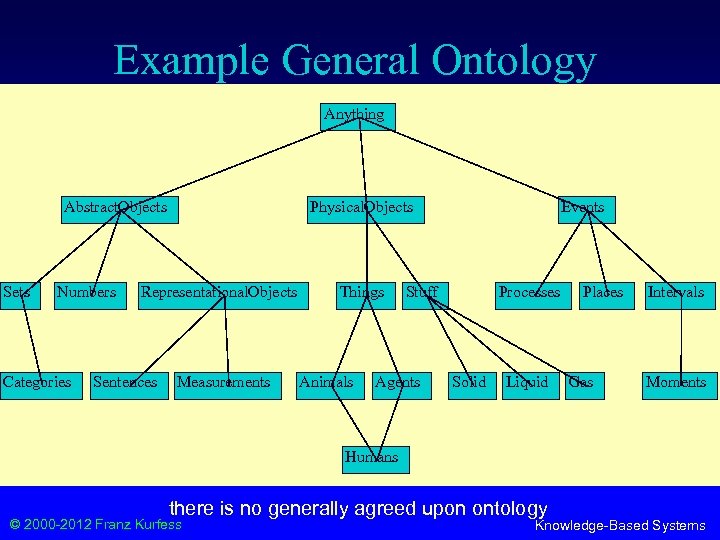 Example General Ontology Anything Abstract. Objects Sets Numbers Categories Physical. Objects Representational. Objects Sentences Measurements Things Animals Events Stuff Agents Processes Solid Liquid Places Gas Intervals Moments Humans there is no generally agreed upon ontology © 2000 -2012 Franz Kurfess Knowledge-Based Systems
 Issues for Ontologies u categories u measures u composite objects u time, space, and change u events and processes u physical objects u substances u mental objects and beliefs © 2000 -2012 Franz Kurfess Knowledge-Based Systems
 Categories u categories are very important for reasoning u almost always organized as taxonomic hierarchies u general statements about related objects can be made easily u specific properties of instances can either be inferred, or specified explicitly u inheritance v similar to OO programming © 2000 -2012 Franz Kurfess Knowledge-Based Systems
 Measures u values for properties of objects u frequently expressed quantitatively u number and unit function u allows the use of ordering function on objects © 2000 -2012 Franz Kurfess Knowledge-Based Systems
 Composite Objects u objects frequently can be decomposed into parts, or composed into larger objects u often expressed through Part. Of relation u allows grouping of objects into hierarchies u frequently the internal structure of objects is of importance u allows general reasoning about certain aspects of objects © 2000 -2012 Franz Kurfess Knowledge-Based Systems
 Time, Space, and Change u can be described around the notion of events and processes u events are discrete u processes are continuous v sometimes also called liquid events © 2000 -2012 Franz Kurfess Knowledge-Based Systems
 Events u an event is an object with temporal and spatial extent u it occurs somewhere for a certain duration u this viewpoint implies some similarities with physical objects v also have temporal and spatial extent u events u intervals u they u places u fixed may also have internal structure are special events include all sub-events during a given time period are special events in time, with a temporal extent © 2000 -2012 Franz Kurfess Knowledge-Based Systems
 Objects u sometimes it is useful to view some types of objects as fluents u may change during its existence, but still be considered as an object v v e. g. the country of Germany the president of the U. S. © 2000 -2012 Franz Kurfess Knowledge-Based Systems
 Substances u allows the grouping of large numbers of primitive objects into “stuff” u denoted by mass nouns in contrast to count nouns u dividing stuff into smaller pieces yields the same type of stuff v quantity is different u intrinsic v v properties belong to the substance of an object are retained under subdivisions u extrinsic v v properties come from the specific object as a whole change or get lost under subdivision © 2000 -2012 Franz Kurfess Knowledge-Based Systems
 Mental Objects and Beliefs u mental objects are “in one’s head” u allows v v the agent to reason about its mental processes some mental processes are the reasoning processes themselves the agent then can perform higher-level reasoning leads to considerable technical and philosophical complications assumed to be a pre-condition for consciousness u beliefs are used to make statements about mental objects © 2000 -2012 Franz Kurfess Knowledge-Based Systems
 Important Concepts and Terms u u u u agent automated reasoning belief category change composite object domain event hierarchy inference knowledge engineering knowledge representation logic © 2000 -2012 Franz Kurfess u u u u measure mental object ontology physical object predicate logic process propositional logic rule space substance time vocabulary Knowledge-Based Systems
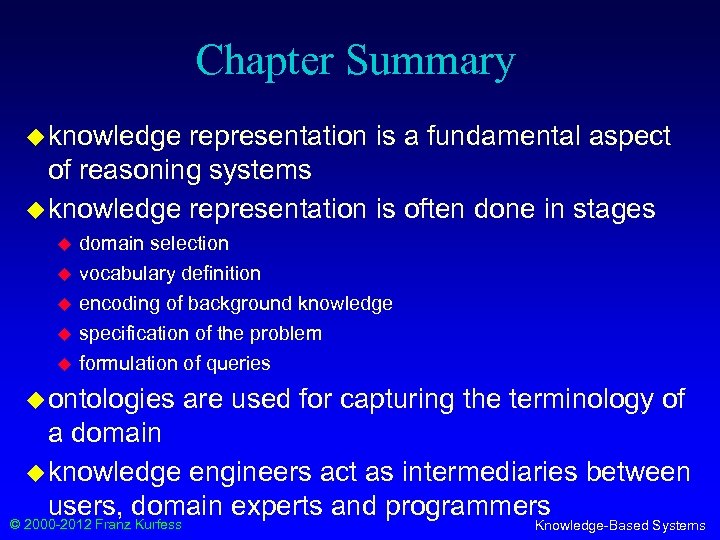 Chapter Summary u knowledge representation is a fundamental aspect of reasoning systems u knowledge representation is often done in stages u u u domain selection vocabulary definition encoding of background knowledge specification of the problem formulation of queries u ontologies are used for capturing the terminology of a domain u knowledge engineers act as intermediaries between users, domain experts and programmers © 2000 -2012 Franz Kurfess Knowledge-Based Systems
 © 2000 -2012 Franz Kurfess Knowledge-Based Systems